Dark electronic music producer, MISS FD has just released her latest bewitching cinematic gothic music video for her song, ‘Curse Breaker’.
‘Curse Breaker’ is a liberating dark piano piece with laid bare female vocals that channel raw emotion, empowerment, and mystique. A spell unbinding transformative song about overcoming and letting go.
The music video, directed by long-time collaborator and friend Tas Limur, was filmed in a Victorian mansion in Historic Old Louisville, KY.
The video follows MISS FD through a curse-breaking séance which releases her from a haunting apparition, symbolizing freeing oneself from the binds and limitations of the past.
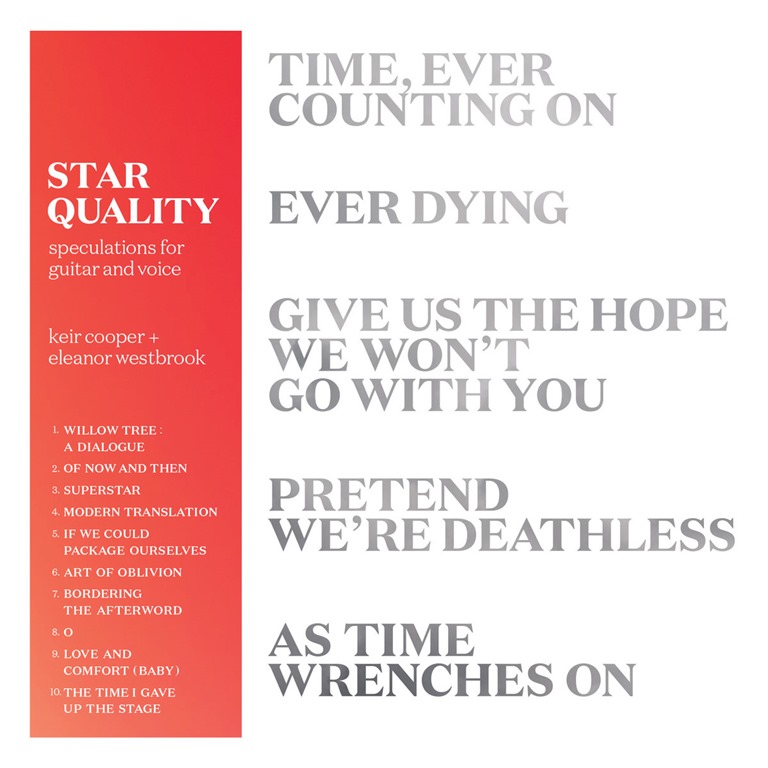
One way to tell an avant-garde musical work from its title alone is when the title provides a quite precise statement relating to its compositional nature. And so it is that this collaborative set of songs by Keir Cooper and Eleanor Westbrook are structured around guitar and voice.
‘Willow Tree – A Dialogue’ takes the interesting form of – perhaps not surprisingly – a dialogue of sorts, in which Westbrook’s adopts two contrasting modes of delivery, with a spectacular operatic aria juxtaposed with a spoken-word interrogation as a counterpoint. The effect is closer to a simultaneous internal monologue running across the song itself rather than a dialogue in the conventional sense. Meanwhile, the delicately picked neoclassical guitar is subject to interruption by clunks and distortion and occasional whirs and bleeps and the operatic vocal strays off kilter and the dream which drifted in twists and flickers with darker shades: not pronounced enough to be truly nightmarish, but unsettling.
The pair continue to explore the contrasts of melody and disharmony as Westbrook squeaks, squawks, trills, and purrs an infinite array of vocal gymnastics and Cooper’s guitar work, which chimes and treads delicately from folk to flamenco via classical streams, stamps on its own beauty with sudden and unexpected stops and stutters and forays into wrongness with stray notes and dissonance.
‘Superstar’ strays into the space which soundtracks a sense of derangement, the territory where things make no sense, and that place of incomprehension instils an unsettling confusion that borders on anxiety. ‘Modern Translation’ follows a similar trajectory: it’s a piece of magical neoclassical chamber music that’s twisted as if performed in an auditory hall of mirrors. Everything is wrong: something that should be soothing and beautiful is warped in a that it becomes unheimlich, eerie.
It’s hard to locate a touchstone or reference point for this: perhaps there are elements of later Scott Walker present, blended with hints of The Ex with its more avant-jazz leanings. One can only muse as to how they came to create this work: despite its clear foundations in the realms of classical and opera, Star Quality ventures so far from this path that it often bears little resemblance to any given style. The pieces evidently do have quite detailed and complex structures, as there’s nothing haphazard or uncoordinated about the way the two play together, but it’s impossible to decipher them from an outside perspective.
There’s a grand yet ethereal theatricality to ‘Bordering the Afterworld’, and ‘O’ soars and swoops and squeaks and whoops its way theatrically – and somewhat crazily – across some sprightly, if vaguely gothic-sounding guitar picking that suddenly, from nowhere, begins to buzz and thump. ‘The Time I Gave Up the Stage’ draws the curtain on an incredibly curious and as far off the wall as is imaginable.
Star Quality clearly has theatrical inspirations and aspirations, but shows two artists who are more interested in exploring their outer limits than taking the limelight in a mainstream setting – and for that, I applaud them.
Back in April 2020, writing on the release of their second album, Prepared for a Nightmare, I remarked that it had been four years since their debut, Observed in a Dream, and it had felt like an eternity. And here we are, a further four years on, and ‘A Foretold Ecstasy’ has landed as the prelude to album number three, due in the autumn.
Here, they’re straight in with that tight, solid rhythm section – a chunky bass with a hint of chorus to fatten it out while also giving it that classic spectral goth sound, melded to a relentless four-four metronomic thump, minimal cymbals, no flamboyant fills, just taut, a tense, rigid spine around which the body of the song grows. This, of course, is the foundation of that vintage gothy / post punk sound which originated with The Sisters of Mercy and, thanks largely to Craig Adams – who is arguably one of the greatest bassists of all time by virtue of his simple style of nailing a groove and just holding it down for the duration – carried on in The Mission. The Mish may lack some of the style and certainly the atmosphere and lyrical prowess of The Sisters, but the musical ingredients – and in particular that unflinching rhythm section – are fundamentally the same. And so it is that while the dominance of that thunking bass and bash-bash-bash snare may have become something of a formula, it’s hard to beat and absolutely defines the genre.
Mayflower Madame have always sat more toward The Mission end of the spectrum, whipping up songs which owe a certain debt to Wayne Hussey’s layered, cadent guitar style. But what they bring that’s unique is a swirly, psychedelic / shoegaze hue, a fuzzy swirl of texture and light. There’s a dark decadence, a lascivious richness to Mayflower Madame that accentuates the dramatic aspects of the gothiness: theatrical, flamboyant, but without being hammy or campy. And of course, Trond Fagernes’ vocals drift in an ocean of reverb, and the cumulative effect isn’t simply atmospheric: it carries you away on a sea of mesmeric sound.
With layers of synth which drift like mist across a production that balances dreaminess with a driving urgency, ‘A Foretold Ecstasy’ floats between haunting verses and surging choruses – and it’s hinting at their best work to date.
CAMERATA MEDIOLANENSE unveil the occult video clip ‘Hermaphroditus’ as the second single taken from the Italian ensemble’s forthcoming new album Atalanta Fugiens ("Atalante Fleeing"), which is based on an enigmatic alchemist tome and slated for release on June 14, 2024.
Watch the video, directed by Alan Factotum and Carmen Onophrii, here:
CAMERATA MEDIOLANENSE comment: "The song ‘Hermaphroditus’ is based on the thirty-third emblem of the treatise ‘Atalanta Fugiens’ written by the German alchemist Michael Maier and released in 1617", composer, multi-instrumentalist, and choir vocalist Elena Previdi reveals. "The Hermaphrodite, also called rebis (‘double thing’), is the fruit of a chemical marriage between opposites: the masculine and the feminine, naturally, but also the sun and the moon, hot and cold, blood and milk, gold and silver, or even, as in this passage, sulfur and mercury. The Hermaphrodite therefore represents divine perfection, which is achieved at the cost of unspeakable suffering that underlies the process of transformation of derangement into stillness, and that underlies the conflict between delirium and reason. Musically, a timeless voice starts the tormented alchemical process generated by the two choirs and the two harpsichords. The direction of the music is clear and neat, but at the end the funeral march of the horns makes its way. "
I hadn’t been looking for something that straddled Bauhaus’ more experimental cuts and David Devant and his Spirit Wife… But that’s how it goes. You don’t know what you want – or need – until you find it, and stuff lands on your lap when you least expect it. This is theatrical, crazy, over the top. It’s the sound of a band flipping out, melting down in every direction – more of a document of an electrical shock to the brain than the frazzled fizz of the frothing seafront.
‘The Wheel, the Spade, the Stars in Motion’ is no instant grab post-industrial froth: instead, it’s a frenetic electronic mania, all the froth and panic. The panic… the panic is real. It’s the soundtrack to waking up disorientated and wondering where the hell you are and what on earth is going on, and the video only adds to the bewilderment, the wackiness as surreal as the most inexplicable dream.
Strolling bass and wonky guitars are only half of a story which throws into the melting pot the sharp, sinewy guitar pop of Franz Ferdinand and the over the top agitated dramatics of The Associates.
The lyrics are utterly barking, but shouldn’t be dismissed as mere quirky nonsense: there’s a genuine poeticism and flair for language on display here.
The maid was in the garden
Disfigured by a bird
That reactionary raptor
Left her undeterred
The specksioneer made it clear
harpoon held aloft
Declaring that his love for her
could melt the permafrost
Playing with the tropes of the Elizabethan sonnet, but at the same time spinning circles of Surrealist imagery, Erotic Secrets of Pompeii are a unique proposition, and for all the warped oddness, which shouldn’t work but does, ‘The Wheel, the Spade, the Stars in Motion’ is a cracking single if you can step back from the craziness for long enough to reflect and absorb.
As my sweep-up of singles released a few weeks back but still in the later stages of 2023 continues, we come to John X Belmonte’s ‘Under the Stars of Andromeda’. The New Yorker has been slipping out slabs of dark alternative pop since 2020, and has maintained a fairly steady output these last three years. Citing David Bowie, Depeche Mode and Kate Bush as influences, he promises ‘Haunting atmospheres, beautiful melodies, driving rhythms, and rich sonorous vocals [which] draw the listener into his musical dream world.’
With perhaps the exception of Depeche Mode from Black Celebration and later, these touchstones don’t really convey just how gothy Belmonte’s work is. ‘Under the Stars of Andromeda’ is a dark, stark electro cut that pulsates and has all the ingredients of the kind of electrogoth which started coming through in the mid 90s. There are chilly layers of synth which drift and hang like a freezing fog to conjure murky atmosphere, and as the track evolves, it feels that we’ve left earth and are being carried through clouds of dust particles, floating free of any gravitational pull, and a thumping techno beat cuts in and takes things stratospheric.
It’s the vocal which really defines the sound, and the genre leanings, too: Belmonte’s baritone croon is theatrical, taking obvious cues from Andrew Eldritch and Peter Murphy, and it’s subject to heavy processing and compression, meaning that while it sits tightly within, rather than above the music, in terms of not only mix but tonal range, it feels detached, dehumanised. It’s effective, in that it sounds menacing, and sends a shiver down your spine, as you wonder just what he has in mind when he says ‘we’ll find a better place.’
The synth sounds may be trancey and expansive, but clocking in at four minutes, ‘Under the Stars of Andromeda’ is neat and compact, structurally, and the production is faultless.
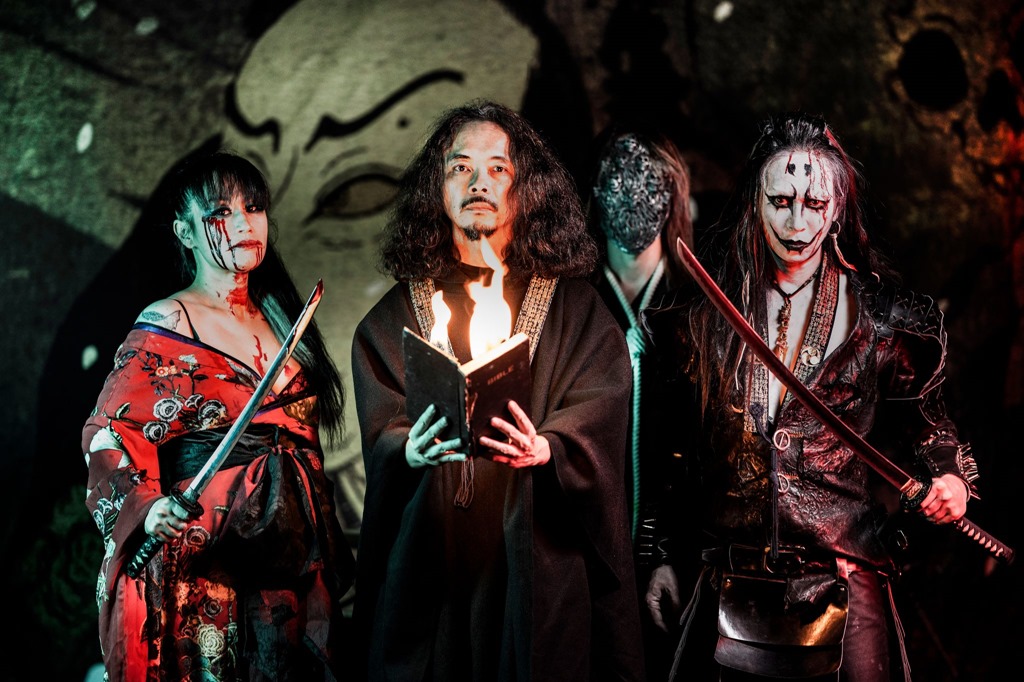
Following the announcement of the band’s new live album, ‘Live: Eastern Forces of Evil 2022’ and first single ‘Mayonaka no Kaii’. The band have unveiled their next track to come off the live album ‘A Victory of Dakini’.
The track is taken from the band’s visionary album ‘Scorn Defeat’, which the band will be performing in full, later this year at the UK’s Damnation Festival. The track, reminds us of the band’s beginnings and explores their more primitive style that would come to progressive into the fully fledged Sigh sound we know now.
The song details the story of a Japanese goddess ‘Dakini’ that rides on a white fox, according to Buddhist religion. Kujaku-Ou is a Japanese manga published around 1988 – 1991 and in it featured a lot of oriental occultism and were often the inspiration behind Sigh’s early material. Originally Dakiki is a goddess from India that would eat human flesh, however in Japan she is considered to be the goddess of sexual lust.
Mirai elaborates below:
‘A Victory of Dakini" is the opening track of our debut album "Scorn Defeat". I believe the first track of the first album is something special for most bands, and this is true to our case, too. Of course the song is way more primitive and simpler than what we are doing today, but obviously it’s got a magic feeling, which we will never ever recapture. "Dakini" is a goddess riding on a white fox in Buddhism. I wrote this song inspired by a Japanese manga, "Kujaku-ou".
‘A Victory of Dakini’ kicks off the live performance with ominous chanting before Sigh’s signature Death Metal crawl begins, conjuring all manner of otherworldly entities. The song itself is a masterful blend of Japanese culture with angular Death Metal precision, a style that has only been improved upon with each release right up until 2022’s ‘Shiki’.
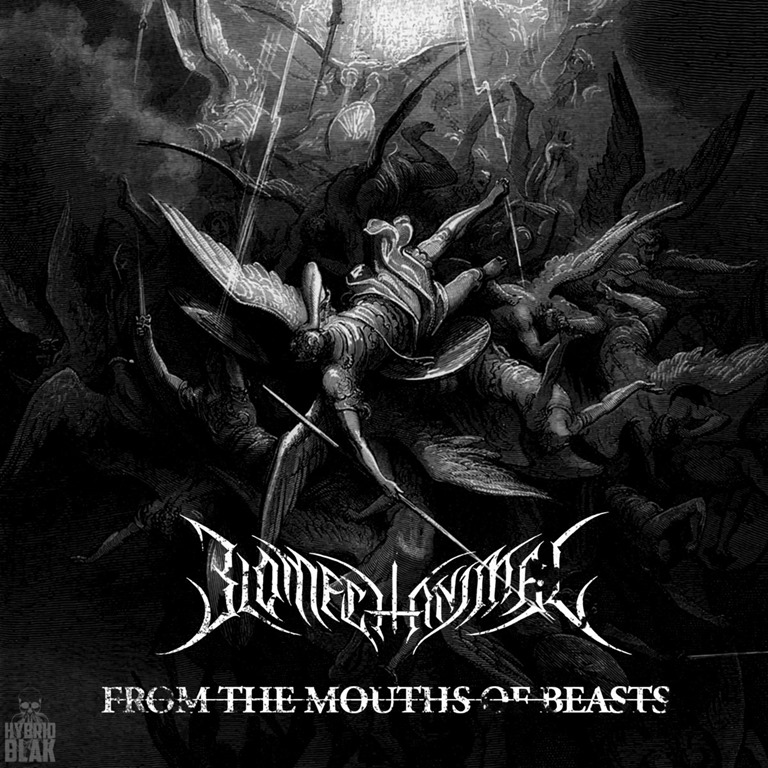
Industrial metal band, Biomechanimal has just unleashed their epic new single and video, ‘From The Mouths Of Beasts’. The song is a celebration of all the music that became part of Biomechanimal’s influence; hard beats, epic orchestras, and a complete lack of reliance on genre boundaries.
’From The Mouths Of Beasts’ is a take on the phrase, ‘from the mouths of babes’, a concept in which children have a way of telling magnificent truths in their innocence. ‘From the mouths of beasts’ is the reverse of this.
We are surrounded by people, especially in the music industry, who use and use people, taking what they want from others, spouting whatever they like to get what the want. These people are incapable of truth and innocence. This is a song about them. Lines like ‘devolve to entropy’, ‘burn up my wings’, describe the effect these people have on others.
Recorded at Monolith Studio, "’rom the Mouth of Beasts’ s the focal point of the band’s efforts to reimagine themselves into something heavier, ferocious, and dramatic. Says Matt Simpson, “We wanted to commit to being as authentic as possible, with all our new material using studio drums (a first for the band)”. ‘From The Mouths Of Beasts’ is a far cry from Biomechanimal’s industrial and EBM beginnings.
Check the video here:
AA
Biomechanimal are a genre-smashing act from London, UK, mixing harsh vocals with massive bass design, huge guitars, and pounding kick drums. The brainchild of Matt Simpson, and active since 2013, the act have played from Finland to Australia, but are most often found in Slimelight, their home stomping ground, and have played shows with 3TEETH, Hocico, Aesthetic Perfection, and many more.
Biomechanimal has reinvented itself as one of the foremost bass acts in the UK, mixing the signature sound of the London underground with the brutal theatrical drama of orchestral metal. The proof is, of course, in the pudding, which has been sampled by venues all over Europe. After a string of releases in 2021 (including a vocal feature on Matteo Tura’s midtempo masterpiece Corrupt), the band has now unleashed their next single, "From the Mouth of Beasts" ahead of the upcoming EP.
Fronted by Matthew L. Simpson on production and vocals, Kekko Stefano Biogora on drums, Sarunas Brazionis on guitar, and Keith Kamholz on mixing & mastering, Biomechanimal is pulling out all the stops with a sound that is as menacing as it is immersive.
Well, this is a lot to take in: the pitch alone is a back and forth slap around the face of information overload as I struggle to absorb the idea of a ‘post-punk, synth-pop, new wave concept album that sings of the pleasures and difficulties of life within a haunted house’ which is ‘also multi-lingual’ whereby ‘Daniel will sing to you in Spanish about a werewolf, in English about a Ouija board, in Portuguese about a haunted house and in French about bats at Christmas time’.
Is anyone equipped to deal with this in our tiny-mind, hyper-anxietised, attention-short culture? I don’t really know if I am, and rather suspect I’m not, or even if I want this, and ‘m not sure I do, but there’s really only one way to know for certain, and that isn’t to ask someone who’s heard it.
According to the accompanying notes, ‘The title of the album, El Salón has multiple meanings. In Spanish it can reference a classroom, an art studio, a living room and of course, a salon. Daniel Ouellette says, “The best place I have learned to speak is in living rooms with loved ones who speak Spanish and this the title is in honor of my mates, my loved ones to whom I speak Spanish.”
As such, it’s a polylingual cocktail that draws on pan-cultural sources and a host of genres. This doesn’t make it any easier to assimilate, and the resulting product is a mixed bag to be polite, something I’m not always given to being. What do you get if you throw together Rammstein, Young Marble Giants, and Flying Lizards? The absolute toss of ‘A Planchette’. Pretentious, precocious, corny theatricals… it’s hard to swallow. It has novelty value, and I can accommodate that, but it just feels so painfully self-absorbed.
‘Duérmete’ is more palatable, 80s synth pop with a dash of Cure in the mix, and ‘O Lindo Sonâmbulo’ is a tidy slice of vintage electropop with a crisp and dominant snare. ‘The Kitchen Witch Who Stayed.’ is more bleepy, bouncy, and it’s wincey. It sits somewhere between Erasure and St Michel Front, but has the panache or aplomb of neither. St Michael Front demonstrate a winking knowingness, whereas Daniel Ouellette lacks that same sense of self-awareness, resulting in a clunky, awkward delivery made without a nod or a wank – and Ouellette is no Throbbing Gristle either. As a consequence, El Salon is a mixed bag and a shade patchy: at its best, it’s dark, stark, brooding and theatrical electropop: at its worst, it’s pretty cringy. In favour of El Salon, the best is proportionally better represented than the far from best, which is simply grating and cheesy. With its shifting forms, it’s hard to digest. Or maybe I’m just not ready to take it in all at once.
Prophecy Productions / Auerbach Tonträger – 13th May 2022
Christopher Nosnibor
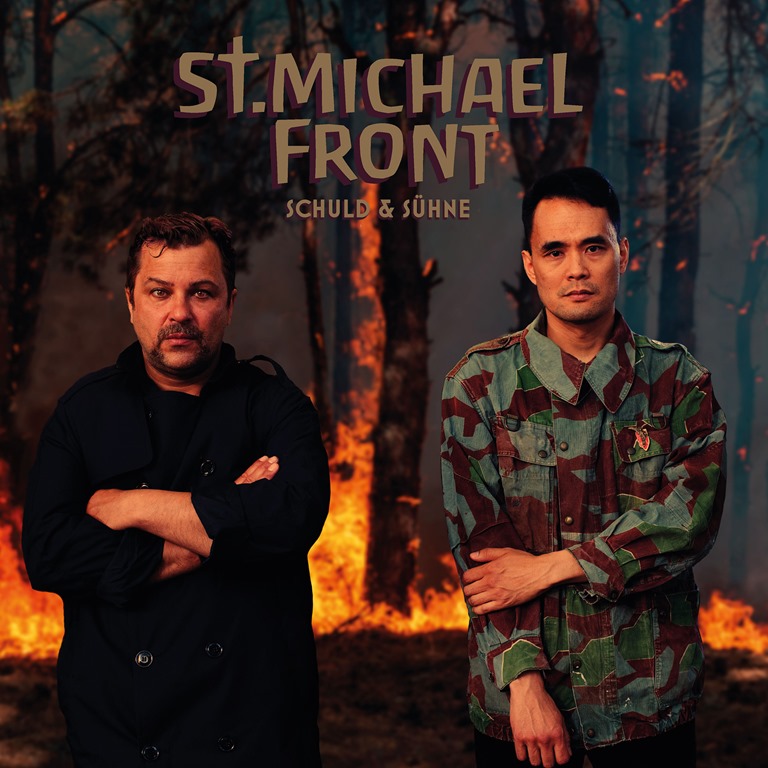
Anyone who tells you Germans lack a sense of humour probably doesn’t have one themselves. Many of the Germans I’ve had contact with have been wry wordplayers and incredibly droll. Who could deny the humour of a nation that gave us Die Toten Hosen? And so it is that St Michael Front showcase a certain tongue-in-cheek amusement, and while their debut album revelled in the preposterous, their latest, which also happens to be the first in their native tongue, exploits the disparity between drama and drollery. For a band who play small venues domestically, and with a minimal setup beyond the projection of movie clips, their sound and presentation is very much a cinematic widescreen and 5.1 sound that’s bold and ambitious – and not just a little self-aware of the pomp and extravagance of their songs.
I have to confess that the arrival of ‘Knochen und Blut’, the second single from Schuld & Sühne completely skittled me, and I immediately found myself somewhat obsessed by the song, and its accompanying video. The song is so magnificently poised, balanced, dramatic, theatrical, while the video… the video is weird. Lifting clips from vintage movies is nothing new, but there seemed to be a certain revelling in the brutal here, and it cut a path from the previous video, suggesting that these guys have something of a fascination with clips of people pummelling or shooting the crap out of one another and scenes of destruction by fire and extreme weather. I’m actually reminded a little of Home Alone, and can picture them glued to all the old black and white gangster movies.
AA
Schuld & Sühne seems to revel in being overtly German, in the way that Rammstein are – yes, I know – more German than German (although it was Hanzel Und Gretyl who took this comment on the Jewish community prior to WWII and the label ascribes to architectural historian Niklaus Pevsner for his dubious support of the Nazis as a song title for a technoindustrial banger). St Michael Front are a hell of a lot more subtle than Rammstein, and a lot more fun, too: it’s far smarter than ‘Amerika’, but no less German, and no less bold or steeped in pomp.
There’s more than a hint of Sparks or even Pet Shop Boys here, and St Michael Front clearly ‘get’ the essential dynamic of the quintessential pop duo: impassive, static, stone-faced guitarist Bruder Matthias is the perfect deadpan foil to the subtly flamboyant and vaguely campy trenchcoat-wearing Bruder Sascha, and the interplay between the two across the songs is entertaining. They build drama, and there’s a keen theatrical element to the songs.
It helps that St Michael Front don’t resort to force, lyrically or sonically. Instead of bludgeoning the listener, Bruder Sascha has a knack for an expansive gesture, a raised eyebrow that’s arch and disarming, vaguely absurd, and knowingly so – and it translates beyond the videos – you can actually hear this coming through in the songs themselves. At times incongruously jaunty, at others giving a knowing nod, there’s a dry comedic element to the performance.
AA
Schuld & Sühne is at times brooding, at times breezy, even borderline cheesy (none more so than third single ‘1000 Namen’) – but for all this, there is something aching and beautiful about so much of it that makes it a magnificent and really quite special album.





 Aural Aggravation