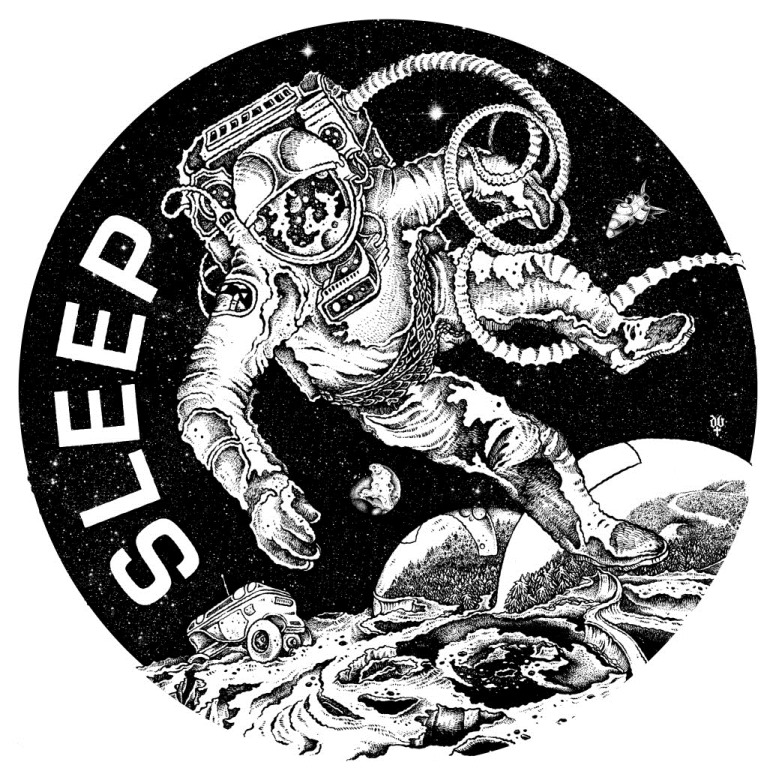
Compared to the release which preceded it, the magnum opus which was Jerusalem (later released in it full hour-long glory as Dopesmoker), ‘The Clarity’ is a pretty concise affair, clocking in at a fraction under ten minutes.
As is Sleep’s trademark, it’s a slow-paced, riff-centric trudge, crushing, sludgy guitar and bass form a thick, bubbling coat of heavy-grained sonic soup around crushing percussion. The vocals emanate a heavy-lidded sedatedness as the lyrics conjure tripped out images, and the whole thig plods its way on with no regard for anything, really. There’s an extended guitar solo, which really does go on and on and is a total wig-out, and all the while, the riff – and no doubt the spliff – just rolls. It’s a beast, alright, and certainly worthy of the special etched vinyl treatment.
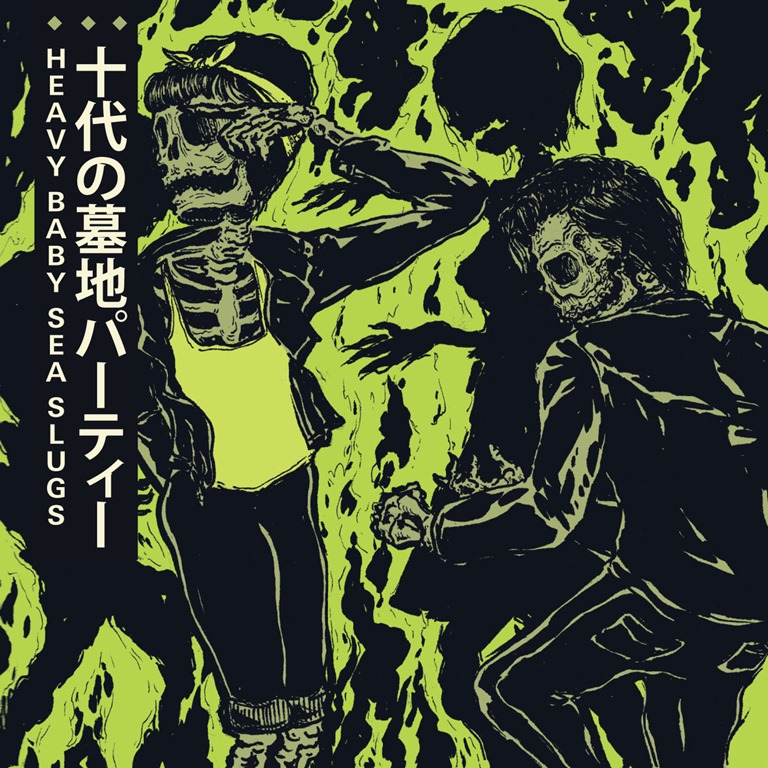
Ok, so I’m not one to judge a record by its cover, but obviously there’s a lot to be said for packaging music in – or with – cover art which reflects the contents in some way. Heavy Baby Sea Slugs’ new offering, the Teenage Graveyard Party EP has artwork which says ‘sixteen minutes of raw, full-tilt sludge-metal racket’, and funnily enough, that’s precisely what it delivers (as one might reasonably expect from a band who previously released an album entitled Fistula Missile and who seemingly enjoy considerably more success in Japan and Taiwan than at home in Texas).
‘King Midas of Shit’ launches the EP with a savage deluge of nasty, gnarly noise, piledriving in at a hundred miles an hour. Talk about a sonic slap round the chops! It’s a frantic, frenetic and stubbornly unpolished aural assault which spits and snarls and spews in all directions.
The title track slows the pace and actually offer some semblance of a tune, with some proper singing and everything – at least until about halfway through when the band put their collective pedal to the metal and thrash their way senseless to the end. Don’t expect any cuddles from the bass-led thunder of ‘Pit Bait’, either. It comes on like a Motorhead 45 being played at 33.
The six-minute closer, ‘Zero-One’ really brings the grind with a downtuned, gut-churning trudge that’s somewhere between early Swans and early Melvins. It’s a gruelling dirge which makes no real attempt to get going, and instead spends is time making threats, with slow, heavy drums, scrawling feedback and yawning bass drone. It’s crushingly heavy, and feels like the soundtrack to an eternity in purgatory.
It may only be sixteen minutes in duration, but Teenage Graveyard Party is a gloriously unpleasant, dirty, mangled mess of noise. Party on, dudes.
Another release it’s taken me four months to review, and for no reason than that I’ve been utterly swamped and a little disorganised, both in terms of my time management and my thoughts. Such is the life of an unpaid music reviewer who stumbles in from working the day-job to be greeted by around twenty emails each evening and a bundle of CDs on the doormat, all demanding attention.
Somewhat ironically, this latest offering from Italian band Humus, purveyors of nasty metal noise, is one of the shortest releases – including singles – I’ve had come my way all year, with the running time for these four tracks totalling barely a fraction over five minutes.
We’re in authentically brutal, crusty, grindy d-beat metal territory here. The guitars a dirty, murky, churning mess, the drums a frenzied thousand-mile-an-hour tempest. The bass is all but lost in the frenetic, furious low-fi treble fest, while the vocals are all about that snarling, strangulated, torn-throat demonic rage, the sound of one of Satan’s minions gargling nitric acid while dancing over hot coals en route to a purgatorial abyss.
It’s dark, the sound of burning rage, a blurring welter of relentless noise. Keeping the songs savagely short and the production mercilessly raw, it’s everything you would want from a band who trade in thrashcore crustpunk.
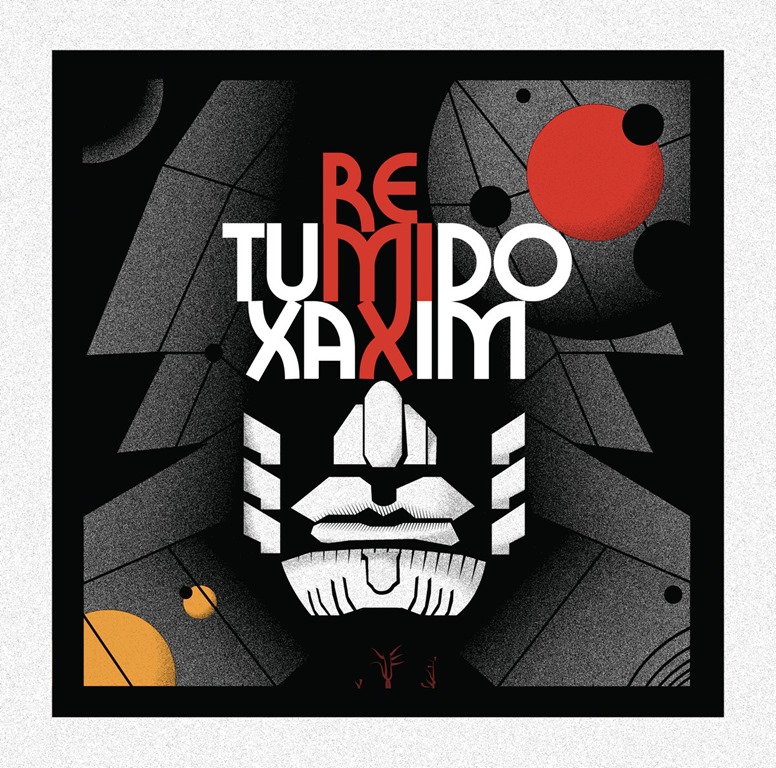
Two years on from the release of the album Nomads, Tumido return with xaxim – an EP of remixes of the track from Nomads. That’s two years to assemble four remixes, one of which they’ve done themselves. There’s nothing like working at a leisurely pace. Was it worth the wait?
Nik Hummer’s remix goes for the slow build, shuddering bass throb and flashing electrode treble rumble for an eternity, building tension and expectation. It’s three minutes before the bumping beats slide in and kick out a devilishly low-down groove. Stefan Nemeth strips it back to a bare bass loop, all subsonic tones and burred edges, grinding out a monotonous yet majestic dirge. The Buenventura remix offers some relief, with an uptempo, beat-led reinterpretation. Hectic rhythms bump hard, and the bleepy analogue synths over the top have a classic vintage vibe about them. The tracks builds and expands, layering up and growing in density until it obtains an optimum groove.
Tumido’s own reworking is perhaps the most radical of all, accentuating the darker tones with elongated, organ-like drones which swell and crackle with overloading low-end frequencies. Rippling waves of metallic-edged sound tear through the deep, wide expanse to create a vast swathe of pulsating sonic space. It’s a towering display of magnificence which ends abruptly and rather disappointingly.
Was it worth the wait? For the final track alone, yes.
What’s with the guy with the bear’s head mask thing? What’s he doing? And why? There are press shots of the bear’s head man playing guitar on a beach. It’s not sinister, but whacky, and without any real context, rather absurd. There is no real context, beyond the fact that this is the work of Otso Lahdeoja.
Otso Lahdeoja is a Finnish composer, described as a guitarist and ‘omnidirectional researcher of all things sonic’. As such, Dendermonde is an exploratory work, which conforms to the limits of neither genre or structural conventions. Dendermonde also finds Otso explore contrasts and sonic variation, and the four tracks are each very different from one another.
‘QC’ begins with what sounds like a vocal sample playing on a loop of stretched shape, before rolling acoustic guitar flits in to occupy the foreground. But these are compositions built around continual movement and endless flux. Woozy, warping notes, formless and malformed sounds stretch and bend. ‘Banshee’ builds a slow, undulating rhythm: there are beats, but it’s the thick, murky bass which dominates. An unexpectedly ‘rock’ guitar line breaks in and drives the subtly dance-orientated groove in an altogether different direction. There’s a dubby vibe to ‘Overwinning,’ and ‘Mue end’ manifests as a long, drawling harmonica drone.
The contrasts of style, rather than making for a disjointed work, functions in a complimentary manner, and there’s a strong sense of focus and direction across the release as a whole.
There’s something about the post-industrial, post-fishing east coast towns and cities. One might consider them to be appropriately named: Hull is just a vowel away from hell, and Grimsby, well, forget Douglas Adams’ ‘Meaning of Liff’, it’s all in the first syllable. But as history shows, time and again, run-down areas reinvent themselves as creative hotbeds as people channel their frustration creatively, and ultimately lift themselves out of the doldrums.
And so, first, it was all exploding in Hull, and the fishy backwater hellhole proved itself worthy of the ‘city of culture’ title in no small part to its thriving music scene which has given us some belting bands of late.
Sewer Rats evoke the spirit of Seattle – another dingy city in decline before it became the musical hub of the world in the early 90s – with the EP’s lead track, ‘Mother Acid.’ It’s a gritty, grainy, guitar-driven effort, and Luke Morris’ vocals betray the influence of heavy psych and US hardcore, and are as much coughed and spat as sung. And as the rhythm section rumbles on, a twisted guitar solo teeters from the speakers. And such is the flavour of the EP as a whole: it’s got some serious heft, the hell-for-leather drumming combined with the gnarly vocals sounding very Mötörhead, particularly on ‘Take Me Home – and everything is, indeed, louder than everything else, amped to the max and close to overload.
It’s not friendly: it’s full-on, fierce, and fucking furious.
A year or so back, maybe, from the ashes of York-based psychedelic drone act Muttley Crew emerged York-based psychedelic drone act Soma Crew. Sort of. The same band in essence, it was undoubtedly time for a change of name, but there’s been something of a lineup reshuffle in the process, and, on the evidence of this, the first Soma Crew EP, a sonic evolution too. This means that while there are still heavy hints of Black Angels, and the songs are still built around two or three chord chugs swathed in layer upon layer upon layer which twist and turn over the course of six minutes or more, there’s new stuff going on which wasn’t present on the Muttley Crew album which came out in the Spring of 2015.
With a ragged guitar sound and Simon Micklethwaite’s vocals adopting a sneering, drawling tone, there’s a punk edge to the EP’s first cut, ‘Pulp’. After a left-turning detour around the mid-point, it bursts into a raging racket of dissonance. And all the while, the drums keep on hammering out a relentless mechanoid rhythm, holding it together while everything else collapses to beautiful chaos. The slow-burning ‘Path With Heart’ brings it down a notch or two and offers a more low-key and introspective aspect. It’s exactly the music you’d expect from a band named after a muscle relaxant which works by blocking pain sensations between the nerves and the brain.
‘Vital Signs’ is perhaps the first track here that’s truly representative of their live sound, a motoric droner, with murky, overdriven and reverby guitars yawning and veering across one another over a thumping locked-in groove with no let up for over six and a half minutes. The eight-minute ‘Prizefighter’ begins at a lugubrious crawl. It takes its time… and then the overloading lead guitar breaks in, noodling in a smog of a chugging rhythm to drive it to the end.
The rough edges and hazy production give the songs an immediacy, and beneath the layers of reverb and cavernous delay, there’s a pulsating energy that gives EP 01 (aka Soma) a rare vitality. Rebirthed, re-energised, this band may be habit-forming and should be used only by the person it was prescribed for.
There must be something in the air. Or the water. Or maybe it’s climate change. Or perhaps it’s simply how things go with the passage of time: Courtney Love becoming uncool has slipped off the radar, and there’s a whole new generation discovering Live Through This and albums by L7 tucked away in their parents’ CD collections. This is certainly the most rational explanation for the current rash of female-fronted grunge-orientated bands. It makes sense: look at the contemporary female role models. Outside the mainstream, proliferated by slick, overproduced r’n’b and anodyne pop and as promulgated by the likes of Beyoncé, Rihanna, and Miley, strong contemporary female role models ae few and far between: even the likes of Amy Lee and Hayley Williams – a front-woman who spawned infinite clones by virtue of being practically alone in her field – are inching towards moving beyond the position of well-established toward establishment. Besides, they never stood out quite as strong as the old guard: neither of them had the guts of Courtney in her prime, or Lydia Lunch, ever.
Weekend Recovery are a Kent-based band, who cite the likes of Paramore, Green Day and Jimmy Eat World amongst others as their influences, and they’re pretty self-evident in their debut single, ‘Focus’, which sees them go for what they describe as ‘a straight up catchy pop punk number’. It’s also precisely what they deliver.
But make no mistake, this is a band with ambition, grit and drive, not to mention some songs with aggression and edge, and here’s no question that Lorin Forster is a strong vocalist and front woman. Cliché as it is, with some high-profile support slots booked, they’re ones to watch.
With seven tracks and a running time in excess of half an hour, it’s one hell of an EP. ‘Elderflower’ is also a whole lot more than the prescriptive ‘post-rock’ tag attached to the duo. Much as I appreciate labelling as much as the next time-pressed music journo struggling to place a band and clutching for pointers for pitching a band in a review, and much as I like a lot of what slots into the post-rock bracket, Defy the Ocean are a band who create music that simply cannot be readily classified on their expansive and accomplished new release.
For a start, it’s more rock than post rock. It’s pretty loud. It’s pretty heavy. There are a lot of vocals. None of these are bad things, and ‘Elderflower’ is a work of depth, range and power. From the get-go, they demonstrate a knack for shifting between segments and moods with real panche, dragging the listener along with them: ‘Rest’, the first track may only clock in at two minutes and fifty-five, but it’s got more twists and turns and ideas and emotional range than some bands’ entire albums.
‘Veils’ is restrained, darkly atmospheric, moody and is perhaps the most post-rock track of the set. But it’s got a bleak, metallic edge that also tips a nod to the mid 90s alternative rock sound.
The title track breaks into full-on grunge mode, the quiet / loud dynamic and brooding atmosphere more Alice in Chains and Soundgarden than I Like Trains, and the crushing power chords are thick and heavy, and paired with a drawling vocal delivery, it calls to mind Melvins – the mellow piano breakdown notwithstanding. ‘Brine’ is serpentine, stripped back, and provides a distinct contrast with its chiming guitars which does call to mind I Like Trains – but then again, the burst of powerchords, distorted vocal and full driving climax, alludes to millennial progressive acts like Oceansize, Amplifier, Porcupine Tree, Anathema, and if anything, ‘Vessel’ amalgamates neoprog with the desert rock vibe of Queens of the Stone Age and their ilk. There’s a lot going on here, and it’s all well-assembled and musically articulate.
Everything about ‘Elderflower’ points to a band who aren’t confined to any one format or bank of instruments, which makes for a refreshingly varied collection of songs, and one which demands repeated listening in order to reveal its full richness.
Gang of Four’s Entertainment! Still stands as one of the definitive post-punk albums, capturing the zeitgeist of the late 70s. ‘Left’ and ‘socialist’ weren’t terms spat derisively by the media. The early years of Thatcher’s dismantlement of the country in the pursuit of the neoliberalist dream was already finding many disenfranchised and angry, with musicians articulating the sentiments of a generation in voicing dissent and dissatisfaction. Sound familiar?
I’ve been listening to Gang of Four since I was in my teens: too young to appreciate them in their day (I was born in1975), I was hooked a good decade before Franz Ferdinand and others started namedropping them and their status as one of the most important bands of the era. This isn’t any kind of hip gloat – not least of all because it would be a pretty shit one if it was. But my experience of the band live until earlier this year was limited to a few shitty VHS recordings, and the not so shitty various artists compilation VHS from circa 1984 that I picked up at a car boot in the early 90s.
So finally seeing them play live in 2016, given that the current lineup only features one original member could have been a disappointment on a monumental scale. But it wasn’t. the current lineup not only sounds great, but still has that vital sense of tension, of danger, that was always the band’s trademark.
‘Live… in the Moment’ captures this perfectly, and is released in two different forms: During a year spent touring the world, the band recorded two of the best, namely their sold-out show at New York’s Irving Plaza (which will be available as a DVD or download) and their penultimate show of 2015, at London’s Islington Assembly Hall, which will be available as an audio CD, double coloured vinyl album and download. The DVD will be packaged with the CD. Both, it has to be said, are excellent.
As a live recording, the quality is good, but it’s not excessively crisp or polished, and doesn’t scream heavy EQing, mixing, overdubbing. No, this is an honest, real live album that captures the intensity and immediacy of being in a room with a band playing live at high volume. If sounds and feels like a live album: as it should: any act who sound exactly the same live as in the studio may be musically accomplished, but fails to make the live ‘experience’ an actual experience. What matters most is that the separation between the sinewy, choppy guitar lines and elastic, funk-infused stop/start bass grooves is spot on.
Similarly, the concert visuals, whole shot from a number of cameras, is straight-ahead: dark, murky, primarily from a lower, audience vantage point. Budget? Maybe, although I’d prefer to watch something that replicates the actual experience of the live show, rather than some ponced-up, glossy fixed-up representation. My only criticism of the footage lies not with the footage itself – I can handle the wobbles and slightly amateurish hand-held pans – but the editing: the cuts are simply too fast, and the zooms on fretboards, etc., simply too… zoomy. With multiple angles to choose from, they haven’t always picked the best. Still, it’s watchable enough in a way fits with the rough ‘n’ ready, ‘as it was’ approach. Moreover, it sits with the band’s general ethos: this is no major-label, big-money production and no corporate exec’s coining it at the expense of hard-working artists.
The track listing draws from across their albums with the exception of Mall, although no-one’s going to be disappointed to see that Entertainment! Is well-represented, with ‘Love Like Anthrax’, ‘Damaged Goods’, ‘At Home He’s a Tourist’, ‘History’s Not Made by Great Men’ and ‘I Found That Essence Rare’ all featuring. The DVD also features ‘Return the Gift’, which doesn’t appear on the CD, as well as non-CD cut ‘I Love a Man in a Uniform’. They all sound great, spiky and urgent, ‘To Hell With Poverty’ as pertinent now as 38 years ago. Irrespective of their influence, Live… In the Moment shows that Gang of Four are very much a going concern, and a band who aren’t only relevant after all this time, but a cracking live act.