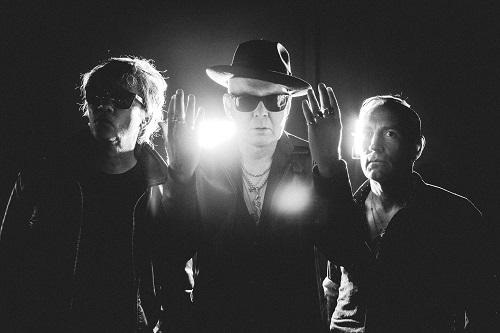
Ben Wood & The Bad Ideas return to follow up on August’s ‘Black’ with ‘You’re The Crash I Needed’, and of this release Ben says, “We wanted the lyrics to reflect an awakening, a coming-to after a period of being insular and unaware of one’s own actions but for that to be entirely forced upon you by someone else. Musically ‘You’re The Crash I Needed’ was composed to mirror that sensation of when you fall asleep in front of the TV and then it seems explosively loud and totally overwhelms the senses when you wake up.”
That jolt… to nab the line penned by Editors, it kicks like a sleep twitch. We’re all guilty of sleepwalking through life at some point or another, oblivious of ourselves and the potential repercussions of our actions, and such somnambulance has become the characteristic behaviour in 2020 as we drift from one day to the next. The kick will happen, and no doubt the jolt will provide a real shock to many.
‘You’re The Crash I Needed’ is an indie-goth gut-punch of a song, with hell-for-leather drumming and interweaving guitars reminiscent of Rosetta Stone and early Mission and it’s got a vibrant energy and a kind of sweeping openness that’s simply not commonplace in contemporary music. Then again, nor is that kind of chorused guitar sound.
Balancing breeziness and shade, this is a tight and tense rack and a clear single choice, and while it’s retro it’s anything but cheesy. I for one am excited.
Grunge-noise duo GHXST have recently announced the release of their new EP ‘Dark Days’ on 16th November.
Following up the release of ‘P.U.R.R’ back in September, the duo has now shared a second track from EP. ‘It Falls Apart’ was written when GHXST drove out to California leaving New York behind, after having lived there for over a decade. Hazy vocals are mixed with the downtuned riffs of a Marshall cab, a loving reference to two of their all-time heroes Jimi and Iommi.
It’s easy to forget just how absolutely massive The Mission were at their peak, packing out headline shows at Wembley Arena, Finsbury Park, and Reading Festival.
There was a time when Wayne Hussey looked like being the new Bono. Or something. And now he’s gone and done Band Aid for goths, with a rerecording of ‘Tower of Strength’ featuring a truly immense roll-call of luminaries from the gothier end of the alternative / post-punk scene to raise funds for covid charities around the world.
The press release reports that alongside Mission frontman Hussey, the project involves Andy Rourke (The Smiths), Billy Duffy (The Cult), Evi Vine, Budgie (Siouxsie and The Banshees), Gary Numan, James Alexander Graham (The Twilight Sad), Julianne Regan (All About Eve), Kevin Haskins (Bauhaus, Love & Rockets), Kirk Brandon (Theatre of Hate, Spear of Destiny), Lol Tolhurst (The Cure), Martin Gore (Depeche Mode), Michael Aston (Gene Loves Jezebel), Michael Ciravolo (Beauty in Chaos), Midge Ure (Ultravox), Miles Hunt (The Wonder Stuff), Rachel Goswell (Slowdive, The Soft Cavalry), Richard Fortus (Guns N’ Roses, The Psychedelic Furs, Love Spit Love), Robin Finck (Nine Inch Nails, Gary Numan, Guns N’ Roses), Jay Aston (Gene Loves Jezebel), Steve Clarke (The Soft Cavalry), Tim Palmer and Trentemøller, the latter of whom has provided a remix of the new recording.
Having properly got into The Mission by hearing ‘Tower of Strength’ during the weekly top 40 (I was 11 and my exposure to ‘alternative’ music had been quite limited at that point), the song has a certain special place on a personal level, and the likelihood is that it’s the same for many fans. Reworking a classic is risky, potentially an act of desecration or sacrilege (referential word-choice half-intended).
The EP contains four 2020 versions in total, with the regular single version, a radio edit, and three remixes.
In term of the instrumental backing tracking track, the single-version sound very like the original, only with some additional extraneous details and the meat where the bass and extra layers kick in stripped out. Meaning it’s ok, but while one of the major criticisms of The Mission has ben that they lean toward the bloated and bombastic, the fact is that was always a part of the appeal. But overall, it’s nicely done: the guest contributions, both instrumental and musical weave into one another pretty seamlessly, and there are no instances of any one person stealing the limelight with their overstepping delivery of a line. There’s no ‘tonight thank God it’s them instead of yoooouuuu’ moment, and this feels very much like a collective, collaborative, egalitarian effort, and I almost feel as if I could give it a virtual hug for that.
The nine-and-a-bit ‘Beholden to the Front Line Workers of the World’ mix comes closest to the basking, expansive glory of the original. It’s a song that’s meant to just keep going, and this version does just that.
Trentemøller goes technoambient with his reworking, and kudos for breaking the mould, and double for the fact that it works. It’s all in the strings, of course. The Albie Mischenzingerzen remix is drummy but doesn’t seem to bring quite as much to the party.
It might not quite pack the power of the original, but it’s not far off: the people playing on it are worth hearing, and it would be churlish to criticise a release made with such positive intentions. In bleak times, Hussey and his pals aren’t only a tower of strength, but a beacon of humanity, and it’s a powerful thing.
Hex Records (USA) / Bigout Records (Europe) – 23rd October 2020
Christopher Nosnibor
For what is essentially a side-project for some of its members, USA Nails have sustained a remarkable output since their inception in 2014, with Character Stop being their fifth full-length release.
It is less full-on, less manic, and less of a messy blur than the bulk of their previous works, but the energy is still very much present, manifesting in a sound that’s more defined, more sharply focused. Which means, in short, it’s more like being attacked with a saw than a hammer. That said, there’s no shortage of blistering punk assaults: ‘I Am Posable’ is a furious flurry of slurry, and hits the spot hard.
We’ve already been given a flavour of the album with the short sharp shocks of ‘I Don’t Own Anything and the opening track ‘Revolution Worker’ both of which combine the growling bass rumble of Shellac with skewed guitars and a motoric beat, and consequently comes on like an early Fall outtake being covered by Tar, and it’s fair to say they’re wholly representative of the album as a whole. Well, don’t you just hate it when you buy an album because of a great single only to find the rest of the album is absolutely nothing like it, and it’s crap to boot? Maybe it happens less now in the digital age, but I used to find that a lot back in the 80s and 90s. Anyway, what this means is that if the prefatory releases appealed, then you’ll be happy to get lots more of the same, while conversely, if the singles didn’t do it for you, then you’re really going to find this a chore.
Recorded in just four days at Bear Bites Horse in London with producer Wayne Adams, Character Stop is urgent, immediate, and raw, and the songs are all brief and more angular than a great-stellated dodecahedron. And yet for that, it’s not math-rock, nor does it really belong to any specific genre, unless jolting, jarring, slightly discordant shit is a recognised genre now.
The album’s longest track, clocking in at four and a quarter minutes, ‘How Was Your Weekend?’ slows the pace and darkens the tone, with a stark, post-punk feel, a tone vocal paired with a thumping metronomic beat at tripwire tense guitars, and likewise the stark, jittery ‘Preference for Cold’. The bass shudders as it runs hither and thither, while the guitars crash in splintering shards. Elsewhere, if ‘No Pleasure’ filters The Stooges through Black Flag and slips its way through at a hundred miles an hour in a torrent of sweat and angst, it’s still got a vaguely post-punk tint to compliment its hardcore hue, and ‘Temporary Home’ is all about the motoric thud. It’s also got something that sounds like a chorus and a bit of melody, although it’s soon swallowed up in a scream of nail-scraping feedback and racketous riffage.
You wouldn’t exactly call Character Stop a minimalist work, but it is often stark, almost contemplative, going beyond all-out thunderous noise to explore dynamics and contrast. In short, it’s a cracking album.
New York’s Lip Critic return with their second album, imaginatively titled Lip Critic II. Now, I have a tendency – and I know it’s spurious – to associate numbered albums with prog and indulgence, ranging from Peter Gabriel to Led Zeppelin. But there is nothing remotely proggy or indulgent about Lip Critic’s second eponymous release, which crams nine tracks into 21 minutes of genre hybridity and maniacal mayhem. And make no mistake: this is intense and crazy shit, all going off in a boiler at once.
The lazy hookline would be that the album’s first track, ‘Why Not’, sounds like The B52s on acid, but more accurately, it sounds like The B52s on acid and meth imitating a fictitious Dead Kennedys / obscure hip-hop collaboration for the Judgement Night soundtrack. But none of this really convey just how frantic, frenetic, fucked-up and actually quite how wrong this all is. Yes, the world of Lip Critic is a bewildering one that absolutely defines the concept of ‘crossover’, and the closest comparison I can think of is Castrovalva, who were ace but niche and probably for a reason. It’s so far into niche crossover it’s hard to determine the level of seriousness behind the hybridized mess of noise that is Lip Critic II: this is an album that goes beyond so many boundaries all at once.
I don’t know what this is, and I suspect it doesn’t either. And nor should it: music should exist for its own sake, free from any constraints of genre. But with Lip Critic, it’s brain-bending and bewildering: there is simply so much going on, and all of it’s incongruous and seemingly incompatible.
‘Dreamland I’ is out-and-out mad, not so much a mash-up or hybrid as a multi-genre pileup with gas tank explosions and flames and wailing sirens and probably some people being cut from cars by fire and rescue and others being abducted by aliens.
‘Like a Lemon’ brings garage, grime, and industrial-strength hip-hop together with mangled beats a punishingly heavy groove that provides a backdrop to a more narrative-orientated approach to the lyrics, describing a guy with ‘A double-breasted suit and tight shorts / they’re so tight they cut off the circulation to his legs / … he said ‘I’m going to fill you up with rhinestones’.
At every turn, Lip Critic deliver mind bombs of every shape and form: sonically, stylistically, lyrically, Lip Critic II is simply an explosion. With every song being so brief, one barely has time to realise it’s started before it’s finished, and by the end, the listener is left punch-drunk, bewildered and dizzy. I think it’s good. I think it’s horrible. I think it’s a mess. But I can’t be sure.
NYC industrial trail blazers Uniform reveal the title track from their forthcoming album due September 11th on Sacred Bones. “Shame is the song that sets the thematic tone for the rest of the record, which seems appropriate for a title track. It is a portrait of someone riddled with regret in the process of drinking themselves to death. Night after night they sit in dark reflection, pouring alcohol down their throat in order to become numb enough to fall asleep,” vocalist Michael Berdan explains.
“I took inspiration from a few stories of alcoholic implosion, namely Sam Peckinpah’s Bring Me the Head of Alfredo Garcia and John O’Brien’s Leaving Las Vegas. The line ‘That’s why I drink. That’s why I weep’ appears in homage to Rod Serling’s Twilight Zone episode ‘Night of the Meek.’”
Abrasive Trees may be the solo project of Scottish-born guitarist and singer Matthew Rochford, and this may be a debut release, but already the project has acquired a roll-call of contributors on a par with Pigface or The Damned. Amongst these are Peter Yates (Fields of The Nephilim), Mark Beazley (Rothko/Band of Holy Joy), Steven Hill (Evi Vine), and Jo-Beth Young (Talitha Rise/RISE/Yates & Young).
The sum of this three-tracker bears little obvious relation to its parts, in the best possible way: there’s no sense of baggage or of any of the contributors striving to define the sound with their various stylistic signatures, and what’s more, none of the compositions sound remotely alike, showcasing a creative openness and willingness to experiment and embrace different forms.
Emerging from a thick atmospheric mist, ‘Bound for an Infinite Sea’ has gothic overtones, with picked guitars echoing out over a deep, rumbling bass. With hints of early Cure, Skeletal Family and Salvation, it broods through shadowy shapes in a fashion that’s perfectly evocative of the early 80s post-punk sound, but it’s also spun with an ethereality that owes as much to the 4AD roster and 90s shoegaze. Rochford’s voice sounds dislocated, disembodied, as it floats into the air, lost, alone. The production is hazy, a vagueness hangs over the notes, with the instruments blurring together as the percussion lingers hesitantly in the background.
Beginning with hints of expansive post-rock, there’s almost a folky feel to the delicate instrumental ‘Brother Saint’, which washes into the more abstract, experimental semi-ambience of ‘Replenishing Water (Stripped)’.
Uncertainty, trepidation, and a certain sense of otherness permeate this set, and if Abrasive Trees’ identity and direction seems unclear at its conclusion, then it’s all to the good, leaving open all avenues and possibilities for exploration.
In the ever-expanding world of microgenres based on hybrids and crossovers, Montreal-based trio Boar God may be onto something as close to unique as you could imagine, describing their style as drone-punk. That said, drone takes many forms, ranging from the elongated notes that tend to feature in electronic works, to the dirgy, doom sustain of Sunn O)), with the kind of Psychedelic drone of The Black Angels in between.
Boar God’s sound belongs to none of these areas, and as such, does stand apart as different. The EP’s four tracks all sit around the six-minute mark, and blend driving alt-rock with a dash of shoegaze, and amp it all up with a spiky edge that’s as much post-punk as punk, but then I’d always say it’s the attitude that counts more than the sound in defining what’s punk.
Echoed tremolo tones shimmer like a heat-haze around guitars that scratch like sandpaper on the intro to ‘Life Eternal’. It’s a long, gradual build. The tempo quickens as the bass begins to run, faster and faster, the guitars chiming and swirling before everything breaks into a punchy clamour of everything, with Eric Bent’s vocals adding to the urgency. If it’s reminiscent of anything that immediately springs to mind, it’s Trail of Dead.
‘Azrael in Crisis’ goes all-out for the epic, with atmospheric synths swirling and wafting in the background, but still remains tightly-structured and punchy and dominated by a gritty guitar and booming bass. The energy is tempered by a chill, a bleakness, reminiscent of early Joy Division (think the outtakes that appeared on Still). The production is murky, and this is actually a good thing, as its low-budget, unpolished feel gives it an immediacy as well as replicating the late 70s’ / early 80s 8-track recording sound.
The pace and the angst are amped up on ‘The World Set Free’, a pounding amalgamation of Killing Joke and Red Lorry tallow Lorry, and again, it’s the thick, floor-shaking bass that defines and dominates the sound. Things take a twist for the gothic around two-thirds in, and as the fractal guitars glisten, the song acquires a dream-like quality.
Everything comes together at once on the closer, ‘The Tar Pits’, which locks into a motoric groove and drives it home with a searing guitar break and shrieking strains of feedback.
I know I’m a complete sucker for this kind of new-wave stuff, but as dark, angry, claustrophobic and steely-grey musings on loss go, Boar God bring a rare intensity on Near Extinction.
The band – the coalescence of an enigmatic visual artist, a prodigal singer-songwriter and an ambitious beat-maker ‘trapped inside a digital landscape’ describe their debut, ‘Lumbering’ as being ‘about viewing the world with a sense of claustrophobia and dread, as humanity bounces between various financial crashes, wars and climate disasters, whilst continuing to lumber endlessly forwards, seemingly in a wounded state.’
This is, indeed, the world of the now, and as such, I expect it’s broadly relatable to many on its perspective. It’s certainly relatable to me on a personal level, having become attenuated to a sense of perpetual panic and wild upheaval. The only thing you can be sure of is that nothing is certain, and you can’t rely on or trust anything – or anyone. The fact is, no-one is exactly who you think, and we live in an evermore divided and more extremely polarised society, be it Brexit or the wearing of masks.
‘Lumbering’ is pitched as ‘an intriguing soundscape of skeletal guitars, layered angular rhythms and fantastic lyrics’ and a hybrid of Boards Of Canada, 00’s Radiohead and The Cure’s Bloodflowers era.
With clattering drums and a pulsing bassline, I’m reminded more of the early 00s New Wave revival as spearheaded by the likes of Interpol and Editors, as well as The Cinematics. A Cause In Distress capture that tension and sense of urgency and distil it down to a truly gripping three-and-a-half minutes of surging dynamism.
It doesn’t necessarily make me feel better, but articulates my restless tension perfectly.
Former New Creatures / Johnathan Christian co-founder Johnathan Mooney and Machinery of Desire’s Adrian Auchrome have teamed up to form the new project THE FUNHOUSE COLLECTIVE. The duo has announced the release of their cover of Golden Earring’s classic song, ‘Twilight Zone’. The original song was written by Golden Earring guitarist George Kooymans who got inspiration from Robert Ludlum’s book, The Bourne Identity.
Produced by Johnathan Mooney and Michael Bann, this new darker, post-punk version aptly arrives at a very poignant time in the world.
“Growing up during the Cold War and coming of age when the original came out left me with indelible memories of that era. Add the events past few months to the mix and it seemed this could have new relevance.” Says Adrian Auchrome.
Pitched as being for fans of The Sisters of Mercy and The Mission, to our ears, it’s more reminiscent of technoindustrial gods PIG, and that’s no bad thing. Get your lugs and peepers round it here: