Posts Tagged ‘Noise’

Empty Quarter – 1st June 2021

Christopher Nosnibor

The latest instalment in the reissue series of albums by oddballs Photographed by Lightning is something of a departure from its predecessors – but then, each album marks a different departure, and if one thing this contemporary appraisal of their back catalogue highlights is that they never stated still or retrod ground, which each release existing in a completely different realm from those which came before.

Recorded in 2002 and released in 2004 and considered by the band to perhaps be their strangest offering (and it’s got some tough competition), it lists as its inspirations the works of Kenji Siratori, Friedrich Nietzsche, Suehiro Mauro, Georges Bataille, J G Ballard. I’m often particularly intrigued when a band’s citations are literary, or otherwise non-musical, perhaps because in some respects, while there is naturally much crossover between all creative disciplines, literary influences tend to be more cerebral, ideas or concept-based over sonic. When a bands say they’re influenced by Led Zeppelin, you can probably hear certain stylistic elements in the composition: but you’re not going to hear elements of Ballard in the guitar technique of any band – although with a substantial catalogue of releases to his credit, Kenji Siratori is a notable exception to the rule, particularly as the experimental Japanese polyartist’s forays into extreme electronica and harsh noise in the vein of Merzbow actually do very much resemble his literary works also as a brain—shredding sensory overload.

This is certainly a fair summary of the experience of this album: the title track, a mere intro at under two minutes, is a blend of scratchy, synthy noise with extraneous elements collaged here and there.

‘The Embryo Hunts in Secret’ and ‘Putrid Night’ are both a sort of psychedelic new wave collision, and with the wandering basslines that veer up, down, and everywhere amidst treble-soaked chaos, the effect is disorientating dissonant, as if everything is slowly melting or collapsing in on itself. Everything is murky, dingy, kinda distant-sounding and discordant. Take ‘Kundalini Butterly’ – a spiralling kaleidoscopic mess or scrawling feedback and a bass that sounds like an angry bee bouncing around inside an upturned glass, coming on like Dr Mix covering Cabaret Voltaire’s ‘Nag Nag Nag’.

Blood Music is noisy, but it’s not straight-ahead guitars noisy: instead, it’s a mangled menage of bits and bobs hurled together – not clumsily, but then, not delicately, either, with pulsing washes of rhythm throbbing and crashing all around. It gets weirder and darker as they plunge into ‘My Hole’, where the bass bubbles and throbs beneath a continuous stream of trilling distortion, synth whistles and wails, and there’s a lot of overloading, whupping distortion that derails the helicotoptoring synths and froth and foam that sloshes around at the lower end of the sonic spectrum. ‘Dark Sun’ goes kind of industrial with a hefty, thunking beat, with a relentless, distorted snare, low-slung, booming bass and heavily treated vocals, and there’s chaotic piano all over the place: the emphasis is very much on the dark here.

Dave Mitchell’s lyrics are, we’re led to believe, to have been inspired by whatever he was reading, but buried low in the mix, bathed in reverb and given a grating metallic edge, he sounds like a malfunctioning Dalek chanting incantations. To be clear, that’s by no means a criticism.

Final track, ‘Frame’ is more overtly ambient, but dark, with a certain industrial hue as it shifts to pound out a relentless beat against braying sax and a whirlpool of aural chaos: I’m not about to suggest that PBL were going through any kind of NIN phase, but there are hints of parallels with The Fragile in places here.

Everything about Blood Music is seemingly designed to challenge, to present the music in the least accessible way possible – and it’s far from accessible to begin with, for the most part. The dark density of the sound is heavy, and there’s something quite deranged about the album as a whole, in a way that’s hard to define… but deranged it is. Which seems a pretty fitting summary of the band’s catalogue as a whole: the only thing you can really predict is their unpredictability.

AA

a3521472505_16

1st July 2021

Christopherr Nosnibor

No doubt it’s an age thing, but the title of this compilation from Leeds noisemakers Thank – a collection of everything they’ve released to date, which number three in total existing across a brace of EPs and a one-off single – makes me think of Maureen Lipman in the 1987 ad for BT when he grandson tells her he‘s failed all of his exams except pottery and sociology, and she famously cries, ‘He gets an ology and he says he’s failed… you get an ology you’re a scientist!’ I’m amused by this, and I have an A-level in Sociology, and I’m certainly no fucking scientist (I also have a PhD in English literature, and lot of good that’s done me, too). As a further pointless digression, the title also reminds me of the third album by another legendary Leeds band, That Fucking Tank.

This is relevant, because back in 2004 or so, Tank were ubiquitous, and proved to be an absolute revelation. It wasn’t that the DIY ethos was anything new – it emerged when punk broke, and has long been a major feature of the Leeds scene. Track back about 40 years and The Sisters of Mercy were representing Leeds internationally on their own label. Whatever bollocks recent governments have spouted, the North has always been a powerhouse of its own making. Free of the sway of whatever’s cool in London at any given time, the Noeth – and particularly Leeds – has forged its own identity and done its own thing. And Leeds has, over the last tent o fifteen years, been a city with a scene throwing up a lot of angular, noisy stuff.

Emerging from the DIY microscene centred around the rehearsal space / occasional gig venue that was CHUNK, Thank draw on a host of influences from home and away, but sound like no-one else.

That debut EP, Sexghost Hellscape, from 2017, was – and still is – a wonderfully deranged mash-up of all kinds of strains of noise, with throbbing synths and punchy fink-tinged post-punk basslines reminiscent of Gang of Four providing the backbone of some off-kilter blasts of noise and some ragged, shouty vocals. The insistent pounding of ‘Punching Bag’ – a dismal, depressed swipe at celebrity taking ‘Stars in Their Eyes’ as its starting target – has that twitchy relentlessness of Shellac about it, and it really only cuts loose right at the end. Thank get delayed gratification – and sometimes they really torture us: there’s no real gratification on the squirming, crawling eight-and-a-half-minute dirge of ‘Petrol Head’ that grinds mercilessly like early Swans. It has the roaring rage of hardcore, slowed to a glacial crawl, and it twists at the gut with its low, slow percussion-driven relentlessness.

Standalone single ‘The Curse’ is an anguished roar of rage – it’s sparse, mangled, messy, and comes on like Uniform minus the riffs. It’s pretty fucking dark and brutal.

Skip on to the last EP, and it’s an even more rabidly raging effort, harder, harsher, more furious. ‘Commemorative Coin’ ups the rage another forty percent. It’s like PIL on steroids: pink and fuck, but more articulate than some three-chord thrash, many time more oppressive and infinitely more powerful. In contrast ‘Think Less’ goes full 80s electro, but it’s jitter, jarring, a three-way collision between Talking Heads, Revolting Cocks, and DAF. It’s crazed, manic, and intense. ‘No Respect for the Arts’ is all-out, foaming-at-the-mouth frenzied. It’s raw. It’s passion, and it’s real. And they speak from the heart here. Please was released in the Autumn of 2019, and this reminds us that the arts were being battered to fuck long before the Covid pandemic shut everything down. Over the last decade, successive Tory governments have been shafting the arts from every whichway. Artists have a right to be angry, but so few articulate that anger so directly though their music. We have reason to thank Thank.

Thankology give us no fewer than ten reasons to thank Thank, They stand as the very epitome of the Leeds underground / alternative /DIY scene: uncompromising, unbeholden to trends, and doing it because they believe in it, and just because. Bands like this are rare these days, and Thank stand apart in these times.

For those who’ve had a taste, this will give the full flavour, and for the uninitiated, here it all is. Get stuck in.

AA

AA

a0669879946_10

A Place To Bury Strangers share new single/video ‘I Might Have’ from their forthcoming Hologram EP out 16 July on founding member Oliver Ackermann’s label Dedstrange. Following lead single End Of The Night‘, ‘I Might Have’ is a fuzz-soaked sonic disaster in the best possible way. Past reflections collide with the brutality of a disintegrating world, stories of personal trauma, acceptance, and human failings emerge from the rubble of noise and destitute motorik rhythms. This is A Place To Bury Strangers at its most honest and unfiltered. Hologram serves as an abstract mirror to the moment we live in and ‘I Might Have’ smashes that mirror into a thousand pieces.

‘I Might Have’ is about the insecurities of life and growing up and when you just have to turn around and say ‘F*ck it,’” says Ackermann. “Life sucks so we may as well have a good time.” The accompanying video visualizes this mentality as it shows the band raucously hanging out together in New York City.

Watch the video here:

AA

A Place To Bury Strangers 2022 Tour Dates – Tickets on sale NOW

Wed 09 March – Hafenklang – Hamburg, Germany  

Thu 10 March – Beatpol – Dresden, Germany

Fri 11 March – Klub Poglos – Warsaw, Poland

Sat 12 March – Futurum – Prague, Czech Republic
Sun 13 March – Randal Club – Bratislava, Slovakia

Mon 14 March – Durer Kert – Budapest, Hungary

Wed 16 March – Control Club – Bucharest, Romania

Thu 17 March – Mixtape5 – Sofia, Bulgaria
Fri 18 March – Eightball – Thessaloniki, Greece

Sat 19 March – Temple – Athens, Greece
Mon 21 March – 25th of May Hall – Skopje, Macedonia

Tue 22 March – Club Drugstore – Belgrade, Serbia

Thu 24 March – Mochvara – Zagreb, Croatia
Fri 25 March – Freakout Club – Bologna, Italy

Sat 26 March – Largo – Rome, Italy
Sun 27 March – Legend Club – Milan, Italy

Tue 29 March – Bogen F – Zurich, Switzeralnd
Wed 30 March – Backstage – Munich, Germany

Thu 31 March – Caves Du Memoir – Martigny, Switzeralnd

Fri 01 April – La Trabendo – Paris, France
Sat 02 April – Lafayette – London, UK
Mon 04 April – Kayka – Antwerp, Belgium
Tue 05 April – Gleis 22 – Munster, Germany
Wed 06 April – Melkweg – Amsterdam, Netherlands

Thu 07 April – Vera- Groningen, Netherlands
Sat 09 April – Hus 7 – Stockholm, Sweden
Sun 10 April – John Dee – Oslo, Norway
Mon 11 April – Pumpehuset – Copenhagen, Denmark

Tue 12 April Hole 44 – Berlin, Germany
Wed 13 April – MTC – Cologne, Germany

AA

5tqs_APTBS1PressPhotoWEBVERSION600

Christopher Nosnibor

No two ways about it: coinciding with the NIM compilation album Deprived of Occupation and Pleasure We Feast, FEAST 4 offers the most jam-packed and solid quality lineup they’ve put on yet, with sets from a number of acts featured on the album and a stack more besides.

After some weird woozy shit off Territorial Gobbings’ recent Automatic for Nobody album release (which we covered and coveted here), where Theo Gowans hoarsely whispers corruptions of lines from REM, Rejections Ops kick things off early doors with a blitzkrieg of stuttering beats, squalling bass feedback and squealing, crackling synths: the guitarist’s wearing a veil and there are strobes galore. The noise is complete overload, a devastating mass of distortion, and while it would perhaps benefit from a little more contrast – it’s absolutely fucking full-on from beginning to end – it would just be amazing to witness in a small, sweaty room at proper ear-bleeding volume. I could happily go home now – but of course, I’m already home, and am thirsty for what’s to come.

DSC_7128

Rejections Ops

Hubble’s cover of Swans’ ‘No Cure for the Lonely’ from the aforementioned compilation provides a mellow interlude before Omnibael’s set. It’s another intense work, and probably their best yet. Stark, black and white footage accompany the duo’s low-down, dubby industrial scrapings. There are some mangled vocals low in the mix, while the crashing metallic snare is pitched up high, and driven by a relentless sequenced synth bass groove overlaid with explosive noise, the atmosphere is dark and oppressive.

DSCPDC_0003_BURST20210523204013324_COVER

Omnibael

Blackcloudsummoner brings more overloading electronica, dark, dense, story, tense, crunching electrodes crackling distortion, occasionally rent by trills of feedback. And it all sounds as if it’s coming from an immense cavern, about a quarter of a mile underground. The bass sounds like a nuclear experiment, and it’s all going off at once, making for an intense and disorientating experience.

AGED’s sound is rather more ambient, and considerably less abrasive, and it’s well-timed. That isn’t to say that this is in any way soft: there’s a crackling decay at the edge of the sound, and distant samples, barely audible, create a disorientating effect. And it’s over in the blink of an eye.

Making a return for …(something) ruined, the full-tilt, all-out noise abrasion with shouting seemed to hit the spot, and the altogether mellower sounds of Pigsticks and the Wonderbra, making droning harmonica noises in some woods arrives just in time to prevent any aneurysms. This is wonderfully weird, with leaves dropping and being raked creating a ‘field recording’ element to this curious experimental concoction. Birds tweet. A helicopter flies over. Atonal woodwind. Random words. What is it all about? The epitome of avant-garde oddity.

DSC_7133

…(something) ruined

Paired with Pressure Cooker Release valve for a collaborative set, Territorial Gobbing bring all the oddball experimentalism you’d expect. For TG, anything and everything is source material, and on this outing we witness some effervescent vitamin tablets fizzing in bowls, the sound contained by a folded IKEA box. And then they bring on the squeezy sauce bottles, which puff and sigh and gasp in their varying degrees of emptiness. Drainpipe and walkie-talkie, toast, toasters, lighters, phone ring tones, egg slicers, books, paint tube, polystyrene packaging, and kitchen sink also provide sound sources in this bizarre object-led experimental set. It almost feels like we’re watching an album being recorded in real-time. Maybe – and even hopefully – we are. With a track per object, it would work well.

DSC_7134

Territorial Gobbing / Pressure Cooker Release Valve

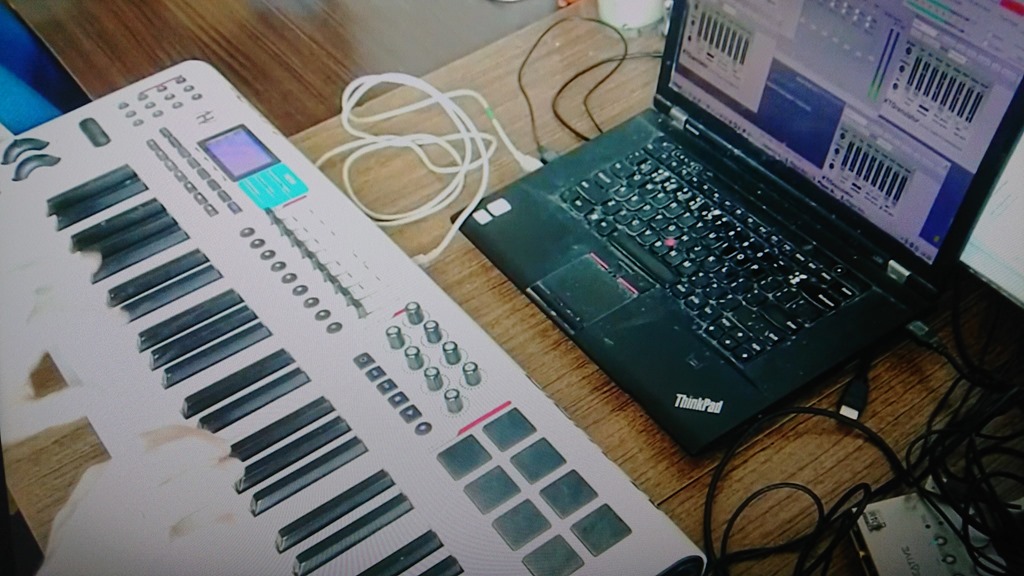
Gintas K’s set is a brain-bending bleepfest, a tangle of jangling synths and collapsing synapses that fray the nerve-endings. Everything squelches and zaps every which way, and we get to watch it all happen in real-time as the notes twitched away on his keyboard are run through software on a dusty Lenovo Thinkpad to create a crazy sonic foam that bubbles and froths all over. But deep, resonant bass tones boom out over the stuttering bleepage and groaning, croaking drones emerge. It all squelches down to a mere drip before finally fizzling out in a patter of rain, and it’s well-received, And rightly so.

DSC_7136

Gintas K

Hubble’s headlining set is accompanied by some eye-opening PoV visuals of a parachute jump and clips of people leaping off mountains, and the footage is so terrifying I actually hope it’s CGI even though it looks like it’s actually real. The freefalling blue sky space is the ideal accompaniment to the disorientating fretwork of the musical accompaniment which sounds like multiple guitars and keys playing interloping lines together and across one another. The rapid ebbs and flows are immersive, hypnotic, and a long, mid-range drone builds and hangs against the dizzying blanket of fretwork that weaves the rich and sense sonic tapestry of this bewildering sound on sound. It couldn’t be more different in sound from Ben’s regular gig as guitarist in NY noise act Uniform, but everyone needs a break, and this is wonderfully, if dizzyingly, realised. It makes for a top ending to a top night packed with all the weird and all the wonderful from the full noise spectrum.

Not Applicable – 25th June 2021

Christopher Nosnibor

Chris Sharkey’s first album released under his own name is what I suppose one might call an ‘environmental’ album. Not an album about the environment in the broader sense, or the ecological sense, but in the sense of having been inspired by the artist’s surroundings, and the music herein is a direct response to that in many ways. While so many releases from the last year have been environmental in the context of creative responses to lockdown and a shrunken vista consisting of four walls and the view from the window, paired with a pervading anxiety on account of the 24/7 news media and social media doomscrolling, Presets comes from a very different perspective. First and foremost, its inspiration is travel.

“I had been touring and travelling a lot. Lots of long car journeys, the M1, driving between shows in Europe. Long waits in airports. The occasional long-haul flight to play farther field. Throughout this period my relationship to music changed. I found that listening to songs or short pieces would leave me agitated and frustrated. I’d been listening a lot to Actress, particularly ‘Ghettoville’ and ‘Hazyville’ which really worked for me on the road. I wanted a music that develops slowly over time, drawing you in, making you forget about the clock. Music that has so much grain and texture that you could almost pick it up and turn it around in your hands, examining from all sides. Like a physical object. Music that resembles something you might see out of the window of a plane, high above the clouds, a meteorological event or a storm on distant mountains from the back seat of a car.”

I can certainly relate to the agitational effects of listening to certain musical forms while in transit: I always had to stop music and be on full sensory alert on arriving at a train station and walking through an unfamiliar city, for example, and since lockdown, I’ve not been able to listen to my MP3 player at all while walking around anywhere.

The physical setup for the album’s production was minimal, and Presets is the product of two months’ intensive recording, producing hours of material. But this was only the start of a protracted second stage, which Sharkey details as follows: “As the process continued, I would select my favourite parts and create playlists just for myself. By the end I had over 4 hours of music that lived on my phone and whenever I would travel, I’d listen. Over the course of the next 5 years: touring, travelling, listening, I slowly whittled it down to what you hear on Presets.”

In short, Presets is the product of many years’ work – not just the five years in post-recording evolution, but the years of experience and observation that preceded its creation also. It was, unquestionably, time well spent: while many of the individual segments are quite short – mere fragments – the album as a whole sees them sequenced and segued so as to feel like one continuous piece that gradually transitions between tones and shades. It’s also an immense work, clocking in around the eighty-five minute mark. It’s very much a good thing that it’s intended as a background work, because it’s practically impossible to sustain focus for that kind of time. But Presets is about not focusing, about disruptions and interruptions, about life.

It begins with quavering, key-ranging notes that do, at least vaguely, sound like guitar, before layers of processing build, before the source instrument becomes lost, evolving to conjure organ -like drones and entirely abstract washes. Before long, particularly over the course of the eighteen-minute second track, ‘the sharecropper’s daughter’, you find yourself not so much listening as floating along with the sounds as they slowly creep and shift.

The titles are sparsely descriptive and evocative at the same time: from ‘blue cloud, red fog’, to ‘scorpion bowl’ via ‘detained at the border’, there are hints of mini-narratives attached to each piece, and the sense of travel and movement does come across through the difficult drones and scrapes of feedback that build and buzz through the foggy murk.

It’s an epic work, and a major achievement.

Chris Sharkey Presets cover 3000px

Dret Skivor – 7th May 2021

Christopher Nosnibor

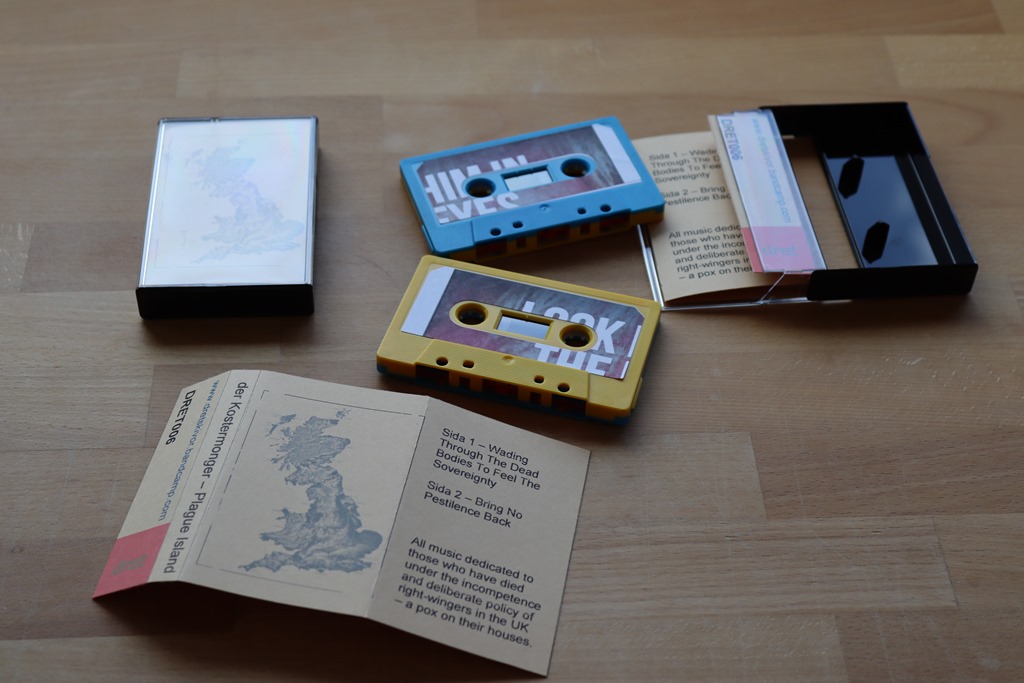
The island of Poveglia in the Venetian lagoon, where plague victims were sent to quarantine – and die – is commonly known as ‘plague island’. But the ‘unprecedented’ pandemic that has circulated the globe in the last eighteen months or so has created a new ‘plague island’, where almost every element of dystopian fiction has become a reality.

There’s no question that this is a political album. The cover alone says it all: this is not some fictional place, but an album that’s explicitly inspired by a specific island that is – sadly, for many of us – very real. The UK, the tiny island with one of the highest death tolls in Europe from the COVID-19 pandemic is indeed a plague island – an island ridden with not only literal plague, but metaphorical plague, its seedy government the worst exponents of capitalist excess, and widely reputed as being more corrupt than the mafia, its racist, jingoistic bullshit-by-the-dozen prime minister with more children than he can account for, tossing money at his mistress while in a position of power, slinging multi-million pound contracts to associates to cash in on the pandemic, and misappropriating funds for a lavish refurb on his flat while unable to find the funds for more than a 1% pay rise for medics… A prime minister who would ‘fuck business’ but would still rather let ‘the bodies pile high’ than shut down and further damage his precious economy’. That’s a plague on a plague, a pestilence on an international scale, and also an absolute fucking disgrace.

It’s an island that also seems to have forgotten how small and isolated it is, both by geography and, now, politically: it’s forgotten it doesn’t have the empire it once did, and so, cut loose from the EU, isn’t an economic powerhouse on a global scale… just a tiny pathetic spec on the map, deludedly flexing its muscles and posturing while plunging further into debt by the hour. It’s a scabby scummy pit of self-importance and irrelevance, where the ruling elite trample the rest every second of the day purely out of self-interest. It’s a hellhole of division and decline that would rather cut off its face to spite its nose, all in the name of reclaiming its borders and blue fucking passports – and all of this is neatly encapsulated in the album’s opening blitzkrieg of noise overload, ‘Wading Through the Dead Bodies to Feel the Sovereignty’.

Because words alone cannot articulate the violent disgust at the country’s policies on immigration, welfare, child poverty, this barrage of cranium-crushing overload is the perfect expression of the rage and the fury – fizzing static and electronic sparks fly through a stammering buzz and headlong collisions of explosive distortion. It’s ten-and-three-quarter minutes of sonic annihilation that’s almost unbearable in its intensity and sheer abrasion. It’s weight and intensity feel like being trapped underneath a tank stuck on a mudbank. You’re clinging on as it tries to run you over the edge, where you can only hope to find a sleazy, lying scumbag lying dead in a ditch before you.

The churning earthworks continue unabated on second track, ‘Bring No Pestilence back’, which dissolves into a babbling, streaming gurgle that accelerates in pace and tapes to a treble as a thin, scrawling drone extends out over its final minutes, before fading to silence. It’s unpleasant and uncomfortable, and clearly intentionally so. For all that, it’s not as unpleasant or uncomfortable as living in post-Brexit Britain in a semi-lockdown state and knowing that the future offers no hope on the horizon.

IMG_9306

Miasmah Recordings – 16th April 2021

Christopher Nosnibor

It was the heavyweight score of his debut album, Hold, that provided my introduction to the work of James Welburn, and very much piqued my interest – because in some way, sonically at least, it seems I like to be published. Almost six years to the year on, Welburn delivers another immensely heavy set with Sleeper in the Void.

According to the accompanying blurb, the album ‘feels like a story in two parts, rising lethargically, but with gargantuan power. The second begins with the momentous In and out of Blue, where Juliana Venter’s disembodied, spectral dirge takes center stage among the furious drums and bassy riffs, reaching a full crescendo with seconds to go. Parallel marks a release – Hilde Marie Holsen’s nostalgic soundscapes, pristine as glass, meeting the distant thunder of Welburn’s strings on the horizon. And finally, Fast Moon ends the record in a most surprising way – a tribal industrialized banger, complete with vile distorted beats and every other spice in demand on a blackened dancefloor.’

It’s intense from the outset, and ‘Raze’ is anything but lethargic. It begins with a modestly middling dark ambient drone, but before long, pattering drums are hammering like machine-gun fire and whipping up a frenzy while all around the drones increase in volume and intensity until there’s a veritable cyclone of sound raging all about. The experience is dizzying, suffocating.

The percussion is again punishing on ‘Falling from Time’, but while the sound is still dense and murky, the thundering rhythm, is far more mechanised, more industrial, thudding in a furious frenzy amidst an impenetrable smog of sound. The tempo is fast, and it’s relentless: you could perhaps even dance to it, although that’s not so much my thing: instead, I found my pulse accelerating and a glow of perspiration as the tension grows. Finally, the synths break into a softer swirl, although there are ominous tones eddying around as the drums finally peter out and it’s finally possible to catch your breath and compose yourself. It’s but a brief respite before crushing percussion crashes in on the doomy dirge of the title track: stuttering, stop-start detonations cut through the shoegaze on ketamine crawl of the blurred blizzard of extraneous noise.

Julia Ventner’s vocal on ‘In and Out of Blue’ and ‘Fast Moon’ (the latter of which is a grating, bulbous bass-driven beast of a cut that loops and lunged in a trill of treble and a crackle of fizzing distortion) are haunting, ghostly, and pitched against the lurching cacophony of drums and juddering blasts of noise that hit like a taser to the abdomen, it’s not only a contrast and a change of atmosphere her presence brings, but a new level of trembling intensity.

Sleeper in the Void unquestionably makes an evolution for Welburn: while incorporating many of the same elements fundamentally, their application is quite different on Sleeper in the Void in comparison to its predecessor. The basslines are less overtly structured, and Sleeper in the Void sees Welburn move further from any loose conventions of ‘rock’ toward something more abstract. It may be less direct, less bludgeoning, less reminiscent of early Swans, but it’s certainly no less intense or powerful, and it’s still dense and percussion-driven. If anything, the greater sense of nuance and Welburn’s expanded palette only amplify its menacing resonance, making Sleeper in the Void an album that may be challenging, but achieves optimum impact.

AA

MIA050_front

Following a handful of corking releases including US release of the stunning debut by Health Plan, fledging Iowa label Nim_Brut look set to really make their mark with the release of the snappily-titled compilation DEPRIVED OF OCCUPATION AND PLEASURE WE FEAST.

It boasts a cracking array of contributors, and the first available track is ‘No Cure For The Lonely’, a cover of the Swans song from their 1992 album Love of Life by HUBBLE, the rather more gentle side-project of Ben Greenberg, guitarist with New York’s harshest, Uniform.

I personally have a serious soft spot for White Light /Love of Life era Swans, despite many diehards being less keen on the more accessible folksier sound that defined it: the songs felt rather more like songs instead of crushing slabs of brutality, and instead we witnessed the band discover a more expansive, epic sound.

The last track on Love of Life, ‘No Cure for the Lonely’ is a simple, sparse acoustic song that’s only a couple of minutes in duration and finds Michael Gira downbeat and introverted, and HUBBLE recreate the mood perfectly – albeit with a much fuller arrangement and a more psychedelic folk sound.

Ben says ‘It’s a Swans cover, with four finger tapping through an approximation of Terry Riley’s ‘Time Lag Accumulator’ method via a Boss DD-5, which is actually the guitar sound for every Hubble track.’ The floating vocals are bathed in reverb and are definitely secondary to the intense guitar work that dominates. It’s unexpected, and inventive, and sets the bar high for the rest of the album.

AA

a2705195024_10

25th April 2021

Christopher Nosnibor

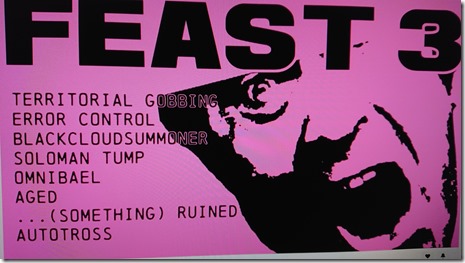
While real gigs still aren’t possible, nim_brut are keeping the fringe noise community together with their ‘FEAST’ streams – and it’s an appropriate moniker, as they offer a veritable smorgasbord of experimental, noisy, and weird shit that fans of this disparate (anti)scene can fill their boots with at one of these events – eclectic, engaging, and inclusive, with something for everyone (as long as they’re into this kind of niche). Admittedly, the lineup was predominantly white and male, but that’s by no means an issue unique to experimental / electronics / noise, and the chat that ran alongside the stream was both welcoming, supportive, and encouraging for all comers. And in terms of replicating the live experience, it’s pretty good: something obscure provides a backdrop as people arrive and there are greetings in the chat, much like turning up at a similar show in person: a fair few people know one another from the circuit, and it’s relaxed and accommodating. In real life, these are some of the places I feel happiest: there’s no pressure as such, and people are accepting and accommodating of others not feeling particularly sociable, and the shared appreciation of diverse and indigestible music is simply accepted as enough.

So we’re here, and it feels comfortable.

The gig poster is replaced by footage of a lot of knobs and wires… a lot of panning and close-ups of this complex kit accompany drippling, blipping, bleeps and whistles, trickling, babbling sounds create a light, skipping mood. It’s Autotross, and they certainly don’t outstay their welcome with this short set. A nice taster, it would be interesting to see what more they make of this setup.

Soloman Tump’s pulsating dark ambient electronica is quite a contrast, and the rumbling, droning groan is accompanied by a walk in the woods, blurred, rasterised and colourised to render it most uncanny and unsettling. Clicks and burrs spike through the murk, the thudding beats thick and heavy, slow and deliberate, while will-o-the-wisp lights flicker and skip in the upper tonal regions, bringing a full sonic spectrum with good separation. The walk ends in a strange place with what looks like pouring paint and the sound winds down slowly like the life is slowly being sucked from it. While it would no doubt he great to see and hear in a real live setting, it does work well through phones.

DSC_6899

Soloman Tump

I was rather anxious ahead of the slot reserved for …(something) ruined: technical difficulties meant that the intended set wasn’t good to go, and I had stepped in last minute with a solo track I’d been working on, which I had about an hour to add visuals to before submission, thus making the debut for instrumental offshoot …(everything) ruined. Seven minutes of gnarly digital distortion accompanied by an eight-second clip of a sink-unblocking chemical in action looped for seven minutes seemed to go down pretty well.

Grating electroindustrial and eye-bleeding, fit-inducing flickering visuals are the order of the day from AGED at the start of the set – and then things start getting really weird as skeletal birds begin to drift back and forth against low oscillating scrapes and hovering drones.

OMNIBAEL had threatened a set involving banging railings and that’s what they delivered. Somewhere between Test Dept and Einstürzende Neubauten, it’s a heavily percussive clanging racket, and it’s brutal and oppressive. Marking a significant shift from their previous FEAST appearance, it’s a short, sharp shock of a set, and its impact is immense.

DSC_6904

OMNIBAEL

Blackcloudsummoner’s set starts out dark and sense with a grimy, distorted bass booming. Not a lot happens: the drone drones on, as shrill whistles of feedback strain through a discoordinated chatter of sound that reminds of being in a crowded place… it’s unsettling and tense. Red lights drop like lava against a dark background in a loop, and in combination, the effect is hypnotic.

There’s a whole lot of gnarly nasty noise from Error Control, and there’s a definite sense of performance here too, as we see him twiddling the knobs on his compact but knob-dense kit while blindfolded. On one hand, this could be taken as a critical comment on the nature of harsh noise and the lack of technical prowess required to create it, as well as the S&M subculture associated with some corners of the scene, but I feel it’s more about exploiting the ransom elements of music making – and he works his patches well, generating some head-shredding tones with some abrupt tonal shifts.

DSC_6907

Error Control

Even if you ‘get’ and dig Territorial Gobbing, Theo Gowans’ outré approach can’t fail to evoke a certain ‘wtf’ response. Sonically, this set is very much standard territory, a series of groans, drones, bleeps, blips, burp and farts, with random samples flying in from all angles to dizzying and bewildering effect. Only this one, he’s dialled in from bed with a hot water bottle and some kind of elephant trunk hat thing made out of foam and paper mache or something. He coughs, splutters, wheezes, mutters, and snores, the din stops and starts and you wonder if he’s perhaps unwell, maybe delirious, but then you remember that’s just how he is, and he’ll probably be doing shit like this on his deathbed. It’s a cracking set that reminds us that there really isn’t anyone else doing anything quite like this.

DSC_6910

Territorial Gobbing

It’s a top end to a top night. At some point in the future, this will happen in a small room, at extreme volume and will be observed and appreciated with a fervent enthusiasm by a dozen or so people, and it will be aMAYzing. For the time being, it’s a real joy that the creativity continues and the sense of community remains.

And you can watch it all here:

DSC_6900

Buzzhowl Records – 7th May 2021

Christopher Nosnibor

Health Plan’s all-caps bio on their Bandcamp doesn’t really tell us much, bujt it does, I suppose, tell us enough in the pan of three short, declarative sentences: ‘HEALTH PLAN ARE DAN, STEVEN AND FRANCOIS. WE PLUGGED GUITARS STRAIGHT INTO A LAPTOP AND MADE SOME POP SONGS. MEMBERS OF USA NAILS, BLKLSTRS, THE EUROSUITE, DEAD ARMS’. Whether or not that qualifies them as a supergroup I’m not sure, but this emerging hub of intersection musicians is proving to be a fertile melting pot, and on the musical evidence of this, their eponymous debut, they are a super group. And of course, as you’d expect, a noisy one.

The album’s eight tracks are an extended exercise in crashing, droning noise rock, and it’s not intended to be pleasant: this is the kind of music where you marvel at the layers of noise as they scrape and clash against one another, feedback shrieking against low-end-grooves, as reverbs bounce off one another in different directions. And maybe there is something masochistic about enjoying this kind of thing, but it’s about sensation, and feeling the sound batter your body and brain.

‘Post Traumatic Growth’ piles in as an introduction, a mess of buzzing bass, relentless percussion, and squalling guitars, landing somewhere between Big Black and The Jesus and Mary Chain, with additional blasts of exploding lasers and blank monotone vocals.

And this is the flavour of the album: motoric and messy, lo-fi and abrasive. The rhythm section holds things down, albeit muzzed up, fuzzed out and indelicately. It works a treat: the bass buzzes and booms, and the drums thump, and in combination they punch hard. The guitars are toppy, discordant and disco-ordinated, slashing away at angles across the linear rhythm grooves.

When they dial it down a bit, as on the altogether more sedate instrumental ‘Fade’, where a thumping bass beat flutters like a heartbeat beneath a current of swirling, meandering sound, the production is still such that it’s anything but comfortable, and it’s not lo-fi, but wilful awkwardness: there’s a cymbal that cuts through the mix at a mean volume, and it’s not smooth or in keeping, but harsh, crashing, incongruent.

‘Vapid Expressions’ comes on like The Fall, like MES at huis most hectoring in a swelling surge of motoric repetition that drills into your brain. ‘Stuck in a Loop’ lives up to its title, a cyclical repetition of a motif pinned to a relentless beat, providing some kind of lull before the acerbic hollering of ‘Cataract’ that drives it to a finish in a frenzy of sax and distortion.

While so many bands take cues from The Fall, Health Plan do so with real style, and moreover, take as much influence from the band’s stubborn refusal to conform, or to pretty up their sound with tidy production. To my mind, punk has always been about an aesthetic rather than a style – primarily about going against the grain and not giving a toss about anything other than pleasing yourself – meaning that Health Plan is truly as punk as fuck.

AA

a3115426715_16