Posts Tagged ‘Nine INch Nails’

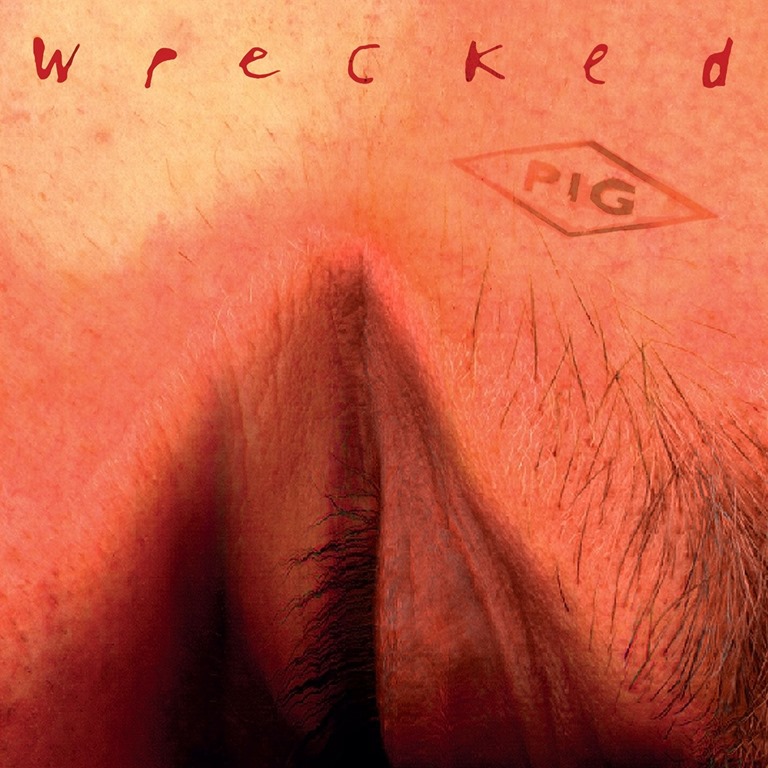
Industrial glam kingpin Raymond Watts aka PIG will reissue a remastered and expanded version of his 1996 album Wrecked via Metropolis Records on 7th March. His fifth full-length record, the remastering has been made by Tom Hall at Abbey Road, while its reappearance coincides with UK live dates to promote the 2024 studio album ‘Red Room’. The PIG live band currently includes En Esch (ex-KMFDM, Pigface) and Jim Davies, formerly of Pitchshifter but best known for his acidic and acerbic guitar lines on several chart hits by The Prodigy. Davies co-wrote many of the songs on ‘Red Room’.

Whereas the recently reissued Sinsation (1995) had originally been released on Nothing Records (the label established by Trent Reznor of Nine Inch Nails), its follow-up saw a switch to Wax Trax!, the leading ‘90s exponents of industrial rock.

“Revisiting Wrecked for remastering was a sobering experience that left me shaken,” states Watts. “I recalled a period when I was stirred to a creative frenzy of crisis and desperation while searching for beauty. Although I can still hear glimpses of it, the bonfire of my hope was more an expression that was savage and twisted.”
Following the desperate burning that had resulted in Sinsation, Watts considers it more “a yearning, grinding plea for liberation that manifested in ‘Wrecked’, a tomb I had built for myself and my troubles that only the very bravest would dare enter.”

The original press release for Wrecked had described the album as “a nihilistic slash and burn, a scrapbook of manifestos and suicide notes written in dried blood.” In the cold light of day almost three decades later that description still holds true.

Wrecked features contributions from former KMFDM members Günter Schulz and Steve White, as well as Julian Beeston (ex-Nitzer Ebb, Cubanate).

Ahead of the expanded remastered reissue, they’ve released a video for ‘Everything’, which you can see here:

AA

67fd98d7819df26e756c1ecba56842acbbd35016

11th November 2024

Christopher Nosnibor

13x is reborn – or perhaps reanimated, resurrected, something – as dEddGvRL, and the title of gives a hint as to its tone and themes of this this seven-track release.

As she summarises in the accompanying notes, Anhedonic Succubus is ‘More a collection and recovery from extreme trauma over the past couple of years. Fake friends, S.A, declining mental health, alienation, despair, suicide, revenge….’ As such, this is music that’s issuing forth from a dark and difficult place, and there’s not only no escaping the fact – it’s necessary to take this head-on. There are doubtless many who will find these subjects triggering, but life does not come with trigger warnings, and a key function of art is to get to grips with life in all its complexities, all its pain and ugliness. And in connecting with art which does this, we strive to find ways to navigate life and the traumas it puts us through.

From a creative perspective, many artists channel their own experiences – however painful – into their craft as a channel of catharsis, a release, a way of comprehending or coming to terms with things. All of this is clearly an oversimplification of a complex relationship between an artist and their art, the nature of the creative process, and the way an audience – an infinite array of individuals rather than a collective with a single, fixed perspective – receive and respond to said art, in whatever medium. But I tentatively step towards Anhedonic Succubus with this preface because it’s particularly pertinent.

As has been the case with work as 13x, dEddGvRL channels considerable pain and anguish into these works – something which represents a continuation of the inspiration behind much of the previous work as 13x. But dEddGvRL plunges deeper into those dark places, and the eclectic sample credits feature some illuminating inclusions:

Drums on "Ophelia: Drained" taken from Tool "Die Eire Von Satan"
"Deathbearing Machine: Killng December" contains a segment from Charles Manson’s interview with Dianne Sawyeri
Cock Speech on "Sterben, Kranke Fotze" – "Female Trouble" (John Waters – 1974)
"Scared Of This Place" – Johnny Depp in Court
Catwoman (1968) appears on "Valenbitch"

‘Ghosts of My Body’ starts the set off quite gently, as it happens: dark, atmospheric, yes, but not without a certain levity, with hints of early-80s Cure B-sides and a dash of Disintegration, until the fizzing, distorted spoken-word vocals bring a more unsettling aspect. It creates a sense of detachment, which is likely almost entirely the objective, given the context.

Slow, sparse, murky, ‘Ophelia: Drained’ is reminiscent of Nine Inch Nails circa The Fragile. The tension builds and the percussion tears through the surface of a swirling wind and things start to get darker fast from hereon in.

Based on the context and the content, one may be forgiven for expecting more rage, more abrasion, more visceral noise, more attack. But Anhedonic Succubus is harder and heavier in its absence: instead of exploding outwards with a brutal sonic assault, dEddGvRL keeps things contained, introspective and seething. The effect is disturbing and menacing. Electronics buzz and hum around distorted vocals, and the percussion, too, is restrained, subdued. Things crackle and glitch, stutter and clatter, and the atmosphere is claustrophobic, oppressive.

When things do get noisier, on ‘Fuck What You Kill’, it really hits hard, and that’s before one reflects on the perverse implications of that title and hookline. But even then, the noise is sociopathically restrained, and pinned to a hypnotic repetition. The technoindustrial stomp of ‘Scared of This Place’ is by far the most accessible – and uptempo – track on here, and it works well and is well-placed, providing a late – and unexpected – rush of energy, before ‘Valenbitch’ leads the way to the exit in a relentless churning grind.

Anhedonic Succubus is heavy, but not in overt or conventional ways: instead, as the title threatens from the outset, it slowly sucks the air and energy, dragging the listener into dEddGvRL’s hellscape. It’s a tough listen, but artistically, it’s a success, delivering on its promise.

AA

a1542349256_10

Former LORDS OF ACID vocalist, Mea Fisher is back unleashing the inner demon with her new single featuring En Esch (Slick Idiot, <PIG>, Pigface, ex-KMFDM). ‘Devil Inside’ is a twisted and delicious siren-like song where distorted guitar riffs, metallic percussion, and dystopian synth bring deep, dark fantasies to life. Written originally by Mea and strictly made for Lords of Acid, she has refined and transformed the song into a creation that is distinctively hers. Its heavy metal elements fused with a trance-inducing dance beat truly sell the feeling of traversing through the underworld’s hottest night out. Méa easily takes charge—her spellbinding vocals whispering temptation and commanding attention in the same breath. “There’s a hunger that lies,” she admits, “and you hold the key.”

Mesmerizingly, Méa calls fans to follow her and “take a bite of forbidden.” En Esch’s guttural, gruff backing vocals light the whole thing aflame. Danny Lohner (Nine Inch Nails) also lends his guitars to the track.  The seductive, Luciferian qualities of ‘Devil Inside’ compel listeners to close their eyes, lose themselves to the beat, and indulge in their deepest desires.

Check the video here:

AA

ed7e1c64-bd6b-529d-b152-d5795e48c59e

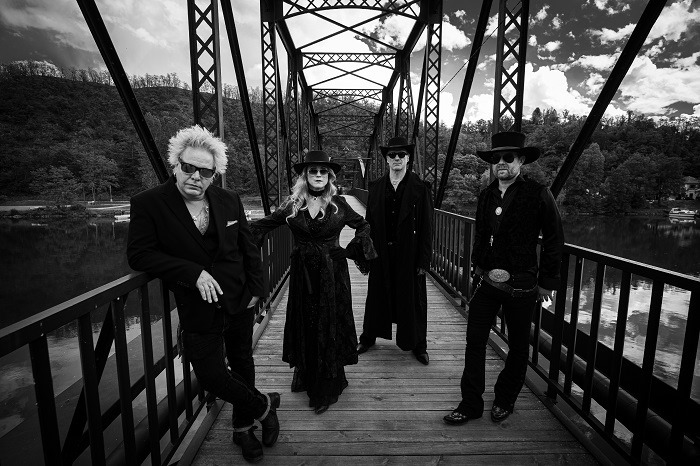
The long-awaited new album from Prague gothic cowboys, CATHEDRAL IN FLAMES titled Count To Nine, has finally been unveiled on the Musicraft label! The themes of the songs cover contemporary psychological problems and addictions, Lovecraftian mysticism and magical sexual practices.

The title, ‘Count To Nine’ refers to both the number of songs and the mystical number 9. Nine is the number of fulfilment, closure and completion. It also symbolizes the coming of age and the connection between dimensions and worlds on all levels.

The nine tracks were mixed by the legendary John Fryer (Fields of the Nephilim, Nine Inch Nails, Depeche Mode, Paradise Lost, Cradle Of Filth and more). The band has significantly tightened up their dark gothic rock on their third album, from the hypnotic and gothic rock purist track, ‘Dreaming In The Witch House’ to the cowboy shuffle of ‘Pale Rider’ to the dark pop of ‘Summertime.’ 

Vocalist Phil Lee Fall says of the album, “On Count To Nine we tried to cross boundaries. We ventured further and deeper than ever before. Musically, lyrically and sonically. It took us almost three years, but we are extremely happy with the result. Dark, mystical and monumental gothic rock for the 21st century.”

Gatsby adds: “Each track is heavily influenced by the mood and situations in which it was created. That’s why I make music, to get the emotion out. So the fact that it’s dark is probably natural. In a way, it’s a catharsis of the disgust and confusion we live in.”

AA

95f4349b-6ad8-398e-373c-ffb1fe4ea8f6

24th May 2024

Christopher Nosnibor

Welcome… to The Royal Ritual! I simply felt the urge to open with that. It felt necessary, if only to me. But if you can’t please yourself…

In my case it’s something of a belated welcome, having been aware of the act and its founder, David Lawrie for quite some time, but having only recently come around to the actual music, with my introduction being their recent show in York. There’s something to be said for hearing a band live first, without knowing the songs, rather than the other way around: if they can grab you in that twenty minutes or half an hour, when you’re not necessarily primed to absorb songs and details, then there’s a strong chance they’ve won a fan, provided the recordings are up to scratch.

Where The Royal Ritual really stand out live is with the use of live guitar, which brings the benefit of not only an immediacy and human aspect to the predominantly digital music, but an additional body on stage, which creates not only a visual balance but a greater sense of movement.

Recorded, these elements are less essential, and the songs here are clearly the product of extreme focus and a meticulous attention to detail. When I wrote in my review of the York show that The Royal Ritual sound ‘produced’, I observed that ‘their approach to production owes more to the methods of Trent Reznor as pioneered in the early 90s on Broken and The Downward Spiral, balancing gritty live guitars with synths and fucked-up distortion and harnessing their tempestuousness in a way that creates a balanced yet abrasive sound.’ And so it is on record, also.

Pleasure Hides Your Needs is The Royal Ritual’s second full-length release, following MARTYRS in 2022. A lot has happened, and much has changed since then, and the project, born in lockdown, has evolved significantly – as have many of us. Life is different now: that’s a fact.

We learn that ‘Pleasure Hides Your Needs sees David contemplate his own life and experiences, adopting a distinctive, more personal tone than the expansive and outgoing approach of MARTYRS: “Pleasure Hides Your Needs is much more introspective when compared to the social and political commentary of MARTYRS,” says David. “For me, it is about the closing of three distinct chapters of my life. Finding the common threads through each of those chapters in order to represent them sonically, and in a consistent way, was a really interesting challenge – if at times quite emotionally exhausting.”

Life is exhausting, in every way, but there’s a tense energy to Pleasure Hides Your Needs. It builds from the instrumental intro piece, ‘Shadow Self’, where crashing waves erupt from soft ripples, dark rumbles and inaudible muttering contrast with chimes, before ‘Vantage Point’ opens a broad sonic vista paired with a solid kick drum beat. Just as it’s leaning into the proggier end of alternative rock, a gritty guitar kicks in and the mood immediately turns darker.

‘Fifteen 14’ lands as an unexpectedly pop tune, with a solid chorus, which softens the arrival of the album’s nine-and-a-half-minute centrepiece, ‘Sinner Gambler Fugitive’, which really does run the gamut for range, a sonic and emotional rollercoaster. It’s ‘Modes of Violence; that goes full industrial, with a metallic smash of a snare and snarling bass providing the backdrop or Lawrie’s wrought vocal as he wrestles with a veritable tempest of emotion, before he hollows himself on the bleak, minimal title track.

The album as a whole is more geared toward tension than release, always simmering but rarely bursting the floodgates. Muted isn’t the word: it’s more a case of clenching tightly to maintain a grip of control for fear of what may erupt otherwise.

Pleasure Hides Your Needs is dark and exploratory, but still eminently listenable. As The Royal Ritual evolves its sounds and expands its horizons, there remains much potential to explore myriad paths in the future, and recent touring will likely serve to open new avenues of exploration.

AA

a0879761406_10

Metropolis Records – 27th September 2024

Christopher Nosnibor

Hot on the sweaty trotters of Red Room, released in May, the Lord of Lard, Raymond Watts has managed to mine fresh truffles for a whole new EP ahead of embarking on an extensive tour of the US, which so happens to take its name from the first track on said EP, ‘Heroin for the Damned’. The fact that this isn’t a set of remixes

The title alone is glorious, and you can almost feel the relish with which Watts conjured up the phrase, wicked, perverse, dark, and equally ostentatious and grand, evoking an image within the realms of The Last Supper but with an S&M slant as the participants dine on an orgy of gore… or something. When it comes to relishing the richness of language and delighting in deliciously devilish wordplay and alliteration, sifting through PIG’s catalogue for titles and lyrics (there’s a suitably extravagant book containing all of them just out) provides abundant evidence that Watts really gets kicks from it.

It’s also clear he is absolutely loving the whole self-styled industrial rock-god posturing, hamming it up in leather and mesh, and simply the whole music-making thing, perhaps more than at any point in his career. Instead of being awkward about self-promotion, he’s fully embracing its absurdity, and in a genre that’s largely dominated by serious, angry people, PIG stand out as being rather less po-faced, and altogether more fun than your average industrial act. I’m not sure I’ve seen Al Jourgensen or Trent Reznor posting pics on Facebook hugging their pooches.

That doesn’t mean that the music is any less serious. Watts and his various collaborators really know how to bring a crunching riff and a stonking beat, and, occasionally, having taken early cues from the legendary JG Thirlwell, spin in some bombastic strings and grand orchestral strikes. And Feast of Agony is dark, heavy, intense, and marks a strong return to the more experimental 90s work following a pursuit of an altogether glammier sound of late.

‘Heroin for the Damned’ – the opium of the people for the 21st Century, perhaps – starts low, slow, and sinister, Watts’ vocal a croak amidst a dank electronic swamp before a steady riff, laden with grit, grinds in, rubbing hard against a lowdown pulsating synth groove. It’s a bit NIN circa The Downward Spiral, but equally it’s quintessentially 90s PIG, and lands a monster chorus that combines the raging roar of Sinsation and the grainy grooves of Praise the Lard with gushing gospel grandeur – something that really dominates the final track, the Jim Davies remix of ‘Baptise, Bless, Bleed.’ Piano and bold orchestral sweeps meld with stark synths and crunching guitars on ‘Fallout’, before Watts comes on like Bowie on the slow-paced anthemic ‘Comedown’, while the verses of ‘Hand of Mercy’ owe more to Prince.

It’s a PIG release and therefore it’s a pure [serial killer] thriller, alright – but even within the now-expansive catalogue, Feast of Agony is a strong entry.

AA

a2658647365_10

Metropolis Records – 23rd August 2024

Christopher Nosnibor

Even at their commercial peak, PIG releases weren’t all that easy to come by, at least here in the UK, despite some of them being on big labels with big distribution. PIG – the project of London-born Raymond Watts – is an act which can legitimately claim to be big in Japan while largely unknown at home.

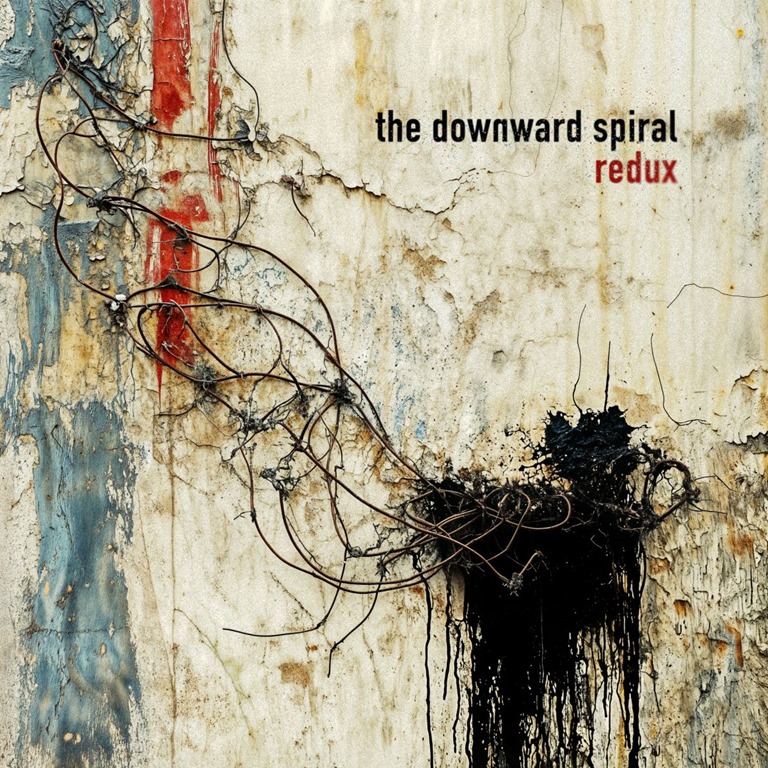
My own first encounter was seeing them support Nine Inch Nails on The Downward Spiral Tour in Wolverhampton in 1994. I was in the middle of my A-level exams, but no way was I going to miss NIN. I didn’t even know who the support were, but witnessing the heavy grind of PIG, with pigs’ heads on poles at the sides of the stage, as their lanky singer writhed his way through a gritty set was an absolute revelation. The set’s opening song stuck with me, but it was some years before I would actually source a copy of Red Raw and Sore, on this new site called eBay. The debut album, A Poke in the Eye…. With a Sharp Stick and the ‘Sick City’ 12” were fairly easy to find at record fairs around 1994, as Wax Trax! vinyl was available in abundance, and often cheaply, too, but anything else? Pretty much impossible to find. And so it was that PIG felt like a near-mythical act, and despite having played these big shows with NIN, still no-one was really aware of them.

Sinsation was released first in Japan in 1995, and a year later in the US, and on learning of its existence, I got my local record shop to order it in, but had to wait literally months for it to arrive on import. Oh, but it was worth the wait. It delivered all of the theatrical pomp that defined A Stroll in the Pork, but cranked up the dirty industrial guitars and found Raymond Watts in top form with his extravagant wordplay. In short, it reset the bar, not just for PIG, but for what ‘industrial’ music could be. This wasn’t just hard and heavy, but also playful, witty, intelligent, and still dark, seething.

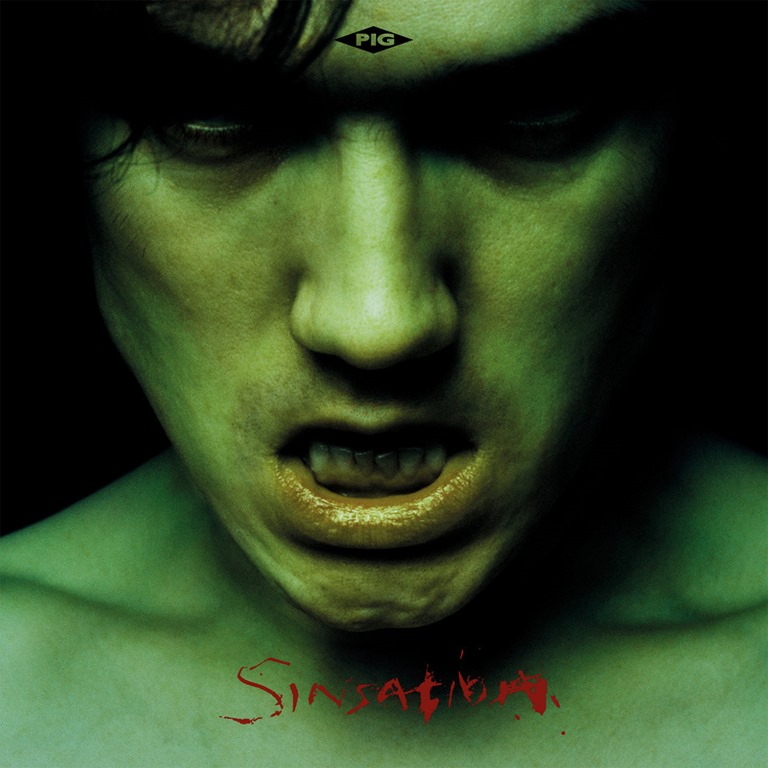
The cover alone is striking. Watts’ image is a standard feature on all PIG releases, but whereas more often than not he is depicted looking buff or brooding, the sickly green hue is unsettling – and slamming in with a series of orchestral strikes and a low, grumbling bass before hitting full-on industrial anthem mode on the first track, the six-minute ‘Serial Killer Thriller’ (the chorus of which provides the album’s title), it’s immediately apparent that Sinsation is something special (and not something sad…).

Admittedly, despite this being an album I’ve played to death over the last thirty years, apart from a few tracks being a few seconds different in their duration, I can’t discern any huge differences between this remastered version and the original: there are, perhaps, more details revealed in the mix, but then, the production on the original was impressive, and again, I’ll come back to that word, ‘detail’. There’s a lot happening; samples, snippets of bits and bobs, strings, multi-layered vocals… A touring member of Foetus early in his career, with JG Thirlwell involved in the early singles and debut album, Watts clearly learned much from Thirlwell, as well as his early involvement with KMFDM. Sinsation felt like the point at which he brought these two aspects together in perfect balance while simultaneously realising his own unique sonic vision. The result was a set of hefty, driving songs, exploding with ideas and noise, and so many layers, so much going off all over the place. It was bold, audacious, and while it’s easy enough to say that it’s a bit Foetus, a bit KMFDM, it goers so far beyond these points that comparisons are a diminishment of Watt’s achievements here.

Sinsation is certainly the first PIG album to showcase the full range of styles and compositional aspects Watts has in his locker, and as such, represents something of a creative peak.

While nominal single ‘Painiac’ (an early version of which was the lead track on a Japanese-only EP, and a video for which got a few spins on MTV on the album’s release) is a throbbing industrial beast of a tune, ‘Golgotha’ is a dark, semi-ambient interlude which sits between the driving snarl of ‘Hamstring on the Highway’ and the swaggering industrial-strength glam-tinged gospel-infused dark pop of ‘The Sick’, which would provide the blueprint for the PIG renaissance which started with The Gospel in 2016. ‘Analgesia’ is a magnificently atmospheric piano-led instrumental which incorporates elements of ambient and electronica and extraneous noise ‘Volcano’ is serpentine and sleazy, with some audacious orchestral work in the mid-section which take the bombast of Foetus’ Nail to another level, while ‘Hot Hole’ drives hard and heavy with pulsating electronics colliding with hefty chugging guitars and ferocious beats.

For the many who likely missed this the first time, this re-release provides the opportunity to make acquaintance with one of the definitive PIG albums, and for those already familiar, it’s a timely reminder of the incredible journey that has been PIG’s career to date, while offering the first chance to get it on vinyl. Almost thirty years on from its first release, Sinsation still sounds phenomenal – insanely ambitious, utterly deranged, and in a league of its own, quite unlike anything else before or since, even within the PIG catalogue.

AA
a2059987689_10

Following hot on the heels of his new album ‘Red Room’ (released in May 2024), industrial rock mainstay Raymond Watts aka PIG has today reissued a fully remastered version of his seminal mid-‘90s album ‘Sinsation’ via

Following hot on the heels of his new album ‘Red Room’ (released in May 2024), industrial rock mainstay Raymond Watts aka PIG has today reissued a fully remastered version of his seminal mid-‘90s album ‘Sinsation’ via Metropolis Records (CD, digital) and Armalyte Industries (deluxe 2xLP vinyl). Out of print for almost three decades, it makes a timely reappearance just ahead of a North American tour.

‘Sinsation’ was originally released in 1995 on Nothing Records, the label established by Nine Inch Nails kingpin Trent Reznor, and not long after PIG had opened for NIN at a number of shows. Nothing was an influential and commercially successful label with a cult underground following that also issued records by Marilyn Manson, Squarepusher, Autechre, Meat Beat Manifesto, Pop Will Eat Itself, Einstürzende Neubauten and Plaid, as well as NIN themselves.

(CD, digital) and Armalyte Industries (deluxe 2xLP vinyl). Out of print for almost three decades, it makes a timely reappearance just ahead of a North American tour.

‘Sinsation’ was originally released in 1995 on Nothing Records, the label established by Nine Inch Nails kingpin Trent Reznor, and not long after PIG had opened for NIN at a number of shows. Nothing was an influential and commercially successful label with a cult underground following that also issued records by Marilyn Manson, Squarepusher, Autechre, Meat Beat Manifesto, Pop Will Eat Itself, Einstürzende Neubauten and Plaid, as well as NIN themselves.

Check the video here…. Album review to follow….

AA

9af61b6130ce938e2fa6f1d2fbf2db35b6784588

ant-zen – 12th February 2024

Christopher Nosnibor

First – the format! So much is being made of the vinyl renaissance right now, and much as I love vinyl, it’s hard to be entirely comfortable with this comeback, in this form. Back in the 90s, when CDs were in the ascendence, I often bought vinyl because it was cheaper: I could pick up an LP for £7.50 when a new-release CD was £11. I still have the receipts in my vinyl copies of PJ Harvey’s Rid of Me and Pandemonium by Killing Joke, among other treasures. Now, vinyl is a luxury item. Even a standard LP is around £25, and many are pressed on two pieces of heavyweight vinyl and cost closer to £40, or more if released on Record Store Day. This isn’t right. It’s not honouring the format, it’s another example of exploitation.

But this is rather different, and altogether cooler on so many levels: ant-zen have brought us this release by Kojoohar & Frank Ursus in the form of a 7” EP, with two tracks on each side. You can’t blame them for the price tag given production costs, but the unique hand-printed inlays, etc., at least make each copy unique and make this release a million miles removed from the capitalist conveyor belt.

The thing that matters here is that this release is completely suited to this retro format: a 10” or LP release would have been extravagant, indulgent, and frankly, ill-keeping.

It’s worth quoting the liner note for the back-story here, too: ‘The spark that ignited this collaboration came from a conversation between KOJOOHAR and FRANK URSUS – aka Te/DIS – about the kojoohar album that has just been released at the time and about angst pop and its position in the music scene. talking about new tracks kojoohar was working on, the decision was made to start a collaboration.’

And so we’re presented with Frost Drought, which they describe as ‘a 4-track ep that offers edgy angst pop with analog, gripping synthesizer sounds, metallic rhythms and enigmatic melodies, complementing by frank ursus’ vocals… music and lyrics of FROST DROUGHT describe a world of isolation, mistrust, alienation and the individual’s distance from itself. left alone in the dark…’

Entering the ‘debris field’, we’re presented with dark synths, groaning, whining, whistling, and a slow-tempo-echo-heavy beat. If the baritone vocal is distinctly from the gothier end of post-punk, the instrumentation is equal parts post-punk and ultra-stark, bleak hip-hop. ‘never compromise’ pushes into stark, dark, electro territory, in the realm of mid-80s Depeche Mode. Ursus’ vocals are commanding, but so dark, and the music is so claustrophobic as to be suffocating. ‘never compromise’ sounds like a manifesto, and whipping snares sounds crack and reverberate in an alienating fog of synth, and with hints of Depeche Mode’s ‘Little 15’, it’s as bleak as hell, too. ‘threshold’ is dark and boldly theatrical, like Bauhaus battling it out in the studio with Gary Numan.

There’s no light here: this is dark and it feels like a dragging weight on your chest, on your heart. Drawing on early 80s electro but adding the clinicality of contemporary production – and a dash of Nine Inch Nails – Frost Drought is a challenging work, thick, dense, and intense, it’s a heavy listen, and one that’s incredibly intense.

AA

a3285530151_10

Negative Gain Productions – 9th February 2024

Christopher Nosnibor

Pitched as ‘a battle cry against the facade of perfection that suffocates an authentic connection’ and a song that’s ‘about the dark, often unseen journey of seeking forgiveness and finding solace in the unexpected kindness of strangers’ ‘Necessity Meal’ is perhaps the ultimate hybrid of everything that’s gothy and on the darker side of electro/synth pop.

I’d wager it’s pretty much impossible to write about ‘Necessity Meal’ without recourse to Depeche Mode. That isn’t to say it’s just some rip-off, so much as an indication of just how deep and broad their influence is felt at the darker end of the electro spectrum.

‘Necessity Meal’ is built around a rolling drum beat with a harsh snare, and some brittle, trilling synths pave an intro that gives way to some guitars that are by turns cutty and deliver strains of feedback. The verses are a bit rappy / spoken and I can’t help but think of it being like a gothy take on grebo and it sort of works but sort of doesn’t – in the way that The Sugarcubes worked but didn’t: you know, you either dug – or more likely tolerated – the Einar bits, or outright hated them as rubbish intrusions into some great songs, but ultimately, it worked because the Björk bits and the overall thing was more than worth the clash. This feels confused and confusing, a bit messy. But then, as front man Mychael says of the song, “In the end of it all, life can be rather messy, and I can sing if I want to, at my own pity-party!” In the mix there’s a bunch of noise that casts a nod to Nine Inch Nail, and…

…And so it is that from all of this sonic jostling emerges a magnificent refrain: the vocals suddenly come on like David Bowie, and with a heavy sarcasm, deliver the line, ‘Thank you, thank you for the guilt’. It’s unexpectedly, and almost inexplicably, affecting, but somehow, in this moment, the whole song, and everything around it makes some sort of sense.

AA

a0341299273_10