Posts Tagged ‘goth’

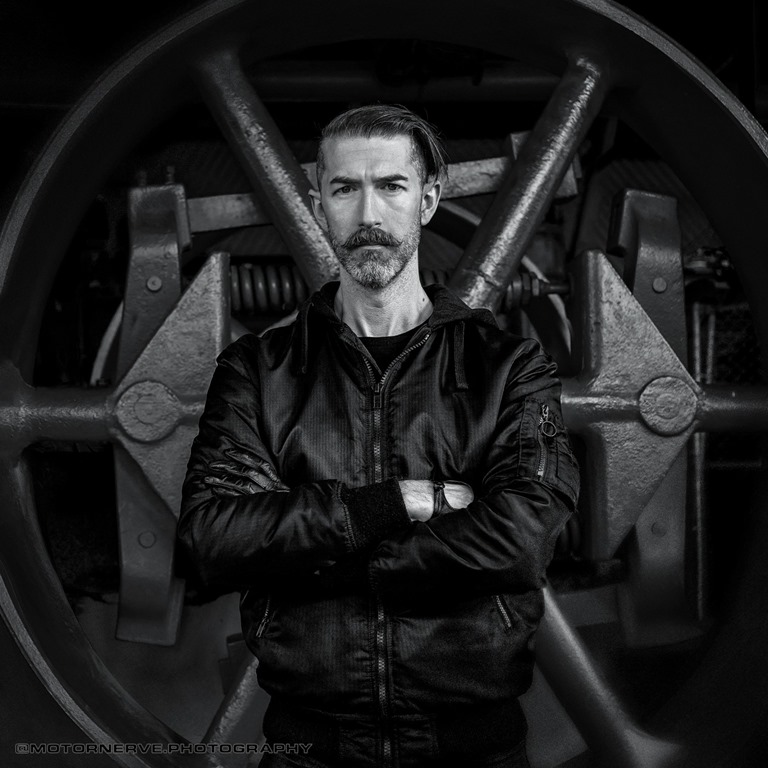
Recently signed to Peaceville, Scorpion Milk have shared their first new music today, alongside news of the debut album Slime Of The Times (out 19th September). The new single ‘Another Day Another Abyss’ arrives with a brand-new video, revealing Scorpion Milk’s darkly imaginative universe for the first time.

“It is about trying to stay upright under the daily flood of catastrophe, the headlines, the numbness, the helplessness. But there’s a double edge to it: the only way to get through the abyss is to become it. To move through the darkness, you have to carry some of it inside you.” – Mat McNerney

Watch the video here:

“I used AI to create the video because we’re living inside the very dystopia we fear the most. The song deals with the psychological weight of modern catastrophe, and AI as both a tool and a threat, mirrors that perfectly. A mirror can be humorous but also diabolical. It’s an aesthetic artistic choice, but also a commentary: our nightmares are now automated.” – Mat McNerney

Scorpion Milk is the new project from Mat McNerney; the founding creator of Beastmilk’s highly-revered Climax album and the subsequent three Grave Pleasures albums. Infused with elements of Beastmilk’s original DNA, debut album Slime of the Times marks the most direct, raw, and explosive evolution of his self-defined genre: Apocalyptic Post-Punk. An eclectic artist in his own right, McNerney’s roots are also firmly in the black metal underground of Finland and Norway, and continues to work in that genre (having formerly featured as vocalist for Dødheimsgard, among others), plus is also currently active with his band, Hexvessel.

Continuing the lineage of Mat’s cult post-punk and goth-metal hybrid music, Scorpion Milk draws from the decaying spiritual core of UK anarcho-punk and 80s post-punk with an opus ideal for fans of Killing Joke, Godflesh, Crass, Flux Of Pink Indians, Crisis, The Fall, and early Sisters of Mercy, yet also set to resonate with contemporary audiences into Health, Drab Majesty, Soft Kill, High Vis, Molchat Doma, Creeper, and Uniform.

AA

C3zvM7PA

Photo: Andy Ford

Negative Gain Productions – 25th July 2025

Christopher Nosnibor

It’s been three years since Curse Mackey delivered Immoral Emporium. Three years may not be a long time, but a lot can happen in three years – and it has. And very little of it has been good. There has always something about industrial music – something I’ll unpick in a moment – which has displayed a sense of the apocalyptic, to the extent that at times it seems to almost bask in it. And that is not a criticism. The end is nigh, and while it’s always a question of ‘when’ rather than ‘if’, we seem to be ever closer to the brink of total annihilation. These are dark times, which call for dark music.

Industrial has come to mean many things, in terms of musical forms over the years, while Throbbing Gristle were the progenitors of all things industrial, technological advances saw acts more interested in pursuing more structured works with tape loops and drum machines, eventually giving us the more electro-orientated strain of industrial that became synonymous with Wax Trax!, and, subsequently, industrial metal, not least of all due to Ministry’s evolution from one to the other. Curse Mackey’s work very much belongs to that late 89s / early 90s Wax Trax! domain.

Concluding the trilogy which began with 2019’s Instant Exorcism, Imaginary Enemies promises to be ‘his most intense and intimate album to date… A bleak, beautiful meditation on paranoia, grief, and the ghosts we conjure from within’.

And so it is that the listener is lead into the album by route of looped samples, layering across one another, before a pounding beat crashes in, and Mackey, accompanied by a low, thumping synth bass groove, sets out his stall with ‘pressure points’, ‘psychosis’, and ‘decay’ delivered with a processed growl. There are many layers to the arrangements, creating simultaneously an expansive and claustrophobic feel. Single cut ‘Vertigo Ego’ swiftly plunges into darker, denser territories: brooding and ominous, Mackey’s vocals are a barely audible whisper. It sounds tormented, stressed, anguished.

AA

If ‘Discoccult’ and ‘Time Comes Clean’ (which calls to mind early (electropop) Ministry and Trudge era Controlled Bleeding) find us in fairly familiar industrial territory, something about the production imbues the material with a suffocating intensity. More often than not, there’s a brightness, a crispness, something of a ‘digital’ cleanness about the genre. In contrast, the sound here is murkier, more ‘analogue’ in feel, alluding to eighties synth music – something I’ve never been quite able to pinpoint as a listener and critic rather than a producer.

One can reasonably assume that album centrepoint ‘Blood Like Love’ makes a reference to Killing Joke’s ‘Love Like Blood’, even if only in title, but sees Curse lean towards gothier territories, stark, brooding, yet ultimately layered, graceful, with synth melodies and dramatic piano weaving around the samples and mechanised beats.

AA

The second half of the album locks into an atmosphere that’s less aggressive and attacking, and more brooding, moody, and introspective, and as such, marks a clear departure from its predecessors. What’s more, it works well, with the more uptempo title track marking a high point in the album, sitting comfortably alongside some of the more contemporary goth classics with its nagging, reverb-heavy guitar line and pulsating bass all held together by that classic, relentless, drum machine sound.

For my money, it’s Curse Mackey’s best release to date.

AA

a1263141378_10

Christopher Nosnibor

Seeing the same band twice on the same tour – especially twice in the same week – may seem excessive to some. However, it’s not – and certainly wasn’t historically – unusual for fans to follow bands around the country, and even the continent. It’s something I’ve only done a couple or so times myself previously, at least that I can recall, and discounting the misfortune of having seen Sona Fariq around six times in three months supporting various bands in the early noughties. My first experience was seeing The Sisters of Mercy in Glasgow and Nottingham in the same week in 2000. The setlists may not have been radically different, if not identical, but the experiences could not have been more different. The Glasgow crowd was lively, and the band, visible through minimal smoke, were relaxed, and Andrew was chatty. A couple of nights later, in front of a static audience, the band were barely visible behind the wall of smoke and Eldritch didn’t speak a word all night. And so it was that I came to appreciate different locations, different crowds, etc., all have a bearing on the experience, and how two nights are never the same. I also decided to stand to the other side of the stage tonight, and being at the front that not only means a different view, but a different mix due to the proximity of the backline. We’ll come back to this shortly.

It’s perhaps less common to follow bands around now because the cost of tickets, accommodation and travel has skyrocketed way above the rate of inflation, and no-one hitch-hikes or sleeps on train stations anymore.

Anyway: some disclosure. Tonight is personal, I suppose. Having been offered press for the Leeds show before this one was announced, I jumped in, but on seeing a show a fifteen minutes’ walk from my house added to the itinerary, felt compelled to buy a ticket for the simple reason that I love the band, and – as they later remind us – their last visit to York was in 2011.

In the bar before doors, there’s a DJ spinning goth and post-punk tunes, and I get to hear ‘The Killing Moon’ over a PA for the second time in three days. And for the second time in three days, and the third time in as many months, I’m (pleasantly) surprised by the demographic: the first wave goth acts are no longer primarily the domain of those in their late forties or older. It could be that bands like support act Vision Video are proving to be something of a gateway – having discovered bands like The Violets and the whole early 80s scene pretty much the same way I did as a teen, they’re making music that’s influenced by those bands, with clear and accessible nods to The Cure and New Order, and finding an audience who are the age they were… etc. Anyway, it’s all to the good, and tonight’s audience is an enthusiastic one, and with youth on their side, they can dance and wave their arms without worrying about giving themselves a hernia.

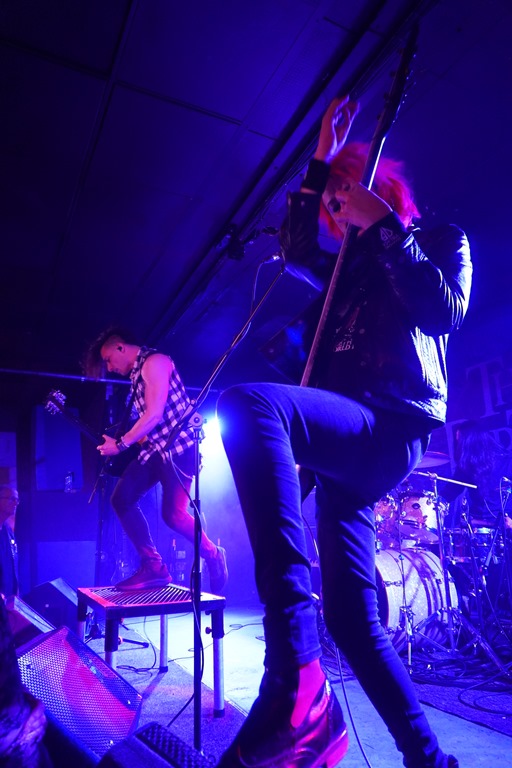
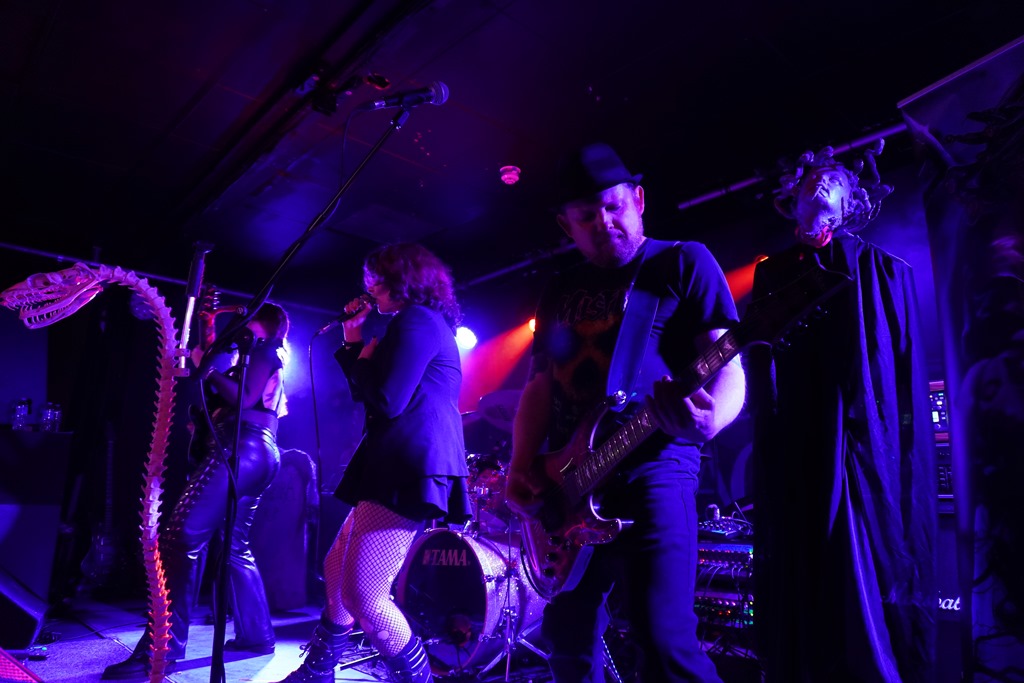
The Crescent is a smaller venue than The Warehouse, and when Vision Video arrive on stage, aspects such as lighting and PA variations are thrown into sharp relief: it’s darker, smokier, the minimal lighting is predominantly purple, and the thumping bass I enthused over in Leeds was significantly less present or impressive. In between songs, they offer similar chat, but it’s clearly not scripted, but notably a lot less chat in general. Vocalist / guitarist Dusty Gannon talks faster, seems less more hyped up, rushing to remind us that the current tour is the ‘Death to Fascism’ tour. Given the state of things over here in the last week or so, they should probably be careful about things like that. But more seriously, anyone with a platform needs to be calling this out right now. Because it’s through silence – and allowing ourselves to be silenced – that fascism spreads.

DSC02601DSC02588

Vision Video

Notably, the whoops in support of the band’s anti-fascist messaging are louder tonight. It’s a smaller crowd, but they dance harder, encouraging Dusty to find the confidence to leave the stage and be among the crowd during last song of the set, ‘In My Side’.

I arrived home buzzing and without having written a single note during the whole of The March Violets’ set. The setlist was the same as Leeds, the intros were similar… but it was anything but a carbon copy show. On the one hand, the sound wasn’t as crisp, but this wasn’t by any means a detraction, in that it replicated that sonic haze of yesteryear, and even the early recordings. Not having Tom Ashton’s amp at face-height perhaps gave me a better sense of balance, and Mat Thorpe’s vocal were both louder and clearer, which was a strong plus.

DSC02614DSC02626

The March Violets

Notably, while the front of the Leeds show was frequently disturbed by a number of ambulant photographers – the usual types, tall blokes in T-shirts and knee-length cargo shorts hauling cameras with massive lenses – there was no evidence of any press or lens-luggers tonight (I exclude myself from this category because while I do now use a ‘decent’ camera, I stick to a small lens and keep to my spot, to one side, for numerous reasons, but not least of all to remain as inconspicuous as possible and not to interfere with anyone else’s view). As a consequence, the audience were free to move about down the front, and the band seemed more relaxed, presenting a different energy. They were still clearly enjoying themselves – if anything, more so. Rosie spent the entire set bouncing around like a pea on a drum, and her energy is infectious and joyous.

DSC02661

The March Violets

Ordinarily, one would anticipate a more rapturous response at a hometown show: this has certainly been my experience with other Leeds acts through the years. But perhaps Leeds has been spoiled: it was only last year they played at The Old Woollen, while across the border, it’s been a lot longer – like more than a decade (Whitby appearances notwithstanding).

Tellingly, in Leeds, the claps and chants after the main set had been the somewhat irritating (and rather lacklustre) call for ‘one more song’ which has become a thing in recent years. Tonight, there is a relentless baying noise from a crowd who want as many songs as they can get (there were calls for ‘Bon Bon Babies’ and ‘Undertow’ during the set, and there was a fair bit of banterous to-and-fro with the audience). ‘Fodder’ was well-received, but the place positively erupted for ‘Snake Dance’. The band seem to respond to this, and really attack it, making for a blistering finale to an outstanding performance. If the rest of the tour is half as good, people are in for a treat.

Christopher Nosnibor

In terms of goth history, The Warehouse is pretty much ground zero. Synonymous in particular with The Sisters of Mercy in their early days, it was this milieu which also spawned The March Violets, making their return to the venue for the first time since 1983. I missed that one myself, having been seven at the time, but a fair few of the songs played that night are in tonight’s set list, too, and one suspects they probably sounded better this time around.

Early doors, there’s an almost 50/50 split of old goths and twenty-somethings, who really do seem to have embraced the original 80s dark punk look (as opposed to the ersatz emo stylings that passed as goth in the 90s). The Psychedelic Furs and Christian Death and Strawberry Switchblade are blasting over the PA as we wait for Vision Video, and I make myself comfortable with a pint of Weston’s Vintage at a reasonable £5.80 for a pint.

Vision Video have a long-established relationship with the Violets, with Tom Ashton having produced their first two albums. Stylistically, they’re at the rocky, post-punk end of the goth spectrum, who clearly take their cues more from ‘our’ brand of goth rather than the US ‘death rock’ scene (a mid-set cover of The Comsat Angels’ ‘You Move Me’ is illustrative).

DSC02498

Vision Video

A three-piece with guitar, synths and live drums, the sequenced bass is really solid and sounds… real, with proper low-end frequencies delivered at appropriate volume that make your nostrils vibrate. They’re over here from Athens, Georgia, with a message: they’re anti-fascist, anti-war, anti-capitalist, anti-Trump and anti-dickhead. And as guitarist / vocalist Dusty Gannon is a veteran and ex-firefighter, this is a message that’s delivered with sincerity from a place of experience, and a message which informs the songwriting as much as a vintage record collection. He speaks at length in between songs: none of is it preachy, but it is passionate, and the crowd warms to them (and judging by the clamour front centre, a fair few had warmed to them and learned the words in advance).

The March Violets take the stage as The Sisters’ ‘Marian’ comes on, and it’s a swift fade as they’re straight in with ‘Long Pig’, with a barrage of squalling guitars and stuttering beats. It’s immediately apparent that they’ve still got it, and pleasingly, they haven’t faffed about with the arrangements of the old songs, right down to the hyperactive drum machine programming which defined their early sound. ‘Crow Baby’, dispatched near the top of the set is still wild and sounds like nothing else.

Reminding us that they didn’t release their first album proper until after their post-millennium return, they give us ‘Made Glorious’, from their epic 2014 debut, followed by ‘Hammer the Last Nail’, lead single from recently-released follow-up Crocodile Promises.

DSC02543DSC02539

The March Violets

Playing ‘Grooving in Green’ and then ‘Steam’ replicates the running order of their 1982 single, and the interplay between the different elements comes through clearly: first, there’s that unique Leeds sound, with a thick, chunky bass welded to a thunderous drum machine, juxtaposed with a guitar style that draws at least a certain degree of influence from Gang of Four – scratchy, trebly, choppy, with some unconventional use of harmonics – and then there are the songs themselves, which are the product of distinct personalities. Bassist Mat Thorpe, who joined for the new album provides the more shouty male vocal counterpoint to Rosie Garland’s clean, theatrical enunciations, and as such, the essence (no, they don’t play that) of the old classics is retained. Meanwhile, ‘Kraken Awakes’ and ‘Crocodile Teeth’, lifted from the new album from new album sits comfortably alongside the older material.

The sound seems to get louder and brighter (and probably purpler) about halfway through the set, and they take things up a notch, Rosie confessing that they’re having a blast up there – although, truth be told, it’s pretty obvious: she’s in fine voice, and busting moves all over, and Tom spends half the set with a massive smile on his face. They know they’re sounding good, and they know we’re loving it, too.

DSC02556

The March Violets

Towards the end of the set, ‘Strangehead’ is particularly wild and wonderful. They encore with a blistering ‘Fodder’, and there is simply no way they could leave without giving us ‘Snake Dance’, which is one of the definitive anthems of goth – the Violets’ ‘Temple of Love’, if you will.

Tonight, we’ve seen a band on peak form, and proving that they’re a lot more than simply a heritage act, too. Long may they continue.

DSC02535

21st May 2025

Christopher Nosnibor

Ashley Reaks first came to the public’s attention under the guise of Joe Northern, fronting promising turn-of-the-millennium dark synthpop act Younger Younger 28s, a head-on collision between The Human League and Clock DVA, who released their sole LP, Soap in 1999. Since then, the Harrogate-based Reaks has expanded his field and is now as known for his disturbing collages as he is for his eclectic musical output, which spans dub, postpunk, and whatever other genre concepts come his way. Reak’s creative diversity, while very much an artistic strength, has likely been an obstacle to his achieving more commercial success, because the sad fact is that polyartists who venture into the domains of oddness are extremely difficult to market, because, well, how to you pigeonhole or genre categorise someone who works not only in a host of media, but does stuff which is, at times, quite disturbing and impossible to place in a given bracket? Of course, another likely, and more obvious, obstacle to commercial success is that the fact that a lot of his work is what a lot of people would likely consider plain fucking weird.

But even before Younger Younger 28s, Reaks – whose appreciation of The Sisters of Mercy and the like is widely-stated on his social media – was dabbling with the gothier aspects of post-punk, and would continue to do so for some time. His decision to release Ancient Ruins may only be for the sake of posterity, as a document, but here it is, and it’s not bad either.

Because this is Ashley Reaks, it’s not a set of songs which adhere to straight-up genre conformity, as is immediately apparent from the first track, ‘A God in the Devil’s World’, which has a certain swagger and a swing to it, the female vocals not only providing a counterpoint to the growling baritone Reaks adopts, but also a pop shimmer that’s still more Human League than The March Violets.

‘No Man’s Land’ offers picked guitar and jittery synths melded to an insistent drum machine, and comes on with the trappings of mid-80s rock, and a bit Prefab Sprout. ‘Disconnected’, however, plunges into darker territories, an echo-heavy bass-driven blast of angst that’s more the sound of the underground circa 1983. And it’s good, but then you realise how anachronistic it is for the time it was recorded.

Between 1997 and 2002, Britpop died a slow and painful death and Nu-Metal exploded. The post-punk revival was still some time off, and simply no-one was making, or listening to, anything that evoked the spirit of The Batcave. But then, they weren’t really digging 80s synth pop, other than the original stuff in a kitsch or nostalgic way, and the much-touted 80s revival hadn’t really gained any traction. To top it, in keeping with Reeks’ other output, thew songs on here are littered with lyrical observations and kitchen sink vignettes, pithy pairings, and couplets which are wilfully wordy and awkward.

‘Christiane’ is a campy goth pop effort that’s wistful and theatrical, with hints of late 80s Damned woven into its fabric, while ‘I Always Wanted to be You’ brings some indie jangle and… brass. Then again, there’s the chugging industrial blast of ‘Swimming Against the Tide’ which sounds a bit like Therapy? circa Nurse but with an overtly ‘baggy’ beat and a Prodigy-influenced midsection. Oh yes, it’s all going on here.

If nothing else, Ancient Ruins provides some insight into the evolution of Reaks’ compositions, from oddball pop to off-the-wall melting-pot madness, with loads of ska brass and a whole lot more besides. The dubby closer ‘Ghost Town In My Heart (Version 2)’ is particularly illuminating.  If only all history lessons were this interesting.

a3128964198_10

Negative Gain Productions – 6th June 2025

Christopher Nosnibor

Just as the birds of prey from which they take their name are creatures of the night, so this Irish act – essentially one guy – who draw inspiration from the darker realms of postpunk, goth, and synth-based music are very much dwellers of the dark hours, as debut album Death Games attests, with titles such as ‘Perfect Nightmare’, ‘Tombs’, and ‘Send Me to My Grave’. The album’s themes are timeless and classic, offering ‘a haunting exploration of love, mortality, and the fragile nature of existence,’ while casting nods to touchstones such as Lebanon Hanover, Boy Harsher, and Black Marble.

Lead single ‘Give Me Your Stare’ opens the album in style with a disco beat and throbbing bass giving this bleak, echo-soaked song a dancefloor-friendly groove. The vocals are backed off but ring clear through a haze of reverb, offering a hint of The Cure’s Seventeen Seconds in terms of production values.

AA

The compositions on Death Games are pretty direct: there’s not a lot of detail or layers, and it’s the electronic beats and pulsating basslines which not only define the sound but drive the songs. The sonorous synths which twist and grind over the top of these predominantly serve to create atmosphere more than melody, although haunting, repetitive motifs are commonplace, and the vocals, too, being low in the mix and with a fairly processed feel, are more a part of the overall sound than the focal point.

‘Skin on Skin’ brings a wibbly, ghosty synth that sounds a bit like a theremin quivering over a minimalist backing of primitive drum machine and bass synth, and the likelihood is that they’re going for early Depeche Mode, but the end result is more like a gothed-up Sleaford Mods, although, by the same token, it’s not a million miles away from She Wants Revenge around the time of their electro-poppy debut, and that’s perhaps a kinder and more reasonable comparison. ‘Fevr 2’ brings an increased sense of urgency with skittering bleeps skating around the reverberating drums: it has both an 80s movie soundtrack vibe and a vintage goth disco feel, and despite its hectic percussion and busy bass, ‘Tombs’ conjures a haunting, requiem-like atmosphere.

The ‘death’ thematic may not always be literal, and as much concerned with the death of love and the ends of relationships, but the duality the theme offers serves OWLS well. There’s no denying that it’s both a stereotype and a cliché that an obsession with death is such a goth thing, and OWLS fulfil these unashamedly – but then, why should there be shame? Why is it only goth and some strains of metal which embrace life’s sole inevitability, and explore mortality and the finite nature of existence? Even now, after millennia, we aren’t only afraid of death, but, particularly in Western cultures, we’re afraid to think or talk about it. People passing in their eighties and nineties still elicits a response that it’s a tragedy or that they should have had more time, and I’ve seen it said of people departing in their sixties or even seventies that it’s ‘no age’. We seem to have a huge blind spot, a blanketing case of denial when it comes to death, as if it shouldn’t happen, that it’s an injustice, and that no-one deserves it. But nothing is forever, be it love or life, and while loss – any loss – is painful, it comes attached to inevitability, being a matter of when, not if.

The stark and sombre ‘Send Me to My Grave’ commences a trilogy of dark, downbeat, funereal songs, which grow progressively darker, more subdued, the vocals more swallowed by evermore cavernous reverb. Even when the beats kick in and the bass booms, things warp, degenerate, and seem to palpably decay and degrade. There’s a weight to it, a claustrophobic heaviness, and the kick drum thwocks away murkily as if muffled by earth and six feet under sods. ‘This Must be the End’ is brittle, delicate, the calm that comes with the acceptance of… of what? What comes after the end? It feels like the song, and the album, leave this question hanging with an ellipsis, a suspense mark. It seems fitting, since we simply don’t know. But it does very much leave the door ajar for OWLS’ follow up, and that is something to look forward to.

AA

AAlbum CoverA

Christopher Nosnibor

Yes, they’re still going. Despite not having released any new material since 1993, they’ve continued to tour frequently over the last thirty years, and have during that time showcased about two albums’ worth of new songs. And while performances of said new songs are all over YouTube, it’s no substitute for a live performance witnessed in person, which goes some way to explain why this, the first of two nights at the Roundhouse, is sold out. Another key reason of course is that people love this band with a rare devotion. I am here as one of those people, rather than in a press capability.

The support act, Oversize, deliver 90s-style alt-rock with grunge and shoegaze elements. I’d have probably dug them if it was 1992-3. Or perhaps not: there’s too much “How are you doing?” and “Let’s see those heads banging” calls between songs, in addition to the obligatory merch plugs. The longhaired bassist stomps about and flings his hair around, while the lead guitarist, who’s waring a Type O Negative T-shirt, does melodic backing vocals and also some metalcore screamy bits which don’t really gel within the overall sound. Still, they were well-received and did the job of warming the crowd up.

The Sisters’ set list on the current tour may not be radically different from those of the last couple of years, and as we will come to learn to no surprise whatsoever, identical to every night on this tour, but it’s certainly quite a different crowd they’ve drawn compared to the last few times I’ve seen them (either side of the pandemic, the last time being in this same venue in September 2021 on their three-night run belatedly marking their fortieth anniversary, and before that in Leeds in 2020). Dare I say it… younger. There are a lot of makeup goths out tonight, people born after the turn of the millennium dressing in the 2025 reimagining of 1985. Or something. No doubt many of the older fans – the ones who were there in 1985 who like to moan endlessly about how The Sisters have been shit since Wayne Hussey left will say that they missed out and are only seeing a karaoke tribute or similar now, but that they’re all here more than validates the case that The Sisters are still a going concern, and that there are plenty of more recent concerts who are keen to hear the unreleased material live alongside back-catalogue hits and classics. It’s certainly a livelier crowd than I’ve witnessed in these later years (although the less said about the tall woman dressed like a member of Bananarama who was swinging about and busting moves in the second row near me the better – I’ll simply leave it that there’s lively and there’s being an attention-seeking dickhead).

20250525_20542620250525_205246

‘Alice’ is dispatched early on in a set which largely ignores their pre-Floodland releases, with ‘Marian’ being the sole representation of First and Last and Always (in contrast, there’s a lot of Vision Thing). It’s almost as if Andrew is stubbornly ignoring the forty year anniversary of the band’s debut album to wind up the ‘golden age’ complainers, and you wouldn’t put it past him.

The band – and that extends to Chris Catalyst, former guitarist and now nurse to the Doktor – look to be enjoying themselves. Eldritch’s vocals sound rather more warmed up and he relaxes into the show more with the arrival of ‘Summer’, and the newer songs – in particular ‘I Will Call You’, ‘Here’ and ‘On the Beach’ – sound particularly strong. Yes, his voice is still a scratchy, crackling croak for the most part, but he’s much more audible and there some of the deeper notes come through. Eldritch seems to revel particularly keenly in giving it some on ‘More’: ‘I don’t know why you gotta be so undemanding’ he growls, before snarling a full-throated ‘I what MORE!’ and the bombastic backing vocals power in. Credit to Chris and Kai for their contributions on that score and the pair do work well together, bringing movement and energy to the stage, the former with classic rock poses, the latter twirling and pirouetting about with abandon, and Kai’s switching between electric, acoustic, and twelve-string guitars adds texture to the sound.

20250525_21223020250525_214626

On the subject of the sound, for many years, Sisters gigs have been on the quiet side, with the drums reduced to a clattering in the background rather than the relentless boom that was always integral to the band’s signature sound. Tonight, the volume and mix are both substantially stronger, with a denser sound overall, even the sequenced bass sounding more powerful and resonant. And this, this is what we came for: because when The Sisters are good, they’re GOOD.

Eldritch remains on stage after the band depart at the end of ‘Temple of Love’, performed in the 1992 style, with Kai doing the Ofra Haza parts. They do a decent job, too, although I find myself on the fence with it, not least of all because I wasn’t rabid about the later version in the first place. But, as with the more backing-track-based version of ‘This Corrosion’, a lot of people in my vicinity seemed to be absolutely over the moon to be hearing the hits in a recognisable form, and it’s quite possible that this is what the newer fans want to hear over, say, ‘Heartland’ or deep cuts from The Reptile House EP. You can’t please all of the people all of the time, but tonight, the Sisters seem to be pleasing enough of the crowd as well as themselves.

“I take requests,” he jokes, before muttering the punchline and leaving the stage.

20250525_21554620250525_212212

On returning, Ben takes up a bass guitar (something rarely seen onstage at a Sisters gig since the 90s, particularly since ‘Romeo Down’ was dropped from the set) and leads a hefty version of ‘Neverland’. It seems the song suits Eldritch’s current vocal range, and Andrew’s vocals sound the best yet, and remain strong for both ‘Lucretia’ and ‘This Corrosion’ which cap off a solid set. Overhearing exchanges on the way out, there seemed to be an overall positive consensus, and with this, I would have to concur.

Negative Gain Productions – 16th May 2025

Christopher Nosnibor

‘Give Me Your Stare’ is the first taste of the forthcoming album, Death Games from Irish darkwave artist OWLS.

It’s pitched as ‘a seduction: a desperate call for the gaze of someone whose love comes with a quiet promise of devastation… a dance floor confession in the fog of emotional collapse…. With echoes of goth romanticism and a subtle menace beneath its polish.’

Seduction and desperation strike me as sitting at odds with one another: desperation has a scent, a look in the eye that’s less ‘come to bed’ and more ‘flee the situation’ – and yet with ‘Give Me Your Stare’ it makes some kind of sense.

These contradictions are elementary, harking back through time and now well-worn cliché to the tropes forged by Elizabethan sonneteers. I’m reminded of Sir Thomas Wyatt’s ‘I Find No Peace’, which contains the lines, ‘I fear and hope. I burn and freeze like ice’, and ‘I desire to perish, and yet I ask health / I love another, and thus I hate myself,’ concluding ‘And my delight is causer of this strife.’

And in essence, ‘Give Me Your Stare’ succeeds as a contemporary articulation of that inner turmoil, all delivered with a steely control that’s either clenched-tight keeping things together, or sociopathic.

With the vocals down in the mix, and delivered with an easy soulfulness, it’s the bass and beats which dominate, and the groove is simultaneously smooth and hard-edged, thanks to the combination of soft synth layers and a crisp kick drum that packs some punch. And for all of the glass-like production, there’s emotion there, and, what’s more, it’s all packed into a neat dark pop package that clocks in at a perfect three minutes and thirty.

AA

7810be40-75e2-1e57-11c8-450e960b5eb5

Sister 9 Recordings – 9th May 2025

Christopher Nosnibor

Since showcasing single cut ‘Discretion’ last month, I’ve been totally gripped by this new EP by Italian post-punk electro duo Kill Your Boyfriend.

There’s something about the consistent use of one-word titles that adds punch. The complete catalogue of Foetus albums is a strong case in point: Hole, Nail, Gash Blow… Four letters, forming a single syllable, prove to be powerfully evocative, even when there is no context – or perhaps more so because there is no context.

The titles of the six songs on here are rather less abstract, more descriptive, but still strong and evocative in isolation: ‘Ego’, ‘Obsession’, ‘Apathy’… words with emotional connotations, words which plug straight into the beating heart of the human condition. And, just as ‘Discretion’ threatened, Disco Kills is a full-on sonic kicking that registers blows from every direction.

It’s all about that throbbing, hard-hitting rhythm section, and once again, I feel compelled to sing in praise of the drum machine. Much-maligned and still contentious when used in a ‘rock’ context, the relentless thud and crash of programmed percussion can be so compelling – hypnotic, yes, but also in the way it registers in a purely physical way, the toppy snare explosion sending shockwaves through the nervous system while setting eardrums quivering. From Suicide to Uniform via Metal Urbain, The Sisters of Mercy and Big Black, there’s a rich lineage of bands for whom a drum machine used well – and at an appropriate level in the mix – absolutely defines the sound. It doesn’t work for a lot of rock acts because they’re more about having a certain flexibility, but for absolutely smashing the senses with precision timekeeping, drum machines really come into their own, especially when solid, four-square basslines which follow the beats with equal precision are involved.

And so it is that for all the mesh of treble and distortion, Kill Your Boyfriend structure these songs around a punishing rhythm section. No fancy fills or extravagant bass runs – just hammering, solid grooves, which underscore all the rest. I say ‘all the rest’ as if it’s somehow lesser. It isn’t, not by a long shot. ‘Obsession’ would be dancefloor-friendly – to the point you could imagine people turning and clapping in time with the crispy snap of the vintage Akai snare sound, were it not for its dark, distorted vocal. ‘Apathy’ a bubbling dance banger that’s twisted by some dissonant chord changes and an echo-soaked shouty vocal, the end result sounding like The Prodigy remixing Alien Sex Fiend. Apathetic it is not: a Hi-NRG banger with a dark, serrated edge, it is.

They do trancey / shoegaze / synthwavey lightness on ‘Illusion’, which offers an unexpected – and unexpectedly welcome – pause for breath. But although it pulls back on the breakneck pace and abrasion of the tracks which both precede and succeed it, ‘Illusion’ is still dense, richly textured, and overtly beat-driven, with a thick, churning bass lurking beneath. It just doesn’t drive as hard or as aggressively, with an altogether gentler vocal delivery, and it builds tension with twisty guitars with strong echoes of the sound of 1984. Yes, it’s a bit gothy, and it sits well, and all of this means that the thick, buzzy, echoey electrogoth stomp of ‘Discretion’ hits even harder after the lull, highlighting just what an absolute beast it is. And make no mistake: it’s a pumping, pulverising dark disco monster. It’s brashy, it’s trashy, not so much a car crash as a flaming, petrol-tank-exploding pileup with Sheep on Drugs, Selfish Cunt, KMFDM, and Sigue Sigue Sputnik. It’s an instant adrenaline spike, a rush of pure exhilaration.

‘Youth’ begins darkly but offer something more buoyant as a bookend to the EP, like an electro Sex Pistols, it echoes and bounced its way in a rush to the end. It does feel like a rather flimsy add-on, but works in terms of bringing things down again to wrap it up.

Disco Kills is solid and fierce from beginning to end – and while it’s predominantly electronic in its instrumentation, it’s also very much rock, and it’s pure punk all the way.

AA

052932

Christopher Nosnibor

Is it acceptable to wear the band’s T-shirt to their show? It’s a frequent topic of debate amongst my gig-going friends. As a rule, we tend to agree it’s not cool, although we all have our notable exceptions, and I got mine. But IST IST fans would largely disagree, it would seem – unless this is their exception band.

Usually, with the front bar right next to the auditorium, people sit at the tables supping until the bands start, sometimes until the headliners take to the stage. Not tonight. A large cluster of middle-agers in IST IST T-shirts are queueing and actually blocking access to the bar room half an hour before doors.  There’s a guy with an immense beard wearing a sleeveless black denim jacket with Sisters of Mercy and Fields of the Nephilim patches paired with red tartan trees and he’s standing in the queue too. The queue is practically out of the front door by 7:25, but the bar remains almost empty. These people are keen.

The support is an Ian McCulloch wannabe in a knee-length coat doing sub-mid-80s Psychedelic Furs lifts with a goth tinge. The drum machine is nicely up in the mix and the sound is great, even if the songs are only middling at best, and wince at worst. and it’s mostly backing track. But the Jarvis Cocker moves are overdone, suddenly throwing shapes in the most uncool fashion, sometimes going for a power pose or something a shade more aggressive and all the more incongruous, and the shades are off and back on and off and I again and the cringe only increases as the set progresses. It’s one of the longest half hours of music, and probably the most painful since the band supporting A Flock of Seagulls at The Brudenell a few years ago. It’s a rare talent to be this technically competent and so fucking embarrassingly awful at the same time.

DSC01981DSC01982

Oliver Marson

Having clocked a vintage Sisters T in the gents and emerging to find the front of the stage absolutely rammed, I was reminded just how hardcore – not to mention fucking stubborn – older gig-goers can be. It’s no wonder I learned spot-bagging and elbows when I started going to shows as a teen in the early 90s. And, as then, I’m probably a sound 10-15 years younger than the majority of these buggers. Those clustered in the front row in groups are discussing the set lists placed on the stage. Smoke drifts as Interpol’s ‘Roland’ blasts from the PA.

It’s not hard to comprehend why this band enjoys such devotion from this demographic: they present all of the quintessential post-punk elements, delivered with precision and panache. It is, it must be said, post-punk as viewed through the prism of the 21st Century revival. And there are many who are here for that, too, with plenty of under 30s grooving away behind the first five rows of old sods.

DSC01992DSC01990

IST IST

There has been no shortage of bands doing precisely this since around 2004, but Superlative drumming elevates their Editors /Interpol / White Lies – etc. – sound. The vocals are a flat, monotone and slightly twangy baritone with all the reverb, which take me a while to place, but they land somewhere between I Like Trains and She Wants Revenge. Credit to the sound guy, too, who’s working hard with the reverb and echo, especially on new song ‘Echo’, which has ‘instant classic’ written all over it and goes down a storm. They’re tight as and the sound is outstanding, with some super-solid bass at the pulsating heart of it all – and unlike Oliver Marson, leather jacketed bassist Andy Keating keeps his shades on – although I can’t help but wonder if they’re prescription and he’s doing a Wayne Hussey.

DSC02012DSC01998

IST IST

One of the tracks later in the set – my notes are sketchy as I was a bit engrossed – is pure She Wants Revenge, and it would be easy to shrug that IST IST offer nothing new, and it would be a valid criticism – but the counterpoint to that would be the consistency of the material and sheer quality of the performance, where some nice 12-string action adds some all-essential texture, and there are abundant I Like Trains-style post-rock crescendos along the way – and shshsh, don’t tell the younger fans, but it’s all as goth AF.