Posts Tagged ‘Cruel Nature Records’

Cruel Nature Records – 27th September 2024

Christopher Nosnibor

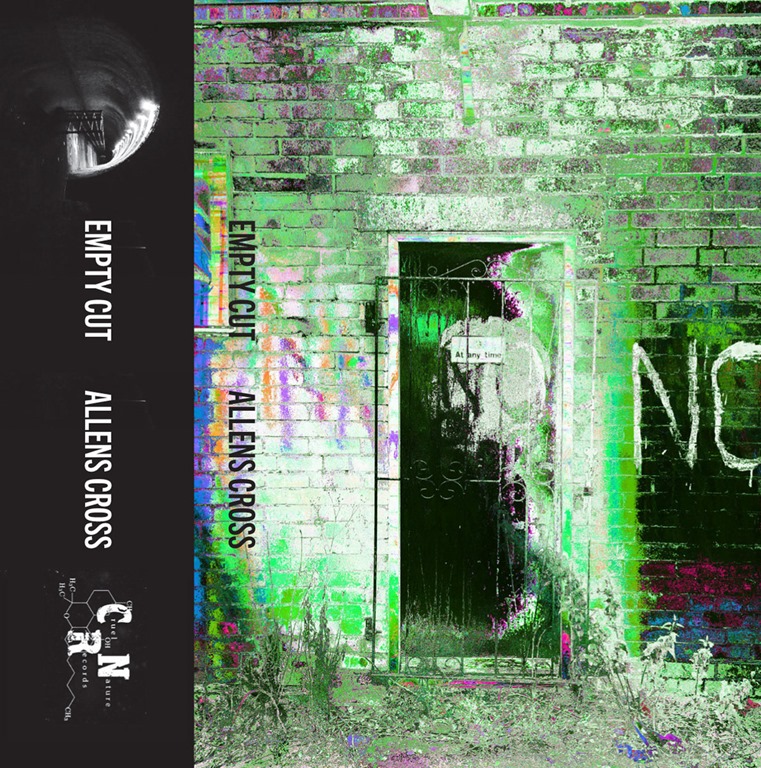
The scene of microlabels will always give you something absent from the mainstream. I mean it’ll give you many things, but I’m talking about variety. We live in the strangest of times. Postmodernism brought simultaneously the homogenisation of mainstream culture and the evermore extreme fragmentation of everything outside the mainstream. And example of that fragmentation is the existence of Cruel Nature Records, who operate by releasing albums digitally and on cassette in small quantities. Further, the second album by Deep Fade, is typical, released in an edition of forty copies. It’s better to know your audience and operate on a sustainable model of what you can realistically sell, of course, but do take a moment to digest the numbers and the margins and all the rest here. It’s clear that this is a label run for love rather than profit.

The sad aspect of this cultural fragmentation is that so much art worthy of a wider, if not mainstream, audience simply doesn’t get the opportunity. Not that Deep Fade have mainstream potential, by any means. As evidenced on the seven tracks – or eight, depending on format – tracks on Further, Deep Fade are just too weird and lo-fi for the mainstream to accommodate them. They simply don’t conform to a single genre, and with tracks running well over eight minutes and often running beyond the ten-minute mark, they’re not likely to receive much radio airplay either.

Opener ‘Tidal’ is exemplary. Somewhere during the course of its nine minutes it transitions from being minimal bedroom pop to glitchy computer bleepage to a devastating blast of messed-up noise. Yet through it all, Amanda Votta’s vocals remain calm and smooth as she breathily weaved her way through the sludge. The twelve-minute title track veers hard into wild Americana, a mess of country and blues and slide guitar, before tapering into fuzzed-out drone guitar reminiscent of latter-day Earth. Amidst trudging drone guitar, thick with distortion, it’s hard not to feel the lo-fi pull.

We’re immensely proud to present an exclusive premier of the video for the mighty ‘Tidal’:

AA

‘Surge’ arrives on a raw metallic blast before yielding to a spacious echo-soaked guitar drift and some dense, grating abstractions. Texture and detail are to the fore on this layered set of compositions are by no means easy to navigate.

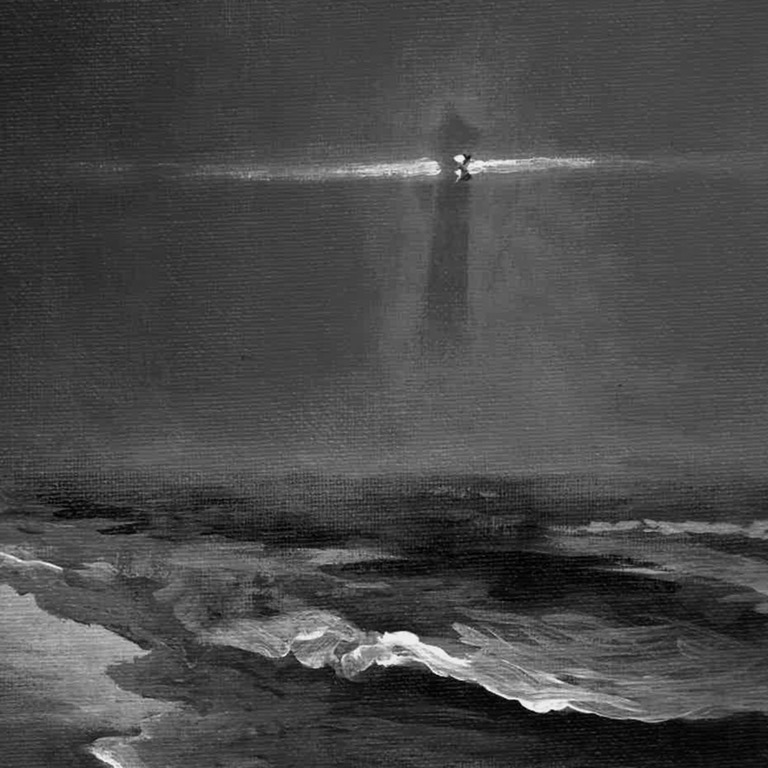
As the band explain, ‘The album, influenced by Neil Young and Einstürzende Neubauten, was recorded across various locations including St. John’s, Providence, Liverpool, and Edinburgh. Environmental elements play a significant role, with guitars recorded during a nor’easter and vocals captured at lighthouses, incorporating natural sounds like wind and bird calls… Toronto’s Church of the Holy Trinity and the Cowboy Junkies’ The Trinity Sessions also influenced the album’s sound, adding to its atmospheric and melancholic feel.’

Atmospheric and melancholic it is, although many of the aforementioned touchstones aren’t easy to extrapolate from the mix. Nevertheless, and you feel your stomach enter a slow churn, which is exacerbated by the low-gear drones which sound like low-circling jets – there have been a lot of those lately and the air is filled with paranoia and mounting dread right now. Further, however not only provides a sonic landscape that matches this mood, but runs far deeper into the psyche.

The acoustic ‘Little Bird’ scratches and scrapes over a fret-buzzing acoustic guitar. The fifteen-minute ‘Heartword is simply a mammoth-length surge of everything, occasionally breaking down to piano and deep tectonic grinds.

It’s fitting that Deep Fade should call their second album Further, because this is where they take things. At times it’s terrifying and at times it’s immense.

The lyrics are as breathtaking as the crushing bass on ‘Wake Me’, and the sparse arrangement of closer ‘Fixed and Faded’, with its breathy, folky vocal and crunchy overdriven guitar which drones, echoes, and sculpts magnificent spares from feedback and sustain, brings a sense of finality and offers much to digest.

The digital version includes an additional track, another monumental epic in the form of the eleven-minute ‘Hawk’, a work of haunting, spectral acoustic country: it’s one hell of a bonus worthy of what is inarguably, one hell of an album.

AA

a1741881484_10

Cruel Nature Records – 11th September 2023

Christopher Nosnibor

For those unfamiliar with ShitNoise, their bio describes them as ‘a noise punk band hailing from Monte-Carlo (Monaco). Formed in February 2022, the band has undergone several lineup changes. Currently, it consists of Aleksejs Macions on vocals and guitar, Vova Dictor on guitar, and Paul Albouy on drums.’ What’s more, they reckon their third album, I Cocked My Gun And Shot My Best Friend, ‘showcases their most energetic and mature work to date… Departing from their previous noise-centric style, the band blends grungy guitar riffs, metal-influenced double-kick drums, and a more polished production. The album explores themes of confronting the harsh realities of society and the lasting psychological impact of traumatic events. Through gritty soundscapes and stream-of-consciousness lyrics, it paints a raw portrait of present-day existence and the enduring human spirit in the face of adversity.’

I’m often wary of bands and artists who claim to have matured: all too often it means they’ve gone boring, that they’ve lost their fire and whatever rawness, naivete, edge, that made them stand out, drove them to make music in the first place. But these things are relative, and ShitNoise isn’t just a gimmicky moniker, but a fair summary of what they do. Here, they’ve stepped up from no-fi racket to lo-fi racket and evolved from the trashy punk din with dancey and electronic elements that at times sounded like a Girls Against Boys rehearsal recorded on a Dictaphone, toward a more wide-ranging and experimental approach to noisemaking. As for the album’s title… well. Was the act an accident, one of stupidity, gross negligence, or intentional? Either way, as the adage goes, with friends like these… ShitNoise are certainly not the friend of sensitive sensibilities, or eardrums.

So sure, they’ve ‘matured’ inasmuch as they’ve broadened their palette, but in doing so, they’ve discovered new ways of creating sonic torture.

‘Ho-Ho! (No More)’ launches the album with shards of shrill feedback and distortion: it’s two and a quarter minutes of nails-down-a-blackboard tinnitus-inducing frequencies and deranged yelping that’s somewhat reminiscent of early Whitehouse, minus the S&M / serial killer shit. Not that I have a fucking clue what they are on about, and the noise is so mangled it’s impossible to differentiate any of the sound sources from one another – guitars sound like screaming synths, and there’s so much dirty mess in the mix everything sounds so broken you begin to wonder if your speakers are knackered.

Proving just how much they’ve ‘matured’, ‘Brown Morning’ barrels into churning noise driven by thunderous beats as the backdrop to a rappy / spoken word piece, after which the arrival of the fairly straightforward punk tune ‘Gum Opera’ feels like not only light relief, but somewhat incongruous. But then, in the world of ShitNoise, anything goes, as long as it’s noisy shit. And keeping on with the noisy shit, there’s the gnarly Jesus Lizard meets Melvins gone rockabilly slugging sludgepunkfest of the oxymoronic ‘Pleasant Guff’ to go at, and it’s abundantly clear that they’re absolutely revelling in following their curiosity in every direction when it comes to exploring any and all avenues of racketmongering. I Cocked My Gun is wild, and wildly divergent, stupid, chaotic, and fun.

If the off-kilter grunge of ‘X-Ray Phantom’, with its incidental piano tinkling along behind crunchy guitars hints at something approaching a kind of sensitivity – and a closet ability to write songs – ‘Endless Void’ demonstrates their capacity to step back from noise completely, and venture into near-ambient territories, and with remarkable dexterity.

But mostly, these deviances only serve to bolster the impact of the manic racketmaking which dominates the album, which brings us to the epic penultimate track, ‘Hashish (The Yelling Song)’ – a ball-busting seven-and-a-half-minute stoner-doom slammer that slaloms its way through some heavy drone and some explosive psychotic episodes… and we’re immensely proud to be able to present an exclusive premier of the video which accompanies this mammoth slab of sonic derangement right here:

Get it in your lugs. Let it permeate every cell. Bask in the insanity. With I Cocked My Gun And Shot My Best Friend, ShitNoise have really gone out on a limb, and while teetering on a precipice of madness, have proved that artistic fulfilment lies on the other side of mania. It’s a far more enjoyable place than the everyday in which we find ourselves of late, so why not dive on in?

AA

a2752328939_10

Cruel Nature Records – 26th July 2024

Christopher Nosnibor

Who’s got guts nowadays? Who even talks about guts nowadays? When I was growing up, guts was a big deal. Succeeding or achieving against adversity took guts and the papers would applaud. Now, you’ll occasionally hear of artists giving gutsy performances, but it’s rare.

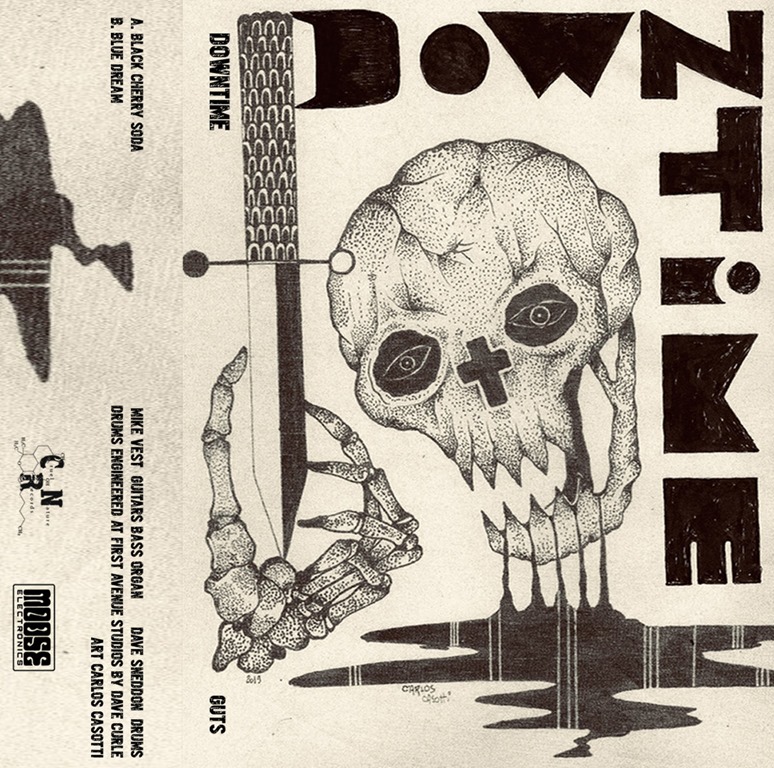
But Downtime – ‘the dynamic duo of Dave Sneddon and Mike Vest’ – yeah, they’ve got guts. But then, Mike Vest clearly has restless guts, his monumental and ever-evolving CV listing Guitar Oblivions, BONG, Drunk In Hell, Blown Out, Haikai No Ku, Modoki, Depth Charms, Brain Pills, Hollow Eyes, Lush Worker, and 11Paranoias. Collaborations include Mitsuru Tabata (Acid Mothers, Boredoms), Aoki Tomoyuki (UP-Tight), Fred Laird (Earthling Society, Artifacts & Uranium). When does this guy actually sleep?

Anyway: the naming of this project is likely ironic, and Vest’s concept of downtime differs from that of the rest of the world. He calls it downtime: we call it having a night off to sleep after finally taking a piss.

On Guts, Downtime immerse themselves in long, long, guitar and rum noise workouts, exploiting textures to the max.

The album contains but two tracks, each stretching out to the twenty minute mark.

‘Black Cherry Soda’ goes deep into a psychedelic groove, but it’s dominated by layers of feedback and blistering noise. I’m reminded of Head of David’s HODICA unofficial live album, which captured the band intentionally sabotaging a showcase gig that would have landed them a record contract by playing none of the songs and instead blasting out an ear-shredding wall of noise ;aced with a slew of uncleared samples. As middle fingers to the industry go, this stands, even now, as one of the best. The track drives forward and crashes through every fence and gate standing in its way, picking up pace and volume as it careers, out of control, onwards, ever onwards, on a heartstopping collision course towards its final resting place – smouldering in wreckage having slammed headlong against a wall, feedback and howling tones still spewing forth from the calamitous chaos. But we’re still only seven minutes in… and then shir really goes off the rails in a tempest of truly shattering noise. Every minute sounds and feels like the end, and every second is pulverising. The mess of noise, underpinned by a deep, strolling bass, is a chaos of discord, but also a spectacular document of collaborative musical capability. And this sounds like the work of more than two people.

Colossal noise is an understatement, and ‘Blue Dream’ fades in where ‘Black Cherry Soda’ tapers out, on a tidal wave of feedback before locking into a hefty psychedelic groove with thumping percussion, a foot-to-the-floor bass thunder and a blistering guitar racket that’s truly tranportative.

Downtime have no such specific agenda here, but the bottom line is that that they’ve no interest in the machinations of bigger labels and are quite content to have their staunchly uncommercial noise released to a small sliver of ‘the masses’ by a label who actually cares about what they do. If you dig noisy psychedelia, you need this.

AA

a0740017337_10

Cruel Nature Records – 28th June 2024

Christopher Nosnibor

It’s a perennial complaint around the passage of time, an oft-tossed-out remark with each month that everyone churns out as a space-filler, especially when speaking to someone they haven’t seen in a while – ‘I don’t know where’re the year’s going!’ But 2024: what the fuck?

I recently read Four Thousand Weeks by Oliver Burkeman after a friend kindly sent me a copy after I’d been bleating about how I always had too much to do and too little time to do it in. I almost simultaneously had a heart attack and shat myself reading the opening chapters which explained the book’s premise – namely, that the average human lifespan is around 4,000 weeks. Somehow, I’ve blinked and missed about 20 of them already this year. And whenever I receive an album in advance of its release, I add it to the list, and think ‘Hey, I’ve got a while on this one, I can take my time and still get a nice early review in.’ Because getting in early is satisfying – and, being transparent, brings traffic. I don’t make any money from doing this, so hits don’t equal quids, but there’s a certain pride involved – not to mention a sense of duty.

On learning of there being a new release imminent from The Incidental Crack – longstanding regulars at Aural Aggravation, an occasional collective who’ve managed to maintain a steady flow of releases in recent years, I was immediately enthused, but the end of June was a way off, and life… and here we are at the end of June. In no time, it will be the end of the school year, and once we hit August bank holiday the nights are shorter and it’s time to think about jumpers and central heating and the end of another year and being another year closer to death.

The Incidental Crack have a knack of conveying the pessimism that pervades the futility of the everyday, the way in which those small, mundane disappointments mount up and slowly sap your soul. Look no further than titles like ‘The Kettle Broke’, and ‘There Was No Path At the End of This Field’ on this latest offering for evidence of microcosmic gloom and frustration. The impact of small – almost non-events – can never be underestimated in the context of a stressed and overloaded mind. And people aren’t in that headspace simply don’t get it. Kettle broke? Just get a new one, they’ll say. No, no, that’s not the point. The kettle broke, the cat was sick on the rug, the bread went mouldy, I spilled my drink and it’s an absolute disaster and my life sucks.

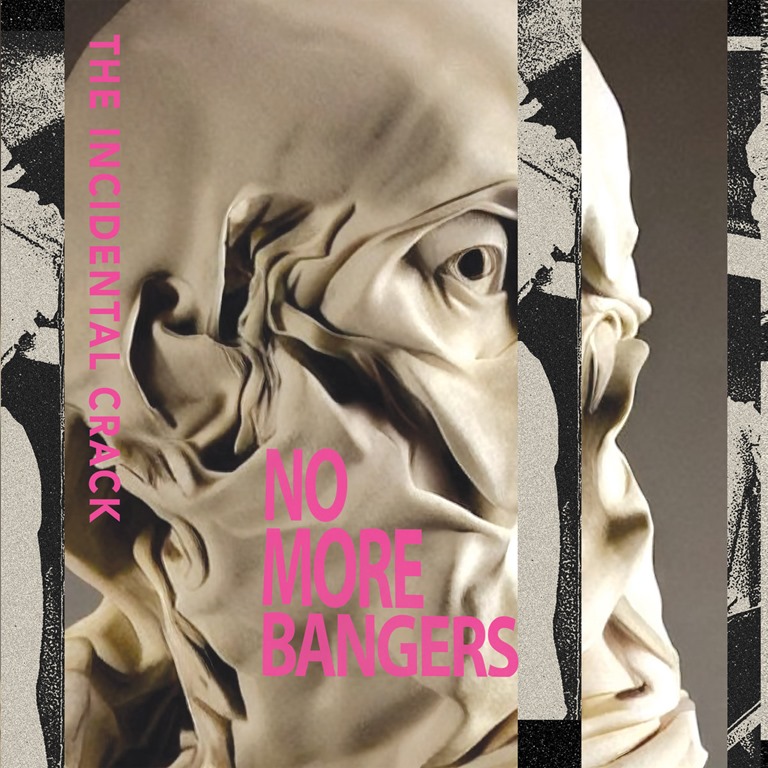
The fact is that sometimes, when life feels intense, the smallest details count for a lot: it’s not making a mountain out of a molehill when simply getting through a day feels like an epic battle, and walking to the corner shop feels as daunting as a marathon. And No More Bangers – a title which is equally ironic and carries a tone of sadness, of defeat – is detailed, with infinite nuance proving integral to these five minimal – and lengthy – compositions.

The pieces are constructed around nagging electronic loops, scrapes, drones, hums. There’s nothing dominant, sonically, or structurally. Ten-minute expanses of trickling dark ambience create brooding soundscapes and a tension that sets in the jaw, the shoulders. Insectoid chatters and clicks, stutters and scrapes build the fabric of the sound. Clamouring echoes and rapid repetitions evolve internal rhythms without percussion, with surges and swells driving the second half of the twelve-minute ‘The Springtails Love It.’ But it’s a nagging tension and feels more like being poked repetitively while trying to rest than an inspiration to get up and dance.

‘The Kettle Broke; is largely a hum, a room ambient sound which does next to nothing other than play back the sounds in your head and your kitchen when you’re trying a new recipe and find it requires digging the blender out from the back of the cupboard.

Sometimes, late at night – but also during the day, as I work from home – I find myself acutely aware of the quietness. There will be spells with no traffic, no planes or helicopters overhead, no dogs barking, no pings alerting me of new messages, no meetings. During these often unexpected moments, I will become aware of the whir of the laptop fan, the constant hum of the dehumidifier in the bathroom adjacent to my office, my own circulation.

This is the soundtrack that No More Bangers presents. Low-ley, low-level ambience which sounds like the boiler running through a maintenance cycle, like the throb of the fridge, the fizz of extractor fan. Delivering 100% on its title, this album is absolutely banger-free. But more than that, it feels strangely familiar, and yet familiarly strange.

AA

a0749472000_10

Cruel Nature – 24th May 2024

Christopher Nosnibor

It seems as if every album of the year has been released on this date, May 24th – and by every album of the year, I mean all of the releases have landed at the same time, but also that this album and the other ‘best album’ contenders have all landed simultaneously, too. It’s meant that I’ve been absolutely swamped, and struggling to listen to everything, let alone formulate thoughts and render them coherent – something I fear I struggle with at the best of times.

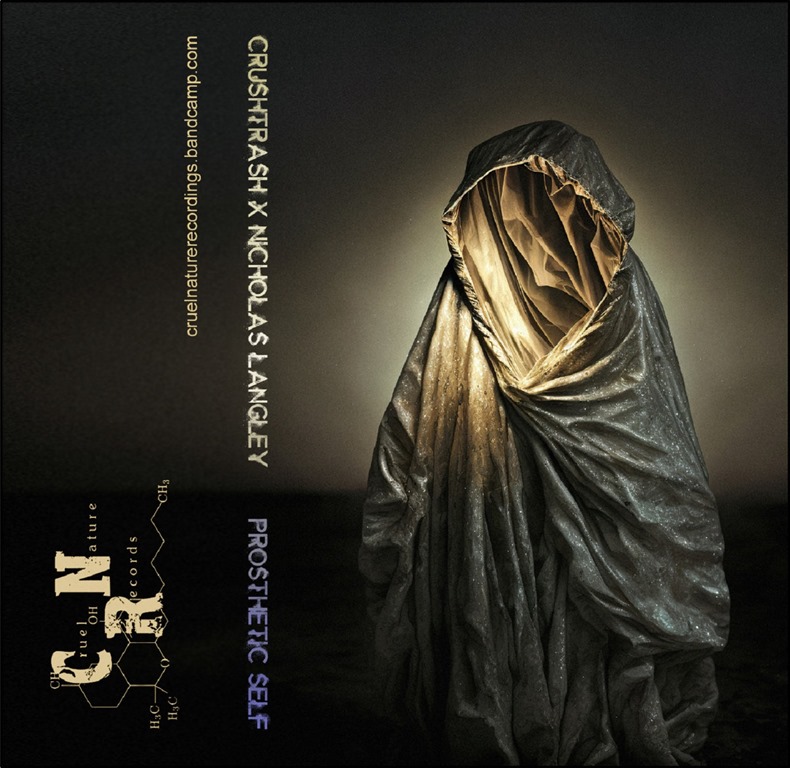
Surveying this release, I learned that ‘Prosthetic Self is a collaboration between CRUSHTRASH & NICHOLAS LANGLEY that seamlessly blends the energy of early ‘80s dark industrial synth pop with the mesmerising allure of ’90s electronica. Drawing inspiration from iconic acts like Coil, The Associates, Depeche Mode, Björk, and Portishead, this album is a sonic journey that transcends time and genre boundaries.’

It does feel as if every electronic act with a dark leaning wants to be Depeche Mode, and every electro-based Industrial act is essentially wanting to be Pretty Hate Machine – era Nine Inch Nails – who in turn sounded a fair bit like Depeche Mode if truth be told. That’s no real criticism, as much as an observation of the extent to which those two acts broke ground and created new templates in the 80s. However, the industrial elements of Prosthetic Self hark back to a time before Nine Inch Nails, and presents a more experimental form.

The tile, Prosthetic Self Connotes a sense of falseness, the fake exterior we apply to ourselves in order to deal with people and society. Workplaces – particularly offices – tell us to ‘be ourselves’ at work, while at the same time telling us we need to leave our problems and personal baggage at the door, but at the same time seem incapable of dealing with non-conformity. Well, come on then: what do you want: individuals or clones? Prosthetic Self is an exploratory work which presents a multitude of facets, and it’s a fascinating journey which leads one to the question as to what is real and what is construct, artifice. The cloak, on the cover, with its empty hood feels like a representation, not necessarily for this collaborative project, but the album’s themes, searching for what lies beneath the prosthetic self: is there, indeed, anything at all? Then again, how much here is style, and how much is substance?

There’s certainly a lot of well-studied style on display. ‘Bring Some Change’ is dark but also soulful, and their referencing The Associates hints at the almost operatic stylings of the vocals at times, and against some stark backings prone to some unexpected sonic ruptures and moments of heightened tension and drama, I’m also reminded of Scott Walker.

‘Claustrophobia’ is appropriately-titled. ‘In my dream, something’s wrong, caving in…’ Crushtrash croons with hints of Dave Gahan in his delivery against a slow-moving murky throb. But there’s a really attacking percussive loop that knocks on the top of your skull which makes it tense rather than soothing, and before long, panicked breathing gasps in the darkness, and you’re drawn into the nightmare.

Elsewhere, glitching, knocking beats shuffle and click, and the production really brings these to life in a way that makes you clench your jaw and tense your shoulders. ‘Selective Memory’ has something of a collage structure about the way the sounds are brought together and overlaid, with sampled snippets woven in alongside the bubbling vintage synth sounds.

In places, the kind of retro vibes which permeated 90s trip-hop seep into the shadowy atmospherics, and ‘Subtle Fetish’ comes on like Marc Almond in collaboration with Tricky, spinning lascivious wordplay along the way.

Prosthetic Self creates a lot of atmosphere with minimal arrangements, and they work because of the close attention to detail, the multiple layers of percussion which pulse and snake through spartan synths, more often than not with a simple, repetitive bass overlaid with subtle details, in a fashion which adeptly recreates the sound of the early 80s. In doing so, it recalls a time when so much was new, innovative. Coming at a time when there is so much sameness, and production and mixing has come to be all about the loudness, to hear a set of songs which really concentrate on dynamics and detail, it seems unexpectedly different.

AA

a1438080285_10

Cruel Nature Records – 26th April 2024

Christopher Nosnibor

Plan Pony – the solo project of Jase Jester, one half of Ombibael / Ombibadger – has been simmering for a while, and we’ve been following his output since the release of the ‘Martyr’ single back in 2020. So I was naturally excited to hear his latest offering.

I felt suddenly uncomfortable, concerned, even, on seeing the accompanying blurbage, which leads with ‘RIYL: Animal Collective, Madlib, Nurse With Wound, Hype Williams, Black Dice’. I mean, I do like a bit of NWW, and don’t mind some Black Dice, but I absolutely abhor Animal Collective. So, so much. Something about Animal Collective radiates muso smugness – something it would be hard to accuse Jase of.

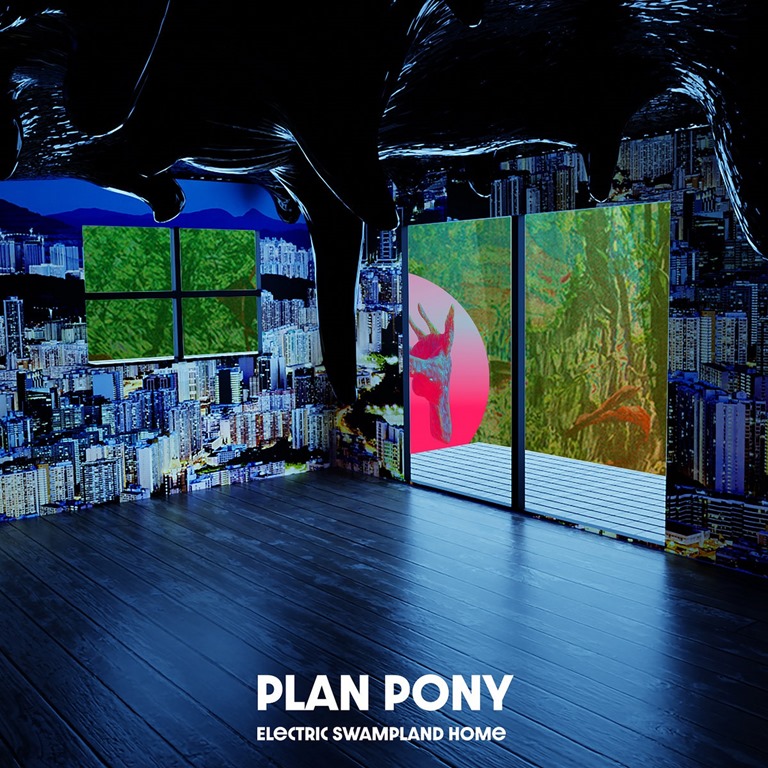
Electric Swampland Home is the first Plan Pony album, and as with previous outings, finds Kester grappling with vintage gear to conjure authentic vintage noise inspired by those early adopters. He’s right when he tells me that emulators simply aren’t the same, and that when technologies were emerging, the sound of the resulting recordings was born of necessity – like when you bounce tracks on a cassette four-track and lose some quality and definition in the process, and the presence of amp hum and tape hiss because amps hum and tape hisses. Adding tape hiss or vinyl crackle digitally is an affectation, and while some may be sold on this kind of nostalgic artifice, it lacks that certain something.

While questions of authenticity provoke heated debate in circles around some genres – punk, obviously, grunge, perhaps to a lesser extent, and right now, indie and alternative as new acts track stellar trajectories seemingly from nowhere while claiming modest grass-roots credentials while obfuscating middle class and public school backgrounds and major label backing, Electric Swampland Home is a truly authentic work. Kester hasn’t amassed a pile of highly-sought-after vintage kit in the way people with hods of cash buy up 808s and Moogs to try to be cool. Electric Swampland Home is the sound of a Boss sampler and an old Tascam digital studio he’s had for yonks, and which by today’s standards are pretty primitive.

From the very start, Electric Swampland Home creates discord and chaos with the woozy, bent, and frankly fucked-up ‘Travelling There’, a loop of atonality that gives way to a rolling rhythm and feedback-squalling bass crunch… and from thereon in, everything goes.

‘The Village’ tosses a salad of tribal beats, twisted Kyoto and a dash of Joujouka. While I’ve never been comfortable with the kind of cultural appropriation that the likes of Paul Simon’s takes on ‘world music’ present, this is something entirely different – a full global exploration which occurs simultaneously. This owes more to the tape experiments of Burroughs and Gysin, Throbbing Gristle and Cabaret Voltaire than anything else, conveying a sense of the way in which everything happens all at once, and linearity is a construct.

Across the album’s eight tracks, Plan Pony meshes some dense sonic textures and layers of difficult dissonance. Notes and tones bend and warp, things twist and melt and bleed into one another: edges blur and fade. The way the juxtaposing and often incongruous elements are brought together isn’t explicitly jarring, it’s not a bewildering collision of noise, but something rather more subtle – although no less impactful and no less disorienting. As with Burroughs’ cut-ups, Electric Swampland Home captures – recreates, distils – the overwhelming experience of modern life, the blizzard of information, the endless intertext, the diminished attention span, the globalisation and the egalitarianism of everything. That isn’t to say we live in an egalitarian world – but that everything equally demands our attention from every corner of everything, to the point that it’s impossible to prioritise or even reasonably assess what’s of more importance than anything else. And so we quiver, frozen in stasis, poised between myriad options and so often spend hours selecting none of them.

This is nowhere more clearly conveyed on the warped, glitchy layerings of ‘Same Cloud’, which brings everything all at once. On the one hand, it’s the most overtly ‘song’ like piece on the album. On the other, it’s like listening to the radio from the next room while reading a book with the TV on in the background, and your phone’s ringing and next door are doing DIY and your mind’s wondering about what’s for dinner – and this continues into the sample-soaked looping stuttering jangle of ‘Amphibian’.

‘8pm Local Time’ combined field recordings, a low-level quivering bass and squelchy laser-blasting electronics together, and not necessarily in the most comfortable of fashions.

Electric Swampland Home revels in incongruity, in awkwardness, in otherness, and in many ways, it’s a magnificent representation of life in all its colours and chaos, its business and unpredictability. It’s not an easy or immediate album, and it’s not for a second intended to be. It is an unashamedly experimental work, and one which succeeds in its explorations.

AA

a3913248541_10

Coju Recordings – 1st April 2024 (CD & digital)

Cruel Nature Records – 29th April 2024 (Cassette)

Christopher Nosnibor

Letters and things lost have an almost mythical status in the field of literature. So many volumes are dedicated to the reproduction of exchanges between authors of revered status, and are poured over, clawed over, by both fans and academics. Many writers of great novels were also great letter-writers, and the letters often serve to build not only biographical depth and detail but also shed light on the development of the novels, that mystical ‘creative process’. Much of history exists in letters – the rich primary source material from which we piece together the picture and assemble a coherent narrative. It may be a construct, but it’s a necessary one when it comes to understanding the world and how we collectively came to arrive at the present.

The fact no-one writes letters anymore is a great loss. The same thought and effort simply doesn’t go into emails, and they tend to be considerably shorter, too, especially in the last decade or so. In fact, the quality of communication has slumped through the floor in recent years. Emails volumes – at least, ones that aren’t transactional in some way, have plummeted in favour of WhatsApps and messenger missives via FaceBook, Twitter, etc. It’s hard to really articulate just what’s been lost over the last few years, besides simply the art of in-depth, detailed longform communications, but with anything more than five lines long likely to be dismissed as TL;DR, it’s significant. I digress… because there are rare avenues open to expand on these matters.

Benjamin Heal, one of those multi-faceted, polyartistic individuals who is hard to pin down due to the sheer range of his output, has, through the years, pursued an academic career with a focus on William S. Burroughs – a prodigious writer of letters – and performed experimental noisy indie under the guise of Cowman, sharing stages with the likes of Trumans Water and Gum Takes Tooth, as well as his more electro-centric vehicle Coaxial.

Now resident in Taiwan, his latest project seems to bring together these elements of a diverse life. The material on this, the debut release from The Lost Letters – which finds Heal working with Fulia, is a calm and calming collection of delicate songs. The duo offer a quite gentle and melodic set of tunes in which is mostly centres around mellow acoustic-led indie, and slow, sparsely-arranged, soporific shoegaze and it’s not merely projection on my part in detecting a wistful, vaguely nostalgic air permeating the songs. The songs effortlessly drift and weave, Fulya’s vocals adding a layer of sound rather than easily audible lyrics.

The seven-minute ‘Cecille’ has, by its trilling gentility, nothing to do with The Walking Dead: it’s a graceful exploratory work which is mellow, melodic, and carries heavy hints of The Cure circa Disintegration thanks in no small part to its fulsome, airy bass sound and crystalline guitars, and it’s fair to reference Cocteau Twins at this juncture, too.

Things take a turn for the darker and more discordant on the lugubrious, plodding ‘Cut’, which scrapes and scratches for another seven minutes. With its muttered, monotone vocals and insistent sparsity, it offers hints of Shellac and latter day Band of Susans, in contrast to the soft acoustic instrumental work of ‘Route Rute’. These songs are on the longer side by necessity: repetition has greater impact over duration, and if the literary allusions and lifts by means of the deployment of the cut-up technique devised by Burroughs and Gysin are largely lost in the mix, the overall effect of discomfort and disjointedness remains strong throughout the set. ‘Crystal Skies’ is murky, with a drifting ambience spun through with a softly picked guitar, before ‘Sails and Sou’wester’ brings the album full circle to its nautically-themed beginning. While inviting comparisons to Slowdive and Cranes, it cascades dreamily into a mesmerising sea of sound, so richly evocative that you ache as it drifts on toward the horizon, leaving you reaching for something intangible.

Critics often write of craft, but the most moving music often comes from intuition and feeling, and this is moving in the subtlest of ways. Quite simply, The Lost Letters is a beautiful album.

AA

a3976784992_10

8th September 2023 – Cruel Nature Records

Christopher Nosnibor

One of the things that really makes Cruel Nature stand out as a label is that you never know what they’re going to put out next. Many labels – and music fans – claim to be eclectic in their tastes, but such claims rarely hold up to scrutiny. Anything that involves a permutation of guitar, bass, drums and vocals isn’t ‘eclectic’. Cruel Nature are eclectic in the John Peel sense, spanning the full gamut of experimental rick and electronica with a fair amount of jazz on offer too.

As the bio sets out, ‘Dragged Up are an off-kilter psych-garage proto-punk band. Formed in Glasgow in late 2018 by Eva Gnatiuk (Las Mitras), with Simon Shaw (Trembling Bells) & the writer Lisa Jones. In 2019, Chas Lalli (Vom/Bad Aura) & Julian Dicken (The Cosmic Dead) joined. In 2022 Stephan Mors (The Owsley Sunshine) replaced Dicken on drum duty… Their debut mini-album "D/U" was released in 2020, show-casing their seamless cross-pollination of doom, psych, proto-punk, garage, and spoken word.’

They give a track-by-track summary of their latest offering, Hex Domestic (which does have connotations to my intertextual brain of a collision of The Fall and Pavement), and the track-by-track summary maintains this vibe:

‘Hex Domestic’, is their new E.P. consisting of:

Juvenile bone-throwing at the shut-in occultist (Hex Domestic)

Posthumous Pac-Mania (Fairytale in the Super Arcadia)

A lungful of mud, a hail of toads (Hurricane)

Peering out from the eiderdown, crawling back in again (Blaming the Weather)

So now you know what the songs are about… And you’ve seen the cover art, which is a black metal parody, the horned goat almost butting at Bathory… but how do they sound?

The title tracks comes on like The Fall circa 83, jangling guitars nearly in tune, merged with Sonic Youth. It’s slackedrist, it’s proto-grunge, it’s indie with edge and at the same time it’s loose and harks back to simpler times when bands could spend a day or two in a ‘studio’ which was no more than an 8-track in someone’s garage, cut a record, and get it played by John Peel.

‘Fairytale in the Super Arcadia’ is almost seven minutes long, and it sticks to the band formula and froths with budget distortion, plugging away at the same riff for it’s almost seven-minute duration without a moment’s respite.

The three-minute ‘Hurricane’ is necessarily explosive and blows everything away, and ‘Blaming the Weather’ maintains the meteorological theme as it guides the EP to a close.

Hex Domestic is wonky, lo-fi, the clean but ramshackle guitars and overlapping vocals defining the sound, its sound very much replicating that of the late 70s and early 80s. It’s budget and it’s boss.

AA

a2573698021_10

Aural Aggro faves Pound Land have unveiled an eye-bleeding, brain-melting video for the track ‘Liar’. It’s taken from their recent Singles Club compilation, released last month on Cruel Nature, which collects all the digital singles released between April 2022 and April 2023 in a physical form. It also emerges ahead of new album Violence which is out next month.

Check it here (and please watch to the end….)

AA

a3877052305_10