Posts Tagged ‘collaboration’

Dret Skivor – 1st December 2023

Christopher Nosnibor

Yes, that’s fjord, not fox, meaning you won’t find these collaborating sound artists bouncing around the woods dressed as furry animals, making daft, random sounds. Well, you won’t find them bouncing around the woods dressed as furry animals, anyway, although Dave Procter did spend many years performing while wearing a latex pig’s head, but he put a stop to that after David Cameron started turning up at his shows.

This latest collaboration between Martin Palmer and Dave Procter is, in fact, inspired by the site of previous experimental audio tests in 2019, namely the sculpture “what does the fjord say?” in Trondheim harbour. As they tell it in the accompanying notes, ‘Armed with percussive sticks, contact microphones, audio recorders and the occasional toy and synth, they set about a full exploration of the sculpture and their own sonic ideas in and around the sculpture, using created and environmental sounds to answer the question posed by the sculpture. These recordings are Palmer and Procter’s replies.’

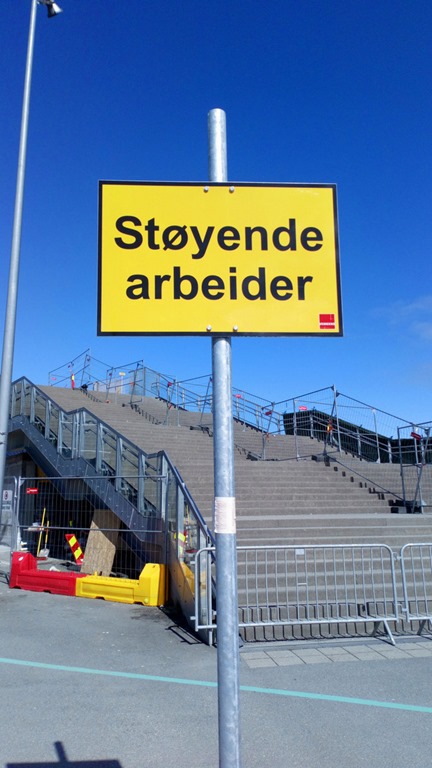
The first reply ‘støyende arbeider’ is more of a lecture than a simple reply, with a running time of twenty-one minutes. Consisting of random clatters, crashes, squidges, squelches and shifting hums which ebb and flow amongst an array of incidental intrusions, it’s more of a non-linear rambling explication, and exploration of the rarely-explored recesses of the mind than a cogent conclusion. But then, why should a reply necessarily be an answer. This, then, is a dialogue, a discussion, not an interview constructed around a Q&A format. It’s nothing so formal, and all the more interesting for its being open-ended, evolving organically. There are points at which the thuds, clanks and scrapes grow in their intensity, creating a sense of frustration, as if attempting to unravel a most complex conundrum and finding oneself stuck and annoyed by the fact that there is something just out of reach, something you can’t quite recall. And at times, this is also the listener’s experience. The way to approach this is by giving up on the expectation or hope of coherence, or anything resembling a tune, and yield to the spirit of experimentalism.

‘Moose Cavalry’ and ‘Mock Paloma’ are both significantly shorter pieces, the former being atmospheric and evocative, the animalistic calls conjuring images of beats roaming moorlands in the mist. Plaintive, droning moans and lows transmogrify into warped, pained cries and needling drones. The latter is different again: dark, tense, shrill tones scratch and scrape, flit and fly, reverberating from all directions. It’s unsettling, uncomfortable.

These three compositions are so different from one another, it superficially makes for a somewhat disjointed set, but on deeper reflection, what Palmer and Procter have forged a work which demonstrates how it’s possible, and even desirable, to approach a subject from multiple angles and perspectives. I still don’t know what the fjord says, but I do know that Palmer and Procter have posed some interesting musings in response.

AA
a3551752136_10

Sacred Bones – 16th June 2023

Christopher Nosnibor

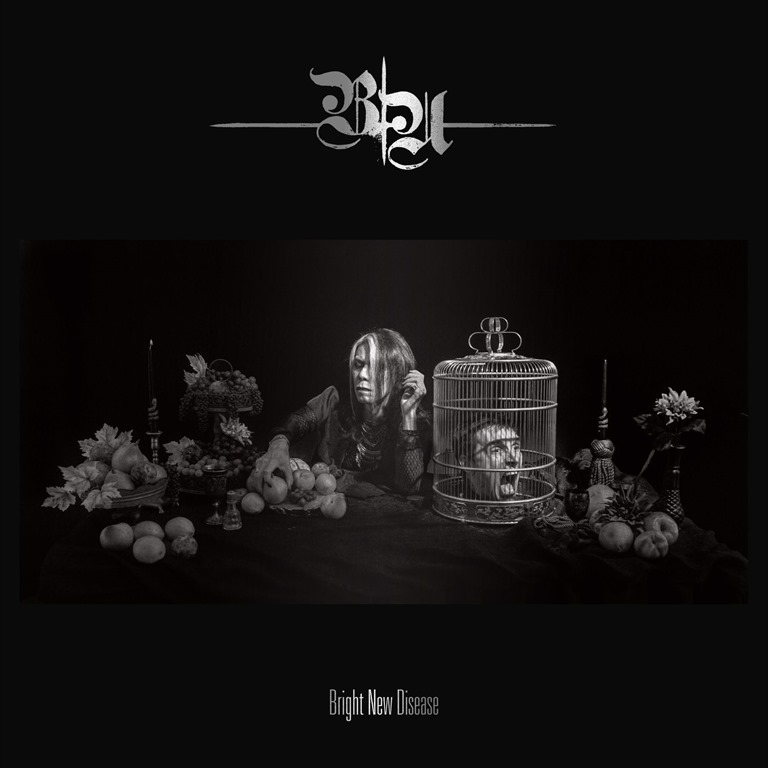
They’re the first to admit that this pairing may seem like an unusual one, having first teamed up for a US tour in 2019: as the bio notes, ‘Sure, both bands harness the power of big, blown-out riffs, but Boris’s rock heroics, lysergic sprawl, and monolithic sludge summon a different energy than Uniform’s mechanized bombardments and frenzied assaults.’ But often the most exciting and unexpected results emerge when pairing contrasts rather than sameness. Put two drone bands together, you can predict the outcome will be amplified drone; sludge with sludge equals more sludge, and industrial matched with industrial is unlikely to yield any great surprises. Yes, pairing like with like makes sense, it’s safe, there’s an intuition and interplay that comes from familiarity with the territory and the form, and fans will likely be happy being served a double helping of what they like.

But neither Boris nor Uniform are acts who are overly concerned with appeasement: that isn’t to say they don’t care about their fans, but more that they both trust their fan bases to be broad-minded and accommodating of the idea that creative fulfilment is integral to their existence. Even those more casually acquainted with their respective catalogues will recognise that both Boris and Uniform are driven, not by the desire to entertain, but to follow their creative instincts. The way these manifest musically are very different, but in this context, the parallels become more apparent, and it also becomes easier to understand their mutual appreciation for one another. And neither act is new to the spirit of collaboration, with Boris having have collaborated with the likes of Sunn O))), Merzbow, and Keiji Haino, and Uniform having previously released a blistering collision with The Body back in 2018, as well as remixes with Zombi more recently.

It will be news to no-one that this is big on riffs, that it’s loud and heavy, but this is a collaboration like no other: ordinarily, artists will bring their ‘thing’ to the table, and the songs will represent the meeting in the middle ground. This isn’t so much the case on Bright New Disease: the two acts are given equal billing and play evenly to their strengths and stylistic methodologies: but don’t necessarily play ‘together’ in the conventional sense. But when did either Boris or Uniform do ‘conventional’?

The album’s first track, ‘You are the Beginning’, aired online a few weeks ago, is the perfect combination of the two bands’ individual sounds: hard, heavy, the blistering harsh industrial intensity of Uniform, angular, antagonistic, crackling with the punk-tinged rage of Michael Berden, suddenly melts into a wild blitz of fretwork which paves the way for a monster thrash workout. Even the tone and texture shifts from harsh treble to murky mid-range, and it feels like a song of two halves. Quite unexpectedly, it works. When you weight up the value of any collaboration the question is always ‘is it different from or better than their independent works?’ Bright New Disease throws a curveball in that it’s a yes and a no at the same time, and that’s the genius of it.

The explosive ‘Weaponized Grief’ is a sub-two-minute blast of feedback and fury, and another thing which is notable about Bright New Disease is just how short the songs are. While there are a couple over four minutes and the finale, ‘Not Surprised’ does just creep over five minutes, the majority are significantly shorter, and condense a lot into those brief times, too.

‘No’ goes all-out grindcore / thrash in a two-and-a-half- minute flurry of churning guitars, but at the same time there’s something vaguely Spinal Tap – or Melvins –about its overblown excesses, and this may be a short album, but it’s high impact, and that’s true of much of the album: they slam down riff after riff with relish. ‘Endless Death Agony’ brings together the boldest excess of Boris with the most brutal attacks of Uniform, with a shrieking guitar solo fading out ahead of a most punishing riff with more solo mania blistering and melting on top, before the megalithic slow grind of ‘Not Surprised’ drags its way through the pits of hell.

Apart from the gloomy atmospheric suspense of the intro to ‘The Look is a Flame’ there really isn’t much respite on Bright New Disease. It’s harsh, heavy, relentless, by turns sludgy and slow, or otherwise frantic, frenetic, explosive – and packed with surprises, from the murky ambience of ‘The Sinners of Hell’ to the bubbling electronica of ‘Narcotic Shadow’ that sounds more like DAF collaborating with A-Ha and the straight-up glam pop of ‘A Man from the Earth’. Never could I have anticipated describing anything involving Uniform as ‘glam pop’. But then they kill it hard with ‘Endless Death Agony’, which is some brutal shit. Bright New Disease is everything all at once: it’s often punishing, sometimes spectacularly theatrical, and (almost) always heavy, but it’s smartly realised and expounds the importance of identity as both bands showcase and celebrate theirs in triumphant tandem.

AA

326319

Subsound Records – 10th March 2023

Christopher Nosnibor

It’s easy in the age of the Internet to conduct enough research behind the scenes to present oneself as having an extant k knowledge of a subject. It’s also a huge temptation to do this as a reviewer or critic, because there’s a certain expectation from audiences that if you’re going to proffer opinions on things, you ought to know what you’re talking about. It’s that knowledge and authority that ought to differentiate someone who presents insightful critiques from the boorish tosser down the pub – or, as is more common now, on social media who has an opinion on everything but talks out of their arse because they know nothing.

But life is an open-ended learning experience, and the day you stop learning, you’re effectively dead. And so it is that while I’m familiar with Malcolm McDowell, primarily for his role in A Clockwork Orange, and Massimo Pupillo of ZU, but not the Italian poet and essayist Gabriele Tinti – which is surprising given his prolific output and the immense reach of his work, especially considering that his career hasn’t been without controversy. Still, the fact he is prolific and has immense reach, as well as being a keen collaborator, explains the coming together of these three for a collaborative album, which finds McDowell reading Tinti’s works over music by Pupillo.

McDowell reads five pieces from the 2021 collection Ruins, dedicated to what he calls the “living sculpture of the actor”, ruminating on the distant past as it echoes through to the present. In keeping with the subject matter – where art and mythology of the ages provide evocative contemplation – there are weighty words, formulated with such syntax as to accentuate their gravity and import, and McDowell’s delivery does them admirable justice. As much as Tinti is given to elevated tone, there’s both a resonating sense of spirituality and an earthiness to his words, and McDowell reads with nuance, bringing the more visual aspects to the fore as he speaks of flesh and blood and bones wounds and exploding veins. There’s a physicality to the writing which possesses a rare potency, and as such, the words are well-suited to the context.

Pupillo’s atmospheric score, conjured using ‘a plethora of different sources, various synthesis, samples of eastern European choirs, processing McDowells’ voice,’ lends further layers of depth: at times choral and monastic voices rise and ring out against elongated drones, rich and organ-like, at others billows of sound creep like tendrils of fog.

Songs Of Stone may only be some twenty minutes in duration, with each side working nicely as a single, continuous soundwork punctuated by the spoken segments, but its grave intensity means that any longer would be difficult to digest. As it stands, Songs Of Stone feels perfectly formed.

AA

a3543316873_10

Boris and Uniform might have seemed like a strange pairing when they teamed up for a US tour back in 2019. Sure, both bands harness the power of big, blown-out riffs, but Boris’s rock heroics, lysergic sprawl, and monolithic sludge summon a different energy than Uniform’s mechanised bombardments and frenzied assaults. However, when Boris invited Uniform to team up on a reimagined version of their classic “Akuma no Uta” as a part of their encore, there was an obvious chemistry between the artists. The idea of a collaborative album came up, and the bands spent the next year swapping song ideas and recordings from their home-base studios until Boris and Uniform had an album that captured the fearless exploration and unbridled power of their live performances.

Sacred Bones Records is proud to present the Boris & Uniform collaborative album Bright New Disease on June 16, 2023.

Bright New Disease opens with the collaboration’s first single, ‘You are the Beginning,’ a ferocious thrash-inflected banger concocted by the Boris camp. It was the first piece the band composed during the initial day of their studio session in July 2020. As the title insinuates, the song was written with the idea that it would open the album and, hopefully, open a show one day too. “At that time, we didn’t know when we would be able to resume concerts,” says Boris’ Atsuo, “and our wish became the song directly.”  The uncertainty and anxiety of the early months of the pandemic fuelled Bright New Disease, and “You are the Beginning” sets the stage by stampeding out of the gate with vicious palm-muted riffs, snarling vocals, and dual drum bombardments courtesy of Atsuo and Uniform drummer Mike Sharp. 

Listen here:

AA

“On tour, we learned more about the depth of their musicality, which we felt was compatible with our own expression,”  Boris’s Atsuo and Takeshi say of their tour mates. “They are a band that can be described in many ways—punk, metal, industrial—but they truly excel because they are not locked into any style. They are always experimenting and innovating.” The feeling was mutual.

“Uniform have been longtime fans and admirers of Boris. Supporting them on tour was a dream come true,” says Uniform vocalist/electronics wrangler Michael Berdan. Guitarist and producer Ben Greenberg was equally excited by the opportunity to team up with Boris and shape the recording of Bright New Disease in his studio. “Wata is one of my favourite guitar players ever, so I’m very stoked we got two duelling solo tracks on this record,” Greenberg says, referring to the intertwined guitar leads on “Endless Death Agony.” This isn’t to say there wasn’t also a shared appreciation for certain classics, particularly when it came to Japanese hardcore. “The first time I met Atsuo he was wearing a Gastunk shirt, and Takeshi has schooled me harder on Burning Spirits than any fetishist westerner could ever hope for,” says Berdan.

Members of both Boris and Uniform talk about songs on Bright New Disease in the context of how they’ll play out in a live setting. Under normal circumstances, such considerations are a part of the writing process for any band with an active live presence. But considering that Bright New Disease was written and recorded in the darkest days of the pandemic, it frames the agitated and tumultuous spirit of the album in a new light. Yes, this is the sound of frustration, but it was founded on resilience. “In the end, it sounds like the crystalised essence of both bands at the heights of their creative abilities,” says Berdan. “It is a testament of friendship and hope in the face of a world on fire.”

8Le7_pXw

Möller Records – 23rd March 2023

Christopher Nosnibor

It’s clear that while the pandemic is officially over, collectively, we’re still very much coming to terms with it, and its aftermath. Lockdown, in particular, has had a deep psychological impact, on so many. Everyone’s experience was, and is, different, of course. I have friends who almost deny to themselves that it happened, that it was a dream or something, and for some of us, in some respects, it’s as though it never ended. This is how people deal with shock and trauma.

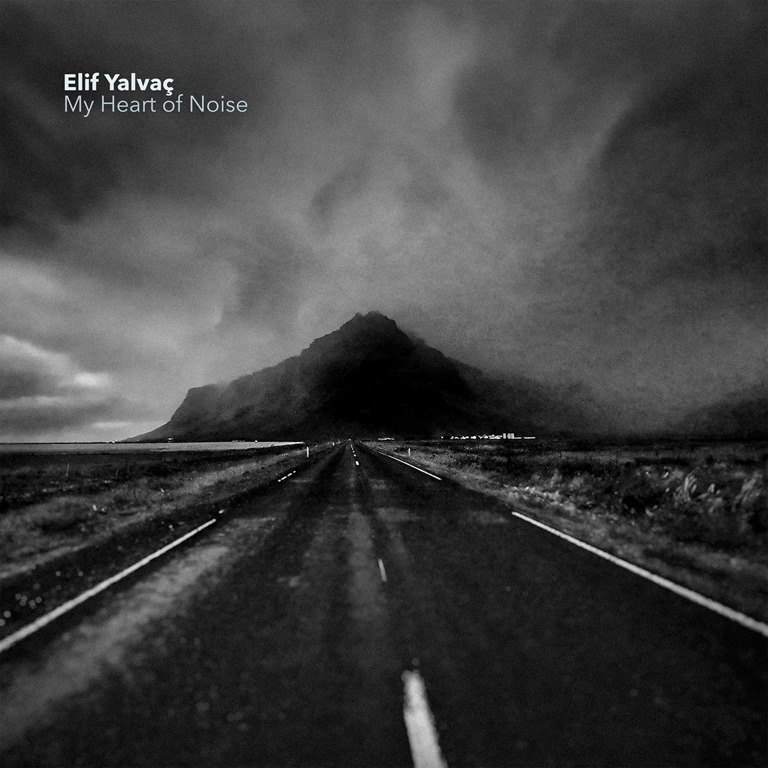
My Heart of Noise is not a pandemic album, a lockdown album, a post-trauma album, but as Elif explains, the album “began with a collection of studio and concert recordings from my travels north before the pandemic. It became like a puzzle: I could hear something special, but also that the pieces didn’t fit together well or feel complete. The breakthrough came in realising that this project was meant to be more about creation than preservation, and that it didn’t need to be a literal document any more. It could still be faithful, but instead to the spirit that inspired this music and my travels in the first place, instead of a particular recording. I created new musical starting points, and invited artists I met on my travels plus others, asking them to choose one to begin to work with together. Some artists incorporated our previous recordings, others set off in a new direction, while I shaped the pieces and found a way to connect them together.”

Recent history, then, is marked not as BC and AD, but BP and AP – before pandemic and after pandemic, and My Heart Of Noise reflects Yalvaç’s attempts to ‘make sense of a noisy world’. And the world is indeed, noisy, and difficult to articulate. There is simply too much noise too much happening all at once. It’s a perpetual sensory overload.

For this, her debut album, Elif Yalvaç involved a number of the people she encountered along the way of her journey, and the title also references this, the way she became the hub in a collective process.

The collaborative aspect means that each track does have a slightly different feel, despite all being centred around eerie ambient soundscapes.

‘Orchestra of Light’, the album’s first track, is a layered composition of dronies and hums and whispers which drift and swirl around some of the mind’s darker recesses. The textures and tones rub against one another and the edges aren’t all smooth, with buzzes and barbed, drilling sounds grating against the grain, meaning there’s a certain friction, a tension, creating a sense of discomfort.

‘Gate Check’, which follows, is softer, but the notes bend and twist and the supple, mellow tones are spun with a sense of the awkward and the uncanny, but nothing so warped as ‘Mielmaisema’, with its collage of human vocalisations and clunking clumps of thuds and thumps Amid whirls and crackles and hums, from which grinding groans of decaying Krautrock creak. It may be less than five minutes in duration but it packs a lot of shiversome strangeness into its short space, in which even chirruping birdsong feels somehow unsettling.

My Heart of Noise is not an overtly collage-based album, but it does assemble many sources and sounds, and often overlaps and overlays them to disquieting effect, and I’m at times reminded of vintage sci-fi and the BBC Radiophonic Workshop.

‘Cloud Score’ sits somewhere between post-rock and classic drifting ambience, while seven-minute closer ‘Taiga II’ very much feels like the lifting of the clouds and the breaking into light, but at the same time feels like a storm building on the horizon, and ‘Dronasaurus’ indicates that it’s not 100% serious 100% of the time.

My Heart of Noise is a restless work, one which ventures and explores, and never for a moment settles into comfort or conformity. It is not an easy album: whenever things feel like they’re settling into something nice, a cloud of disruption and difficulty will drift over and raise a shiver. You can never really settle or feel at ease with My Heart of Noise – but as a representation off life in the world as is, this is a fair summary. Keep your eyes and ears open: there is always something around the corner.

AA

a3629223309_10

Front & Follow – 14th April 2023

Christopher Nosnibor

These are shit times to be alive in Shit Britain, UK Grim: having taken back our borders, this green and pleasant isle is floating in a sea of shit – literal shit – that we’ve pumped out onto our beaches for our domestic holidaymakers to swim in, and we have 16-hour quest to leave the country to go on holiday for those who want to escape for a bit – damn those French bastards for checking the passports off non-EU visitors. But hey, at least we got rid of all of those foreigners working on coffee shops and bars for minimum wage and those doctors from overseas, right?

And yet, while the cost of living is spiralling, major corporations – and not just energy providers – continue to push up prices, not to cover the cost of paying their workers, but to preserve profit margins. It’s not that they can’t afford to increase wages, they simply won’t because capitalism is built on maximising profit. Fuck the staff, look after the shareholders. And of course, rent continues to rocket: landlords, too, need to protect their rental yields

An investigation undertaken in behalf of The Guardian late in 2022 found that ‘asking rents on new listings are up by almost a third since 2019, and some people are facing increases of up to 60%. Prices in 48 council areas are now classed by the Office for National Statistics as unaffordable when compared with average wages’.

The trouble is, capitalism is based on exploitation, and invariably, the wealthy become wealthy and grow their wealth through the exploitation of the less wealthy.

There is an irony here: in nature, the most successful parasites achieve a symbiotic relationship with their host. Under capitalism, the parasites seem determined to kill the host (the poor) on the premise that there will always be more. But then, the same is true of the human relationship with the planet: only, the resources are finite and there isn’t another planet, so we’re fucked.

The accompanying text pulls no punches in explaining the context:

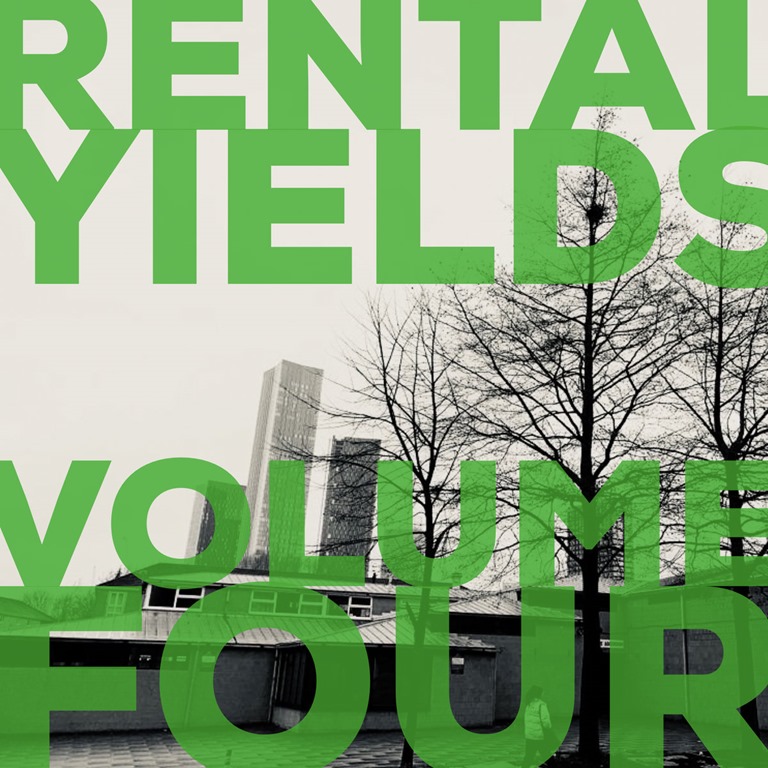
“As we travel further into the year of our overlord 2023, the cold snap that had enveloped the country no longer seems to mock us as we struggle to complete the simplest of daily tasks. With public services at a standstill as the people actually doing the jobs fight tooth and nail for honest payment and work prospects, the rest of us eke out a little more of the heat reserve to keep us going as the ice finally begins to thaw. But the Rental Yields do not stop. The opportunity to make hay while the sun refuses to shine carries on as if no one was suffering. The money continues to be made and the towers in space continue to be built. Dark shadows now dominate the skyline of a city that has been forgotten to the wishes and demands of the few. Some will say this is the progress promised by those in charge of levelling up. But many others will suffer as the bankrolls of the rental yielders grow ever fatter. Still, the spring brings promises of its own.”

What makes life in this endless torrent of shit in which we’re all sinking is that there are some people who aren’t cunts, and who go out of their way to make the quality of life better for others, as well as themselves. The guys who run Front & Follow are among them, as are the many, many artists who have contributed to the Rental Yields compilation series, of which this is the fourth, showcasing tracks by myriad underground acts, remixed by myriads more in an exercise in infinite cross-pollination.

Featuring 26 new tracks and 52 artists, all money raised from this release will go to SPIN (Supporting People in Need), whose purpose is to feed, shelter, clothe and generally support the homeless and people in need of Greater Manchester.

As with the previous instalments, Volume 4, is very much geared towards ambient and more sedate electronica. With so many tracks and such an epic duration, and given the nature of the material, Volume 4 is a wonderfully immersive experience.

The overall quality is, again, excellent – meaning it’s consistently great across the duration and there’s nothing that makes you feel inclined to hit skip. There are, as always some names that leap out for a range of reasons: Kemper Norton. Yol, Omnibadger, The Incidental Crack, Field Lines Cartographer, Sone Institute – but the main point of this is not the names, but the merits of collaboration and collectivism.

Some tracks do stand out, notably ‘Acid Bath’ by BMH vs Lenina for it’s pumping beat, and CuSi Sound vs Robbie Elizee’s ‘I’m Not A Tourist, I Live Here’ for its overt wibbly synth weirdness, for starters. ‘The Enamel Hamper’ by Cahn Ingold Prelog vs The Ephemeral Man is a nine-and-a-half-minute dark psychological drift, while Omnibadger vs Grey Frequency’s ‘Speeding Ground (Part iii)’ is a glitchy, collaged morass of disorientation, with layers of noise, tribal drumming, and disembodied vocals, and ‘Home on the Whalley Range’ by Opium Harlots vs Yellow6 combines dark ambient, murky noise, and a hint of The Cure’s ‘Pornography’ to forge something intensely claustrophobic.

Solo1 vs yol’s ‘Black Spoons And Crosses’ is a collision of ambience and noise that will twist your brain, and the sonorous drones of Laica vs Learn to Swim’s ‘High Yields, Low Prospects’ is a doomy post-punk affair with an agitated drum machine hammering away amidst a sea of murk, and both the title and sound encapsulate the sentiment and the message of the album as a whole.

It is, once again, a triumph, not only artistically, but socially: the Rental Yields series is the epitome of community. And while our government speaks of community while acting in every way to destroy it, promoting division by every means, and social media has become a warzone whereby the goal is achieved, musicians are showing the way. This, this is how we will survive the shit and create a better future.

AA

a0601616053_10

2022 has been a phenomenally active year for Greg Anderson as The Lord. Having previously shared standalone track releases, he then released his debut solo album Forest Nocturne in Summer followed by a collaborative album with Petra Haden, Devotional, in October.

Now, he is heard in collaboration with David Pajo in a brand new track, "Nazarite", which sees the two musicians meet over ominous arpeggios and spoken word segments in this new track which Greg suggests is a "gateway" to more collaborations in the future.

Greg says, "I’m beyond honoured to have been able to collaborate with David Pajo for this ever evolving output as The Lord. Slint remains one of the most important bands ever to me. I composed the music for ‘Nazarite’ as a love letter to Slint that exemplifies my obsession and devotion. David’s brilliant response to my humble offering is clear proof of his genius."

David Pajo says, “In Tennessee, I played a bit of acoustic guitar on the Goatsnake song ‘Another River To Cross.’ It was then that I realized we had a perfect working dynamic. We seem to be able to push an idea from nothing into solid shape, without much effort or ego. I trust Greg’s ear and musical sense implicitly—he’s fearless.”

Listen to ‘Nazarite’ here:

a2264078713_10

Composer and experimental filmmaker Christina Vantzou has shared "Kimona I", set to powerful and heart-breaking footage from Lizzie Borden’s 1983 feminist film, Born in Flames.

"Kimona I" is a sparse track with only a piano and one vocal present, echoed and distant as though the song is being performed at the end of a cathedral. Quietly melancholic, the track is somewhat at odds with the footage of smiling women, which makes the ending all the more impactful. Christina Vantzou speaks to the inclusion of the Born In Flames footage;

"Filmed in the early 80’s, mainly in the East Village, largely with friends, non-actors and activists, Born in Flames is a film about work, class & race divisions, and organized revolt. Meanwhile on No. 5, ‘Kimona 1 & Kimona II’ were written for workers, specifically low-wage employees at giant institutions."

About her collaboration with Christina Vantzou Lizzie Borden says;

"I was honored when Christina Vantzou approached me with her beautiful piece of music “Kimona I,” accompanied by scenes from my film Born In Flames. As we collaborated, I was stunned to see familiar images take on new meaning when set against her haunting, elegiac music. Thank you for your exquisite work, Christina."

Watch and listen here:

AA

gaHEv3Ic

Limited Noise – 29th April 2022

Christopher Nosnibor

With a CV that lists near-multitudinous membership and participation in bands (notably his regular gigs with Snack Family and World Sanguine report, but also contributing to Sly ands the Family Drone and countless others), renowned experimentally-minded jazz drummer and percussionist Will Glaser has taken some time out to continue his solo album sequence with the fourth instalment of Climbing in Circles.

Over the course of three previous releases, Glaser has explored jazz, folk, and beyond, through an experimental prism and with a methodology that’s very much about improvisation. This outing features long-time collaborator, Matthew Herd, on saxophones and piano, alongside trumpeter, electronic artist and producer, Alex Bonney, and was assembled over the course of five day. While the album is loosely constructed around two overarching ‘acts’, they consist of eleven separate and distinct pieces, and bookended by ‘Beginnings’ and ‘Endings’, there’s a narrative arc of sorts, here.

It begins with crawing birds and a gentle piano playing what one could readily describe as a charming melody with a quite conventional structure, and ends with a genuinely pleasant lilting piano tune – and yes, I mean tune in that it has all the conventional features of one.

In between, there is slow decay and infinite space. Rumbling, echoes, notes reverberate off one another at distance. Sax and trumpet trill and drone, sometimes at one, at others as if duelling. The percussion rolls and crashes, but more often than not, at distance, and creating texture and atmosphere and colouring the pieces with expression rather than maintaining rhythm.

The combination of instruments is relatively conventional in jazz, and, similarly, there’s nothing particularly radical about the way they’re played and interact on here. But there’s considerable joy to be had in simply listening to the musicianship and the way the musicians themselves interplay on the pieces. ‘Spiral Dance’ is a hypnotic serpentine spin, while ‘Bad Dream Machines’ is a drifting mass of fragmentation, dissonant, discordant, and above all, a work that exists in the spaces between the notes and in the reverb and echoes as in the notes themselves.

There will be some – perhaps many – who are deterred by the very mention of jazz, and there is a perception of there being a certain elitism about jazz – the idea that random notes and borderline unlistenable chaos is somehow a superior art form, and anyone who doesn’t ‘get’ it is clearly a philistine. But Glaser is a remarkably positive showcase for jazz, with a focus on the listener rather than purely the musicianship. Climbing in Circles Pt 4 is about atmosphere, about vibe, rather than indulgent wanking: this is jazz you don’t need to be an aficionado to appreciate. It’s listenable, and it’s varied, too.

On ‘Dead Fly Disco’, he and his collaborators play completely straight, a song with structure and swing, something you could even dance to, or at least nod a long to its toe-tapping groove in a basement bar late at night. ‘Ballad in the Jazz Style’ almost feels like they’re playing with and working within the tropes as an example of discipline, and it’s highly restrained and wonderfully moody in that sad, smoky jazz melancholy way.

There’s plenty going on, and enough to maintain interest, but not so much as to be chaotic or to lose the listener. Whether these things make it a good access point to jazz, it’s hard to say, but what it does mean is that Climbing In Circles pt.4 is a jazz album that’s accessible and enjoyable simply as a musical work.

AA

Climbing In Circles cover 1000px CMYK

Karlrecords – 27th August 2021

Christopher Nosnibor

Well this is an interesting one, and it was, admittedly, Thurston Moore’s name that compelled me to give it some ear time. While listening to the first pounding space-rock psychedelic jazz freakout, it dawns on me that this isn’t actually my first meeting with Turkish free form ensemble Konstrukt, and that I was blown away and bewildered by their 2018 collaboration with Keiji Haino, A Philosophy Warping, Little by Little That Way Ahead Lies a Quagmire (Live).

It’s hard to tell what’s going on and who’s doing what on this first piece, especially what Moore brings to the mess of noise that is, ‘Yapayalnız (Gezerler Sokaklarda)’, which sees a motoric rhythm hold steady amidst a vortex of punk-infused chaos until, ultimately, everything collapses. There are some shouted vocals, but they’re muffled and drenched in so much echo that it sounds more like a riot than a performance, and it makes for an eye-popping, headache-inducing ten minutes. The fact that this was recorded live makes you wonder what it must have been like to witness first-hand: on the one hand, it’s exciting, unpredictable, while on the other, it’s vaguely frustrating, because you don’t know where it’s going – or where it will end.

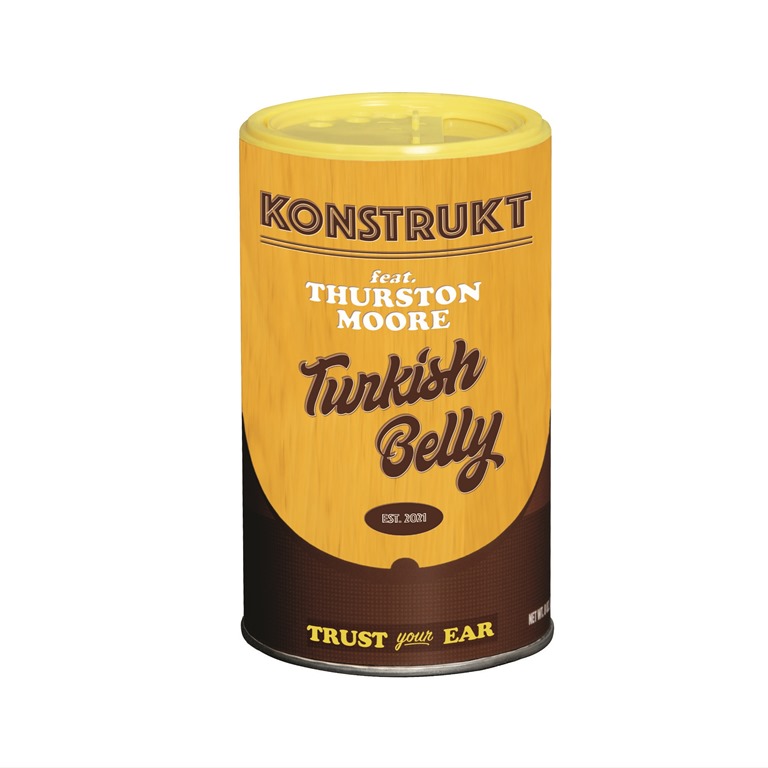
Turkish Belly is the fifth and latest entry in the ongoing series of collaborations between the four-piece ensemble and an array of guests, and it’s certainly experimental and freeform, to the point at which one could question whether there really is much form at all, and it’s extremely difficult to extrapolate precisely what Moore brings to the chaotic party. Perhaps it’s simply another layer of chaos.

‘Kurtadam’ in two parts is very much percussion-dominated and almost hints at the conventions of rock – but it’s only a hint, and more to do with the solid rhythm section than anything else. It does nail a groove, which is welcome, but everything else especially the horns, are all over and flying every whichway.

The final track, the eleven-and-a-half minute ‘Uğultular’ is a braying beast of a tune – if you can call it a tune as such. The deadened drum beats thwack out a damp rhythm amidst a serpentine sway of seeping discord and disarray. There’s murky bass and some wild, reverb-soaked guitar work, and the whole thing lumbers and lurches, bleats and brays blindly. Wordless vocals growl and grunt amidst a buzz and a howl that yawns and churns and crawls its way to conclusion.

The audience’s applause and cheers after jolt the listener back to reality, and the fact that this a document of a live performance. Maybe you had to be there to fully appreciate it, as it seems those present on the night very much did, but on record, it’s interesting, but at times a bit of a slog.

AA

KR084_front