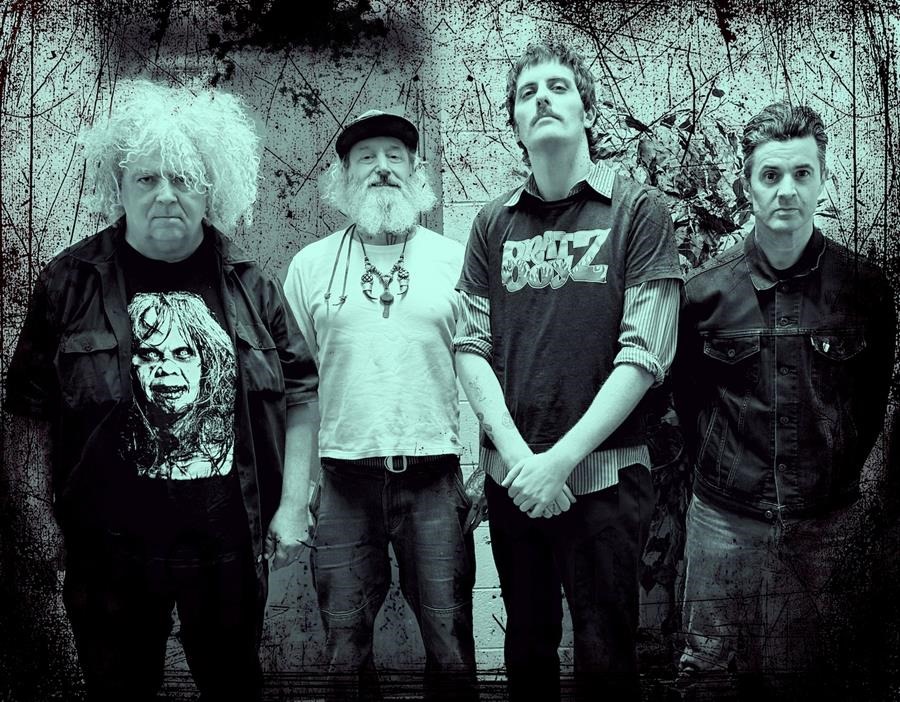
Buzz Osborne didn’t need another band. JD Pinkus didn’t need another band. Coady Willis didn’t need another band. Together with Clinton Jacob, they started one anyway. Meet Gatta Morta.
The quartet makes its debut today with Burn Witch Burn, a 4-song EP, available now via Amphetamine Reptile Records. Listen to the single ‘Black Hall’, which accompanies the release, here:
AA
“It’s always a good time for the world to embrace a new heavy/weird band,” Osborne says. “I had the idea for Gatta Morta while touring last fall. I realized I needed to start a band with these three. Seemed like a no brainer. Solidly weird rock music that needs to happen.”
Butthole Surfers bassist Pinkus agrees: “It’s been way too long since I got to write a heavy album from scratch with such high caliber players with such complimentary styles… and we’re just cat scratching the surface of what we got goin’ on!”
Rounding out Gatta Morta is Clinton Jacob, the creative force behind Chicago’s weirdo, pop-noise rock duo Mr. Phylzzz. “I just had this feeling that one day we would work together. I became friends with Buzz over the past few years doing shows together and having him play guitar on a Mr. Phylzzz song. When I was asked to be a part of Gatta Morta, I was speechless, but I was 100% ready for it.”
Burn Witch Burn lurches between thick, riff-driven heaviness and warped, psychedelic passages, with Osborne, Pinkus, Willis, and Jacob creating music that’s simultaneously reminiscent of their previous work and entirely new.
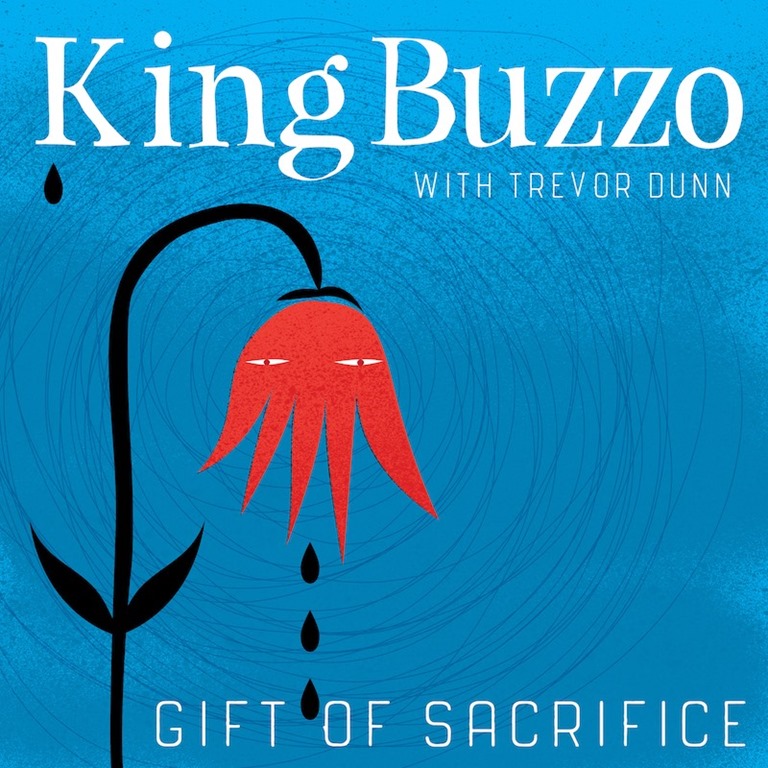
Because Melvins’ staggeringly prolific output clearly isn’t enough to keep singer and guitarist Buzz Osborne occupied, he’s gone and put out a second solo album, following on from 2014’s This Machine Kills. This time working with the equally prolific frequent collaborator and some-time Melvin Trevor Dunn, Buzzo offers up nine primarily acoustic songs.
The first thing to point out is that it doesn’t sound remotely like Mevins. There are some stoner / psychedelic twists spun in, but the overall vibe is one of brooding folk. Buzzo’s trademark full-lunged vocal I more often than not replaced by a hushed, breathy drawl. It’s pretty cool and works well in context. Solemn strings swoop and soar and cast long, lugubrious shadows over soft-strummed guitar: ‘Housing, Luxury’, Energy’ has the guitar feel of one of Nirvana’s acoustic songs, but tears into a heft chorus that growls and lurches hard.
There are some moments where the simplicity is stunning in itself: sometimes, when stripping things right, right back, there is time and space to bask in tones and the way notes resonate. There is a rare beauty in the way acoustic notes hang in the air, the details of how a harder or softer pick or strum varies the intonation. And we get this often on Gift Of Sacrifice: the sparse instrumentation is magnificent, notably on the rolling ‘Delayed Clarity’, but across the album a whole it’s a feature. ‘Science in Modern America’ finds Osborn growl-crooning over a cyclical chord sequence. It’s kinda sci-fi, it’s kinda dystopian and suddenly kinda now. Elsewhere, and in contrast, ‘Mock She’ is some kind of drunk country, and the depths and layers of Gift Of Sacrifice continue to reveal themselves, meaning that what may superficially appear ordinary is, in fact, pretty warped.
So, yes, this being Buzzo, things do weird out in places – many places, if truth be told – like on the brief interlude that is ‘Junkie Jesus’, and the frantic warped string frenzy that is the outro, ‘Acoustic Junkie’. Then there’s the fact that the portentous strum of ‘Bird Animal’, to all intents and purposes a psychedelic acoustic motoric minus percussion, dissolves into fluttering R2D2 bleeps a minute or so before the end. Like the way ‘Mock She’ descends into frenzied free jazz for 30 seconds in the middle, while fractured distortion obliterates the vocals in the final verses. You envisage Buzzo sitting in the studio with the producer, leaning over and twiddling knobs here there and everywhere, and everyone present shouting ‘just leave everything alone!’ But of course, then it wouldn’t have that unique twist that transforms some solid songs into works of warped genius. And that’s precisely what this is.
The Brudenell Social Club, Leeds, 13th November 2016
Christopher Nosnibor
As I’m not a resident of Leeds, my time in the city largely consists of pegging it to and from pubs and music venues on an evening. It’s a cold, damp November Sunday afternoon, but the city streets are bustling with shoppers. The Christmas Market is teeming. I watch some people enjoying a fake snow fight in a giant snow globe. Passing through the university campus there are virtually tumbleweeds. Where are the students? In bed or shopping at 3.30pm, I suspect. Or working to earn a crust towards their immense tuition fees. The Brudenell is the perfect oasis, something of a home from home for me. I’m early so settle with a pint of Kirkstall Back Band Porter (5.5% ABV), a packet of salted peanuts and an Ed McBain novel.
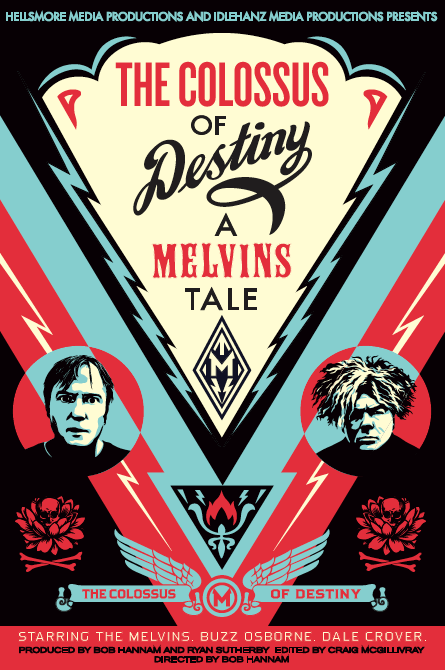
Ahead of its global DVD release in the spring of 2017, producer Bob Hannam is taking his film – many, many years in the making, and finally realised with the assistance of Ryan Sutherby and a well-supported Kickstarter campaign, which saw some 982 people chip in to enable the film to be edited and ultimately released – around a select number of venues. After a handful of US dates and a London screening, and ahead of a return stateside, it feels like an immense privilege to be able to sit and enjoy the fruits of his labours in the Brudenell Games Room.
The roll-call of interviewees all pitching in with reminiscences or simply expressing love for the band is remarkable, and is credit to Hannam’s networking skils, and testament to The Melvins and just how well-liked and respected they are. Krist Novoselic. Jello Biafra. Josh Homme. Mark Arm. Lou Barlow. Keith Morris. Donita Sparks. JG Thirlwell. Mike Patton. David Yow. Greg Anderson. Frank Kozik. Lustmord. The list goes on: many of the talking heads are collaborators, Gene Simmons! Even J Mascis manages more than three words, and seems uncharacteristically animated. And then there are of course the band members: Buzzo and Dale contribute lots of recollections, and many former players are also featured, which is quite something, especially considering just how many former players there are.
The Colossus of Destiny is an achievement simply by virtue of its existence. I mean, where do you start with The Melvins? They’ve been going forever and have released more tracks than Metallica or The Rolling Stones. And what the film achieves over the curse of its two hours and ten running time (including the seemingly endless credits) is to give a fair chronology of their history, while at the same time giving a real sense of what the band are about.
The one thing that every last one of those talking about the band attest to is The Melvins’ singularity, and this also shines through in the interviews with Buzzo and Dale. Often whacky, sometimes deeply serious and occasionally grumpy, their genuineness and honesty – and above all, their commitment to making music, and making the music they want, in the way they want – shines out throughout. Eternally heavy, but also a lot of fun, there really is no other band like The Melvins.
There are heaps of archive photos and reams of cover art and gig posters, and masses of grainy footage of early gigs, as well as some great footage of their more recent, utterly pulverizing, double-drummer lineup, which really make The Colossus of Destiny a must for any fan. But equally, watching Buzzo running off CD covers and posters and .giving an insight into the workings of a band who – apart from a brief stint with Atlantic, which they knew was destined to fail before they even signed the contract – have existed as a largely DIY concern since 1983, is essential viewing for anyone with an interest in making it in (or perhaps, more accurately, outside), the music industry.
Some of the audio during the interviews is a shade wobbly, and during the informative and entertaining Q&A (being a local las by birth, Bob Hannam is familiar with a large portion of the audience, making for some good-natured banter, with his dad is sitting behind me and Danny Mass of Salvation a row or two ahead), Hannan admits it’s a source of irritation. But this is a first-time work, and the product of passion and dedication, and as a ‘warts and all’ rockumentary, it’s entirely in keeping with the band’s ethos.
It may be lengthy, but moves at a decent pace, and is entertaining and informative throughout. Whatever your position on The Melvins, there’s something to be taken from Colossus of Destiny.