Posts Tagged ‘Album Review’

Love Love Records – 26th April 2019 – LOVLP03

Christopher Nsnibor

However you remember Sly and the Family Drone, whatever your past experience, and whatever you may expect, the reality of each new entry in their catalogue brings something slightly different.

My first encounter with them was in a live setting, and I was left reeling with images of a bloke in boxer shorts pummelling drums and getting half the audience to join in. I remember noise, rhythms and chaos. Various YouTube footage confirms this is pretty much representative.

All of those elements are present on their studio recordings, but in different measures. It works: it’s a different medium. And moreover, each release reflects an evolution, usually a subtle but nevertheless key shift. And so it is on Gentle Persuaders, the collective who describe themselves as a ‘neo-noise-jazz outfit’ (one suspects that as apt as the description is, there’s an element of tongue-in-cheek here, just as their absurdist track titles aren’t entirely straight-faced) ‘vomit forth a smooth serving of curious and clattering noise not devoid of fun’.

Smooth is perhaps one thing it isn’t, and for that we should all try and be grateful. Challenging, angular, tonally and structurally abrasive, Gentle Persuaders finds Matt Cargill and co. playing to their ever-growing strengths.

The album opens in suitably uncompromising style, with the longest of the four compositions, the fourteen-minute ‘Heaven’s Gate Dog Agility’. It takes its time to get going, and with minimal instrumentation save for elongated sax drones, it has something of a sparse, free jazz feel. The percussion is restrained, distant, muted, and the emphasis seems to be on atmosphere, and – so it would seem at this stage – musicianship. But by the mid-point the drums are full-blooded, and the sax is battling amidst a barrelling wall of extraneous noise. The closing minutes find the rare emergence of an overt structure, a form, with repetition and a coalescence of sound that could almost be mistaken for a tune.

Crashing, head-blasting industrial beats worthy of Test Dept or perhaps reminiscent of Revolting Cocks’ ‘Beers, Steers & Queers’ shatter the air on ‘New Free Spirits Falconry & Horsemanship’. And they continue to pound away for the duration, while the sax screeching becomes ever more strangled and frenzied.

‘Votive Offerings’ ventures into murky, dark ambient territory, and reveals glimmering flickers of light shifting amidst the shadows of sombre drones and unsettling incidentals. It’s a mosaic of fragments: forms start to emerge, solid rhythms kick in, only to halt after a few bars, and if it’s jazz with noise, it’s jazz with noise penned as a soundtrack to the fragmented hallucinatory anti-narrative of Naked Lunch.

It’s this change of mood that renders the finale all the more impactful: beginning stark, sparse, eerie, with single notes ringing out into a sea of black echo and swampy low undercurrents, the spectacularly punny (and so very typical) ‘Jehovah’s Wetness’, a low-end bass grind begins to build the foundations of a swirling sludge-trudge climax. It’s not gentle, but it’s extremely persuasive.

AA
Gentle Persuaders

COdA / Lonktaar – 20th March 2019

Christopher Nosnibor

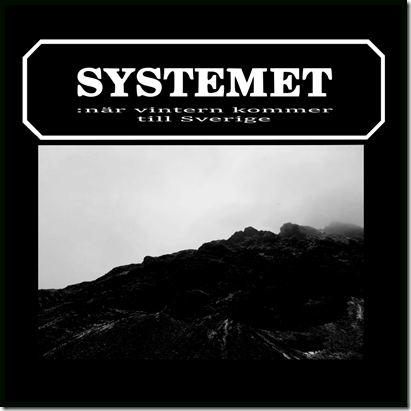
This release came my way via master purveyor of noise and drone and occasional collaborator of mine, Dave Procter. The man with more pseudonyms and projects than possibly anyone I’ve ever met – with Legion of Swine, Fibonacci Drone Organ, Wharf Street Galaxy Band, Hundbajs, Dale Prudent, and Trouser Carrier being just a few of his outlets – he’s immensely well-connected (and deservedly respected) in this niche corner of difficult experimental music (with forays into poetry and spoken word and with an angular post-punk band in the mix). I’m therefore assured that anything he recommends will be suitably obscure, and challenging, and probably very good and right up my alley. This is very much the case of Systemet’s När Vintern Kommer Till Sverige.

According to the press sheet, ‘Systemet is a collective that challenges the architecture of a standard band. While the sounds have their roots in early industrial, dungeon synth, dark ambient and noise drone music, only a segment of Systemet is a harsh reinterpretation of the mix of these genres.’ And it is harsh. Meanwhile, according to Dave, it’s a ‘beast’. And it is a beast.

I learn that ‘the aim of this album is to recreate the sensations of the Swedish winter, based on a one-week off-track trek in the Sami area north of mount Kebnekaise, where the cover picture was taken, in the period between autumn and winter 2018.’ Having never experienced a Swedish winter, I’m ill-equipped to comment, but if it really is anything like När Vintern Kommer Till Sverige, I can only conclude that Swedish winters are seriously tough.

I also learn that ‘all sounds were produced by ELI and ELQ synthesizers’ – which, being custom-made, you won’t find in the shops or emulated on-line – on a quadraphonic system, and recorded in dual stereo. The effect is deep, wide, immense.

‘Čievrrajávri’, the first of the album’s four pieces – I’d be reluctant to call them compositions, begins as barely a whisper of wind, a delicate breeze laced with almost invisible, inaudible traces, before the low-gravity bass notes begin to amble and moan in rumbling undercurrents that set an uneasy tone.

Things don’t get lighter or easier from thereon in: ‘Glaciären Brinner’ brings more space-age pulsations, oscillating rhythmic throbs of distorting low-end and murky mid-range over which whistles and screeches. But mostly, it’s about dark washes out found, swirling gurgles that spiral and whip the air. It’s an ever-shifting soundscape of swirling, pulsating darkness, a vortex which sucks the listener in. and it only become s progressively more difficult. It’s perhaps a cumulative effect: scrapes and drones in small doses are simply scrapes and drones, but over the course of almost forty minutes, it slowly becomes increasingly torturous, and När Vintern Kommer Till Sverige offers no respite.

The ‘extended version’ of ‘Gaskkasvággi’ is 11:11 of elongated, grating drone and what sounds like heavy breathing up close to a mic amplified and looped. It’s a shade hypnotic. It’s followed by the final piece, ‘Vy Över Visstas’, Which is the sound of collapse and a protracted final meltdown; circuitry slowing, fizzling to a halt, howling and braying like slain robots in an uncoordinated wash of distortion and stuttering analogue froth.

När Vintern Kommer Till Sverige is indeed a beast: challenging, uncompromising, bridging the gap between Tangerine Dream, Throbbing Gristle and the vast field of contemporary dark ambient / industrial / electronic crossover, it succeeds in pitching unsettling layers of unease in the pit of the stomach.

Systemet – När Vintern Kommer Till Sverige

Gizeh Records – 15th March 2019

Christine Ott has graced the virtual pages of Aural Aggravation on a number of occasions, and has been on my radar for a while. Here, she comprises one half of newly-founded Snowdrops, a France-based keyboard duo formed with Mathieu Gabry.

With Yann Tiersen, Tindersticks, Foudre!… as resumé namedrops, the pair have pedigree. Snowdrops is a soundtrack work, composed for Phuttiphong Aroonpheng’s film of the same name, which has won several awards including Best Film in the Orizzonti section at the Venice Film Festival.

The press release explains that ‘the Thai film trains a poetic look at the void of humanity through the story of two men, a Thai fisherman with peroxide blonde hair and a nameless stranger stuck in a foreign land and supposed to be a Rohingya of Myanmar, whose continuing persecution is constituting one of the biggest human rights scandals of our time’. And so Snowdrops is a film of extreme importance right now. The world is in turmoil, and while culture is supposedly the most evolved it’s ever been, humans right are being eroded, disregarded. Corporations and governments act s if they’re exempt, and yet they all talk of ‘the will of the people’.

According to the press release, ‘Snowdrops’ soundtrack brings another dimension to Aroonpheng’s movie. The duo was especially focused to build their sound here on a frame of keyboards of different generations (Ondes Martenot, Mellotron, MS2000 or Altered keyboards). The color is sometimes dark (‘The Mangrove’, ‘Losing a Friend to Death’), sometimes surrealistic (‘Lights in the Deep), and in the case of ‘Weird Dance’, a suggestion of romance between the two main characters on the rhythm of a dreamy electronic tune.’

A soundtrack’s function must always be to enhance the movie it accompanies, and to add depth and dimension. But my initial response to any soundtrack release is ‘does it work without the visuals?’ And while immersing myself in the work, I ask ‘what visuals, what images does this conjure? What mood does it convey?’ Soundtracks which are reliant on the film they accompany are fine, but are better not release independently. And I’m doubly not a fan of those ‘OST’ works which feature snippets of dialogue or scenes intersected with songs. 20 years ago, it was maybe cool. In fact, it was. It was the way soundtracks were, and showcased classic dialogue that would pass into postmodern parlance. But listening back now to the CD of Pulp Fiction, it sounds somehow naff. And the Trainspotting soundtrack albums aren’t soundtrack albums, but compilations. Has the world changed or have I changed? Perhaps both: there’s an entire generation coming through who haven’t even heard of Trainspotting, let alone its vast cultural impact. Culture has a short memory, and it’s depressing.

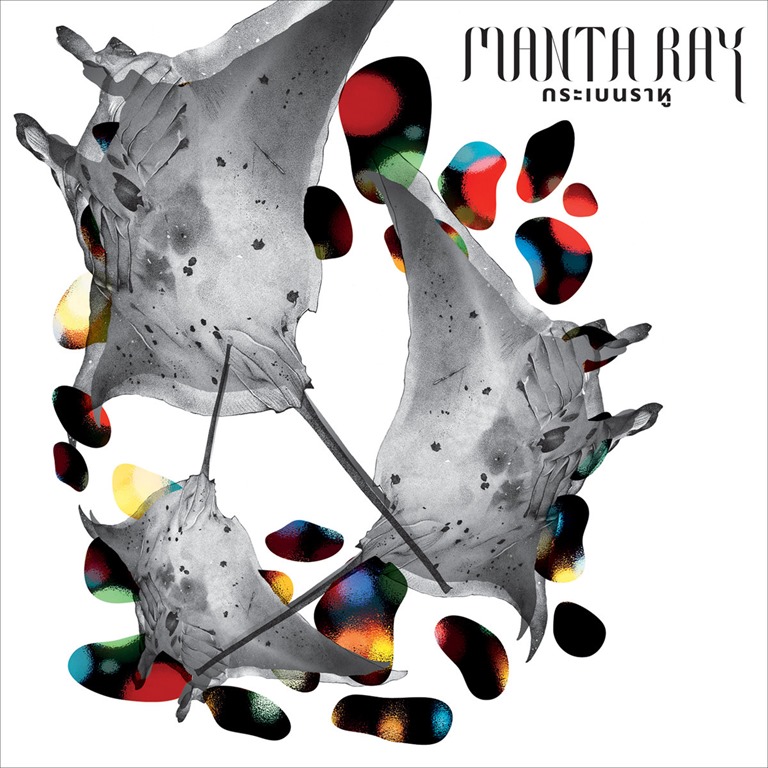
Snowdrops’ soundtrack to Manta Ray is very much a musical work in its own right, designed to compliment the film. It isn’t glitzy, it isn’t mainstream.

Sonorous, rumbling pulsations sound out into the depths on the first piece, ‘Introduction / Gemstones in the Forest,’ before soft, delicate sonic lacework begins to drape its semi-abstract from over the fluid framework of the composition as it drifts in a loose, languid form.

‘The Monologue’ may have more solidity for French-speakers, but the mumbled utterances, delivered against a backdrop of distant piano, played as a dolorous, single chord motif, whispering contrails and melancholic atmosphere speaks beyond language. And indeed, language and its abstraction shapes a large part of this album’s organic feel. It bubbles, mellifluous, and isn’t an easy work to grasp any sense of tangibility from.

Much of the album consists of muffled dissonance and unintelligible murmurings, and these work well in the way they conjure deep, dark atmospherics. They do little to convey any sense of filmic narrative, but in context it’s hardly a problem. Manta Ray is abrim with subaquatic abstraction, subterranean, swampy sounds, and exists within a sense of itself. 

AA

Snowdrops

Gizeh Records – 26th April 2019

Christopher Nosnibor

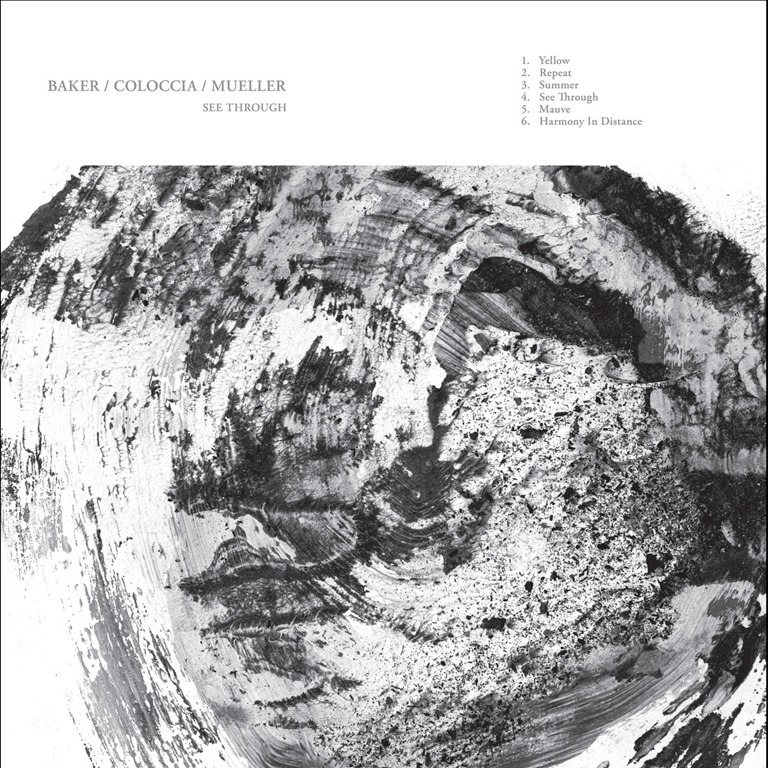
Aidan Baker has done it again: pulling together a brace of collaborators to form a perfect triangle, See Through is a magnificent sum that’s greater than the parts, showcasing the way relinquishing individuality in favour of collectivism can yield something… other. And See Through is decidedly other. The press release describes the process, an evolution and layering: ‘The project was brought to life through Baker exploring textural rhythms created by sampling small, sharp and abrupt sounds on the electric guitar and then sequencing them in a drum machine to form the bedrock of the tracks. Mueller then added his particular, signature brand of intricate, hypnotic percussion to the mix and the compositions began to grow and take shape. The pair agreed that the pieces needed a more human touch and Coloccia was invited onboard, contributing processed vocals via looping, tape manipulation and microphone feedback.

To describe it as ‘ambient with beats’ – a phrase I’ve used to describe worriedbaoutsatan, who sound nothing like this – may be vague, but it’s accurate. It’s all about the slow build… and the percussion. Starting with higher-pitched finger drums, it evolves to a polyrhythmic experience. Insistent tribal drumming hammers a martial beat that underscores wraith-like vocal echoes and soft, supple surges of abstract ambience… the effect is mesmerising, hypnotic. Snaking hints of the exotic twist through the hazy infusions of the sprawling eight-and-a-half-minute ‘Repeat’, which finds the percussion dampened, dulled, yet no less insistent as it clumps and clatters along in the swirling sonic mists.

See Through is an album of evolution, and the tracks seep into one another to form a cohesive but ever-shifting sequence. As is the case in respect the album as a whole, the percussion is key, and changes between each piece, backing off and rising to the fore once more.

‘Summer’ takes a more ambient direction, the beats subdued and submerged, muffled and distant and pulsing through a viscous, subaquatic density, before the title track ventures deeper into darker territory, an unsettling, shifting rumble that shudders and shuffles, suffused with incidental scrapes and vaporous drones which creep in and out of the frame like ghosts, like drifting mists, like so many intangibles. It’s dark, uncomfortable, disorientating, and extremely difficult to pin down -which is precisely its indefinable source of both its appeal and its artistic success. It builds to a scraping crescendo around the 8-9minute mark.

The final track, ‘Harmony in Distance’ wafts drifting ambience over a soft rhythm that builds in intensity, until the soft sonic washes and drifting vocals give way to a rising thunder of drums that drive the album to a tidal climax.

AA

Baker et al

New Heavy Sounds – 1st March 2019

Christopher Nosnibor

There aren’t many Welsh-language bands who’ve made much progress beyond the border: Catatonia only really broke through when they switched to English, and they were pedalling accessible indie-pop tunes, not pulverizingly heavy sludgy doom metal.

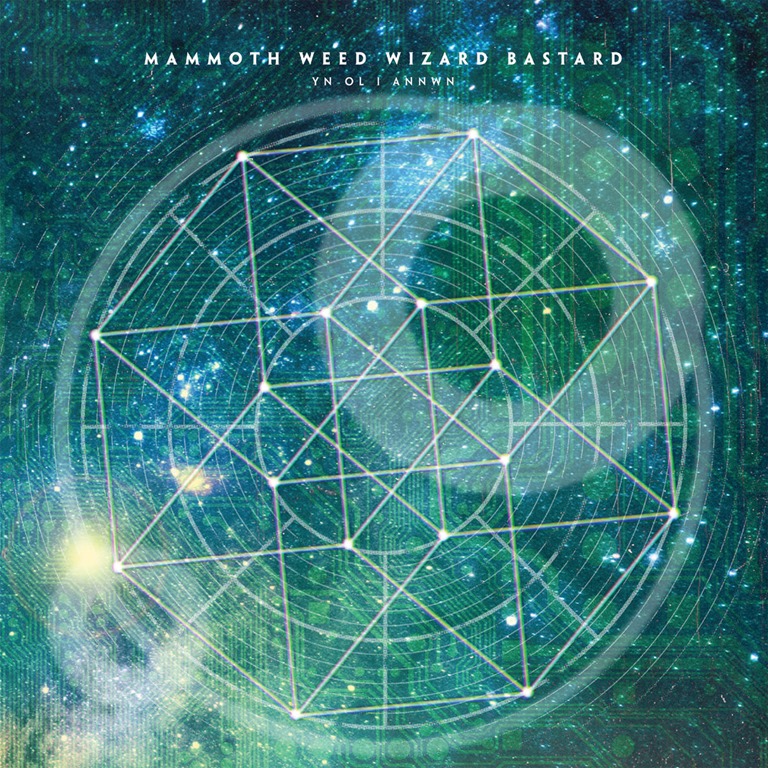
And so it seems very much against the odds, that the absurdly (and most certainly not mainstream-media-friendly-monikered) Mammoth Weed Wizard Bastard broke into chart territory on the release of Yn Ol I Annwn (Welsh for ‘Return To The Underworld’) the third part of the trilogy of albums that began with Noeth Ac Anoeth in 2015 and 2017s Y Proffwyd Dwyll, and is pitched as ‘the final phase of the band’s first intergalactic voyage.’

And ‘intergalactic’ is a fitting description. The band’s intention was to move even further from the standard doom tropes without losing sight of their origins: this involves pulsating, gloopy synths and rippling waves which introduce the album, before a wibbling waft of retro-futuristic analogue wobbles give way to the album’s first megalithic lumbering riffage on ‘The Spaceships of Ezekiel’. It’s every bit as preposterously huge and epic as the title suggests; galactic and of biblical proportions, with fizzing lasers firing left, right, and centre, all framing Jess Balls dreamy, melodic, almost folksy vocals to create something that’s out of this world, but also has clear ties to vintage Hawkwindian space rock.

‘Fata Morgana’ pursues the folksy aspect further, and colours it with picked guitar that’s pure vintage gothy post-punk and wouldn’t sound out of place on a Sisters of Mercy record circa 1984/85 before the power-chords crash in at the mid-point – from which point it builds, and builds, to a sustained crescendo propelled by pounding percussion.

It’s all in the detail on Yn Ol I Annwn. For all the devastating grind, the ribcage-crushing, heart-stopping heaviness, there are layers and details that make it an album to listen to. The nuance doesn’t reduce the force, but simply makes this an album with more points of interest than your average in its field. The spiralling synth incidentals should sound corny but work incredibly well; it’s perhaps because it’s delivered with both conviction and panache, meaning MWWB rise above pretence to drive it home not only sincerely, but artfully.

Significantly, for all the synth and cello, there’s no shortage of repetitive, grinding riffage, with the thirteen-minute ‘Katyusha’ bringing all the overdrive as the band up the pace and really rock out while synthy fireworks blossom and bloom all around. It bleeds into the slow, heavyweight trudge of ‘The Majestic Clockwork’, and the closer, the ten-minute ‘Five Days in the Abyss’ is a full-weight doom crusher of a climax.

With each release, MWWB have broadened the scope of doom, and Yn Ol I Annwn sees them forge another immense expansion, and further solidify their unique place as trailblazing innovators in the genre.

AA

MWWB

This is it Forever – 15th March 2019

Christopher Nosnibor

It would be perhaps too obvious to quip that worriedaboutsatan / related releases are like busses, what with Gavin Miller’s latest solo offering appearing just weeks after the arrival of the duo’s fourth full-length album, Revenant. It would also be somewhat inaccurate, as both Gavin and Thomas Ragsdale have maintained a steady flow of solo releases in recent years, and, indeed, for much of the band’s lifespan to date.

I’ve variously sung the praises of split singles, and increasingly, split albums are a thing which well-suits the resurgence of both vinyl and cassette releases. Front & Follow’s The Blow series is a clear standout in the field of the split release, with some well-considered (or otherwise wonderfully random) curation resulting in some truly inspired pairings: sometimes, contrasting is every bit as satisfying as complimentary.

This release, according to the label, is ‘the first in a series of splits for the label’, which ‘sees Polypores and Gavin Miller explore their more dreamy, ambient sounds by taking a side of cassette each’.

Miller’s ten-and-a-half minute ‘Dragon Lily’ is a work of delicacy. There is movement, slow, sweeping, the tones soft and warm. There is progression: barely perceptible in the moment, as the listener is carried on the long drift, but definite, as picked notes begin to chime and the sound gradually swells with the scraping drone of an ebowed guitar drenched in reverberating echo.

Polypores’ ‘Those Infinite Spaces’ is more overtly structured, with distinguishable note sequences and sounds that are more ‘synthy’ in comparison to Miller’s abstract washes of sound. This gives the piece a certain sense of solidity, and although mellow and soporific, it’s the repetition the soothes and lulls – until around the mid-point, when everything flattens to an elongated, wavering multi-tonal drone, which quite changes the tone, if not the mood, as the trajectory moves towards a long, slow wind-down.

Individually, and side-by-side, the two compositions work well, and I suspect it’ll be worth keeping an ear out for future split releases from TIIF.

AA

Gavin Miller & Polyspores

Panurus Productions / Inverted Grim-Mill Recordings – 22nd March 2019

Christopher Nosnibor

It feels like I’ve been bombarded with spectral oceans lately, what with Teeth of the Sea’s Wraiths and now The Sea to Which the Body is Drawn by Wreaths, the project of Northumberland based artist Michael R. Donaldson, which utilises ‘four track experimentation, aged equipment, drones and field recordings to build haunting soundscapes’ lands in my inbox.

And such soundscapes are precisely what Wreaths deliver here. ‘Sea Lulled | A Spire Remains’ is what you might call a ‘classic’ example of contemporary ambient music, and opens the album in the most spectacularly understated style. It’s background, bit it’s also deep, layered, and multi-faceted.

Listening to the vast washes of sound in context of the album’s title, I become preoccupied with drowning. So often, I’ll describe ambient works as enveloping’ and ‘immersive’, but what is it like to be truly immersed?

‘Sorries’ hangs on a desolate, metallic drone that scrapes and swirls for some nine-and-a-half minutes. Ambient as it is, with soft piano notes ringing out into the air, the dominant textures and tones are harsh mid-range.

It’s a contrast to the titles, which allude to the soft, damp, organic, and also tell dark, depressing tales in Twitter-flash form: ‘Her Ornate Gown Marred by the Sea’; ‘Tides of Soil and Loam, Tides of Wreck and Ruins’; ‘Fell Foul of the Shallows’ – these all tell bleak and harrowing tales in their own rights, oblique hints of tales like tsunamis, tales like the flooding of Mardale Green beneath Haweswater Reservoir in Cumbia, and the creation of Ladybower Reservoir with Derwent village’s church spire rising above the water for some years after the village was submerged.

Water always wins, and even man’s harnessing of water is but finite, a power held on a knife edge.

The final track, the eighteen-minute ‘Timbers Sodden’ is a low, slow drone that hovers and drifts, conjuring the smell and feel of dank dampness, the sensation of slow decay. And herein lies the power of Wreaths: The Sea to Which the Body is Drawn is an album of atmosphere and evocation. It celebrates the transient, the fleeting, and conjures the ebb and flow, the mists and slow tidal pulls to create a listening experience that draws the mind as the sea draws the body.

AA

Wreaths - The Sea

Buzzhowl Records – 5th April 2019

Christopher Nosnibor

The first time I stumbled upon Beige Palace – a band with a name that simultaneously and contradictorily evokes blandness and grandeur – was at one of their early shows, back in May 2016. They were still ramshackle and difficult, in the best possible way, a couple of years later. On record, Beige Palace capture that awkwardness,

‘Mum, Tell Him’ congeals a discordant cacophony as shrieking feedback grates against a throbbing organ, off-key and out of time, hollered atonal vocals, hoarse, raw and not giving a fuck about musicality bark in the background – and then the rhythm section slams in, angular, stuttering, at which point it lurches into the territories of early Shellac and all things Touch ‘n’ Go, that early 90s noise attack recreated in full effect, and it bleeds into the dissonant racket of ‘Dr Thingy’, half-serious, half irreverent, it tears into a dense bass-driven shouting din reminiscent of the criminally underrated Rosa Mota around two-thirds of the way though. It’s the balance of dual male / female vocals tat does it. that. and the underlying aggression, and the raw, underproduced DIY sound.

Slowing it down, there’s a bit of a Pavement- feel to ‘Candy Pink Sparkle’. It’s stripped back, minimal and unpretentious in its lo-fi nature. In many respects, Beige Palace are prime representatives of the emerging underground scene in Leeds, much of which centres around the rehearsal space CHUNK, in the middle of a bleak industrial estate in Meanwood – it’s dingy, off the beaten track, and consequently affordable. Which also means it’s a community built on a collective desire to make music for art’s sake rather than commercial ends.

The lurching, stop-start ‘Illegal Backflip’ and jolting, sinewy ‘Ketchup Dirt’ both evoke the spirit of the 90s underground, and I’m going way underground in referencing the first album by Pram (but justified in that they would subsequently sign to classic cult label Too Pure). ‘Dinner Practice’ closes in a stop/start jolting mess of guitar that’s overloading the treble, the shouty atonal vocals… it’s so wrongly ace. And I’ve no idea why the album’s called Leg.

AA

Beige Palace - Leg

Burning Witches Records – 20th February 2019

Christopher Nosnibor

No, it’s not a reference to the movie. A revenant is ‘a person who has returned, especially supposedly from the dead.’ It’s a fitting title for the Yorkshire duo’s fourth full-length album: having disappeared, mutating into Ghosting Season and perusing solo projects following their initial flurry of EPs and debut album. It was six years before they would return with Even Temper in 2015, and since then, they’ve maintained a pretty strong work-rate. But, not so healthy as to feel like their output is a constant spate, and as such, a new album still feels like an event.

The write-up says that Revenant ‘marks a slight departure from their previous album, the critically acclaimed Blank Tape, by venturing into more synthesiser heavy pieces, based around dark, brooding atmospheres and switching from the bouncing arpeggios and slow, hypnotic rhythms of 10 minute album opener ‘Skylon’, to the jittering, cinematic rush of ‘Making Your Masks’’.

Revenant in fact begins with a brief introductory passage in the form of the soft-focus, minimal, and haunting ‘Hawk’ with muffled, distant voices echoing over almost subliminally-hushed droning notes, before the aforementioned ‘Skylon’, which inches its way in discreetly with subtle rippling rhythms and slowly building layers and textures. It’s a semi-ambient opus that carries heavy shades of Krautrock: the beats are s backed off as to be non-existent, but the pulsating notes coalesce to a steady, insistent rhythm.

Both the shoegazey, post-rock guitars and glitchy, flickering beats that characterise so much of their work, are largely left in the background and are sometimes virtually absent. Revenant is extremely subtle, low-key, and favours muted hues and abstract shades.

‘Strax’ is propelled by a flickering heartbeat, while the wispy contrails of ‘Making Your Masks’ are underpinned with a slow, deliberate beat and definite notes, and it marks the beginning of a closing sequence which sees a growing solidity of form, segueing into closer ‘Wasteland’, which is more overtly structured, beat-driven. The effect is like swirling mists solidifying, a phantom taking corporeal form.

Revenant is very much an album: a beginning-to-end experience. What it lacks in immediacy, it more than delivers in detail: the attention to subtle forms and also the overarching structure is impressive, but, one also feels somehow intuitive. There’s something special and unique about the interplay between Thomas Ragsdale and Gavin Miller, and it’s this which has always made worriedaboutsatan an act without peers, an act who effortlessly amalgamate styles and forms to create a space outside of time-frame and genre. Rarefied and refined, Revenant represents another step in the evolution of worriedaboutsatan, without denting the arc of their developmental trajectory.

AA

WAS - Revenant