Posts Tagged ‘Album Review’

Unsounds 65U – 15th June 2020

Christopher Nosnibor

While Andy Moor’s distinctive guitar playing is central to this collaborative work, it’s worth stating from the outset that this is a challenging listen. Spacious and eerie, above all it’s atonal and discordant, as if the two musicians are playing against one another, rather than with, and, moreover, against themselves, particularly in Moor’s case as he digs deep to pick notes in counter-time and counter-melody.

How this album came to be is worth recounting, so I shall quote directly: ‘In 2017 Andy Moor and Yannis Kyriakides were invited to participate in Xavier Veilhan’s ‘Studio Venezia’ at the French pavilion for the 57th Venice Art Biennale. This was a space where a series of musicians were in residence throughout the six month duration of the festival, recording and performing there in an open environment. The two musicians had access to a variety of instruments and machines including Moog, Buchla and Vermona synths which were used for some of the recordings. The unusual situation here was that they were working in a studio, experimenting, trying out ideas while at the same time being a part of an ongoing art installation. So they were part of the space, yet not really knowing whether they should play for the crowds who were constantly passing through the pavilion or just ignore them.’

‘The result was nine hours of recorded material mostly improvised or based on a few basic rhythmic patterns that Kyriakides had prepared as starting blocks. For this album they selected 45 minutes of what they considered to be the strongest material after several listenings and editing sessions.’

That’s a lot of material, and a lot of whittling and editing, but the end result is well-assembled and flows together nicely – while at the same time mining a seam of arrhythmia and clanging dissonance. Moreover, each piece is distinct and distinctive, with different textures, tones, and moods, and as such, Pavilion represents a disorientating, difficult journey.

The layers on ‘Camera’ build at different rates, crossing over one another and interfering with one another’s time signatures so as to become bent out of shape, colliding against one another in a clutter of discoordination. The synth bass on ‘Dedalo’ warps and scratches and scrapes away as low grooves that trip and curl, wow and flutter. There’s a playful side to it, with the rhythmic swing and metallic clattering that sounds like pots and pans, which contrasts with the more ponderous atmospherics of ‘Concha’, a nine-and-a-half minute exercise in detuning and retuning, as notes bend and bow with a slow, resonant decay.

‘Diluvio’ is unpleasantly tense and prickly, and the album ultimately drifts towards an uneasy conclusion with the last couple of pieces, which are simultaneously dolorous and soporific, albeit in a dark, horror-movie dreamscape sort of a way.

Pavilion leaves you feeling… not quite bewildered, but spaced, separated, as if standing half a step behind your own body or your own shadow. It’s less about if this is a good thing in itself, as much as the fact that this is a work which has a degree of psychological resonance, which marks it as a creative success.

AA

Yannis Kyriakides Andy Moor – Pavilion

Jam Records/343Records

Christopher Nosnibor

Misophonia is the third solo outing for Third Of Never guitarist/founder Jon Dawson, and it’s certainly quite a departure from his main musical vehicle. Instead of mining a seem of driving rock with clear ‘classic’ roots in the vintage greats, Misophonia is an exercise in dreamy floaty, droney electronica, punctuated with some magnificently mellow, understated guitar work.

Everything is drenched in infinite reverb, and has an aura of ethereal otherness and distance. On ‘Lighter Fluid’, a child’s voice cries out amidst crunches and crackles of static, while ‘Coffee From a Stranger’ is a sliver of whimsical country slide that chimes and tinkles and fades in and out of focus. There are dark undertones and dank rumblings to be found on ‘David Lynch Owes Me Money’ as well as distant instrumentation and a rising tension.

Birdsong, glitches and extranea feature heavily across the album’s fifteen short segments which segue into one another to form a near-continuous abstract drift, and the story behind the album’s development during the recording of Third of Never’s last album, Austerity, as told by Dawson himself, is interesting and useful in proving some context:

“I started the Misophonia project during the sessions for the Third Of Never album Austerity, which turned out to be a real bruiser,” Dawson said. “As a way to cleanse the palette between sessions, I started scoring the events of the day using drones, soundscapes, and piano. Listening back to it now, it seems as if the proceedings had taken a tense tone.”

It resonates: while taking isolated walks, like many, I have noticed birdsong more. Perhaps not because there are more birds or more songs, but because the roar of traffic and planes and general noise is diminished. Then, against the backdrop of such quiet, distant engines and other sounds stand out more. I’ve heard fewer sirens, but suspect that’s because ambulances and other emergency vehicles have no traffic to clear, not because of a lack of emergencies. Context counts, and it makes sense to clear the mind with something completely unstructured and soft while bashing out hefty riffs by way of a dayjob.

‘Someone is Walking Toward the House’ is filmic, but also captivatingly haunting, as a picked guitar motif drifts across a low-end grumble, while the final piece, ‘The Age of Anxiety’ pins a rarefied atmosphere to a sad, lonely piano that echoes into emptiness. And it hits home: we are all there, surrounded by nothing, just sound in space and we cling to whatever we can. This is indeed not only the age of anxiety, but the specific point where life threatens to overwhelm us.

What Misophonia offers is the opportunity to step back, reflect, and create much-needed mental space.

AA

AA

su4683-A_Late_Night_Stroll

Loyal Blood Records – 22nd May 2020

Christopher Nosnibor

Nothing says metal like calling your band Barren Womb. And nothing says DIY like making that metal / noise-rock hybrid racket like being a duo. Norwegian noisemongers Timo and Tony have been hard at it for nine years, and Lizard Lounge is their latest effort: it’s pitched as being for fans of Quicksand, Melvins, Clutch, Refused, and Big Business, and the work of a band who capture ‘their raw and unpolished live energy in studio recordings’.

‘Raw and unpolished’ perhaps does them a disservice, with implications of amateurism and a certain shambolicism. Lizard Lounge is cranked up, the production direct, unfiltered, but they’re tight and everything is perfectly balanced. They know what they’re doing, and they fucking nail it here.

Bringing the intense blast of 80s hardcore but with a twist of humour (as titles like ‘Crop Circle Jerk’ and ‘Karma as a Tour Manager’ indicate), and elements of mania that so indeed call to mind Melvins and also contemporaries Cinema Cinema, they burst out of the traps at a hundred miles an hour with ‘Cemetery Slopestye’, a sub-two-minute punk roar that sounds like a full band.

‘Hairy Palms’ brings a loose swaggering groove and grunge pop flavour that combines Pulled Apart by Horses with DZ Deathrays, and this pretty much encapsulates the playful edge that brings light to the hefty riffery that defines their sound.

The aforementioned ‘Crop Circle Jerk’ is jaunty, almost indie, in its funk-tinged style, but its delivery is more like Melvins or JG Thirlwell covering Tom Waits, while ‘Molten Pig’ brings the sweaty, grungy heft of Tad: it’s dirty, dingy, the cyclical overdriven riff simple but effective and played hard and fast, while the vocals grunt and snarl, and it certainly captures the essence of that late 80s / early 90 Sub Pop sound. ‘Nerve Salad’ continues along the same vein. It’s not pretty, but it’s got a vital energy.

Likewise, ‘Be Kind, Have Fun, And Try Not to Die’, which is the poppiest song on here by a mile. Fuck me, I might even call it ‘anthemic’, but it’s anthemic in the way bands like, say, hawk Eyes’ do anthemic, and melds Kerrang! Radio with full metal edge that borders on a mid-90s Ministry kind of grind, and closer ‘Hydroponic Youth’ carries that Filth Pig vibe to the close.

It’s no criticism to say that for all the lyrical intents and purposes, this is an album you just allow to pummel you. The sentiments are articulated through the medium of sound more than the words themselves, the delivery of which conveys more power in context. Lizard Lounge is wild and loud and absolutely hits the spot.

AA

a3511453681_10

MUZAI Records – 12th June 2020

Christopher Nosnibor

Theo Gowans, aka Territorial Gobbing, is a frenzy of wild creativity at the best of times. Not only are his frequent live performances bewildering displays of manic energy and cacophonous noise, but his recorded output is less a constant stream than a relentless spate. He’s still doing posters and virtual gigs, but with no actual gigs to promote or do sound for, he’s seemingly got time on his hands which he’s filling with the production of even more intense noise than ever, and this collaboration with Newcastle artist Plastiglomerate is exemplary.

Packing five cuts of swirling sonic soup, a chaotic collage of samples, rolling tones and extraneous blasts of noise, it’s all churning like mad in kaleidoscopic postmodern blender. The first track, ‘Crocodile Mayonnaise’ chucks everything in up front, with clanking chimes and rattling cutlery and electronic foam and twanging elastic and just a completely brain-bending blizzard of random shit, and some extreme stereo panning only makes it more nausea-inducing.

It doesn’t get any easier or more accessible thereafter, with the ten-minute ‘Government Gloves’ being an utterly head-shredding stuttering blast of noise that surges and splurges so hard and so fast as to cause whiplash. The question is, of course, is it really 10 minutes and 43 seconds long, or is it 643 seconds long? Or do we count left and right channels separately, making it 1,286 seconds long? Or should we also include the tracks either side, or the soundchecks and outtakes in that statistic? Should we amplify it by the frequency range? I have no answers. I have no thoughts. I have too many thoughts, all of them conflicting, none of them coherent. In that context, The Internet Made Me Parkour is a perfect soundtrack.

Lockdown – and moreover, the circumstances surrounding it, and the (mis)management of information in an already difficult situation – is enough to drive anyone round the bend. These guys were already several corners further on than many, and this weird, whacky wig-out is perhaps as sane as response to life as it is right now as any: certainly, ‘Total Lobby’ is total nonsense, but makes perfect sense if you’re looking to purge your brain of everything else, and the obliterative blast of white noise that is the final track, ‘A Generous Fly on that Mascot’s Outfit’ is cleansing: it’s impossible to consider anything while the inside if your cranium is being scoured by such abrasion. No-one knows what the fuck is going on: every message is scrambled, and you can’t trust anything – certainly not your government, and probably not even your instincts. But you can trust these guys to make a crazy racket. And we love them for it.

AA

TG

Human Worth – 25th August 2020

Christopher Nosnibor

Modern Technology crashed the scene hard with their eponymous debut EP in January of 2019. A devastating detonation of thunderous post-punk nihilism that dismantled consumer culture with half a dozen hard-hitting sonic blasts, it was focused and perfectly formed. It also very much captured the zeitgeist, while plunging sonic depths appropriate to the bleakness of mass consumerism and a culture that favours conformity and the erosion of individuality.

The duo – bassist / vocalist Chris Clarke and drummer Owen Gildersleeve gigged hard for a full year off the back of the EP, proving themselves to be a truly formidable live act: with a clear grasp of dynamics, intensity, and the importance of volume, they not only won a proper grass-roots fanbase, but also used their art for social good, donating proceeds from their Human Worth events and the profits from said EP to a selection of charities, notably Mind, Shelter, and The Trussell Trust.

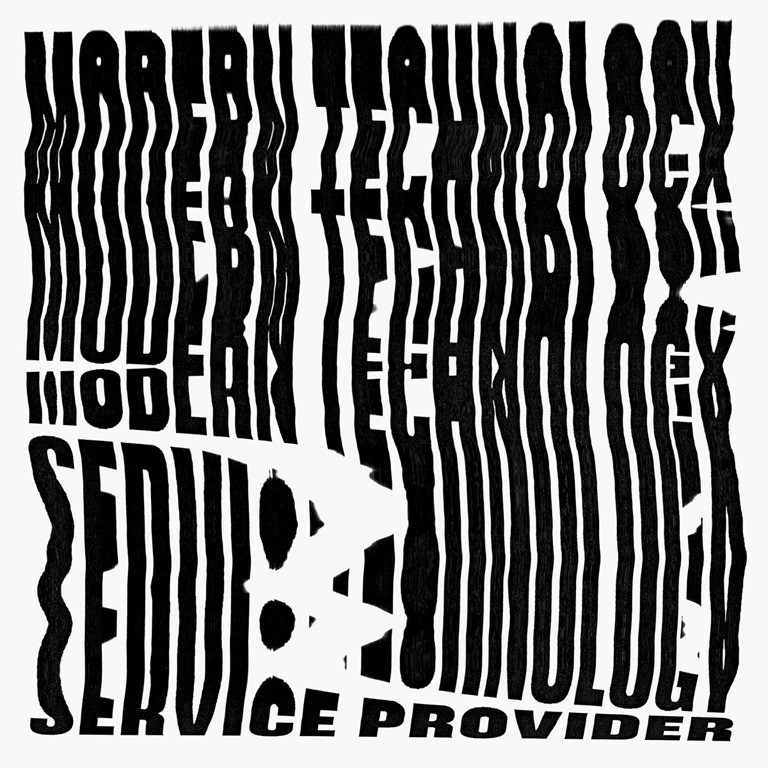
Service Provider finds the duo even more aflame with fury and frustration at contemporary society, and although they seemed pretty well-honed on their first outing, they’ve taken things up another level or three here. The formula – such as it is – is unchanged, with the compositions centred around repetitive, cyclical grooves, pulverizing percussion and anguished vocals swamped in reverb to forge dense capsules of nihilism. The artwork, similarly, consolidates their identity, and the stark monochrome design with its dissolving text is a perfect summary of the stark images of social decay the band depict in their songs. But now, they’ve triple-distilled their ire, and the mammoth production only enhances the effect.

The first of the eight songs, ‘Therapy’ starts sparse, just Clarke’s brooding baritone voice and a primitive thudding drum beat. Those opening bars contain pure anguish, his voice cracked and distorted. Then, in a sharp squeal of feedback, the bass tears in like a whole troop of tanks crashing in, their caterpillar treads tearing at the earth, before locking into a single grinding note that booms out, each simultaneous strike of drum and bass like an explosion. Part Unsane, part Swans, it’s a heavy-hitter, and sets the tone and weight from the outset.

The bass buzzes and rumbles, the drums are understated, thumping away an insistent slow build, and it’s mostly just a scream of feedback like a jet engine that accompanies Chris’ vocal, an edge of distortion on the epic reverb, while he hollers, half-buried in the mix on ‘Blackwall Approach’. According to Wikipedia, ‘The northbound Blackwall Tunnel is a traffic bottleneck with tailbacks. A TfL study in 2009 revealed that the 1.1-mile (1.7 km) approach to the northbound tunnel took around 19 minutes in rush hour traffic, or a delay of approximately 11 minutes per kilometre.’ As such, it makes sense, the band casting a bleak eye over miles of excess traffic and literally tonnes of CO2 emissions. Because this is how we will die, choking the planet and ourselves in our question for exponential growth. And if you think ‘The Great Pause’ will change anything, then while I applaud your optimism, you are completely deluded: lockdown isn’t even over and there are mile-long queues of traffic to access beaches and beauty spots.

‘All is Forgiven’ is an epic grunger, coming on like an outtake demo for Nirvana’s Bleach played at half speed, with Owen’s powerhouse drumming driving thunderously. It’s raw and dingy and hits with serious velocity. The riff on ‘Gate Crasher’ is cyclical, repetitive, gut-churning, ribcage rattling, an intensely physical experience, which captures the force of the band’s live performances perfectly.

Describing a riff as ‘crushing’ may be a cliché, but fuck it: ‘Twitcher’ is a monolithic doom-weight crusher of a beast. A low-slow stealth verse yields to a thick distortion-ripping chorus that is absolutely punishing.

‘Terra Firma’, the album’s shortest song at a mere two-and-a-half-minutes, finds the band explore their more experimental side in a bleepy intro that gives way to a devastating bass blast paired with a squall of treble that calls to mind early Head of David, and serves as an into to the closer, ‘Life Like’, into which it segues. It begins with a spoken-word narrative, a rolling drum and bass almost serene as Clarke hovers around a calm monotone. Early crescendo threats subside and contribute to a simmering tension. But around the four-minute mark the build really begins in earnest, the bass thickening, swelling, and emerging in a tempestuous burst for an elongated outro that takes it to near the eight-minute point.

As a social commentary, Service Provider gets right to the rotten core of capitalist exploitation, and the way it pitches everyone as competition. The upper echelons are competing for supremacy: the majority are competing for scraps and for survival as the divide grows wider. And yet the irony is that the supremacy at the top is predicated on the rest purchasing whatever they’re selling, and all too often it’s shit they don’t need and can’t afford but that’s somehow become essential to contemporary living.

If anyone believes a world emerging from lockdown after the first wave of Covid-19 will be kinder, more accommodating, more humane, the early signs are that they’re sadly mistaken, as businesses slash employees and push even harder to return profits in the wake of a global financial slump.

We’re all fucked, and Service Provider sells it out loud – very loud – and clear, in stark, brutal terms. It’s a pretty punishing set, and what’s impressive is that they sustain the bludgeoning impact throughout, making for an absolute monster of an album. It’s hard to fault service like this.

AA

a1432357693_10

30th May 2020

Christopher Nosnibor

Having begun May with a new release in the form of Beyond Life, an exploratory ambient work in the form of a single twenty-six minute track, Ashley Sagar ends the month with a follow-up, and counterpart of similar scope and scale.

If the title suggests something a bit new-age, a bit hippy, trippy cosmic, and a bit pretentious, the music is contains isn’t anything of the sort, although there is a certain haze of mysticism and perhaps a sniff of incense about the album’s slow-drifting atmospherics.

There’s a faint scratching pulsation, like a metal object scraping against scratched glass, that grabs my attention early on: the arrival of slow, sedate, rolling percussion– possibly conga or similar hand drums – provides a new focus for the attention, and changes the tone considerably. With a rhythmic structure providing a framework and solidity, the piece becomes less overtly ambient and abstract. Shifting further over time towards cyclical, non-percussive rhythms transports the listener into a softer pace, before an unexpectedly weighty segment around the eleven-minute mark where the beats crash in and dominate, however briefly.

Thereafter the looming shadows are longer and darker, with rumbling low notes and heavy drones underlying Ian Mitchell’s delicate picked guitar notes and the returning percussion, along with one of Sagar’s distinctively strolling basslines. It may be subtle and muted, but its presence builds depth beneath the numerous shimmering layers which ebb and flow.

The segments are short and the transitions relatively swift, which gives The Temple… a strong sense of movement, movements that’s effortless and natural, since the parts flow seamlessly into one another like a stream flowing through a varied landscape, cascading from a spring-line, down a hillside and through a woodland. This may not be the most fitting metaphor, but you get the idea, and it’s perhaps telling that my mind is drawn to the natural rather than the spiritual, and I’m drawn to the distant horizon as the final notes throb and ripple to the fade.

AA

a0892150820_10

Sargent House

Christopher Nosnibor

Chelsea Wolfe and her band drummer Jess Gowrie came together while touring Wolfe’s Hiss Spun album in 2017. I reasonably expected Chelsea to be the dominant force here, and it’s perhaps because of that expectation that Self Surgery, the fruits of their collaboration under the moniker of Mrs Piss, hits as hard as it does. It’s the best kind of collaboration, greater than the sum of its parts, and finds Wolfe standing equal creative billing.

If Wolfe’s albums are marked by a degree of poise, control, balance, then those are tossed to the wind in a deluge of noise on Self Surgery. It’s unrefined, even messy in places, and all the better for it. It feels like a true exploration as the pair cut loose, dredge deep, and find what’s really inside themselves.

‘To Crawl Inside’ is but an intro track, 43 seconds of no-wave buzz and a vocal stew that bubbles discord and disquiet. It sets the tone in that it’s raw and ragged, angular and challenging, but it barely begins to set the levels for volume and abrasion. On Self Surgery, Wolfe and Gowrie crank it up and go all out.

‘Downer Surrounded by Uppers’ blasts headlong into a grunge blast, and we’re talking more early Hole than the stereotypically formulaic quiet/loud dynamic of what’s come to be associated with grunge since Nevermind and Live Through This redrew the template and rendered it accessible. It’s not the only full-throttle grunge explosion: ‘Nobody Wants to Party with Us’ is throws in some skull-cracking percussion and an industrial edge that lands it somewhere between Pretty On the Inside and The Downward Spiral. It’s heavy-duty.

‘Knelt’ finds Chelsea in more familiar territory, with a grinding, low-registering bass and swirling maelstrom of distorted guitar providing a dense, murky backdrop to a breathy, brooding vocal that’s reminiscent of ‘Spun’. But while still cinematic, and also deep, dark, and weighty, as well as simultaneously ethereal, the guitars wrapped in layers of effects and drenched in reverb, there’s a different feel to the production here: less polished, less precise, everything is more up-front, more direct.

If the first half of the album is intense, the second is next level: muscles twitch and nerves jangle in the face of the upshift in pace and intensity that begins with the driving riffery of ‘M.B.O.T.W.O.’ and steps up with ‘You Took Everything’, which is shadowy, gloomy, gothic in mood, stark snare ricochets shaping the direction as screaming banshee backing vocals fill the backdrop with a fearful hauntology.

The title track is a daunting morass of dingy bass and pulverising percussion that paves the way for the mess of no-wave noise that is the pair’s titular tune and sums up what their about perfectly, as the guitars and dual vocals swirl in currents of feedback before a driving drum thrash that calls to mind Bleach-era Nirvana hammers to an unexpected moment of calm to fade.

Because of its timing, and its staunchly uncommercial titling, this project could well be a bit of a sleeper, but the fact is, it’s as strong as anything Wolfe has released during her career to date, and is a truly killer album in its own right.

A

AA

a4118909094_10

Cruel Nature Records – 19th June 2020

Christopher Nosnibor

Much as I love living in York because of The Fulford Arms, and the ease of access to limitless gigs in Leeds (without having to actually live in Leeds), I’m starting to think that Newcastle is the place to be.

Cruel Nature’s roster is reason alone, and this latest offering from full-throttle noisemakers Ballpeen is exemplary. Three years on from their first live show and, the band have established themselves, ‘through releases on premier DIY punk label, Serial Bowl Records’. As the press release recounts, ‘2018’s ‘Loose Knot’ with its wry nod to Black Flag in title and excellent artwork, rapped five across the listener’s brow from the get-go, with its attention-grabbing power and undulating groove, coursing through the 6 tracks, leaving you thirsty – but not miserable – for more’.

In attempting to capture the energy of their live performances, Pachinko is a relentlessly balls-out, up front amalgamation of all things post-hardcore, with a big, bold 90s slant that evokes the spirit of Touch & Go and Amphetamine Reptile, as well as contemporaneous little UK labels like Eve Recordings and Jackass.

At times, it feels like we’re wading through endless indie sameness, and even so much alternative music, spanning metal, hardcore, post-hardcore and whatever else you’ve got simply fails to hit the spot, and I’ve felt listless, uninspired many evenings while reviewing these last few weeks. And then Pachinko slams in with a proper smack to the chops and I’m instantly reinvigorated and reminded of all of the reasons for music. Pachinko is distilled excitement. The album’s eight tracks are packed back-to-back and are all the guitars, spasmodic, jolting, big distortion. The fact it’s a mere twenty-one minutes in duration indicates the density and hell-for-leather pace of the album, which last less time than it takes some bands to tune up, or in the case of Sunn O))), to strike the first chord.

Pachinko isn’t pretty: it’s direct, and drives straight for the jugular. Following the lurching drive of ‘One Man’s Opinion’, a thorny mess of Killing Joke and early Therapy? with a dash of Milk, ‘Flipper’ brings a downtuned churning riff assault, before ‘Ornate Coleman’ slugs out a messy morass of guitar-driven abrasion.

Blending Trail of Dead and Blacklisters at their most attacking, or to pluck lesser-known but perhaps more accurate reference points, Tar, Guzzard, and Hora Douse all spin into Ballpeen’s sonic blast.

‘Kancho’ goes full-on Bleach era Nirvana with a driving, circular riff and sprays of feedback bursting from the halts in the crushing percussion. It’s heavy in a relentless, churning way. Some songs, like the closer, ‘No Mark’ are straight-ahead hardcore punishers that are Black Flag and all the hardcore releases Southern Lord have released in the last five years rolled together and deep-fried in breadcrumbs that stick in the throat simply to choke you.

No prisoners. No respite. Just full-on fury. The best.

AA

ballpeen outer

Pretty Ugly Records – 13th March 2020

Christopher Nosnibor

So I stumbled over Sex Cells by practically sticking a pin in last year’s Live at Leeds programme, and it paid off. Ok, that’s not quite true: while surveying the schedule, they looked interesting and probably worth a punt, so I took a gamble it paid off, with the their tense industrial-edged electronica that reminded me of Pretty Hate Machine era Nine Inch Nails, only weirder and sleezier. Coupled with the duo’s slightly oddball, even vaguely awkward, presentation, it was compelling. The same has been true of their releases to date, which lead us to this, their debut album.

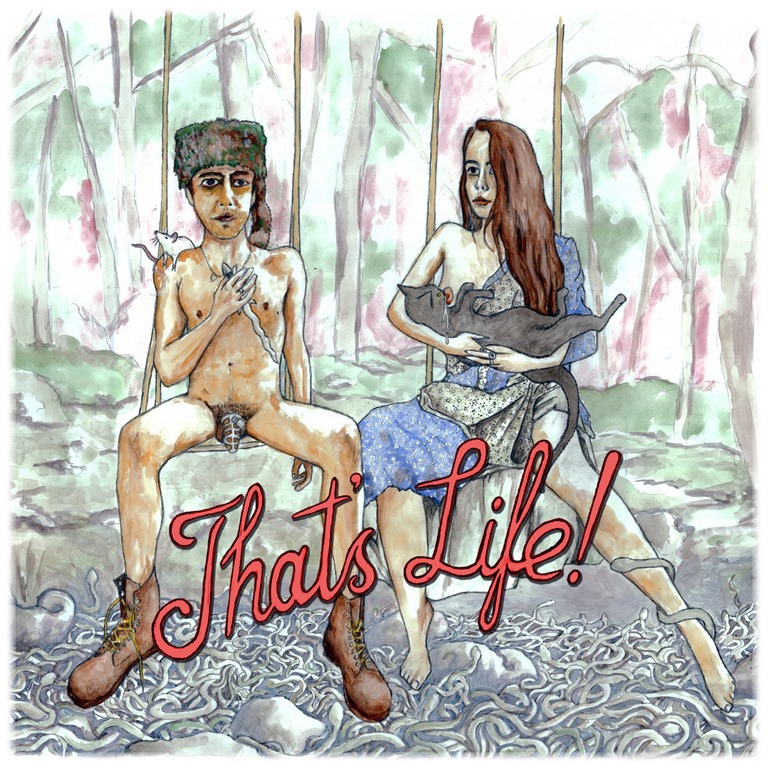
The album’s cover is a bizarre watercolour-style tableau of the pair, and on the one hand, it’s naff (and I’m being polite: the more you look at it, the more awful details reveal themselves. Like, is the cat really supposed to be licking her nipple? What’s that on his dick?), but on the other, it’s a perfect encapsulation of their perverse, quirky style. They don’t play by the rules. And if their name is a play on the adage and Soft Cell, then it’s entirely fitting. If it isn’t, it maybe ought to be.

The headline here should perhaps be that David M Allen is the lead producer here. Renowned for his work with The Human League, The Sisters of Mercy, The Mission, Depeche Mode, The Psychedelic Furs, Wire, The Associates, and The Chameleons, little more probably needs to be said here, beyond the fact that in terms of production, ‘That’s Life’ sounds like you’d probably expect.

‘That’s Life’ bridges the gap between The Human League and Nine Inch Nails, and doesn’t include any of their previous single releases apart from leader ‘Deranged’, which crashed in with a suitably salaciously shocking promo video in March, demonstrating their tenser, harder-edged side while at the same time nailing everything about the band into a box of two-and-a-half minutes.

Opening song, ‘Shimmer,’ is dominated by a low-slung oscillating bass and trudging drum machine that provides the backdrop to Matt Kilda’s monotone spoken word vocal and Willow Vincent’s lost, demented banshee shrillness that calls to mind Skeletal Family, early Siouxsie, and early Cranes.

‘We Are Still Breathing’ is a neatly-crafted reflective electropop tune. It’s got hooks, melody, and a dreamy quality. Things take a dark turn on the next song, ‘Human Costume’ a spiky post-punk electrogoth stomper that screams Hallowe’en and horror, with some pretty barbed lyrics that turn the mirror on society and the human psyche. And it still packs a killer chorus, too.

They go full death disco with ‘Cruel Design’, and Willow coms on all breathy and ice witch in the vocal department, bringing a contrast between the vibrant energy of the instrumentation and the cold detachment of the voice, in a role reversal between human and machine. It’s a complete contrast to the final song, ‘Hang the Flowers’, which is a sparse, folksy number that ripples dappled shade to fade.

The combination of shock tactics and neat dark-edged electropop is a well-established tradition that can probably be traced back as far as Suicide, but really became a thing in the 80s, and as such, Sex Cells should by rights be a yawn, their edginess predictable, their material laden with well-worn tropes, and the metaphorical shrug of a title does nothing to raise expectations. And yet they make it work, and make it exciting.

AA

a3207339964_10

AA

Cruel Nature – CN132 – 25th May 2020

Christopher Nosnibor

Mike Vest happens to be in several noisy bands I really, really rate, notably Ozo, Bong, Blown Out, 11Paranoias and Drunk in Hell. And now, while I’m wondering if the guy has somehow mastered cloning and not told anyone, you can add to that staggering list Lush Worker, his solo project.

Cruel Nature, one of two Newcastle-based cassette labels who represent the city’s tight-knit but remarkably prolific and outstandingly strong underground scene, which is a melting pot for all shades or nasty noise and dark metal-orientated music, here serves up a whopping portion of Lush Worker, with three albums bundled onto a limited-edition double cassette spanning nearly two hours of what they describe as ‘heavy shockwave drone and dream guitar noise overload, perfect to bliss out to’.

The first of half a dozen Lush Worker releases from 2019, Cruise was first released digitally last February, and essentially comprises the twenty-eight-minute title track, a long, swirling guitar drone that straddles shoegaze and ambience, with a brace of shorter (sub-two-minute) ‘sample’ tracks, omitted here presumably for space, continuity and purpose. Because while this may be three albums, it may s well be one monster album, and is perhaps best approached as such.

Admittedly, no-one is likely (alright, I’m making a substantial assumption here) to listen to this either an album at a time, or as a whole in a single sitting. Not because it doesn’t flow perfectly as a single-sitting piece, but because even in lockdown, does anyone have that kind of time?

So ‘Cruise’ cruises on, slowly, a spiralling cathedral of guitar that simultaneously drones and soars in a mess of wailing feedback and misshapen chords. There’s some distant beat in the mix, but its submerged beneath an undulating tide of treble.

The five cuts of ‘slow burn guitar’ from the appropriately-titled Uplift, released in October 2019, with the exception of ‘Flatliner’ are all around the nine-minute mark, and are more rhythmic, if not necessarily overtly structured: ‘Sub-Ether’ is a heavily psychedelic shoegaze swirl, centred around a repetitive, cyclical motif overlaid with layer upon layer of FX-soaked overdrive, with the album tapering to an elongated buzzing drone on ‘Frozen Egypt’, where it’s the slow-melting bass trip that makes it.

Somewhere in the haze of dubby desert rock, there’s a soaring experimental psychedelic drone on ‘Slow Zone Design’, and howling lead guitars duel against one another, occasionally colliding in a smash of metallic sparks.

Although presented here out of sequence (and the cassette sequence is different again from the digital release), with Hb1c MkII having been released in May, it makes sense for its two half-hour behemoth efforts to round off this release, mirroring its opening counterpart. However, ‘Hb1c MkII’ is a much mellower piece, a near-ambient drift of echo and delay, the chiming notes floating and fading into a rippling haze, before ‘Sobek 110’ delineates things further, a twenty-eight minute single-note drone at heart, it’s a meditative, medicated, soporific experience.

Collectively, these three albums demonstrate different but connected and complimentary facets of Vests Lush Worker output. Dim the lights and explore.

AA

cover