Archive for the ‘Albums’ Category

Dret Skivor – DRET008 – 6th August 2021

Christopher Nosnibor

The latest offering from Dret Skivor, a Swedish tape label specialising in drone and various shades of experimental noise, is the new album from Danish maker of electronic noise Thomas Li, who, as Li, has self-released almost a dozen works digitally. Biographical details are less than minimal, and that’s cool. Why do we need to know about the artist, their background or their back catalogue? Do we really need to know the context or the intent, the theory behind a work? Sometimes, when it’s an experimental work informed by theory or a certain concept, it helps, because the concept and theory are integral to both the process and the end product. Then again, there’s a danger that sometimes said theory or concept can impinge on one’s appreciation of the work. Sometimes, it’s best to just be able to listen, and allow oneself to be immersed in the sound, without pouring over lengthy liner notes, researching myriad avenues presented by the references, and straining one’s brain over concepts. This is particularly true of many works of a more ambient persuasion. I’m not remotely anti-academic or anti-intellectual – quite the opposite. But sometimes, you just need a break, and music can be the perfect conduit to vital headspace. An overemphasis on context can detract from the often underrated pleasure of simply listening, and enjoying.

Admittedly, enjoyment of an album like this is the preserve of a small minority: it doesn’t contain any ‘tunes’, it’s beatless, and it’s not always entirely mellow either. But it does have a great deal of texture, and this is something you can really lose yourself in.

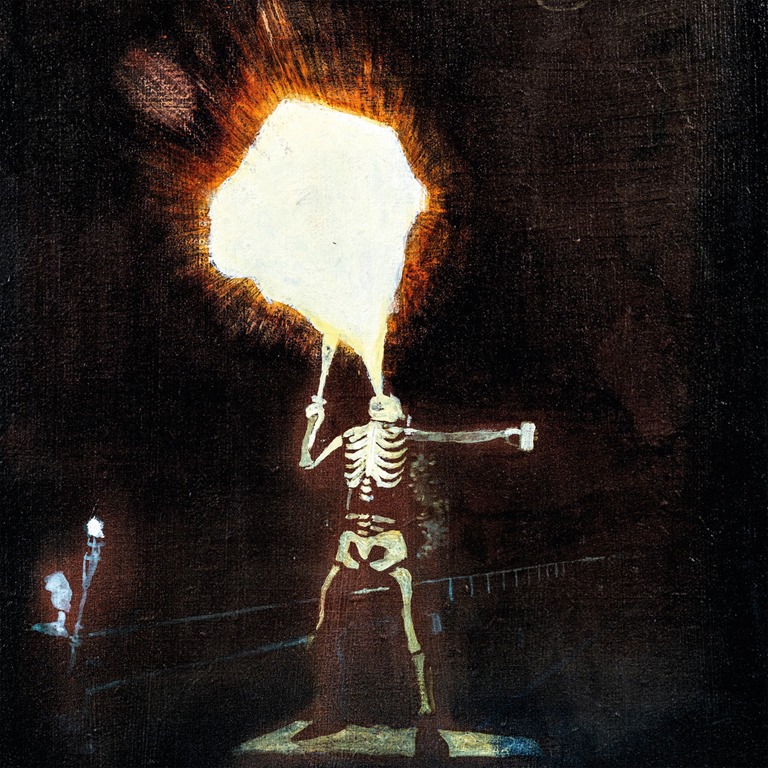
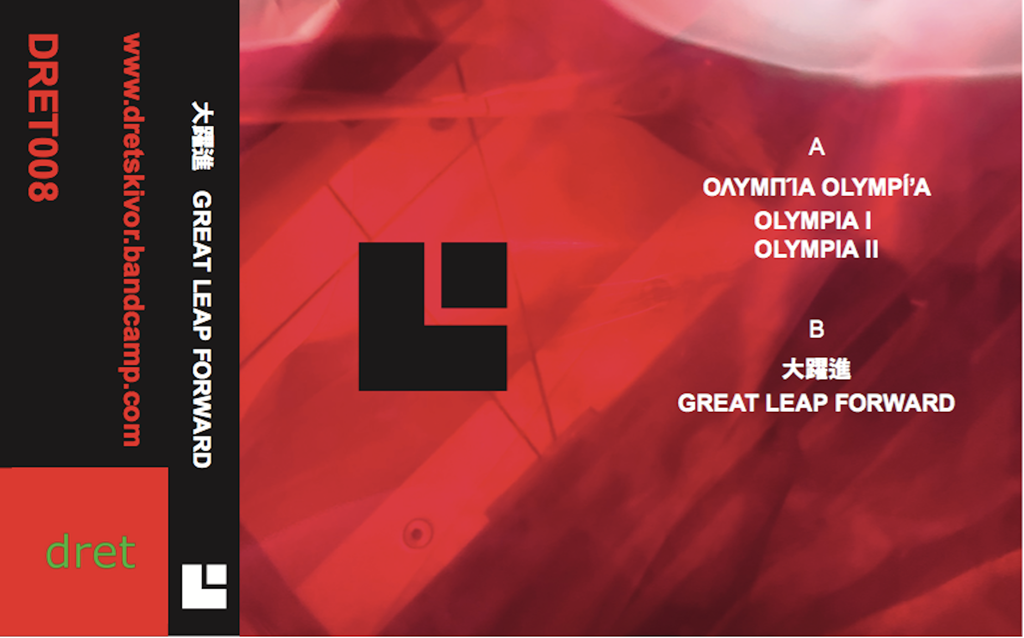
Great Leap Forward contains three tracks, with side one occupied with the two-part ‘Olympia’ and the second side containing the eighteen-minute monster title track.

‘Olympia I’ is nine minutes of dense, churning drones, billowing sonic clouds that choke and smother, while counterpart ‘Olympia II’ gurgles and churns a dark whirling cyclone of sound. The latter is more interesting, sonically, with a lot more going on – meaning it’s also more challenging and more tense, as crackles and hums fizz and spin from the dank depths of bubbling noise.

The title track is altogether less tumultuous and more background ambient by comparison. Being eighteen minutes in duration, on the face of it, not a lot happens: there are no climactic blasts of noise, there’s nothing explosive or even overtly disruptive. And yet for all its subtlety, it is engaging, and there is movement, there are shifts and distract and divert. Howling winds blast over barren landscapes of drifting sand and strains of treble and whines of feedback emerge from the eternal mid-range rumble that drones on, and on, and on.

In the context of his output to date, this may not really be quite such a great leap forward, but it does clearly mark an evolution and an expansion on the soundscapes sculpted on previous works. And, played with the accompaniment of a candle and some CBD-infused beer, Great Leap Forward is a well-executed soundtrack to mental recuperation.

AA
tape label grab for bandcamp

Hallow Ground – HG2104 – 13th August 2021

Christopher Nosnibor

There are few things in life you can really rely on, but Hallow Ground is one of them, if you’re seeking music from the darker side. The clue’s pretty much in the name here: this is pretty dark. Of course it is. It’s also quite an interesting and unusual blend of styles and sounds, for while this forty-minute, seven-track work is predominantly instrumental and ambient in its leanings, it pushes wider and deeper than that, to span a range of territories, with often quite unsettling results.

DarkSonicTales is a project by Rolf Gisler, who was granted an artist residency in a 300-year-old farmhouse in the Swiss countryside in autumn 2019, by the label. How this sort of thing comes about, I’m not really sure, but there it is. I am a shade covetous of artists who get dedicated time and space to work on their art in whatever medium, because the simple fact is that in ordinary life there never seems to be enough time. For anything. And creativity requires headspace and time, both of which are rare and precious commodities.

Rolf seems to have made the most of his time, and the result is an album that’s varied in terms of form and tonality, which makes for a fascinating listening experience. From the mellow chiming of the short intro piece, ‘Info Pandemie’, to the eight-minute drone-swirl of ‘Best Buddies’ that drags the album to a slow-simmering conclusion in a bilious fog of sonic drift, DarkSonicTales is a deeply exploratory piece.

‘I Still Believe’ is a long, slow-burning, low-key, low-tempo gothy tune, where Gisler whispers in a baritone croon over a delicately picked guitar that’s hauntingly atmospheric and pinned down by a distant but insistent drum machine, its cracking snare cutting through the sonic haze.

‘Best Buddies’ brings the finale, and there’s a stuttering heartbeat drum flickering like a palpitation against the slow, majestic musical backdrop.

In some respects, it’s a challenge, simply because however much the album leans towards electronics, the way the instrumentation is used is so widely varied this feels like an album that’s harder to accommodate far more than it actually is. Somehow, the pieces of the jigsaw fit together.

AA

a4220900238_10

SIGE Records – SIGE100 – 25th June 2021

Christopher Nosnibor

Woah! Dizzying, head-spinning chaos and cacophony! Twangs and bangs – strings stretched to within a millimetre of snapping, bending and scraping and scratching. Every instrument is playing across the others at an angle. About ten minutes into side one, you realise the discoordinated racket, having had some flickers of brass bubble through – like tentative flames licking around an oversized log on a fire that’s yet to fully establish itself -has congealed into a dense, soupy drone with industrial strength hip-hop beats played by a live drummer. And it just doesn’t stop. For twenty minutes straight. It gargles and parps and booms and toots and parps and growls and farts on and on and on, while the drums clatter and crash and thwack and thwock and bump and fuck me it’s an almighty headache-inducing din.

Details about this release are fairly limited, but details tend to be lost to history anyway. And most of history suggests that White People Killed Them is a common recurring theme throughout. There are so many of ‘them’, anonymous, often buried in unmarked graves in the name of progress – white progress. History is a narrative of shameful exploitation and bloodshed.

Whether or not the three musicians, Raven Chacon, John Dieterich, and Marshall Trammel, intended any such connotations when they came together in New Mexico in 2019, I have no idea, but the forty minutes of music recorded and relayed on this eponymous release would certainly make for a fitting soundtrack to the sheer brutality of history as a catalogue of killing. It’s so relentless, it makes you want to stand up and shout ‘stop! Enough is enough!’ But of course, as history shows us, it never stops. And nor, seemingly, does this album. It’s not a particularly pleasurable experience. It is an intense experience, and one that instils a kind of anxious excitement, even exhilaration. But pleasure… not really.

Things take a turn for the strange on side two, where from some warped, stretched-tape nastiness, there’s some twangy, spaghetti western weirdness that emerges briefly, before everything gets fucked up and mangled again. And it just builds and then sustains this massive wall of thick, discomfiting sound. The end leaves you absolutely drained, desiccated, mentally and physically decimated. If it was possible to achieve death by avant-jazz, White People Killed Them have slain us all with this monster.

AA

SIGE100_front

Fabrique Records – 18th June 2021

Christopher Nosnibor

Berlin-based composer and sound artist Jana Irmert has approached her third album for Fabrique with a view to exploring the way in which sounds have a certain sensory aspect. There’s a way in which music touches us, not just aurally, nor emotionally: some music you really do feel. Beyond music at the louder, harsher end of the spectrum – be it electronic or more conventional in its instrumentation, this is something that is perhaps more common to experimental forms, where contrasting sounds and the shapes and textures of those sounds are more the focus than the unity of a collection of instruments for create ‘songs’.

Articulating how music makes you feel is one challenge, but articulating how music itself feels – or moreover, how the sounds themselves feel – is an immense challenge. Because writing, like any other art, can often reveal its authors limitations, however well they’re working. Every artist has their own personal limitation. Francis Bacon was unable to paint feet, for example. The greatest limitation is invariably the disparity between concept and execution, and often, for musicians, it’s articulating the sound in their head using actual instruments – or, if not articulating the sound, conveying complex emotions through the medium of sound.

Jana Irmert’s challenge here was to render one sensation through another. “I felt I wanted to get closer to the sounds, feel their structure and surface and how they contrast each other,” she says. And, during the process, her recordings yielded some quite unexpected results: “It turned out the processed sounds resulting from hard materials would often have soft and tonal qualities whereas those made from ‘soft’ materials like water or air would ultimately be of percussive or harsh and noisy character.”

The opening bars of the first piece, ‘Lament’, are unexpectedly dense and heavy, a rugged, grainy tone that grinds from the speakers before slowly tapering down to something rather more tranquil, yet draped with the weight of melancholy. Moving into ‘Against Light’, Irmert creates a much more upbeat ambience, a shimmering, shuffling stuttering of sound, and it’s gentle, but not entirely calming or comforting, like being stuck in a tractor beam, a glitching loop that affords no forward trajectory.

With the sounds of the sea, the title track initially seems like it will fulfil the description, offering something soft, soothing, immersive. But as layers build, darker sounds clunk and rumble and loom and lurk in thickening shadows.

There is a certain sense of progression over the course of the eight compositions, with more percussive sounds coming increasingly to the fore. In doing so, the album gradually moves from intangible to something altogether more substantial, its physicality developing an almost corporeal tangibility.

Listening to The Soft Bit, one feel as though one is somehow in nature, and surrounded by nature, from the clouds, and the air – invisible, yet capable of substantial force when moving as a wind – to solid objects – stones, trees, the ground beneath the feet. Listen, inhale it all in, and feel it flow.

AA

FAB088_front

16th July 2021

Christopher Nosnibor

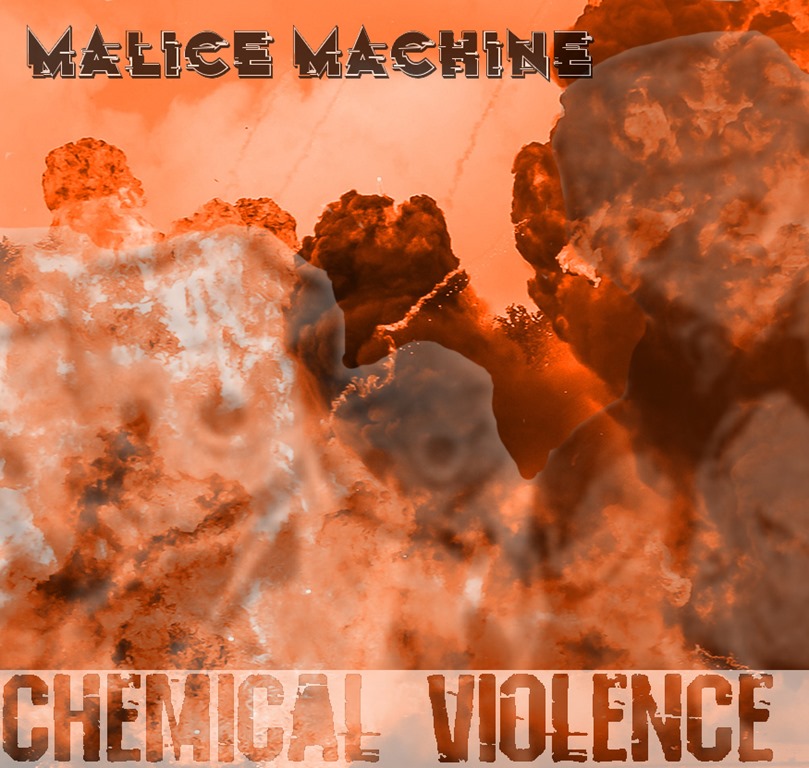
Initially intended as a straight follow up to their 2019 debut, Digital Scars, Chemical Violence evolved as a more technoindustrial work, with less primacy given to the guitars. But having said that, the band explain that they were keen to present a range of elements across the album: ‘We don’t want to be pigeonholed into one sub-genre so all the songs have their own flavor. Retro and post style, Electronic, driven guitar, grinding Noisecore and Aggrotech elements, Synth bass, Drum dominant. We don’t want to be pigeonholed into one sub-genre so all the songs have their own flavor. Retro and post style, Electronic, driven guitar, grinding Noisecore and Aggrotech elements, Synth bass, Drum dominant.’

The album slams straight in with the shuddering synths and thumping beats with the hard-edged stomp of ‘Prototype’. The vocals are gnarly, mangled, snarling, robotic – yes, derivative of Twitch era Ministry and a million Wax Trax! releases from 86-89, but that’s entirely the idea.

It was The Wedding Present who turned a negative music review into a T-Shirt bearing the slogan ‘all the songs sound the same’ and while it served to turn the criticism back on itself, it raises the very fair question of ‘what’s the problem?’ Certain genres particularly require a significant level of sameness.

Dance music is necessarily constructed around a narrow range of tempos, and this strain of electro-centric industrial is in many respects, an aggressive rendition of dance music (no, I’m not going to call it fucking EDM. Or EBM, either. Because there is just so much tribal wankery around genres, and rebranding shit doesn’t make it new shit, it just makes it the same shit rebranded. I never blame bands for this: it’s a press and marketing thing.

Chemical Violence most definitely isn’t shit – it’s an astute work that sees the band really exploit the genre forms to their optimum reach, and the point is that the further you delve into a genre, the more important the details become. Malice Machine know this, and this album is the evidence. ‘Dead Circuit’ presents the grinding sleaze of PIG, while ‘Machine Hate’ is pure insistent groove that’s overtly dance – most definitely drum dominant – but clearly has its grimy roots in that Chicago c86 sound. Flipping that, ‘Techno Pagan’ goes full raging Ministry industrial metal in the vein of ‘Thieves’. It wraps up with a killer rendition of Tubeway Army’s ‘Down in the Park’ that’s quite a shift, being both organic and robotic at the same time, and very much captures the stark spirit of the original. Covered by so many, from Marilyn Manson to Foo Fighters, and it’s become a synth-goth classic. Malice Machine seem to take some cues from the Christian Death version, but brings something unique to the party as well.

Where Malice Machine succeed with Chemical Violence clearly isn’t in its innovation, but its execution, and they don’t put a foot wrong, making for an album that really is all killer.

large explosion

Sargent House – 6th August 2021

Christopher Nosnibor

Here in England – and Britain, as elsewhere further afield – division is rife: views and positions have become increasingly polarised and entrenched in recent years, and man, it’s fucking ugly. From here, it’s perhaps difficult to appreciate just how much uglier it gets when fervent religiosity is added to the mix. And while the white, Christian west expends boundless energy vilifying Islam, much of this feels like so much hypocrisy. For a religion that officially preaches for its adherents to ‘love thy neighbour’, Christianity is prone to being particularly harsh and judgemental, and as the album’s title suggests, there is a strong element of Christian judgment at the heart of the songs here.

The press release describes Sinner Get Ready as ‘an abrasive, unsettling portrait of devotion and betrayal, judgment and consequence, set in the severe and derelict landscape of rural Pennsylvania, a neglected and interstitial region deeply embedded with a particularly austere brand of Christianity, and where Hayter currently lives.’ It goes on to explain: ‘The rigorous and almost procedural site-specificity reflects an obsession with externalizing that site as the locus of great personal pain – pain that is the Will of that region’s presiding God; an atonement for sin that only the blood of Jesus can cleanse’. There is a certain specificity about the songs collected here, but, as is so often the case, the personal radiates out to become the universal, and however specific the subject and inspiration on a personal level to the artist a work may be, true art resonates far beyond.

Sinner Get Ready is an album that proves, demonstrably, that you don’t need noise or volume to achieve levels of devastating intensity. It’s spectacularly simple, raw, and at the same time complex and layered, not least of all in the vocal arrangements, and also hits like a tsunami. Sinner Get Ready is an intensely spiritual work, but it’s also quite simply an intense work, and one that conveys the power of the word of the Lord, that conjures fire and brimstone and that forewarns sinners- and non-believers – what they can expect.

The album begins gently enough, with rolling piano and strong but melodic vocals, operatic and elevating. But it doesn’t take long before things grow dark and disturbing on the nine-minute opener, ‘The Order of Spiritual Virgins’. The delicate, ethereal, choral evocations are rent with crashing, violent blasts of piano – fist-smashing thunderousness. It hits hard.

There is something of the musical about this, at least in terms of there being a narrative thread and a sense of characterisation running through it. It’s certainly more than simply a collection of songs: there is a sense of sequence, of progression. ‘I Who Bend the Tall Grass’ is sparsely arranged around a soft organ drone, and over which Hayter’s vocal cracks and breaks with force and emotion, and harmony melts into warped dissonance. ‘He has to die! There is no other way!’ she barks, rough and raw, before an atonal chorus of voices and drones carry it away.

Contrastingly, ‘Many Hands’ is traditional folk with an element of roots American country. It’s also dolorous, painful, its many-layered beseeching vocal, and ‘The Sacred Linametnt of Judgement’ is similarly folky, with a rich earthiness that speaks of tradition and evokes bygone times. Yet, as ‘Repent Now Confess Now’ brings into sharp relief just how alive some of those traditions still are in certain places, and these aren’t just small pockets, but huge swathes, and while the deep south is most commonly associated with hardline Christianity, it’s a trait of many rural areas. It may be 2021, but fire and brimstone and divine retribution are still dominant in these places, and what may seem strange to an outsider – like the material for a Louis Theroux documentary – this shit is real, and people live and die by their beliefs. There are some well-selected, well-placed samples, too, which accentuate this.

The songs on here soar, but rage with intensity, trembling with the fear of God and the weight of judgement and the threat of punishment. It would be hard to hear Sinner Get Ready and not feel moved in some way or another.

AA

701993

Misanthropic Agenda – MAR057 – 7th July 2021

Christopher Nosnibor

The title of Dave Phillips’ new album is quite explicit: it’s an album dedicated to death. He explains this in the liner notes, ‘not death the spectre that installs horror and fear in many (in the western world), nor death the enemy of the (western) for-profit medical system, but death as part of a cycle, like birth. death the only certainty in life. dying, like living, as something that can be done well – or not. death also something that can be a release, a relief, a liberation, the end of suffering, a freedom.’

The album, which he directs the listener to play as one continuous session, was inspired by his father’s illness, deterioration and death, and being his carer for the 15 last months of his life, and was, poignantly, sent off to press in early June 2021, when his father died. This clearly makes To Death an incredibly personal work.

Perhaps predictably, To Death is a dark album. Predictably, not primarily because of the subject matter, but because my last encounter with Phillips’ work – 2014’s Homo Animalis – was pretty dark, too, although he’s done a hell of a lot since then. And for Phillips’ observation that death can be ‘a relief, a liberation, the end of suffering, a freedom’, death is rarely seen as a cause for elation or celebration in the human psyche, particularly in the west, where there is a deep-rooted fear of death, and a culture that promotes prolonging and preserving life at all costs, regardless of quality. Death is perceived as a loss, something devastating, and to be avoided at all costs, and I’m forever presented with news items and comments on social media about people who have died in their 70s or 80s – particularly during the pandemic – having been ‘taken before their time’. But when is their time? Everyone has a time, and everyone has to die of something, and the state of denial about the inevitability of death is psychologically detrimental.

But as the title of the album’s second track says it so succinctly, ‘fear of death = fear of life’. A life lived in fear of death is no life at all. Of course, an awareness of death is something else entirely. You have to take some risks to know you’re actually alive. How many people say on their death bed that they were glad they did nothing in case it killed them? There’s a clear theme to this album, both sonically and in the tiles: ‘everyone dies, not everyone lives’ is the perfect encapsulation of Phillips’ ethos. It also manifests as a dolorous booming drone like a ship’s horn juxtaposed with maniacal shouting, distorted and raw, and very much in the vein of Prurient. As such, Phillips articulates beyond words and reaches into the very core of the psyche.

Ominous drones that hum and buzz hover unsettlingly and uncomfortably, eddying around whispered words, barely audible during the ten-minute first track, ‘a cycle completed’. What is it about whispers in darkness that we find so unnerving? Gradually, ponderous bass notes and dubious creaking sounds enter the mix as the drones become more tense and eerie.

The third piece, ‘to death we all go, the sooner the better’ is filled with agonised shrieks and howls and pain and anguish – and the title conveys a sentiment I can truly buy into. Humanity is a scourge, and the worst of all plagues on the planet.

Listening to the album in a single sitting is certainly a powerful experience, and there is some dense, challenging noise, and things grow darker and doomier as the album progresses: a stark piano note chinks out and is quickly submerged in a wheezing drone and more muttered narrative on ‘real catastrophe’ which plunges deep into underground rumblings. ‘We are the virus…’ he whispers amidst a soup of spectral voices. ‘The real catastrophe is that humanity continues.’ Phillips’ apparent misanthropy is hardly unjustified: in the scheme of all eternity, it’s taken us but the blink of an eye to render countless species extinct and decimate countless ecosystems. In nature, other species don’t destroy their own habitat. Even viruses and parasites evolve to achieve maximum replication without destroying their hosts. It’s simply not in their interests. The common cold is the most successful virus of all time because it’s highly contagious but rarely kills its host, other than by complications. The more hosts available, the times it can reinfect, the less work it has to do to propagate itself.

Siren-wailing undulations lead us to ‘the other side’, a groaning, wheezing croak of a composition built on repetition before finally, the title track crawls to the finish – and having made it, I can die happy.

Some speculate that death is not the end, but the likelihood is that it is, and regardless of spiritual belief, physically, it is. And why should that be such a bad thing? All things must end, and it’s a matter of when, rather than if. Live life: accept death.

AA

dp to death digi w newest corrections

21st June 2021

Black Angel emerged four years ago, and released Kiss of Death in July of last year – an album that brought together Matt Vowles’ years of experience from being in and around the goth scene to recreate the spirit of 1985.

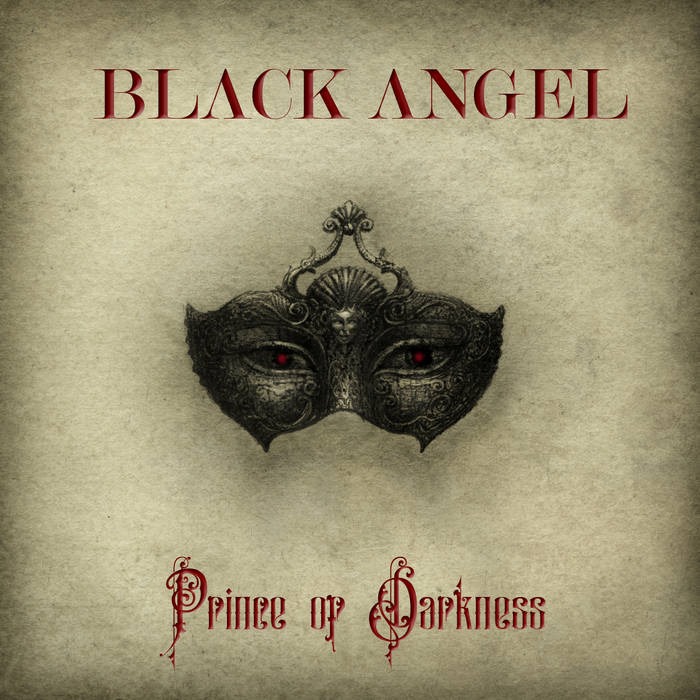
This time, Vowles and co have come out with a concept album for their third outing, which is ‘inspired by cinematic classics such as ‘Dracula’ (Gary Oldman-1992) and ‘Interview with a Vampire’ with contemporary inspiration on tracks like "Alive" and "Give It To Me’" from the modern aristocratic sophisticated vampires in ‘Underworld’.

The album’s concept, the blurbage explains, is ‘to take you on a journey. The record starts out with an introduction to set the tone and to put you in 10th century England. As our protagonist embarks on his pillage through the town, we hear screams from the villagers as they run for their lives. He’s the Prince Of Darkness and causes chaos and mischief wherever he goes’.

There’s a fine line between artistry and pretence, theatre and corn, and despite the concept that veers towards an amalgamation of all the clichés of goth distilled into a dozen tracks, Prince of Darkness once again nails that vintage goth sound, with ‘Alive’ melding the energy of early Mission with the mechanised drumming of The Sisters to create a swirling cyclone of tripwire guitars and gloom with a glint of joy.

The energy is sustained across the bulk of the album, and the vibe is very much a muscle-flexing dominance, delivered with a big, ballsy swagger: there’s a hefty whiff of testosterone and a barrel load of rock god posturing going down here, but it’s delivered with a knowing nod ‘Live to Love’ is a proper old-school rock ‘n’ roll stomper with a smoky vocal growling and grizzled over a piston-pumping beat and a wonderfully insistent bassline that nags away at a repetitive motif. It’s got that level of grab that immediately makes you want to stick the whole album on repeat, especially after ‘Turn Around’, which pushes the quiet / loud dynamic with a searing guitar line that’s right in the vein of The March Violets – it’s that flangey reverby chorus thing.

Vowles has some depth, and range, too – on some tracks, like ’Call the Night Part II’ he showcases a grainy croon reminiscent of Mark Lanegan, and it’s heavy timbre is well-suited to such expansive epics, and then again, on ‘Secretly’ we see a more soulful, even tender side, and ‘My Love’ goes all out for the heart on sleeve grand gesture. It’s theatrical, but at the same times feels emotionally sincere, and while the melody bears similarities to ‘The Scientist’ by Coldplay, it sounds like it’s being sung by James Ray, and it’s quite moving in a brooding, gothy way.

Throughout, the songwriting is solid, with guitar hooks galore and a taut rhythm section that forges that classic goth groove. There’s a clear lineage from its predecessor in that Prince of Darkness is very much old-school goth delivered with a subtly contemporary twist, but it sounds and feels more confident, more ambitious, and not just on account of its embracing an overarching concept. Prince of Darkness is the sound of a band really hitting their stride, and achieves the perfect marriage of concept and execution.

AA

368330

Nefarious Industries

Christopher Nosnibor

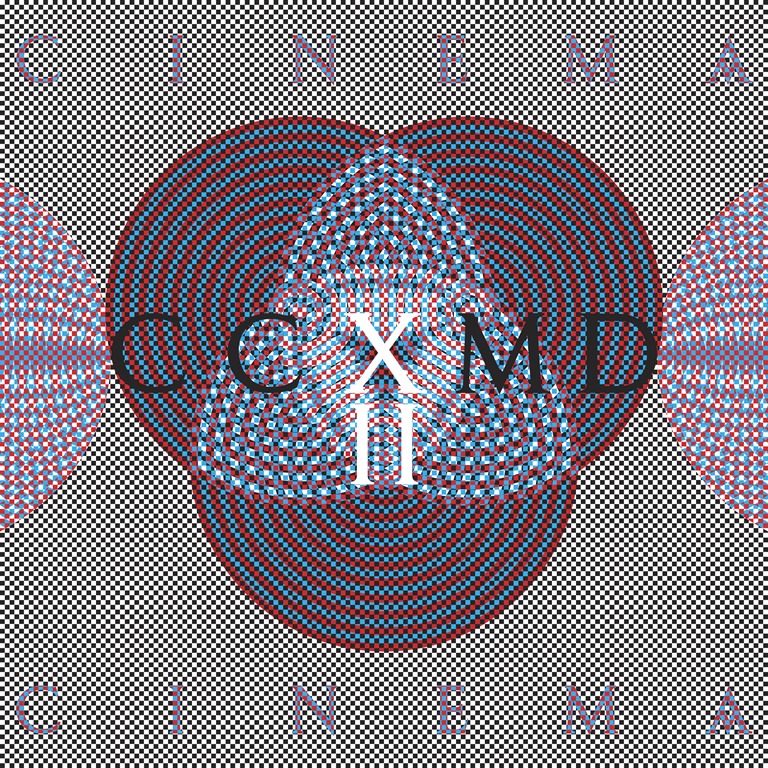
Less than two years after the release of the ambient avant-jazz oddity that was CCXMD (that’s not some random Roman numeralisation, but Cinema Cinema X Matt Darriau (The Klezmatics), the New York duo return for round two of their collaboration with the astutely-titled CCXMDII.

Let’s get the spoiler out of the way up front and early: they couldn’t have shifted further from their noise roots, and there really isn’t an overloading guitar riff in the whole album. If CCXMD was avant-jazzy and ambient, CCXMDII is avant-jazzier and more ambient. Having laid the foundations previously, it’s not so much of a shock, but anyone hoping for a return to their riffier roots will be disappointed by this weirdy, spaced-out experimental work.

It contains but seven tracks, although three of them are over ten minutes in duration, including the eighteen-minute opener ‘A Life of its Own’, which was unveiled as the album’s lead single a couple of weeks ago. And here, Cinema Cinema push further still than on their previous album, with those seven tracks bleeding together to forge one, vast continuous piece.

It begins tentatively, with tremulous, trilling woodwind and some scratchy strumming. Sounds echo and reverberate and voices mumble in a blurred, slowed, hallucinated state that’s most unsettling, and slowly transitions from some shilled, chiming new-age desert vibe into an increasingly bad trip as unintelligible jabbering spits and slurs angrily against the warping backdrop and swelling percussion – and that’s before the crazed jazz horns begin to bray and parp.

There are definite ebbs and flows, but not necessarily correspondent with the transitions between the tracks, and ponderous guitar and trepidatious woodwind teeter precariously through ‘Continued’, which is less of a piece in its own right than a bridge toward the nine-minute ‘Bratislava’. Guitars scrape and the drums stutter and test the waters and levels, and it actually sounds like a band checking their levels between songs during a live show than anything. There are some exploratory post-rock moments, but they’re fleeting, and even when the rhythm section finds a groove, it’s but for a short time and ultimately frustrating and unsatisfying, chopping and changing in a mathy fashion – which is fine in itself, but for the lack of a resolution, a crescendo, a finish. Instead, it peters out and squeaks and toots into the next piece.

The trilling woodwind – pan-pipes or similar – are all over the meandering piece and while the percussion rolls, the guitar is pegged back to providing mere texture, and there is no question that the band have shunned pretty much all ‘rock’ trappings here. The raspy, chthonic vocal whispering and manic hollering returns, before it trickles down into ‘Crack of Dawn’ with its stop / start arrhythmic percussion, hovering drones and eerie formlessness.

It’s not until the penultimate track that we get power chords. There is silence, briefly, before ‘Trigger’, which is unexpectedly led by a stop/start drum and hesitant bass groove that eventually emerges as a core motif. Imagine Shellac with brass instead of vocals, and you probably get the idea. It locks into a motoric krautrock groove – but that freewheeling wild horn action is something else. It brings chaos, it brings discord, riding wild all over some wild improv.

CCXMDII isn’t an easy album, and it’s not the punk or guitar-led set some may have expected. But it is a bold, daring work, one that sees a band who don’t give a fuck about conventions or expectations demonstrating that lack of fucks musically. Every band says they’re making music for themselves, but hardly any mean it. These guys do. CCXMDII is also a wonderfully odd abstract soundscapes that drifts and meanders and entertains and perplexes. CCXMDII is the work of a band in continual evolution, and long may that evolution continue.

AAAAA

CCXMDII_album_art_final_cropped_cover

Roman Numeral (US) / Wolves And Vibrancy (EU) –13th August 2021

Christopher Nosnibor

Linear narrative can be so dull, so predictable, or otherwise lacking in intrigue and imagination. There is so much more challenge – both as a writer and a reader – to a work that doesn’t follow that standard beginning / middle / end convention. There’s nothing predictable or obvious or linear about Fawn Limbs’ their third long player.

‘Day three. I woke up in a bed made of hay and roots. For a brief but fleeting moment, I couldn’t recall the incidents of the past days…’ This is how we arrive in Darwin Falls. It’s a sparse country vibe, a bit True Detective. It’s hazy, hot. The dry, cracked voice of Lee Fisher narrates the scene, and we’re as lost and bewildered as he is. Where are we? Why are we here? What the fuck happened? The picture gets darker as it unfurls, and it’s a slow, languorous build… and then, unexpectedly, everything erupts and shit spews forth as if from a volcano bursting from the very molten pits of hell. It tears with a burning fury at your guts and at your organs, and this is punishment. And then, this is calm, this is tranquillity. This is schizophrenic, unpredictable. It’s too much to process.

How you do describe Fawn Limbs? Odd and experimental is perhaps a fair starting point, and the first track in this is both. ‘Nesting Lumens’ is abstract and ethereal, a shade abstract, but it’s also raging chthonic demon-noise metal and all the brutality delivered with a razor-sharp technicality. It’s perhaps most interesting when the rage dissipates and we’re left with expensive post-rock tropes, and these extend into the majestic

The Transatlantic trio describe themselves as ‘avant-garde mathgrind’ and that seems a fair summary of the blistering hellfest that is Darwin Falls.

We’re still struggling to find orientation amidst the slow-twisting post-rock smog of the opening segment of ‘Wound Hiss’ when things suddenly turn brutal, a battering sonic assault that’s brief but so violent as to cause concussion.

It’s the extremity of the contrasts that render these songs so staggering in their impact. As a post-rock band, they’re outstanding at forging delicate, graceful pastoral pieces, musical passages of delicacy and grace – but instead of breaking into breathtaking crescendos of cinematic beauty, they rampage into howling blasts of anguish that explode on the most frenzied slabs of extreme metal. There are moments of eerie spaciousness, as on ‘Caesura’, a short piece which appropriately provides a moment of respite, and mellow interludes such as the still waters of laid-back jazz at the start of ‘Twitching, Lapsing’ which jolts into life with a haemorrhage-inducing blast of rampant noise and only becomes more impossible as the brass collides with a nuclear storm and a tsunami of noise.

If Justin Broadrick and co successfully combined free jazz with slow, industrial grind as GOD, then Fawn Limbs push the concept to another level, and the spoken word sections provide a fascinating counterpoint to the roaring, blazing sonic blasts that come in between. But ultimately, comparisons simply don’t hold up here. True innovation is rare, and we’re unaccustomed to it: it’s difficult to respond to it appropriately, somehow. It phases us. Shuddering, bemusement, bewilderment. A lack of comprehension. How do you measure it, and how do you process? Darwin Falls is a remarkable album, a sonic supernova, and it’s no mere hybrid: it is truly unique. Prepare to have your mind – and eardrums – blown.

AA

Darwin Falls ARTWORK