Archive for June, 2023

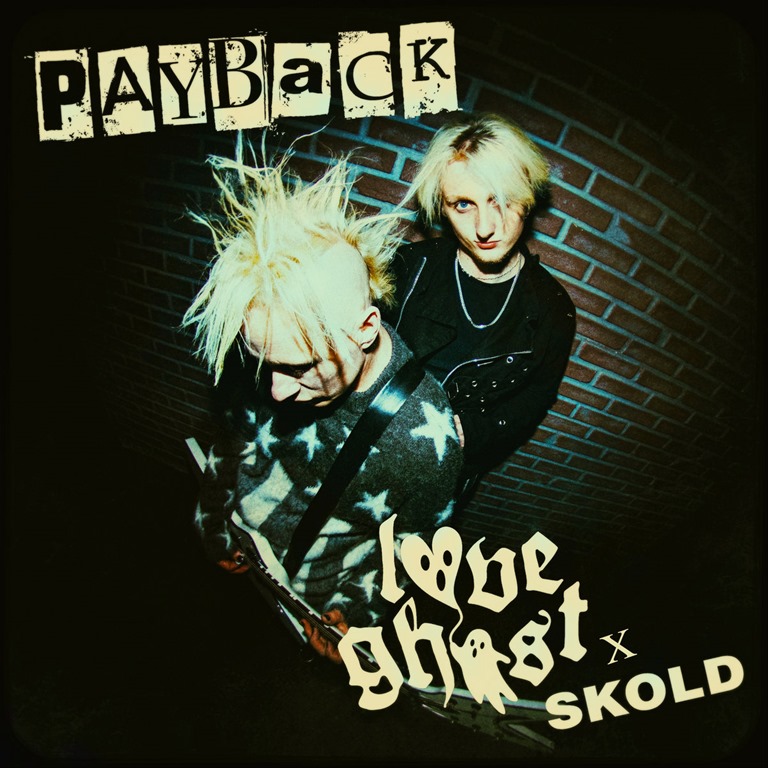
Love Ghost is an enigmatic Los Angeles-based group that has been making waves for some time with genre-bending music that is informed by both Seattle tradition and Soundcloud-era fearlessness. Frontman Finnegan Bell began playing guitar and singing at the age of eleven, soon opening SoundCloud and YouTube accounts to upload his own music and videos. He began playing acoustic shows in 2014 and subsequently founded Love Ghost.

As a quartet, Love Ghost have toured extensively, playing shows in major cities all over the world, while they have earned plaudits from US publications such as Rolling Stone, Alternative Press, American Songwriter and New Noise for their music that has included collaborations with artists from countries that include Mexico, Spain, Turkey, UK, Colombia, Germany and Russia.

They are now adding to that list of territories with ‘Payback’, a first single from a forthcoming album made with Swedish musician and producer Tim Skold. Best known for his work with Shotgun Messiah, KMFDM, Marilyn Manson and as a solo artist, Skold has recently been working as part of the duo Not My God (with Nero Bellum) and has also just toured with Front Line Assembly.

“I met Tim at the Viper Room [in LA] on Halloween night, after which everything magically fell into place,” explains Bell. “We had a few meetings and recorded ‘Payback’ in my band’s studio. Having just come out of a difficult relationship, I wanted to make a song about revenge, redemption and love gone astray. When I was writing the lyrics, Tim had some very interesting tips and production choices that really brought the song to life. SKOLD is a legend and I’m super grateful and excited to release this song and for everyone to hear it.”

Skold adds that “Love Ghost has a super natural flow to writing and performing so it’s pretty easy for me join in, step up and keep the action going. You don’t run into talent like this every day so it was obviously an opportunity I wanted to act on immediately. I’ve been around the block a few times, but I’m very excited about this collaboration and look forward to digging deeper into the full length album.”

Listen to ‘Payback’ here:

AA

a2153956881_10

Khanate, who recently ended their fourteen year hiatus with the surprise release of To Be Cruel (Sacred Bones Records), have debuted an experimental short visual for ‘Like A Poisoned Dog’, bringing the Karl Lemieux-created album art to life.

“These stills are abstract but depending on the context, they become objects and objective. And alongside Khanate, they have this strange organic feeling,” Stephen O’Malley notes. “They’re abstract, hand-painted film stills, not photos of organic objects or something, which I think is really interesting because it’s similar to our music. We put a frame around the music with a concept and it presents something, but otherwise, it’s abstract. This lined up very well with Karl’s work.”

“In addition to my other film work, I like to work with camera-less film techniques and paint directly on 16mm film,” explains Lemieux, whose resume includes films, installations and performances that have screened at a variety of venues including the Montreal Contemporary Arts Museum, MOMA San Francisco, as well as over a decade of collaborative work with Godspeed You! Black Emperor. “In 2021, Stephen asked if he could use some of those images for the new Khanate record. I’m someone who spends a lot of time flipping through the artwork of records, CDs, and cassettes…. It’s part of my listening ritual. I have always loved Stephen’s record design work and I was very excited about this collaboration and the way it all came out. The idea for a video came later. It’s not a film, it’s not a music video, but some kind of collision between an excerpt from the piece ‘Like A Poisoned Dog’ and the raw material that I used to make still images.”

Watch the video here:

AA

42TFpsUg

Divide and Dissolve’s Systemic is a thick wash of sound, equal parts beauty and anguish and creates a wholly encompassing experience for even a casual listener. You can feel the deep intention. Their dense sound is overwhelmingly heavy; a dissonant pounding of percussion, guitars, piano, synths and saxophone, interwoven with passages of orchestral beauty that give a feeling of respite.

The album examines the systems that intrinsically bind us and calls for a system that facilitates life for everyone. It’s a message that fits with the band’s core intention: to make music that honours their ancestors and Indigenous land, to oppose white supremacy, and to work towards a future of Black and Indigenous liberation.

Just ahead of its release tomorrow, Divide and Dissolve share Systemic’s palpable opener. “‘Want’ is a deep dive into longing within a decolonial framework,” tells saxophonist / guitarist Takiaya Reed. “We can want many things, but how will it happen? What is necessary, what systems must be broken in order for people to live?”

It comes alongside a third video from director Sepi Mashiahof who explains, “As ‘Want’ is the song that introduces us to ‘Systemic’, the concept for the video emulates this kind of infant yearning for worlds beyond our current heartbreaking reality. There are so many beautiful textures above our heads that are inaccessible (as there are so many desired modes of existence that are inaccessible), and the rotation emphasises the limbo of what that desire feels like. Trying to reach something, but succumbing to the loop of failure. Still, that infant yearning is persistent, and that compliments the need for hope and cements the importance of idealism as essential tools in our greater struggles for liberation.”

Watch the video here:

AA

w7L-fcDo

Room40 – 30th June 2023

Christopher Nosnibor

There is no quick way to consider this album. And for many reasons – the first being that it needs to be heard in its entirety before being able to summarise and pass critical comment. The second being that after hearing it, one needs to drag themselves from the wreckage of their psyche and process an experience that is likely akin to a week being subjected to psychological experiments at the hands of the CIA under MK Ultra. Brace yourself…

As his bio points out, ‘Tony Buck is no stranger to the realm of durational performance and composition. As a part of Australian unit The Necks he has been central to defining a reductive, but rich sound language that equally interrogates timbre and time…[and] with Environmental Studies he moves even further into these longitudinal pursuits.’

Longitudinal is one word to describe this album. It’s a single, continuous piece, some two hours in duration, and while there are a couple of five-minute excerpts designed to give potential listeners an indication of what it’s like, it’s simply impossible to convey the experience in snippets. The snippets are lifted from the album’s lighter moments: that doesn’t mean they’re mellow, melodic, but the multi-layered clattering percussion that’s evocative of some kind of space-jungle and brief segment of avant-jazz feedback is nothing in the wider context. And – as I always say – context counts.

While chart music – geared toward snappy three-minute cuts which are 90% chorus – and the inclusion of streams when compiling charts, has effectively killed the album in the mainstream, further afield (and to be fair, you can’t get much further afield than this), the album is still very much a cherished format for both artists and listeners alike. In fact, it’s interesting to observe the rise of the really long album. I will often harp on about Swans releases from the last decade, but they’re not isolated. Frank Rothkkaramm released an album as a 24-hour CD box set – which couldn’t be much more different from Throbbing Gristle’s 24 hours box – as he explored sounds which helped with his tinnitus. Numerous doom, drone, and ambient albums in recent years have really pushed the parameters of an album thanks to digital releases not being subject to the same limitations of physical formats – or the same production costs. Is the medium the message? Perhaps, at least to an extent.

The recorded medium was always an issue: even going back to the height of the classical era, once recording became possible, the media limited what could be released, meaning to hear a full performance of, say, Handel’s Messiah, you had to be there, since even a recording which required a box-set album release required truncation. It also, of course, required the turning of records and the segmentation of the work.

In its day, Earth’s groundbreaking Earth 2 challenged the conventional notion the ‘the album’ – more even than any monster prog releases like Yes’ eighty-one minute Tales from Topographic Oceans and the two-hour plus, sprawling triple YesSongs. Because what differentiates these is the fact that Yes was a lot of noodling wank, while Earth did something different, with a specific desired effect intended, and its duration was in fact integral to its cumulative effect, namely that of a sonic blanket of suffocation. Anyway: the point is that Environmental Studies is an absolutely immense album, and it’s a work that needs to be heard as an album. You may find yourself drifting in and out, but it feels as if this is part of the experience: better to drift than experience in fragments.

The accompanying notes describe Environmental Studies as ‘An incredibly dense matrix of interwoven voices and layers, each occupying and exploiting a unique space within the fabric of the sound-environment, co-existing to slowly reveal themselves in multiple interconnected relationships.’

Immediately from the start, the listener is assailed by a deluge of discord and dissonance and streams of noise. It gradually drifts through an ever-evolving, eternally-shifting journey, where mellow jazz piano and slow-melting notes emerge and drip slowly over cascading cymbals and an infinite array of extraneous sounds which wash in and out. There are passages of supple, strummed acoustic guitar – which get harder and more challenging at times but also explore mellow passages –– and gurgling extraneous nose, straining, clattering. There are sections which so tense, straining and submerged by noise that as feedback twists and turns and groans and hums, that the enormity of Environmental Studies finally hits.

There are infinite layers of percussion rattling shakes and clangerous curiousness, with errant twangs and all kinds of shades of strange, with dingy distortion crashing in heavy amidst the a maelstrom of noise that sounds like a hundred pianos being thrown down a hundred flights of stairs at the same time while someone in the top floor flat blasts a Sunn O))) album at wall-cracking volume and there’s a fire broken out in the basement and it’s rapidly escalating upwards.

An hour in, we’re in sonic purgatory – and it’s absolutely magnificent. The polytonal percussion builds and builds; industrial, tribal, everything all at once, with sonorous drones and crushing distortion and noise and wailing feedback whistling and screaming all the while, it’s a relentless barrage of sound – but not noise, and that’s an important distinction here. There are noises, and they’re collaged into something immense, with the rattling of cages and furious beating of skins.

When it does simmer down, some time further in, we find ourselves in an alien landscape, that’s strangely spacey and tense before the next round of percussion barrels in. Environmental Studies is big on beats, but not all of the beats are big: insectoid skittering and scratchy flickers are as integral to the complex interweaving as the thunderous floor toms and reverberating timpanis, and everything melts together to weave a thick sonic tapestry.

While there is nothing about Environmental Studies which is overtly heavy in the conventional sense, to immerse yourself in the album is an exhausting experience, both physically and mentally. But if art doesn’t challenge, what is it for? It’s merely entertainment. This is not entertainment. But it is an incredible work of art.

AA
a1038790420_10

UK industrial band Binary Order just unleashed their new EP; a release containing three remixes of previously released tracks and a reimagined, industrial cover of Papa Roach’s song, ‘Thrown Away’.

Says Binary Order’s creator, Benjamin Blank, “The song’s subject matter is something that resonated sharply with me when I first heard it. It’s about being an outcast and only knowing a life of being rejected. It has continued to resonate with me till this day.”

The Thrown Away EP is available now on all digital platforms.

Hear ‘Thrown Away’ here:

AA

c206e651-d149-3d6c-c64a-cae2c7632717

Blaggers Records – 30th June 2023

Christopher Nosnibor

Earlier this year, JW Paris were the millionth act to cover Chris Isaak’s ‘Wicked Game’ – a song that bombed on initial release in 1989 and only started getting attention when it was featured on the soundtrack to David Lynch’s Wild at Heart, and becoming a hit in 1991. What was interesting about JW Paris’ version is that it was different. It didn’t pussyfoot around being nice and delicate – not that it was insensitive or trashed the original, it just had the guts to be different instead of a predictably, safe, straight copy. And I suppose this sums the band up, really. They do their own thing – and it so happens to be good.

‘Leave It Alone’ is three-and-a-half minutes of choppy post punk with bite – not to mention a yawning guitarline that evokes the essence of Nirvana and The Pixies, straddling a magnificent strolling bassline and exploiting that classic quiet / loud dynamic – but keeping the overdrive in check in favour of a cleaner guitar sound – but with a chorus that’s eminently moshable.

Yes, of course it all pulls me back to the early 90s – no one song or band or anything specific, but that vague, aching haze of what it was like to be there in my late teens and early twenties. There’s some recycled gag about the 60s now being applied to the 90s along the lines of if you can remember the decade, you weren’t there, and there’s an element of truth on a personal level with it being the time I got into beer (and vodka) and live music, but there’s that other key element, namely the passage of time. It’s not even about memory fading: when you’re living life and simply in the midst of things, you don’t stop to take stock or pin a marker on your memory that any given moment in time was something to remember as special. It’s only in hindsight – even if that hindsight is developed in relative proximity to the event – that you often come to appreciate things for what they were. This is, of course, the nature of nostalgia, and why people in their thirties become fixated on the ‘golden age’ of music, movies, and TV, which almost invariably coincides with their late teens and early twenties before the weight of adulthood and the crushing tedium of work and shit took over. But I say this because the further a time recedes into history, the vaguer and more nebulous the recollections become.

It’s not that I can’t pinpoint where bands have leaned on Nirvana or The Pixies for inspiration, but the bigger – and vaguer – picture is that TV and radio and gigs were awash with acts which represented the zeitgeist: it’s impossible to remember all of the little bands who maybe released one single or nothing at all, who played in upstairs rooms in poky pubs, but the period overall is indelibly etched into my memory banks. And this is important, because JW Paris don’t sound like they’ve studied key albums of the time and appropriated accordingly, but have, instead, soaked up the spirit and distilled it into a sweet and powerful shot.

There are layers to this: ‘Take a look at me, am I the person that you wanna be?’ becomes ‘am I who you want to see?’ How much is projection, perception? And not just perception of others, but self-perception. Look in the mirror: are you who you want to see? And how much does that change over time? It’s not always easy to make peace with your former selves.

Speaking on the single, the band say “‘Leave It Alone’ is a deeply personal song that reflects our own inner journey of self-discovery and acceptance… With honest lyrics and a haunting melody, it invites our audience and listeners on an introspective exploration of identity and the longing for inner peace”.

And I guess that’s what the preceding five-hundred-word contemplation is: it’s my introspective exploration, as inspired by the song. A good song does so much more than fill a few minutes with sound: it enters you and takes you places. ‘Leave It Alone’ is a fucking good song.

AA

923819

It is with great honour that we inform you that Glasgow-based duo HANGING FREUD join hands with the Belgian label Spleen+ (division of Alfa Matrix) for the release of their 7th studio album Worship!

‘Falling Tooth’ is the first song from the album, and evokes the band’s influences ranging from post punk, ethereal, synthgaze, cold wave, ambient pop or yet experimental electronica.

Paula’s vocals are dark, haunting, almost glacial, her enunciation is both plaintive and full of echoing fragile grace. While the cinematic music warps them all in a melancholic ethereal cocoon made of mechanical funeral melodies, icy minimal sequences and suffocating synth atmospheres.

Listen here:

AA

a0231191648_10

Suburban Spell Records – 23rd June 2023

Christopher Nosnibor

The pitch, which recommends Suburban Spell as being for fans of OMD, Boy Harsher, The KVB, Kraftwerk, Gary Numan, The Cars, Rational Youth, piqued my curiosity, rather more than it did my interest. We’re clearly in retro synth territory here, but then there seems to be something of a glut of artists falling into this bracket right now. It can’t all be nostalgia: most of the current crop of artists emulating the late 70s and early 80s weren’t even born before the 90s or even the turn of the millennium. Some of it I suspect is kids discovering their parents’ music collections, while equally, per perhaps more so, it’s a sign of the times we live in. It’s hard to really explain in depth or detail precisely why nostalgia depresses me, but it does, and ersatz nostalgia several fold.

Suburban Spell, however, require less exploration or explanation: this is the solo project of Peter Endall, who was a member of Schizo Scherzo, who were, according to his bio, active in ‘the heady days of Melbourne’s 80’s music scene, playing alongside the likes of The Eurythmics, Pseudo Echo, Real Life and Fergal Sharky.’ These are names to conjure with, names to reflect on.

So when I read that Suburban Spell ‘combines the austere beauty of Kraftwerk, 80’s melodic sensibilities, driving rhythms and some noisy grind thrown in for good measure. Influenced by the heyday of new wave and 70’s-80’s electronica, this music carries the beautiful imprints of such artists as Ultravox, OMD, Visage, Jean-Michel Jarre, The Cars, Gary Numan and New Order’, it makes sense. This is the music of the era which is coded into his generational DNA. Not that I really get much sense of Ultravox, OMD, or Visage from the five tracks on offer here. But… they’re good.

The songs on the Falling Down EP are both much darker and much more sophisticated than those on Schizo Scherzo’s Back to Back EP – but then, that was 1985, and technology has evolved and people mature and evolve also.

The title track is the opener, and while it’s very much 80s in its stylings, it’s contemporary in its production. It’s driven by a pulsating synth and beat dominated by a whip-cracking Akai snare, while Endall delivers a vocal smoothed by reverb and EQ balancing. But it’s the echoey bass break, that evokes the spirit of New Order and Disintegration-era Cure that really makes this a winning groove.

‘Salvation Army’ explores deeper atmospherics through a starker musical backdrop before ’12 Causes of Pain’ thuds in with some hard dancefloor-friendly trance-pop. The looping pulsations cast a nod to Dionna Summer’s classic ‘I Feel Love’ – a song that feels like it belongs to the 80s, but was actually released in 1977 – and the vocals and rippling synth overlays are pure Kratwerk. It’s easy to forget that the sounds so commonly associated with the 80s actually came from the late 70s, but there’s always a lag between decades: s, too. songs from the early 90s can so easily be mistaken from the late 80s, too.

I’ve spent a huge chunk of my evening trying to figure out which 80s track ‘Natural Science’ reminds me of, and while I can’t quite pinpoint it, Depeche Mode’s ‘Enjoy the Silence’ is as closed as I can get, although it equally brings strong vibes of Howard Jones and the like.

The six-minute closer, ‘Side Car’ goes all out for spacious, atmospheric, and ambient, twisting into post-rock territory with the breaking out of a reverby guitar. Against a swirling synth backdrop with a slow, ponderous bass and shimmering textures, before fading to quiet in a wonderful fuzz of ambience.

Falling Down has much going for it: so much so, that by the end of the set, it’s more pick-me-up than falling down.

AA

a4010990686_10AA

Chicago riff-doom four-piece HIGH PRIEST officially present their debut full-length Invocation to the world, now streaming everywhere and available in record shops across the galaxy from 23rd June 2023.

The band comment: “Our debut album Invocation is the culmination of years of hard work and collaboration”, guitarist John Regan writes. “We wanted to represent our breadth of influences and create something new while harkening back to the bands that inspired us to play music in the first place. I am the most proud of this record of anything I’ve ever worked on, and I’m so excited to share with the world.”

Hear it here:

AA

9b8ad402-34a0-1adf-46fe-a27b1f8d9ca5

7th July 2023

Christopher Nosnibor

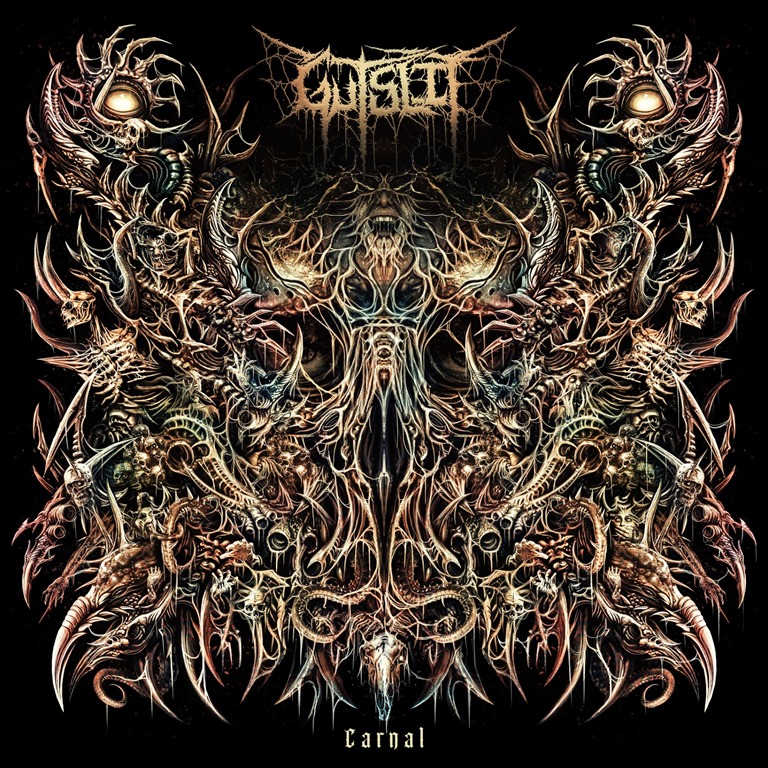
When it comes to band names, metal is one of those genres that has a unique way of throwing out monikers that mean you know it’s a metal band just from the name – unless, of course, you can’t read it because of the unintelligible spiky logo, in which case you absolutely know what to expect without even knowing the name. Indian deathgrind act are a quintessential example. Just look at that cover! It’s all the thorns – and it encapsulates the listening experience perfectly. Yes, it’s sharp, it’s a set of songs that snags and tears at your skin and your psyche.

Fifteen years into their career, Carnal is their third album, and if it sounds like that’s perhaps slow progress, the eight brutal cuts on here suggest that the time goes into compressing everything down to its tightest, densest form, honing it to the point at which its mass and velocity is absolutely optimal.

With the exception of the six-minute epic closer and the forty-one second blast of mid-album track ‘Insidious’, the songs range between around three-and-a-half and four minutes – and they pack everything into these compact sonic slabs. They don’t do fiddly, twiddly stuff, and there are no squealy notes or solos, apart from on ‘Bodysnatcher’ where they work -and wank – all the frets in a frenzy: this is music which sounds like it’s the output of a car-crusher – compacted, mangled, brutally fucked and as dense and weighty as it gets.

The album’s themes are clear from the song titles, with opener ‘Son of Sam’ setting the tone, ahead of ‘Bind Torture Kill’, ‘Body Snatcher’, and ‘Alter of Putridity’, which, like the font and everything else, pretty much speak for themselves. They’re well into their serial killer shit, but as I observed just the other day, this stuff is mainstream now. Pouring over mass murder and serial killing is no longer the domain of trenchcoat-wearing loners who aspire to wreak their own revenge on this cruel world; it’s David Tennent on ITV scoring eleven million viewers per episode.

That doesn’t mean that this kind of brutal tempestuous racket is mainstream, but people can no longer judge the work of a band like Gutlsit as sick or perverse when their subject matter is primetime. We’re all murder junkies.

‘The Killing Joke’ opens with a sample from an interview with notorious sadistic serial killer John Wayne Gacey (who makes Son of Sam with his seven victims look like a mere hobbyist), saying ‘The dead won’t bother you. It’s the living you gotta worry about’. Gracey may have been somewhat flippant in his remarks, but he had something of a point.

Gutslit sound neither dead nor living, their grating attacks sounding more like the undead on EST, a least vocally, and they go all out to deliver punishing intensity on a satanic level. It’s a churning mass of guitars that grinds at your guts as beats blast so fast as to blur to a flickering rattling sound rather than form an overtly structured rhythm. The obligatory guttural vocals growl and snarl, switching between styles fast and often between growl and barks, coughs and vomiting streams of vowels. It’s frenzied, demonic, furious. It sounds murderous, it sounds brutal, disturbed and disturbing.

‘Primeval’ is slow in terms of chords, but countered by a thunderous rush of beats, which renders it disorientating, harsh, and high on impact, and as a whole Carnal is pretty nasty – just as intended.

AA

407112