Posts Tagged ‘Sludge’

Human Worth – 20th May 2024

Christopher Nosnibor

The latest album from Norwich based two-piece Kulk, It Gets Worse, arrives two and a half years after the release of We Spare Nothing, described as ‘thunderous and experimental’, and honing their ‘unique and monolithic brand of heavy doom and sludge’.

The timing – and the title – couldn’t be more apt. Just when you were probably thinking we’d endured the absolute worst of life on this planet – from Brexit and Trump via a global pandemic and insane inflation and everything money-related being utterly screwed and still getting more painful by the day after 14 years of a Conservative government – it continues to get worse – half the world is at war, the other half the world is either flooded or in flames, and there are mass killings practically every other week. It’s not, then, simply a nihilistic strapline to grab the attention, but pretty much a demonstrable fact. Things never get better – only worse.

The band articulate both the circumstances and the mood when they frame the album thus: “This album is about the universal suffocating weight of hoping for more while navigating a climate where the apparatus for seeking it is being consistently undermined. What it feels like to not only struggle keeping your head above water but to try jumping out from the deep end without losing your trunks. It is selfish guilt and misplaced woe, desire is a distraction from the world at our feet”.

Bookended by short instrumental intro and outro tracks, ‘More’ and ‘Less’, It Gets Worse packs back-to-back balls-out riff-fests, where the bottom end sounds like a bulldozer and the beats sound like bombs. Whereas a lot of stuff on the doom and sludge spectrum is simply plain slow, Kulk are masters of the tempo shift. ‘A Heavy Sigh’ comes on at pace and builds a real groove, before hitting the breaks around two thirds in, at which point it becomes reminiscent of Melvins. The reason Melvins have endured is that – perhaps despite the popular perception – they’ve showcased a remarkable versatility and an urge to experiment, and it’s here that the comparison stands strongest with Kulk: they’re not just big, dirty riffs and shouting, although they do a first-class job of putting those things up front and centre. ‘Out of Reach’ is a pounding, raging roar of frustration amped up and overdriven to the max, hitting that perfect pitch at which blasting out a repetitive riff at skull-splitting decibels is the ultimate catharsis and the only practical and sane response to the world in which we find ourselves.

Things take a turn with ‘Mammoth’ showcasing a more hardcore bent initially, before descending into a howl of feedback, a noise-rock quasar delivered with the most brutal force. The vocals are barely audible, and then things get ever harder and harsher on ‘Beyond Gone’ which goes full industrial, hammering away at a simple, repetitive chord sequence with murderous fury. You feel your adrenaline pumping as they thunder away, combining pure precision with absolute chaos as feedback swirls and squalls all around like an ear-shattering cyclone.

The slower ‘Fountain’ shows considerable restraint and makes for an oppressive four minutes: it brings a bleak mood, and the hit lands late but hard when the distortion slams in. Getting Adam Sykes of Pigsx7 to play on ‘Life Will Wait’ is a major coup, and the track is a belter, built around a hypnotic three-chord riff – because all the best riffs have three chords – and really works the quiet/loud dynamic to the max.

Often, when people – particularly people in my demographic – write of the music of the 90s, it’s with a dewy-eyed nostalgia for their lost youth. Sure, I have my moments, but when I say that It Gets Worse takes me back to the 90s, I’m recalling the excitement of discovering endless obscure little bands cranking out major racket in pubs and tiny venues, some of whom managed to either get records or CDs released by shoestring labels, or otherwise scrape together funds to record and release a 7” or CD – and many of whom didn’t, and only exist in hazy recollections. The point is that these were exciting times. The only positive about living in shit times is that shit times make for good music, as people need an outlet to channel their pain, anguish, frustration, and rage. It Gets Worse is saturated with pain, anguish, frustration, and rage. And because of that, it’s very much a product of our times, and it’s absolutely essential.

AA

AA

a2498304630_10

We love a bit of Pound Land here at Aural Aggravation, so we’re particularly proud to be able to break some news and present an exclusive in the form of the video for ‘Pistol Shrimp’ waaaay ahead of the release of the forthcoming album.

Following 2023’s critically-acclaimed album Violence, Pound Land return with Mugged which despite being their 7th album release, is their first to have been fully recorded in an actual studio.

Recorded live in one intense day at Tremolo Studios, Stoke-on-Trent (UK), Mugged is a 48-minute whirl of raw frustration, kitchen-sink surrealism and filthy noise-punk sludge, soundtracking vitriolic stream of consciousness societal observations.

It’s also the first album to fully feature the full Pound Land band that many experienced on last year’s UK tour: Founding duo Nick Harris and Adam Stone, along with Rich Lamell on bass, Steve Taylor on drums and Jo Stone on sax. Additionally on this album, Jase Kester of Omnibadger/Omnibael joins on electronics.

Check it here:

AA

cover

Sacred Bones – 1st December 2023

Christopher Nosnibor

Released simultaneously with the reissue of their eponymous debut, Khanate’s second album originally released in 2003 – which is, incomprehensibly, 20 years ago further evidences just how far out they were at the time. And the time is worth assessing: in 2003, Nu-Metal was in its final throes, and Post-Rock was in the early arc of its ascendency. It was something of a wilderness time in many respects, with no real dominant trend: it was the year Avril Lavigne and Evanescence broke and Muse exploded, amidst an ocean of limp indie and even shitter commercial pop and r’n’b. The underground was the only place of interest, but even in those underground circles, there wasn’t anything quite like this.

The bio accompanying the release points us toward the darkness that pervades the album and does so from the start: ‘“Pieces of us in my hands, on the floor, in my pockets/red glory,” Dubin howls on opener ‘Commuted,’ setting the stage for Khanate’s second installment of existential dread. Dripping in death, murder and desperation, the album is somehow less forgiving than its predecessor. Which was probably the point”.

On this outing, they really do seem to have gone all-out to engineer an album that’s as stark and brutal as is possible, and the four tracks are drawn out to torturous lengths to achieve maximum discomfort. The aforementioned opener, ‘Commuted,’ is over nineteen minutes long, and the instrumentation is sparse, minimal and heavy with lugubrious atmosphere, while Alan Dubin howls like he’s having his fingernails pulled out slowly and painfully, one by one. It’s as bleak and harrowing as one of Derek Raymon’s ‘Factory’ series novels. It’s not pleasant, not even slightly, it’s not even enjoyable, but it’s perversely compelling. When a rhythm and guitars do coalesce, it’s at a glacial BPM, the kind of crushing, feedback-strewn, bludgeoning grind of Swans around the time of Cop, but with the more paired-back, spacious sound of Greed and Holy Money. But Khanate didn’t simply take these as templates – they scrawled all over them and then trampled on them in order to forge something even more challenging and even more fucked-up. There are lengthy passages where there is little more than crackle and hum, and the occasional burst of percussion. It may employ the tropes of avant-garde jazz, but it ain’t jazz. But what it is is hard to define. It’s not industrial, and it’s not doom. It’s not really metal in any recognisable form. But it is heavy. And it is unsettling, harrowing, and an absolute endurance test.

By the end of ‘Commuted,’ you feel utterly beaten and find yourself wilting from the sheer brutality of it all. And then ‘Fields’ crawls in, lower and slower, taking obvious cues from Earth 2 and marking clear parallels with Sunn O))). This is sinister, chthonic, demonic, not so much other-worldly as nether-worldly. It’s almost ten minutes before the bowel-juddering billows of overdriven, low-tuned guitar slides in like a slow-crawling river of lava. It’s monstrous, ugly, explicitly outright horrible. The hovering hum that takes hold around the fifteen-minute mark isn’t in any way a calming pause, but a nuclear wasteland of tension that pressurises the skull. Dubin raves maniacally like a psychotic locked in a soundproofed cell, and there’s a sense that the whole of Things Viral is a prison, whereby the listener is trapped within walls of sound. ‘I did this for you’, he screams murderously. It doesn’t sound like a kind favour, but like it’s time for payback. It’s chilling and grotesque. This is a fair summary of Things Viral overall. Even the quiet segments – and there are many – are occupied by sections of such weight that make your body feel as if its being dragged down, not by gravity, but by a darker force, one which will suck your very soul.

‘Dead’, at ten minutes, is but an interlude, but it radiates serial killer raving lunatic mania vibes for its entire duration, as the guitars throb and burn. It’s messy, and so, so heavy: you feel the pressure in your ribs, a weight in your limbs. The final track, ‘Too Close Enough To Touch’ is an absolute monster, which sits more closely alongside the harsh noise and overt extremism of Whitehouse and the point at which industrial strains its mangled way into power electronics than anything even remotely metal. ‘Stay inside… stay inside’ Dubin snarls, his vocals distorted and crazed. You barely dare move a muscle, let alone leave the house.

Things Viral goes way beyond darkness, and plunges into purgatorial depths that would have terrified Milton, and 20 years on, still sounds like the dankest, nastiest thing you could hear in any given year.

AA

a2725064236_10

Cruel Nature Records – 29th September 2023

Christopher Nosnibor

Following the stop-gap video release of ‘Liar’ from their singles compilation, Manchester’s most miserable are back with another long-player.

For their sixth album, they promise ‘eight filthy tracks of vitriolic desperation’ on a set that ‘often veers towards a nineties alt-metal/industrial sound, along with the usual smatterings of customary Pound Land abstraction…In addition, this new album continues to aggressively push lyrical themes relating to the same old shit that seems to be getting worse: corporate hegemony, business culture, mainstream media influence, automation, class polarisation and economic austerity.’

I sit in the dim, narrow ‘spare bedroom’ that is the office where I work my day-job by day and write reviews by night, slumped, exhausted by life. I moved into this house ten years ago, and while I was fortunate to be able to buy it, it was previously a magnolia-coated rental with fire doors and stain-forgiving turd brown carpets throughout. The fire doors may be gone, but my poky office which, measuring 7 feet by 12 feet, would make for a fucking tight bedroom, still had the turd-brown carpet, because when presented with the choice of food and beer or a new carpet, carpet seems like an extravagance I can survive without. I realise and appreciate that I’m fortunate: I can at least afford both food and beer.

If Pound Land’s releases seem to plough the same furrow only deeper and laced with a greater despondency, that’s largely the point. As they say, ‘the same old shit that seems to be getting worse’, and that’s the shit that’s grist to their mill. No doubt their mill will be sold off or shut down, or knocked down to make way for a hotel or flats before long, but for the time being at least, they’re still plugging away. And thank fuck they are.

Yes, there is a rising swell of music that’s telling it like it is: if Sleaford Mods led the way, it’s been a slow trickle rather than an opening of the floodgates in their wake, most likely because people are too busy working overtime in their day jobs to pay the electricity bill to make music, but lately we’ve seen these guys, plus Benefits, Kill! The Icon, and Bedsit calling out the shitness of everything. And make no mistake: everything really is fucking shit, unless you’re a fucking billionaire.

‘Programmed’ barrels in with a squalling mess of grimy bass and screeching electronics reminiscent of Cruise-era Whitehouse, and it’s a sonic amalgamation that’s painful and penetrating, hitting the guts and piercing the ear drums simultaneously. The thunderous ruff buries the drums and when the snarling vocals enter the mix, spitting vitriol with blinding rage, everything combines to tear forth with a wall of nihilism that’s in the same field as Uniform. Then – what the fuck? Wild roaming saxophone sprays all over before another onslaught of rabid rage. It’s seven and a half minutes of devastating carnage that leaves you feeling hollowed out and wondering where they could possibly go from here?

More of the same, of course: grimacing and with gritted teeth, they grind, thud, trudge and bulldoze their way mercilessly through another six tracks – and half an hour – of relentlessly grey sludge, by turns angry and despondent.

Like Sleaford Mods, Pound Land’s compositions are built around monotony and repetition, but whereas the former place predominant emphasis on the lyrics, the snappy wordplay and caustic commentary, Pound Land batter and bludgeon repetitive lyrics in the way that Swans did in their early years, and their music is very much a mirror of the crushing effects of drudgery. It does articulate the gut-puling anguish of the everyday, and in the most direct way possible.

The raw, raging punk of ‘New Labour’ offers a shift in tempo, but it still sounds like it was recorded on a mobile phone left in a corner of the rehearsal room.

The majority of the album, though, is a succession of crawling dirges dominates by overloading bass. The lyrics are simple, direct – when they’re audible. ‘Fuck the facts and roll the news’ Adam Stone yells repeatedly over a bowel-busting bass growl on ‘Media Amnesia’. ‘Life is so much easier / with media amnesia,’ he spits before launching into a brutal rant – one of many.

There is absolutely no let up on Violence. It’s hard and heavy, uncompromising and unpleasant. Even sparser tracks like ‘Low Health’, where it’s more spoken word with churning noise, the atmosphere is never less than crushingly oppressive, harrowingly bleak.

The last track, ‘Violence Part 2’ is five minutes of brutal racket that’s the nastiest of lo-fi- sludge and which is the perfect encapsulation of the album as a whole. It’s grim, it’s bleak, and it’s supposed to be.

Rarely has a band so perfectly captured the zeitgeist through a horrible mess of noise that makes you physically hurt and ache and feel like you’re being subjected to an array of tortures. This is the world. This is Britain, in 2023. If you’re not a millionaire, you might as well be dead. It’s what they want. Poor, disabled? Fuck off and die. This is the grim reality of the world Pound Land present, and while that isn’t actually one of their lyrics, the bleak message is clear: we’re fucked.

AA

a1836109826_10

Human Worth – 15th September 2023

Christopher Nosnibor

It may not be apparent from my review output, bur I am uncomfortably familiar with experiencing torpor. That weight that descends like a cloak and simply loving is as much as you can manage, and in no time, half an hour, an hour has elapsed, and… what? Where does the time go? Where does your life go? For many of us, work eats our lives, as does just doing whatever it takes to keep afloat and on top of things. I will admit to being less familiar with abscission, which I had to look up to find that it’s ‘the shedding of various parts of an organism, such as a plant dropping a leaf, fruit, flower, or seed. In zoology, abscission is the intentional shedding of a body part, such as the shedding of a claw, husk, or the autotomy of a tail to evade a predator,’ according to Wikipedia.

I get the sense from listening to Abscission that this shedding is rather more metaphorical, and that the album is more of a work of catharsis, shedding skins and layers of shit, of unwanted emotions, to feel lighter, to emerge somehow freer, less encumbered by emotional baggage. But this is also something else. More than merely a shedding of dead skin, the experience of listening to Abscission is closer to tearing the skin from your body, the flesh from your bones to escape your corporeal being. Bloody, brutal, unspeakable pain.

On Abscission, Torpor bring the weight, the crushing weight that drags you down at every limb, your spine, your guts, your heart. The first track, ‘Interior Gestures’ is pure leaden punishment. It starts with megalithic raging, guitars like slabs of basalt, the guttural vocals growling and snarling beneath it all, before shifting into a dark yet graceful expanse, and for a moment, you can breathe, and feel a radiant energy. There’s something about slow, heavy music which is, in some instances, uplifting, and Torpor’s gentler passages are truly magnificent, delicate, elegant, even.

‘As Shadows Follow Body’ has a few delicate moments, but for the most part, it’s simply devastating. If the likes of Neurosis and Amenra are perhaps obvious touchstones, where Torpor stand apart is that they make both bands sound like PWL era Kylie. This goes beyond heavy. When everything is churning low and slow, you feel your muscles wilt and body sag. It’s how you perhaps imagine being hit by a truck, or the implosion of a submarine where the intense pressure simply collapses your body. I may be alone or in a very small minority in imagining these things, but sometimes, articulating the experience of particularly intense music requires something of a stretch when it comes to articulation, and most similes and metaphors simply fall a long way short.

I can’t decide – perhaps because my brain is melting – if it’s appropriate or ironic that listening to Torpor should induce torpor. I’m feeling numb, weary, my back and libs ache, likely from spending hours observing bad posture practices during my dayjob before returning to the same position to sift take care of life admin and review submissions. And listening to Abscission only seems to accentuate my aches, because listening to it feels like carrying a heavy load, for miles, in intense heat.

‘Accidei’ locks into a grinding repetition that’s reminiscent of early Swans or Godflesh, and crawls sluggish and sludgishly, before the album’s shortest song, ‘carbon’ ploughs into the depths and tears the ground apart.

‘Island of Abandonment doesn’t so much plunge new depths of heavy, as sound like the real-time death of an underworld god. It does pick up the pace around the midpoint, building to a sustained crescendo that feels like a typhoon. By the end of its enormous eleven-minute assault, I find myself at a loss. I’ve been covering heavy music for a long time, and have spent it developing my descriptive vocabulary. But words fall short, so short, in the face of this. This is another world. Enter it at your peril.

AA

a1160466171_10

Invada Records – 30th June 2023

Christopher Nosnibor

You know what? This never gets tired. I started reviewing live stuff in the 90s, but it wasn’t until 2008 I started receiving albums for review. Receiving albums ahead of release was a big deal back then: it made me feel somehow special. Advance promos probably meant something more then, on reflection. They would be, more likely than not., a single CD – or even a single-track CD – and my objective would be to get my review out ahead of, well, as many people as possible. It wasn’t so much about generating buzz as feeling a buzz.

I miss the steady drip of CDs and vinyl through the letterbox, although am coming to accept that space is an issue here, and if the endless bombardment of emails with downloads and streams sometimes – often – feels overwhelming, with up to fifty review submissions a day, when I clock a release I’ve been getting excited about well before time, the buzz still hits.

The way albums are released now isn’t quite the same, either: time was when there would be a single or two ahead of release, there’d be reviews and then the album would arrive and you’d have to buy it to hear it. Now, singles aren’t really singles and half the album’s been released on various streaming platforms along with a bunch of lyric videos and ‘visualisers’ (that’s one for another time). But having only slipped out a couple of tracks in a relatively low-key fashion in April and May, this landing in my inbox to download ahead of release, gave me a genuine buzz.

Gas Lit, released in 2021, was a powerful, album on so many levels. As they put it, the album was their ‘fight for Indigenous Sovereignty, Black and Indigenous Liberation, Water, Earth, and Indigenous land given back.’. The Australian duo make music with meaning, and do so with passion and sonic force.

How often do we hear recently that the failings were systemic? Systemic failings in the NHS led to deaths, and systemic failings in the schooling system resulted in kids committing suicide, systemic failings in vetting and so on has resulted in a culture of racism and misogyny in the MET police… daily, we hear or read news about systemic issues. And we know, we know the system is fucked. Not merely flawed: fucked.

And on fourth album Systemic, Divide and Dissolve examine ‘the systems that intrinsically bind us and calls for a system that facilitates life for everyone. It’s a message that fits with the band’s core intention: to make music that honours their ancestors and Indigenous land, to oppose white supremacy, and to work towards a future of Black and Indigenous liberation.’

“This music is an acknowledgement of the dispossession that occurs due to colonial violence,” says Takiaya Reed, saxophonist and guitarist in Divide and Dissolve. “The goal of the colonial project is to separate Indigenous people from their culture, their life force, their community and their traditions. The album is in direct opposition to this.”

Divide and Dissolve represent a people for whom the system hasn’t failed: it was always pitched against them, and succeeded in stripping Indigenous people of everything. What kind of system is it where this brutal debasement is a success? A capitalist one, of course.

Systemic certainly isn’t a flimsy pop record, then. But it is inherently listenable and does unashamedly incorporate pop elements, and this dynamic only serves to heighten its sonic power.

‘Want’ lulls us into a false sense of tranquillity, a looping motif pulsating over grand drones: it’s quite pleasant, even. And then ‘Blood Quantum’ hits: after a delicate, supple chamber-pop intro, the guitars crash in and it’s like a tidal wave. It’s a slow-stomping riff that grinds hard, and the textures are thick and rich.

The setup is simple, and the guitar and drum combo has become increasingly popular in recent years – but for all of its limitations, it also has considerable versatility, and Divide and Dissolve exploit and push those parameters by exploring the interplay between the two instruments when played slow and heavy and at high volume. And so it is that without words, their songs convey so much.

Photo_by_Yatri_Niehaus_516198

Photo by Yatri Niehaus

There’s almost something of a Duane Eddy / Western twang to ‘Simulacra’ before it explodes in a thrashing flurry of distortion and pummelling percussion. But for all the sludge-laden noise of ‘Reproach’, there is a grace and beauty about it, too, and this is what differentiates Divide and Dissolve from their myriad ‘heavy’ contemporaries: they imbue their songs with a palpable emotional depth. ‘Indignation’ begins with trilling woodwind, and possesses a wistful, aching jazz vibe before the thunderous deluge of guitar and drums heaps in. Featuring a spoken word recital from Minori Sanchez-Fung, ‘Kindgom of Fear’ is the only one of the album’s nine tracks to feature vocals: it’s a more minimal musical work which allows the words to stand to the fore, supplementing them with atmosphere and adding further variety and contrast to the album, notably ahead of the ragged riffery of ‘Omnipotent’.

The tranquil strings of ‘Desire’ provide the perfect bookend to stand opposite ‘Want’, and their synonymity is highlighted in this way. To want, to desire, something – something back – seems reasonable, should not need so much fight… but while there is the need to fight, Divide and Dissolve make protest music. It may not be protest music in the way many of us recognise it, but slogans and punk and folk are tired and worn, and on Systemic, Divide and Dissolve speak in their own strong and powerful way.

AA

644835

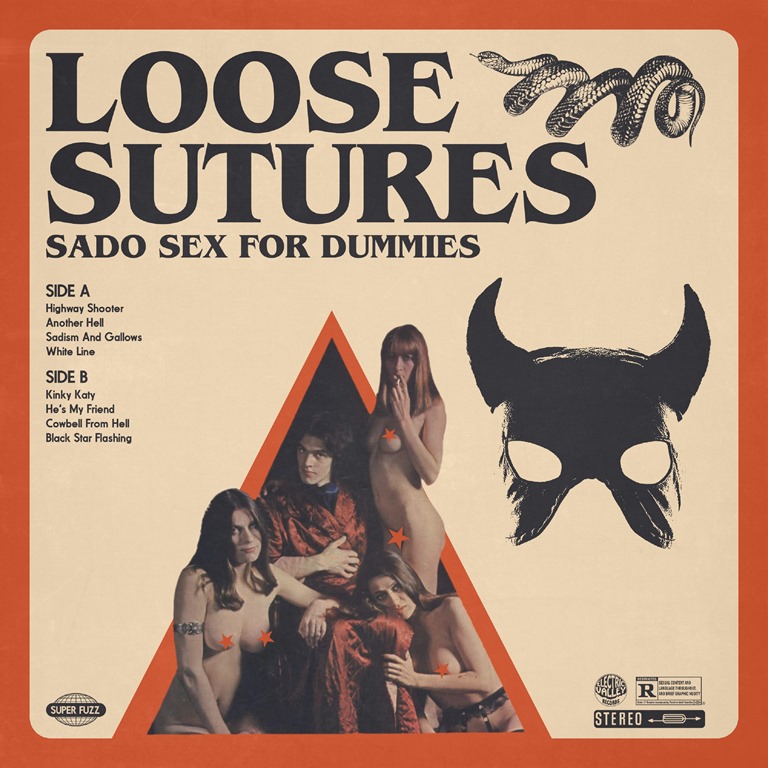
Fuzzy stoner/garage punk group Loose Sutures has released their third record, Sado Sex for Dummies, today (26 May) via Electric Valley Records. The Sardinian act’s first studio outing as a trio, the album features a couple of other guests, including the heavy rock royalties Nick Oliveri and Alain Johannes.

States Loose Sutures: “Sado Sex for Dummies is the ultimate guide for all the pervs across the globe! On this sticky tour, you’ll find all you need: how to escape from a party gone wrong and survive a spell to your bone, chronicles from a highway shooter, valentines from Lucifer, and so much more. So whip out the whips and let’s welcome violence!”

Listen here:

Assembled in 2019 by four roughnecks, Loose Sutures plays classic ’70s riffs with a pinch of modern punk attitude, conjuring a blend of stoner and garage energy and displaying an abundance of evil beats, venomous fuzzes, and raunchy lyrics. Loose Sutures’ music has been praised by fans and critics for evoking a dark and seductive atmosphere reminiscent of cult exploitation movies.

Depicting killer profiles and kinky love stories, the Sardinian group presented their self-titled debut LP in March 2020 via Electric Valley Records. They followed it up with the sophomore album, A Gash with Sharp Teeth and Other Tales, the following year via Electric Valley Records; it later saw a Japanese edition in the Spring of 2022. Introducing the newly recruited Giuseppe Hussain (who replaced Gianpaolo Cherchi, guitars/vocals), the album is “a journey delving into lust with filthy guitars, stoned rhythms, and creepy voices escorting you deep inside the sticky core of what you fear yet desire at the same time.”

Loose Sutures again encountered a lineup change in 2022 when Giuseppe Hussain left the band, leaving the band to operate as a trio. It was a setback, but they refused to let it hold them back. Longtime fellow Marco “Grey” Manca joined to take care of the role of Giuseppe on the “High Heeled Barbarians Tour” around Europe the same year.
Sado Sex for Dummies, as the name hints, is a complete handbook to satisfy the needs of the pervs, sadists, and killers out there. An invitation to indulge in fuzz-drenched, punk-‘n-roll violence, this third record from Loose Sutures has no shortage of lurid stories. While there is a touch of evolution, the album has not strayed too far from the band’s established hard, fast, and crude sound. To add more spice to some songs, the album features some guest musicians, including the legendary Nick Oliveri and Alain Johannes.

Get ready to be taken on a frenzied ride into the depths of your darkest desires.

AA

c2357397-ad8c-5657-a879-8941fe60b354

Human Worth – 17th March 2023

Christopher Nosnibor

For context, I shall quote from the notes which accompany this release: ‘Old Mayor are Adam Kammerling and Owen Gildersleeve (Modern Technology / Human Worth). They were most active between 2005 – 2009 sharing bills with the likes of Boris, Russian Circles, Heirs, A Storm of Light, Orange Goblin and ASVA. ‘Shelter Ceremony Collapse’ was recorded during a stint in New York in the winter of 2008, where the duo laid down this beastly three track, recorded by Chris Pierce at Technical Ecstasy Studio in New Brunswick. But the recording never saw the light of day, with the duo parting ways soon after.

‘Fifteen years later, on hearing the news that legendary Brighton promoters Tatty Seaside Town, who’d given the band their first shows back in the early years, were calling it a day and putting on a final weekender the duo felt it was the right time to finally come back together. To celebrate they unearthed this EP.’

They certainly achieved a considerable amount during their time active, but left a scant record of it in the form of a critically-lauded eponymous five-track EP, which makes the immensely-belated arrival of this archival recording all the more welcome, and for those unfamiliar with them the first time around (myself included), Shelter Ceremony Collapse provides an outstanding introduction.

There’s an adage about how you treat people when you’re on the way up, and this release and the circumstances surrounding it are very much characteristic of Owen and Human Worth: not only reconvening Old Mayor for a farewell concert, but releasing the EP with a portion of proceeds going to charity speaks for the nature of the people and the operation.

As for the EP itself… While the title has a ring to it as a phrase, while conjuring mental images of crumbling edifices and societal disarray and something vaguely post-apocalyptic (or perhaps I simply have a vivid imagination which steers oof its own accord toward the bleaker, darker prospects), it’s also the titles of the EP’s three songs in the order they appear.

That said ‘Shelter’ is so heavy it almost brings about its own collapse inside the first two of its monstrous six minutes. It’s a slow, dirgy tune that begins delicately with clean, picked guitar, building a misty atmosphere of mist and loam, the resonant timbres of the strings rich and earthy and redolent of Neurosis – and then the distortion and drums pound in, hard and heavy and hit like a tidal wave crashing with full force against the abdomen and knocking the air from the lungs.

Kammerling’s screaming vocals are largely buried beneath the sludgy landslide; he sounds possessed, but is barely audible for the downtuned sludge, and Owen’ hard-hitting drums cut through with thunderous force.

‘Ceremony’ is but an instrumental interlude, a cacophony of shrieks and wails. It may only be a couple of minutes long, but the sounds of tortured souls leave you feeling unsettled and uncomfortable, which is either a bad state or the ideal state to receive the shuddering blast of the crushing ‘Collapse’. It’s properly heavy, snail-paced doom, and it’s potent, powerful stuff.

It would be wonderful to think that the one-off reunion wasn’t a one-off, and that it might spur more performances and perhaps even more new material – but they’ve already spoiled us, and Shelter Ceremony Collapse is the perfect release to expand and confirm their place in the annals.

AA

a3926787574_10

Pelagic Records – 5th May 2023

Christopher Nosnibor

‘Biblical’ has become a byword for something tremendously large, epic, or of intense proportion, but also brutal and torturous and bloody. King Herod the Great is perhaps best known, not for his extensive construction projects, but for ordering the slaughter of the innocents: fearful of the threat of a ‘new king’, the story goes (although only according to Matthew) that he ordered the execution of all male children who are two years old and under in the vicinity of Bethlehem. The legend has inspired some pretty horrific depictions in art, from Duccio Di Buoninsegna to Reubens, and in context, Herod is an outstanding name for a metal band. And Herod live up to their name, too.

Iconoclast is a clear step on from Sombre Dessein, released in 2019. Back then, they were touting a ‘progressive sludge’ sound: in contrast, their lasts bio sees the band describe themselves as ‘atmospheric groove metal’.

“I’m obsessed with late 90’s Meshuggah, early Dillinger Escape Plan, and early Cult of Luna,” explains guitarist Pierre Carroz deftly about the influences behind the sound of his brainchild.

But for all the stylistic progression, thematically, they’re still squarely focused on the societal scourge of religion, as the title suggests, and it kicks off hard and heavy with ‘The Icon’, a barrelling, churning grind of dirty guitars which at the most unexpected moments switch tempo and gets tetchy and technical. Then, just shy of five minutes on, there are some clean, drawling vocals reminiscent of Alice in Chains – but disembodied, bent, it’s like Layne Staley is calling from the other side, and within just six minutes and a single track, Herod have slammed down a whole album’s worth of ideas.

The thematic thread is also apparent in the song titles, all of we which are ‘The…’ something. If imbues the album with a sense of being a book with the songs as chapters with corresponding titles which guide the way through a discursive exploration. Only, that discussion is a blast-out, a levelling by force.

There are eight tracks all, most well over the six-minute mark, and they blend sedated melodies with expansive guitar, raging, raw-throated vocals and thunderous percussion. There are slow, sedate passages, as on ‘The Girl with a Balloon’ which invite comparison to the earthy, low-tempo grit of Neurosis, and they really bring the weight when the riffs crash in. As much as the monolithic power chords dominate, the earth-shattering bass is absolutely essential to the sound.

‘The Ode to’ marks a significant shift in form, a resonantly vocal chorus scaling the heights and looking upwards to the heavens, a works of majesty that speaks to the ethereal and the eternal – but over the duration, the guitars harden and drive until the mid-point achieves a punishing plateau of distortion before returning to a mesmerising sway brimming with Eastern promise – before once again a landslide of guitars bring absolute devastation.

Herod get devastation, and get atmospheric, too. They get the merit of a melody, but tend to really delay gratification in favour of punishment before reward. Mostly, though, they get the power of punishment, and they mete out plenty of that over the course of fifty minutes. It’s a big fifty minutes, and it’s as heavy as fuck.

The nine-minute finale is heavily immersed in progressive sounds and styling, but when the crushing riffs blast in, all is well.

For all of the moments of levity and mindfulness, Iconoclast is everything fans – myself included – would want from Herod – snarling, churning riffs and roaring vocals, which combine to absolutely devastating effect. They’ve certainly evolved, but they’ve not lost sight of their sound, and have simply expanded it.

The resultant Iconoclast is an absolute monster.

AA

a1021108326_10

Svart Records recently announced the release of Unissa palaneet, the sophomore album by the Helsinki quintet Radien. Having begun their existence on the earthly plane in 2014, Radien have forged their brand of idiosyncratic amplifier worship with passion that is in full bloom on Unissa palaneet. The debut album SYVYYS (2018), given a warm welcome by the international doom/sludge crowd, swam in murkier and more monotone waters, whereas the follow-up presents breathtakingly heavy widescreen sludge that paints its oozing black hues in technicolor.

Unissa palaneet tells a story of a person who finds a calm spot inside himself or herself amid chaos, and starts to see visions and dreams of the end times of humanity. The band comment,

“The protagonist’s dreams turn lucid, and he/she understands them being prophecies of the future. He/she understands being capable of altering the course of history through his visions, but in the end decides that it is best to let things happen as they are meant to happen and not intervene in anything. In the end the dreams and visions mix with one another and become reality. Nature strikes back at humanity and in the end the human era ends in flames and ash”, comments the Felipe Hauri from the band.

According to the band new single ‘Seinämän Takana’, which features Dylan Walker from Full of Hell "depicts a moment when the boundaries between dreams and reality break. Dreams and visions are no longer merely dreams, but omens waiting to manifest themselves in reality.”

Listen to the single now:

AA

0vzDw2_Y