Cardiff Shoegazer’s ‘WYLDERNESS’ are back with a brand new single. ‘Big Idea’ will be released digitally on Monday 18th of November 2024.
Taken from their forthcoming new EP entitled ‘Safe Mode’ which will be released in 2025.
Woozy sun-drenched pop wrapped in a wall of stabbing fuzzy guitars and mesmerising shoegaze,echoing the sounds of Ride, DIIV, Sonic Youth and Yo La Tengo.
Wylderness’ eponymous debut album, released in 2018, was championed by Steve Lamacq (BBC 6 Music), Huw Stephens (BBC Radio 1) and was part of Radio 1’s Best of BBC Music Introducing. It garnered critical acclaim from Clash, DIY and Drowned in Sound, with the song On a Dais being featured on the US version of the TV show Shameless.
Wylderness have played shows for Huw Stephens, Sonic Cathedral, Swn Festival and support with Acid Mothers Temple.
The Cardiff band’s second album, Big Plans for a Blue World (2022), was recorded with an expanded line up and featured added layers of vintage synths and clarinet. It placed no.28 in Far Out Magazine’s Best Albums of 2022 and charted in the North American College & Community Radio Chart.
Wylderness are Ian (guitars/vox), Jim (bass/guitars), Ben (drums/percussion), Dan (guitars/vox), and Harri (clarinet/keys).
It’s taken me a while to get around to this one. It happens, and happens often: I’m simply overwhelmed by the sheer quantity of new – and exciting – releases that land with me on a daily basis. Of all the things to be overwhelmed by (and I will confess that I often find myself overwhelmed by many other things, too, from parenting challenges to DIY, budgeting and the prospect of driving to the supermarket), I do realise that I’m extremely fortunate. But there’s a specific reason I’ve selected this album to post a review of today. Why today? For those who live in a vacuum – and at this moment, I truly envy you – today is the day Oasis announced their reunion and a fourteen-date UK tour. ‘The news the world has been waiting for’, people frothed on FaceBook. Fuck me: judging by the reaction and the blanket press coverage, you’d think world peace and a handout of million quid for every person on the planet had just been announced simultaneously. But no. Just a couple of gobshites have decided that for a few hundred million quid they can bare to be in one another’s presence for a bit. It’s not even looking like it’s the full or original band reuniting.
For many, Oasis were, and remain, the best band on the planet in the whole of history. For anyone with ears, they were purveyors of lumpen, lifeless, plodding, derivative pub rock. A great many of the people who are going absolutely fucking apeshit at the news are broadly in my demographic, who were in their twenties in the nineties, and who, on hitting thirty, found their cultural clock stalled, and they’ve spent the last twenty years or so bemoaning the fact that there’s no been any decent new music since the 90s and how they miss Chris Evans and TFI Friday.
Just as age tends to have a correspondence with increasing political conservatism, so the same is true of musical tastes. It’s why parents of every generation gripe about the music their kids listen to and dismiss it as being shite, without appreciating that they’re not supposed to like or even understand it, because they’re not the target audience. Do I get K-Pop? No, no more than Skibidi Toilet makes any sense or provides any amusement to me. It would be weird if I was down with the kids at the age of 48, and my daughter would likely find me even more embarrassing if I was than being the dinosaur she perceives me as. BUT – and it’s a massive but, a but so massive Sir Mix-A-Lot would die for, that doesn’t mean that there’s no new music of interest any more.
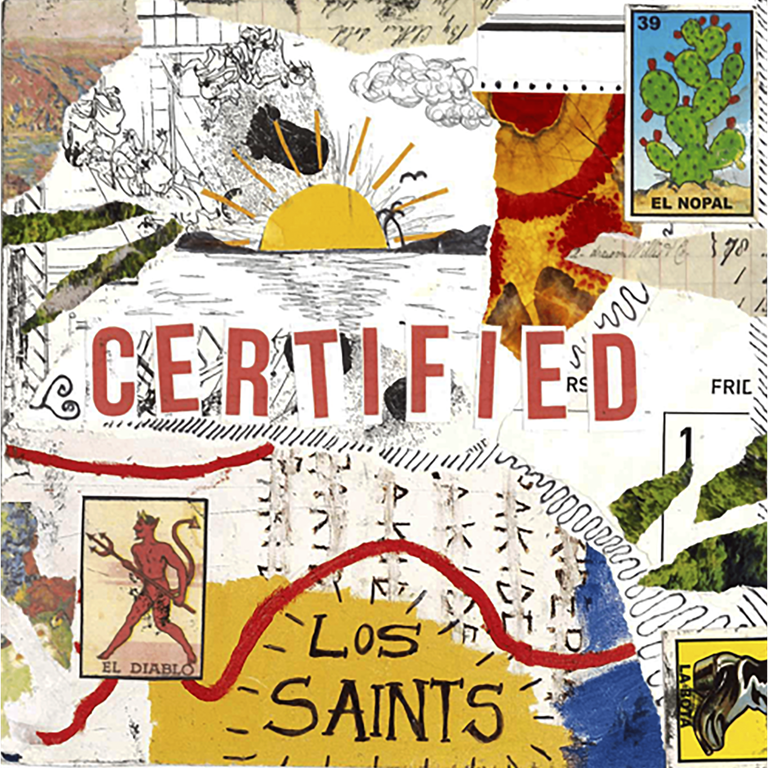
Certified, the debut album by San Diego-based Los Saints, is a perfect illustration of this fact. They describe themselves as an alternative rock band. Various other sources, in their coverage, have referred to them as showcasing a ‘bold indie rock sound’, ‘indie’, and even ‘Chula Vista’s version of Cage the Elephant’, alongside numerous comparisons to The Strokes. I’m not a fan of either The Strokes or Cage the Elephant, but that’s beside the point: both of these acts have produced music far more exciting than anything Oasis mustered during their career spent serving up half-baked bollocks and right now, in the present, amidst the endless wanking over the announcement that after fifteen years a couple of overrated has-beens are going to reheat their tedious, tepid stodge in the name of nostalgia and the interest of payola, we have Los Saints giving us Certified.
There are rib-rattling basslines aplenty, which give the songs – which tend to be on the shorter side, with only a couple of the album’s ten tracks running over three and a half minutes – a really beefy sound and a certain dynamism, an urgency (the likes of which you’ll hardly ever find in an Oasis song). Lead single ‘Faded’, which kick-starts the album with a lively two-minute stomp not only gets things off to a cracking start, but sets the tone, too – dreamy, slightly fuzzy, psychedelic vocals and mellow guitars contrast with the stonking rhythm section, and if anything, ‘Where We Goin’, which follows it is even better, and then again, the punky, poppy, melodic guitar driven indie of ‘Hard’, which lands perfectly between Asylums and Pixies. Even if the rest of the album was shit, after this opening run, you wouldn’t grumble. But no, they keep on delivering joyous tunes with the grungy pop nouse of DZ Deathrays crossed with the driving tones of Darklands era Jesus and Mary Chain and a dash of A Place to Bury Strangers. The title track pairs a nagging guitar with another chunky-as-anything bass before blasting into a breezy but sturdy chorus, and there simply isn’t a dud here.
The production isn’t overly polished, giving the album a live-sounding energy, and this only enhances its appeal, because you feel the band are really in the music, feeling the playing of the songs. Yes, some of the touchstones may be from some mythical golden era – as identified by people of a certain age – but Los Saints show that they can write songs – rather than rip them off – and deliver them with a contagious vibrance.
Bollocks to nostalgia: Certified is proof that not only is there some great new music around, but that a lot of stuff that’s held up as being ‘classic’ is objectively underwhelming and its status is tied to a period in time – and popularity is no measure of anything other than popularity itself – or, more probably, good marketing.
This may be Lanna’s debut single, but she’s by no means new to the industry, and has featured a couple of times here at Aural Aggravation with her band Miss Kill, who have garnered some thumbs up for their feisty grungy / alt rock sound.
Initially, I felt a sense of disappointment, assuming – erroneously, as it turns out – that the duo had parting and would never fulfil the early promise and future potential. It came as a relief to discover that Miss Kill are thriving, and have an album out soon, but in the meantime, Alanna is launching a parallel solo career. It’s a twofer!
But what’s interesting about Lanna’s debut single is that while her bio indicates a continuation of Miss Kill’s energetic flight, their emotive grunge stylings, again referencing inspiration from ‘Alternative, Garage and Pop artists like The Kooks, Hole, Cherry Glazerr, Chris Isaak, Placebo & Pearl Jam’, this feels like quite a departure. The premise is that, ‘rather than whine about breakups and having your heart broken’, ‘Forever’ ‘is all about the amazing feeling you get when you’ve found your special one.’
But for a song that’s so much about an effervescent emotional state, it’s remarkably subdued, with a soft, delicate piano, introspective vocal and backed-off drums with a hushed rimshot keeping slow and steady time. It may be a million miles wide of the mark, but this debut sounds for all the world like Lanna is pining for the thing she’s lost, a sad celebration for the loss of a special one as she finds herself bereft and alone.
That doesn’t mean that ‘Forever’ isn’t true to those principles of grunge and alternative rock, but probably feels more like a mid-album slowie than a lead single, and is more Chris Isaak than Pearl Jam or Hole. Still, it’s a well-realised song with an emotional weight that’s conveyed with sincerity, and leaves many doors open for future releases.
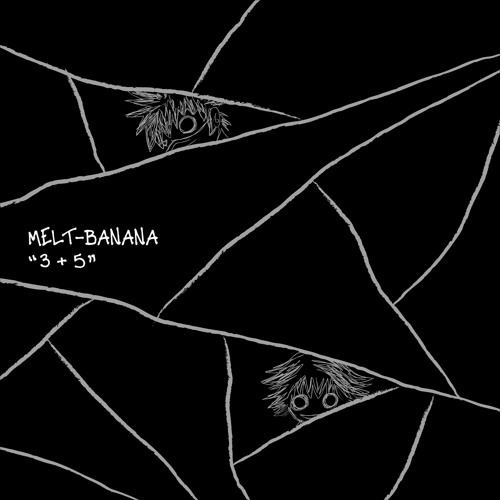
There is truly only one Melt-Banana. And Melt-Banana boldly encapsulate all of the craziness that makes Japanese music so peculiar and unlike the music to emerge from any other place. Here in the west, we can, in truth, only marvel at it – all of it. Because it makes no sense. It’s a country of extremes, with hyper-pop culture dominating, and a sense of plasticness and artifice defining the mainstream. But then, Japan is also the home of the most extreme noise – Merzbow, Masonna, for example. It’s not just extreme sonically, but beyond words in terms of performance.
The pitch for this, their eighth album, informs us that ‘3 + 5’ synthesizes elements of a variety of Extreme Musics, Hyper-Pop, classic Punk, vintage Metal, and Noise. It’s informed by Japanese culture in general, and the subcultures of gaming, anime and homegrown underground music in particular. The album’s nine tracks have been crafted to maximize the independent appeal of each song (since so many listeners will be streaming and playlisting these songs). Each selection boasts its own unique charm and ideas that beg for repeated listening.’
I had the good fortune to witness their live spectacle here in York not so long ago, and they were everything anyone even vaguely aware of their work would expect: intense, noisy, crazy, and wildly entertaining.
They create music that fits with the bizarre incongruity of their name – abstract, humorous, combining elements that don’t – or shouldn’t – really sit together – somewhat surreal, patently absurd, but also perhaps a shade Pop Art. Put another way, everything all at once, tossed in a blender and blitzed, the output being like a bubbling hot smoothie or something.
They do have a tendency to favour short and fast, as recent taster track ‘Flipside’ reminded us, clocking in at a minute and fifty-six. It does happen to be the album’s shortest track, but then, the longest is under three-and-a-half, and the majority of the nine songs are around the two-and-a-half minute mark. That means that with a running time of around twenty-seven minutes, the album would comfortably fit on a 10” record.
For a moment, ‘Code’ hints at something spacious, experimental and electronic to open the album – before seconds later, all kinds of sonic mayhem erupt and chipmunk yelping vocal squeak over something that resembles Metal Machine Music played at double speed, before it takes a turn into space rock territory, but again, at twice the pace, with some prog flourishes and a bunch or bleeps and widdly synths all criss-crossing over one another at two hundred miles an hour. For anyone for whom this is their introduction to Melt-Banana, they’ll likely find themselves dizzy and completely bewildered as to wat the fuck they’ve just heard. It is, unquestionably, utterly deranged, and at doesn’t get much more quintessentially Japanese than this.
‘Puzzle’ is kind of a high-octane rock tune, at least at first – but then someone hits the accelerator and in a blink you’re on ‘Rainbow Road’ on the N64 Mario Kart after eating three bags of Skittles and you’re totally wired.
Hyper doesn’t really cut it. Even the more expansive instrumental segments of ‘Case D’ happen at about 600bpm, and it’s like listening to a prog album at 45rpm.
As I listen, I find myself typing faster and faster, as if I’ve sunk six cans of Red Bull while chomping on a whole packet of Pro Plus. My fingers are pale blurs against my black illuminated keyboard, and they’ve seemingly run away from my brain and are just frothing out words in response to the frantic mania pouring into my ears – no, not pouring, but being injected by 10,000-volts of electrical current into my brain via my eardrums.
‘Scar’ slams big guitar rock and skittish melodic pop together like a banging of heads. It sounds like music from a computer game or an animated movie. It sounds like music made in a fictional context. Because in real life, music like this couldn’t exist. And in the main, it doesn’t. Only Melt-Banana are demented enough to actually make it.
Penultimate track ‘Whisperer’ goes big on dance / rock crossover and actually slows to a pace that doesn’t feel like a synaptic twitch or a seizure, before ‘Seeds’ closes the album with a two-and-a-half minute frenzy which chucks everything into the mix.
The whole experience leaves you feeling giddy, dazed, amazed. 3 + 5 may not bring anything radical, new, or revelatory to the Melt-Banana oeuvre, but stands as a classic example of what they do – and it’s as ace as it is nuts.
The latest single, ‘Forget About You’, from ‘nouveau post-punk troubadours’ Monta At Odds’ is pitched as ‘a dark-natured opus about resisting attraction, especially when the bound proves hazardous.’
The trio, consisting of Mikal on vocals, Krysztof wielding the baritone guitar, and founding member Dedric polymathing on all other sonics are aiming for a ‘danceable mixture of eras past and present to match this raw but crisp sound.’
It’s very much of the school of neo-new wave / post-punk from circa 2004-2006 – think of Editors breaking through, Interpol’s Antics, and the likes of The Organ, and The Cinematics – particularly The Cinematics, in fact – with the electro element of She Wants Revenge’s debut. It’s post-punk with that clear contemporary slant, and a heavy dose of New Order’s buoyancy and accessibility. There’s shade around ‘Forget About You’, but a lot of sunlight and vibrancy, too: the crisp, clean, vaguely brittle guitars positively jangle against a thumping disco beat, and the melancholy is cut through with eyes cast to bright blue skies and a forward-facing optimism.
It’s only while writing this that the fact 2004 was twenty years ago has begun to register. What goes around comes around, of course, but twenty years is a generation, broadly – it seems, in my ever-lengthening experience – and the time it takes for kids to start picking up their parents’ record (or CD or whatever) collections and start drawing influence and inspiration. I say ‘or whatever’ because I do worry about the future. I worry less about styles rolling round in a repetitive cycle than what music will be coming through another twenty years from now. How is it going to go when it comes to teens raiding their parents’ Spotify playlists and finding nothing but Ed Sheeran, Taylor Swift, and, er, does anyone listen to anyone else? Of course I’m dramatizing slightly, but the point is that so much of the mainstream has become focused on quite literally a handful of artists – and what will be their legacy? Does Sam Smith capture an element of the zeitgeist beyond his identity? What does Dua Lipa speak of, and who does she speak to? A part of the problem is that where we used to have shows like Top of The Pops, The Tube, The Roxy, The Chart Show (with its alternative charts and other segments) and the Top 40 on Radio 1 (followed by something rather more alternative), the charts were pretty open and it was possible for stuff that wasn’t slick major-label sonic wallpaper to chart. This meant that it was possible to encounter something different without having to go to great lengths to seek it out. Now what do you do? Where do you go? How do people source music beyond the endless pumping of algorithms?
‘Forget About You’ hits me with a sense of nostalgia I had not anticipated, and which isn’t welcome: for some, nostalgia brings golden-tinged fuzziness and a warmth, an uplifting sensation. For me, it’s more like the sand tricking down in a sand timer, a slow-sapping pull in the guts, a seeping sadness. 2004 was twenty years ago. Less ‘yay, good times’ and more ‘fuck, I’m that much closer to death and twenty years have evaporated with depressingly little to show.’
Nostalgia isn’t a defining element of ‘Forget About You’: that’s simply something I bring to the table, highlighting the way that reception and perception colour the way an individual responds to music. It’s uptempo and catchy, bouncy even, and ultimately danceable, and neatly balances darkness and pop.
Another day, another artist I’m discovering and wondering if I’m increasingly poor at keeping up or of there really is just more music in the world than I could ever keep abreast of even if I devoted every waking minute to trawling every corner of the Internet for news and playlists. Maybe it’s a bit of both. There is, perhaps, something of an expectation that someone who writes about music should have a deep and wide-ranging knowledge of the subject. The trouble is, the more music you’re exposed to, the more avenues it opens up, and suddenly there’s this and this and this… and how is there time for all of it?
If you’re obsessive about a given genre, you may be an expert in your field, but you’re missing out on all of the other fields. Explore the other fields far and wide, and you’re missing something elsewhere. I see people on social media who seem to spend their entire days playing – usually streaming – new albums, and they’ve heard pretty much everything on release, five, six, seven albums a day. I’m rarely able to listen to music while working my dayjob, and when reviewing, I can’t really manage more than an album a night to hear, digest, process, formulate an opinion and sentences to articulate it.
In daily life, I rarely suffer from FOMO, but when it comes to music, I feel – increasingly -that I’m unable to keep up. I’ve not listened to the latest Taylor Swift album, for example. Or any of her albums for that matter. Am I missing out? My daughter would insist that I am. But as much as I listen to music for pleasure – at least when I can – I also listen with a view to providing coverage to artists who aren’t Taylor Swift, who you won’t find covered in every other publication. And so we come to Yosa Peit, who I clearly can’t claim to have discovered at the dawn of her career, but who, while having gained a following and a contract with Fire records, clearly isn’t a household name either.
The pitch for ‘The free-ranging sound of Yosa Peit’ is that her work ‘recalls the intense arrangements of a cyber-era Prince with the surrealist tones of Arthur Russell and the vulnerability of Arca circa 2017.’
I’m a little uncomfortable with Prince. By that I mean, likely somewhat controversially, I think he’s massively overrated, and moreover, I’m not really a fan of anything funk.
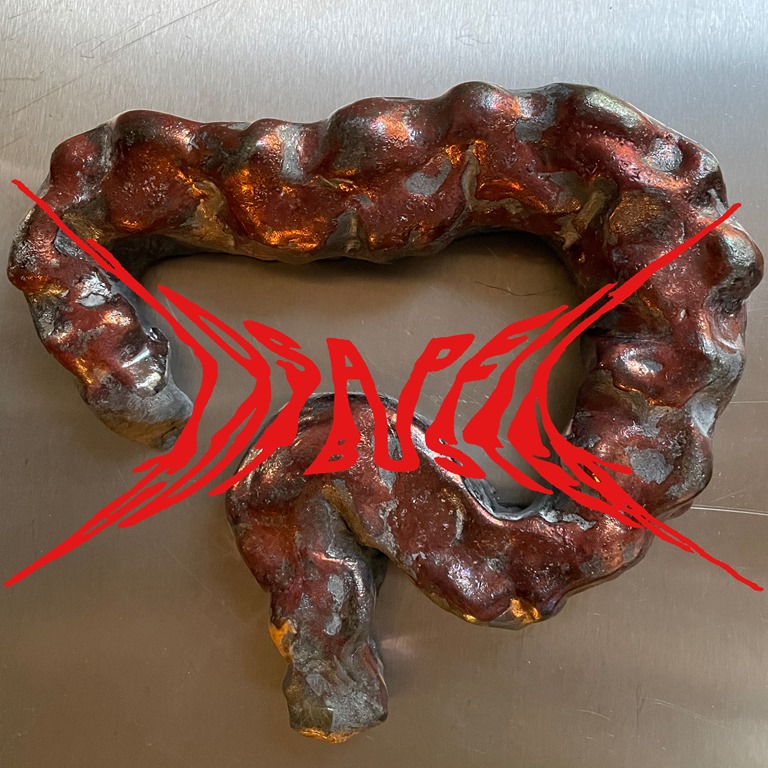
Perhaps it’s my relatively superficial knowledge of Prince that’s the reason that Prince is by no means my first point of reference on hearing Gut Buster, an album which is positively brimming exploding with ideas. There are elements of crisp pop and some bust-up, fucked about bluesiness to be found in the mix in this extravaganza of inventiveness, which also sculpts dark electropop shapes with some heavy bass and ethereal synths. At times, skitters and ripples rush by faster than the mind can compute, and there are some pretty slick grooves, even hints of what one might broadly refer to as ‘urban’ shades – as exemplified on ‘Tower Shower’, which also brings some dubby bass and blasting beats.
Gut Buster has soul – bit tosses it in a liquidizer and pulses it to a pulp with skittery bits and pieces of synth and hyper-processed vocals, 80s AOR melted into soporific trip-hop and hyperactive techno tropes. The chipmunk vocals area bit irksome at times, but there’s so much else that’s good that you can forgive it. The minimal gloop of ‘Call Me’ is a slow bump and scrape, and showcases the way in which Peit’s compositions are riven with intricate and fascinating detail.
Gut Buster is odd, quirky, in places dark and in others, less so. Unashamedly other and oddball, there is much to unravel here.
Following the stop-gap single release of their remixed version of their debut, ‘Messy’, Eville are back and firing on all cylinders with their first new material of 2024. While it incorporates the defining elements which made their previous two single, ‘Messy’ and ‘Leech’ – namely hard-driving nu-metal guitar slabs juxtaposed with electronic drum ‘n’ bass, which combine to drive a ‘a huge pop chorus,’ ‘Monster’ represents a clear step up, and is, as the title suggests, a monster.
Having a specific goal can provide vital focus in the creative process, and this was central to the creation of ‘Monster’.
If Yard Act are striving to make hits, self-professed ‘brat-metal’ trio Eville are all about the Pits, as Eva (Guitar and vocals) explains the objective for ‘Monster’: ‘We are building on the success of our singles by keeping up the standard our fans expect. ‘Leech’ and ‘Messy’ have done us proud, but we are ready to move up a level with ‘Monster’, I wanted to write a feral tune that would be perfect to open up mosh pits.’
It may be old-school, the notion of making music that will hit live and by playing support slots and touring to build a fan-base, but unless you’ve got massive label backing and PR that can score bags of radio play, it’s the only way for an independent act to grow. And it seems to be working pretty well for Eville.
With its stuttering electronic beats and muted, twisted, heavily filtered synthesized sound at the beginning, we’re instantly reminded of The Prodigy and turn of the millennium Pitch Shifter. Being in the demographic where the arrival of ‘Firestarter’ proved to be an absolutely pivotal moment in music – where a rave act brought in hellish guitars and brutal aggression and went absolutely stratospheric – hearing ‘Monster’ evokes the excitement of that time. It was a seismic shift from grunge, and while grunge served to articulate angst, what followed was more aggressive, more nihilistic, more angry.
What goes around comes around, and it figures that a nu-metal revival would ultimately happen following a lengthy grunge renaissance – but more than that, the generation of new bands are coming of age in truly shit times. It stands to reason that they’re feeling angry and nihilistic. And after many missed out on key life experiences during the pandemic, they’re now finally finding the cathartic release of going mental at a gig. The moshpit is the perfect release.
And yes, ‘Monster’ delivers the potential for an all-out mosh-frenzy. And it’s also got huge alternative radio potential, too. The production is super-crisp, ultra-digital sounding, in the way that on their emergence, Garbage slapped us with a sound that was at once dirty and slick. There are some mammoth guitar chugs, and they’re big and chunky, but smoothed and polished. It may only be a fraction over three minutes long, but this is a massive tune.
What doesn’t kill you makes you stronger… so the cliché goes. ‘That must make me Hercules’ was JG Thirlwell’s response on the Foetus track ‘Grace of God’ from the album Flow. He’s a man who should know, having not only forged a career on the outermost limits of the fringes and survived a brief spell on Sony and else controversy and vilification and general unpopularity as a contrast to a rabid cult following add up to in combination.
Eville are living proof of Thirlwell’s take. When they wrote and first released ‘Messy’ they could not have had the vaguest inkling of just how messy things might get. Theirs is a classic story of disappointment and industry failings, but also of bloody-mindedness, stubbornness and ultimately of resilience.
While Eville’s debut release, ‘Messy’ was picked up – and received enthusiastically by a minority of outlets – and you know, I will take a moment to blow the Aural Aggravation trumpet here, becausedespite our extremely limited capacity, we do get behind those acts we recognise as having clear potential and which, given the right exposure could and should break through.
Instead of a straight-up re-release, they’re following up ‘Leech’ with a killer remix of their second single. Blair the Producer’s twist on it preserves the blunt force and ferocity of the original version, but brings some extra edge. It’s beefy as fuck and is the definitive sound of nu-metal for the new generation.
No doubt there’ll be middle-aged twats bemoaning how it’s too pop or it’s not the same as the shit that was coming out twenty-five years ago. Middle-aged twats – and generally people over the age of thirty-five, who’ve hit the wall and concluded there’s been no decent new music since they were twenty-one – are plain wrong, and they should be directing their dissatisfaction inwards, and not only examining their own sad old lives, but remembering what is was like when they were in their late teens and early twenties. The sad old cunts who still revel in the days of Britpop might want to remind themselves that the golden age they so revere was largely a revival of various bygone eras, primarily the days of 60s pop and mod – mashed up and rehashed. These people are missing the point that progress happens, and the next generation will inevitably pick up on the music of the one before, or the one before that, and make it their own, and instead of bemoaning kids and their lack of ideas, should take it as a compliment that they’ve picked up the baton and are running with it in their own direction. Eville have that baton clenched tightly, and are running far faster than the pack right now.
Few artists can state that they’ve been developing their skills from the age of six, but Katie Arndt is very much a rare breed, and her bio lists her as a ‘prolific producer, vocalist, pianist, and composer.’
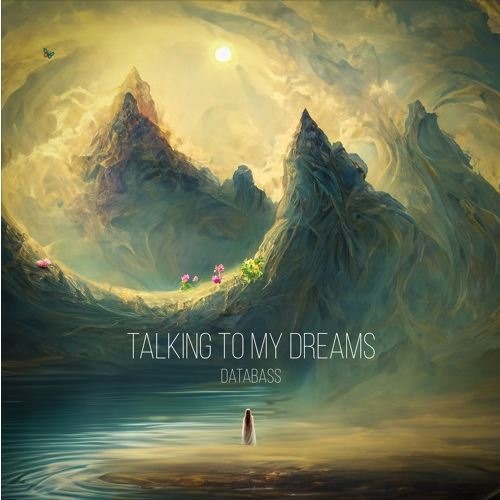
All of this is in evidence on her latest offering under the DataBass moniker – as project she’s operating while also, again according to her bio, ‘pursuing studies in classical and commercial voice, with a major in Music Media Production at Ball State University’.
But more impressive than any of this is the quality of her material. ‘Talking To My Dreams’ is a truly captivating composition, and if it stands as rather a departure from most of the releases I cover here, it’s for two reasons: the first being that a bit of a breather is essential. Sure, I like heavy, I like really heavy, and I like really fucking bone-crushing heavy. But I also like tunes, and to drift in moments of tranquillity.
‘Talking To My Dreams’ is both a tune and a moment of tranquillity, as Arndt’s clear voice skips over a delicate piano. Her skills as a producer are in evidence with the inclusion of subtle incidentals, subtle layers of synth and so on, before the vocals are doubled, with backings and harmonies drifting in with the greatest of naturalness.
That the song is barely two and a half minutes long is noteworthy, too, as it seems to reflect something of a trend toward shorter songs, as we had back in the ‘50s and ‘60s. The reasons for such succinct singles may be different now, but it does mean that we’re hearing songs which aren’t stretched out or padded, and simply say what they have to say. ‘Talking To My Dreams’ is a work of great economy, and its brevity adds to its gentle impact.
It’s only a bit of a brag – and a collateral one, at that – to say I’ve followed the Human Worth label since its inception. There’s a contextual reason to mention it, namely that while I’ve long raved about their being consistent in their selection of all things noisy, Human Worth isn’t a label with a ‘house’ style devoted to any one strain of music of an overdriven guitar nature. One need look no further than then recently-released angular indie noise-rock hybrid of Beige palace’s Making Sounds for Andy for evidence of that. It’s most definitely an ‘alternative’ record, in that it’s a million miles from the mainstream, but it’s not particularly noisy.
A. L. Lacey’s mid-bill placing on the label’s recent eight-act extravaganza in Leeds was an inspired one, as her graceful tunes provided the perfect respite from predominantly noisy guitar-based acts, and her performance set my level of anticipation for her album, Lesson.
It’s a landmark release for both Alice and Human Worth: having long established herself as a contributor to numerous acts in her locale of Bristol, Alice explains how “there was a frustrating sense of unfinished business. In that, my piano parts and ideas were being restricted to someone else’s’ vision – a vision which was often ‘less is more’ – a tasteful afterthought… A huge part of this project therefore became the need to challenge myself and to see what I could achieve or lessons I could learn, if I did things my own way – a bit of a journey towards autonomy – a predominant theme in most of my songs, along with finding purpose from confusion, and strength in your weaknesses.”
Lesson, then, is Lacey’s statement of identity, as she steps out from the shadows of other people’s work to present herself and her own musical ideas. And what’s striking is just how eclectic the album’s nine songs are.
‘Sewn’ opens up with rolling piano propelled by a vintage drum machine sound that’s pure late 70s/early 80s. But if this evokes the lo-fi sparseness and simplicity of Young Marble Giants, her vocals, swathed in reverb and strong yet delicate, are equal parts folk and shoegaze. And yet for all these elements, Lacey creates a maximal expansiveness with minimal instrumentalism. With swells of energy, it’s a soaring, uplifting piece, which hooks the listener immediately into the unique world she conjures with her magical fingers and tuneful voice.
It paves the way for eight further slices of creatively crafted musicality that combines elements of neoclassical, folk, and experimentalism. ‘Complaint’ is exemplary: the instrumentation is sparse, subtle, a soft wash of thrumming, droning synths underpinned by an insistent but understated beat. Incidental sounds weave in and out, creating depth, while Lacey’s multi-tracked voice is simultaneously trad folky and otherworldly.
There’s an energy and pace to many of the songs on Lesson which are far from the kind of bland, plodding fare common to many singer-songwriter types: ‘Memo’ may be but a brief note, but has the vintage pop vibes of Stereolab as it breezes on through and makes its mark. Elsewhere, the title track is wistful, swooning, without being remotely twee, and ‘Home’ brings post-rock dramatics to the proceedings. Bold yet understated, ‘Paper’ is worthy of all the airplay, and would sit comfortably on soundtracks and being performed at arena shows alike, being accessible, easy on the ear, hooky, emotive, and –
AA
Perhaps because she’s been doing this for a lot longer than the arrival of a debut would imply, Alice’s accomplishment as both a musician and a composer shine through every moment of this spellbinding collection of songs: the attention to detail the nuances of the playing and the production only accentuate the multi-faceted qualities of her songwriting and performance. It all adds up to a uniquely special album.




 Aural Aggravation