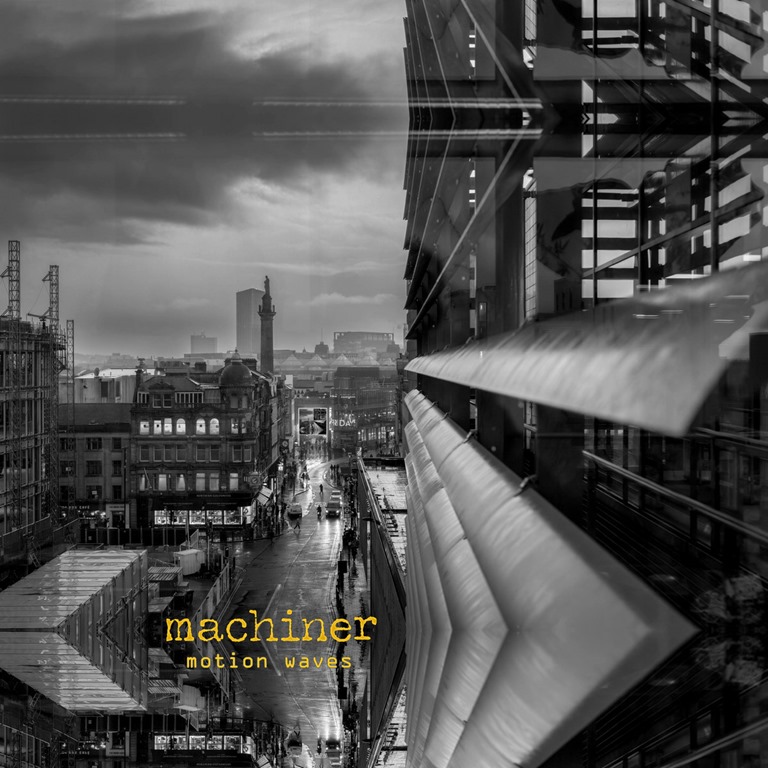
Butterfly Effect Records – 7th August 2026
Christopher Nosnibor
It’s always the north, isn’t it? Sure, The Cure and Bauhaus and Siouxsie all originated down south, but it’s always been the North of England that’s been the true heartland of all things dark and gritty, and, well, goth. Reading – somewhat belatedly – Lol Tolhurst’s roundly-lauded tome on the topic, one thing that shines through is his being struck by the north / south divide, and how places like Manchester in the late 70s displayed a far more pronounced level of deprivation. It is, indeed, grim up north, and the reason that Leeds was the true spawning ground of the goth scene in the early 80s is in many ways self-evident.
History has a habit of repeating itself, and for all the talk of the ‘Northern Powerhouse’ a few years back, it’s still grim up north, and there are numerous parallels to the late 70s and early 80s when it comes to life in England post-Brexit.
machiner list among their influences Nine Inch Nails, New Order and Depeche Mode, and state that their objective is to ‘transform emotional vulnerability into something expansive and cinematic’. And they’re from Hartlepool in County Durham. While for some, County Durham will likely connote the cathedral, the university, and cobbled streets of the city itself, but beyond this, the once industrial county, where mining was its primary source of employment, there is a very different, and far less idyllic picture. And its in this context that we come to machiner, a band who balance elegance and a sense of the epic in what one might call the classical sense, with the dinge and deprivation of much of the region.
Over the course of the eight songs on motion waves, machiner weave some deftly-crafted slices of expansive, dreamy alternative rock, the soaring guitars interlaced with layers of synth, and while the results are neither overtly dark or heavy, there are undercurrents of brooding tension. And what’s more, the melodic, cinematic nature of the music makes for an accessible vehicle for altogether bleaker lyrics. Take these lines from ‘ivory skies’, for example:
low life in the hall outside my door
and a girl cries in the bedroom just below
last night I heard her head crack off the wall
then a silence like I’ve never heard before
well this is England…this is now
And sadly, this is life now. By way of a brief detour, but for necessary context, it’s a grim statistic that instances of domestic violence spike when there is international football being played. Womensaid quote research which found that cases of domestic abuse increased by 38% when England lost a match and 26% when they won or drew. The response of the Reform party – who run Durham County Council – was to post a video cheering England on to prevent domestic violence. This is England, and this is now. And these are shit times.
The seven-minute ‘dark age’ is a magnificently poised, almost prog-leaning composition, and the piano-led ‘the sound of disappearing’ rolls past on a soft drift which is not only gentle, but truly pretty. And herein we arrive at the essence of machiner: as much as they detail the grimy, gritty realities, they’re looking towards escape routes and better futures. motion waves is the sound of a way out of a thorny thicket. ‘iceburn’ in particular soars skywards, and the easy ‘cast me in amber’ – which again extends to almost six and a half minutes – brings a strong New Order vibe, and pairs it with some nagging electronica laced with heavy hints of shoegaze: in short, it’s perhaps the ultimate assimilation of the elements which make up the textured sonic amalgamation of machiner’s dynamic style.
‘ever over’, which reminds very much of Oceansize, brings things to a strong and solid conclusion, and it makes for a dextrous conclusion to a magnificent album, one which brims with texture, dynamic energy, and a sense of movement. Bold… and beautiful.
AA