Posts Tagged ‘Noise’

Cruel Nature Records – 28th March 2025

Christopher Nosnibor

Pound Land have evolved, expanded, metamorphosed, mutated, from two guys cranking out two-chord dirges, to a shifting lineup of musicians cranking out some wild freeform jazz over murky two-chord dirges. And now we learn that they’ve returned to their roots for this latest offering, their third of the year, no less. As they put it, ‘Can’t Stop sees founding Pound Land members Adam Stone and Nick Harris return back to the gratifying freedom and eccentricity of DIY recordings and lo-fi audio projects. Nine diverse tracks spread over half an hour, this short experimental collection nods to Pound Land’s absurdist ‘kitchen-sink punk’ past’.

Can’t stop? Or won’t stop? Not that they should, either way: Pound Land’s mission, it seems, is to proliferate their dingy bass-driven racket as far and wide as possible, and the world – as unspeakably shit as it is, especially right now – is in some small way better for it.

“Got my joggers on / got my flapjack / got my shaven head,” Stone mumbles laconically as if half asleep, over some trickling electronics at the start of the opening track, ‘Armed with Flapjack’. Then some dirty, trebly guitar clangs in and everything slides into a messy mesh that’s neither ambient nor rock, providing a seething, surging drone by way of a backdrop to the spoken word narrative, which is only partially audible, but seems to be a gloriously mundane meandering tale involving, essentially, leaving the house and going about ordinary business.… But it actually turns out to be more of an internal monologue of an anxietised mind. “I’m alright, I tell myself that, I’m gonna be ok, I can do this… bus, and train, take one thing at a time…” It’s really quite powerful in its way.

And staying with the mundane, ‘Watching TV’ is a spectacularly sloppy-sounding celebration of the mindrot pastime that starts out sounding almost sensitive and with a dash of country in the mix, but slides into soporific sludge, before the choppy ‘Lathkill’, which clocks in at just under two and a half minutes, shifts the tone again: it’s a classic Fall rip, or perhaps Pavements ripping The Fall, a sparse, lo-fi four-chord effort which just plugs away repetitively.

Things get really murky with the pulsating ‘Stuff’, where Stone’s meandering contemplations ring out through waves of reverb, and the whole thing feels – and sounds – very Throbbing Gristle. Dark, muffled, monotonous, it grinds and clatters away, a thick sonic soup, and it’s as primitive and unproduced as it gets. It’s not pleasant, but it works perfectly: it needs to be rough, raw, unfiltered. There’s simply no way this act is ever going to have commercial appeal, and that’s perfect: Pound Land are made for limited cassette releases and playing tiny venues to audiences who will be split roughly down the middle between absolutely loving them and wondering what the fuck they’ve stumbled upon. Pound Land really aren’t for everyone. They’re the anti-Coldplay. They’re for people who relish being challenged. ‘I Spy’ brings that challenge straight away, being different again, the rawest, scratchiest, scratchiest, most abrasive no-fi-punk you’ll hear all year.

Things get even more jarring and difficult towards the end of the album. ‘Janet’s Here’ should be a breezy interlude, announcing the arrival of a guest, but instead it’s tense because the delivery is straight-up demented, and ‘Affordable Luxury’ is a rabid rant, again reminiscent of Throbbing Gristle. It’s uncomfortable, the drawling vocal secondary to the warping drones and scratchy experimentalism. Stripped-back not-quite acoustic ‘EGG’ is a trick: again, it has hints of The Fall doing ‘sensitive’ – like ‘Time Enough at Last’, for example – and it’s delicate, but it’s also not.

And this is the thing. Can’t Stop is their most wide-ranging and accessible album to date. And yet… well, it’s not really accessible, for a start.

Can’t Stop is challenging in new ways, too. Working with so little, they’ve pushed the songwriting in divergent directions, making for an album that reaches in all different directions, while, of course, retaining that primal Pound Land core and purposefully simple, direct approach and aesthetic. I love it, but I expect many will hate it. And that’s the way it should be. It’s peak Pound Land.

AA

a3349026030_10

Cruel Nature Records – 14th January 2025

Christopher Nosnibor

Released on various formats by various labels in different countries, the latest offering from genre-blasting French instrumental trio Toru is being released on cassette (and download) by Northumberland’s Cruel Nature in an edition of 65. Following on from 2020’s eponymous debut and a split release with Teufelskeller, which saw Toru join forces with CR3C3LL3, this time around, they’re different again, and having been featured as album of the day at Bandcamp Central just the other day, the signs are that Velours Dévorant could see them significantly expand their fanbase – and deservedly so.

Velours Dévorant featires five V-themed tracks defined by some riotous riffmongering and big, dirty, overdriven guitar noise with tempo shifts galore. Blasting in with ‘VHS’, it’s a manic ride through waves of tempestuous, bludgeoning racket from the very start. Trilling feedback fulfils the duty of a lead guitar line, while a shuddering, ribcage-rattling bass tears its way out from the chaos atop some heavy, but highly skilled jazz-inspired drumming.

Some will likely describe their sonic blitzkrieg as ‘experimental’, but that’s something of a misrepresentation, in that it suggests a lack of coherence, a haphazard and unplanned approach. The sudden stops and starts, the moments where a chord hangs, suspended in the air for just the briefest moment before the fractionally-delayed snare smash or cymbal crash, where the three of them simultaneously draw breath in just a split second… those microcosmic moments require remarkable precision – unquestionably, intuition is key, but rehearsal too. The skill is to make it sound haphazard, unpredictable, to keep the listener on the edge of their seat, buttocks clenched, while having it all worked out. Every composition contains moments which feel like the sonic equivalent of watching trapeze artists, where you tense and momentarily stop breathing as they fly through the air, seemingly in slow-motion, tense in case they fail to grab on: will they keep it together, or will everything collapse into a mess of sludge like a sewer rupturing and spewing a fountain of slurry?

These are long tracks – the shortest is over five and a half minutes – with infinite twists and turns. The skewed, surging jazz-grunge of ‘Voiles’ – a whopping eleven and a half minutes in duration – is representative, and encapsulates the essence of the album. The guitars squall and screed in a showcase of noise-rock par excellence, while the bass lurches and snarls, grooves and grinds, and the percussion is simply wild. It’s like listening an instrumental version of every track by the Jesus Lizard all at once. There’s a low-impact, atmospheric mid-section that rolls and rumbles, yawns and splashes… lazily would e the wrong word, but it takes its time, with bent guitar chords twanging like elastic bands, while the sparse percussion meanders seemingly without aim. But then it all reshapes and takes form once more, building, building, and then exploding so hard as to detonate so hard as to blow your eyeballs out of their sockets. Fuck, when these guys hit the pedals, they really do go all out.

I’ve heard a plethora of zany noise-rock acts, and have loved many – most of whom are so obscure that to reference them or draw comparisons would be the most pointless exercise imaginable: ‘hey, wow, this band I’ve not heard of sound like a bunch of other bands I’ve never heard of, that’s informative!’.

On Velours Dévorant, Toru take the tropes of post-rock, with its protracted delicate segments and slow-building atmosphere, and incorporate them within a noise-rock setting, with the result being epic tunes with some incredibly graceful, and ultimately poignant expanses, pressed tight against some of the most explosive overloading, overdriven abrasion going. And then, of course, there are the jazz elements: ‘Volutes’ is the apex of jazz/grunge hybridization, and it works so well. Not sold on Nirvana meets The Necks? Trust me.

The fourteen-minute title track is… special. It is, in many respects, the evolution of post-rock circa 2004. Chiming guitars, infinite space, haunting atmosphere. The intro is magnificent, beautiful. Her Name is Calla’s sprawling ‘Condor and River’ comes to mind. That use of space, that simmering tension, that sense of something growing which is more than… well, it’ s simply more. There are things hidden. When the riffing lets rip, holy shit, does the riffing let rip, fully shredding blasts of distortion tear through with obliterating force. The track feels like an album in its own right.

It seems like a while since I’ve felt compelled to describe an album as ‘epic’ – but this… this is next-level epic.

AA

a0213833004_10

Noisepicker share the remarkable video for ‘Chew’ ahead of the release of their second record, The Earth Will Swallow The Sun, out 21st March 2025 via Exile on Mainstream.

The band says:

"7/8 groove and a mountain of fat chugs. Splattered with disgust at the human form displayed in the mirrors. ‘Chewed up and spat out’ as the chorus declares. The result of generations of human failure through self interest. ‘So sick and tired of that stupid grin’. The only logical solution: destroy it."

…and further about the video itself: "The two of us live on opposite sides of the country, which makes getting together tricky at times. To the point where we never rehearse. Apart from two songs, we had only played the entire new album together when we entered the studio to record it. And those two tracks were only ever played during soundcheck, an hour before we played them live. Which probably explains a lot! This means we need to be ‘inventive’ when thinking about videos, basically making sure that we are not the main focus of them. We grab footage of each other when we can and store it up in case it’s needed. That’s where the puppet idea came from. I couldn’t get us both in the same room, so I had to improvise. I think it actually makes for a better video! The song is about hating what you’ve become after chasing the expectations of an unfulfilling society, and only realising you’ve been had when it’s far too late. You’ve been played. Like a puppet on a string. Enjoy!"

AA

Noisepicker_2_byJerryDeeney-scaled-99000003cf05143c

Photo credit:  Jerry Deeney

Mortality Tables – 24 December 2024

Christopher Nosnibor

There’s something about Christmas that really does send people spiralling in one of two directions. The people who absolutely love it seem to love it just too much to be considered sane, and this year has been one of the worst I can remember for people actually buying chocolate and putting their trees up almost immediately after hallowe’en. Amusingly, I’m seeing them taking down their trees and decorations from Boxing Day, declaring that they’ve had enough now. Well, it’s hardly surprising after three months. I really for feel sorry for the kids of these deranged households: it must be quite confusing for them, not least of all seeing their parents troughing whole selection boxes to themselves in November as they effervesce about the Christmas spirit and plaster their hedges, bushes, trees, and house frontages with lights – which is as trashy as it is environmentally unsound (‘oh, we use green energy, it’s 90% nuclear now!’) – only to tear them down a whole tend days before twelfth night. But these are the kind of people who call what they do – things like going to work and parenting – ‘adulting’ and piss and moan about it on social media, while posting pics of their decorations at the start of November. And it’s cunts like these who make me loathe Christmas with a passion I didn’t even know I possessed. They spoil it for more moderate, more sane people – and people who just despise other people and herd mentality twattery in general.

And so I’m with Mat Smith, the main man behind Mortality Tables, and am one hundred percent into ‘Grouch Thoraces (II)’, pitched as ‘The festive sentiments of a misanthrope, processed into dark and enveloping ambient texture. An updated version of a release from 2023’. In fact, I consider this to be a release that stands alongside – in spirit, if not necessarily sonically – with my own Festive Fifty noisework, released on December 20th. Against the tidal wash of syrupy, saccharine Christmas tunes – shit covers or endless rereleases or just the same toss that’s been the staple of the airwaves since the 70s and even earlier – nothing says ‘fuck this commercial Christmas shit’ like some dark noise.

‘Grouch Thoraces’, released on Christmas Eve in 2023 was a dank, murky cut, presenting just shy of five minutes of the most rumbly dark ambience. This year – to use a phrase I despise almost as much as the cheery festivity fanatics who bounce around the office in Christmas jumpers and Deely boppers or reindeer antler headbands and start arranging secret Santa and team drinks and buffets from the middle of November – Smith has doubled down on his anti-festive sentiments with a reworked ‘Grouch Thoraces’: this time it’s even darker and danker and almost eight minutes in length. It’s a churning, disorientating mess of stuff thrown together, found sounds and elongates drones twisting together to forge a thick morass of unsettling, uncomfortable noise. According to the credits, there’s a vocal by Carroll Spinney, but it’s submerged in the slow-sinking swamp. There are chimes clattering in the dark whorl of purgatorial noise, but they sound like the ching of broken decorations swinging in a post-apocalyptic nuclear wind as the survivors crawl, blind, skin peeling, through the ruins of what little remains.

On its own merits, this is a strong dark ambient work with a certain edge: in context, it speaks. Fuck this festive shit, fuck this commercial shit, fuck the obligation to socialise: let’s celebrate stepping back from it all and just getting through it, without feeling the need to pretend that we love any of it. We misanthropes need to stand together.

AA

a0412538683_10

Transylvanian Recordings – 31st October 2024

Christopher Nosnibor

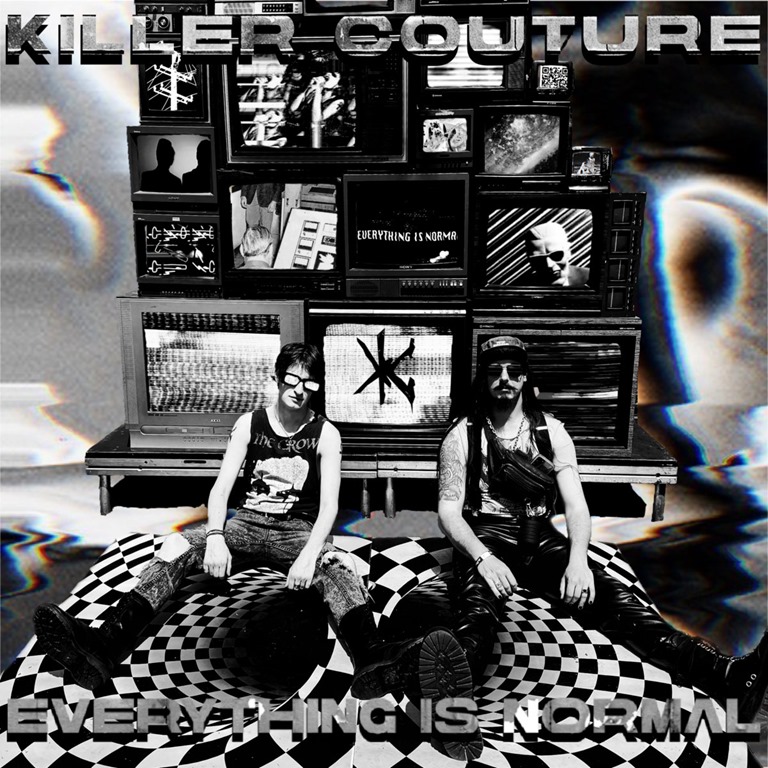
The title is, sadly, true. Somehow, recent years have ‘normalised’ everything, but not least the worst and most cuntish behaviour. Men being sleazy shits is just so normal that ‘grab ‘em by the pussy’ is an election-winning slogan, and a majority – however slim – in the US is ok with electing a convicted felon to the most powerful political position in the world. Somehow, billionaires have been normalised. Genocide has been normalised. These things have just become the backdrop to the every day. Many of us simply reel at this realisation.

But instead of reeling, we need to react. And if we ourselves find ourselves unable, it’s at least something to find there are other out there who are able to articulate on our behalfs. Enter Killer Couture, with their third album.

Gothface celebrate Everything Is Normal as being ‘Not overproduced; just back-to-basics angry, editorial of society style late 80’s/early-90’s music; the kind of stuff you could expect from Skinny Puppy’s and Ministry’s DGAF approach in the 80’s’. The band themselves describe it as ‘a 40-minute violent outburst of pent-up energy, challenging the concept that there ever was a status quo to begin with, the people who feel the need to try and uphold the illusion, and exploring the psychic maelstrom of living in the true chaotic reality beneath the mask.’

From a muffled cacophony of discord and a patchwork of samples emerges the first pulsating beat and blasting riff, from which ruptures forth squalling guitar and the intensity builds as the collage of snippety bits layers up to an unbearable level… and then ‘Terrible Purpose’ barrels in, the guitars thick and fat and dirty, overloading but with that digitally crisp edge, and as much as Ministry and Skinny Puppy so come to mind, while the speaker cone-shredding distortion hits like a two-footed flying kick to the chest, I’m thrown into recollections of early Pitch Shifter, of the searing industrial metal abrasion of Godflesh. The bass snarls, the percussion is simply devastating, and this is proper, full-tilt. If you need more comparisons, and more contemporary ones, I’d be placing this alongside Uniform for its uncompromising, full-on raw industrial attack.

Hot on its heels, the title track is a relentless percussive blast which propels a mess of noise, guitars set to stun, vocals set to rabid punk rage.

The guitars on ‘Teeth’ come on like a wall of sheet metal. If the refrain ‘I’d like to break your teeth’ lack subtlety, it achieves the desired impact. Everything Is Normal is not about subtlety or nuance: it’s about expunging that raw, brutal rage, it’s about catharsis, it’s about venting the fury, and Killer Couture are simply splitting their skins and breaking open their craniums with it.

‘KCMF’ brings another level of overload, the bass crunching and guitars churning and squalling against a relentless mechanised beat, and this is some furious, high-octane adrenalized noise shit. ‘Bastards’ speaks – or rather hollers – for itself, and ‘Composite Opposite’ is as gnarly as hell.

Everything Is Normal is one of the few self-professed ‘industrial’ albums I’ve heard of late which isn’t some Pretty Hate Machine lift, and isn’t essentially an electropop album with a dash of distortion. Killer Couture deliver on their promises with an album that’s brutal and uncompromising, heavy, and properly noisy.

‘Bad Waves’ brings things to a close, combining a certain shoegaze element with the hypnotic throb of suicide, and calls to mind The Sisters of |Mercy’s legendary live renditions of ‘Ghostrider’ circa 1984, often segued into ‘Sister Ray’ and / or ‘Louie Louie’ with the same relentless beat. And yes, my only complaint is that at 4’59”, it simply isn’t long enough by half. But then, the best songs always leave you wanting more, and despite Everything Is Normal being truly punishing album, a little more wouldn’t hurt that much… probably.

It’s important – and now sadly necessary – to distinguish between the red-faced outrage of those perpetuating hate and raging against all things supposedly ‘woke’ and those who are calling out the injustices, who are willing to stand up and point out that we need to be woke, that if you have an issue with antifa, you’re pro-fa, and you’re the problem.

Killer Couture are the voice of anger, the conduit of rage, and Everything Is Normal is precisely the album we need right now.

AA

a2402686568_10

Christopher Nosnibor

Hull has produced some impressive bands – especially at the noisier end of the spectrum –in recent years, with Cannibal Animal, Bedsit, and Ketamine Kow being particular standouts, but not to forget BDRMM, Chambers, or Low Hummer. It’s always a treat when they send a contingent to York. Warren Records have established some sort of exchange programme with The Fulford Arms, offering some quality lineups for little or no money – as is the case tonight, thanks to the support of a well-deserved arts grant for the label. Turnouts tend to be decent, too, with an unusual ratio of travelling fans from that spot just north of the Humber.

Having raved about Bug Facer’s releases, there was no way I was going to pass upon the opportunity to see them live, and there’s a growing buzz around Wench! too.

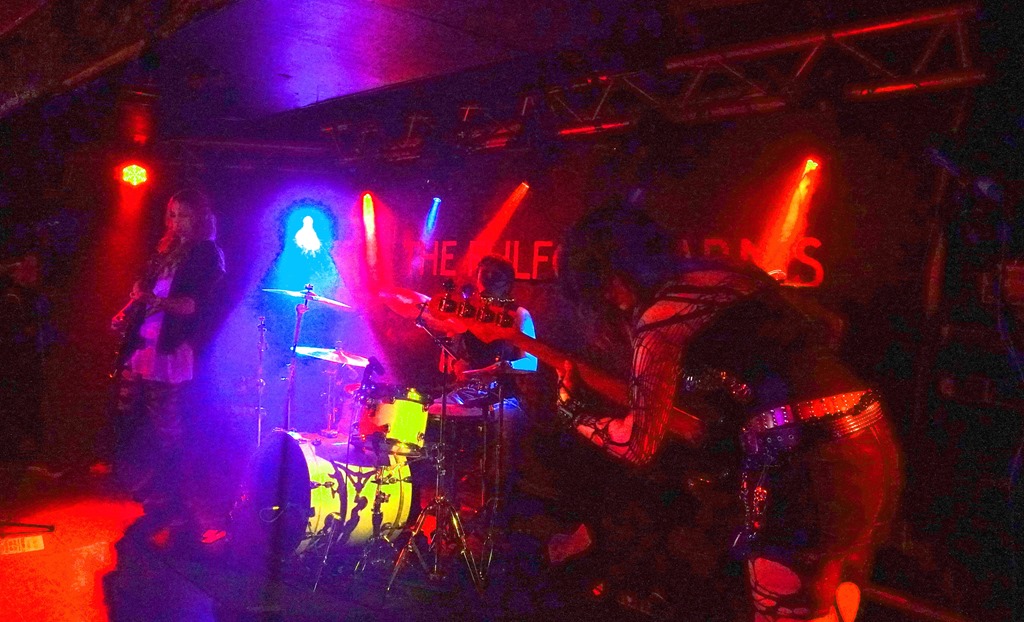
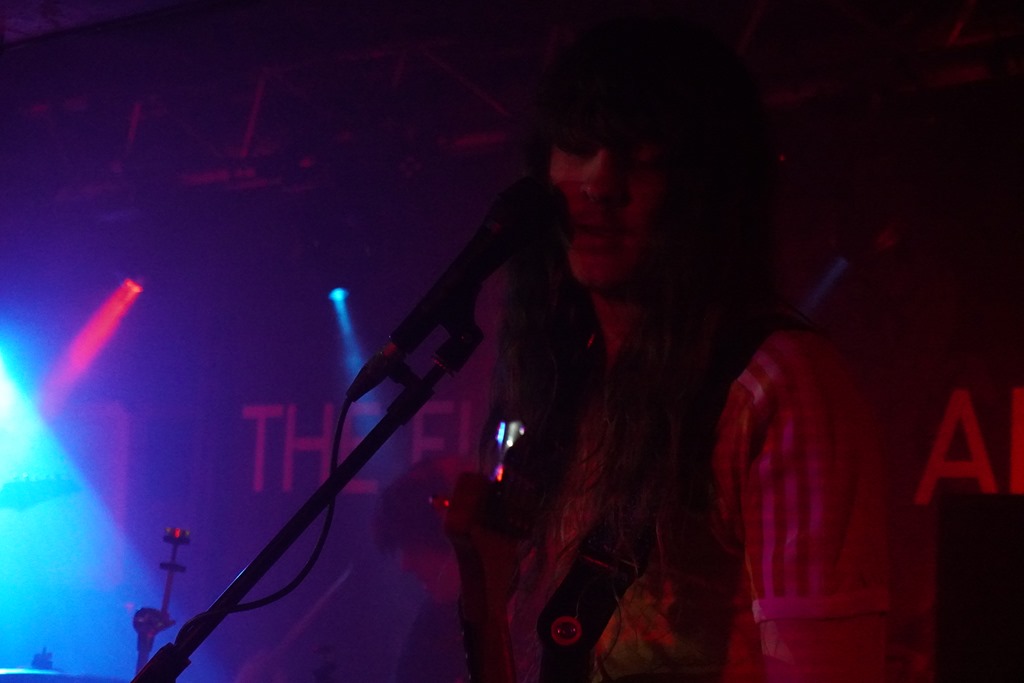
It’s immediately apparent that the buzz is more than justified. Wow. Fuck me. Wench! are phenomenal. An all-female power-trio with the emphasis on power, they play proper punk, and play loud and hard, and they’re as tight as they are fierce. It’s drummer Kit Blight who covers the majority of the vocals, and the vocals re strong, all while blasting beats at a hundred miles an hour. Bassist Hebe Gabel, a headbanging blur of spikes and studs is a dominant physical presence on stage, and steps in with some super-heavy wah-wah loaded lead breaks which owe more to stoner rock than punk. The interplay between the three is magnificent: each brings a different style of musicianship and performance to the stage, and they are one hundred percent complimentary. This may only be their second gig outside of Hull, but shows like this are almost certain to get them bookings – and fans – racking up fast.

When you read about how grassroots venues are vital for feeding the upward chain, and you realise you’re watching a band with the potential to join the ranks of Dream Wife and Amyl And The Sniffers a few years hence, the narrative takes on a powerful resonance.

Wench

Wench!

Bug Facer’s studio work is a blinding cacophony. Live, they’re something else, a brain-melting, eardrum-punishing, feedback-shredding squall of filthy chaos. The vocals are shared between the drummer and bassist – who is also, it turns out, guitarist, to add to the confusion.

They look like they sound, and sound like they look: the bassist is a burly guy with tattoos and a Meshuggah T-shirt; the bassist looks like he’s travelled in time from 1974, sporting an orange Adidas T-Shirt, flared cords and long hair with a home-cut fringe; meanwhile, the drummer wears comfort-fit faded jeans and a comedic cast T-shirt. You never saw such a bunch of misfits, and it translates directly into the music – perhaps more accurately described as a blast of sonic mayhem.

DSC00462DSC00468

Bug Facer

Driving rhythms underpin a wild tempest of discord and noise. They boast the crunchiest ribcage-rattling bass and a wall of guitar noise that sounds like war. The vocals are an array of shouts and grunts and monotone spoken word mumblings and psychotic screams. More than once, the bassist and guitarist swap instruments.

They don’t say much. “Is this in tune? It’s close enough” is representative of both the bantz and the approach to performing. It’s not punk, it’s not post-punk, it’s not sludge, or stoner, or anything really; but it contains elements of all of the aforementioned, and they play like they want you to hate them and getting the biggest kick out of being as sonically challenging as they can muster. Ragged, raw, and absolutely wild, it’s one hell of a set.

Credit to Heartsink for being on this bill and willing to follow Bug Facer, with whom they’ve shared a stage previously. It’s certainly a brave move – or an example of insanity.

The last time I – knowingly – saw them was when I caught the tail-end of a set at The Key Club in Leeds in 2018. Six years is certainly time enough to evolve. But punk-pop doesn’t really evolve, and exists in a state of arrested development, just as it always did, when, on breaking in the early 00s, middle-aged men would sing songs about being in school and having crushes on their classmates, or their teachers, or their classmates’ mums.

“Is anyone a fan of the US Office?” In this question, we get a measure of both the quality of the chat, and the inspiration behind their songs. I’m not entirely convinced it counts as evolution.

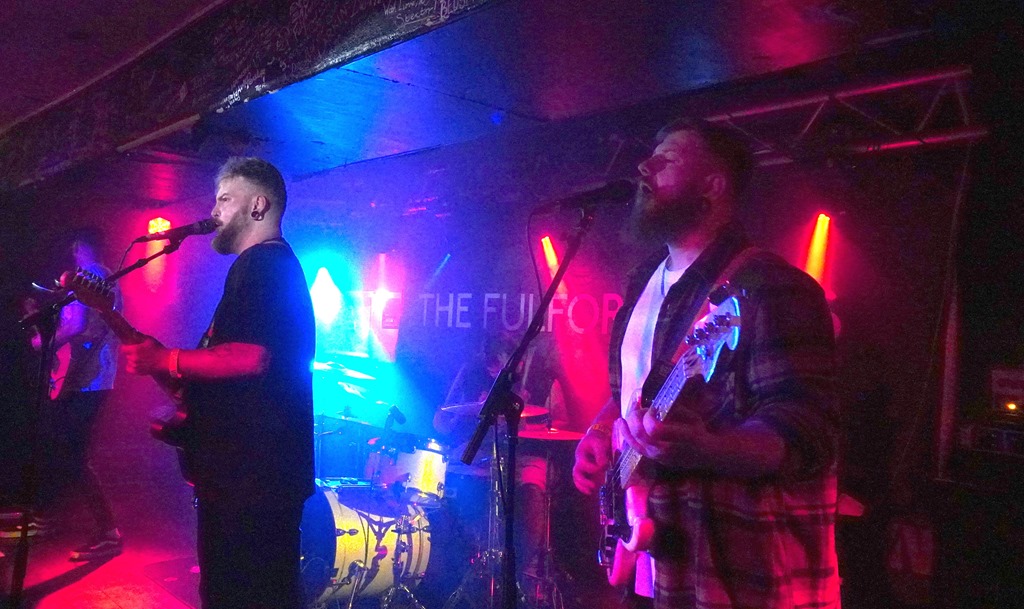
Heartsink

Heartsink

Credit where it’s due: they are undeniably solid, energetic, the songs are catchy, and they’re clearly enjoying themselves. People down the front are enjoying them, too. They’re co-ordinated with matching rainbow guitar straps… and trainers, and beards. They do bring some big riffy breakdowns in places, and the melodies are keen. But… but…ultimately, it’s generic and bland. And pop-punk. There’s clearly an eternal market for this, and fair play, especially as, what they’ve ultimately achieved is to get people out and dancing to original (‘original’) songs at a grassroots venue on the coldest November night in a decade. When venues around the country are disappearing by the week, and the ones we have are hosting tribute acts five nights a week, having the option to view three solid quality bands – two of whom are absolutely out there, albeit in very different ways – for no quids is something to shout about.

Crónica – 5th November 2024

Christopher Nosnibor

Simon Whetham’s latest work is a fascinating hybrid which incorporates found sounds and elements of layering in order to create a whole other world, a different dimension. The album itself is part of a larger project, which is more readily explained through quotation than a stumbling stab at paraphrase:

Successive Actions is an iteration of the larger kinetic sound performance project series Channelling in which various motor devices, salvaged from obsolete and discarded consumer technology, are activated by playing sound recordings through them. In turn, this produces new sounds from the devices, which are amplified using various microphones and techniques. The title comes from Dirk Raaijmakers’s "The Art of Reading Machines" as a term for mass production processes. As such, the recordings played through the devices are recordings of other devices used in previous versions of Channelling, in which the sounds used were seemingly mundane sound phenomena that occur unpredictably and irregularly in everyday life, as passing traffic, wind, doors closing. So now the sounds of devices malfunctioning and breaking from their programming are causing further action and disruption.

Successive Actions contains sixteen pieces, although only four extend beyond four minutes in duration, with the majority sitting only a short way over the two-minute mark, giving the album a fragmentary feel. But there’s a strong sense of cohesion, too: the title of each of the pieces ends in ‘action’, from ‘Action’ to ‘Protraction’, via ‘Inaction’, ‘Impaction’, and ‘Abstraction’.

While much of the album takes the form of abstract ambience and general murk, there are moments which stand out with levels of heightened discomfort: ‘Reaction’ conjures the bleak whistling wind of a nuclear winter. ‘Inaction’ scrapes and buzzes; it’s unsettling, but it’s not uncomfortable to the point that it’s unbearable: it just makes you feel tense, awkward. You want to seem a less stressful environment. But there s no less stressful environment, and life is stress: to escape that is to deny the reality of the everyday, for the majority. Under capitalism, we are all stressed, and on Successive Actions, Simon Whetham gives us a soundtrack to that stress and anxiety.

Mass production is, arguably, a fundamental source of our woes in the modern age. The Industrial Revolution brought so much promise, but as capitalism has accelerated and expanded at a pace which exceeds our capacity to assimilate, so it has become an ever-greater source of alienation. And here we are, overwhelmed by the road of the big machine as it continually whirrs and grinds. Sometimes its but a crunch and a gurgle, a hum and a thump. A buzz of electricity, a mains hum, as dominates both ‘Retroaction’ and ‘Counteraction’. It’s a cranial buzz and pushes frequencies which are uncomfortable, and as the album progresses it plaiters, and turns dark.

For myself, I feel a certain sense of release while immersing myself in the textures and layers of Successive Actions. There are moments when the album really achieves a heightened sense of – and in panic, of anxiety, of intensified reality. Other moments are altogether more sparse, steering the listener inside themselves into a the depths of an interior world.

Successive Actions is deep, dark, difficult. And so is life. On Successive Actions, Simon Whetham captures it, all elements of life that is. It crackles and fizzes with tension, and tension is high.

AA

a0457389705_10

Dret Skivor – 1st November 2024

Christopher Nosnibor

Procter’s been at it again. The only artist I know who can go on tour and play under different guides doing different music – or ‘music’ – depending on the booking. Not that anything he does is commercial or has any kind of mass appeal: it comes down the question of if you’re on the market for harsh noise or something a bit gentler. And how he’s back from one of his excursions, here we have new studio work, which clearly didn’t make the merch table – released in a limited physical edition of just three hand-painted CDs.

One might wonder just how far it might be possible to push the concept of Fibonacci Drone Organ, but since the mathematical Fibonacci sequence is endless, so it would seem are the limits of this project. This particular outing, with a title inspired by Ken Loach, does mark something of a departure for FDO, being less droney and more barrelling bassy murky noise. It’s also more overtly political – nothing new for Dave Procter, but usually something reserved for his other projects.

‘Disenchanted with the state of the fucking world? You’re not alone’ he writes. ‘This is a synthesised reflection of the current state of my brain. I hope it brings you some peace.’

How much peace one can expect from longform tracks entitled ‘war war death death’ and ‘american client state’ it’s hard to really know, but I for one can relate to Proctor finding solace in the cathartic release of creating dense noise. Because there comes a point where words are not enough: indeed, there are no words. In fact, I derive some comfort – small as it is – from this release. It does indicate that the state of Dave’s brain isn’t the best, but with the US election looming and the very real possibility that Trump could become president again, I can’t help but feel a combination of gloom and outright terror. In recent months, as the war in Ukraine has rumbled on, and the hell on earth in Gaza has escalated, and escalated, and escalated, and Israel’s nauseating genocidal mission continues to be funded by the West, it’s felt like a growing weight in the atmosphere. I’ve found myself tense and on edge. Everything is wrong. ‘I find no peace,’ as Thomas Wyatt wrote.

It feels as if the world was waiting for the pandemic to pass, and as if during the successive lockdowns, world leaders were simmering, festering, building their fury to unleash the moment restrictions were listed. Recent years have been painful, and as Procter’s brief notes indicate, there are many of us who are struggling, powerless, as our governments continue to push the line of Israel’s ‘right to defend itself’. No-one would deny that right, but no rational person would agree that a death toll of almost 44,000 – with many tens of thousands of women and children, not to mention other civilians in that figure – is proportional, or merely self-defence. While news outlets do report these figures – which are, it has to be said – beyond nauseating – there is no compassion in the reporting. Deaths are but numbers, the words ‘humanitarian crisis’ but words. The images of smoke and dust and devastation are horrifying, but to actually be in the midst of it, with no safe places to go, as schools and hospitals are targeted, is beyond imagination.

It’s in this context that Procter has created two grey, grating, heaving and ugly tracks, one fifteen minutes in duration, the other over twenty-three.

‘war war death death’ is bleak, and dense. There’s the heavy whip of helicopter blades at the hesitant start of the track, which gradually emerges as a long, wheezing, churning drone, resembling the rumble at the low end of the mechanical grind of the first Suicide album. And this is pretty much all there is. And from this minimal piece emerges a sense of desolation, particularly as the end, which concludes with just rumbling static – and nothing. Devastation. Dust. Annihilation.

‘american client state’ is again, heavy a serrated edged, humming drone that hovers, panning and circulating like a malevolent drone. It’s pitched in the range that really gets under your skin and penetrates the skull, not in an exhilarating way, but instead slowly wears down the spirit, dissolving any sense of motivation. The monotone hum seems to somehow articulate, in ways that words cannot, the sense of powerless I personally feel, and suspect others do, too. There’s something empty in the monotony, not to mention a squirming discomfiture. What can we do?

All digital sales money from this release will go to the Palestinian Medical Relief Society, and while it may be a drop in the ocean, and while what needs to happen is for aid to actually be allowed to be delivered – something which will require an intervention which is long overdue – something, anything, is better than nothing.

Often, there’s a droll humour to Dave Procter’s work, but apart from the title, the higher the monkey climbs, the more you see of his arse is a bleak work, and a depressingly droney as it gets. But it provides an outlet, an expression through which to focus that release, and reminds us that we must hope against hope for better ahead.

AA

a1192190513_10

Panurus Productions – 24th August 2024

Christopher Nosnibor

I take heart from discovering that Panurus Productions are as far behind on their PR as I am on my emails and messages. Even if it weren’t for the relentless flow of submissions – I’m looking at an inundation of around fifty a day, via email, messenger, and all the rest, even drops of CDs through the letterbox – there’s still that matter of… life. It consumes all of your time, and it wears you down. It’s an endurance test. Just living is a full-time job. No, it’s more than that. It’s exhausting, draining, it saps your very soul. On a personal level, just the day to day is too much at times for reading emails and listening to submissions. Throw in a dayjob, life and a single parent, and bereavement on top, and simply opening all the email submissions become too much. So arriving at the most recent Shrimp album around two months after its release, I feel ok about that – and by ok, I mean pleasantly calm, which is a rare sensation in the main.

Fucking hell. It’s a monster. It packs four tracks, the shortest of which clocks in at just under twenty five minutes. It’s more than a monster. It’s a skull-crushing leviathan. It will leave feeling week and so drained. It makes predecessor Mantis Shrimp sound like Barry Manilow.

They promise ‘a sprawling mass of free-form guitar, vocals (an associated miscellanea), effects and percussion’, whereby ‘the listener is thrown about the room with the sound, as the initial dirge collapses into a frantic scramble of activity, glitch and movement as the various pincers and claws dart out from the sonic mass. The sound field shifts as elements are isolated or the entire band is channelled through the snare, sometimes in line with the music and others completely of its own accord. Not even the platform you are listening from is stable.

‘Hidden Life’, with a running time of forty-one and a half minutes is an album in its own right. And it’s dropping tempo mood-slumping jazz with stutter percussion, at least at first. Before long, a slow-driving riff grinds in, and shortly after, it slumps into a drone and a feedback wail, while snarling, gnarling, teeth-gnashing, demented vocals rave dementedly amidst a tempestuous cacophony of… of what, precisely? Cacophonous noise. Everything is a collision, a mess, every second is pulled and pummelled, and it’s like The Necks on acid, only with chronic roar and an endless raging blast bursting every whichway, amidst howls of feedback.

Then you realise that this is only the first track and you’re already physically and mentally exhausted. You are absolutely on your knees here, battered, bruised, ruined by the noise, and still the frenzied furore continues.

There’s mellow, trippy, almost jazz vibe which lifts the curtain on ‘Leaf-like Appendages’, another epic track – but then they’re all epic, all challenging. ‘Maximum Sanity’ brings maximum pain and derangement, as howls and sputters from the very bowels of the very depths squall in anguish. James Watts has a rare talent for creating the most chthonic tones

Brine Shrimp trills and shrills, quills and spins in so many directions. It’s not only a mess of chaos, but a truly wild, and at times hellish, mess of chaos. It’s heavy, and it hurts. It’s Shrimp erupting like the Godzilla of the crustacean world: a monster in every way.

AA

a0473555031_10

Klonosphere Records / Season of Mist – 13th September 2024

Christopher Nosnibor

We’re promised ‘an unprecedented auditory experience’ and warn us to ‘Prepare to be engulfed in a sonic journey where brutal rhythms meet wild improvisations, pushing the boundaries of what metal and jazz can achieve together.’ As much as I think ‘unprecedented is a much overused word – and often as spuriously as ‘exponential’, when presented with a work which combines metal and jazz, I have to admit that there’s fairly limited precedent in what is, unquestionably, a very small field. There’s GOD, perhaps, but they were of a more industrial persuasion, in a meat grinder with heavy avant-jazz, whereas Killing Spree are dirty, dark, guttural growly metal. The pitch is that ‘Following the acclaimed release of their EP A Violent Legacy, featuring inventive covers of classics by Death and Meshuggah’, Camouflage ‘continues to showcase their unique blend of death-metal ferocity and electrifying, irreverent free jazz textures’.

Killing Spree is Matthieu Metzger (Klone, National Jazz Orchestra, Louis Sclavis, etc.) and Grégoire Galichet (Deathcode Society, Glaciation, Kwoon, Vent Debout), and it’s Metzger who brings the jazz. As we learn, his sax is heavily treated, ‘manipulated with an array of machines’ and in truth, it doesn’t sound like a saxophone for the most part. In fact, while at times it sounds like an angry three-foot hornet having a fit, it generally sounds like nothing else on earth, at least not that I’ve heard. Consequently, it doesn’t even sound particularly ‘jazz’; it’s an aggressive drone, a buzz, a deep whine.

The title track is a wild ride of what sounds like a combination of technical metal and sludgy, doomy Sabbath-esque metal and blasts its way past the seven and a half minute mark. The drumming is colossal, positively megalithic.

At times, shit gets really weird, and no more weird than on the frenzied thrash of ‘Disposable’, where everything jolts and crashes against everything else: the riff is as relentless as it is chaotic, then from amidst the frenetic cacophony, bold brass bursts forth, and fuck me if it doesn’t border on ska-punk, and it would be quite the knees-up were it not for the fact that everything else in this manic maelstrom is gritty metal and heavy as hell. ‘The Psychopomp’ sounds like a stomping keyboard-led synthy glam stomper , and is perhaps the most overtly prog piece on here. Around the mid-point it hits a heavy groove, overlayed with some agitated-sounding but also absolutely epic brass. These guys certainly get thee way of layering: there is simply so much going on across the span of each song, let along the full expanse of Camouflage that it’s difficult to digest.

The delicate woodwind into on ‘Toute Cette Violence Qui Est En Moi’ gradually evolves into some brazenly meandering jazz, with rattling percussion and a sense of space – space to breathe, space in general. Moments later, ‘All These Bells and Whistles Part I’ piledrives in with a frenzy of horns and percussion and off-the scale discord and crazed incongruity – not to mention thunderous end-of-days power chords which slug their way, low slow, and heavy, to the end. It’s a long four and a half minutes, a crawling trudging grind worthy of early Swans, with the addition of dingy, devastating vocals.

The two-part ‘All These Bells and Whistles’, with a combined running time of almost twelve minutes is truly a monster, and this is a fair description of this genre-smashing effort. I expected to have some pithy summary, but my brain is fried. It’s dark, it’s gnarly, it’s jazzy, it’s heavy… it’s everything all at once.

AA

509094