Posts Tagged ‘Noise’

Forking Paths – FP0015 – 5th October 2018

Christopher Nosnibor

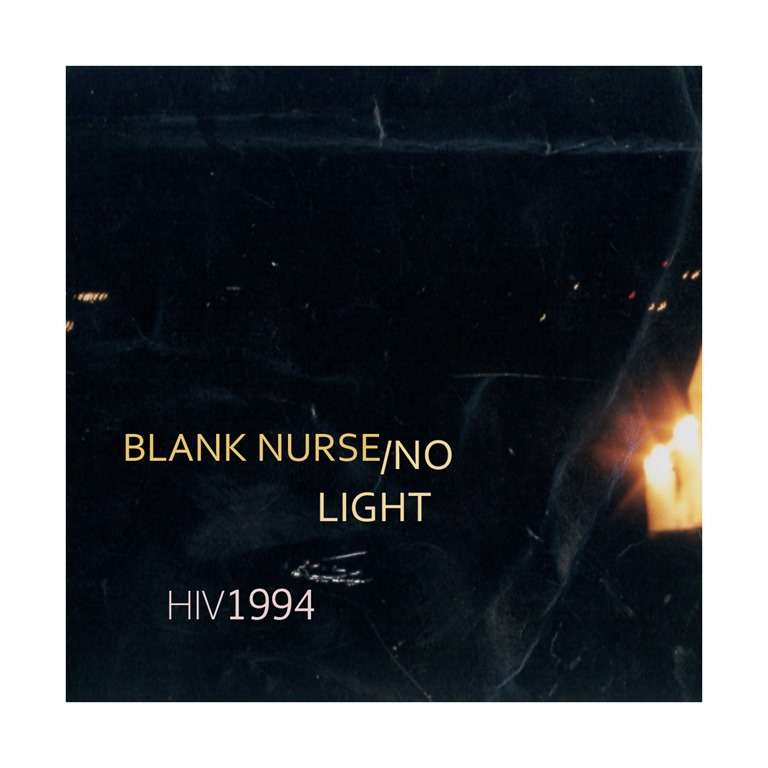
The title has very personal origins for Evan Davies, the man who records under the Blank Nurse / No Light moniker. A sufferer of Pure OCD – a form of OCD which manifests with no external behaviours or rituals, with the compulsions being mental rather than physical – and depression, Davies spent his teenage years tormented by the fear of HIV infection.

HIV 1994 sees Davies confront and channel the experience creatively, using what the press release describes as ‘often-overwhelming mental health issues’ to create song which are ‘like exorcisms for emotions and memories’. The context suggests that this was never going to be an ‘easy’ album, and however deftly Davies combines his wide-ranging and, in the face of it, incongruous and incompatible influences, which span ambient and neoclassical, hardcore, black metal, noise, and house, the clashing contrasts would be awkward enough without the anguish behind the compositions themselves. And so it is that on HIV 1994, Blank Nurse / No Light hauls the listener through an intense personal hell.

‘Blood Fiction’ begins with a collage of voices and extraneous noise before lilting string glissandos and a soft bass steer toward a calmer, more structured path. It provides a recurring motif, but one frequently interrupted by passing traffic and low rumbling noises. And so gentle tranquillity and ruptures of disquiet are crunched into one another before ‘Mocking of the Ghost of Crybaby Cobain’ really ratchets up the intensity with unsettling collision of styles, with pounding industrial percussion and expansive electronica that’s almost dancey providing the backdrop to the most brutal screaming vocals. It actually sounds like an exorcism. Or Prurient with more beats.

And it only gets darker, more disturbed and more disturbing from here: the lyrics are unintelligible, guttural screams of pure pain, and the tunes mangled to fuck, glitchy, twitchy anti-rhythms hammer around behind quite mellow synth washes. ‘Flu Breather’ sounds more like a demon dying of plague in a nightclub conjured in a nightmare, or, perhaps more credibly, the outpouring of indescribable, soul-shredding anguish that cannot be articulated in any coherent fashion.

There are some straight-ahead, accessible moments amidst the cacophonous chaos: ‘Outside the Clinic is a Hungry Black Void of Nothingness’ is a brooding electro-pop piece with a real groove and a narrative of sorts, and calls to minds Xiu Xiu, while ‘No Ecstasy’ goes all Wax Trax!, coming on like late 80s Revolting Cocks . But these tracks are very much the exception, as the majority of the others twist, turn, break and collapse in on themselves. Redemption and light are crushed and swept way in a succession of disconnections and claustrophobic dead-ends. It’s deeply uncomfortable from beginning to end, and much of it sounds like opposing sonic forces at war – which probably makes this a successful work, providing a deep insight into the tortured mind of the artist.

AA
Blank Nurse

Christopher Nosnibor

My appreciation of the debut album by Leeds noisemongers Irk is already out in the public domain, as is my admiration of their capacity as a live act. It was only fitting that they should launch their debut album at Chunk, the rehearsal space which has become the hub of the new Leeds underground / alternative scene which has begun to emerge since the Brudenell – still the best venue in the country – has become increasingly popular and catering ever more to bigger-name acts. And there’s no escaping the fact that without the tiny venues, the microscenes, the free and cheap spaces where anything goes, there’d be nowhere for the bands of the future to explore and develop ideas free from the limitations of marketability and the pressure to achieve success. Commercialism strangles creativity, and we need the obscure band who want to fuck shit up more than ever in these desperate times in the stranglehold of corrupt, constricting neoliberalist capitalism which is not-so-slowly eroding every real freedom for the ordinary person.

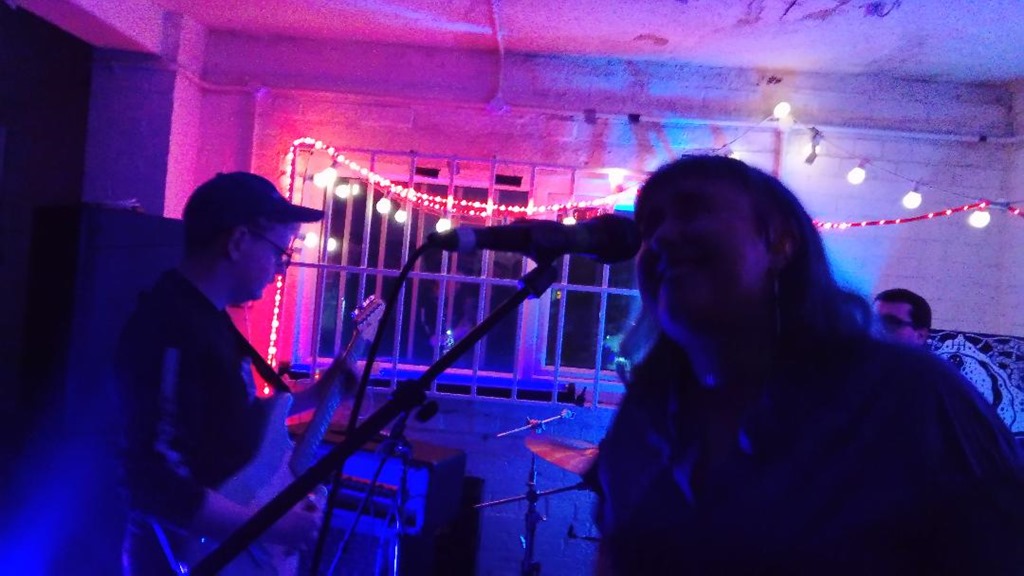
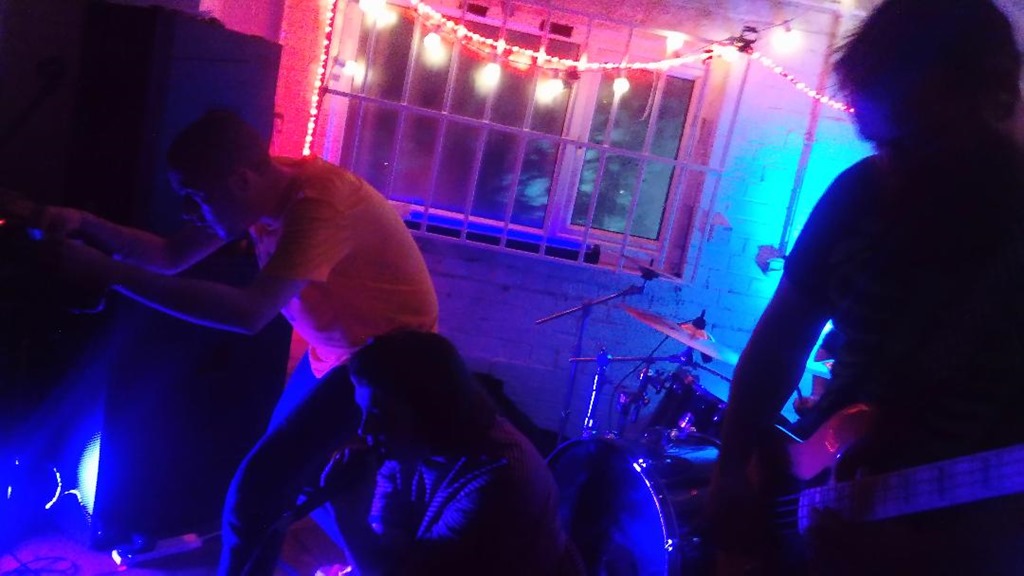
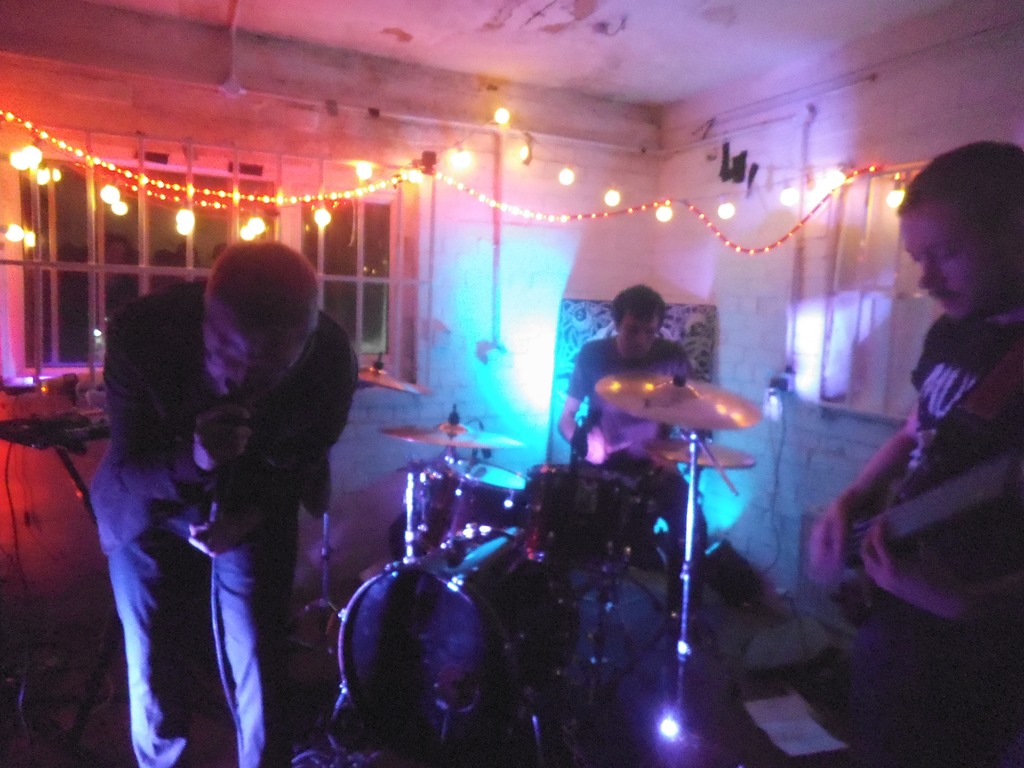
Chunk is so no-budget, so DIY that there’s no licence for tonight’s (free) event: its BYOB, and people file in with carrier bags containing four-packs and the atmosphere is just so laid back that my anxieties about finding the place (Chunk is hidden through a door up some steps (which I worry I may fall down on my way out) next to a car repair place in an industrial area two miles out into the arse-end of nowhere) and all of the other stuff I panic about but tend not to talk about evaporate almost immediately. There are friendly faces, faces I recognise, faces I can chat to, and it feels more like a house party than a gig.

Only, there’s a gig PA and there are bands, and Beige Palace are on first. I note that they’ve been using a quite from a review I wrote of their live debut on my only previous visit to Chunk in the summer of 2016, which says ‘Beige Palace make sparse-sounding music that’s jarring, dissonant and hints at a clash between early Pram and No Wave angularity.’ Two yeas on, it still seems a fair summary. ‘It’s not math-rock’, their diminutive and moustachioed front man, Freddy Vinehill-Clifee forewarns the audience before they begin their set. He’s right. It’s atonal, droney, repetitive noise-rock with an almost spoken word delivery. Kelly Bishop’s flat, elongated vowels are reminiscent of Mark E. Smith in the early years of The Fall. They’re bursting with nagging, awkward guitar lines and clattering percussion playing unusual time signatures, too. So, like math-rock, only not. Or something. But it’s not about labels, but the music, and while they’re still rough ‘n’ ready, their confidence and intuition has evolved a lot over the last two years, and they turn in a more than decent performance.

Beige

Beige Palace

It was the release of BRITN3Y that brought deranged Edinburgh 3-piece Britney to my attention, and I’d been itching to see them live ever since. They don’t disappoint. Comprising bass – through a fuckload of pedals; vocals – through an even bigger fuckload of pedals; – and drums, they deliver sonic riots in the form of blistering sub-two-minute noisefests. Occasionally, chuggy riffs and even grooves emerge from the screaming, spasmodic mess, albeit fleetingly. It hurts after two songs. It hurts a whole lot better after ten. The speaker a foot from my right ear is sounding like it’s fucked and they just fuck it harder with a relentless barrage of explosive, brutal hybridized noise that draws on elements of metal, hardcore, and grindcore and Final Fantasy (the victory fanfare is a recurrent feature throughout their set and closes it, too, while the infamous Tidus Laugh from FF X also features). They’re joined at the end by NALA for some screaming vocals to wrap up set appropriately culminates in an ear-splitting wall of noise, and I’m not the only one blown away.

Britney

Britney

It turns out that Jack Gordon still has the copy of The Rage Monologues from the time we exchanged books. He’s read my review of the album, and during our brief exchange, I’m reminded that so many of the people who make art that pushes extremities, in whatever way, are the most pleasant, polite, and mild-mannered people you could wish to meet. It’s their outlet, and it’s what keeps them sane. Better to make brutal art than commit mass murder. Probably. Jack – bespectacled, sporting jacket and chinos and looking like any other smart-casual office worker – is a nice guy. But with the aid of a PA, a backline, and a bottle of Buckfast, he brings the brutality.

DSCF7106

Irk

If the disappearance of Blacklisters from the Leeds scene following Billy Mason-Wood’s departure for Germany left a jagged, gaping hole, then Irk more than manage it fill it with their own rendition of that Jesus Lizard, Touch ‘n’ Go skewed 90s US noise-rock racket. The trio are quite a different proposition and are very much their own people, but the comparisons and local lineage are impossible to ignore. And in this enclosed space, with the volume at pulverising levels and the warmth of community and camaraderie only adding to that of the proximity of bodies, everything comes together perfectly.

Elli Records – EL07 – 13th November 2018

Christopher Nosnibor

Silence has long intrigued us. Variations of the philosophical question, ‘if a tree falls in a forest and no one is around to hear it, does it make a sound?’ have been a subject of contemplation since the 18th Century. As much as this ponderance is concerned with perception rather than the existence of silence, it does also hint at the idea that sounds are only what we hear. Does silence actually exist? In an evermore noisy world, the possibility of silence seems to have diminished beyond the vanishing point. And the more impossible its attainment becomes, the more we seek and desire it. And yet, at the same time, some people fear silence, even if only subconsciously.

In my own experience, even a moment of peace is conspicuous by its mere existence. My attempts to escape the noise of the world invariably prove futile; the babble of the office, the endless throng and thrum of traffic and people on the journeys there and back; a wife and child and general domestic noise on either side of those. Taking refuge in my office, I spend my evenings listening to music, the whirr of my laptop’s fan and the click of the hard drive a constant even when the music stops, while dogs bark outside and neighbours clatter around in their kitchens on either side. The lived experience is one of no escape, and no respite, and one which confirms the myth of silence.

Much meditation and mindfulness is concerned with seeking silence, if only internally, and musical experiments with silence have been manifold, although perhaps most famously by John Cage. It was on visiting an anechoic chamber – a room designed in such a way that the walls, ceiling and floor absorb all sounds made in the room, rather than reflecting them as echoes, and also externally sound-proofed – at Harvard University and Cage’s realisation of the impossibility of silence that prompted the composition of ‘4’33”’.

It was a similar room – this time at the Mechanical & Acoustic Research Lab LMA-CNRD in France – which not only inspired Julien Bayle to explore silence, but provided the source material for the album, captured during two hours of silence in the room. The results – as the title hints – are anything but silent.

As the text which accompanies the release explains, ‘Tiny random variations of physical electronic noises coming from the recording system itself, as uncontrolled spectres haunting the wires, have been captured and amplified, cut into tiny slices and grains, and used, both as basic sound sources feeding the Bayle’s machinery, and as modulation sources influencing pre-existing sound textures and continua performed live by the artist.’ Evoking Cage, it suggests ‘Violent Grains of Silence is the interpretation of the impossibility of silence by Julien Bayle’.

From what appears as nothing on the surface, Bayle has not only created something, but something immense. Violent Grains of Silence is not a hushed, tranquil work, but one of volume and great sonic turbulence. Violent is indeed an appropriate descriptor. Violent Grains comprises a series pieces through which whispering, grumbling, crackling, groaning, droning sounds swirl and eddy. There are crackling blasts of explosive static, grinding, electric, metal-edged abrasions – ‘Distr’ is a particularly blistering burst of coruscating noise. ‘Unpr’ buzzes and fizzes and thunders, a heavy barrage of low-end sounds creating the effect of an arrhythmic percussion.

Amplification counts for a lot, but it’s only possibly to amplify something which already exists. And so it is that Bayle has created a work which is rich in texture and tone, dynamic and at times disturbing.

This is truly the sound of silence. And the silence is at times deafening.

AA

Julien Bayle - Violent Grains

Hull Pair Head Out For Debut European Tour

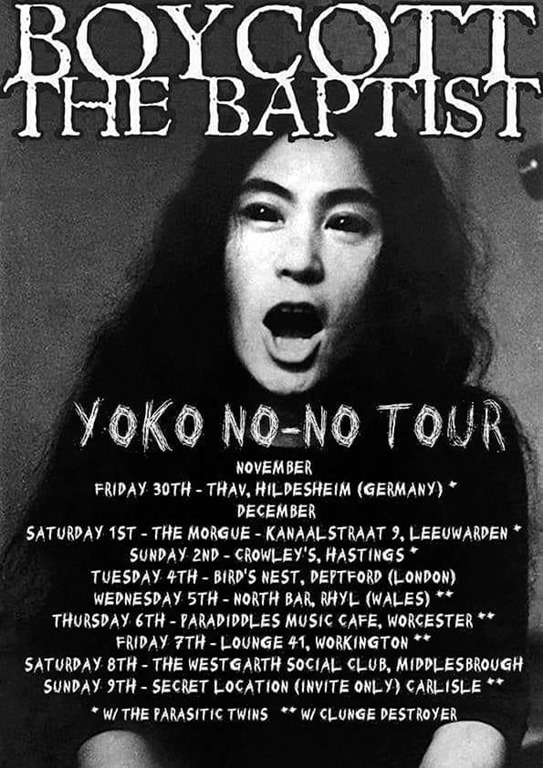
Hull hardcore duo Parasitic Twins are set to hit the road later this month with the monstrous Boycott The Baptist! The band, who released their visceral debut EP, “All That’s Left To Do Now Is Sleep With Each Other”, on October 26th, are set to appear in Germany and Holland with BTB! Remaining dates see support from Clunge Destroyer. Full dates for the tour below:

November 30th – Thav – Hildesheim, Germany (w/ Parasitic Twins)

December 1st – The Morgue – Leeuwarden, Belgium (w/ Parasitic Twins)

December 2nd – Crowley’s – Hastings (w/ Clunge Destroyer)

December 4th – Birds Nest – London (w/ Clunge Destroyer)

December 5th – North Bar – Rhyl, Wales (w/ Clunge Destroyer)

December 6th– Paradiddles Music Café – Worcester (w/ Clunge Destroyer)

December 7th – Lounge 41 – Workington (w/ Clunge Destroyer)

December 8th – The Westgarth Social Club – Middlesbrough (w/ Clunge Destroyer)

Ripping a page from the Killing Joke school of lo-fi noise, then setting it on fire via the way of Today Is The Day and Godflesh, Hull’s scariest kids, Parasitic Twins are riding high following the release of their debut EP. Recorded live and raw, at Melrose Yard Studios in York, the hardcore duo, made up by guitarist/vocalist Max Watt (Rotting Monarchs) and drummer Dom Smith (Mary and The Ram), have performed together previously as part of Seep Away was born of a desire to create the most abrasive sound they could.

Discussing their debut single, “Massive”, Watt had this to say: “It’s about that mental sense of abandon that comes once in a while and turns our lives into ash. Temporarily, of course. Everyone’s been in that place where long term plans and prospects just become irrelevant and all you can focus on is immediate day to day shit, and one day you wake up and think “Goddamn, what was all that noise about?” At the time it’s huge but with time just becomes a notch in your past, then you gotta make the reparations, and push all that negative shit to the back.”

Hammered into the raw aggression like a nail into splintered wood is a youthful rage desperate to be heard. Taking comfortable influence from the late 90s sludge scene, the track “Flipswitch” borrows from the Raging Speedhorn school of duel vocal ferocity while “End” wraps a chain around the Biohazard-esque bouncy hardcore and throws it on the heap. Making “ATLTDNISWEO” a white-hot blast of crusty oblivion, perfect for fans of low end, aggro-punk. Listen to at wielding volume.

AA

Boycott

GX Jupitter-Larsen – musician best known as the founder of noise act The Haters, who feature on some 300 or so releases, performance artist, conceptual artist, film-maker, writer, and ultimate polyartist – is the epitome of ‘cult’. Widely regarded, and avidly-followed by a small but discerning fanbase, he’s forged a career of enviable – and almost unrivalled in the broader field of ‘noise’ barring Merzbow and Whitehouse – duration stretching back to the 1970s.

With The Haters’ 40th anniversary looming large on the horizon, John Wisniewski snatched a brief Q&A with GX for a progress report…

John Wisniewski: What projects are you currently involved with, GX?

GX Jupitter-Larsen: 2019 is The Haters’ 40th Anniversary, so there will be a few releases and performances to mark the occasion. Including a double 10-inch on Influencing Machine Records. That’s a decade a side! Ha!

JW: What were the first recordings of yours like? Were they noise or collage?

GX: Kind of a mix of the two.

JW: What was the ethos of The Haters. What did you want to accomplish?

GX: I was in New York in 79; in many ways, The Haters was my reaction to being in THAT city at THAT time. New York in 79 was such a celebration of entropy and decay. I just wanted to keep the celebration going.

JW: What was the audience reaction at the time?

GX: People either got it or didn’t. Those who got it didn’t need to be told what was going on. Those who didn’t get it were never going to get it. Either you didn’t need an explanation, or no explanation would do. Forty years later, nothing seems to have changed much in that regards.

JW: Any future plans for you, GX?

GX: I’ve started working on my third feature-length movie. This one takes place in a library; a library full of noisy books. Ha!

JW: Do people still seek out challenging art today?

GX: Fewer and fewer. Sadly.

GX Jupitter-Larsen is on-line here.

Room40 – EDRM419 – 30th November 2018

Christopher Nosnibor

Despite having released about a thousand albums since first emerging in 1979 (Wikipedia states ‘over 400 recordings’, which still makes for a completists impossible dream), a new Merzbow album still instils a certain glimmer of excitement and anticipation. Perhaps it’s the fact that while Masami Akita’s work sits squarely in the domain of ‘noise’ and the element of surprise is limited when it comes to a new release – there’s no dropping of a sudden and unexpected pop or country album, for example – his capacity to push the parameters of a genre he almost singlehandedly defined means that there’s always something to warrant interest.

Writing on MONOAkuma, a live recording made in Brisbane in 2012 at the Institute Of Modern Art, Lawrence English, the man behind the ROOM40 label, recalls ‘this was the second time I had the pleasure to present him live in Australia. To me, this performance epitomises the physiology of Merzbow’s sound work. He creates in absolutes; sonically he generates a tidal wave of frequency that sweeps across the spectra with tireless frenzy. Merzbow’s capacity to conjure a massive swirling mesh of analog and digital sources is without comparison. His work is one of physiological and psychological intensity; a seething, psychedelic and utterly visceral noise-ocean.’

English continues by noting that ‘2019 marks the 40th anniversary of the commencement of Merzbow. This recording, which epitomises Merzbow’s 40 years as arguably the most important noise musicians of our time, demonstrates the intense and complex audio world Merzbow has created. It’s the perfect starting point from which to wade into the noise ocean that is Merzbow’s vast output.’

Sidestepping the fact Merzbow has been in existence almost as long as I’ve been alive, I’d be inclined to agree: MONOAkuma is quintessential Merzbow and encapsulates all of the defining features of said vast output.

I’ve personally only witnessed Merzbow once, performing in Glasgow in 2004 – a set which saw him split the signal between the PA and a massive – and I mean immense stack of Marshall cabs. Akita was barely visible, perched atop a wall of speakers that made the combined backline of both Sunn O))) and the Quo look like they’re travelling light. The sound he produced through this set-up was a face-melting, brain-bending, tone-shifting wall of noise. I’m not sure I’ve ever been quite the same since.

MONOAkuma, then, contains 50 minutes of classic Merzbow. It begins with s few seconds of scratchy feedback. It tweaks at the nerve-endings. And then the levee breaks and the sonic deluge explodes. All the frequencies, all the tones, all the textures erupt simultaneously and blister and burn and fire in all directions. It’s so dense, so immense, so all-encompassing and immersive: the experience is overwhelming. There is noise, and then there is Merzbow. There is so much detail here… although it’s almost impossible to absorb even a fraction of it with so much, and delivered at such volume. Everything is tossed and churned in a barrelling tempest of relentless abrasion that scours the skull’s interior – select cement mixer / blender / washing machine / oil drill / swirling vortex / apocalypse simile of choice here. Whiplash blasts of funnelling distortion howl and scream in a churning tunnel of overloading distortion, and within six minutes it’s hitting the lower levels of pain and by 21 minutes aural and psychological ruination is achieved. The power lies in the ever-changing textures and tones: there isn’t a second were the sound doesn’t change, and it’s this constant shift that makes it so powerfully challenging, with layer upon layer of howling racket tearing the air to the point of atomization.

Few artists – if any – have the capacity to inflict brain-pulping anguish like Merzbow. This isn’t just nose: it’s all the noise. All at once. Amplified to the power of ten to create screeding, screaming, multi-tonal, multi-faceted blitzkrieg. There is no respite, no space to make shelter. It hurts. And until you’ve experienced Merzbow in full effect, you really haven’t experienced noise. And MONOAkuma is relentless in its assault. This is total noise, relentless, obliterative, devastating.

But as punishing and oppressive as it is, there’s something cleansing and cathartic about it. And herein lies the pleasure of the pain and the ultimate joy of Merzbow.

Please note: All proceeds from MONOAkuma will be used to fund research and preservation attempts for the Tasmanian Devil, which in recent years has suffered greatly due to effects of a transmissible facial cancer.

Merzbow - Mono

SVS Records

Christopher Nosnibor

This one positively explodes in the opening moments: a swirling black hole of noise that eviscerates the senses and assaults the eardrums with such ferocious force and excruciating volume that it feels like the end. The actual, living end.

Yet again, I find myself scrabbling for the press release while questioning the benefit of being told about the origins, mechanics or methodology behind the work. And so I find myself research one-line, and discover the visuals which accompany the audio, and begin to develop a real appreciation of the multimedia vision of Lukas Rehm, operating as Lybes Dimem for the purpose of the Syncleft Chronem project, a work which celebrates error and explores the relationship between various input stimuli and cognitive frictions. It’s complex, but can be readily reduced to the experience itself.

The visuals intensify the experience, but the sonic experience alone is intense and brings a blistering sensory overload. Syncleft Chronem is loud, attacking. Uncomfortable. Placing the album isn’t easy but then, it’s not entirely necessary: as a barrage of electronic noise with beats, it’s a work which assaults the listener from the outset with its sonic intensity, a combination of dense walls of noise, abrasive textures and tones, and sheer volume. How do you feel? I’m feeling tense, but excited, exhilarated as this racket assails my ears. Rehm clearly isn’t making music to win friends or influence people. He’s generating sound to see what it sounds like and how it feels.

Sometimes, you simply don’t need words. On ‘Saas’, there are threats of dancefloor-friendly beats for an industrial night as booming 4/4 bass thumps start up – but they halt abruptly, and the whole thing fractures and fragments. Everything halts before it hits a stride, everything jolts and shudders. Everything is too loud to hear properly.

Syncleft Chronem is brutal, in the sense that it affords no respite, no pause for thought. And nor should there be an apology for this: as with the best art, its intensity sustains fever pitch, is uncomfortable, feeds tension to the point of perspiration and palpitation. It hurts.

AA

LYBES-DIMEM_SYNCLEFT-CHRONEM-front-cover-woskin

Forking Paths PF0013 – 13th July 2018

Christopher Nosnibor

With a title referencing William Gibson’s Neuromancer, L5 finds maker of experimental minimal electronica New Tendencies explore an array of textures and tones with a real focus on the space around the sound. Sonar bleeps warp into whistles of feedback, consumed by underwater monsters and sonic detonations that linger like a heavy cloud of smoke, dust and rubble.

The shifts aren’t always delicate, the tones rarely gentle: the listener is dragged and hurled from high to low, abrasive, serrated edges sharpening the intensity of upper frequencies juxtaposed with rumbling, muffled lower ranges which pull at the pit of the stomach. The album’s ten compositions – which, given the way New Tendencies pull, drag, stretch, twist, and manipulate, are perhaps as well described as decompositions – are affecting by virtue of the physicality of the sound, and this in turn provokes a cerebral response.

Ordinarily, I find abstraction gives rise to an analytical rather than emotive response, but L5 is a different beast. The beats and rhythms – however diversely they manifest (and they range from distorted, crunching poundings to EQ-tweaked whiplash cracks via blasts of static) – create a sense of structure, however vague, a frame on which to hang the infinite varieties of noise, and thus draw the pieces back from absolute abstraction. And with the combination of structure and sonic impact comes a different type of response. Instead of seeking to analyse the technique, L5 invites the listener to feel the effects. And the effect becomes emotional on a certain level: the rippling waves and vibrations test the tension levels, pushing the up and pulling them down. Tense, intense, and at the very least, interesting.

AA

New Tendencies – L5

Season Of Mist – 31st August 2018

Christopher Nosnibor

I don’t know what’s more exciting about the proposition of Loved – whether it’s the introduction of ‘decidedly more extreme tone and presence of death and black metal’ into KEN Mode’s palate, or the fact it’s been produced by Andrew Schneider (Unsane, Cave In, Daughters), who has, we’re told, a ‘vision of noise and girth’.

It’s got to be the girth.

And add all this to their existing sources – ‘the desperate noise and industrial sonics of the 80’s and 90’s’ and you’ve got a truly lethal cocktail.

Lead single ‘Doesn’t Feel Pain Like He Should’ sets the tone, a squall of feedback prefacing a deluge of thunderous bass and drums and shouted vocals. The Unsane parallels are immediately apparent. This isn’t just intense, but claustrophobic: less black than steely grey, hard, and with a matt sheen.

A heavy bass trudge and guitar that’s more geared toward texture than tune evoke the spirit of Godflesh and early Swans on ‘The Illusion of Dignity’. However, the braying sax owes more to another Justin Broadrick-related project, the industrial avant-jazz brutality of GOD. It hits hard, both sonically and sentimentally.

And that sentiment is the motivation to produce an album that responds to the fucked-up ties in which we find ourselves, while also revelling in the absurdity of it all. Because the only sane response to such madness as Trump and Brexit and social media and the dominance of global corporations is insanity – to adopt an antic disposition, to appropriate from Shakespeare. In the postmodern climate, an appropriation is appropriate, although Loved lifts more in terms of spirit than anything concrete.

Jesse Mathewson (guitar / vocals) sets out the purpose: “We wanted tones that bash and cut, and for you to feel that desperate part of yourself clawing for a way out. And then, just when things are at their most bleak, you start to focus on what’s actually being said, and you’ll see the humour in absolutely everything that is transpiring before you.”

In surveying the scene that is the socio-political landscape, the humour is pretty bleak – more grim irony and a gallows grimace than a belly laugh. But it is funny in the sense that you couldn’t make any of this shit up. Loved is also pretty bleak and also full-on and brutal. It grinds and points relentlessly, churning guitars carving angularity and discord. And the bass… it hits the guts. Hard.

The tempo and tone don’t alter all that much over the course of the album’s nine tracks (‘This is a Love Test’ notwithstanding, that is – its spacious intro with strolling bass and wandering sax create an eerie calm): like any album by Unsane, it’s a work to simply let pummel you furiously, channelling the fury of US hardcore and beefing it up to industrial strength. And yes, fury is the key: this is the sound of the fury. And while the majority of the songs are fairly short, sharp shots of adrenaline injected with a large dose of acidic bile, the album closes with the eight-and-a-half-minute ‘No Gentle Art’. It goes for the slow build, scratching away, quiet but chugging away on the low end. In that sense, it’s a bit Shellac… and when it breaks out into an explosive cacophony of distortion and braying brass… it’s a bit crazy. And by the end, I’m more than ready to kill everyone. Now.

AA

878050

Finnish noise rockers Throat who are set to release their highly anticipated and Aural Aggro approved second album, Bareback on August 31st via Svart Records have shared a second track. ‘Born Old’ is described by vocalist/guitarist Jukka Mattila as ’a deliberate effort to break some formulas we always fall into when writing music. To most people it might sound like the same drivel we always do and in spite of the fact that they’re probably right, we’re proud of our song. Lyrically, ‘Born Old’ is about feeling bad in every which way possible. Feeling good is overrated anyway. Plus there’s a Coil reference in the lyrics, see if you can spot that!’

Listen to ‘Born Old’ here:

AA

throat-006-by-hilja-mustonen