Posts Tagged ‘Industrial’

Ipecac Recordings – 1st September 2017

Christopher Nosnibor

Dälek have always been about progress and evolution, and not only remaining contemporary but pushing the parameters. Since they emerged in ’98, they’ve stood at the forefront of the challenging end of hip-hop, a genre which has witnessed immense expansion over the last two decades – but has equally seen its horizons shrink dramatically within the suffocating avenues of the commercial mainstream. One might say that this polarity is a key fact in the framing of Endangered Philosophies. The polarisation between the mainstream and everything else musical is representative of the world at large: the political landscape provides perhaps the most significant and substantial indicator here, with left and right parties both moving further away from centre and claiming almost equal ground in the process, and not just domestically here in England.

Endangered Philosophies is an album for the now, as the press release points out: ‘Within the context of the current political landscape, the title Endangered Philosophies certainly brings to mind pertinent issues of moment, notably the rampant rise of anti-intellectualism, as well as the all too rapid erosion of genuinely progressive values in the face of fearful reactionary forces.’

‘Echoes Of…’ launches the album with a nauseating washing machine churn that grinds along before the thumping rhythm crashes in. the vocals are low in the mix – rare and seemingly contradictory for a hip-hop album, but this is Dälek, an act as inclined toward rock and industrial tropes as conventional hip-hop stylings. It’s a gnarling industrialised trudge, and the whiplash scratching and other overt concessions to genre form are crushed hard against one another into an oppressive and intense slab of sound.

‘Weapons’ is woozy, dark, and suffocating. ‘Few Understand’ is less abrasive, but rides on a dense, pulsating swell of sound underpinned by a plodding beneath that carries a real weight. Sometimes, a live drum sound is all it takes to elevate a hip-hop track above the conventions and into fresh, liberated territories.

With the vocals enveloped in delay and heavy layers of extraneous noise, the lyrics aren’t always entirely prominent, but the sentiment is entirely clear at all times. The shuffling trudge of ‘Son of Immigrants’ is underpinned by an almost subsonic bass. In contrast, there’s something approaching a levity about ‘Beyond the Madness’, the semi-ambient synths drifting cinematically over the insistent rhythm, and the seven-minute ‘A Collective Cancelled Thought’ is monumentally weighty, the bass churning beneath a shifting, turning squall of sound. ‘Battlecries’ is slow and bleak, with lyrics about black males being murdered and the state of culture and society providing the message to the work of the mixed medium.

It’s the contrasts which lie at the heart of the compositions on Endangered Philosophies which make it the album it is, and which render it so compelling.

Dalek_EP_Cover

ChristopherNosnibor

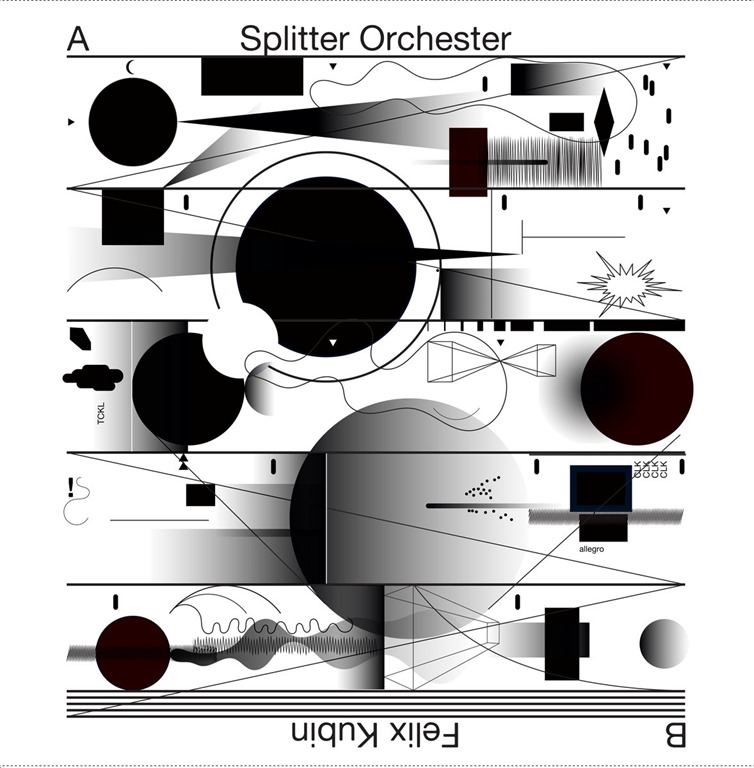
The split album seems to be in vogue again, and it’s a format which perhaps offers more scope for artists who don’t trade in punchy little tunes than the split single or EP. Shine on you Crazy Diagram may only contain four tracks and have a running time of just over thirty minutes, but it allows both contributing acts to showcase the range of their sound by presenting expanded, developed musical works.

The two tracks by Splitter Orchestra explore and examine weird digital percussion: the ever-shifting pitch creates the illusion of ever-shifting tempo (or does it? Perhaps the tempo does shift albeit subtly) beneath whistling contrails of feedback. They sputter and scrape and drone and hum. ‘Diagram 1’, at under four and a half minutes, is but a prelude to its counterpart, ‘Diagram 2’ which hums and wheezes for almost eleven minutes. There are rhythms in the mix, but they’re pinned back in the mix and bounce around against a shimmering backdrop of feedback and extraneous noise.

Kubin’s compositions are altogether less overtly structured, or at least rhythmic, as swampy swashes and thumps rumble and eddy before – from seemingly out of nowhere – faceripping blasts of distortion roar and blast. ‘Lückenschere’ is constructed around a clattering, shifting rhythm.

‘Lichtsplitter’ clatters and moans and hums and drones for an eternity, before stepping up about ten gars. By the end, one has a fair idea of what it just be like to stand within two feet of a Boeing 474 taking off.

This is, without doubt, one of those releases which lends itself perfectly to vinyl: it is, after all, an album of two halves. They compliment and contrast, and showcase two quite different sides of the experimental digital coin.

There’s a digital bonus track from the Splitter Orchester. ‘Diagram 3’ is a ten-minute extravaganza of thick, impenetrable hums and drones. It might not exactly change the complexion of the release, but it does unquestionably fill out and round off the intangible, non-physical format nicely.

Splitter Orchestra   Felix Kubin

March 2017

Christopher Nosnibor

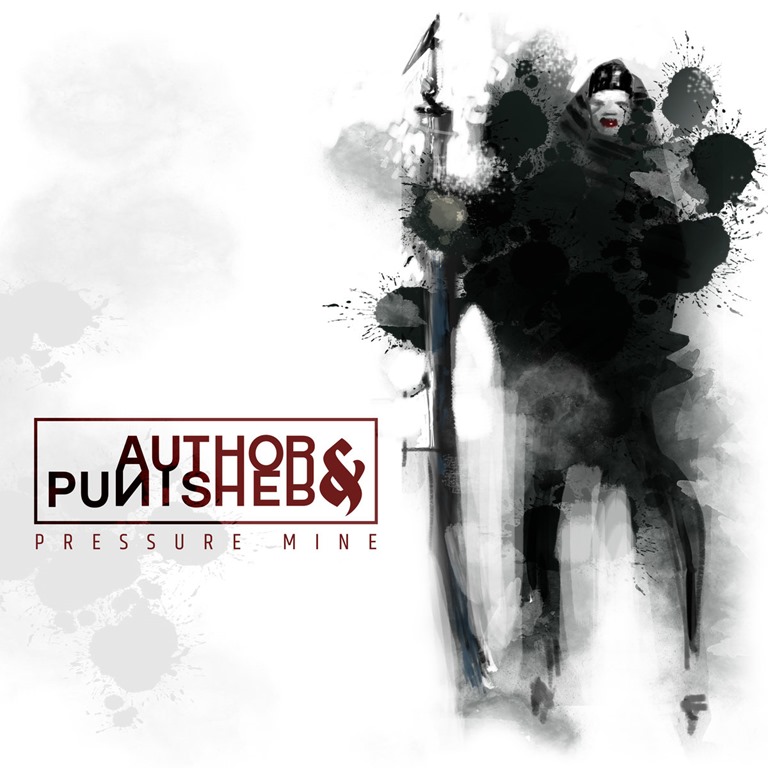
I’m not actually a fan of physical violence. The sight of blood – particularly my own – is enough to make me nauseous or even pass out, and I struggle with pain. And yet I’m also strangely, perversely drawn to violence. I consider the Marquis de Sade’s 120 Days of Sodom to be a comic masterwork. Why? Because violence at that level becomes absurd, as real as Tom and Jerry. It’s also perhaps important to distinguish art and life. So much brutal music and art is an outlet of the darker psychic states channelled by some of the mildest, sanest people you’re likely to meet. I haven’t met Tristan Shone so can’t vouch for his character, but his work under the Author and Punisher moniker is pretty brutal, and appeals precisely because of it.

The Pressure Mine EP, which finds Shone bring everything in-house to deliver five new tracks, all written, recorded, mixed and self-released by Shone himself balances brutality and beauty. What’s more, there’s a definite trajectory which runs over the course of the EP: something of a downward spiral, if you will, which sees each successive track prove darker, bleaker, heavier and more fucked-up than the one before. It may not be quite as gnarly and doomy s some of its predecessors, but that hardly makes this a stroll in the park and if anything, the absence of eardrum-shredding lasts of noise only accentuates the uncomfortable tension Author and Punisher is capable of creating.

First track ‘Enter This’ is a magnificent, mechanised droning industrial trudge, synths interlacing to forge a dark atmosphere over a battering mid-tempo rhythm. It’s all a backdrop to Shone’s vocals, which balance disconsolation and anguish. While reminiscent of Prettty Hate Machine Nine Inch Nails, it’s also rather more emotionally nuanced. ‘Pressure Lover’ lunges deeper into a woozy, nightmarish fugue, a dense, rumbling bassline and clanking percussion dominating.

‘New World’ warps and grinds, a dislocated discord emerging from the echoes and twisted vocals, and the last track, ‘Black Wand’ comes on like Depeche Mode on a cocktail of Ketamine and LSD. It’s not entirely pleasant, but it is unsettlingly awesome.


Author and Punisher - Pressure Mine

Helen Scarsdale Agency – HMS039

Christopher Nosnibor

We live in a world of noise. We live in a decaying, post-industrial world. The so-called developing world is on an inexorable trajectory toward the same calamitous end, a world of tertiary industry and a level of noise – literal and metaphorical – which the framework of postmodern hinted at and but failed to fully appreciate the totality of its eventuality. To contextualise Natural Incapacity requires a certain grounding in postmodernism and the idea of a society defined by information overload. But, to reframe my comment on the shortcomings of postmodern theory, it essentially fails to account for the impact of the culture on those who find themselves existing in that culture. What have we done in making such technological leaps with so little consideration for the psychological consequences? Has the human mind evolved at a pace correspondent with the technologies we’ve made? What does the infinite noise actually sound like in the middle of that blizzard of information?

Natural Incapacity is an immense work, with a total running time of some two and a quarter hours across its two discs. Housed in a hand-rusted cover produced by Jim Haynes, this is serious art. The album soundtracks not the external noise so much as it does perhaps the internal noise, and the experience of the collapse of everything into an amorphous cyclone of everything happening all at once. The human brain simply isn’t built for the world in which we find ourselves. There’s so much talk of ‘white noise,’ but ultimately, total overload is an entirely different kind of noise, an explosive noise, simultaneously conveyed as the sound of collapse, of panic, anguish, and screaming despair.

Disc one is the shorter of the two, with has a running time of an hour and two minutes. A dark, quiet rumble soon breaks into a dense, harsh wall of sound. Tidal waves crash and planets explode in slow-motion, creating layer upon layer of textured noise that pounds the senses relentlessly. This is heavy, brutal stuff. The violent turbulence is punishing, effecting a psychological disturbance. The moments of calm are but brief and heavy with tension, the suspense of how and when the next wave of noise will erupt. And erupt it invariably does, tearing the fabric of the atmosphere, an annihilative volume of atomic force.

There’s no obvious shift moving onto disc two, but the effect of so much oppressively dense, murky and irredeemably inhospitable noise is cumulative. As the time crawls on, one senses the walls slowly moving closer, the light and oxygen gradually being pushed from the room and the life slipping from one’s soul.

Hums and whirs offer cold comfort in this funnelling fermentation of foul decay as factories collapse in slow-motion under the weight of so-called progress. The absence of vocals renders this even more disturbing, in that there are no obvious signs of human life to be discerned in the churning melee. As such, were reminded of our ultimate obsolescence, and there can be no bleaker prospect than that. Natural Incapacity is nihilistic in the absolute, a soundtrack to the end of time.


Relay for Death - Natural Incapacity

Sacred Bones – 20th January 2017

Christopher Nosnibor

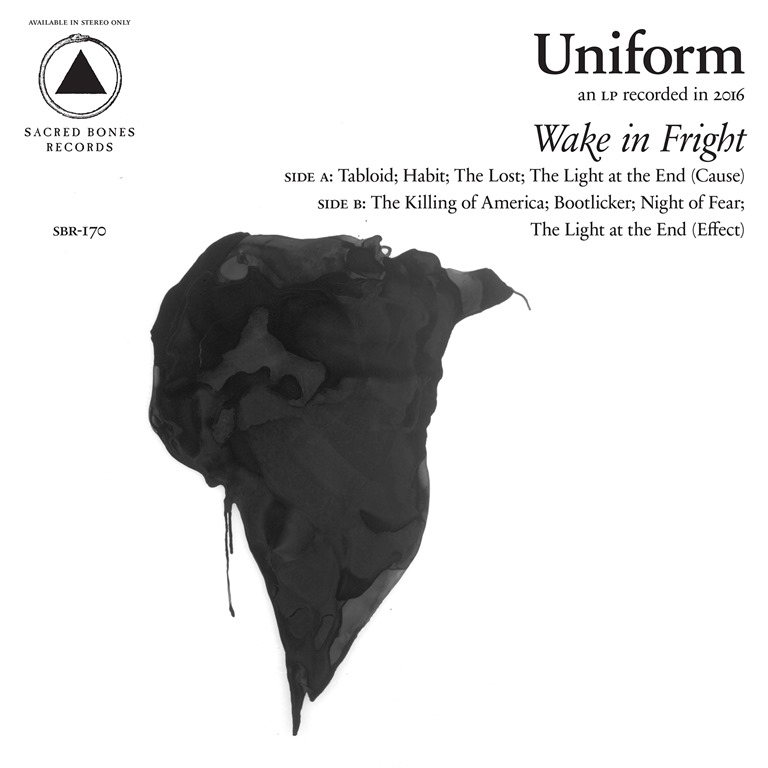
‘Nasty’ is a word you’re likely to hear or read in relation to dark, gnarly, mangled black metal or crust punk, or perhaps some particularly unpopulist industrial effort, or some particularly savage techno. But on Wake In Fright Uniform offer something that’s a different kind of nasty. And yes, it really is nasty, brutal, savage, uncompromising and unfriendly. And while there are elements of metal, thrash, industrial and power electronics, Wake in Fright – described as ‘a harrowing exploration of self-medication, painted in the colors of war’ – throws down the challenge of a noise all of its own.

Preview cut ‘Tabloid’ doesn’t so much open the album as tear the lid off the thing in a squalling, brutal frenzy. The drums are pitched to a frenetic pace but largely buried under the snarling, churning mess of guitars, feedback and distortion. Michael Berdan sneers and hollers venomously like he’s in the throes of mania, and to describe it as raw would be an understatement. It’s still on the bone and walking around. A gnarly mash of early Head of David, Foetus, Godflesh and the most obscure hardcore punk demo tape you’ve ever heard, it’s anything but easy on the ear. It is, however, a real blast of adrenaline, not so much a smack around the mouth as a succession of steel-toed boot jabs to the ribs.

The earthmoving bass grind of ‘Habit’ is coupled with the dirtiest, dingiest guitar noise you’ll hear all year. ‘The Lost’ combines the harsh edge of late 80s Ministry with an old-school punk feel, New Order trampled under the boots of a thousand-strong army of brutalists. It’s a stroll in the park compared to the thousand-mile-an-hour rage explosion that follows in the shape of ‘The Light At the End (Cause)’, which is nothing short of brutal, a black metal assault. There’s nowhere to take refuge with this album: cover your face, the blows land in the ribs, the back, the legs. Uniform are fucked off, and are going to vent their unremitting ire on anything, everything, and everyone.

The most striking thing about this album – short as it is, with just eight tracks and a total running time of thirty-eight and a bit minutes, (aside from its eye-popping intensity, that is) is its diversity. ‘The Killing of America’ is a full-tilt industrial metal slogger which evokes the spirit of Psalm 69, and packs a truly wild guitar breaks. The tempo is off the scale, to, and th third most striking thing about Wake in Fright is its sustained attack. There’s no let up. Not even for a second. Just when you think there might be a moment’s respite, the buggers up the tempo and the volume and the fierceness by at least another ten per cent. By ‘Bootlicker’ (track six), it’s all reached an almost unbearable level of noise, as the drums pound like machine gun fire through a gut-churning barrage of guitars. Seriously, with Wake in Fright, Uniform make Strapping Young Lad sound like Mike Flowers Pops.

Curtain closer ‘The Light At the End (Effect)’ may slow the pace at last, but the murky Swans-like dirge, with its scratched spoken narrative, remains anything but an easy exit or an uplifting finale. It’s six minutes of postindustrial grind, and a fitting close to an album that comes out, fists flailing, whirling chains and spitting venom.

Don’t come to Uniform looking for a hug. Wake in Fright is utterly terrifying, a horrorshow of a record with not a moment of calmness or humanity. It’s horrifying, squalid, beyond harsh: a sonic kick to the gut. You bet it’s already one of my albums of the year.


Uniform - Wake in Fright

empreintes DIGITALes – IMED 17141

Christopher Nosnibor

The background:

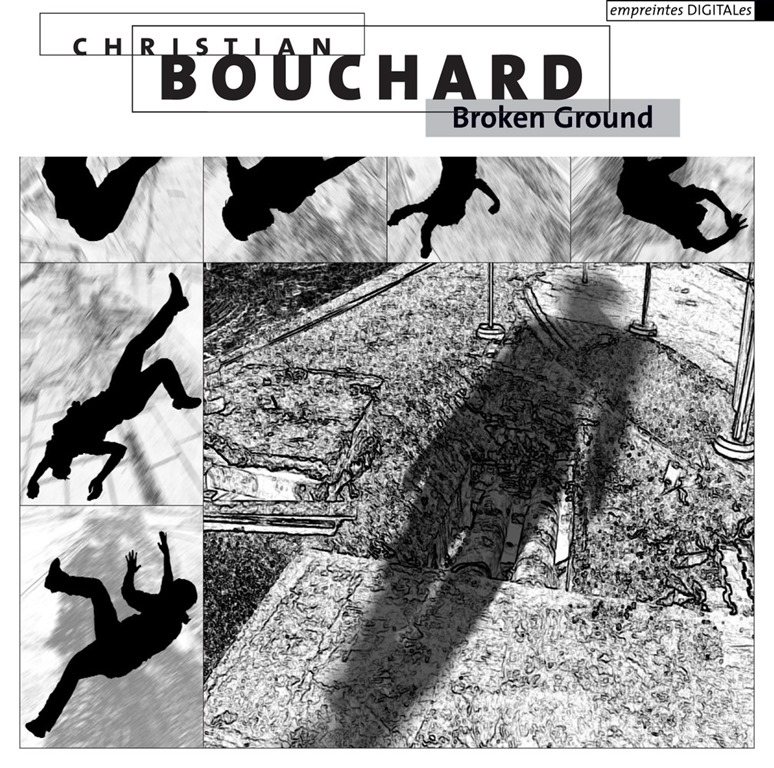
The exhibition Broken Ground looks at seven cities over ten years, and how redevelopment infrastructure changes our perception of cityscapes. These cities could be anywhere (everywhere). Reconstructed from the opportunities of street level construction, I treat the sites more like stage sets, where there are props, actors, entries and exits, and evidence through the debris, disarray, shadows of figures and randomness throughout.

In our contemporary world the works have taken on hybrid references of displaced people from war zones, or natural disasters that fill nightly newscasts in the media.

The review:

It’s an unsettling work. An apocalyptic, post-nuclear work. An album that lurks under the shadow of the bomb. It’s an album for unsettled times, a soundtrack to a return to the distrust of cold war politics and a global culture defined by social and political division, fear, uncertainty and mass murder. Broken Ground is a dark album for dark times.

From the very outset, Bouchard manipulates dark, throbbing layers of undulating, yawning drones and grating tidal waves of noise, dragging them across birdsong-like tweets of analogue twitters, sounding like a corpse in a tarpaulin being hauled down gravel drive at sunset. Yawning, drawling harmonica-like notes drift lazily, and somehow awkwardly, stretched and distended, over groaning low to mid-range backdrops: almost-familiar sounds are bent out of shape and rendered unfriendly. ‘Intergranular Attack’ goes in low, snake-like whispers and bleak monotone narrative samples deliver reports of atomic science with a detached clinicality, and the theme is revisited in the fragmented, fractured post-apocalyptic time capsule that is ‘Resistant Materials’.

Dark tones creep and hover, while washes of snarling noise and contrails of feedback linger amidst screeds of sharp-edged sheets of sound and washes of nebulous noise. Glitchy, crackling beats thud disconcertingly through a stammering hum on ‘Hysteries’, and the scratchy oscillations of ‘Voids Patterns’ offers a fresh take on spacey / spaced out reverby darkness.

Broken Ground finds Bouchard exploring well-trodden experimental fields and offering something new. Charming chimes assume an ominous demeanour; voices drift, detached in empty space. There is no comfort or solace to be taken from their presence: they’re distant, disconnected, out of reach, perhaps by light years. You may be receiving, but there’s no way to make two-way contact: you’re lost in a wave of pink noise and a fizz of rolling static.

As in space, so on earth: each person sitting, alone, boxed in: connected in the virtual world but never more alone and isolated now. Tapping out comments and messages, condolences and sympathy for the displaced and the damaged reported by the media: it’s merely mechanical. You feel nothing for them, you feel nothing for yourself: you’re numb, a drone. You don’t really connect. You’re floating in virtual space.

The voices, stammering, echoing in fractured snippets of different languages from the speakers are no more familiar than the voices from around the world, beamed to your computer and smart phone. This is the world of dislocation and dis-ease Bouchard depicts with such precision on Broken Ground. It’s awkward and uncomfortable, but looking in the mirror always is.

Christian Bouchard – Broken Ground

Consouling Sounds – 9th December 2016

Christopher Nosnibor

Listening to Gnaw Their Tongues always feels like a dubious pleasure, something that’s almost masochistic. You listen to GNT to channel dark energy, to release bad vibes, for the letting of anguish and pain and anger, for an experience akin to a sonic exorcism. You don’t listen to a GNT album to feel better about life and the world, to lift the spirits. In keeping with Mories’ myriad previous releases under the Gnaw their Tongues and various other monikers, Hymns For The Broken, Swollen and Silent is an album for venting, or when feeling the need for some pugilistic self-flagellation.

Structurally, there is a certain narrative thread which is possible to interpret fromt e tracks and their sequencing. Sonically, this is the sound of hell: Hymns For The Broken, Swollen and Silent is the soundtrack of existence in purgatory.

Woozy, near subsonic bass dominates, while above, impenetrable demonic screams and below, almost submerged, drums like machine gun fire rattle at 250bpm. It’s an unholy racket. ‘Your Kingdom Shrouded in Blood’ brings a vast, cinematic expansiveness to the sound. The drums roll like thunder and crash like tsunami, reverberating through immense canyons, and monastic voices send wordless invocations to the heavens. It’s pompous and bombastic and it works magnificently, as if soundtracking the preface to a climactic battle of mythological proportions, a combat between good and evil where the two sides each summon their ultimate deities.

‘Silent Burned Atrocities’ ratchets up the pain, marrying extreme sounds at extreme volume to extreme tempos, barrages of rapid-fire beats from deep within the morass of noise, snippets of dialogue emerge, to be engulfed in a wall of noise and screams of anguish. ‘Hymns For The Broken, Swollen and Silent’ ventures into the territory occupied by Sunn O))) on Monoliths and Dimensions. The dronesome doom and the creeping fear chords are bathed in a quasi-religious light. Here, with sampled vocals floating in and out between the monumental, crushing beats the sound takes on a different perspective on eternal darkness. But dark it is, and there is no hope of finding hope here. ‘I Have Clad the Pillar in the Flayed Skins’ sounds like a black metal remix of early Swans, a punishing cacophony of noise that’s every bit as torturous as the scene the title conveys. These are the spoils of battle, and there is rejoicing in the bloody scene of victory.

The final track, ‘Our Mouths Ridden with Worms’ is the subterranean song of the dead, the defeated. It’s a dank, dark, lugubrious trudge of a track. Perhaps death is not defeat, but victory: to live in a world where this is the sound of living is a bleak prospect.

Hymns For The Broken, Swollen and Silent is not fun. It is not pleasant. It is not enjoyable. It’s dark, and darker still. It’s oppressive, and terrifying. It’s classic Gnaw Their Tongues.

Gnaw Their Tongues - Hymns

ROOM40 – EDRM426 – 4th November 2016

Christopher Nosnibor

This is one for the David Lynch fans, but also fans of experimental industrial noise, and those who appreciate works which exist in the realms between media.

Factory Photographs was one of a number of commissions made by the curator of the exhibition David Lynch: Between Two Worlds, a retrospective exhibition held at Brisbane’s Galley of Modern Art in 2015. The exhibition featured Lynch’s works in painting, sculpture, installation and photography, and included a large section of his Factory Photographs: shots of factories in various states of disuse, taken over several decades.

Raised in the country, surrounded by woods and farms, Lynch developed a fascination with the architecture, the machines and ‘the smoke and fear’ of factories from his visits to his mother’s native Brooklyn. HEXA is Laurence English and Jamie Stewart (Xiu Xiu), and Factory Photographs is their sonic response to Lynch’s images.

While Lawrence English’s work is often typified by a delicate approach to sound and the use of delicate field recordings, it’s clear that the inspiration and the collaborative input of Stewart have pulled him toward something altogether more visceral: Factory Photographs is an intense and brutal work.

‘Sledge’ rumbles and crashes in with some heavy noise, an amorphous roar barrels and funnels a dense sonic cloud, from amidst which shuddering throbs grind and thrum. Each piece is a blast of earthmoving noise, more evocative of a super-scaled atomic destruction than heavy industry or its demise and dilapidation. Yet as noise without clear definition or shape, it’s still highly evocative, and does correspond with Lynch’s conception of ‘the ideal factory location’, with ‘no real nature…’ This is sound which is brutal, harsh, unrelenting and unnatural, wholly man-man made yet wholly inhuman. The barrage of noise is built from a conglomeration of hums drones and thunderous sounds on sounds, roiling, churning. The rhythms are not percussive, but born from cyclical undulations, the churn of industry at its heaviest, in its earthiest form: the mine, the quarry, the drilling rig, the smelting of ore and the forging of metals. But of course these are only echoes of an industrial past: the factories lie empty now, derelict or inching toward dereliction, and the workers have gone, transferred, replaced, relocated, on the same scrapheap as the rusted machinery or otherwise forced into alternative careers.

As crushingly depressing as the factory may have been, its absence leaves only a lack and the question of progress, but as what cost? But equally, the earth-gouging sounds of Factory Photographs reminds of the finite nature of the earth’s resources, in particular fossil fuels. What is left apart from irreparable scars on the landscape once every last scrap has been excavated? Where is the future?

Dark, sonorous notes hang heavy on ‘A Breath’, and Factory Photographs is rich in gloomy atmosphere. Sheet metal thunder resonates through vast empty spaces, and clusters of clangs reverberate in the grimy darkness to create a bleak and oppressive sensation. The turbulent roar of ‘Vertical Horizons’ is harrowing and unforgiving, building to a shrieking howl of feedback while the regular rhythm of heavy machinery rotating is replicated on ‘Over Horizontal Plains’, while thuds and distant rumbles continue endlessly beneath. Digging, dredging…

It’s unsettling but exciting, and the prospect of an audiovisual work, featuring, with Lynch’s approval, the original visual montage of his photographs in 2017 is a thrilling one. Meanwhile, the album more than works in its own right as a dark, stark and uncomfortable collection of pieces which shake the listener’s sensibilities and leaves a hollow, uneasy sensation in its wake.

https://f4.bcbits.com/img/a0775137879_10.jpg

Gargarin Records – gr2035 – 1st November 2016

Christopher Nosnibor

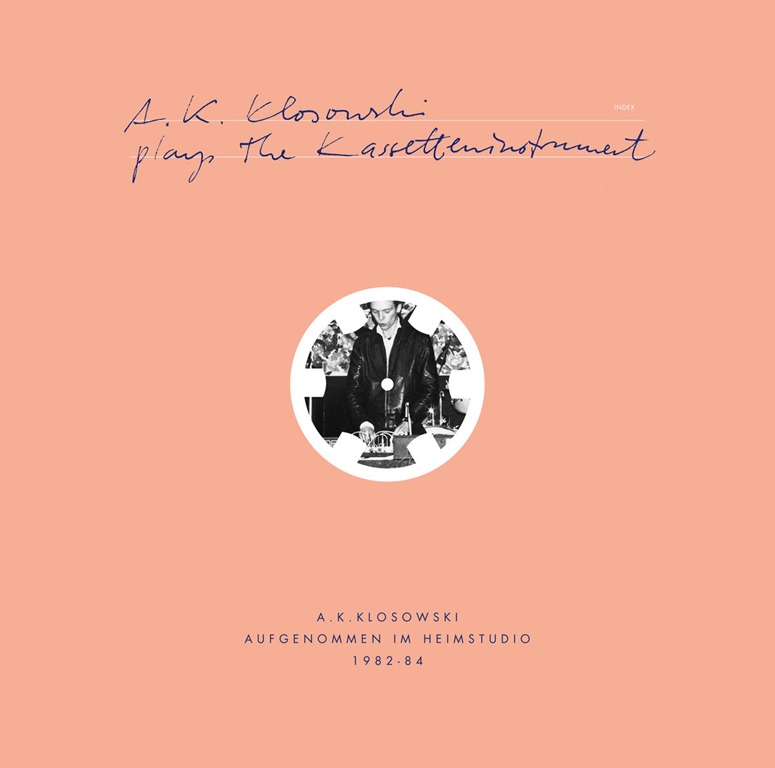
Something is very wrong. Ok, so there are lots of things that are very wrong, but in particular, there’s something wrong with A K Klosowski, and by the sounds of things, his audio archive. And his tape deck  – or decks, to be more accurate. Listening in 2016, one might think that whatever combo of kit constitutes a ‘kassetteninstrument’, something is awry, that the heads are worn and the tapes are chewed, with loops and samples continually playing at random, all at once.

But context is important here and the mic on this album creates digital technology by a mile. As the blurbage explains, ‘Long before digital sampling was affordable for everyone, A.K.Klosowski invented his Kassetteninstrument, a custom-made music apparatus consisting of eight SONY-Walkmen combined with a mute/demute mechanism. The outputs of the instrument could be controlled both by hand and by an automatic trigger module. In addition, a drum computer and some effect machines were fed into the circuit. This technique allowed for very intuitive and simultaneous control over the analogue tape sources.’

Eight Walkmen? That would have required some wedge back in ‘82 to ‘84 when these recordings were produced. …plays the Kassetteninstrument is perhaps an album of its time, but still holds up on every level in 2016. It’s chaos from the offset, and the whole album is a riot of snippets and sounds, bits and pieces, crushed together to create something… different.

Elsewhere, grating, mangled synth sounds and extraneous noise skrawks and clanks hither and thither, and processed beats slither and jitter beneath vocal snippets, robotix voices, whipcracks and car crashes. It’s all going on: synapse-popping, electrode-melting disco and stuttering 80s inspired electronica interfuse in an audio wilderness.

At times it’s an awful cacophony; at others, the mood is playful, while at others still, it’s darkly sinister. Bendy organs and warped tape loops, stretched and scratchy, make weird, woozy wigouts. With motorik rhythms twisted out of time, it’s like Krautrock on acid, with nods to Throbbing Gristle and Suicide, William Burroughs and Cabaret Voltaire. It’s pretty fucking cool.


A.K. Klosowski - …plays the Kassetteninstrument

Uniform are old friends Ben Greenberg (ex-The Men, Hubble, and the producer/engineer responsible for much of the Sacred Bones catalog) and Michael Berdan (ex Drunkdriver, York Factory Complaint) and formed in New York City in 2013.

To coincide with the 28th October release of their Ghosthouse EP (which has scored Aural Aggravation’s vote), they’ve unveiled their cover of Black Sabbath’s ‘Symptom of the Universe’.

Get your lugs round it here…