Posts Tagged ‘Industrial’

Uniform hit us with their most powerful, most emotional and bleakest endeavour yet. Vocalist Michael Berdan and instrumentalist Ben Greenberg have joined forces with drummer Greg Fox (Liturgy, Zs) to perfect their vicious post-industrial dystopian cyber-punk and are ready to announce their new studio album The Long Walk incoming via Sacred Bones on 17th August. They’ve also revealed a video for the album’s lead single ‘The Walk’. Created by Danny Perez, the video highlights the cynicism, absurdities and downright bloodlust of our current news cycle. 

Intense doesn’t cut it. Check it here:

Ventil Records – V008

Christopher Nosnibor

Variations on Bulletproof Glass follows 2016’s Decomposition I-III which also featured Christina Kubisch, and set out to explore – and demolish – the well-worn thematics of field recordings.it represents something of a deviation in terms of its methodology, as well as its focus. This fourth decomposition collapses material rather than location, and places a very different focus on the concept of field recordings, centring not on the out and about, but the controlled space, and with a clearly defined specificity.

Variations on Bulletproof Glass is a literal title, being constructed from ‘waves which were transmitted through a bulletproof glass pane while it was exposed to major physical impacts’. But of course, like most works which are devoted to a microcosmic sound source, that source becomes increasingly obscured the closer the lens looms. While there are moments that do sound vaguely evocative of glass, cracking and splintering, there’s not a single classic crash and tinkle, a solitary smash and splinter. None of the sounds here betray their origins, and Kutin and Kindlinger have manipulated the source material to forge something altogether in a different sonic sphere from the pieces that lie scattered at source. There may be hints of scrapes and ricochets on/off glass, but there’s nothing which overtly says ‘this the sound of glass’ in the (de)construction of these samples. Because this is bulletproof glass, for a start. It has different properties, and can withstand greater punishment. The consequence is that so must the listener: this is challenging, and difficult to readily access.

‘X26’, the first of eight pieces, clanks and scrapes, and the chanking treble is countered by woozy bass. It has all the hallmarks of experimental dub, and even builds some dense, gut-churning rhythmic pulsations and dynamic beats – none of which even hint in the slightest at the source of the sounds. ‘Throne’ is a jolting, stop/start attack, and Elvin Brandhi’s vocals are stark, dishevelled, wild and wide-eyed. ‘PANE#2’ blasts away at a beat that echoes Throbbing Gristle’s ‘Discipline’ as synth-like sounds howl and wail aggressively before tapering to a quieter place.

Elsewhere, the sonorous, trilling done and scrape of ‘L.I.W’ is uncomfortable, and not for a single second does one listen to this and think that this is an album to mellow to, or even to function to. It’s not just distracting, but the sound of abstract obstruction.

AA

Kutin Kindlinger – Decomposition IV

ANTIME – ANTIME20

Christopher Nosnibor

According the bio, ‘Bad Stream is guitars and machines vanishing in the spaces between Radiohead, The Notwist and Nine Inch Nails only to reemerge amidst ambient, noise, and drone. It marks Martin [Steer]’s attempt to release his own history, alienation and loneliness into the chaos of the digital world and to retain their substance in doing so.

This is very much Martin’s thing, essentially a solo project, and the album represents five years of work, of gathering, of sifting, of seeking ways to represent the realities of life in contemporary society.

“I look at my phone even while I’m playing guitar,” says Martin Steer, “and that isn’t even entirely voluntary. The 2010s really changed my perception of how digital technologies and social media affect me as a musician. Through Bad Stream I want to make sense of this particular kind of anxiety, and to use sensory overstimulation as a way to develop an independent and progressive musical language.”

I can relate. Starting out as a writer around the turn of the millennium, I was fascinated by the idea of postmodernism – because although the concept emerged in the 70s in considering writing of the 1950s and 1960s, I was completely engaged in the notion that this was something that was happening now. Whatever McLuhan, Lyotard, and Jameson, or Deleuze and Guattari had to say about the effects of accelerated communications and a ubiquitous blizzard of media and sensory overload, nothing could truly predict or account for the psychological impact of living in the second decade of the second millennium. Nothing we’ve seen before corresponds with the endless twitching, the nagging anxieties of text messages without response, the barren Facebook page, the diminishing Twitter following, the hassling, haranguing, emails and messages, the relentless barrage of information and contact from every direction.

Besides, theory and practise, however closely they endeavour to merge, invariably and inevitably exist with degrees of separation. And so it is with Bad Stream. It’s a nicely-assembled album, with some suitably dark and intense moments, and the production balances the slick, crisp ultra-digital with the messy, reverby, sonic halo that pulls it all back a way.

I often wonder what the musical landscape would look like if Nine Inch Nails hadn’t happened. It seems that one act not only spawned a genre unto themselves, but reshaped the musical landscape, to the point that what would once have sounded ‘edgy’ now sounds mundane, and so much can simply be filed as ‘derivative of Nine Inch Nails’. In drawing in a samples, semi-ambient segments and more besides, Steer extends hi sonic palette beyond the NIN template – but by the same token, Reznor’s shadow looms large over the majority of the compositions here.

Amidst the accessible (granted, it’s all relative) electro tunes, the bleak ‘Drown on Mars’ builds a pulsating bass groove over an insistent beat that call to mind the darker, more downbeat moments of The Downward Spiral and With Teeth. But where Steer separates from Reznor is his unswerving tendency to offer melody and chorus over obliterative noise. On the one hand, it’s a relief: life is punishment enough – but on the other, there’s a sense that he simply doesn’t push far or hard enough, and fails to convey the anguish, the anxiety, the trauma. ‘Polyzero’ is a cracking stab at surging shoegaze with a resonant electro throb, and it’s perfectly executed – a kind of hybrid of ‘March of the Pigs; with Nowhere era Ride. And I dig. But Bad Stream fails to convey the claustrophobia and relentless bombardment and the mental anguish it engenders. It’s a relatively minor criticism, though: everything is fucked-up enough as it is, and do we need more music that mirrors, even amplifies back, the torment of the overload that is life as we experience it? I’m too fried to conclude right now…

AA

badstream_cover_digital_2800px_300dpi_rgb

Sacred Bones – 8th June 2018

I’m accustomed to feeling tense and anxietised. It’s more or less my default setting. The insomnia. The 4am sweats, the nocturnal panic attacks that feel like asphyxiation. There are peaks and troughs, of course, although I often find that immersing myself in music that probably ought to add to my unsettlement has something of a neutralising effect. After a few wavering weeks, during which I discovered that Naproxen isn’t the painkiller for me right now, experiencing shortness of breath, accelerated heartbeat and heightened anxiety being the most pronounced of the side-effects. None of this was especially conducive to writing, and even listening to music was proving to be less enjoyable than usual. The prospect of facing my inbox was more than I could reasonably bare most days. A week after my last dose, I’m feeling the calmest and most overtly ‘normal’ I’ve felt in a fair while. If this is perhaps excessive disclosure, it’s a question of context. However objectively I want to operate as a reviewer, listening to music as a ‘job’ inevitably entails an element of the personal. There’s simply no escaping this. Any response to art necessarily involves a subconscious and emotional element. A critic is a person, not a machine: we don’t critique and opine with algorithms.

Sifting through the scores of emails, I’m cheered to find a fair few releases to get excited about. Where to start? Well, this seems like a reasonable opener…

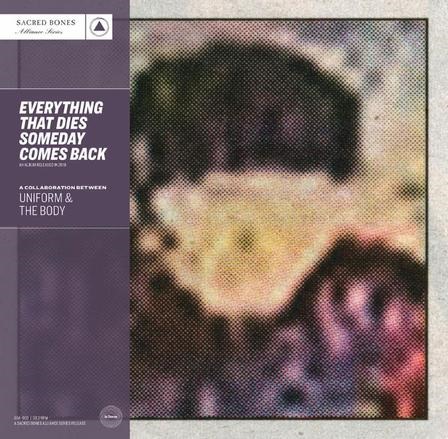
That Uniform and The Body should come together – or perhaps collide, screaming head-on into one another – is a logical, if terrifying idea. It’s pitched as ‘a collaboration that pushes both bands far beyond their roots in industrial music and metal – creating an immersive listening experience that truly transcends genre’. And I suppose it does. The Body have long pushed far beyond the confines of metal, and have forged a career that thrives on collaboration – or, put another way, a career that extracts new levels of nastiness by channelling carnage through other acts.

It’s a messy, murky sonic miasma that seeps from the speakers: a cacophony of impenetrable shrieking – like some mass acid-bath or people trapped in a burning room as the flames seer their flesh – tears through a thick aural sludge that’s heavy on bass and light on production polish.

A nervous drum machine pumps frantically, as though in the throes of a panic attack, beneath a mess of noise on ‘The Curse of Eternal Life’. The vocals are distorted, dalek-like, and there’s more screaming in the background, and with everything buzzing and whirring away, it’s impossible to know what the fuck’s going on, let alone if there’s any kind of attempt at a tune in there. It’s like listening to the Dr Mix and the Remix album played on a shit stereo through next door’s wall.

There are crushing guitar chords and crashing beats on the slow grind of ‘Come and See’, evoking the essence of early Swans or Godflesh, but with Michael Berdan’s sneering vocal style, there’s an overtly punk aspect to the pulverizing industrial trudge. It may be one of the most structured compositions on the album – in that there are actual chord sequences audible through the sonic smog – but it’s still hard going. But then, it’s no accident: neither act is renowned for its accessibility or ease of listening. And when two acts as uncompromising as Uniform and The Body meet, and there’s still no compromise, then the sum is instantly an exponential amplification of uncompromising. It was always going to hurt: it was simply a question of how much. And it’s nothing short of punishing.

When they do turn things down a bit, back off the guitars, and tweak musical motifs from the electronic setup instead of extraneous noise, there are hints of melody – and even grace – these emerge through the fog on ‘In My Skin’, and in context, it’s almost soothing. In any other context, though, maybe not so much. It’s like saying that Prurient are soothing in comparison to Whitehouse.

Mental Wounds Not Healing is – to use a term all too often tossed about in reference to anything a bit raw or intense – visceral. Listening to the album, I realise I’m grinding my teeth, chewing my lip and gnawing at the inside of my check. I’m clenching my jaw, tightly. My shoulders are hunched. Mental Wounds Not Healing isn’t just intense: it makes me feel tense. The density and lack of separation makes for a sound where everything congeals into an oppressive morass. The production – such as it is – only emphasises the claustrophobic sensation; being unable to distinguish one sound from another elicits a broiling frustration, and a certain paranoia, as you wonder if maybe there’s something wrong with the speakers or your hearing. It’s not pleasant, and the seven songs – none of which run past the five-minute mark – make for an endurance test. And yet for all that, it’s a powerful experience. It’s no wonder the wounds aren’t healing: this is the soundtrack to scratching and scraping at the scabs, picking away until the blood seeps once more. Insofar as any psychological damage foes, this isn’t going to help, but it’s fair reflection of various tortured states.

AA

516556

Metropolis Records – 6th April 2018

Christopher Nosnibor

However much music you know, there’s always a near-infinite realm beyond your ken. Until now, German electronic crossover act Haujobb – a hybrid of electro, noise, IDM and techno, who lean toward the more mainstream electro-industrial sphere – have existed beyond my range of awareness. I can’t imagine why.

I would rarely recommend a live album by way of an introduction to any band, but then again, it was by listening to Concert that I found the motivation to explore The Cure in more detail, and it was Welcome to Mexico… which compelled me to listen to releases beyond Gub.

So, we’re presented here with ‘a career-spanning collection of the band’s most beloved songs, recorded at various recent concerts throughout Europe’, which, according to the blurb, ‘stands as a testament to the band’s live prowess and unique creativity’.

They’ve produced a vast body of work over the course of their 25-years existence, and Alive gathers 15 cuts from across it, opening with the slow-building ‘Machine Drum’. Lifted from 2011’s New World March, it’s brooding, dark, and angry. But – overlooking the absence of audience noise, which on one hand can interfere with the listening experience, but by the same token is also pretty much integral to the live experience, and I always eye (metaphorically) a live album with no audience noise suspiciously – the question of how representative it all is encroaches on the enjoyment of such a release. And sequencing matters: is this live collection in any way representative of the actual live experience? I suspect not. The sound quality is pretty consistent given that it’s a compilation culled from various shows, but then again, the slickness and uniformity mean it doesn’t feel very ‘live’, and equally, with so much of the instrumentation sequenced and preprogrammed, meaning that it’s a little hard, perhaps, to convey the band’s live prowess.

‘Renegades of Noise’ – and a fair few others, if truth be told – sounds like a Depeche Move studio offcut, as remixed by RevCo. Elsewhere, ‘Input Error’ is driven by a clanking industrial beat and a bucketload of aggression and anguish. As on ‘Let’s Drop Bombs’, The anger is palpable, while electronic stabs rain in like gunfire from every angle near the end. And while Haujobb occupy well-trodden territory, the semi-familiarity of the structures and delivery doesn’t undermine the fact they’ve got some strong songs and a mastery of driving beats and hypnotically looping sequenced grooves. In all… it’s not bad.

017339

If you’re on the market for a snarling slab of black metal driven by a relentless technoindustrial beat and laced with a twist of humour and a tang of schlock-horror, you probably can’t go too far wrong with the latest offering from The Netherlands courtesy of Walthar the Unbearable of Evil.

It’s got a narrative and everything: ‘Depressed by the corruptive powers and silly fearbased methods of the big religions, Walthar The Unbearable now turned his hopes to the Haitian Voodoo religion. Learned to master their sacred tantrums from his bokor. With these new powers he is desperate to give them a try……. Who will be the first!’

Who, indeed?

Jahmoni Music – JMM209 – 23rd February 2018

James Wells

Straight into weird shit territory here. Wordless, atonal vocals layer up, ululating and droning and whatever, the tape stretched and slowed and generally fucked about with, while a monotonous bass throb and thumping industrial beat holds an insistent four/four. Think The Fall crossed with Throbbing Gristle. It’s not the full picture, but is a flavour of ‘To Evacuate is Difficult and Infrequent’. It may or may not be a song about bowels. But probably is.

DJ Marcelle is certainly not a DJ in either the conventional or contemporary sense: nor does she present the image of the club DJ throwing down bangin’ tunes for the euphoric masses. Her website uses a kind of Scooby Doo Mystery Machine typeface, and her tour photos all document the soups she’s consumed. This explicit lack of coolness is a cause to celebrate her as an artist. This is not about trends or commercial endeavours: this is about making art with sound.

‘To Reveal the Secret’ is a lo-fi mess of sample loops and clattering drums, and calls to mind the jittery experimentalism of the early 80s avant-garde scene: again, the shadow of TG looms, but equally, the playful oddness of early Foetus and lesser-known acts like Meat Beat Manifesto offshoot Perennial Divide. It pretty much bleeds into ‘Walking Around Aimlessly’, another mash-up of looped samples and old-school tape effects, mining that seem of William Burroughs cut-up inspired audio experimentalism that marked Cabaret Voltaire’s first few albums. Firecracking percussion and wild analogue bleeps provide the fabric of the frenetic finale, which lands in the form of ‘To Sing Along’. The irony is as heavy as the bass, and it rounds of a set that’s noteworthy primarily for its weirdness and apparent celebration of the random.

And random’s where it’s at. Psalm Tree is weird but groovy.

AA

DJ Marcelle

Loner Noise – 9th February 2018

Christopher Nosnibor

The second in their series of singles for Loner Noise, ‘Glitter’ finds Bristolian purveyors of post-punk / industrial racket mining a full-on grunge seam. And Christ, do they bring the weight on this outing. A thunderous, churning riff, as dark as hell and twice as dense, provides the backdrop to Charlie Beddoes’ angst-filled reverb-drenched vocal.

‘Glitter’ is pitched as ‘an introspective and poetic take on the mental strains of being a performer, with the moments of exhilaration on stage often coming at the cost of a great deal of stress and in some cases depression, ruminating on whether the highs would be as powerful without the lows’.

Lyrically, it’s introspective, but sonically, it throws it all out there, and slams it down, hard. And then kicks it around a bit. While Nasty Little Lonely have always had attack, ‘Glitter’ is perhaps one of their hardest, heftiest, and most unforgiving cuts to date. While instrumentally they’ve never been soft, the melodic vocal elements common to their previous outings are relegated in favour of all-out abrasion here. And it’s absolutely bloody storming.

AA

NLL - Glitter

5th February 2018

Christopher Nosnibor

Sidestepping any comparison of the title to Chocolate Starfish And The Hot Dog Flavored Water and perhaps clocking a nod to Cinema Cinema’s Manic Children and the Slow Aggression, The Tattooed Aunts and Mice on Speed stands not only as one of the most intriguing juxtaposed item album titles I can think of, but is probaby one of the best you’ll hear all year.

It’s been some time in coming, but Rick Senley’s fourth album under the I Am A Man with a St Tropez Tan guise. He has many, including musicforvoyeurs, alongside his work as a photographer, journalist, writer, teacher, actor and guitarist in a number of bands. I Am A Man With a St Tropez Tan is – according to Senley himself – ‘the sound of aggression borne of death, mental health struggles and addiction. It’s also a project centred around one man and his Dictaphone, a magpie-like approach to lifting and combining snippets of sound to create a nasty, messy and quite abrasive collage.

The biographical context to The Tattooed Aunts and Mice on Speed is genuinely harrowing, and I shall quote without abridgement: ‘After the death of his girlfriend and an accident left Rick housebound for months he channelled his rage and despair though electronic sounds and screams – a Chemical Brother nightmare put to sleep by Apex Twin’s downers, a bed-bath by Depeche Mode with Nine Inch Nails glaring through the keyhole and The Prodigy banging on the door.’

It’s a challenging mess of splintered noise, fragmented and disjointed, with pumping technoindustrial beats and dark club-orientated grooves pounding insistently beneath it all.

The whole thing has a nightmarish quality about it. Warped vocal samples taper in the way for a juddering beat and warping bass groove on the first track, ‘Killing Seals’, and thins become only more challenging from hereon in. the second Senley seems prepared to offer an inroad, an accessible structure centred around a solid rhythm and consistent bassline, he tears it to shreds and throws it all up in the air.

Senley pitches the album with the summary ‘Bursts of Burma, Thai ladyboys, Egyptian dogs and kittiwakes from Iceland join forces in equally disturbing measure.’ It’s perhaps a slanted perspective of the actual contents of The Tattooed Aunts, but it does give some indication of the wide-ranging sourcing of material Senley has engaged in in order to formulate this near-Burroughsian cut-up collage of sound. It’s disruptive, disturbing, a soundtrack of dissonance and dislocation. And it very much captures and conveys a mood of a difficult headspace, making for an album that’s at times tough, but ultimately rewarding.

AA

I Am A Man - Tattooed Aunts

Cold Spring Records – 23rd January 2018

Christopher Nosnibor

Never mind the cat, listen to the whale! There’s a rather trippy, dubby crossover feel to the trilling new-age rhythmic bass-led groove of ‘Thee Whale’, one of the three tracks on the second disc of this two CD plus DVD extravaganza of a release, which includes the film Dead Cat, which was released in 1989, and shown only at a handful of cinemas that year, including once at the infamous Scala Cinema in London. According to the accompanying blurb, ‘it was never issued on general release and has only recently been uncovered by David Lewis (writer & director).’ This release finally presents the full film, re-authored from the original source. The film itself features unique starring roles from cult film director Derek Jarman (who also worked with TG on In the Shadow of the Sun back in 1980), Andrew Tiernan (The Pianist, 300, The Bunker, and Derek Jarman’s Edward II) and Genesis P-Orridge. The film features the music of Psychic TV, included here on CD1, in its complete form.

On the one hand, it’s classic Psychic TV. On the other, I’m reminded why I parted ways with Psychic TV and much of the industrial movement, when, post-TG, everyone seemed to disappear up their own arses, otherwise ceased making music that felt either challenging or essential. It’s not that none of the members of Throbbing Gristle made any decent music after the initial split, because they clearly did, and early PTV and Chris and Cosey releases are proof of this. But at what point is enough enough? At what point does it all become so much indulgence?

That the material here is lifted from the archive provides only so much justification or defence. There’s very much a sense that all of the early groundbreakers have been surpassed, and that the myriad artists they’ve influenced have advanced far beyond the parameters their forebears pushed to new places. And they were already pushing on in 1989. Listening now, in 2017… ‘Dead Cat’ is a gnarly mess of humping and pumping, grind and drone, a seemingly formless throb of grating dissonance, and it sits well enough as a soundtrack. As a musical piece, the short (23-minute) version which closes CD2 is preferable: the plaintive mewlings stretched across the shuddering scrapes, punctuated by obliterative detonations, are challenging to the ears, but in some respects it feels all rather predictable. Whereas Throbbing Gristle still sound dangerous and deranged, ‘Dead Cat’ sounds like a safe assimilation of the template.

‘Thee Whale’, recorded on 23rd January 1988, is the soundtrack to the film Kondole, which was never made, although if it had been, it would have been 23 minutes long. ‘Thee Shadow Creatures’, the track which sits between ‘Thee Whale’ and the short ‘Dead Cat’ is also 23 minutes in duration. It’s dank and ominous, muffled rumblings and disembodied voices buried amidst swampy echoes. And way off in the distance, low in the mix and submerged by the distorted tribal rhythms, tortured jazz horns honk their anguish into the subterranean depths. While recorded some years later than the other tracks – in 1993 – it’s arguably the most successful, not least of all by virtue of being the most menacing, sustaining its atmosphere to the end.

As a whole, it is a nice set. As unsettling and noisy dark ambient works go, it delivers precisely what you would expect. And, regardless of my opinions as to whether or not it’s essential on any level, it is, unquestionably, a valuable and intriguing archive document. And on that basis, it’s very much worthwhile as an addition to the PTV catalogue.

AAA

PTV - Kondole