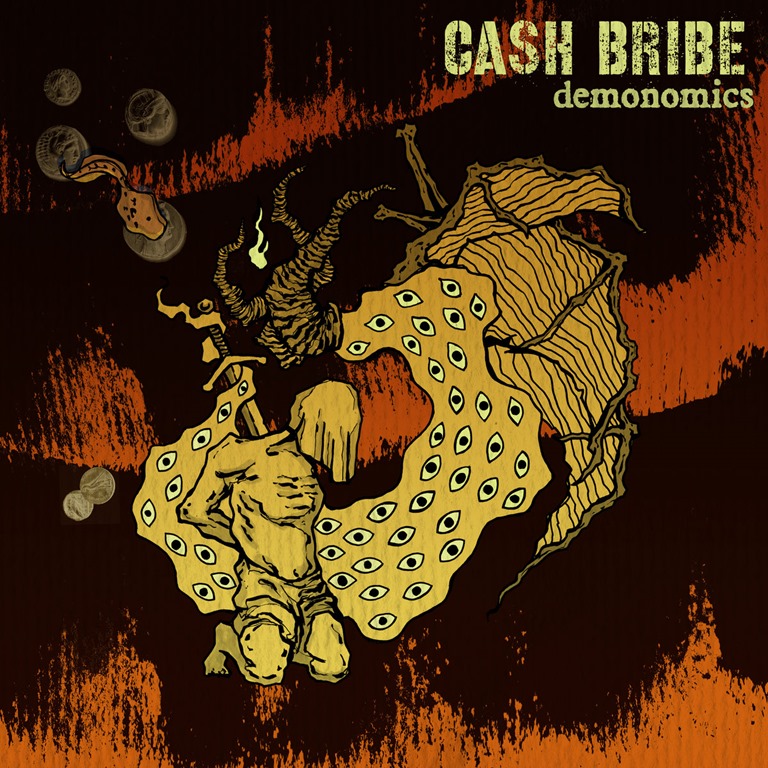
Brooklyn bruisers Cash Bribe are back with their third EP, Demonomics, dropping June 13, 2025, via Futureless. This marks their first release on the label, and they’ve never sounded louder, sharper, or more furious.
Leading the charge is the blistering first single, ‘Death Tax,’ now streaming everywhere.
Listen now:
AA
Of the single vocalist Joe Dahlstrom: says, “’Death Tax’ comes from thinking about entropy and decay. Nature can be cruel, violent, and indifferent — the suffering seems pointless — but accepting and understanding the terms of our existence comes with a certain viriditas, an empowering vitality to approach it head-on.”
Guitarist Kirk McGirk adds, “This one made it into our live sets pretty quickly – people would respond to it pretty well, and we like when we do something that makes people move.”
The band’s very name carries considerable weight. It’s a phrase oft-used, but rarely really assessed and processed. But the band’s comments around their second album place it front and centre: “This is more of a statement about how things are going in the world right now.” says Spencer. “Things were pretty shitty before. I think things may actually have gotten a little bit worse.”
In the last week, here in the north of England, it’s rained. A lot. Here in York, the river breached its banks for the first time this autumn. Last year, this didn’t happen until sometime in October, although – despite multi-million-pound work being done on flood defences – vast swathes of land lay under water for the best part of six months thereafter. It’s also rained a lot in the south, too, with flash flooding. Yesterday, I turned on the news to see images from the US, which showed trucks being driven on rapid currents of rivers which hours earlier had been roads. And yet still people shrug and say ‘meh, it’s cyclical, we’ve had ice ages, we’ve had climate change before, I don’t see any evidence it’s man-made. Besides, we’ve just had the coldest summer in years, how’s that global warming, eh?’ When it comes to climate denial, denial is the operative word. Sure, climate is ever-changing, but not at this rate.
But as a species, we seem hell-bent on self-destruction: seeing things unfold in real time in the Middle East is terrifying, the mounting death toll in Gaza – or what’s left of it – a horror almost beyond words, while Russia continually alludes to a nuclear response. But this isn’t even a return to the Cold War climate, because a very hot war rages all the while, with no sign of abatement or a peaceful resolution.
So, have things ‘gotten a little bit worse?’ It would seem so. And the thing about history is that it happens – or is made – fast, and sometimes faster than others. As I type, I’m having to turn the volume up to drown the sound of fighter jets running night exercises – I like to hope they’re exercises – nearby and over the city. RAF Eurofighters – currently, it would seem there are seven running circuits around the area – and occasionally US planes, too, have been evermore present of late, and it’s hard not to feel nervous.
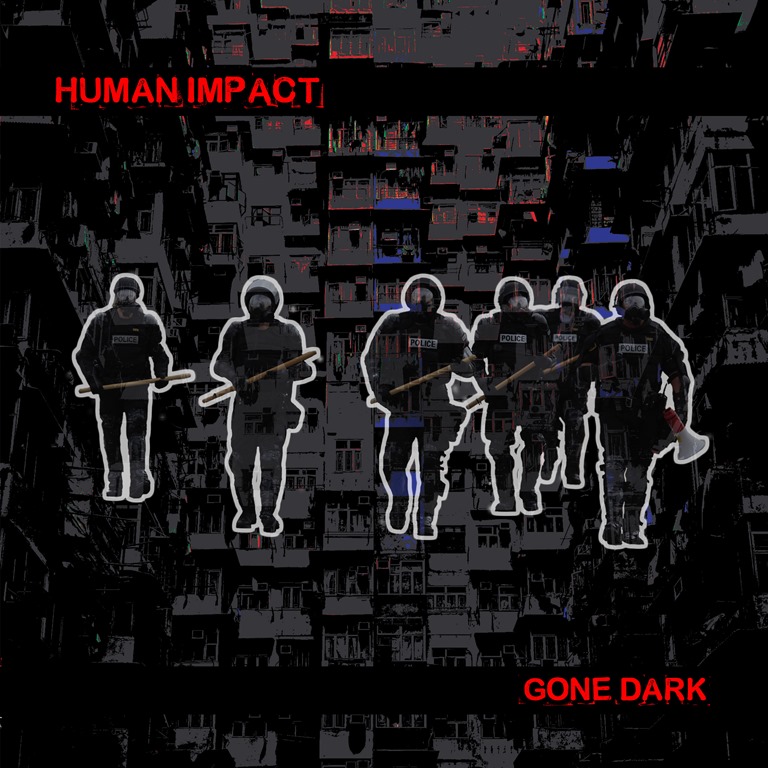
Turning up the volume on Gone Dark at least is no chore: it’s an album which needs to be heard at the kind of level it was played, the kind of level you know it would be played live. Seeing Unsane at The Brudenell in Leeds back in 2011 will forever be a standout for me. Nothing fancy or showy: they were simply relentless and brutal. And so it is that Human Impact bring the best of their component parts, consisting as they do of Unsane frontman Chris Spencer and Cop Shoot Cop squallmaker Jim Coleman, with bassist Eric Cooper (Made Out of Babies, Bad Powers) and drummer Jon Syverson (Daughters). These are four guys who know how to make the most punishing noise. And if noise has colour, the colour of Human Impact is a stark, steely grey, with the texture of sheet metal.
As the accompanying notes explain, ‘Gone Dark‘s songs emerge from a cinematic miasma ofdark ambience, processed field recordings, street rants and industrial grinding. Like embers flickering from an inhospitable wasteland, Gone Dark‘s nine tracks provide paths away from total annihilation, with Spencer barking “Wake up or live on your knees” (‘Collapse’); “Now is the time to resist” (‘Destroy to Rebuild’) and “Follow the sound … the future is now” (‘Corrupted’) “It’s just sort of the modern state of being, to me. From really a human perspective in terms of us being part of the masses, all of us together as one giant conglomerate of production and taxpayer bullshit,” says Spencer. “I make a conscious effort to try to think of things in terms of ‘we’ and ‘us’ and what’s happening to us as a whole instead of just my stupid problems.”
Understanding this context is integral to appreciating Gone Dark. There’s a pervading weight to every song, and the mood is of rage – the kind of rage that comes from a feeling of powerlessness. ‘Collapse’ sets the bleak, nihilistic tone as it hammers away, the guitar and bass meshing together to form a dense sonic sludge. It’s abrasive, but suffocating, conveying a sense of desperate confinement. Anger, anguish, anxiety. Gone Dark positively burns with all three.
It would be wrong to bemoan any lack of variety across the album’s nine punishing assaults: Gone Dark reflects life in the real world. There’s no respite, only relentless, brutal onslaught, kicking after kicking. You don’t get to catch your breath or mellow with some nice time out: no, you just have to endure the blows and do whatever it takes to stay afloat, and you stagger, punch-drunk, swaying on your feet wondering how much more you can actually take. It’s not a real question, since there is no option to do anything but plough on. Life is harsh, and this is a harsh album – not in the sense of harsh noise, but in its unyielding density. Gone Dark is the sonic equivalent of a good kicking. It’s so raw, so harrowing, and so intense it hurts.
Well, this one landed unexpectedly. It’s a welcome arrival, although taking a second hit of material from Uniform’s latest and quite possibly most brutal and challenging album to date does feel like an exercise in Masochism. It’s also a superb example of alternative marketing, landing this alternative version of American Standard less than a month after the album’s release, on digital and tape formats.
Context, from Uniform’s bandcamp: ‘A companion piece to American Standard, Nightmare City is essentially the same record devoid of the rock elements. By removing the presence of traditional instruments, the synths, lap steel, and pianos that sit beneath the surface of the proper album are allowed room to breathe and speak for themselves. The end result straddles the worlds of Basic Channel influenced dub, Tangerine Dream inspired soundscapes, and brutal death industrial.’
It’s a bold move, befitting of Uniform, a band who have relentlessly pushed themselves to explore ever-wider horizons, switching from their original drum-machine driven raw industrial noise to adopting live drumming, undertaking a number of collaborative projects with the likes of The Body and Boris, and especially befitting of this album, where Michael Berdan tore away the last vestiges of artistic separation to rip off his skin and purge the rawest emotions stemming from his dealing with Bulimia.
Nightmare City is another step towards stripping away the layers and presenting the naked self. ‘The bedrock of American Standard stands upon the Nightmare City. It’s not the happiest of all places, but understanding the landscape yields its own rewards,’ they write alongside the Bandcamp release.
One thing about being in a band – even if there are only two of you – is that there’s somewhere to hide, somewhere to transfer the focus. Hell, even performing solo, if there’s noise, there’s something take shelter behind. I’ve always thought that solo acoustic and spoken word performers were the bravest: there is simply no place to hide, and nothing to blur or mask any fuck-ups. Nightmare City isn’t quite solo acoustic, but it is seriously minimal.
Removing the ‘rock’ elements to reveal the bare bones of the songs shows the inner workings of Uniform, and they’re unexpected, to say the least. One would expect them to build up from the elements of drums bass, guitar. But this leads us on a different journey.
Punishing riffs and pulverising percussion, rather than supple layers and swirling instrumental ambience. As the band put it, ‘Although the finished product stands as a culmination of cohesive sounds, the individual threads that weave songs together often provide necessary nuance and exposition all of their own. Each isolated stem might be part of a greater story, but the whole cannot stand as intended without a complex series of seemingly disparate elements.’
Hearing the swirl of these ‘seemingly disparate elements’ feels like hearing the ghost in the machine, a haunting, eerie, ethereal echo, which barely seems to correspond with the structured framework of the final versions of the songs. One might almost consider this a palimpsest, an album beneath the album, submerged by process of layering and erasure. The tracks are – and I shouldn’t be surprised, but still I find I am – completely unrecognisable. Instead of being the punishing beast the album version is, ‘American Standard’ sounds more like one of the epic instrumental segments of recent SWANS works. There’s a muffled thud like a heartbeat on ‘This is Not a Prayer’ which possesses something of a womb-like quality, while ‘Clemency’ feels like a moment caught between heaven and hell, soundtracking the struggle of being pulled between the two in some purgatorial space as ceremonial drums hammer out a doomy passageway and spluttering vocals spew raw anguish.
In common with American Standard is the darkness which looms large, the tension, the suffocating gloom, the discomfort which dominates, and hearing this spectral echo of the album brings a fresh understanding and appreciation of the process and the depth of layering and everything that goes into their material. ‘Permanent Embrace’, too, sounds both like an ascent to the light and a sepulchral sigh, a funereal scene in which the grave suddenly opens like a sinkhole sucking everything down into the bowels of the earth.
Nightmare City is appropriately titled: it is a truly hellish, tortuous listening experience – but at the same time quite remarkable. Uniform, in their quest to do something different, to push themselves and in refusing to conform to genre conventions, continually find new ways to articulate the pain of the human condition.
Traditions are important: they’re grounding, they give us a sense of comfort and safety in their familiarity. In times of tumult, of confusion, during difficult times, they offer a raft to cling to in a sea of unrest. I’m not referring solely or specifically to old traditions, either, especially not the ones where Christianity has usurped pagan tradition, only for these traditions to in turn be usurped by the mechanisms of corporate capitalism. Christmas is the kind of tradition that should be tossed on the fire. What we need is to establish new traditions, traditions which are personal and meaningful – anniversary gigs or meet-ups, for example.
On a personal level myself, since one of the last holidays we made as a family saw us meet my late wife’s step-mum on Lindisfarne on August bank holiday week, and we had been due to stay there in accommodation with a view of the castle, we instead scattered some of her ashes with that view of the castle, and visit the spot around the same time each year before going to the pub we lunched in on that last visit. On the one hand it’s sad, but in such a magnificent and historically-rich location (we got married in Northumberland, and had Lindisfarne fruit wines obligingly delivered directly to the venue across the causeway), this new tradition of ours feels right, and in many ways positive.
The same is true – albeit in a different way, of course – of the traditional reconvening of the pairing of Procter and Poulsen. Something was written about it once, I seem to recall. Two friends, who see one another infrequently, but always make some noise together, and release the results, at some point or another. This is the kind of tradition which possesses real meaning, a symbol of connection. In a way, whatever music the session yields is irrelevant: this is about ritual, and interpersonal resonance.
As the title suggests, this is their eighth collaborative release, and contains two longform tracks, each occupying a full side of a C40 cassette, this time released in a limited edition of six.
There’s no way you’d describe the devastating soundtrack to nuclear annihilation that is ‘A’ as ambient: distorted, mangled vocals crackle out from the howling wails of feedback torn from shredded circuitry in a heavy gale which carries pure devastation. Once that raging storm dissipates, we’re still left with the sonic equivalent of a nuclear winter, the sounds drifting over shattered remains, fragments of things which existed before. Glitching beats fizz out in crackling walls of noise and fizzing distortion. Bleeps and wibbles pop and buzz and there are moments where it’s possible to catch a short breath. Sometimes it’s almost dubby, but it’s always a desert. It’s always desolate. The atmosphere is always thick, uninhabitable.
‘B’ is dronier, buzzier, more overtly electronic – but more like a giant bee hovering in suspension – sedate, bur trapped. As the track progresses – at least in terms of duration – it seems to degenerate, forms disintegrating, fracturing, crumbling, degrading. It’s not done elegantly, aesthetically, but presents as a greyening mess of murk and twisted wires, indistinct moans and Triffid-like clicks and clacks. It’s oppressive, and feels like crawling through the soundtrack to being a survivor of the apocalypse in a bleak 80s dystopian series.
Nothing is comfortable. Nothing is right. Tension and darkness are all around: every inch of this experience is eerie, uncomfortable. You don’t want to be here – but there is no escape. This is sheer horror, without words.
The shuffle into some sort of 80s industrial experimentation with a scratching guitar and stammering heartbeat percussion which soon slips into fibrillation, which comes to pass close to the end, only renders the experience all the stranger, before birdsong and groans hint that perhaps, this is it – you’re here, you’re dead. Perhaps we are all dead already, and life is an illusion. Perhaps this would be for the best.
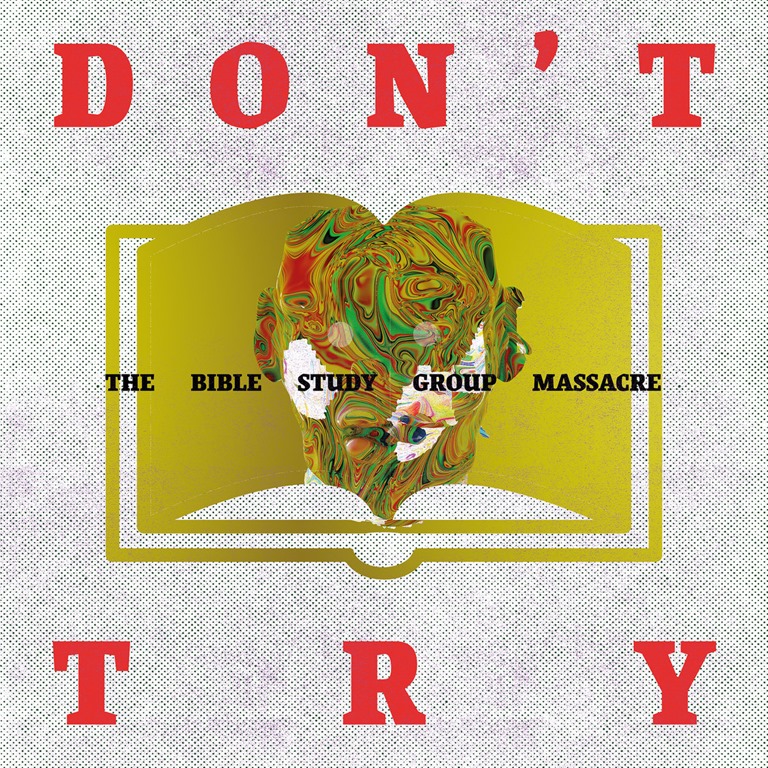
Once again, following the release of a four-way split showcasing local talent a few months ago, Stoke proves the be the spawning ground of more off-kilter noisy noise, this time from no-wave duo Don’t Try with their second EP. As an additional point of note, and also something of a recommendation / hype point, the EP’s artwork is courtesy of Dan Holloway, of USA Nails/Eurosuite/Dead Arms fame, who worked with the band previously on their 2018 single ‘JWAFJ’. To accompany the release, Dan has also realised a video in his own inimitable style.
Like ‘JWAFJ’, their first EP, Elvis Is Dead was released in 2018, meaning it’s been a full six years since they last released anything, suggesting that on the output stakes at least, they’ve been living up to the band’s name.
Lead track ‘my grazed knee’ with its gritty yet poppy synths and urgent, determined beats isn’t actually a million miles from the sound of The Eurosuite. It reminds us of the proximity of new wave to punk, and the reasons why new wave and post-punk are essentially interchangeable terms. And while punk did, undoubtedly, spawn some great tunes (I’d perhaps contend less great bands, in that many punk acts, with a few notable exceptions like The Ruts and Adverts, produced only one or two outstanding or even memorable sings, and were unable to deliver the entirety of a solid album, let alone a career), it was post-punk where things got interesting, after things had evolved from three-chord stomps. If punk was predominantly pissed-off, railing against boredom and just off the rails, what followed explored a greater emotional range, and was more articulate, both musically and lyrically. For all its rebellion and antagonism toward conventions and norms, punk very quickly established its own conventions and norms: post-punk broke down those definitions to explore in myriad different directions, fragmenting and evolving into countless new genres.
It’s been a long time since the advent of both punk and new wave now, and in theory, any contemporary exponent of either is liable to tie themselves to certain tropes. But contemporary punk bands, more often than not, seem to be so limited in their scope, whereas many current acts who align themselves with post punk / new wave offer a broader range – even the ones who have been lazily lumped into the bracket of Joy Division imitators. I mention this as I discovered both Interpol and Editors because they were constantly being compared to Joy Division, and while I came to like both bands very much, my first reaction was dismay laced with disappointment over how unlike Joy Division either act sounded.
And so, circuitously, we arrive back with Don’t Try. ‘my grazed knee,’ as I was starting to say before I embarked on my obligatory and epic detour, is a fuzzy, low-fi keyboard-driven cut that boasts a monstrous throbber of a grindy synth bass groove that lands between Suicide and Cabaret Voltaire’s ‘Nag Nag Nag.’ But it’s a lot harder, harsher, noiser, more aggressive, more antagonised. Punkier? I suppose it’s representative of the point at which that nascent industrial sound began to evolve, but there’s also a manic hardcore edge to it, which is more apparent on the harsh assault of ‘climax in the imax’. Here, everything is ratcheted up in its volume and intensity, there’s a clattering metallic snare sound that crashes like a bin lid through the song’s duration, and about two-thirds in, it sounds like someone’s started up a drill and it all suddenly goes slower and heavier and you start to feel like things are getting dark and tense. This is very much a positive, in case you’re wondering.
There’s a clear trajectory to this EP, a sonic evolution which moved forward with each track, and things turn full-on industrial on the third track, ‘ritual’, which manifests are a monstrous, relentless rhythmic pounding reminiscent of mid-80s SWANS and the heavy grind of Godflesh. The crazed, anguished vocals are howled, yelped, drawled, hinting at the manic howl of the Jesus Lizard (and so, equally, Blacklisters). After hitting what feels like a locked groove around the mid-point, everything explodes and the track – and EP – climaxes in a slamming wall of ear-blasting noise. None of it’s pretty. All of it’s good.
Finish purveyors of extreme noise, Vorare, has paired up with Earthflesh to create the abrasive blast of an album which is Rope Tower. We’re on the edge of our seats for the album, and are beyond thrilled to present an exclusive premier of the second track from the album to be unveiled after ‘Seepage’.
On the face of it, a mining disaster in the North of England which occurred way back in 1844 may seem like an unusual choice of subject matter for two artists based in mainland Europe: it’s a pretty niche piece of local history. But it’s also a harrowing historical event that warns of the risk to life the industrial age brought. County Durham had a long mining heritage, and Haswell was one of the county’s largest collieries, employing over 300 men and boys. This single incident – an explosion – caused the deaths of almost a third of the workforce, with the blast itself killing 14, and a further 81 dying by suffocation.
For a moment, just imagine the scene, and the sensation. ‘Haswell’ makes for a fitting soundtrack, with a reflection on not only the how of their deaths, but the why…
Lyrics:
We find ourselves in the mines day in and day out, breaking our bones, shoveling our route to the alluring ore necessary for someone else to thrive off of. The caged canary leads the way deeper and deeper into the uncharted maw of Earth left gaping by bombs built by weak little men far from here. The clangs of pickaxes haunt our dreams while the fetters on our ankles might as well be extensions of our limbs alongside the instruments designed to violate the soil below our homes. As the morning seeps in lightless, we continue our work. Descending to the black hole stretching for miles on end, the explosions seem particularly strong today. We can’t see, but we can hear and feel. The chirp of the canary abates and soon runs out. Is this the smell of profit?
An account of the Haswell Colliery Explosion can be found here.
Leeds based militant dance-punk duo Polevaulter dropped their debut album ‘Hang Wave’ on Friday to widespread acclaim.
If you haven’t heard it yet, it’s a superb sonic assault of seismically sharp bass and loin-grinding beats, and we wrote about it at length recently.
Now following the album release and ahead of their UK / EU tour starting this week, Polevaulter have unveiled a brand-new video for the album’s latest single ‘Pissed In The Baths’, which you can watch here:
The sonic assault the two create is almost arrogant, fathered from the marriage of seismically sharp bass and loin-grinding beats. The words are quipped and brayed atop the aural landscape. They are boastful, accusing, repellent and inviting, they question and skewer the veins of masculinity, sexuality, the order of things, the music industry and the miserable reality of the North. Polevaulter have toured with JOHN, shared a stage with Thank, Mandy Indiana, Pink Turns Blue, Bambara, A Place To Bury Strangers, VR Sex, and others.
Now, following the album release and ahead of their UK / EU tour starting this week, Polevaulter have unveiled a brand new video for the album’s latest single ‘Pissed In The Baths’.
On writing the track, Polevaulter’s Jon Franz explains; “Pissed In The Baths came about from Dan’s chorus riff which he just pulled out of thin air, we made the verses more straight and got it to swing with my delay. I wrote the lyrics pretty quickly on a bus to the doctors, lyrically it’s about manifesting strength and about us setting sail, I tied the chorus into it as those lines came from a while ago about warming oceans and rising sea levels, it all got glued together.”
The result is a cacophonous injection of climate change activism, brimming with hypnotic beats and thick fuzzy bass and glossed in a coat of sharp unnerving darkness. Chaotic and smashing you in the face with its tidal wave of full-on noise and addictive shouted refrains, Polevaulter are not holding any punches with ‘Pissed In The Baths’ as they continue on their bulldozer-like mission to tear up boundaries.
Debut Polevaulter album ‘Hang Wave’, is a hard-hitting dark and fiercely off-kilter slab of awesome sickly noise alongside baritone-led lyricism acerbic, vitriolic and intense throughout, raising eyebrows and dropping jaws. The album features recent hits like ‘Trend’ and newly released single ‘Violently Ill’ which Polevaulter’s Jon Franz explains- “has more sparse vocals than most of our tracks, gives our music a chance to shine. Its maybe my favourite song on the album.” Other tracks like ‘Pissed In The Baths’, ‘Mint Condition’ and ‘Mia Goth Made Me Do It’ all stand out in what is essentially an absolute mind melting juggernaut of a punk electro dance record for 2024, which lays down the gauntlet from a studio perspective alongside Polevaulter’s diligent process to earnestly take the title of ‘hardest working band in showbusiness’.
Polevaulter weren’t always a duo though as Jon Franz recalls, “We were steaming along as a post-punk band with various noise elements and then lost some members over covid, but me and Dan wanted to keep going. We thought about starting a new band, but we felt that this still had legs. Ultimately, it’s not that different, me and Dan did most of the composition, and we’ve got a clear vision on what we want to do. After touring last year as a two-piece, figuring out whether we could even do it, we realised there’s definitely no reason to stop – and it’s definitely getting better every time we have a round of gigs. I like not carrying instruments around – that’s quite nice. Although, having said that, we’re a duo now and we have more amps, which is weird. Dan has three amps now, and I have two.”
The album was co-produced by longtime friend and artist Shaene Hunter which straddles confidently atop several themes, to which Jon Franz says, “This being our first album or our maiden voyage, I dunno why, but I like a lot of nautical terminology and see that kind of visual imagery when this album was being made. I also write a lot of lyrics about things that directly affect me, like my masculinity, my mind, about being tough and overly arrogant to sell the image of us we’ve created. We have a lot of reference points that I work in, and since we’ve become a two piece, I think there is a lot more depth to everything we do now. We’ve made ‘Hang Wave’ because it’s about time we made this kind of a statement about who we are, what we want to do and what we sound like after multiple line-up changes and situations slowed the progress me and Dan were desperate to make. Since we’ve been a two piece, we’ve got far more done, and we both feel really proud of this album, and we feel strongly that it will do what we need it to do.”
Polevaulter recently performed their debut album on repeat for 8 hours straight via a livestream to raise funds for the Gaza Sunbirds, a para cycling team based in the Gaza Strip. The team is currently providing emergency food parcels and aid to families sheltering around the Gaza Strip. Watch the livestream back here:
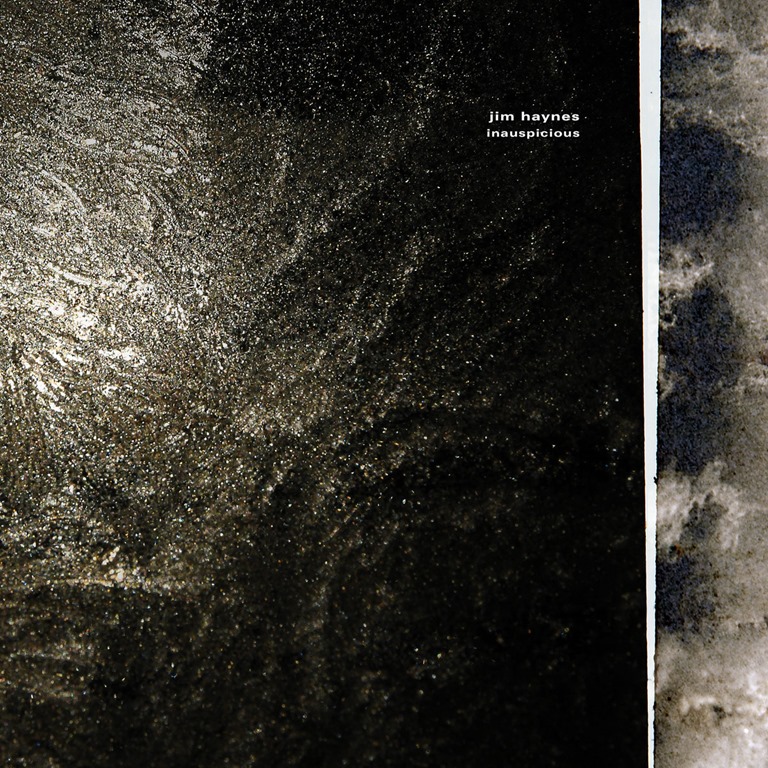
It’s often difficult to keep up with artists’ outputs, especially the super-prolific ones. Jim Haynes not quite make the super-prolific category, but having first written on his work with a review of The Decline Effect back in 2011, I’ve covered three albums between 2017 and 2021 alone. I tend to take a particular interest in albums released through The Helen Scarsdale Agency, which despite sounding rather prim and literary, is a label which has a particular knack for platforming music of an experimental and often difficult and noisy nature.
Haynes’ work has become progressively harsh over time, and the press release for Inauspicious notes that this has been particularly true post-pandemic, while acknowledging the cliché that the pandemic marked a pivotal point for many musicians. Crucially, it notes that ‘The tools for Haynes’ work remain limited: motors, electronics, shortwave radio, found objects, all applied with considerable pressure. Compositionally, Inauspicious is a very rough moire pattern from overlapping elliptical structures that can negate and obfuscate just as easily as they can compound and aggregate. The album surges and collapses upon the two twenty minute chunks of controlled noise that follow an internal logic that snakes from brooding power drones, spectral radio transmission, and an aktionist demolition cast upon metal, glass, and unfortunate wooden objects. Rupture and release. Purge and pulse.’
As such, while the output, and the dynamic may be different, Haynes’ fundamentals remain unchanged, and this matters, in that it demonstrates that more often than not, the end product is not so much dependent on the input and the raw materials, but their application and the process.
Inauspicious features just two compositions, ‘Variant, Number Fourteen’ and ‘Variant, Number Fifteen’, which each run to precisely twenty minutes apiece. It’s a work that’s seemingly designed for a vinyl release, with each piece occupying a side of the LP, and I daresay that the dank ambient rumblings have their greatest impact when rolling from the grooves of a thick chunk of vinyl. Still, it works digitally when played through some decent speakers which afford air to the album’s slow, granular churnings. It’s not that fat into ‘Variant, Number Fourteen’ that it’s built to a brain-shredding blast of drilling noise. Beneath the ear-destroying mesh of treble and shredding abrasion, there are swells and surges of lower-end noise. It’s easy to overlook the slight details in the face of such a wall of abrasion, but it matters. While Haynes is bringing a relentless assault, it’s important to pause by the details, and Inauspicious is abrim with them, although ‘Variant, Number Fourteen’ spins into a restless ancient howl in its final minutes and tapers into a dank rumbling that brings a heavy tension.
‘Variant, Number Fifteen’ brings more of the same: heavy drone, grainy texture, harsh noise, spluttering and droning, a deep sense of ominous foreboding, only with lower, deeper, more resonant bass, the tone of which drags on the lower abdomen among the swishes and swirls. And then grating mid-range abrasion. It’s hard to know how to react to this truly painful grind. By turns, I feel as if I need to defecate and vomit, although in the end I do neither as I simply clench my stomach during passages of this dark mess.
This is an album that brings noise and it brings pain. It’s a relentless grind and growl, and not for the first time, Jim Haynes has tapped into a sense of awkwardness which really grates and grinds.
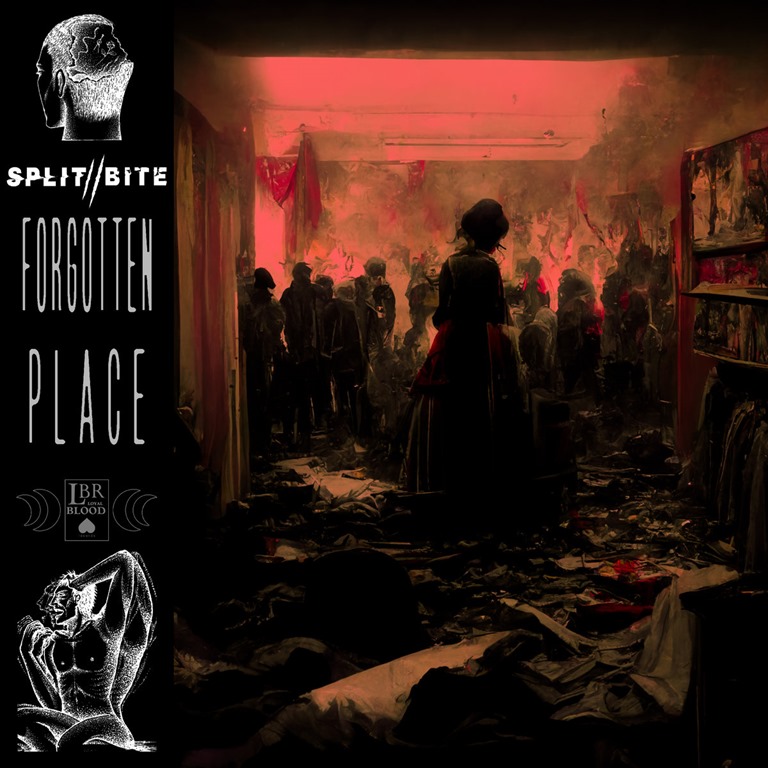
Norwegian metallic hardcore four-piece group SPLIT//BITE have recently shared a new song off the band’s debut EP, which is set to be released on June 9th via Loyal Blood Records.
SPLIT // BITE is a fresh new four-piece group from Bergen, Norway, yet all members have a vast experience in other projects from the local hardcore and metal scene. The band’s debut EP "404 ends" shows a highly-energized quartet playing a chaotic and pummeling metallic hardcore full of heavy riffs and caustic vocals.
Set for release on June 9th via Loyal Blood Records, this new EP is according to the band "about establishing a precedence in a society defined by cultural norms adapted to your average joe. With this we bring about subjects like existential anxiety, apathy, and also artistic freedom. We preach this through our intensive tempo, and a clear message from start to end."
The liner notes to Trowser Carrier’s A Flower For My Hoonoo, originally released in some form or another back in 2013, say everything you need to know about Trowser Carrier – the duo consisting of Dave Procter (Voice) and Java Delle (Noise) – and their purpose.
‘Noise and vocal delivery tend to occasionally focus on edgelord taboo subjects. Trowser Carrier are not like that. After 10 years, Trowser Carrier once more ask the following question – why can’t noise be nice? Find the answers amongst harsh noise and insipid words.’
Procter in particular is no stranger to the noise scene, performing as Legion of Swine and Fibonacci Drone Organ, among others, not to mention countless collaborations. and he’s no doubt encountered more than his fare share of edgelords along the way. Like many makers of noise, he’s also a fan, but not incapable of critique and criticism, and not without humour. And as such, A Flower For My Hoonoo is something that you could describe as a humorous act of rebellion – and since noise and all of the serial killer and pervo shit that is often the subject matter of noise that’s designed to shock ‘normal’ society – this is a rebellion against rebellion, an attack on cack cliché, a parody of po-faced posturing.
The result is a collection of pieces that resemble Alan Bennett fronting Whitehouse, and the track titles largely speak for themselves: ‘a nice cup of tea’; ‘this ketchup is nice’; thanks for hoovering’; and ‘I remain you humble servant’ are all representative – and it’s perhaps as well the titles do speak for themselves since most of the actual words are, in true noise fashion, largely inaudible for blasts of intense pink, white, and brown noise layered up with distortion and overloading synth meldown. ‘sausages for supper’ extols the virtues of vegetarian sausages, with lines like ‘my body is a temple… and I don’t eat The Lord’s creatures.’
From the words it is possible to make out, ‘nice’ is probably the word which appears with the most frequency after ‘the’, and the bland lyrical niceness, a porridge-slick spill of pleasantry worse than saccharine sweetness in that it’s a world of magnolia in word form. It’s like being forced to sit in a corporate ‘wellbeing’ room plastered posters of motivational quotes, only instead of pictures of beaches and sunrises as the backdrop, there are images of crashed cars and slaughterhouses as the ear-shredding electronic racket blasts relentlessly. The fact that they’re short bursts – most around the minute mark – doesn’t make it any easier on the ear: if anything, it’s worse, as the stop-start nature of the sonic assault has the same effect as various methods of torture. The ear-shredding blasts are of the bubbling crackling fucked-up analogue kind.
The ‘mix’ versions of the tracks – which double up the sixteen tracks to thirty-two place the vocals up to the fore and back off the noise (which is different), meaning Dave’s sappy words are nauseatingly clear as he gushes gratitude for tine spent washing dishes together and courteous manners.
The contrast between the aural punishment and the fist-clenchingly pleasant banalities of the lyrics is amusing and frustrating in equal measure. Procter utters these grovelingly insipid lines in a blank monotone, often repeating a singe verse twice to fill the minute of noise as it froths and sloshes and foams and bubbles and drives the meter needles to the upper limits of the red.
It’s overtly silly, but does make serious points about the genre trappings and songs lyrics and musical forms more broadly.


 Aural Aggravation