Posts Tagged ‘Godspeed You! Black Emperor’

Christopher Nosnibor

The last tour of Swans’ current iteration, drawing the curtain on a succession of albums – and tours – which have been truly immense in every way: the build-up felt like the end of an era. The event itself, perhaps less so. At one point, someone calls out a request. “We don’t do that,” Gira explains, in a kindly manner. He seems pretty relaxed tonight, and smiles a fair bit. No-one in the band gets bollocked or scowled at, and they all seem to be having a pretty good time.

But no, they certainly don’t do ‘that’. You don’t go to see Swans expecting to hear choice guts from their extensive back catalogue. You don’t even go expecting to hear songs, at least not in any recognisable form. The versions of recorded songs bear only limited resemblance to their studio counterparts, twisted, stretched, and otherwise evolved while on the road to a point whereby they’re almost new songs entirely. Recent shows have seen the band playing sets spanning a full two and a half hours, while only featuring six songs.

Before we come to Swans, Jessica Moss, who, amidst an extensive catalogue of work over the course of a lengthy career, is best known for her contribution to Thee Silver Mt. Zion Memorial Orchestra and being part of the whole Godspeed You! Black Emperor milieu. Tonight, she plays a rendition of her latest album, An Unfolding, in its entirety, and it’s breathtaking. Her nuanced violin and vocal work is augmented with booming, resonant bass tones. There’s a lot of yakking at the bar and further back in the 1,000 capacity, sold-out venue, where the house light stay up toward the rear of the room for the duration of the night, but for those of us in the front two-thirds, it’s a spellbinding experience, which perfectly sets the tone for the main event.

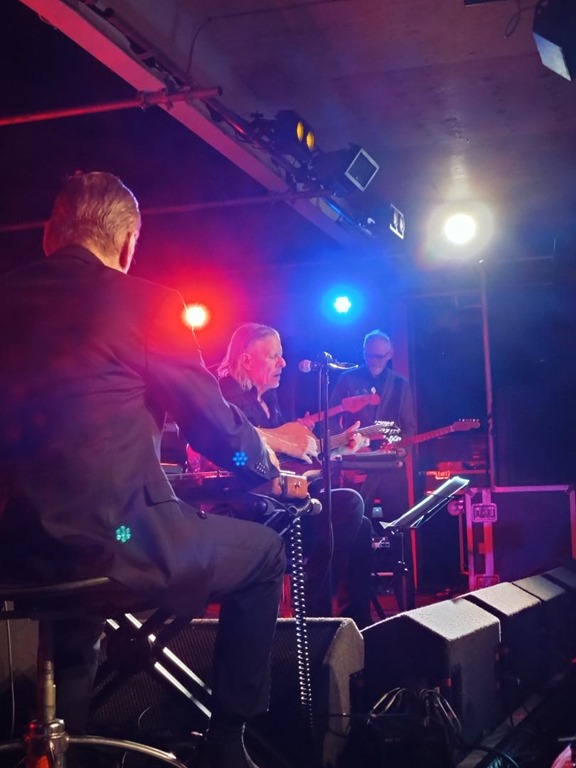
Moss’ half-hour set is over by around 8:40, and Swans, after a few brief checks, take to the stage around ten minutes later. Gira politely asks that there are no cell phones – “at least not where I can see them”, before he begins strumming a monotonous at two strings. He does so for what feels like an eternity. Or perhaps not. When Swans play, time takes on a different meaning, and it’s been a feature of this current iteration that the songs evolve and elongate over the course of the extensive tours, transforming and transmogrifying over the weeks and months on the road. They’ve been touring Birthing and this ‘farewell’ for a fair while now, although the set on the most recent leg has only featured ‘The Merge’ from said album. With ‘Paradise is Mine’, from The Beggar, and ‘A Little God in My Hands’, from To Be Kind, this is as close to a retrospective set as you’re likely to get, but none of these songs much like the studio versions, and half the set therefore features material which is either new or so far removed that it’s been retitled as well as restructured. But as I say, you don’t come to a Swans show for the songs. You come for the experience. And what an experience it is.
S1

It’s fair to say that there is simply no other band like Swans. Their reputation for extreme volume is only part of the story, a piece of the equation. Older fans who saw them in the 80s love to regale with tales of people throwing up, passing out, and so on, and that they’re pretty tame these days, and I have no reason to believe that these are purely apocryphal. Gira just can’t do quiet: even his solo acoustic sets playing smaller venues circa 2003 / 2004 were fucking punishing.

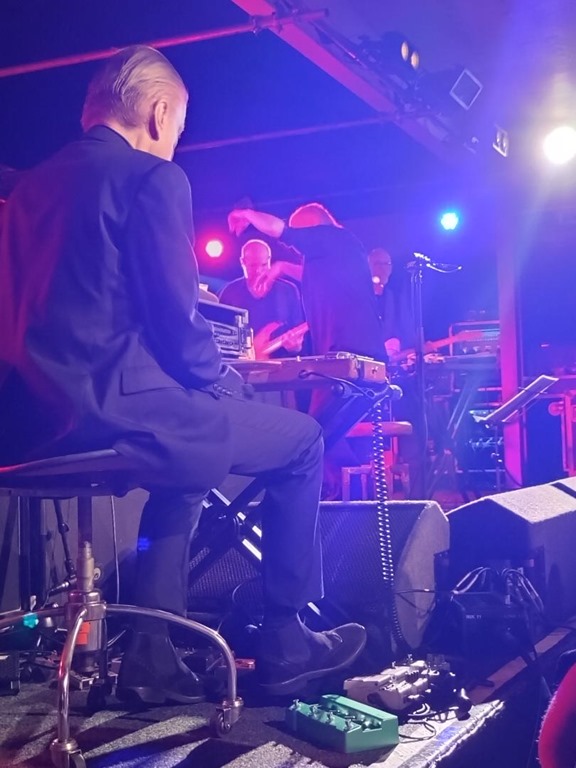
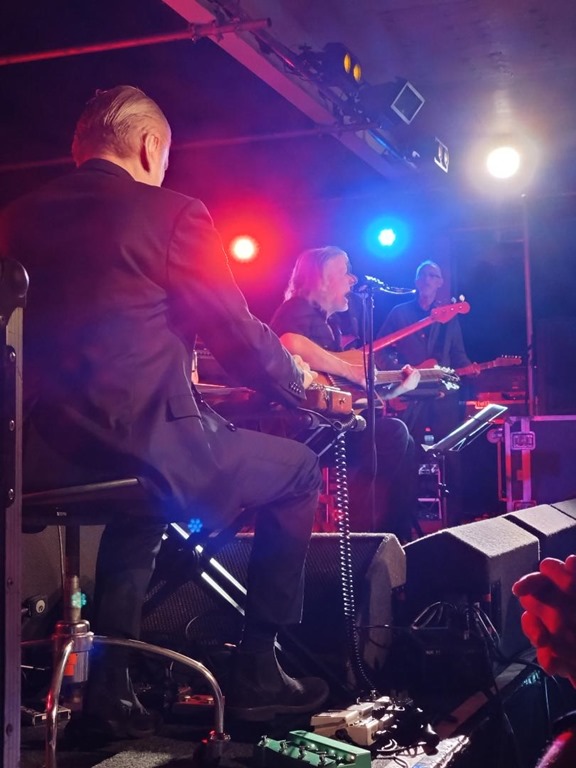
Some time in, Gira downs his guitar and stands up, turning to face the band, and flails his arms as if experiencing some kind of rapture or episode. But every gesture is a signal, from which the band members – there are six of them, plus Gira – and his near-psychotic choreography guides them through ebbs and flows, to ever greater, more intense crescendos. It’s maybe half an hour before the full drum kit kicks in, and I feel my nostrils vibrate with the sheer quantity of air displaced from the speakers. It’s transcendental, euphoric.
S2S3

A number of people who had started the set near me in the front row dissolved. I didn’t really notice when: like almost everyone else, I was simply transfixed. And yet, this was by no means loud by Swans standards: while I can’t claim to have witnessed the nauseating brutality of their early years, or the notorious punishment of the Burning World tour (ironic that their gentlest album, released on a major label, should have been served by a tour of such infamous volume… or perhaps not, perhaps it was a statement to prove that they hadn’t sold out), their shows at Leeds Stylus in 2016 and 2017 were something else – something so intensely physical, it hard to find the words. Then again, on their last visit to Leeds, playing at The Belgrave, I found myself thinking ‘this isn’t so loud’ but before long finding myself dizzy and wondering quitter where that immense noise had grown from. And this is perhaps an indication of how they’ve evolved. The bludgeoning force is still very much present, not least of all with two basses and the return of Norman Westberg to the lineup – surely one of the world’s most patient and understated guitarists, content to stand, not playing for ten to fifteen minutes, before battering away at one or two chords and thirty BPM for the next fifteen minutes, creating noise and texture rather than doing the conventional ‘guitarist’ thing – but now it’s more subtle, growing building, slowly, so slowly. A tweak here and there, another player adds a later, and while you’ve been watching the dynamics of the two bassist and Gira’s windmilling, the volume has increased threefold and your ribcage is rattling and your brain is slowly scrambling. Kristof Hahn does things with lap-steel that is beyond comprehension, cranking out squalling, screaming walls of noise – but there isn’t a weak element in the lineup. They each bring something unique, and the collective output is something else.

If this is the end of Swans doing big band, big noise stuff, then they have certainly delivered a finale of spectacular proportions. And whatever comes next, we look forward with bated breath.

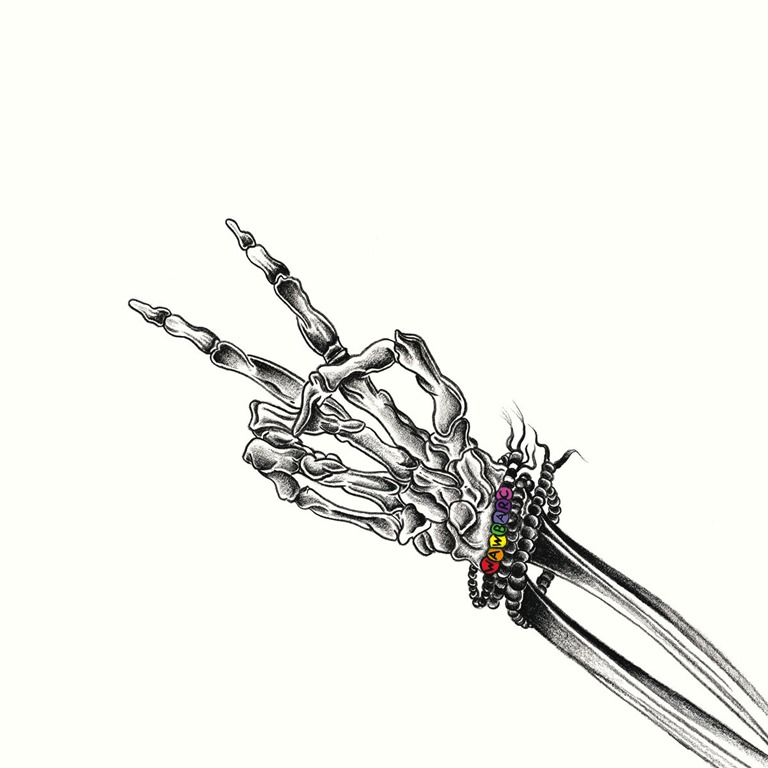
The ever-enigmatic Godspeed You! Black Emperor have announced their new album in suitably oblique form – only, their message is loud and clear here. There’s no press hype for the album in their accompanying statement, but no explanation is required when it comes to the their focus: the album’s title alone speaks for itself. NO​ ​TITLE AS OF 13 FEBRUARY 2024 28​,​340 DEAD. This is, of course, the number of Gazan casualties since 7th October 2023. That number now stands at in excess of 41,000.

The final track on the album, ‘GREY RUBBLE – GREEN SHOOTS’ is an expansive seven-minute piece which balances darkness and hope.

The accompanying statement reads as follows, and you can hear the track below:

THE PLAIN TRUTH==
we drifted through it, arguing.
every day a new war crime, every day a flower bloom.
we sat down together and wrote it in one room,
and then sat down in a different room, recording.
NO TITLE= what gestures make sense while tiny bodies fall? what context? what broken melody?
and then a tally and a date to mark a point on the line, the negative process, the growing pile.
the sun setting above beds of ash
while we sat together, arguing.
the old world order barely pretended to care.
this new century will be crueler still.
war is coming.
don’t give up.
pick a side.
hang on.
love.
GY!BE

Tour dates:

UK/EU

SEP/OCT 2024
27 Sep 2024 • Dublin IE • National Stadium

29 Sep 2024 • London UK • Troxy
30 Sep 2024 • Glasgow, UK • Barrowlands
01 Oct 2024 • Manchester UK • Ritz
02 Oct 2024 • Bristol UK • Marble Factory
03 Oct 2024 • Coventry UK • The Empire
04 Oct 2024 • Tourcoing FR • Le Grand Mix
05 Oct 2024 • Esch-Alzette LU • Kufa
06 Oct 2024 • Paris FR • Le Trianon
08 Oct 2024 • Nantes FR • Stereolux
09 Oct 2024 • Nancy FR • L’Autre Canal (Jazz Pulsation Festival)
10 Oct 2024 • Zürich CH • Volkshaus
11 Oct 2024 • Lausanne CH • Les Docks
12 Oct 2024 • Frankfurt DE • Zoom
14 Oct 2024 • Berlin DE • Huxleys
15 Oct 2024 • Amsterdam NE • Paradiso
16 Oct 2024 • Brussels BE • AB
18 Oct 2024 • Athens GR • Floyd

NORTH AMERICA
NOV 2024

04 Nov 2024 • Hamilton ON • Bridgeworks
05 Nov 2024 • Toronto ON • History
06 Nov 2024 • London ON • London Music Hall
07 Nov 2024 • Grand Rapids MI • Elevation
08 Nov 2024 • Chicago IL • The Salt Shed
09 Nov 2024 • St Paul MN • Palace Theater
11 Nov 2024 • Lawrence KS • Liberty Hall
12 Nov 2024 • Fayetteville AR • George’s Majestic Lounge
13 Nov 2024 • Nashville TN • The Basement East
14 Nov 2024 • Knoxville TN • Bijou Theater
15 Nov 2024 • Atlanta GA • The Masquerade
16 Nov 2024 • Charleston SC • The Music Farm
17 Nov 2024 • Saxapahaw NC • Haw River Ballroom
19 Nov 2024 • Washington DC • 9:30 Club
21 Nov 2024 • Brooklyn NY • Pioneerworks
22 Nov 2024 • Norwalk CT • District Music Hall
23 Nov 2024 • Boston MA • Roadrunner
24 Nov 2024 • Philadelphia PA • Union Transfer
25 Nov 2024 • Montréal, QC • MTELUS

NORTH AMERICA
APR/MAY 2025

25 April 2025 • Austin, TX • TBA
26 April 2025 • Dallas, TX • Granada Theater
28 April 2025 • Denver, CO • Ogden Theater
30 April 2025 • Los Angeles, CA • The Bellweather
01 May 2025 • Santa Ana, CA • The Observatory OC
02 May 2025 • Tijuana, B.C., Mexico • Cine Bujazán
03 May 2025 • Ventura, CA • Ventura Music Hall
04 May 2025 • San Francisco, CA • Curran Theater
06 May 2025 • Portland, OR • Wonder Ballroom
07 May 2025 • Portland, OR • Wonder Ballroom
08 May 2025 • Seattle, WA • The Neptune
09 May 2025 • Seattle, WA • The Neptune
10 May 2025 • Vancouver, BC • Vogue Theatre
12 May 2025 • Kelowna, BC • Revelry
13 May 2025 • Calgary, AB • Palace Theatre
14 May 2025 • Edmonton, AB • Midway

AA

fd21e279-b64c-5048-e0b0-b1f621136f75

WE ARE WINTER’S BLUE AND RADIANT CHILDREN (WAWBARC) is the new quartet of Mat Ball (BIG|BRAVE), Efrim Manuel Menuck (Godspeed You! Black Emperor, Thee Silver Mt. Zion), and Jonathan Downs and Patch One (both Ada). On NO MORE APOCALYPSE FATHER they present six modal lullabies drenched in seared distortion, slathered across striding electronic pulses.

Ball and Menuck began creating music in and for the bleakest moments of Montréal winters: “We’re honoring that idea of winter, when you come inside and your house is warm, a place that only exists because of how cold it is outside,” says Menuck. They later recruited Downs and Patch to flesh out their initial ideas—Menuck met first them in 2015 when recording Ada’s final self-titled album at Montréal’s Hotel2Tango, the same studio where WAWBARC convened to make this record.

The album is out September 13th on Constellation. Meanwhile, you can hear the title track here:

AA

a3239074798_10

Khanate, who recently ended their fourteen year hiatus with the surprise release of To Be Cruel (Sacred Bones Records), have debuted an experimental short visual for ‘Like A Poisoned Dog’, bringing the Karl Lemieux-created album art to life.

“These stills are abstract but depending on the context, they become objects and objective. And alongside Khanate, they have this strange organic feeling,” Stephen O’Malley notes. “They’re abstract, hand-painted film stills, not photos of organic objects or something, which I think is really interesting because it’s similar to our music. We put a frame around the music with a concept and it presents something, but otherwise, it’s abstract. This lined up very well with Karl’s work.”

“In addition to my other film work, I like to work with camera-less film techniques and paint directly on 16mm film,” explains Lemieux, whose resume includes films, installations and performances that have screened at a variety of venues including the Montreal Contemporary Arts Museum, MOMA San Francisco, as well as over a decade of collaborative work with Godspeed You! Black Emperor. “In 2021, Stephen asked if he could use some of those images for the new Khanate record. I’m someone who spends a lot of time flipping through the artwork of records, CDs, and cassettes…. It’s part of my listening ritual. I have always loved Stephen’s record design work and I was very excited about this collaboration and the way it all came out. The idea for a video came later. It’s not a film, it’s not a music video, but some kind of collision between an excerpt from the piece ‘Like A Poisoned Dog’ and the raw material that I used to make still images.”

Watch the video here:

AA

42TFpsUg

Black Ox Orkestar have shared the new track ‘Viderkol’ from Everything Returns.

The new album from the acclaimed modern Yiddish/Klezmer avant-folk group reunited after a 15-year hiatus, featuring members of Godspeed You! Black Emperor and Thee Silver Mt. Zion, is out on 2nd December 2022 on Constellation.

Black Ox Orkestar formed from Montréal’s fertile post-punk scene of the early 2000s, featuring members of Godspeed You! Black Emperor, Thee Silver Mt. Zion and Sackville, releasing two acclaimed and influential albums Ver Tanzt (2004) and Nisht Azoy (2006).

Everything Returns picks up right where the band left off, with incisively atmospheric, uniquely modern Jewish diasporic folk music of brooding balladry filtered through the lens of an indie-rock sensibility, exquisitely recorded by Greg Norman (Nina Nastasia, Jason Molina)

Black Ox Orkestar will be making select live concert appearances in Toronto, Montréal, Keene NH and Brooklyn NY, December 13-17.

a2269891513_10

LIVE DATES • DECEMBER 2022

12/13 • Toronto ON • The Music Gallery
12/14 • Montréal QC • Museum of Jewish Montréal
Co-presented with MJM, POP Montréal and KlezKanada
with special guest Sam Shalabi
12/15 • Keene NH • Nova Arts
12/16 • Brooklyn NY • Union Pool
with special guest Matana Roberts
12/17 • Brooklyn NY • Union Pool
Co-presented with Jewish Currents Magazine

Constellation – 26th August 2022

Christopher Nosnibor

One’s perception of time changes with its passage. As you get older, it seems different, and passes differently too. In childhood, there’s the sense that summers are long and sunny, school holidays stretch out in front of you like a playing field the size of Wembley Stadium, whereas in adulthood, six weeks is no time, and the summer means it’s nearly time to start considering Christmas. But even in adulthood, while there’s a keen and pressing awareness of the rapid passing of time, it’s easy – and perhaps it’s how we’re psychologically wired – to ignore the overall narrative span while focusing on the rapid cycle of existing in the present. You get caught up in the infinite and swift cycle of the working week, thee routine, you complain about how time flies as New Year becomes Easter becomes Hallowe’en becomes Christmas, even how every birthday marks the passing of another year. But for all the talk of making the most of life and living every day or week like it could be your last, that’s what it is – talk. Because it’s almost impossible to comprehend there being an end, not just of life, but of anything. It’s simply human nature to take things for granted, that the sun will always rise, that you will always be able to buy the same bread and crisps and whatever in the supermarket.

And then they stop making a certain brand of crisps or chocolate and there are mutters of discontent, and then, twenty years later, online forums are oozing nostalgia for these things. These things of no consequence.

Over the course of seven previous album since 2001, Canadian quintet Esmerine, co-founded by percussionist Bruce Cawdron (Godspeed You! Black Emperor) and cellist Rebecca Foon (Thee Silver Mt. Zion, Saltland) have, as their bio notes, straddled the boundaries of ‘contemporary classical and late 20th century Minimalism’ and ‘more visceral and lyrical sonic terrain born from post-rock, folk and global.’

Such a broad palette is the perfect base from which to paint scenes of shifting perspectives that explore the theme of the title.

Time stalls during the nine-minute ‘Entropy: Incantation – Radiance – The Wild Sea’ – a piece which transitions through numerous parts and brings a range of atmospheres, from quietly brooding piano solo to soaring, majestic post-rock, trickling into the brass-orientated ‘Entropy: Acquiescence’ which evokes that sepia toned Hovis advert kind of nostalgia. And so it’s here I discover that that isn’t an exclusively English thing, but still – there is a cultural heritage of a nostalgia for a golden age of simplicity and innocence. It is, of course, a fallacy: past times were difficult, flawed. It’s easy to hanker for a rose-tinted rendition of a past you never knew, and ‘Imaginary Pasts’ seems to acknowledge this, wordlessly, via the medium of slow drones and rippling piano.

And so it is that Everything Was Forever Until It Was No More mines a golden post-rock seem of evocativeness, conveyed by means of slow-burning epics, interspersed with fragmentary pieces, which, while under three minutes in duration, give the album a certain sense of pace amidst the spic sprawlers, which culminate in the seven-and-a-half minute ‘Number Stations’. The brooding ‘Wakesleep’ is tense and eerie, with a sense of foreboding, that paves the way for the dolorous funeral chimes that herald the arrival of the closer.

There’s a sadness to it, and it’s this sadness which permeates the album as a whole. It’s a sadness that speaks of lost time and fading pasts. And when they’re gone, they’re gone. And yet there are soft hints of redemption, that nothing is entirely finite. Nothing is forever, but memories linger longer than life.

AA

cover Esmerine - Everything Was Forever Until It Was No More

Christopher Nosnibor

Everything Was Forever Until It Was No More is such a quintessentially post-rock album title: without hearing a note, it evokes the spirit of 2003-2006 or thereabouts. On listening, it’s perhaps not as overtly post-rock as all that – it’s not a slow-building crescendo-fest with chiming guitars like Explosions in the Sky or even lesser-known acts like And So I Watch You From Afar, but with ties to legends in the field, it is every inch of that milieu, with ‘the cello of Rebecca Foon (Saltland, Set Fire To Flames, Silver Mt Zion) and the marimba of ex-Godspeed You! Black Emperor percussionist Bruce Cawdron at its core’.

It’s been a full five years since their last album, 2017’s Mechanics of Dominion, and during this time the Montreal-based collective have been doing what, it seems, the Montreal post-rock scene does best – detaching themselves from the world and conjuring magnificent, magical soundscapes that offer a conduit to planes of pure escapism.

Everything Was Forever Until It Was No More presents a rich sonic tapestry that incorporates a broad range of elements. The press released makes mention of ‘emotive chamber works using threads of post-classical, post-rock, Minimalism, neo-Baroque, jazz, pop and a wide array of folk traditions’ as being Esmerine’s palette.

‘Blackout’ opens the album with a soft, elegant piano draped with brooding strings that’s graceful, subtly emotive, and easy on the ear. ‘Entropy: Incantation – Radiance – The Wild Sea’, the first of the two-part ‘Entropy’ suite is a nine-minute journey through atmospheric ambience, where one treads with trepidation, uncertain of what may be hidden in the shadows. There’s an aura of ancient mysticism that echoes before eventually, the track refocuses toward a driving prog rock finale.

The beauty and joy of such a work is that while there are undoubtedly inspirations and emotions poured into the compositions, such wide spaces without words offer the listener a vessel into which to empty their own experiences and interpretations, and as such, a piece like the seven-minute ‘Imaginary Pasts’ with its lilting piano, roiling drums, and textured guitar work which trips out into hazy space offers so much scope for the listener to invest and reflect upon their own imaginary pasts. Such invitations to meditate on life and to journey into inner space are extremely welcome when life is so relentless.

Despite the title seemingly alluding to a sense of nostalgia, Everything Was Forever feels more like a work that creates its own space in time, rather than reflecting on a time past. Three of the four final tracks are under three minutes each in length, and as such, are almost dream-like fragments, and the listener finds themselves wandering through chiming bells and rippling notes that dapple like sunlight through trees in a breeze on ‘Wakesleep’, before ‘Number Stations’ guides the way not towards the light, but through a murky sonic swamp or eerie echoes before taking its final magnificent form, and reminds us that, ultimately, nothing is forever, and everything is just a fleeting moment in the scheme of eternity.

AA

a2000110854_10

Constellation – 2nd April 2021

Christopher Nosnibor

Godspeed You! Black Emperor are a band I’ve long found perplexing. Not musically: that they stand as one of the definitive post-rock acts is irrefutable, and the reasons why are evident in pretty much every track they’ve released. Moreover, having started out back in 1994, releasing their debut album in ’97, they more or less invented the genre. But there is clearly a lot more to this perversely enigmatic collective, who have spent a career eschewing all industry conventions, refusing to give interviews, and identifying as anarchists, with left-wing themes and ideologies running through their work.

But perhaps one thing that is often overlooked is a certain absurdist humour that’s occasionally evident in the work of a band who have also released material as God’s Pee, and Pee’d Emp’ror. This in no way undermines the seriousness of the band, so much as it indicates they’re more multifaceted than popular perceptions indicate.

As Kitty Empire wrote in The Guardian in 2002, ‘When they made the cover of the NME in 2000, they did not actually appear. The background image was of a cloudy sky, broiling with portent. In place of the traditional sucked-in-cheek band photograph, a quote appeared, from the opening monologue on Godspeed’s debut album, the snappily-titled f#a#OO: ‘the car’s on fire and there’s no driver at the wheel and the sewers are all muddied with a thousand lonely suicides and a dark wind blows’. And yes, it sounds portentous, even vaguely pretentious even, and certainly suggests high art. But maybe it – and they – aren’t as serious as all that? Maybe there’s something parodic in their intent. Maybe they’re the KLF of post-rock?

Their latest offering, the curiously-titled G_d’s Pee AT STATE’S END! only furthers that notion. Not that their music sounds anything but deadly serious, and the band’s statement which accompanies the release reinforces their political position from a bleak standpoint:

this record is about all of us waiting for the end.

all current forms of governance are failed.

this record is about all of us waiting for the beginning,

and is informed by the following demands=

empty the prisons

take power from the police and give it to the neighbourhoods that they terrorise.

end the forever wars and all other forms of imperialism.

tax the rich until they’re impoverished.

And then they sign it off as God’s Pee.

The press release interestingly points to the band’s non-conformist tendencies, citing ‘the heretical anarcho-punk spirit of the title’ and pitching an album on which ‘Godspeed harnesses some particularly raw power, spittle and grit across two riveting 20-minute side-length trajectories of noise-drenched widescreen post-rock: inexorable chug blossoms into blown-out twang, as some of the band’s most soaring, searing melodies ricochet and converge amidst violin and bassline counterpoint.’

But that’s two side-long tracks (plus a couple of interludes – because in the world if GY!BE, six minutes is an interlude, and the two shorter tracks are presented on a 10” that comes as an addition to the 12” vinyl album, which actually makes more sense than the digital version, but then, vinyl often makes more sense, especially where bonus material is concerned): you know that this isn’t some shift towards snappy protest music or anything that’s even vaguely overtly ‘punk’ – at least stylistically. Although I would argue that the most punk thing anyone can do is their own thing and refuse to be swayed by trends or peers. So perhaps G_d’s Pee AT STATE’S END! is the pinnacle of punk in 2021. It certainly isn’t radio-friendly, pop, rap, or R’n’B orientated.

The first track – the snappily-titled twenty-minute behemoth ‘A Military Alphabet (five eyes all blind) (4521.0kHz 6730.0kHz 4109.09kHz) / Job’s Lament / First of the Last Glaciers / where we break how we shine (ROCKETS FOR MARY)’ is effectively an album condensed into one longform composition, a mess of overlayed vocal samples, ambient noise, field recordings, and heavy guitar that displays a droney / psychedelic bent. At times it’s overloading, distorting, but in contrast, certain passages bring it right down to a low throb and chiming top notes. And just shy of the eight-minute mark, the build breaks into the album’s first monumental, sustained crescendo. That crescendo hits an expansive motoric bliss-out and just keeps on going… and going. And things really step up once again around the thirteen-minute mark with some serious heavy guitars. The folksy passage that follows the comedown is both sedate and surprising, and it ends with gunshots and death. I’m speculating, but it seems fitting.

‘Fire at Static Alley’ begins as a volcanic eruption, before yielding to a steady, stately tom beat at a sedate, strolling pace and chiming guitars that are the very quintessence of post-rock. It’s haunting and atmospheric, and provides a moment of respite before crackling radio dialogue disperses among static and trilling wails of enigmatic electronica. A collage of extraneous sounds, cut and overlayed rises before a ponderous bass wanders in hesitantly to change the trajectory of ‘GOVERNMENT CAME” (9980.0kHz 3617.1kHz 4521.0 kHz) / Cliffs Gaze / cliffs’ gaze at empty waters’ rise / ASHES TO SEA or NEARER TO THEE’ – another multi-sectioned, multi-faceted beast that’s a collision of post-rock, progressive, and experimental. At its many, soaring peaks, it’s a full-tilt psychedelic rock behemoth, which soars off toward the end into altogether trippier territory.

If ‘OUR SIDE HAS TO WIN (for D.H.)’ sounds aggressive in its capitalisation, it manifests rather more gently as an expansive ambient composition, which makes for a pleasant and majestic closer.

Matters of formatting make this a difficult release to assess as an ‘experience’, which is likely to differ depending on one’s format of choice. But to take AT STATE’S END! as its two tracks, with their cumbersome titles and multiple segments, it’s by turns intense and soothing – and without question an essential addition to the GY!BE catalogue.

a1526103098_10

Constellation Records – 21st February 2020

Christopher Nosnibor

The moon has possessed a mystical power as long as it has a physical one, the pull of the tides and the regularity of the lunar months forces mankind has never and will never assert control over. The waxing moon, when the moon is growing larger in the sky, is considered by some to be a phase of new beginnings. But new beginnings are equally the reverse aspect of endings: if the moon shows us anything, it’s that everything is cyclical. Time is not linear, and linearity is but a construct that facilitates an accessible narrative.

Rebecca Foon’s Waxing Moon is an album that shimmers and glows an ethereal hue: enigmatic, mysterious, and conjuring a sense of otherness, it’s possessed of a magic that’s difficult to pinpoint.

Rebecca Foon is the composer and musician behind Saltland and Esmerine, as well as having enjoyed a lengthy spell with Thee Silver Mt. Zion Memorial Orchestra. She’s best known for her cello work, but it’s her skills as a pianist and singer that are placed to the fore on Waxing Moon. For Waxing Moon, she’s joined by an impressive array of contributors, including Richard Reed Parry (Arcade Fire) and Mishka Stein (Patrick Watson) on acoustic and electric basses, Sophie Trudeau (Godspeed You Black Emperor) on violin, Jace Lasek (The Besnard Lakes) on electric guitar, and Patrick Watson as co-vocalist on ‘Vessels’.

But understatement is the key here, and the composition very much favour the sparse, low-key and minimal, demonstrating with aplomb the truth of the adage ‘less is more’. Instead of pushing the sound outward, she focuses in and goes deep into the heart of the feelings of each song.

The instrumental ‘New World’ get the album off to an affecting start, and sometimes in a world full of ceaseless noise and endless words babbled without thought, it’s easy to forget just how strongly simple notes played softly can be so richly imbued with emotion that they cam be more moving than any lyrical articulations.

When Foon sings, it’s in breathy, low tones, a sultry croon, as on ‘Pour’, which, with its brooding piano, subtly layered harmonies and haunting guitar, or the ominous, string-led ‘Another Realm’, it calls to mind some of Jarboe’s most evocative work. There’s something vaguely Leonard Cohen that goes beyond vague evocations of ‘Famous Blue Raincoat’ in the deep melancholy splendour of ‘Ocean Song’, while there’s something of a folksy feel to ‘Dreams to be Born.’ It’s semi-sad, entirely captivating.

The instrumentation and mood are focused on low-key, low tempo, for the most part exploring subtle shifts and microcosmic variations, although landing around the middle of the album, ‘Wide Open Eyes’ steps up both tempo and key to venture into folk-infused indie territory driven by an insistent rhythm and repetitive motif to hypnotic effect.

Waxing Moon is subtle, and has a slow pull that’s almost subliminal. It’s this soft-focus partial abstraction that renders the album so powerful: it’s by no means direct, but nevertheless conveys a deep underlying strength.

AA

cover Rebecca Foon - Waxing Moon

10th May 2019 – Constellation

Christopher Nosnibor

SING SINCK, SING was always going to be a bit of a trip, being the fruits of a collaboration between Efrim Manuel Menuck – founding member of Godspeed You! Black Emperor and Thee Silver Mt. Zion – and Kevin Doria from Growing and Total Life.

‘Do the Police Embrace?’ sets the tone: an immense, repetitive, oscillating drone where melody melts into vaporous abstraction and the vocals, not atonal, but keyless and quavering. There’s a heavily sedated, psychedelic feel which is all-pervasive: the album’s five tracks are sprawling patchouli-scented sonic meditations.

‘A Humming Void an Emptied Place’ is the sound of multitonal dronal collapse, and stands comparisons to some of the extended drone-centric workouts that feature on Swans’ Soundracks for the Blind and the releases from their last iteration, only without the build, the crescendo, dare I say the pay-off? The objective is clearly very different: this is an album designed for hypnotic immersion rather than catharsis.

In music criticism, ‘woozy’ is one of those descriptors that has mixed connotations, perhaps more often than not hinting at a vague mixed pleasure a certain level of dizziness can give rise to, the light flip of the stomach after a rollercoaster or a touch of alcohol-induced giddiness. But are SING SINCK, SING (is that an album title or a band name, or both?) feels more like the woozy of carsickness after a long journey on winding, bumpy roads on a hot day. It’s the awkward, slurring slapback reverb on the vocals on ‘We Will’; it’s the droning organ tones that criss-cross in slightly out-of-time waves; it’s the formless expanses which undulate, heave, and sigh.

AA

cover_1551113580700996