Real strings always sing ‘organic’, as well as ‘mournful’, however they’re played, at least to my ear. There’s an ache these sounds inspire which feels in some sense almost biological in the way they resonate. And with violin – and acoustic guitar – being the primary instruments on this gentle instrumental album, there’s an inescapable air of melancholy and a tug of internal tension, even when they slide uptempo and wander lighter, and more mellow, settled territories.
After the fractured soundscape of ‘Agor Llygaid’, which consists initially of pings and sighs and what to some may sound like tuning up, before some loosely-structured pastoral folk emerges, the second piece, ‘Pwis’, switches toward a more electronic-sounding, Krautrock style, and while the pulsating grooves are vaguely Tangerine Dream, the picked strings are altogether folksier – not quite Steeleye Span, but there’s a real feel that Peiriant’s inspirations lie in the 1960s and 1970s, while at times also reaching much further back, to a point that’s difficult to pinpoint – it’s not medievalism, it’s not pre-Christian paganism – but it is something more ancient, more steeped in nature and some deeper, more primal core of human existence. Fumbling and digging for the words to articulate the experience, all I can say is that Plant does something beyond words: it has a depth which feels cellular.
The stuttering, fractured intro to ‘Wrth y Bwrdd’ brings some of the promised experimentalism, before delicate acoustic guitar and sweeping violin take centre stage. Meanwhile, ‘Hwiangerdd’ brings the feel of mournful, minor-key traditional folk crossed with a subtly droning atmospheric. It’s the drone which comes to the fore on ‘Tynnu’. ‘Velfed’ stands out, with its pulsating, almost Krautrock undercurrent bubbling beneath the sawing strings which lock into a tight back-and-forth repetition.
Quite how they achieve their sound, I can only begin to imagine: it doesn’t sound particularly processed, but then, oftentimes, it doesn’t sound like any regular acoustic instrumentation. What’s clear is that Rose & Dan Linn-Pearl are remarkable musicians who have a rare mastery of their instruments, which is matched – and perhaps even exceeded – by their vision and their capacity to innovate.
From the title to the performance itself, Plant is magnificently understated, but possesses a subtle power, not to mention range. It extends far beyond its basic premise of being ‘experimental folk’, and being an instrumental work, its representing Welsh-language acts is somewhat peripheral. Instead, what this does is speak in a way which transcends language – any language – and the result is… quite special.
Having recently written on the retro qualities of Lowsunday’s latest release, the latest hot landing in my inbox is from another act which is preoccupied with a previous time – and who can blame them? I am painfully aware that old bastards like me constantly bemoan the shitness of the now while reminiscing about the golden era of our youth, and it’s no different from boomers still banging on about The Beatles and the music of the 60s and 70s as if time stopped when they hit thirty or whatever. There is a lot – a LOT – of exciting new music coming out right now, and much of it is pushing boundaries in unexpected directions. I for one will never cease to excited by this. But there is a significant amount of music emerging that draws its primary influences from the eighties and nineties, created by artists who simply cannot be drawn by nostalgia. Falling You are a perfect example.
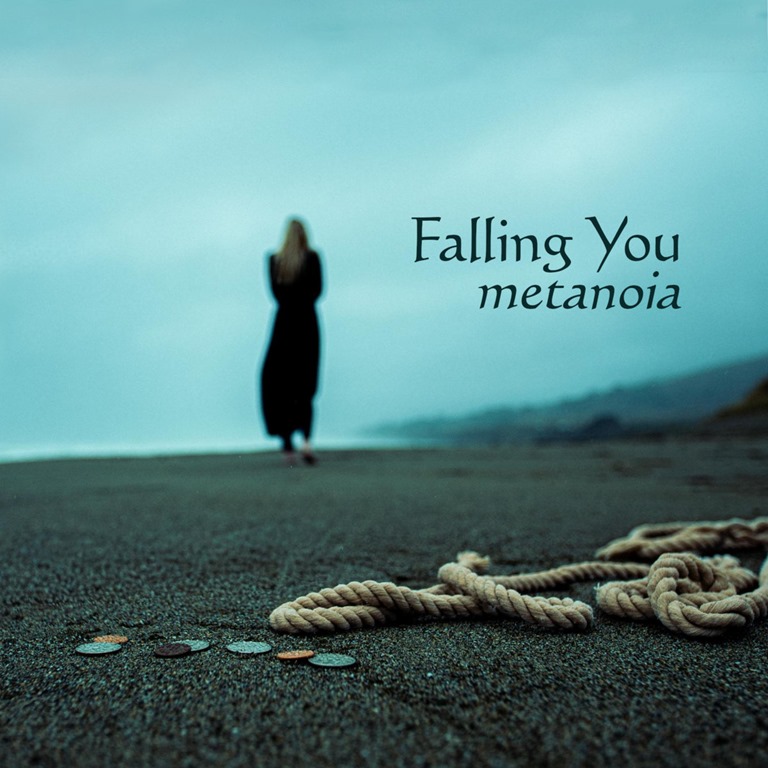
Metanoia is pitched as being for ‘fans of 1980s 4AD dreampop (This Mortal Coil, Dead Can Dance), ‘90s shoegaze (Slowdive, Lush), or the darkwave / ethereal / ambient-electronic releases of the Projekt label (Love Spirals Downwards, Android Lust). It’s quite a span, but the fact is that this is a release with its inspirational roots well in the past. It pains me to be reminded that 1995 is thirty years ago when it feels like maybe a decade. The cover art of previous releases very much state shoegaze / dreampop, and while this album accompanied by altogether moodier artwork, which may in part serve to reflect the album’s title, it’s nevertheless hazy and evocative at the same time. ‘Hazy and evocative’ would be a fair summary of the album itself, too, and the dreamy / shoegaze elements are countered by some really quite unsettling spells of rather murkier ambience.
It starts strong with the bold swell of steel-stung acoustic guitar and a strong vocal – I’m not talking about a Florene Welch lung-busting bellow, but a controlled and balanced performance that really carries some resonance, and it’s mastered clear and loud… and then things swerve into a more electronic, almost dancy territory. Immediately it’s clear that this is going to be less an album and more a journey, and ‘Demiurge (Momento Eorum)’ immediately affirms this with its spiritual incantations and sonorous, droning rumblings.
‘Alcyone’ is the first of the album’s ten-minute epics, and it uses the time well: that is to say, with shuffling drums, spacious synths and layers of lilting vocals, it’s very much distilled from the essence of The Cocteau Twins, and slowly unfurls with an ethereal grace. A delicately-spun pop song at heart, the extended end section tapers down to a softly droning organ.
While the atmosphere is very much downbeat, downtempo, understated, one thing which is notable is the album’s range: ‘Ari’s Song’ is built around a soft-edged cyclical bass motif, around which piano and synths swirl, mist-like, the drums way in the distance, and even as a disturbance grows toward the end, it’s so far-away sounding, and the song itself, beyond that ever-present bass, barely there, and the same is true of the dank, dark ambient echoes of ‘Inside the Whale’. If ‘Ariadne’ is another shimmering indie tune hazed with fractal electronic ripples, the second ten-minute epic, ‘They Give Me Flowers’ provides a suitable companion piece to ‘Alcyone’, swerving from a brooding country and folk-tinged song with hints of All About Eve, and the album’s final track, ‘Philomena’ effectively completes the triptych, pulsing along gently and dreamily before slowly tapering away to nothingness. It’s a fitting conclusion to an album which at times is so vaporous and vague, it’s barely there – which is precisely the design. But in between the hazy drifts and particle-like waftings, there are some beautifully atmospheric and utterly captivating songs with strong leanings towards the dreamy pop side of indie. In terms of achieving an artistic objective, Falling You have absolutely nailed it with Metanoia.
You know you’re in ‘epic’ territory when an album contains just two tracks (or one, depending on the edition). With a running time of thirty-two minutes, The Between is inching into the bracket of monster works that includes Earth 2, Sleep’s Dopesmoker, or much of Sunn O)))’s output – or Swans for that matter – but still. What they promise is ‘a long-form suite of experimental metal that runs the gamut of their whole discography’, described by the band as “a guided meditation through death and dying”, which ‘takes liberal doses of ancient Eastern philosophies on life and death and pairs them with a modern existential despair.’
And so it is that the vinyl release features the half-hour long ‘The Between’ split across two sides, while the digital version features the track unbroken, and paired with a ‘bonus’ track in the form of ‘Remember Death’, which has a running time of over twenty minutes. In short, this is an absolute fucking behemoth.
And it doesn’t stop there: this material was recorded with a twelve-piece lineup. Yes, you read that right. Said lineup features contributions from Oli Genn-Bash (Codex Serafini) on saxophone, virtuosic guitar solos from Alexander Brown (Infected Dead), sound design by new recruit Jack D’Arcy and notably, the return of Dane Cross (Sacred Son) on vocals. No wonder they pitch it as ‘Dawnwalker’s most ambitious work yet.’
I feel a degree of preparation is required for this experience. Candles are lit, whisky is poured. And I’ve brought the bottle up to my office because I suspect that I’ll be needing a refill before the album’s over, and I don’t feel like breaking the spell by pausing it and heading downstairs.
‘The Between’ begins with a bell chime. It rings on… and on… hushed spoken word and hovering tones conjure a rich atmosphere. There’s a magical mysticism about it, as well as a slow-build as rolling cymbals swell and drones hang, thickening the air. Over time, the instrumentation shifts, and doomy folk transitions towards post-rock, then towards cinematic progressive soundscapes. Four minutes in, it goes large… and there’s no looking back from here. It twists and turns, and takes myriad unexpected paths, with a sudden lurch into sludgy guttural metal. With dark, growly noise sharing space with huge progginess, and the riffs lurching this way and that, there’s a schizophrenic feel which begins to take hold after about five minutes. Nine minutes in, a wild solo simply explodes, and POW! Moments later, there’s a sax break. It’s simply too much to process rationally.
Ambitious isn’t the word, really. We’re talking about an album – A SONG – that veers more or less between Black Sabbath and Radiohead. It’s nicely produced, but where does that sit when you’re confronted with such extreme contrasts? ‘The Between’ is a head-spinning, brain-bending experience.,
The same is true of ‘Remember Death’. It begins with haunting, post-rock picked guitar and spoken word, and introduces the idea of years and life itself being cyclical: it’s gentle, its calm, and it’s human. Lyrically, it’s deep, deep, deep… ‘I know it’s an uncomfortable subject, but it shouldn’t be’, says the speaker. And it’s true. Death in our society remains a taboo subject. But why? That as a species we are afraid of death is one thig, but our avoidance of the topic is simply wrong, and the words of ‘Remember Death’ articulate all of this magnificently.
The simple fact is that death is inevitable and we all shall die. Preparing a will or something is good, but simply an acknowledgement of the inevitable rather than fully facing it. Facing it is to live every day like it’s your last. And the fact is, it may be, because you never know.
Things start getting particularly brain-bending around four minutes in. by this point, the atmosphere is hypnotic. You’re invested. You’re open, vulnerable. “The existence that we have now is not real. It’s an illusion. What we see as existence is fundamentally mistaken. What we see and perceive and taste and touch and feel is all filtered by subjective elements… and thus, we do not see reality.” And there is some truth in this: we each experience our own reality. We see colours differently, and our reality is simply our individual experience. It’s why eye-witness accounts of an event vary so. Wildly different as they may be, they will all be true for the person recounting the event. “Through a perfect death, we regain that perception of what is real…” the narrative continues. And this is where it really starts to get difficult, and strange. It is a very, very difficult listen. It continues in this vein, expounding the principles of Gnosticism, while the guitars gradually ebb and flow. The instrumental shifts are subtle, and ‘Remember Death’ contrast dramatically with ‘The Between’.
This would have worked well as a double album, but equally ‘Remember Death’ would have worked as a standalone album. Then again, they’d probably prefer that it was situated as a satellite work, being so far removed from the main release and their other work.
However you approach it, this release documents the work of immensely imaginative band at a creative peak, and it provides much food for thought.
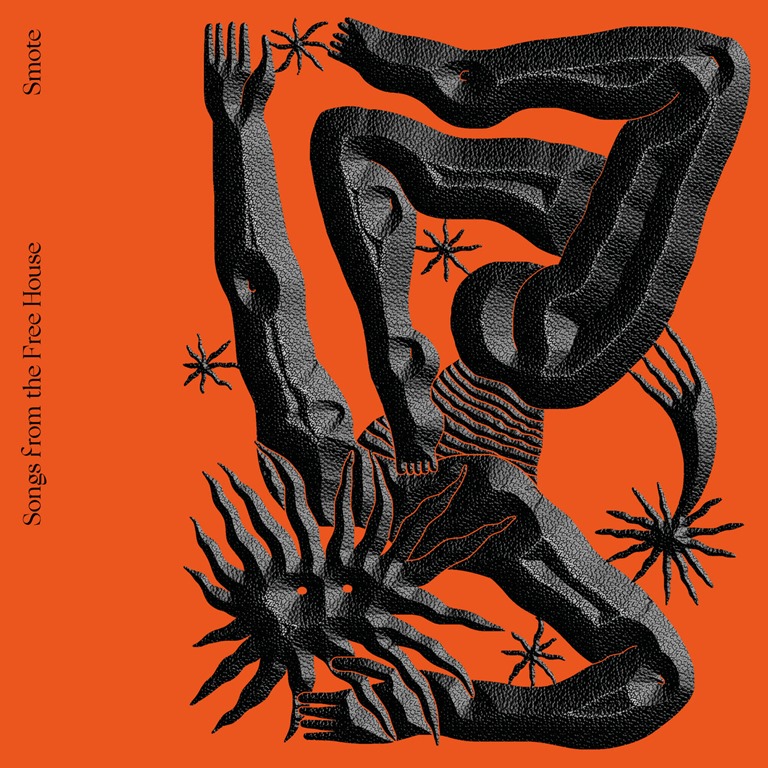
The thing that particularly stands out in the bio for the latest Smote album is this: ‘Daniel Foggin has spent the majority of his adult life working as a landscape gardener, frequently pursuing his trade in conditions of either baking heat or freezing cold and, as he puts it “more often covered in mud than not”. Yet the primal, meditative aspects of this work, the act of communing with nature, its histories and its depths have fuelled his art on a profound level. As Daniel himself relates; “I think the music is a direct reflection of this feeling that I haven’t quite managed to define yet, it is dirty and hard but there is an overwhelming comfort to it.”’
It’s something artists rarely mention: they have day jobs. Perhaps there’s an element of shame in it for some. Maybe it detracts from the mystique. Or it could be that it’s considered a detraction from the pitching of the latest creation. But it’s a truth rarely spoken: most musicians, and artists in any medium, have day jobs and have to make time for their creative work. Tours have to be negotiated with work, taken out of annual leave, often juggled with family responsibilities. Sleevenotes by Joe Thompson of Hey Colossus and Henry Blacker is the most open narrative on the realities of this I’ve read to date, and at times the exhaustion crawls from the pages. As such, it’s refreshing that Foggin not only acknowledges his day job, but recognises it as a significant influence on his creative work. And why not? The most engaging art is drawn from life, after all. Much as it would be a more ideal situation that artists could make their living from art, at the same time, there is perhaps greater value in art created by those who live in ‘the real world’ rather than floating, detached, elevated above it in some kind of bubble.
The words ‘Free House’ make me automatically think of pubs, which perhaps says more about me than the artist, of whom we learn that ‘In the world of Smote, going further out means going inward. Less a metaphysical journey into inner space, more a physical journey into the ground itself, converging with its roots and vibrations. What’s more, a journey right to the heart of its principal architect’s daily experience’.
A cottar is a farmer, and with the album’s first piece, we’re plunged into a deep, surround-sound immersive dronescape, There are many layers to it: reverberating voice, trilling flute, sonorous synths, distant percussion… and it builds, and builds, growing into a hypnotic swell before finally breaking into a slow, weighty post-metal riff that twists and turns with spectacular force, hammering with the force of Pale Sketcher by the six minute mark. It has the weight of sodden earthworks, and conveys the hard exertion of ploughing and tilling, as it descends into a speaker-shredding wall of distortion.
‘The Linton Wyrm’ brings heavy Nordic connotations as it plods on, and on, over the course of a rousing nine and three quarter minutes. It’s not so far removed from the epic force of Sunn O))), but equally Wardruna, a band who evoke earthiness and the essence of pagan spiritualism – not about worshipping mythical gods, but celebrating a connection with nature on a level which is almost primal, and isn’t readily articulable through words: it’s something which transcends language.
Single cut ‘Snodgerss’, which clocks in at under four minutes is both representative of the album as a whole – and not. With its trilling flute and thunderous slow riffery, it incorporates some of the leading elements, but in a way which is considerably more accessible, not least of all with its folk leanings, and presents them in a condensed format. That said, it’s an intense piece, which offers no let-up.
The ten-and-a-half-minute ‘Chamber’ is slower, heavier, dronier, and encapsulates the true essence of the album as a whole, building on a low, resonant throb before the introduction of mournful woodwind. As graceful and soulful as it is, it connects with a primitivism which reaches to the core, a place beyond linguistic articulation. This is the sound of forests, of hills, of streams and moorlands.
The final track, ‘Wynne’ hammers the album home in a squalling blast of overloading guitar and powerful oration propelled by thunderous percussion. It’s mighty, and beyond, seven and a half minutes of blinding intensity which concludes an album that’s varied but unswerving in its density and force. You can truly feel the earth move.
Azure Emote unveil the noire video clip ‘Bleed with the Moon’ as the final advance single taken from their new full-length Cryptic Aura. The fourth studio album of the American progressive death alchemists has been chalked up for release on July 25, 2025.
AA
AZURE EMOTE comment: “Overall, ‘Bleed with the Moon’ is conceptually very simple and straightforward, but also one of the more personal songs on the album”, mastermind Mike Hrubovcak reveals. “Alcohol is a demon and I’ve named him Al-Kuhl. This analogy is based on my personal experiences and the lyrics are about getting possessed by this demon around a bonfire in the woods at night. I’m not trying to glorify excessive drinking here. I rather artistically convey the passion, euphoria, and physical and mental dangers of convening with such ‘spirits’ in the heat of the moment. I have a love/hate relationship with Al-Kuhl and I have learned that eventually it ends up taking much more than it gives. This song was written during such a night however, and even the album cover is a photo of a homemade skeleton that I made and burned in the woods along with a bottle and a bonfire.”
It’s rare to be presented with something that has no immediate or obvious reference or context in terms of other music. But this is where I find myself with This Material Moment, the sixth album by Me Lost Me. And so it proves necessary to delve into the creative process for what Newcastle-based experimental artist Jayne Dent describes as “the most emotionally raw album I’ve ever made”. And so it is that for this release, she utilised ‘the automatic writing techniques she developed during a workshop with Julia Holter, and in the process has spun her music in different directions that draws on poetry, psalms and using mesostic poems and phonetic translations to generate words.’
And in this context, This Material Moment makes sense – at least in its own way. While automatic writing has a long history, dating back to the 16th century, it grew in cultural awareness via Dadaism, before becoming synonymous with Surrealism, and that fact that the results have yielded Dent’s ‘most emotionally raw album’ should not necessarily be a surprise – the theory is that that the process is dissociative, enabling a free passage between the subconscious and the page, with the mind freed from the constraints of self-censorship and linear thought. And This Material Moment very much seems to present an explosion of unfiltered, often free-flowing ideas, untethered by the conventions of form or structure.
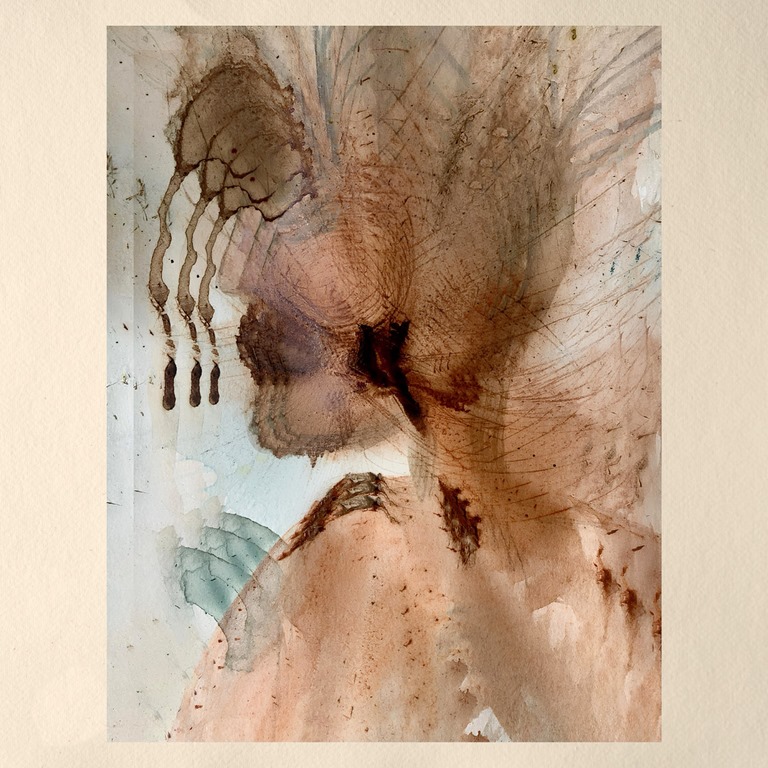
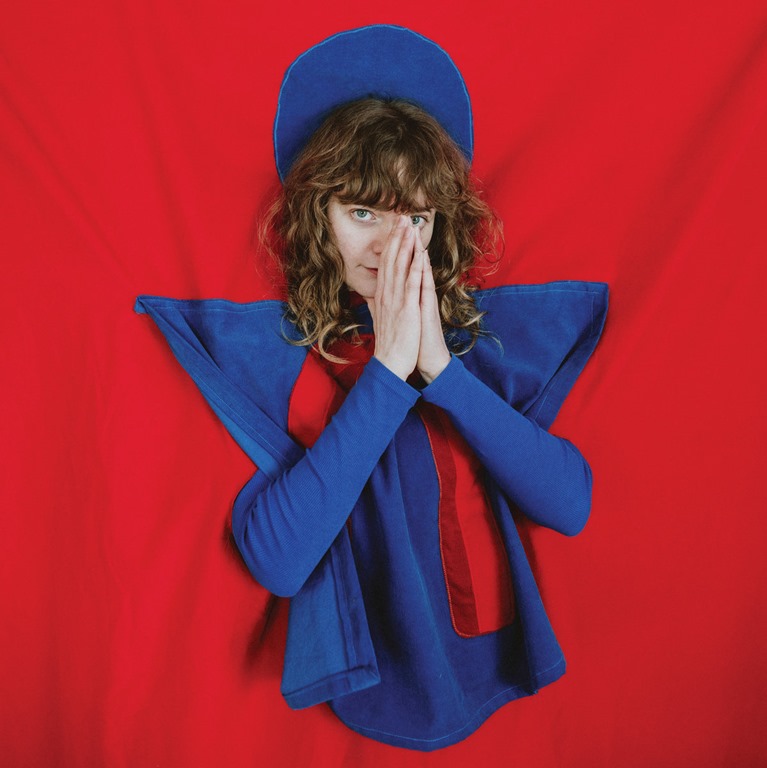
The cover art alludes to the album’s quirkiness, but in a way which rather too easy, a shade gimmicky, perhaps, failing to convey the level of nuance and complexity contained therein.
It’s on the second track, ‘Compromise!’ that the level of ‘otherness’ which defines the album. The drumming is weighty, serious, and Dent’s voice adopts an air of detachedness which is hard to define… there’s both a folksiness and elements of Eastern influence in the way it quavers against the dramatic, expanding backdrop which comes to resemble something of a mystically-hued, almost abstract, Burroughsian psychological interzone.
AA
AA
And so Me Lost Me leads the listener through a succession of dreamscapes which are often simultaneously idyllic and nightmarish. There’s a shanty-like tone to ‘Lasting, Not to Last’, but there are shrill, terrifying wails of strings or feedback which conjure images of dead souls trapped within this dimension. ‘A Painting of the Wind’ presents a sense of the unheimlich. It’s a lilting folk song… but something sits just to the left of centre, the instrumentation isn’t readily recognisable as anything, there are layer and something about is not of this plane. ‘I want to be carried away’, she intimates, and yes, perhaps so do I, I find myself thinking.
The clamour of church bells on ‘Still Life’ chimes a cord of an historical nature, evoking times past with a certain sepiatone sensation, but ‘A Souvenir’ strips everything back to an acapella – albeit multi-layered – delivery, with folk-influenced harmonies conjuring a sense of a bygone era which in many ways contrast with much of the album’s lyrical content.
I find myself flailing here: how to articulate the disconnections and disparities which are the very essence of this album? These disconnections and disparities are nowhere more highlighted than on ‘Ancient Summer’, where Steeleye Span style trad folk meets prog with a darker, almost goth vibe, with a dash of jazz and trip-hop thrown into the mix. ‘A Small Hand, Clamped’ may offer so many meanings in terms of its title: the words aren’t easy to decipher, but the atmosphere… Oh, the atmosphere. It billows and breezes, while a strolling bass… strolls.
Sometimes, albums which are ‘awkward’ to place are a turn-off in their ‘wrongness’, but This Material Moment is so absorbative, compelling, it’s impossible not to be dragged right into its very heart.
This is art which more accurately reflects our lived realities. No conversation really exists as a straightforward back-and-forth whereby each participant delivers a neat line of dialogue, and there isn’t a second in anyone’s life where their thoughts take for form of clear-cut, structurally-sound sentences. And so it is that Material Moment speaks not in a way we can readily pinpoint or identify, because it reaches us through deep, subconscious channels. It’s not an accessible album, and it’s certainly not an easy album to hail for its commercial potential. But it is an understated and yet immensely powerful album – beautiful, crafted, a folk album in many respects, but also an experimental work that seeks to explore dark psychological spaces.
Me Lost Me – the project of Newcastle-based artist Jayne Dent – delights in experimenting with songwriting, creating a beguiling mix of soaring vocals and atmospheric electronics that playfully push the boundaries of genre. She ‘s now shared ‘Ancient Summer’, taken from This Material Moment (out 27th June via Upset the Rhythm), which she describes as “emotionally raw”, and deems it her most honest and vulnerable album yet.
About "Ancient Summer", Jayne comments that "This was the first song I wrote for the album and the first time I’d made a mesostic poem. Taking words from a tourism leaflet for Pont du Gard, a Roman Aqueduct and art museum near Nimes, France, I wrote this song that’s got so much wonderfully hyperbolic and excited language. It reflects quite well how I felt at the time of visiting, I was so moved to be swimming in a river in this beautiful valley under an ancient monument. It’s a song that comes from suddenly noticing your place in time and space, that feeling of being in communion with a past and a future, of being a part of something bigger than yourself. Visiting historical sites is one of my favourite things, and this is a bit of a love letter to the places that I’ve been lucky to visit over the years."
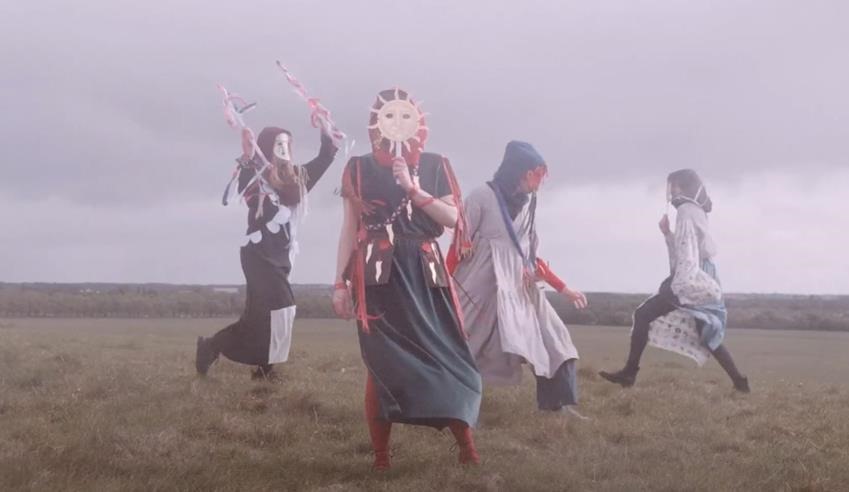
“The music video,” she says, “is a kind of nod to ancient Roman Spring/Summer festivals and the English folk traditions I grew up with, like May Day celebrations, Morris dancing and well dressings. In summer 2024 I worked on some music for a dance project with some incredible performers including Lizzie Klotz, Rosa Postlethwaite and Alys North, which was on the theme Abundance. The process was really beautiful, and I knew I wanted to work with them on this video because it had a similar theme and feeling, plus I knew I could trust them to throw themselves into whatever daft thing I suggested we do! Videographer Amelia Read joined us on Newcastle’s Town Moor to film us dancing and playing games, it was very collaborative and intuitive which was perfect, as I wanted the video for this song to be joyful and light (with a hint of folk horror elements going on too of course!)”
Steve Von Till doesn’t really require any introduction or preamble: the chances are, if you’re reading this, you’re already aware of his work, and if not as a solo artist, then as the guitarist / vocalist with Neurosis, active between 1985 and 2019. As much as Neurosis were labelled a post-metal band, they very much forged their own sound, which has, to an extent, become the house style of Neurot Records.
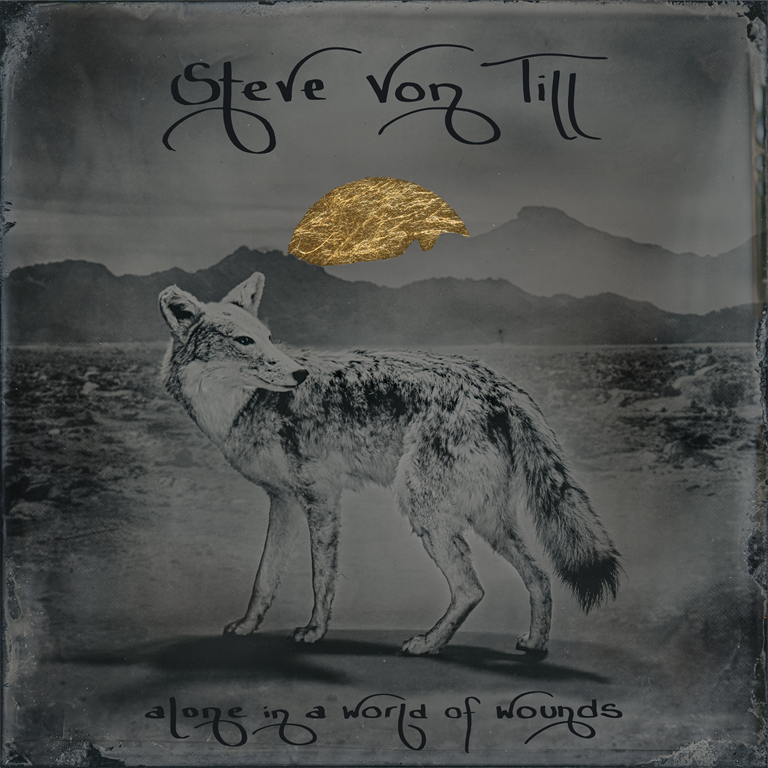
Von Till’s solo works may lean more toward folk and the gentler side of that style, but nevertheless have significant heft, and Alone in a World of Wounds – his seventh solo album, the follow-up to No Wilderness Deep Enough (2020) is no exception (he’s been busy in the intervening years with a trilogy of Harvestman albums, all released in 2024). The heft here comes from a sense of gravitas, rather than volume and distortion, and continues the softer trajectory of its predecessor, an album ‘initially inspired by the harmonic resonance of piano and synths and his long-standing love of ambient music’.
‘The Corpse Road’ sees Von Till croak and croon in a fashion that could me taken for Mark Lanegan in a blind test, against a sparse backdrop of strings which swell and swoon, heavy with sadness and gloom. There is a sense of times past, not just fading memories and bygone days, but a sense of the creak of wood and worn clothing of harder but simpler times. I find myself unexpectedly transported to a walk my daughter and I undertook from Ambleside to Grasmere in the Lake District a year or so back, via the ‘Coffin Route’. It was winding, and wet, and uneven, not to mention long, and it’s billed as a ‘strenuous’ walk, while still suitable for tourists: as the rain battered the hood of my anorak, I found myself contemplating what it must have been like hauling an actual coffin along that four-mile stretch without the benefit of modern hiking gear. Life must have been tough. Von Till taps into the essence of these past times, and a sense of the elemental.
The mood remains lugubrious on ‘Watch Them Fade’, a song redolent with sadness and reflection, weighted down with the reminder that mortality affects us all and is never far. Despite the fact that life’s only certainty is its expiration, we continue to shy away from the topic. While Alone in a World of Wounds does not confront mortality and death head-on, it’s there at every turn. “Keep on diggin’… dig a little deeper” he implores on ‘Horizons Undone’, and while there are psychological connotations here, it’s hard to ignore images of graves.
The eight-minute ‘Calling Down the Darkness’ is a super-sparse piano-led slow-burner, and confounds any expectation for a surging finish by remaining low-key and minimal to the end, ad something about it is so, so achingly sad.
‘The Dawning of the Day (Insomnia)’ is a brief spoken-word interlude with a moody piano accompaniment, while paves the way – or perhaps scatters woodchips – for the arrival of the swirling atmospheric start of ‘Old Bent Pine’, another song which revels in the forces of nature, before the six-minute ‘River of no Return’ flows toward the finish. It has hints of Slowdive about it. Moreover, its superficial ominousness reminds us that rivers only flow in one direction, and as with rivers, so with life: there is no return, no replay, no turning back. there is no undoing mistakes, only not repeating them.
‘Alone in a World of Wounds’ may be a largely acoustic album, but it is still heavy – really heavy – emotionally more than sonically – and consequently not an easy one to process. It would be impossible to deny the album’s quality. But the weight, the sadness…
Eric Quach has been making music – or perhaps more accurately sculpting sound on the fringes of music – as thisquietarmy for over twenty years, amassing a substantial body of work as a solo artist, with an expanded band lineup, and with various collaborations, the most recent being Cîme, his second with Tom Malmendier
We learn that Langue Hybride was written and arranged in less than 4 weeks during thisquietarmy’s music residency at Centre d’Expérimentation Musical (CEM) in the region of Saguenay—Lac-St-Jean, Québec.
The album consists of five longform tracks, which range from seven and a half to sixteen minutes in duration. It’s the shortest work, ‘Les Rayons Cosmiques’ which lifts the curtain the album, with droning, dolorous strings and distant, delicate percussion conjuring evocative atmospherics, coloured with both a simmering tension and an underlying sense of sadness, which, while hard to define, is palpable. Around the midpoint, that distant percussion builds to stand front and centre and a groove emergers, suddenly and unexpectedly, and the whole feel changes towards something that’s a cinematic hybrid of folk and space rock.
‘Respirer l’instabilité’ crashes into altogether darker territory, a gloomy, doomy trudge of slow, deliberate drumming and a low, grinding bass, over which discordant sonic mayhem plays out. After a lull of calm around the mid-point, a pulsating rhythm merges, and things evolve into a strolling wig-out with some strong jazz-funk leanings and already, a pattern is beginning to emerge in terms of compositional structure, in that around halfway, the trajectory shifts, and the piece ends in a completely different place from the one in which it started.
This is confirmed by the pivot which takes place around five minutes into the third track. Reminiscent of latter-day Swans, ‘Les radicaux libres’ is woozy and weird, expansive and haunting, and begins to pick up pace and volume six minutes in, building to a bursting sustained crescendo that’s both hypnotic and tense, and if ‘Organismes en aérobiose’ starts out soothing, the sound of dappled sun through leaves on a summer’s day, it transitions to a fist-waving stomper and concludes as a skyward-facing surge of sonic exultation, via the detour of a post-rock tidal wave, while fifteen-minute closer ‘Solastalgie impalpable’ rides a wave of thick riffage and strings reminiscent of the long play-out on ‘Layla’ – only this is arguably more successful, as it always felt like an epic and overlong anti-climax in the wake of that guitar-line. True to form, ‘Solastalgie impalpable’ does make a shift, tapering into some elongated swirling drones which reverberate and rattle the ribs and taunt the senses, before suddenly bursting into life with a driving rock riff by way of a climactic finale.
Langue Hybride is a wild ride, and while claims for acts producing ‘genre-defying’ works are not just tedious and predictable but usually completely spurious, there’s no neat way of categorising this schizophrenic hybrid, where each track is a work of two halves, presenting almost oppositional styles and characteristics .But this stylistic polarity makes for exciting – if challenging – listening: given that the only thing that’s predictable is that each piece will fly in a different direction at some point, there’s no way one could call this album predictable. The vision – and its execution – are superb, and with Langue Hybride, thisquietarmy offer something which is quite different, and rather special.
While studying English Literature at university, I undertook a module on Anglo-Saxon literature. It was fascinating to learn the etymology of certain words, and the way in which commonplace phrases came to be, and one thing which struck me was the reverence the Anglo-Saxons held for the bear, with not only words like ‘berserk’ deriving from a fierce, angry bear, with armies placing their berserkers at the front of their lines, foaming at the mouth and gnashing their teeth on their shields to strike fear in the hearts of their opponents, but the phrase ‘lick into shape’ came from the belief that bear cubs were born as balls of fur, and their mothers would literally lick them into the shape of a bear. In so many aspects of life, through history, humans have aspired to be like bears.
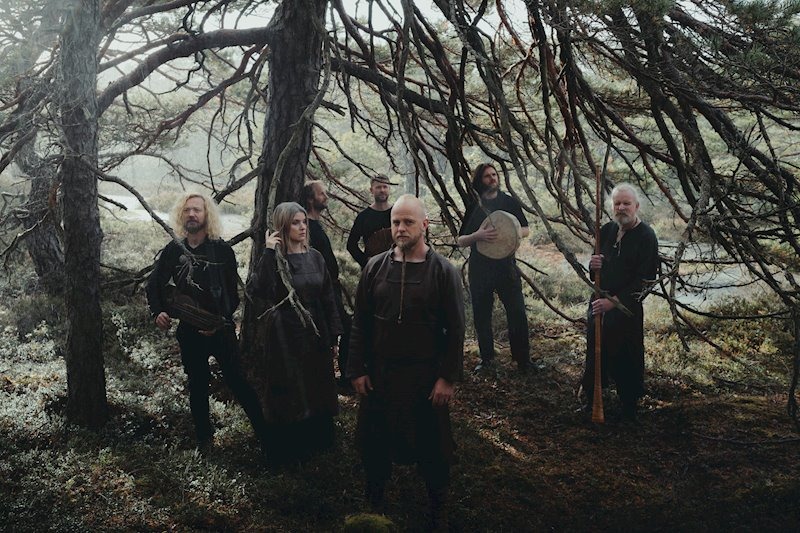
It is this which provides the central theme of Wardruna’s sixth album, as the accompanying notes expand upon:
The bear frequently figures in the oldest myths of mankind in the northern hemisphere, and many indigenous people still regard this animal as a totem, honouring it with rites and songs. It was once our respected guardian, our guide to edible plants and berries, a creature we both feared and admired. Although the bear from the very beginning has constituted a threat to our own lives and those of our livestock, humans have always identified with the bear in various ways. If you skin the animal, its body underneath the fur strongly resembles that of man, which may be a reason legend has it the bear in fact originated from humans, and for thousands of years we have strived for its strength and wit. In some cultures, “treading the path of the bear” means pursuing what you’re truly meant to do in life.
Because this is a Wardruna album, it taps into ancient mythologies on a level which goes far deeper than some kind of conceptual cosplay or superficial skirting around the subject. Wardruna has a way of tapping into a spirituality which resides in our very bones, our DNA. Their music resonates, powerfully, in ways which are hard to articulate beyond the fact it stirs something deep inside. Birna is more than an album, it is a force of nature distilled in musical form.
‘Hertan’ begins with a thudding rhythm like a heartbeat which provides the backdrop to a spoken word introduction and, suddenly, a swelling surge of sound, clattering wooden-sounding percussion and bold choral chants. Immediately, it evokes images of a primal heritage, of rituals performed on moorlands around open fires, animal skins, ceremonies exulting pagan spirits, and a connection with the earth which transcends words alone.
Thetitle track is simply immense, a colossal, powerful blast of sound, which conveys the strength – and also the gentleness – of the she-bear. It’s perhaps here where they most successfully articulate the appeal and fascination of the bear, a creature capable of the most divergent behaviours, so caring to its cubs, but would absolutely annihilate anything when threatened. There’s a reason why you don’t, as they say, poke the bear.
The fifteen-and-a-half-minute ‘Dvaledraumar’ (Dormant Dreams) enters rather more ambient territory, lunging into slow droning darkness after a hooting call like that of a conch shell being blown, or similar. Along with ‘Jord til Ljos’ (Earth to Light), it forms ‘a two-song meditation creates a joint hibernation between animal and listener’. It’s somewhat sad, that we haven’t taken cues from the bear to hibernate. It doesn’t feel natural to drag oneself out of bed and trudge to work in darkness, when it’s often cold, wet (or snowy, depending on geography), and windy. Before industrialisation, before electricity, working hours were limited by daylight, and in feudal times, serfs would effectively hibernate, unable to work the field during the winter months. I’m certainly not saying that this was a golden age of any kind, but capitalism and technology have certainly failed to deliver the lives they promised with a wealth of leisure time.
Sitting and reflecting on this, the rippling, repetitive melodies of these two tracks washing over me, I once again find myself envisaging dense, expansive woodlands, a habitat thick with vegetation, and sparse with population, a world before humans lost touch with nature and even humanity, and fucked everything up so badly. And I suppose it’s this desire to rewind the clock, to unfuck the planet, to undo centuries of mistakes to rediscover that which lies subconsciously in our hearts, which Wardruna connect with so perfectly.
Following this extended hibernative segment, they return first with ‘Himinndotter’ which evolves from being sparse and folksy to a frenetic frenzy of tribal percussion and a powerful choral refrain. ‘Tretale’ presents a haunting rumble with a breathy, hypnotic vocal. It’s built around a low, deep-lunged organ-like drone, but cuts back to some hypnotic passages where the insistent beat stands almost alone.
The eight-and-a-half-minute ‘Lyfjaberg’ brings the album – which is epic in every way – to a close with a slow, hypnotic beat and repetitive instrumentation and vocal chorus. It draws you in in such a way as to suspend time and space: it’s hard not to get lost in the moment, but also, ultimately, in time. I suspect I’ve described Wardruna’s music as ‘transcendental’ before, and more than once… but is the word which most accurately describes their music. Yes, THE word – and perhaps the only one. Because this… this is something else.
 Aural Aggravation