Posts Tagged ‘Experimental’

28th July 2025

Christopher Nosnibor

Beauty, as they say, is in the eye of the beholder. Certainly, it requires a fairly specific subjective standpoint to hear the beauty in a bleeping rush of effervescent electronic froth, but there is something in it – and yes, it is intense – to the extend that it’s like a fizzing chemical reaction, like vinegar and bicarbonate of soda, exploding in your brain. And it’s quite a high.

Intense Beauty finds Gintas Kraptavičius (Gintas K) in his most common setting, with the album being fully improvised, ‘recorded live, using computer, midi keyboard & controller’. Recorded in June 2025 of this year, by the power of the Internet and micro-labels, it was released as a limited cassette on Tokyo-based label Static Disc just weeks later on 10th July, before also becoming available on Gintas’ own Bandcamp page.

As is common to many of Gintas K’s works recorded in this manner and with this – seemingly unique setup, there’s something playful, even joyful and uplifting about the sound. It is chaotic, but it’s also carefree, and it’s not remotely dark or heavy: there’s nothing harsh or abrasive to be heard here. ‘intense’ is skittery and skittish, off-key electric piano thumps and stomps erratically, glitching in and out throughout, while cellular sounds fly around all over like plankton in a storm before gradually slowing, tinkling and flitting at a more sedate pace until grinding to a halt.

‘harmony’ isn’t particularly harmonious, instead merging static and drone with groaning whirrs before yielding to discordant bent notes playing across one another. One thing that is a constant throughout Intense Beauty is a sense of movement. There isn’t a moment is stillness, as sounds and ideas flit from one place to another with no discernible flow, and th9is is nowhere more apparent than on the shifting sonic collage of ‘gal bet’. It’s hyperactive, and should be exhausting, but the sheer energy is contagious and uplifting.

Watching the accompanying video of Gintas recording for the album is illuminating, particularly the vigour with which he plays, simultaneously striking keys on the keyboard with hands, wrists, forearm, seemingly at random, but with remarkable speed and dexterity, while cranking knobs hard and fast: the camera and table shake under his frenetic kinetic activity. K isn’t one of those who creates sound simply by pushing buttons here and there: this is a full-body physical performance. This, too, is an example of intensity, and the artist pours it into the act of artistic creation.

There are a lot of experimental electronic artists around, but no-one else sounds quite like Gintas K.

AA

AA

a3925363230_10

Crónica – 1st July 2025

Christopher Nosnibor

Only yesterday, I expended considerable contemplation – and verbiage – on the matter of press releases, and the level of detail they contain nowadays compared to the old A4 1-sheet – which sometimes contained just a few lines under the heading and the logo. It’s wasn’t really a complaint, as much as an observation, although there is, sometimes at least, a sense that most of the reviewer’s job has been done for them in advance.

However, there are other ways in which the detailed press release can prove to be a double-edged sword, and this is one of them. And so it is that I’m plunging into unknown territory with this release. Not in that I haven’t spent many hours immersed in ambient recordings, and not that I’m unaccustomed to postmodernism, in theory and its application, how it applies to the world as we experience it. But sometimes, a work is so inspired and invested in something specific, specialised, and conceptually-focused that it feels like I’m not fully qualified to approach it, much less critique it.

Before I do dive in, this is the context. Are you sitting comfortably?

At the end of the 1990s, Hakim Bey wrote a book about the then-emerging possibility of the virtual. With the lucidity for which he is known, he recognized at the time that the virtual was nothing more than a new avenue for the expansion of capitalism. He introduced the concept of temporary autonomous zones as a kind of Foucauldian heterotopia — spaces that existed only for as long as they could evade capture. Today’s reality reflects a radical intensification of what Bey was referring to in the 1990s. Temporalities have changed completely. We are now almost overwhelmed by an incessant pursuit of instantaneity, accompanied by the mounting impatience it inevitably breeds.

The temporalities of sound, therefore, are naturally different too.

Time must be disobeyed.

The sounds of our autonomous zones aim to be the opposite of what technology offers us today: fascination and dazzle through excess — more buttons, more effects, louder… AI. These are bare sounds, defiantly rejecting the paraphernalia that surrounds them. They are simple yet perhaps carry the greatest complexity of all: turning their backs on spectacle and presenting themselves as they are: unmasked.

This work is the outcome of a series of studio sessions recorded during the summer and autumn of 2024. We followed an exploratory approach grounded in clearly defined premises and a pre-conceived compositional outline shaped by three key notions that are central to us: repetition, silence, and duration.

There is no post-production manipulation. What you hear is what was played. Inactual by conviction, this represents an utterly contemporary mode of being. These are sounds that seek to endure as a resistant, autonomous possibility — even if only fleetingly. Suspended between silences. Those marvelous, singular, sounds that Cage taught us to hear. They are there to last for as long as they can.

The title Horizons of Suspended Zones is inspired by a book from Hakin Bey.

I find that I’m sitting rather less comfortably now than I was a few minutes ago. I’ve never read a word by Hakim Bay. I’m aware of him and his work, but have never got as far as investigating. Therefore, I’m deficient. And so, in my head-swimming uncertainty, bewilderment and state of flaking confidence, I arrive at this fifty-five minute articulation of time-challenging theory/practice feeling weak, overwhelmed. Where do I even begin? Can I relate it to my own lived experience?

I struggle, because it doesn’t communicate that postmodern overlapping and disruption of the time / space continuum in a way that I can relate. For me, cut-ups and collage works convey how I experience life: the eternal babble of chatter and time experienced in terms of simultaneity rather than in linear terms.

‘Zone One [stay]’ is a drifting, abstract, ethereal ambient work, and while over ten and a half minutes in duration, the time simply evaporates. It drifts into ‘Zone Out [unfamiliarly cosy]’, which is appropriately titled, and I find that I do as instructed, as the slow chimes and resonant tones hover in the air like bated breath. There’s a sense of suspense, that something will happen… but of course, it doesn’t.

For all of the detail around the concept, there’s very little around the construction by comparison. But perhaps a bell chime is simply a bell chime and an echo simply an echo. But those echoes matter. I find myself wading through the echoes of time, how it passes, how we lose time. How did we get to August? How did we – my friends and I – get so old? How, how, how is the world so utterly fucked up right now?

Each extended abstraction turns into the next, and so ‘Zone Zero [nameless]’ arrives unushered, unannounced, and unnoticed. There are whispers, the sound of the wind through rushes, and there’s something dark in the atmosphere. It’s only on returning to this after some time to reflect that I come to note the squared brackets in the titles. It’s an unusual application of this punctuation, which is more commonly found in academic work, and which I assume isn’t accidental – but why?

Anyone who’s read Beckett will know how painful and challenging, and, above all, how his work can be, and so ‘Zone Lessness [with Beckett]’ certainly reflects the emptiness of many of Becket’s works – the sprawling nothing where there are no events, no… nothing, and how life itself bypasses us as we wait. Life, indeed, it what happens while we’re making plans. It has a painful habit of passing us by. Life is not the Instagram shots or ‘making memories’ moments. It’s the trip to the supermarket, it’s endlessly checking your bank balance, it’s the dayjob and the cooking and washing up. It’s the dead moments that count for nothing. Those moments occupy the majority of time. And on this track, a low laser drone slowly undulates throughout, and over time, fades in and out, along with incidentals which allude to lighter shades, and ultimately, the nine minutes it occupies simply slip away.

‘Zone In [landscape]’ is sparse but dense, moody and atmospheric in its rumbling minimalism, and the last cut, ‘Zone Warming [hidden]’ chimes and echoes, bells ringing out into endless silence, without response, before tapering contrails of sound slowly and subtly weave their ways in and out. There are spells of silence, and the silence casts spells, and the spells float upwards in suspension.

Perhaps an appreciation of the context and theoretical framing of Horizons of Suspended Zones is advantageous, but it remains accessible as an abstract ambient work without that deeper comprehension. And it still feels as if there’s a sadness which permeates the entirety of the album. It’s by no means heavy, but it does have an emotional weight that drags the listener in, and then drags the listener down. And then leaves them… simply nowhere. Caught with their thoughts, and nowhere to take them.

AA

AA

a4170718585_10

Torto Editions / Ramble Records / Atena Records – 25th July 2025

Christopher Nosnibor

DuChamp (certainly not to be confused with the seminal avant-gardist Marcel Duchamp) is a Berlin-based artist, and for this release, is the product of ‘a journey of development, research, and refinement of a deeply personal voice’, their chosen selection of instruments is listed as ‘baritone guitar, voice, organ, synths, bouzuki, electronics, incredible stubbornness.’

The baritone guitar is not a common instrument, but oner which sounds quite unlike any other guitar in terms of its tonality. Its application here is in providing the core to elongated sonorous drones on the five compositions on The Wild Joy. It’s a title I take to be somewhat ironic, for despite the resplendent flora which graces the album’s cover, the title of the first piece, ‘Sine proprio’ translates, depending on your choice of reference source, as ‘without property’, ‘without possession’, or ‘poverty’. Whether or not this is a reference to a physical or spiritual poverty isn’t apparent, but what this nine-and-a-half minute dronescape does possess is a wealth of texture as the layers build and vibrate against one another.

‘The Shape of Time’ is very much constructed around contrasts; a whining, scraping drone nags the conscious level of listening, while a low, rumbling bassy resonance lingers way below, and it’s something you feel as much as hear. In the space between, incidentals drift in and out. In the distance, gongs chime and fade slowly, and the disparity between their timing and that of the pulsating throb which has begun to build is disorientating, unsettling.

‘Epithalamion’ marks a dramatic shift – in every way, starting with the change of instrumentation, and by no means ending with the change of approach, with a wild, undisciplined key-bashing crescendo occupying the first couple of minutes, before giving way to a wheezing sound like an organ on the brink of expiry. With its origins in the classical age, an epithalamium is a poem written specifically for the bride on the way to her marital chamber. This, however, sounds more like a piano being pushed down six flights of stairs, before a ghastly gasp sputters along interminably for the remainder of the duration. I pity the bride this was penned for.

Things are different again on ‘Fulaxos’: there, the baritone guitar comes into its own and to the fore, played conventionally, a picked, rolling motif that’s brooding, even doomy provides the starting point for a piece which gradually unfurls toward a place of light and optimism. The final track, which is also the title track, brings us almost full-circle, but there’s a levity to this extended, delicate dronescape, and the soaring vocal only accentuates this sense of elevation.

The joy may be somewhat subdued overall, but it’s there, on what is, ultimately, an accomplished, multi-faceted work.

AA

a3734767457_10

Christopher Nosnibor

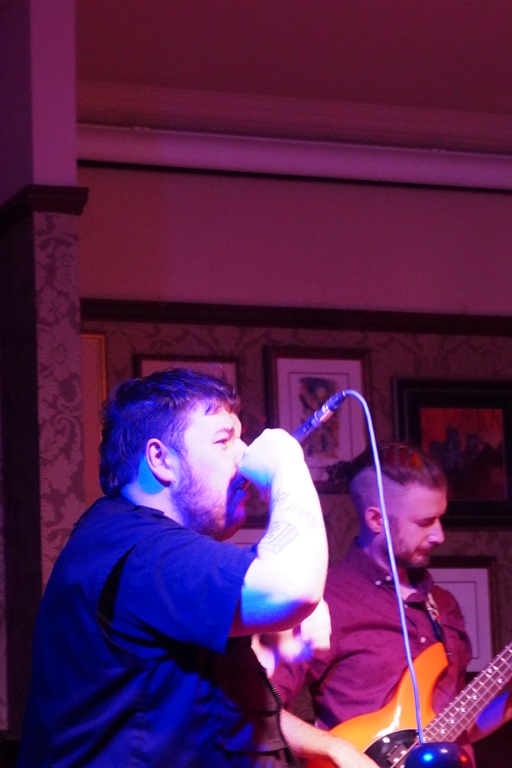
There was a time when there wasn’t really much doing in York, which was particularly disappointing for a city with two universities. But, despite grass roots venue disappearing at an alarming rate, right now, the city is offering up some exciting stuff on the grassroots scene. Tonight, there are three quality live music events on, and had I mastered cloning, I would have gone to all three. The Fulford Arms was serving up a night of top-notch goth and post-punk, while there was experimental and ambient work on offer at The Basement under the City Screen cinema. But I feel I made the right choice plumping for Needlework at The Crescent, not least of all because it transpired that this was to be their last show.

Needlework have only been around a couple of years, and only played a handful of shows, but they’ve made a serious impression, as tonight’s crowd shows. Sure, they’ve got plenty of their sixth-form / college mates down, but this is a band who had built a keen following in their own right. In a previous time, John Peel would have been all over them and they’d have achieved national cult status. Instead, because it’s 2025, they’re bowing out with only an EP (released today, but without mention) and a few shows to mark their existence. But I guess this is how it goes.

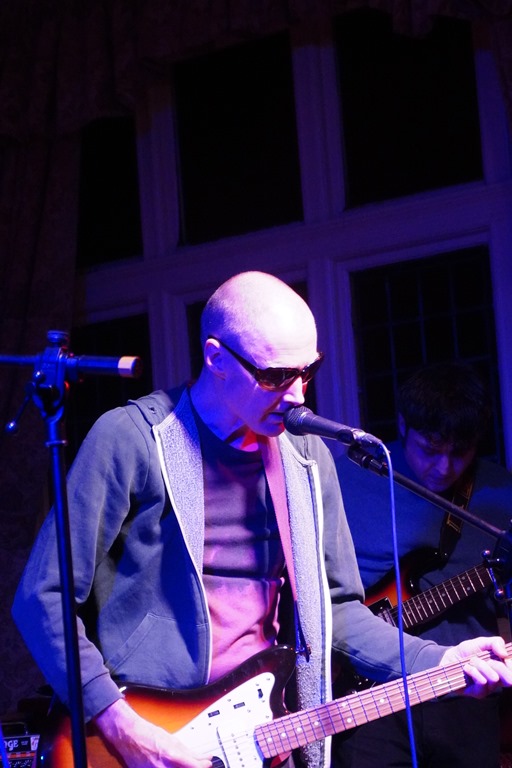
First up, it’s Speedreaders. They’re nothing if not consistent., and tonight’s set brings all of the things I’ve highlighted in my previous coverage. They’re tight, but slow and mellow. And this evening they’re slower than ever. After imparting his opinion on Fleetwood Mac being shite in a rare bit of between-song banter, singer David Mudie spent longer tuning his guitar for the next song than it actually took to play it. That’ll teach him to engage in conversation with the audience. My mate went to the bar and returned with two pints before he was done tuning. Still, when they’re back on track, they’re sounding good. It’s the harmonies which stand out in tonight’s clean, crisp set, with clear balanced sound.

DSC02705DSC02709

Speedreaders

Divorce Finance sound pretty much the same as they look…. meaning I can’t remember the last time I so wanted to punch a whole band. Actually, I lie: Sleuth Gang, who I witnessed in the same venue a few months ago emanated wankerdom from every pore. It must be something about bands who take their style cues from The Village People.

DSC02733DSC02735DSC02720

Divorce Finance

It’s sort of tongue-in-cheek but not really rockabilly country hoedown hillbilly bollocks. There are people down the front getting down with some boisterous line-dancing moves, and there are plenty who are digging it, but I just can’t get on board with this is corny, gimmicky shit, and the fact they play it well doesn’t get them a pass. All the whooping and whelping is high-energy and perfectly executed, but… It’s just so much cheesy turd-polishing, and the singer’s smug, grinning, cheeky chappie, eye rolling delivery only makes everything so much worse. I found myself feeling not irritated, or annoyed, but – most unexpectedly – angry.

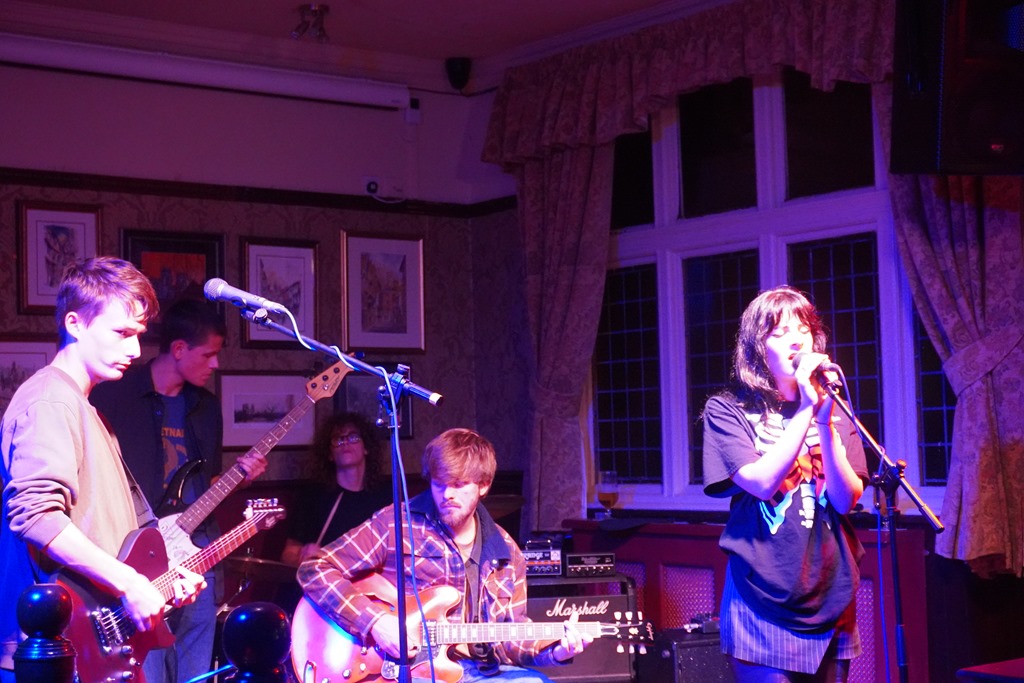
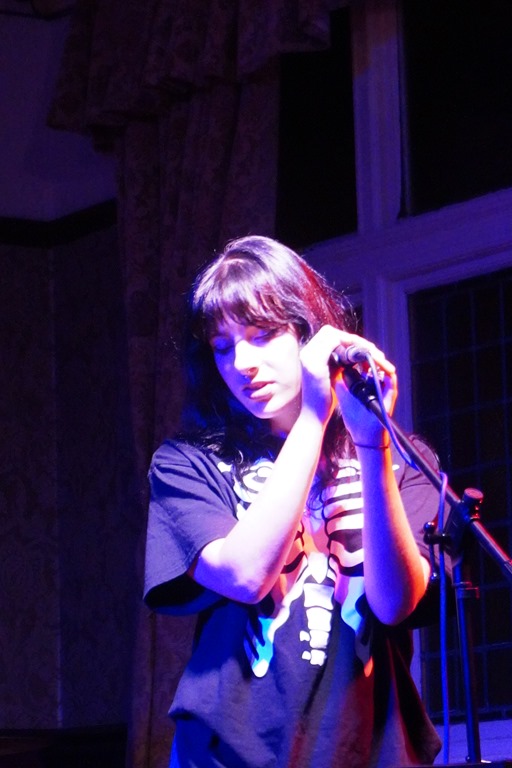
Needlework are simply something else, and what that something is is not easy to pin down. Their entire existence is constructed around a mass of contradictions and paradoxical premises, none of which are reconcilable or make any obvious sense – but this is precisely why they work, and why they exist in a league of their own. They’re really tight and together, but create the illusion of being lose, even a shade shambolic; front man Reuben Pugh is simultaneously intense and aloof. Each member of the band brings something different, stylistically, and in terms of personality – that goes for both their musical contributions and stage presence. Jagged, scratchy guitar work slices across rolling basslines, jittery drumming finds a counterpoint with soft, trilling woodwind and synths interwoven through the scenes as they unravel.

DSC02765DSC02768

Needlwork

They’re not really a ‘songs’ band in terms of conventional verse / chorus structures, either, instead exploring routes which take obtuse twists and turns, and they’re unafraid to do slow, wonky, spoken wordy, abstract narrative. They understand dynamics, and the power of jarring angularity. It’s post-punk, it’s jazz, it’s experimental, and it’s utterly spellbinding. Needlework are one of those rare bands that seem to suck you into a parallel universe while they play. Time hangs in suspension and you find yourself on another plane, utterly gripped while wondering what they’ll do next. During the time they’re on stage, something transformative takes place: it’s more than simply five people on stage making music. Needlework conjure aural pure alchemy.

Pugh takes his shirt off to substantial applause, and a big fella in the front row responds by whipping his T-shirt off and lobbing it on stage after helicoptering it above his head a few times. He asks for it back a song or two later, and the band duly oblige.

DSC02762DSC02741.CROPDSC02801

Needlework

The set builds to a perfect climax, a monumental whirl of sonic chaos which is electric. And then, that’s it. Finished. Done. They leave us stunned, dazed by the magic we’ve witnessed. They certainly concluded on a high, and one suspects that this is a band which will be remembered, and talked about, for years to come.

Portraits – 27th June 2025

Christopher Nosnibor

Stephen O’Maley will be forever synonymous with Sunn O))). However fervently fans revere Khanate, whatever the reputation of Burning Witch or KTL, however many solo albums he releases, and regardless of the outstanding work Ideologic Organ presets to the world, none of it will ever come close to the success of Sunn O))), which will eclipse anything and everything else he is involved ion for all eternity. It’s not difficult to grasp the reasons for this. It likely quite frustrating, but that band have elevated a niche not-really-a-genre to stratospheric levels, and have achieved more with a single, sustained chord than most could ever dream of.

When I saw him perform solo some years ago, he appeared quite comfortable with this, playing – just off stage – through a backline that was so immense it wouldn’t quite fit onto the stage of the 450-capacity Brudenell in Leeds. Better to have a reputation to play up to than not, and since bowel-churning guitar drone played at eardrum-shredding volume is what people want, delivering it seems like a fair trade.

The blurb for his latest solo release suggests, however, something a shift, but by no means a departure, writing that ‘With But remember what you have had, Stephen O’Malley continues and expands his musical approach by transposing it to multiphonic electroacoustic writing and acousmatic listening. Drawing not only on his extensive experience as a composer and live instrumentalist, but also on the countless studio production and mixing sessions he has taken part in the course of his many projects (in solo, with SUNN O))) or KTL, to name but a few), Stephen O’Malley’s work on this new piece is ambitious, engaging in an inspired research that delves into the deep intricacies between polyphony, intonation and timbrality, enhanced by melodic motifs. To do this, O’Malley summons up his own very personal sound universe, constellated with amplified textures, instrumental sustained tones and raw energy, in order to diffract them into wavefronts, waves and blows that weave a complex, rich and fascinating matter. But remember what you have had stands out as an important work in Stephen O’Malley’s repertoire: it brings together the multiplicity of his musical approach in an exemplary way, while laying the foundations and promises for the future of an already extraordinary journey.’

But remember what you have had is a single, continuous piece, just over thirty minutes in duration. It begins with a parping drone that sounds somewhat like a didgeridoo. It lingers, resurging, cyclical hums and layers of sound and texture build atop of one another… and then what the fuck’s this? Bagpipes? It sounds like bagpipes. But then, it also sounds like guitar feedback and a single chord being struck and resonating for an eternity. And then another chord crashes like a giant Wave breaking over rocks at high tide with a stormy wind behind it.

Whereas the overall pitch and tone of the Sunn O))) sound is low and growling, But remember what you have had altogether more keenly favours the mid and upper ranges, and howls of feedback while whining engines fill the air as it heats up. There’s more discord as the sounds bounce off one another. It’s an exploration of the interaction between notes and frequencies, conducted in a way which can only happen at volume,

By the midpoint, the feedbacks are interweaving in such a way to form a huge reverberating howling drone, which in some respects shares common ground with Metal Machine Music, and it would be difficult – and inappropriate – to completely sidestep Earth 2 here, too. By twenty-minutes, O’Malley conjures an immense collision of sound, jousting and jostling amidst a sonic tempest, before gradually diminishing to a point of tranquillity which is more reminiscent of a string quartet than experimental wave of noise. It makes for an unexpectedly soothing finish, but once again shows the range of O’Malley’s musicianship, as well the breadth of his sonic interests, which extend far beyond all-out weight and sheer volume.

AA

AA

a3988746175_10

NYC’s Lip Critic return with their first new music since last year’s acclaimed Hex Dealer – which Consequence of Sound described as “a cannonball to the chest” and Paste compared to “the B-52s on ketamine”, while we here at Aural Aggravation  said was “Lip Critic’s definitive statement”. Double singles ‘Mirror Match’ and ‘Second Life’ are out now and continue Lip Critic’s furious experimental energy, born in a flash of cosmic coincidence and baseball-fueled mysticism.

‘Mirror Match’ is a twitchy, high-octane confrontation with your doppelgänger, arriving alongside a bespoke Lip Critic-designed pinball game set in a cloning facility. ‘Second Life’ throws the chaos into bass-heavy nightmare territory, accompanied by a surreal music video styled like an off-brand cooking show episode, complete with Sandra Lee-inspired semi-homemade absurdity.

AA

"We were on tour near the end of 2024 and had just played our LA show. We had a two day gap before our next show in Santa Ana so we got a room at the hotel Casa Grande. That night after the drive I fell asleep watching Randy Johnson highlight reels. All the great moments from his time as a Diamondback, as well as his years on the Yankees and the Giants.

That night I had a dream I met a tall man with a body made entirely of radiant light wearing a baseball cap. He opened his arms and from them came two perpendicular rays that shot around me to form the shape of a diamond. When the tips of the rays connected I was engulfed in a thunderous sound, like that of a waterfall. It shook me so much that I woke up in a jolt. I woke to see that I had been writhing in my sleep and had completely displaced the other 3 members I had been sharing this queen bed with.

I apologized and brushed it off as another bad dream brought on by a late night binging baseball history videos on YouTube. Upon checking my phone, I saw I had received a text in the night from a number I didn’t recognize, offering us two days of unexpected studio time.

When we arrived at the studio that day, he opened the door wearing a fitted baseball cap, towering over our band with an average height of 5’8”. I instantly felt a familiarity. As he showed us around I felt a sense of having returned, like visiting your old elementary school once again for a younger siblings’ graduation. He led us to the control room which was equipped with a speaker system large enough for a room quadruple the size. He stood at one corner and I sat in a chair directly opposite. The square room shifted to a diamond by our perspectives.

He turned the speakers up and without hesitation played us through a whirlwind of different music at an unbelievable volume, and I was engulfed in a thunderous sound, like that of a waterfall. ‘Mirror Match’ and ‘Second Life’ were two tracks made and completed in the two days at his studio."

Lip Critic are touring extensively across the US this summer with headline dates, festival appearances, a co-headline run with Hello Mary, and support slots for MSPAINT, Pat and the Pissers & Mannequin Pussy.

AA

Lip

25th July 2025

Christopher Nosnibor

2025 continues to be the year of the comeback. My remark earlier in the week, in context of the release of the new Curse Mackey album, that ‘three years is a long time’ pales rather when considering that just a few days before I’d covered the first Red Lorry Yello Lorry album since 1992, and reviewed The March Violets touring only their second album proper since their formation in 1981. And that’s before we consider the unexpected return of the Jesus Lizard… But somehow it’s been fifteen years since the last new material from the progenitors – and likely sole purveyors of – cack pop, Wevie Stonder.

2017 compilation The Beast of Wevie provided a potted history of their exercises in perversely calculated naffness, and since then… tumbleweeds.

Sure Beats Living is every bit as bizarre as anything they’ve done previously, and successfully nudges beyond… and then accelerates over the horizon. It’s not so much cack as demented. Instrumentally, it’s a wide-ranging work, sometimes expansive, bold, ambitious, even cinematic – as the epic, widescreen ‘Piccolo’s Travels’ illustrates. But mostly, it’s a collection of lo-fi electronic dicking about with irreverent babbling in lieu of serious or meaningful lyrical content. So it’s a step up from previous outings…

It’s a sparse electro backdrop which frames the first track, ‘That’s Magic’, and no doubt fans will like it – but not a lot – as is immediately ventures into the domains of the strange, a Scots brogue narrating the steps for performing a magic trick which culminates in setting the cards alight, vacuuming the ashes and moulding polystyrene. What makes it all the stranger is that the delivery isn’t so different from that of a self-help tutorial, and reminds me of the guided relaxation CD I got given when I attended CBT some years ago.

‘Carpet Squares’ pitches the old-skool groove of Mr Oizo against crunching industrial beats… while providing detached directions for carpet-laying amidst a looping reverb-heavy collage of commentary on carpet. But then the urgent wibbly wobbly ping-pong bloopery of ‘Vanja and Slavcho’ takes things to another level. There’s storytelling, there’s cheesy Japanese-influenced pop and a whole lot more, and it’s quite bewildering – but then, so is the stomping glam beat of ‘Tiktaalik’, which kicks in hard and with all apparent intention of bringing something serious… As if these guys have a serious bone in their collective bodies.

In fairness, quirky humour and an overt lack of seriousness should never be seen as corresponding with a lack of ability to be serious. It’s often reported that comedians are in fact depressives who use humous as a way of deflecting their inner sadness, and clowns are often masking. And something in the title carries hints of a clowning subterfuge: you can almost picture a downbeat character in a US sitcom turning to the camera, breaking the third wall, with an exaggerated shrug, and declaring, ‘Well, it sure beats living’. And so it may just be my own state of mind which colours my perception of this, or maybe there really is something darker beneath the surface. ‘Push It’ inches towards funk, but ends up elsewhere completely, and in seemingly taking some of its lyrical inspiration from the game ‘Bop It’, it’s the epitome of irreverence. ‘Customer Services’ is a perfect pastiche of corporate phone line hold hell, down to the frustrated ‘shut up’ and tossing aside of the phone. Because beneath humour usually lies truth.

However you look at Sure Beats Living, this is a different kind of nuts. The core of the album is constructed around bleepy, shuffling electronica and spoken word… spoken word what? They’re not diatribes, they’re not really narratives, either. They’re words, often detached from meaning, or otherwise, where not abstract, designed to be daft, and Wevie explore words because they can.

Sure Beats Living is perverse, it’s stupid, and it know it is, because that’s what it sets out to be. And in these dark, depressing times, we need the wild irreverence of Wevie more than ever. Welcome back, you barmy buggers.

AA

AA

a3883920739_10

Upset The Rhythm – 27th June 2025

Christopher Nosnibor

It’s rare to be presented with something that has no immediate or obvious reference or context in terms of other music. But this is where I find myself with This Material Moment, the sixth album by Me Lost Me. And so it proves necessary to delve into the creative process for what Newcastle-based experimental artist Jayne Dent describes as “the most emotionally raw album I’ve ever made”. And so it is that for this release, she utilised ‘the automatic writing techniques she developed during a workshop with Julia Holter, and in the process has spun her music in different directions that draws on poetry, psalms and using mesostic poems and phonetic translations to generate words.’

And in this context, This Material Moment makes sense – at least in its own way. While automatic writing has a long history, dating back to the 16th century, it grew in cultural awareness via Dadaism, before becoming synonymous with Surrealism, and that fact that the results have yielded Dent’s ‘most emotionally raw album’ should not necessarily be a surprise – the theory is that that the process is dissociative, enabling a free passage between the subconscious and the page, with the mind freed from the constraints of self-censorship and linear thought. And This Material Moment very much seems to present an explosion of unfiltered, often free-flowing ideas, untethered by the conventions of form or structure.

The cover art alludes to the album’s quirkiness, but in a way which rather too easy, a shade gimmicky, perhaps, failing to convey the level of nuance and complexity contained therein.

It’s on the second track, ‘Compromise!’ that the level of ‘otherness’ which defines the album. The drumming is weighty, serious, and Dent’s voice adopts an air of detachedness which is hard to define… there’s both a folksiness and elements of Eastern influence in the way it quavers against the dramatic, expanding backdrop which comes to resemble something of a mystically-hued, almost abstract, Burroughsian psychological interzone.

AA

AA

And so Me Lost Me leads the listener through a succession of dreamscapes which are often simultaneously idyllic and nightmarish. There’s a shanty-like tone to ‘Lasting, Not to Last’, but there are shrill, terrifying wails of strings or feedback which conjure images of dead souls trapped within this dimension. ‘A Painting of the Wind’ presents a sense of the unheimlich. It’s a lilting folk song… but something sits just to the left of centre, the instrumentation isn’t readily recognisable as anything, there are layer and something about is not of this plane. ‘I want to be carried away’, she intimates, and yes, perhaps so do I, I find myself thinking.

The clamour of church bells on ‘Still Life’ chimes a cord of an historical nature, evoking times past with a certain sepiatone sensation, but ‘A Souvenir’ strips everything back to an acapella – albeit multi-layered – delivery, with folk-influenced harmonies conjuring a sense of a bygone era which in many ways contrast with much of the album’s lyrical content.

I find myself flailing here: how to articulate the disconnections and disparities which are the very essence of this album? These disconnections and disparities are nowhere more highlighted than on ‘Ancient Summer’, where Steeleye Span style trad folk meets prog with a darker, almost goth vibe, with a dash of jazz and trip-hop thrown into the mix. ‘A Small Hand, Clamped’ may offer so many meanings in terms of its title: the words aren’t easy to decipher, but the atmosphere… Oh, the atmosphere. It billows and breezes, while a strolling bass… strolls.

Sometimes, albums which are ‘awkward’ to place are a turn-off in their ‘wrongness’, but This Material Moment is so absorbative, compelling, it’s impossible not to be dragged right into its very heart.

This is art which more accurately reflects our lived realities. No conversation really exists as a straightforward back-and-forth whereby each participant delivers a neat line of dialogue, and there isn’t a second in anyone’s life where their thoughts take for form of clear-cut, structurally-sound sentences. And so it is that Material Moment speaks not in a way we can readily pinpoint or identify, because it reaches us through deep, subconscious channels. It’s not an accessible album, and it’s certainly not an easy album to hail for its commercial potential. But it is an understated and yet immensely powerful album – beautiful, crafted, a folk album in many respects, but also an experimental work that seeks to explore dark psychological spaces.

AA

AA

a0524912561_10

Cruel Nature Records – 27 June 2025

Christopher Nosnibor

The cover within a cover artwork is only the first example of near infinite layers when it comes to this complex and inventive work from the truly demented experimentalist who records under the moniker of Cumsleg Borenail.

This latest effort promises ‘a collision of methods—part LLM-based sampling, part MPC assembly, part human lyrics—stitched together into something fluid and unpredictable. AI scavenges random prompts, returning garbled errors and fractured phrases, while voices and instruments drift in from nowhere, guided by no fixed direction. Each track begins as one idea and mutates into another, warping its original design into something unrecognizable yet strangely intentional.’

Oh, and it delivers on that promise, alright. This is truly a derangement of the senses, a collaged cut-up, an uncompromising mash-up, a smash-up, if you will, where absolutely nothing is off limit, and it all gets tossed, unceremoniously and indiscriminately, into the blender and churned up into a mess of the most mind-blowing chaos imaginable.

To provide a detailed analysis of this would be to unpick the threads in a way which would reduce the album to less than the sum of its parts. 10mg Citalopram works precisely because it’s an exercise in brain-pulping loop-heavy derangement.

‘You mean nothing me!’ a female voice repeats, and repeats, against a clattering, springing backdrop of twangs and poings throughout ‘You Mean Something To Me’. My head’s a shed by the time we’re midway through the second track, ‘Denizen Invocation Via Lunar Phase’ – because this is a work that goes off in all directions, all at once, and it’s really not pretty. It is, however, weird and frantic. It’s a mess of noise and samples and glitchy electronic samples and frantic breakbeats. Later in the album, there’s a companion piece of sorts, ‘Now I Know I Am Nothing Because You Said’.

AA

In some respects, I’m reminded of early Foetus, JG Thirlwell’s crazed tape loops and cacophonous noise bursts, and the way Cabaret Voltaire took the tape experiments conducted by William Burroughs and Brion Gysin and the ideas outlined in The Electronic Revolution as their starting point – but it’s also a bit Trout Mask Replica, in that it’s like listening to several songs being played at the same time, only it’s got bust-up techno beats exploding all over the shop and frankly, it’s impossible to know what the fuck’s going on most of the time. Too much, for sure. But that’s the point.

For context, Citalopram is a widely-prescribed antidepressant, described on the NHS website as ‘a medicine that can help treat depression and panic attacks’. This album, however, sounds more like a prolonged panic attack or all of the listed possible side-effects being experienced at once, while the numerous references to being ‘nothing’ appear to allude to the inner voice of low mood. Then again, there are other medical matters of an altogether different sort which provide the reference points for tracks like ‘Clostridium Difficile’ (a bacteria which causes diarrhoea) and ‘Snifflers, Nostril Pickers and Dribblers’. All of it is utterly batshit wonky and wildly arrhythmic, and certainly not for anyone who’s feeling tense or jittery or suffering from any kind of psychosis. For anyone else… proceed with caution. May have unwelcome and unpleasant side effects.

AA

a1363557647_10

16th June 2025

Christopher Nosnibor

Gintas K’s latest offering was recorded live, using computer, midi keyboard and controller in January 2025, and first released by Japanese label Static Disc in May.

It’s worth perhaps mentioning that ‘Breakcore’ is – and I shall shamefully quote from Wikipedia here – ‘is a style of electronic dance music that emerged from jungle, hardcore, and drum and bass in the mid-to-late 1990s. It is characterized by very complex and intricate breakbeats and a wide palette of sampling sources played at high tempos.’ In the main, not really my personal field of expertise, or particularly within the remit of Aural Aggravation.

But this is a Gintas K album, and the nine pieces are typical of his style, combining experimentalism and the application of software and midi / laptop setup, producing a range of glitchy, frothy, gurgly sounds which stop and start intermittently, unpredictably. His live and improvised works always come with a sense of unpredictability, of spontaneity, while bearing his distinctive sounds. One of the key focuses within K’s work is on detail, zooming in on microtonality, granularity. When I say it sounds ‘bubbly’ or ‘frothy’, I mean it’s the sound one might consider the equivalent of the visual experience of slowly swirling a latte or a pint of ale, or hyperfixating on the bubbles in a bath. This is not, however, the gentle swill and flow of currents, but a frenzied effervescence, like the reaction between bicarbonate of soda and vinegar. And look long enough and hard enough, and patterns begin to emerge.

Listening to the bubbling blitzkrieg of digital clicks, beeps, and fizzing of any work by Gintas K can be stimulating to the point of eye-popping discombobulation. It’s almost too much – and this is nevermore true than the experience that is Breakcore. There are beats present – but they’re composed not of beats in the conventional sense, being neither rhythmic nor percussive, either from an analogue source or a digital sampled source or emulation. These are flickers, pulses, rapidfire stutters, hard sounds which replicate the essence of a beat without being a beat, per se. For example, those of a certain age may recall the successive ‘pink-pink-pink’ chattering digital babble of dial-up. Few would necessarily consider those sounds beats in context, but… yes, they have a certain beat-like quality. And this is how the beats often emerge from the clicks and pops, moans and drones or another quintessential Gintas K demonstration of circuit meltdown as an artform.

I had never considered his work in a ‘dance’ context before, and still wouldn’t: one feels as if the title is perhaps a shade ironic. But the tempo is certainly high and the beats are complex and intimate, emerging as they do from the thrum of what sounds like a revving engine, the whirr of an old hard-drive, the click of a CD driver whirring into action. Every second of this release sounds like some kind of digital or mechanical malfunction, as tempos whirl and blur, drawl and slow. Scrunching, crunching, twanging, springing, stammering and stuck, it’s a relentless attack of wrong sounds. But emerging from all of it, there are erratic beats, like a succession of deliberately jarring jazz fills and simply wild judders.

It is relentless, and it’s complete overload. The nine tracks run for a total of twenty-nine minutes: its intensity is such that you feel as if your brain is starting to melt after the first ten. In short, Breakcore is truly wild, and it’s not remotely easy or accessible – but it absolutely encapsulates everything that defines what Gintas K’s does.

AA

AA

cover