Posts Tagged ‘Experimental’

MC/free iOS app Langham Research Centre LRC001

7th December 2020

Christopher Nosnibor

My last encounter with Langham Research Centre was 2017’s Tape Works Vol 1, an experimental set that evoked the spirit of William Burroughs while also being littered with references to JG Ballard which inevitably piqued my interest. However, on the arrival of Quanta / Signal / Noise, I discover that both a remix of Tape Works Vol 1 as well as Tics and Ampersands and the spectacularly mundane yet dauntingly postmodern-sounding Gateshead Multi-storey Car Park, both released in 2018 had bypassed me.

Quanta / Signal / Noise, a work in four parts seems to offer a fair – and welcome – point at which to reconvene with Langham Research Centre. the press release forewarns of ‘a shift away from the conventional building blocks of music: notes and harmony and rhythms that are mapped onto a grid of steady pulse. Instead, the focus is on a fascination with sound itself; with its unfolding textures, shapes, energies and dynamics’. So far, so much standard avant-garde / experimental fare.

The release contains four tracks, in the form of versions 1 to 4 of ‘Quanta / Signal / Noise’, each of which has a duration of four minutes and thirty-four seconds, two of which were composed by Iain Chambers, and two of which were composed by Robert Worby. ‘Version’ is a misnomer: none of the pieces bear any real resemblance to one another, ranging from heavy discordant clunks and thunks to fizzing circuitry and erratic bleepery, with woozy atmospherics, warped chatter of multiple simultaneous conversations and deep, dark, ominous undercurrents. Explosions shattering plate glass windows behind real-time running documentaries collide simultaneously with birdsong and erratic levels of volume. It’s an interesting sonic collage, but, one might say, largely of its type.

But there’s more to this than immediately meets the ear, as in addition to the standard audio release, there’s an iOS app, ‘Langham Research Centre variPlay: Quanta / Signal / Noise’, produced and developed in collaboration with London College of Music at the University of West London, which presents an interactive version of the release. The pitch is that it may be thought of as ‘experimental cinema for the ear or maybe a tool for dynamic sound painting [which] follows in the musical tradition established by composers, specifically in the middle of the 20th century, when sound recording became widely available… In the app version, by playing with these sonic materials, imaginary auditory landscapes may be created. Sonic narratives, with expressive moods, unfold before the ears and mobile, fluid sound canvases can be brushed and sketched and collaged.’

Such interactivity may not be wholly new, but still, to break the third wall in such a way becomes rare, and inviting the audience to become the artist radically alters the dynamic of the relationship not only between the artist and audience, but also audience and material. The material ceases to be something the audience ‘receives’, but instead repositions the audience as part of the art ad its creation. That breaking down of boundaries utterly transforms the experience of reception. It is quite possible that the concept is more exciting than the reality, but then, playing about with sound can be great fun. Unfortunately, the app only appears to be available for Apple / iPhone users, so I’m unable to confirm or comment either way.

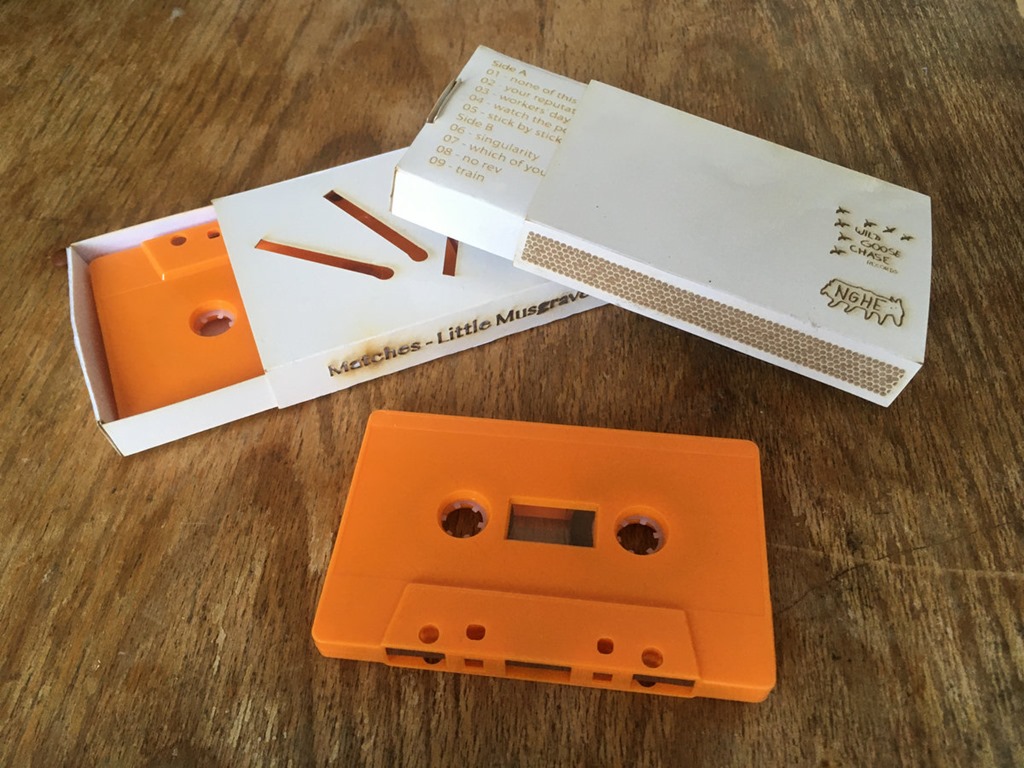
The app version stands in extreme contrast to the physical release, on cassette, a format that was on the brink of obsolescence over twenty years ago, and yet is still going, albeit with a microniche market. The chances are half the interaction with the format involves a hexagonal pencil or a Bic biro.

Nevertheless, it’s an intriguing exercise to witness the evolution of interactive art that strives to question and to redefine the role or artist and audience, as well as the notion of the ‘finished’ or definitive artefact, making this more than just something to listen to, even if only conceptually and for a certain portion of the audience.

AA

LRC001_front

Christopher Nosnibor

Digital release date: 18th December 2020

Physical release date: March 2021

Released as part of a series of collaborative releases between INA GRM and Editions MEGO, this is something of an unusual package, in that it’s presented as a split LP, but is also sort of two separate LPs. – digitally, they’re being released separately, but the vinyl version is split. Given the length of each contribution – in the 20-25-minute zone that neatly corresponds with one side of a 33rpm vinyl album – it makes sense, and certainly more sense than splitting a continuous piece in two over a 45rpm 12”, or the economics of a pair of one-sided albums.

Hecker – Florian, not Tim – contributes a work of ‘computer-generated sound with resynthesized situated texture recordings’. It’s a rumbling tempest of a composition, the crashing of digital waves against a hard shore of tightly-packed circuitry that rolls and thuds. A sonar pulse is rent by tinnitus-inducing drill-like whirr, and over the course of its twenty-five-minute exploration of toes and textures, Statistique Synthétique becomes quite a challenge – one that you may find yourself drifting from and struggling to maintain focus on at times, while at other wishing you could zone out a bit more instead of having an incessant buzzing and crackling piercing your brain.

I often find that with experimental instrumental works that do place such a strong emphasis on texture and that whole ‘cerebral sonic experience’ for want of a better phrase, that my mind does tend to drift while listening. It’s a challenge as a reviewer to critique something that’s so intentionally removed from the domain of overt musicality, or using a combination of music and words (or even not) to express or article something. Because precisely how does one engage with it – or, to consider another perspective, how is one supposed to engage with it? What does the artist want to convey to the audience, what kind of dialogue are they striving to create? Works like this certainly aren’t preoccupied with emotional responses or striking that kind of resonance that’s so integral to music with even the most vaguely ‘popular’ leaning. It’s not a matter of technical competence, at least in the sense of musicianship: there’s no breathtaking virtuosity on display in the world of electronics – and when I say ‘electronics’, I mean laptop and circuitry, not electropop or whatever. And so this is almost purely cerebral, and I’m forced to reflect on the way certain sounds, pitches, frequencies, and textures make me feel, what they do to me – how much treble and fizz makes me tense, how much s just quite exciting. Here, Hecker pushes all the buttons, literally and metaphorically, and I find myself twisting and turning in varying degrees of discomfort.

The objective, apparently, is to stove got ‘a properly hallucinatory state, that is to say to a meeting point where the object and perception dissolve into each other, in a sort of transcendental field.’ I might not quite be reaching that peak, but it certainly has some kind of effect.

Okkyung Lee gives us howls and yowls and overloading circuitry that bleeps and barrels, and of the two pieces, it’s the sharper, and more abrasive, and is also perhaps less nuanced. That’s no criticism: there’s a dense roar that tears from the speakers and there’s a tangible sense of volume. Everything creaks and groans and stammers, as if the equipment is about to buckle and blow under the weight of so much noise all at once.

This fits in context: Teum is intended as ‘a truly telluric moment’, the expression of ‘where tectonic movements and shear stresses become music’. ‘If the earthquakes were, as we thought in the 18th century, due to underground thunderstorms,’ observe the liner notes, ‘there is no doubt that this piece of music, both celestial and continental, could have been their audible manifestation’.

And there is no question that this is a musical work with a strong sense of physicality. The sound veritably heaves and shudders, a gut-lurching low-end heft you feel as much as you hear.

There’s a lot going on here, and there are – so it seems – some wild brass explosions rioting in the distance at some point amidst the churning sprawl. Again, this isn’t about emotional resonance, but how it touches and effects the listener on other levels.

These two works are distinct and different, both sonically and intent and purpose – and consequently, their effects are different too. But equally, the difference can be attributed to the different forms, and textures, with Hecker’s composition being sharper, more abrasive and, I suppose, more overtly ‘computerised’ than the denser, earthier piece by Lee. But for this, the contrasts are complimentary, and the two sit side by side and back to back nicely, and make for a perfectly-pitched double dose of discomfort.

AA

a3134891178_10

Front and Follow – F&F064 – 30th October 2020

It’s taken me a while to get around to this, the fifth and final instalment of Front and Follow’s lockdown fundraising compilation series, Isolation & Rejection, as the last couple of months in particular have found many, including myself in a weird lockdown limbo: schools are back, but I’m not back at the office for the day-job, and regular social activity remains more of less off-limits, even here in tier 2 York. So, not really an excuse, so much as an explanation f how work/ life balance hasn’t been entirely conducive to devoting the time deserved by a mammoth release like this, which certainly deserves more than a cursory glance and a few lines lauding the series’ quality to date and its having raised some £2,000 for The Brick in Wigan.

When I say ‘mammoth release’, Volume 5 contains twenty-four tracks, making a total of 115 tracks released across the whole series. And these aren’t all short efforts, and nor are they of a single genre, so taking this in isn’t like a set of two-minute three-chord punk tunes where the options are ‘yeah, no, ok’.

Yet again, the stylistic breadth, paired with the depth of quality is astounding, and given the open-door policy that was the criteria for this series – namely that submissions must have been previously rejected for inclusion elsewhere – it just goes to show how many remarkable artists there are out there. While there have been some curious and oddly-matched contributions in the mix, it’s fair to say that despite the acceptance of all submission, there hasn’t actually been a duff track in the entire series.

Volume 5 maintains that record. That all important opener this time comes courtesy of Assembled Minds, whose ‘The Eerie Machine Hums a Barley Song to the Sun’ is a lo-fi retro-vibing easy listener in the vein of Stereolab, with all the analogue and some bendy discord to give its Krauty instrumental groove an additional twist. With ‘Mute’, Accidental Tones’ bring the eerie shit, with a dolorous loop of funeral bells, before A.R.C. Soundtracks introduce 80s drum machines to a deep post-punk synth drone, and what ‘Exhibit F’ lacks in duration is packs tenfold in density. It’s a pretty dark opening by any standards, but as a compilation…Not that compilations are never bleak, but there’s a certain expectation that they showcase a certain degree of accessibility: and maybe this is why so many compilations re only so-so: they’re designed with one eye on commercial appeal and drawing a broader audience. Because Front and Follow never even cast a glance at a broader audience and the premise of this series isn’t remotely populist, they’ve remained free to do what they do best.

Cahn Ingold Prelog’s ‘Dwieddon’ is a grainy mess of pink noise and static that crackles like the heavy patter of rain, disrupted by an arrhythmic beat that clunks along awkwardly at first, before a pulsating thud booms in with an incongruously dance feel, while Heat Evolution bring some glitchy, swampy pulsations and some big explosive blasts.

Detailing the entire contents of this would be a task beyond gargantuan, but for the most part this is a set comprised of glitchy oddities and grinding sonic earthworks, with dark, heavy atmospheres – das fax mattinger’s nine-and-a-half minutes of deep, shuddering drone is as much a physical experience as it is cerebral, while contributions from Isobel Ccircle and Jonathan Sharp also explore all the corners of dark ambience. There’s throbbing techno and heavy hip-hop on offer, too, but none of it’s especially gentle or kind. And in saying how dark it is, it’s worth mentioning the gloomy synthy goth of Johnny Mugwump’s ‘the mirror cracked’ and the impenetrably dense black metal murk of Petrine Cross’ ‘Absorbed in Artificial Night’.

If Isolation & Rejection Vol 5 explores a quite focused part of the sonic spectrum, it does so in the kind of detail that reveals its breadth, with all shades of electronica and all shades of darkness and shadow covered in its immense span. It’s a strong end to a strong series, and while Front and Follow aren’t giving any indications that this is more than a one-off, there’s no shortage of back catalogue to explore while we wait for the next wave and, maybe, just maybe, the next collection.

AA

a2030166761_10

Panurus Productions – 25th September 2020

Christopher Nosnibor

The liner notes forewarn us of ‘a relentless free form noise rock onslaught from Dwindling’ with ‘Four tracks of wild soul purging absurdity extracted from strings, sticks and throat for your unsuspecting ears.’

But no forewarning could ever be enough to prepare even the most hardened fan of wild experimental noise shit for this frenzied sonic riot. Wretch – Memento is difficult to digest, and in the moment, it’s utterly bewildering.

Dwindling is Robert Glew (Drums), Giblet Gusset (Voice/Circuits), and Michael Waters (Guitar/Mix), and it’s a discordant cacophony from beginning to end. Mostly is a mess of feedback and clearing, clamorous arrhythmic percussion It all sounds like a drunken din, three people playing five different tunes all at once, all largely buried in feedback and reverb, at a rehearsal played in someone’s garage and recorded on a condenser mic on a 90s Walkman. The vocals are shrill, shrieking, demented banshee howls, ululations and barks, inhuman, demonic. Cathartic, and no mistake, but skin-crawlingly uncomfortable and otherly, it’s a sound that’s unsettling – that experience of unheimlich that unsettles the psyche – it’s identifiable as human, but it doesn’t feel quite human, and so instils a sense of unease that’s not readily articulable. Of course it isn’t: it’s that squirming, awkward sensation in your stomach that’s actually quite unrelated to the matter at hand. The tracks on here my well be a million miles from any sense of conventionality, but ‘Wretch – Memento’ takes discomfort to another level. Everything about it, from the impenetrable, tortured vocals to the nasty treble that never stops is uncomfortable.

‘Alphas Rind, O!’ is a mass of treble, wailing and ululating vocals pitched against a churning mess of noise, the sound of a kitchen blender and some ugly bass, and things get even more intense on the thirteen-minute ‘Axed RailKnell’, which in turn bleeds in to the seventeen-minute finale, ‘GARES’, a squall of noise that actually hurts.

It’s not hard to figure out how this found a home on Panurus: this is a label that trades in noise and has few limits, and if you’re on the market for extreme, Dwindling deliver it with Wretch – Memento. So who wants some more pain?

AA

a2577236056_16

Editions Mego EMEGO292 – 6th November 2020

Nineteen years on from the release of his first audio document, Russell Haswell’s latest effort is a typically wild collection of vintage synth sounds whipped into crazy cacophonous cocktail.

The objective titles of the release echo the statement on artistic commodity made by Public Image Limited on their 1986 release, which went by the titles Album, Cassette and CD (although technically, all three formats contain the album, making the vinyl edition something of a misnomer). In the digital age, and notably in the year which has seen UK vinyl sales hit a thirty-year peak, the format is an integral part of the experience.

As the press release notes, ‘12" channels the original role of the medium with 2 tracks of beats that present themselves in unpredictable ways. 12" also features the head shattering bonus cut, Always Check Their Instagram. LP cut at 33rpm allows explorations into broader territories with deep ambience running into twisted acid and splattered shapes bouncing amongst rapid fire rhythms’. The 12” single in the 80s and 90s did very much acquire a unique position, accommodating extended mixes and longer songs, and often an additional B-side.

That the tracks on 12" are exclusive to the format and not available on the digital release may deprive many listeners of the pleasure of three Haswell classics may seem rough, but on the other, is fair play, because context counts and the medium really is the message. Moreover, while I’ve amassed a hard-drive groaning with digital audio files over the last decade for review purposes, if I’m going to buy music, I’ll still always favour a physical format, despite increasing problems when it comes to storage, and, with vinyl, my medium of choice, actually getting to play it on account of the stereo and record collection being in the living room where the TV is, which is occupied by the family pretty much every waking moment.

So, for review I have just seven tracks, namely the set which comprises LP and Digital. In digital format, naturally: I tend not to get much vinyl in the mail for review these days, funnily enough.

The dark, dank rumblings of ‘Ambient Takedown’ register low in the gut, with heavy tones like a distant jet, and the sound hovers for a time that feels significantly longer than its two-minute duration. It does nothing to prepare the listener for the polyrhythmic drum-machine frenzy that of ‘r-809’, a ten-minute riot of tinny synthesised percussion which bounces along and around in hyperspeed. There’s a thrumming bass and insistent, repetitive squelching sound and there are moments when everything goes off all at once, and it’s as if someone dropped a match in a firework factory. It’s the first of two extended workouts, the second being the album’s closer, ‘End of Eternity’. It’s a sprawling mass of squalls and tweets, a foaming froth of sine waves and howling analogue torture that wows and flutters and goes on, and on, stopping, starting, fizzing and scraping churning and stammering wildly as it scrawls and scratches its way through the terrain of Power Electronics and headlong into an aural apocalypse.

In between, the remining tracks ae fairly concise, with only ‘The Bottom Line of Safety’ running past the five-minute mark. ‘Pulsar 2’ is an overloading crackle of noise, a wibbling modulation rendred unrecognisable by being cranked up beyond distortion: it’s the kind of gnarly mess one tends to associate with Haswell, and precisely what you’d expect from an artist who’s been a member of Consumer Electronics, both live and on record in recent years. If these pieces feel fragmentary, and vaguely frustrating in their lack of a firm form or obvious trajectory, then it’s fair to say it’s entirely intentional.

Some of it may sound like so much dicking about, but Haswell’s grasp on tonal contrasts – and beats – is firm: this is very much about exploration rather than entertainment.

AA

a3854325872_10

Panurus Productions – 4th December 2020

Christopher Nosnibor

Some of these experimentalists, they’re real buggers, you know. Awkward sods. Wilfully obtuse, intentionally unlistenable. Sindre Bjerga & Tanto sure as hell aren’t aiming for mass appeal on this absolute monster of a cassette release. In fact, I’d go so far as to suggest their primary goal is mass-alienation, because this is pretty fucking horrible. And it never stops.

Sindre Bjerga & Tanto’s collaboration contains two pieces which fill a C90. It’s an experimental mash-up, a cut-up, fold-in audio experiment that if not inspired by William Burroughs’ 1960s tape experiments, lots inevitably can be traced in terms of lineage and influence, conscious or otherwise. And for all the levity of the title, it makes for some seriously hard listening.

Amidst crackling fizz and stretched tape discord, there’s a warped, off-key rendition of ‘Don’t Cry for me, Argentina’, that’s buried in an underwater bubbling, a blur of blender nose and a mess of detuned radios. Shrieking feedback emerges and lingers on after grating clanks, and serrated droned, pulsing washed of analogue noise and sharp static blasts that cut through bubbling torrents and crude farting noises and a collage of contrasts and contradictions.

It becomes more challenging as it progresses: ‘Crashing Sonic Pepper Waves’ delves deeper under water and begins to take on the feel of a long underwater swim – the sound of a frenzied splash after being toppled overboard from a liner or destroyer. Beepling wipples fracture and disrupt a narrative of long, dark tones that rumble and scrape and intonate a truly post-industrial, post-apocalyptic soundscape – bleak, desolate, rusted, decayed.

If the first forty-five minutes feel like an endurance test then the second – ‘Tabasco Mist Prescription’ feels even more intensely so. What do you actually do with this? A masochist can enjoy it to an extent, and anyone with an appreciation of Throbbing Gristle and any of the myriad acts of all strains of genre style influenced by TG likewise. TG represent the closest reference here, with the heart of industrial music being less about the stylized appropriation of factory noise and the like than an attitude based on perversion of what was even considered ‘music’ delivered with a confrontational, antagonistic attitude – and Sneezing Waves From The Peppered Oceans is antagonistic, and then some.

35 minutes into ‘Crashing Sonic Pepper Waves’ is shrill blasts of treble are being amped up against all kinds of found-sound dissonance and difficulty, and it only gets messier, more brain-pulping with the messy murk of ‘Crashing Sonic Pepper Waves’. It’s unsettling, uncomfortable, and those are the compliments. It’s not even particularly dark, it’s just a nasty conglomeration of disparate sounds, collaged together to render something that’s uncomfortable, and never-ending, and quite enough to induce heartburn.

It’s good, but don’t expect to like it.

AA

a3254763830_16

Constellation Records share the eighth entry in their Corona Borealis Longplay Singles Series. "Je Vois / Non-Dit" by Montreal based avant-electronic artist Joni Void and featuring vocals by poet/singer and frequent collaborator N NAO, with an experimental film by Sonya Stefan.

"Je Vois / Non-Dit" combines live recordings by the duo into a single track longform where N NAO’s vocals are given unearthly yet organic treatments through Void’s warped manipulations, sampling, atmospheric textures and deconstructed beats – joined by Eddie Wagner on flute about halfway through the track’s 21-minute running time.

Listen to ‘Je Vois / Non-Dit’ here:

…and stream the video here.

thumbnail_JoniVoidimagebyThomasBoucherSonyaStefan2018lores

Photo by Thomas Boucher & Sonya Stefan, 2018

Human Worth- 26th November 2020

Christopher Nosnibor

This one’s been cropping up in my Facebook feed a fair bit lately, and I’m quite ashamed by how long it took me to get around to playing it, given the great work Human Worth do both in terms of music and charitable donations – plus the fact they’re decent guys who I’m proud to know. Shit happens, even in the midst of Lockdown 2.0 where it’s shit mostly because there’s only shit and nothing happens, and mostly it’s simply that there just aren’t enough hours in the day. In the event, it turns out the greatest loss is mine, because this album really is something else. How was I to know that this was the album I’d been looking for, that I needed in my life the last few months?

Given the pedigree of the performers who make up Cower – namely Wayne Adams (Pet Brick / Big Lad), Gareth Thomas (USA Nails / Silent Front) & Thomas Lacey (Yards / The Ghost of a Thousand) – it would be a reasonable expectation for their debut album to contain a fair bit of noise, but then equally, it would be reasonable to expect it to be a bit experimental, a bit electronic, and a bit weird. How do all of the elements brought by the component parts marry up?

The short answer is remarkably well, and Cower sound like all of the component pats simultaneously, but equally none, as they morph together to forge something truly unique, and also quite unexpected.

It begins in a pretty understated fashion, with ‘Tight Trousers and a Look of Intent’ following the path of a dense, woozy, but accessible dark electro tune. Admittedly, that pulsating bass throb is something you could drown in, but the incidentals and the vocals are quite accessible – although all hell breaks loose just halfway through and it’s wild. Initially, I was inclined to say that as an opening, it was ‘tame’, but that would be unjust: restraint isn’t an indication of weakness, but of controlling the beast. But then, when the beast breaks loose… ‘Proto-Lion-Tamer’, brings the noise, and does it in proper full-on style, a squalling, brawling mess of din – old-school noise merchants like The Jesus Lizard are in the blender with contemporaries like Daughters and Blacklisters to whip up a nasty maelstrom of noise.

Tribal drumming dominates the bleak, eerie soundscape of ‘Arise You Shimmering Nightmare’, while the downtempo mid-album slowie, ‘Saxophones by the Water’ finds them coming on like Violator-era Depeche Mode, and this trickles through into the next song, ‘Midnight Sauce’ that combined a rich, soulful vocal with some chilly synths and blasts of percussion-led noise and cinematic drama that goes fully 3D, to the extent that it gives JG Thirlwell a run for his money.

If BOYS pursues a dark, brooding, electro road as its dominant style, it’s the album’s range and diversity that is its real selling point, and the songs are all far darker than most of the titles suggest. And if much of the album feels pointed, challenging, ‘For the Boys’ is outstanding in its emotional sensitivity. Closer ‘Park Jogger’ in particular sounds like it might be light, even vaguely comedic by its title, but no: it’s a colossal electroindustrial behemoth tat packs some seriously pounding force into its short running time.

With BOYS, Cower surprise and excel: the quality of the songs is remarkable: there’s a real sense of everything having been carefully crafted for accessibility, to the extent that this is actually a pop album – making for the darkest, heaviest pop album you’re likely to hear in a long time.

AA

COWER_BOYS-CoverArtwork

Gas Lit is the new album by the multidimensional duo Divide and Dissolve, incoming on Invada Records on 29th January, and produced by Ruban Neilson of Unknown Mortal Orchestra. The album is preceded today by the second single and powerful video “Denial” which encapsulates their message behind the music: to undermine and destroy the white supremacist colonial framework and to fight for Indigenous Sovereignty, Black and Indigenous Liberation, Water, Earth, and Indigenous land given back.

Divide and Dissolve’s mighty new single “Denial” is a potent blend of ominous and unsettling sax that blows wide open into colossal riffs for almost eight glorious minutes. The accompanying video was shot in Taupo, Aotearoa by notable indigenous music video director Amber Beaton at the end of the southern hemisphere’s winter.

The vibrant, unfolding colours and delicate personality of the flowers at the beginning of the film have the potential to be in contrast with the intro of the song, but it’s actually escorted by it perfectly. It’s further varied with the colossal boom signalling the arrival of the guitars and drums while visually we start to explore the thermal grumblings of the Taupo volcanic zone. We follow the Huka falls/Waikato awa (Waikato river) up stream to settle into Taupo-Nui-A-Tia moana (Lake Taupo) as the return of the sax lulls us gently after being nourished so generously by Divide and Dissolve’s signature gargantuan tone. Thanks are given to the local Iwi\tribe Ngāti Tūwharetoa, the rightful guardians of the whenua/land and to Rūaumoko the god of volcanoes, earthquakes and the seasons.

Watch ‘Denial’ here:

AA

thumbnail_DivideandDissolveimagebyBillyEyersloresforannounce

Divide and Dissolve image by Billy Eyers

Pelagic Records – 20th November 2020

Christopher Nosnibor

The Swedish quartet’s fifth album finds them freely drawing on myriad genre references to conjure a cocktail that extends far beyond even the broadest perimeters of post-rock to render this a truly hybrid work. The scale of the ambition is immense, and for a band who rarely spent time together and only rehearse ahead of tours or to write and record albums, the way they’ve drawn everything together so organically is remarkable.

The title is quite fitting as they swing back and forth across the forms and styles, with a brooding electroambient introduction in the form of the title track which builds by stealth over the course of seven and a half minutes to a grand-scale swell of cinematic hypnotism with rolling drums driving a cyclical synth motif.

‘E22’ brings the guitars to the fore and is more overtly conventionally post-rock, but it’s got a certain progressive edge, not to mention some weight, breaking into some hefty bass-dominated riffage around the five-minute mark. There’s a pace-rock / psyche twist to ‘Mindtrip’, by far the album’s most accessible and buoyant tune, and it contrasts with the altogether more tense ‘Shelter’, which emanates a simmering tension. The absence of vocals actually accentuates the mood and renders it all the more relatable, as the listener pours the emotional contents of their own experience into the empty vessel the band present.

This, for me – and doubtless for many, having attended countless instrumental post-rock shows in the decade spanning 2002-2012 – is the draw of the genre, at least when well-executed: post-rock presents sonic expanses without authorial steer, without any insistence on specific meaning, leaving the listener to fill in the spaces. And with vast, expansive spaces in which to wander, into which to pour one’s thoughts and experiences, this is music that opens its arms to a world of freedom.

They don’t do short songs: Oscillate only contains eight tracks, but only two of those clock in under six minutes, and the final pairing of ‘Eraser’ and ‘The Headless Man’, both of which extend well past the eight-minute measure. The first of these is a dynamic rush of a tune, with propellant drumming and a solid bass throb, while the second is a redemptive sunburst of a tune, the light of dawn breaking over the horizon.

Oscillate is a strong set, and the album will indubitably appeal to fans of MONO, Explosions in the Sky, and Godspeed You! Black Emperor, but in context, comparisons are reductive: this is an album that stretches far wider than its influences and is truly impressive in its breadth and scale.

AA

a2086206515_10