Papillon de Nuit’s latest single, ‘Frozen Charlotte’ recently got a straight-up rave review here on its release just over a week ago. They’ve since released a magical, haunting video to accompany it. Check it here:
AA
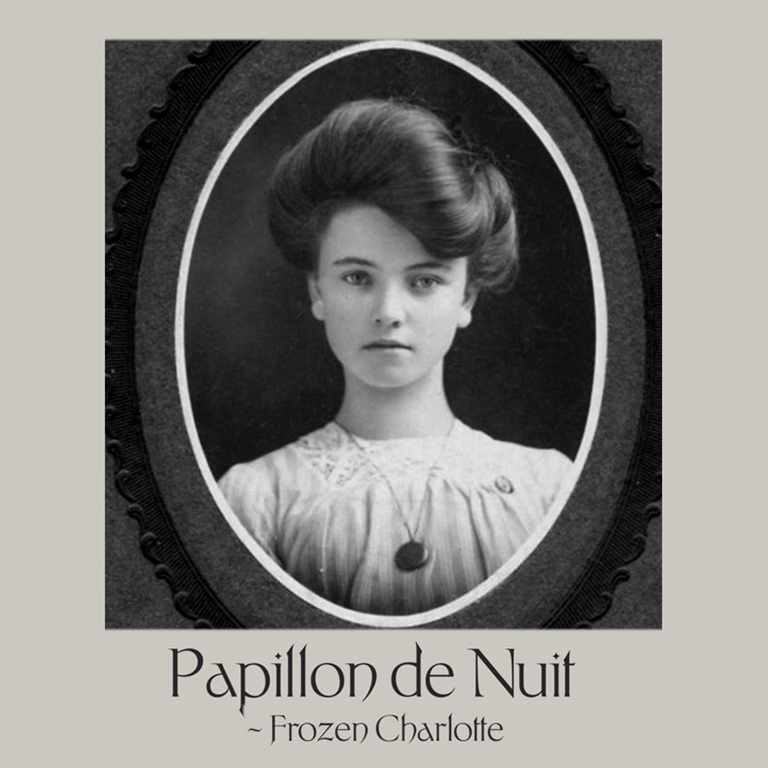
Papillon de Nuit’s latest single, ‘Frozen Charlotte’ recently got a straight-up rave review here on its release just over a week ago. They’ve since released a magical, haunting video to accompany it. Check it here:
AA
After rising through the ranks steadily from their 2014 album Distorture through to 2017’s Invidia record and following a series of EPs and singles, alternative rock hybrid outfit Ventenner return with new EP Slow Dissolve on 31st October (Athanor Records). Known for flawlessly blending metal, atmospheric electronics and doomy riffs, this latest release marks a new era for the band, following a number of years of major changes and upheavals. Though the concept of change has been a constant theme that has run through Ventenner’s music. Frontman Charlie Dawe comments,
"A lot of my music over the years has centered around the idea of something ending and something new beginning. There’s always been a strong theme of death and rebirth in the approach. These were normally restricted to the lyrical themes and to a personal level, this time however it was more about the band as a whole and a concept.
We had got to a good point by the end of the decade. Our 2017 album Invidia had been a success, so had the subsequent singles we released in its wake. It had opened doors to big shows and big tours, management, a publishing deal, tipped as the next big thing etc etc. After the lockdown, we had some key line up changes that didn’t end on good terms, and I spent the following years releasing Ventenner albums and EPs with fellow long time member Luke Jacobs. But the way things were, the industry was on pause still, and our momentum had stalled."
Despite those releases being some of Ventenner’s best work to date, it all came to a head in 2023, with their first step on to the stage in 4 years. Charlie explains,
"The newly joined RomyBen-Hur and Ted Nieddu, both on guitars and backing vocals, came along for the trip and musically it was great. The tour was fun, the people who came said we were on our A game, but it was stressful and difficult and without the support of our agent (who had quit the business in covid) it wasn’t a success. Personally, my life was in a similar situation. Having made some difficult decisions to move on from people and things, done the therapy thing, I had no idea where I fit in to music any more, if Ventenner was still a thing or ever would be, generally an existential crisis and cataclysmic shift on every level.”
After nearly 20 years in London, Charlie admitted defeat, closed his record label and moved to the wild coasts of Rural Suffolk. Away from the pressures of living in the capital, he got sober, ran in the woods every day, immersed himself in a burgeoning career as a film score composer and thought that maybe, that was it…. Charlie adds,
"We had put out an album in 2024, Exit Manual, which was the most startlingly apt title I’ve ever come up with for what I and the band were going through at that point. For me it was probably a swan song and it was time to bow out, quietly and without applause.
At some point, whether it was the newfound clarity and productivity, the letting go of negative elements, or just being away from everything and being ‘on the outside’ of the industry, something just sparked. I had a few things left over from the previous album sessions that didn’t fit, and some ideas I had from a side project called Last Sign which never really came into full bloom. So I started writing for Ventenner again, not because I thought I had to or I had something to prove like the last 10 or so years, but just because I wanted to. I had been writing a lot out here, both for solo work and soundtracks, and it was flowing easily. The long drawn out slow dissolve of the last 10 years was not the demise I had thought it was, rather just a very gradual reveal.”
The results are the Slow Dissolve EP, now once again a solo project with Charlie handling all the music and vocals, this is the sound of an artist refreshed, refocussed and reenergised across 4 new tracks of dark heavy rock & metal, underpinned with atmospheric textures. Essential listening for fans of: Nine Inch Nails, Filter, Smashing Pumpkins, Deftones, Failure, Tool & Massive Attack with Cold in Berlin vocalist makes a guest appearance on ’Sway’.
Today sees the release of first single ‘Ultraviolet’ which according to Charlie, “is about examining things close up. Things that are only visible under a certain light, but are there all the time and affecting everything we do. This song, and this record, is about finding the hidden reason in our actions. Things that wanted to stay hidden for our own protection, but need to be uncovered if we ever want to move forward.”
Listen to the track now:

Metropolis Records – 8th August 2025
Christopher Nosnibor
The singles released ahead of the album did their job, at least for me, in the way it used to happen in the pre-Internet days, when you’d hear a single or two on the radio, and you’d get hyped for the album.
Half the time, the singles were the only tracks that were any good, but the other half of the time, the singles would actually prove to be representative and stand in a solid set of songs.
In this instance, the title resonated early. Perhaps it’s an age thing. In my 30s, I witnessed many of my peers somehow pass into middle-age overnight, bemoaning that there’s no good music anymore, how things aren’t how they were when they were between the ages of 16 to 21, how everything’s shit now and the nostalgia-wallowing would grow deeper with every beer consumed. As I approach fifty, it’s only got worse: many of us have teenage kids, and many of them go on about how the music their kids listen to is shit, it’s just noise, how their kids stay in bed till lunchtime at weekends and on school holidays, and so on. It’s as if the grind of the day-job and family life has erased their memories of what it was actually like being a teenager. It’s broadly true that people become more conservative as they grow older, and, despite the vehement intentions stated in youth, they become their parents, one way or another, perpetuating the same mistakes, while blaming their parents for the fact. This is but one example of the way people do have a tendency to become the thing they hated, but one which is close to my heart.
Right now, the world is almost unrecognisable from the one I grew up in, but instead of fighting the system and pushing for positive change and a more just society, greed, division, and hate have become evermore ingrained.
They open in grand style, with a smouldering six-minute epic in the form of piano-led ‘All Tomorrows’, which builds slowly and creates an air of wistfulness, of reflection, before hitting a solid upbeat dance groove. But as it ends, tomorrow is marked by departure, ending, alone. Across the course of fourteen songs, Rotersand explore the human condition in all its complexity, all the while dusting solid dancefloor-friendly tunes with a deep melancholy, their dark electropop leaning towards more industrial dance at times, as on ‘Father Ocean’, and ‘Watch Me’ particularly mines that late 80s / early 90s Wax Trax! vibe – while the use of autotune and the overall production firmly roots it in Europop territory. Elsewhere, ‘I Will Find You’ rolls up the entirety of electropop circa 1983-85 into a magnificently crisp four and a half minutes.
Unusually, the singles are both to be found in the second half of the album, but this is perhaps an indication of the consistency and depth of the material: while many albums suffer from a second-half slump, Don’t Become the Thing You Hated gets harder and more intense in the final third. ‘Private Firmament’ is a clear standout when it comes to dark intensity.
And so it is that Don’t Become the Thing You Hated is something of a caution, a reminder, a note to self, and it’s heavy with simmering anger – anger and twisted emotions directed in all directions, far and wide outward, and inwards, too. ‘Click Scroll tap Believe ‘ is a particularly taut listening experience and succinctly summarises life in the contemporary climate: ‘Technology the new religion / The lines between us are wearing thin’ may not be the pinnacle of poeticism, but it hits home. And that, really is the strength of Don’t Become the Thing You Hated: Rotersand zone in and hit their targets with a rare accuracy, again, and again.
AA
AA

Leeds collective HONESTY have shared a brand new track titled ‘PUSHING UP DAISIES’. George Mitchell takes lead vocal duties, delivering a gentle, intimate performance that contrasts the song’s morbid subject matter. The result is a subtly exhilarating take on club music that’s become HONESTY’s signature and the reason they’re one of the most essential dance acts coming out of the UK. The track was released today in tandem with ‘MEASURE ME (ALT MIX),’ which injects even more rave-fueled vitality into the lead single from their debut album which came out this Feb, this time led by an ethereal performance from vocalist Imi Marston. Listen here:
AA
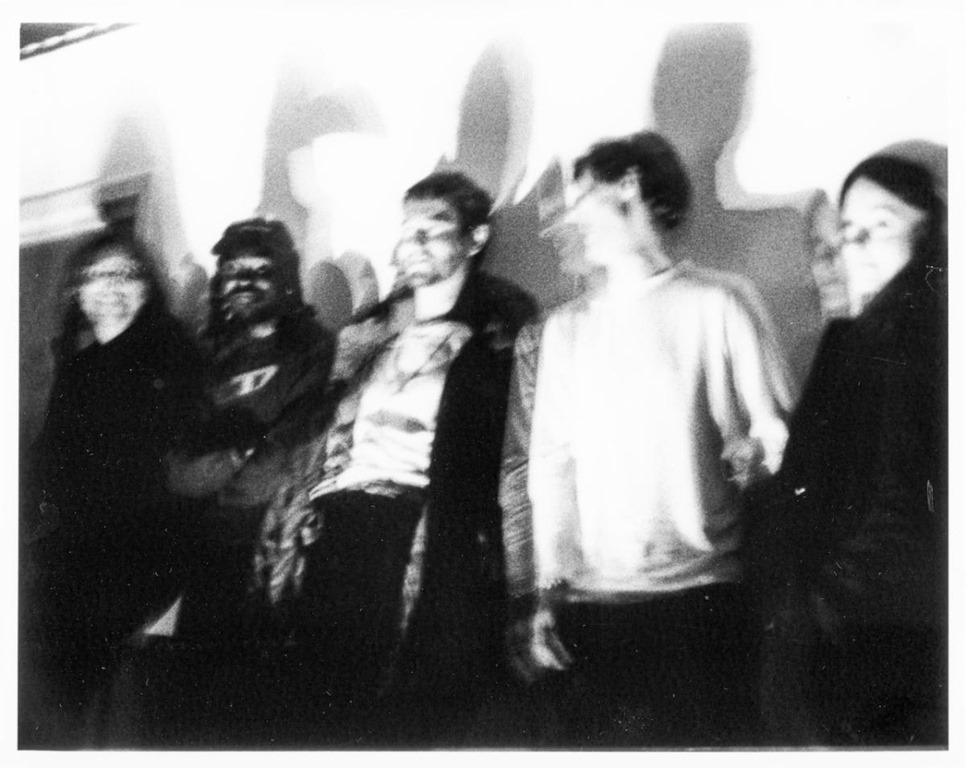
HONESTY (Credit Dan Commons)
COVENANT announce the release of the new Andreas EP. The EP is dedicated to the memory of Swedish band’s former member Andreas Catjar-Danielsson (March 3, 1973 – July 29, 2024) who sadly passed away from cancer on this day one year ago. All proceeds of Andreas EP will go to charity in benefit of his wife and children.
Dependent Records will waive all proceeds from the vinyl EP in contribution to this important charity.
In further news, COVENANT present the track ‘Winter Kills’, a cover of legendary British synth-pop duo YAZOO, as an advance single taken from the Andreas EP. You can hear it here:
AA
FÏX8:SËD8 present the hard-hitting track ‘New Eden’ as the first single taken from the forthcoming sixth album of the German dark electro act: Octagram has been scheduled for October 3, 2025.
AA
AA
FÏX8:SËD8 comment: “The song ‘New Eden’ comes with an epic buildup that is almost reminiscent of 70s progressive rock – just executed with electronic means”, mastermind Martin Sane explains. “I am particularly happy how the lyrics turned out and also with my vocals that change style several times over the course of those 8:45 minutes until it all culminates in an epic finale. The length of ‘New Eden’ is also not accidental but rooted in an ambitious concept that structures the whole album. Each of the 8 songs on Octagram consists of several different parts and is 8 minutes long. They were not created as ‘extended editions’ of shorter tracks, but every song follows a meaningful dramatic composition, with huge introductions, changing drum patterns and time signatures. I went to great lengths to ensure that nothing appears just stitched together but rather comes seamlessly fused into one complete piece – and admittedly to even my surprise: it finally worked out!”
AA
Negative Gain Productions – 25th July 2025
Christopher Nosnibor
It’s been three years since Curse Mackey delivered Immoral Emporium. Three years may not be a long time, but a lot can happen in three years – and it has. And very little of it has been good. There has always something about industrial music – something I’ll unpick in a moment – which has displayed a sense of the apocalyptic, to the extent that at times it seems to almost bask in it. And that is not a criticism. The end is nigh, and while it’s always a question of ‘when’ rather than ‘if’, we seem to be ever closer to the brink of total annihilation. These are dark times, which call for dark music.
Industrial has come to mean many things, in terms of musical forms over the years, while Throbbing Gristle were the progenitors of all things industrial, technological advances saw acts more interested in pursuing more structured works with tape loops and drum machines, eventually giving us the more electro-orientated strain of industrial that became synonymous with Wax Trax!, and, subsequently, industrial metal, not least of all due to Ministry’s evolution from one to the other. Curse Mackey’s work very much belongs to that late 89s / early 90s Wax Trax! domain.
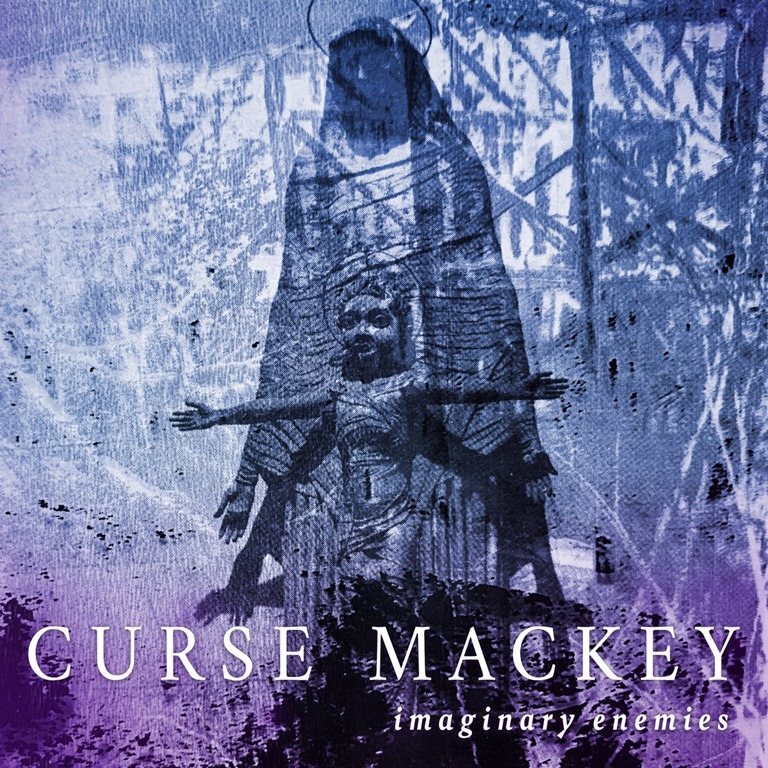
Concluding the trilogy which began with 2019’s Instant Exorcism, Imaginary Enemies promises to be ‘his most intense and intimate album to date… A bleak, beautiful meditation on paranoia, grief, and the ghosts we conjure from within’.
And so it is that the listener is lead into the album by route of looped samples, layering across one another, before a pounding beat crashes in, and Mackey, accompanied by a low, thumping synth bass groove, sets out his stall with ‘pressure points’, ‘psychosis’, and ‘decay’ delivered with a processed growl. There are many layers to the arrangements, creating simultaneously an expansive and claustrophobic feel. Single cut ‘Vertigo Ego’ swiftly plunges into darker, denser territories: brooding and ominous, Mackey’s vocals are a barely audible whisper. It sounds tormented, stressed, anguished.
AA
If ‘Discoccult’ and ‘Time Comes Clean’ (which calls to mind early (electropop) Ministry and Trudge era Controlled Bleeding) find us in fairly familiar industrial territory, something about the production imbues the material with a suffocating intensity. More often than not, there’s a brightness, a crispness, something of a ‘digital’ cleanness about the genre. In contrast, the sound here is murkier, more ‘analogue’ in feel, alluding to eighties synth music – something I’ve never been quite able to pinpoint as a listener and critic rather than a producer.
One can reasonably assume that album centrepoint ‘Blood Like Love’ makes a reference to Killing Joke’s ‘Love Like Blood’, even if only in title, but sees Curse lean towards gothier territories, stark, brooding, yet ultimately layered, graceful, with synth melodies and dramatic piano weaving around the samples and mechanised beats.
AA
The second half of the album locks into an atmosphere that’s less aggressive and attacking, and more brooding, moody, and introspective, and as such, marks a clear departure from its predecessors. What’s more, it works well, with the more uptempo title track marking a high point in the album, sitting comfortably alongside some of the more contemporary goth classics with its nagging, reverb-heavy guitar line and pulsating bass all held together by that classic, relentless, drum machine sound.
For my money, it’s Curse Mackey’s best release to date.
AA
Saccharine Underground – 1st July 2025
Christopher Nosnibor
This one hell of a hybrid. Just when you think post-punk has been explored to the point at which it has been hollowed out, exhausted, and has only well-worn and instantly recognisable tropes to offer, along come Washington DC’s Zabus, purveyors of avant-garde post-punk with an EP which is something of a ‘best of’ with tracks from their two recent albums, Automatic Writhing (September 2024) and Floodplain Canticles (January 2025), plus a new track which paves the way for their next offering Whores of Holyrood (due in August).
With its immense, reverb-laden sound and expansive, drifting desert-like soundscape ‘Grafhysi Fyrir Alla’ makes four and a quarter minutes feel like a hypnotic span of double that duration. The shuffling bass and big, booming bass are pure dub. The guitar chimes and floats into the ether as everything swashes around in a huge echoic pool.
Of ‘Grafhysi Fyrir Alla’, lifted from last year’s Automatic Writhing, project founder and focal member Jeremy Moore says it’s about “the societal imposition of unobtainable standards of beauty, and our obsession with physical perfection at the expense of true happiness”. This is certainly not a case of style over substance, but a coming together of musical inventiveness with a level of intellect which is rare. “Psychopathologies like body dysmorphic disorder, at the extreme, can lead to a path of ruin, if most of your life is spent chasing a ghost—what you believe the world wants you to be. Death doesn’t discriminate. The end is always the same.”
This is some pretty heavy – and dark – philosophy on offer here, and it’s welcome: as much as there is much to be said for the benefits of the escapism music can offer, there’s equal solace to be found in art which articulates one’s own world view. And so it that that Zabus portray contemporary dystopia from a range of camera angles.
‘Orphalese’ is more uptempo and is decidedly cinematic with its broad-sweeping layers of synths driven by propulsive, rolling drums. There’s no verse / chorus structure, but instead a hypnotic expanse of sound, the aural equivalent of standing on a summit and looking out at a three-sixty horizon through a heat haze. It’s immersive, utterly absorbing, and transportative.
The first of the tracks lifted from Floodplain Canticles is the six-minute ‘Tearful Symmetries’, which is low and slow, Jeremy Moore’s reverb-drenched baritone croon approximating the late, great, Mark Lanegan against a dubby backdrop punctuated the clangs and scrapes of guitar drones and sculpted feedback. ‘This is the end….’ He reflects, but not with sadness or panic, but a sense of inevitability.
‘Golden-rot’ goes all out for the theatrically gothic experience: it’s as big on drama as it is on sound, as an insistent mechanised drum beat pounds away, cutting through a smog of murky guitar and thick, booming bass, and if I wasn’t already perspiring hard from the humidity and thirty-degree heat, this would make me sweat, with its tension and crackling energy.
And so we come to the title track, the first taste of Whores of Holyrood. It’s different again, although the cavernous reverb is a constant. This cut is a brooding piece that borders on country, once more evoking the spirit of Lanegan. It’s spacious, but its intensity brings an almost suffocating weight.
Shadow Genesis provides a perfect introduction to Zabus, and at the same time whets the appetite for what’s to come. And let me tell you, it’s something to get excited about.

Dark Scrotuum – Rotting Dream
Cruel Nature – 27th June 2025
Christopher Nosnibor
As the label recently hailed in its midyear roundup, Newcastle-based cassette label Cruel Nature has put out some forty releases so far in 2025, which equates to one every fortnight. It’s no small achievement, particularly considering that not only are they essentially a one-man operation but they’re hardly mainstream in their output – and what’s more, that output is remarkably diverse. More often than not, niche labels adhere to a fairly narrow range, whether it’s black metal, indie, or experimental in nature: they know their audience, and cater to them, knowing they will shift inventory. Cruel Nature takes a different approach, which isn’t without risk, in that they release music they feel meets a standard based on quality rather than style, meaning that label collectors may not love everything – at least at first – but will be introduced to stuff they wouldn’t have otherwise listened to, and fans of given bands or styles will make discoveries by association.
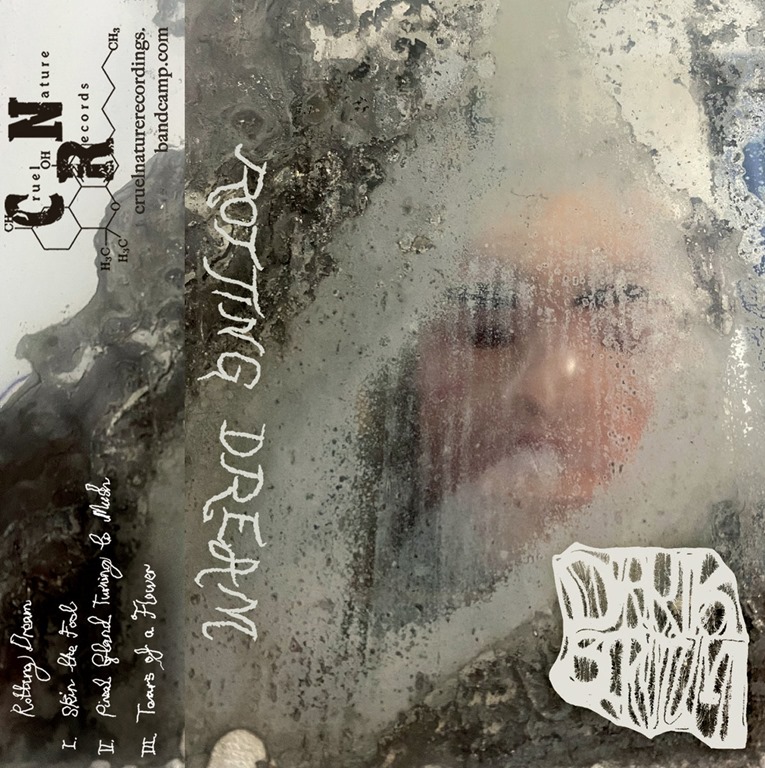
And so we come to Rotting Dream by the wonderfully if somewhat crassly-named Dark Scrotuum. You know before you hit play that whether it’s black metal or power electronics, it’s probably going to be pretty nasty, right? Right. It’s pitched, quite succinctly, as ‘crushing dark ambient BM drone sludge noise’. BM could as readily be taken in the American sense – bowel movement – as black metal here. And believe it or not, that’s not a diss. Anyone who’s familiar with Aural Aggravation will be more than aware that heavy shit is our bag, and specifically my bag. And this is some heavy shit, bowel-trembling, uncomfortable, heavy shit.
The first of the three tracks, ‘Skin the Fool’, is seven and a half minutes of earth-shifting, stomach-churning dark ambience with a growling, grumbling industrial edge. It’s dark, and it’s heavy, a constant, heavyweight rumbling, the sound of destruction, of desolation, like slow-motion detonation. The first three minutes alone are utterly harrowing, and then, from nowhere, it goes nuclear, a churning blast of noise so dense it hurts, an extended billowing explosion that replicates the impact of Threads. Game over? Life over. Existence over.
Dark scrotuum? Tense and shrivelled scrotuum is the initial reaction to this brutally harsh work. ‘Pineal Gland Turning to Mush’ is ten minutes of tension, meaning the track is appropriately titled, barrelling into a relentless wall of harsh noise. It’s not quite HNW because there is texture and variation over its duration… but fuck. It’s abrasive, obliterative. I find myself sitting here, sweating, wide-eyed, uncomfortable. This is… intense, alright. It hurts.
And then, there is ‘Tears of a Flower’, the harshest heaviest, most explosive cut of the three. Toss Sunn O))), Prurient, Swans, and Vomir together and you’re about there. It seems that Dark Scrotuum have pulled together everything – and I mean everything – they can conceive to create the nastiest, most overloading wall of noise possible. ‘Tears of a Flower’ is a punishing, brutal sonic assault which offers no respite, only more pain, and more pain and more pain. And you feel it. There is not one fleeting moment of kindness, no respite. This is music to puke to as you feel your eardrums collapsing and your soul shrivelling. As for our dream…it’s over.
AA
The Helen Scarsdale Agency – 23rd May 2025
Christopher Nosnibor
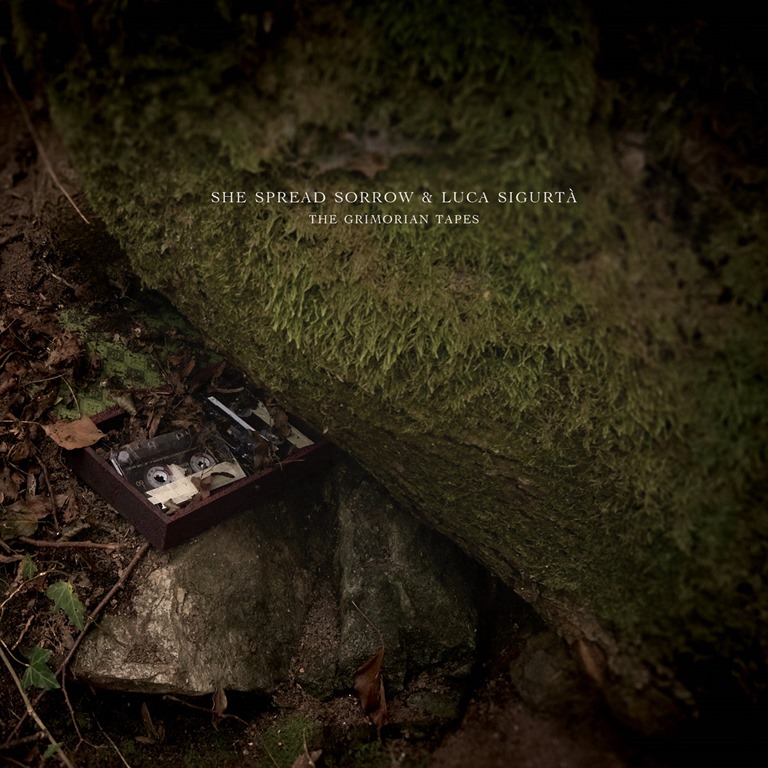
The pitch alone is harrowing: ‘“Don’t be scared by death,” Alice Kundalini (aka She Spread Sorrow) calmly instructs at the beginning of her collaborative Grimorian Tapes with partner Luca Sigurtà. Her words slither from her lips with a subtle, sinister unease, compounded by the unsettling quality of her whisper. The fear of death, this most profound condition, has long been a subject of philosophical, spiritual, and existential inquiry. To fear death is undeniably human; to transcend that fear is often seen as reaching a higher plane of existence. At least, that’s the intention behind the rituals, the spells woven into the fabric of The Grimorian Tapes.”
I myself have spent a lot of time contemplating death, and the fear of death, especially of late. We are all scared of death, particularly in Western culture. When my wife was diagnosed wit stage 4 breast cancer, where it had spread to her bones, I was terrified, not only of losing her, but of waking up to find her dead in the bed beside me. What do you do in that situation? I did not want to see her dead, and she did not want me to see her dead. Thankfully, she made it to a hospice for her last day, but I lived for a year under the shadow of that ‘what if…?’
You might think that her passing brought peace, but it did not: instead, I have spent many mornings twitching and drenched in sweat lest I should die and leave our daughter an orphan, being thirteen. This is not a call for sympathy – simply as summary. It’s hard not to be scared by death, inevitable as it is.
For additional context, it’s worth delving into the details of the album’s inspiration, a large portion of which comes form The Black Pullet, ‘an 18th-century French grimoire filled with instructions for making talismans and magical artifacts’. We learn that ‘Kundalini weaves her own take on the book’s esoteric themes into the shadowy tape loops that comprise The Grimorian Tapes. The Black Pullet is a detailed guide into alchemy, divination, and occult practices, with a particular focus on harnessing hidden forces through the construction of specific objects imbued with magical power. Though Kundalini doesn’t practice these rituals per se, she finds a deep, poetic resonance with these ancient teachings. The allure isn’t in the performative aspect of these rituals but in the seductive power of its symbols and ideas, which speak to a long-forgotten language of metaphysical mystery. It’s this sense of transmutation, hidden knowledge, and occult wisdom that lends The Grimorian Tapes its dark, ritualistic intensity.’
And so it is that ‘grimoire’ introduces the album with a dark etherality, whispered vocals, the words indecipherable. Echoing amidst rumbles and a persistent drone which ebbs and flows. It’s compelling, and enticing, but at the same time, unsettling. It’s the fear of the unknown, of course: the esoteric and other-worldly and anything that speaks of a realm beyond one’s ken is always difficult to assimilate. This, in a nutshell, is the appeal of horror, because a lot of us find entertainment in being scared. It’s the same reason people go on rollercoasters. Being scared half to death reminds you that you’re alive. And The Grimorian Tapes is pretty scary, in the suspense and horror sense.
‘initiatory’ rumbles and hovers dark and murky, sonically entering the domains of Throbbing Gristle, and again, the whispered vocals are menacing, and reminiscent of Prurient’s Cocaine Death, while ‘the stairs’ brings a hint of disturbing playground, psychological derangement, the other ‘other side’ we’re all so afraid of due to a lack of comprehension. And the further this album progresses, the more uncomfortable and unsettling it becomes, the further it extends beyond the domains of the ordinary, the mainstream comprehension.
‘babele’ is a dank, muddy morass of sound over a slow thudding heartbeat rhythm, while ‘kirtan’ brings flickering, stuttering beats, while again leading the listener through hair-prickling terrain, with triffid-like stem-clattering and gloomy swirls and abstract vocals. ‘we worship you’ plunges deeper into a darker space, with sputtering electrostatic sparking, and gargled vocals, deep and robotic, growling, threatening and emanating from another place, another world, one beyond reach. ‘me and I’ churns like slow machinery, and is industrial in the primitive sense. Again, the way we have come to understand ‘industrial’ has evolved: Foetus is a far cry from Throbbing Gristle, and both are a world away from NIN and Ministry. But The Grimorian Tapes takes us right back to the origins of the genre.
This is one dark and difficult album, heavy and suffocating and uncomfortable from beginning to end. Two thumbs up. And now I need to lie down.
AA