The context for this, the debut release from Ergocaust, is in some ways an uplifting tale, whereby something positive emerges from a bad situation. They explain that the track was ‘Composed the day I got fired and refined until I made peace with reality, this song was forged out of blood, sweat, tears, hunger, and misery.’
The wheels of capitalism drive our lives, and we have simply no choice in the matter. Hate your job? Tough shit. Suck it up. You’re expendable, and easily replaced. Labour is cheap, and so is life, and not just to the highest echelons of society, but even to lower-level management. They’re only interested in the stats, and will do anything to save their own arses when under scrutiny by the next level up… and so it goes on up the hierarchy. The bottom line is about profit, and survival, and the person above you does not give a fuck about how you pay the rent or feed your family. It’s about how they pay their rent and feed their family, and how they can make cuts to boost their own bonus.
As Ergocaust writes, this ‘encapsulates the idea very neatly just by the title’. It’s fairly direct, and puts an emotive, anguish-laden spin on the notion that under capitalism, workers are confronted with the contradiction of producing and reproducing the conditions of their own alienation. Never mind religion: work is the opium of the masses, whereby the workers are too busy earning a crust and too exhausted from doing so to rebel. The reason everyone is trapped on the hamster wheel is that as much as you hate your job, you need to work to survive. You want out of the hellish job, but to be released from the hellish job is to wonder how you will survive. There are no options.
Ergocaust channels a host of conflicting emotions by the medium of a song with a complex, detailed structure, which draws together a range of musical styles, spanning black, thrash, and industrial metal to forge a compelling hybrid. The fact that its instrumental is perhaps an asset. Articulating complicated and conflicting emotions is something which, all too often, words fail to achieve: in such instances, the language of sound and the power of music serves the purpose more effectively.
It may clock in under three minutes, but ‘Souls In Pain At Work’ is dense and it speaks – by which I mean, it howls anguish, rage, pain. But therein lies beauty and joy, in that from trauma emerges great art.
I fucking hate winter. And I fucking hate capitalism. These two statements are, in some ways, at least connected. Believe it or not, while the life of a serf is broadly associated with an existence synonymous with slavery, under feudalism, serfs were homed, and – harvests permitting – lived from the land they tended in exchange for providing some of their yield to their lord. As such, it was a system based on reciprocity. During the winter, when there was no work to be done, the serfs would rest, and without books or any of the mod cons we take for granted, would tend to live their lives around daylight hours. Even in Medieval times, a period in history commonly associated with barbarism and a comparatively primitive society, the landed gentry recognised that the people they owned were among their most valuable assets.
Under capitalism, the workforce has become expendable. There’s always another sucker, someone more desperate, who will work longer hours for less money to pay for their rented accommodation. For all the progress we’ve witnessed in giving workers rights in recent years, conditions remain pretty shit.
Since the industrial revolution and the ever-accelerating development of technology, capitalism has sought to squeeze every possible hour of labour from the workforce. Ill? Have a Lemsip and crack on, pussy.
My hatred of winter, then, is largely because of the demands of capitalism. It’s dark when I wake for work, it’s dark before the end of the working day. Many who work in offices or shops will be stuck indoors for the entire – brief – duration of daylight hours (if it actually gets light) and this simply isn’t healthy. I feel sluggish, lack motivation, and suffer from some crushing low moods, often wishing I could simply hibernate.
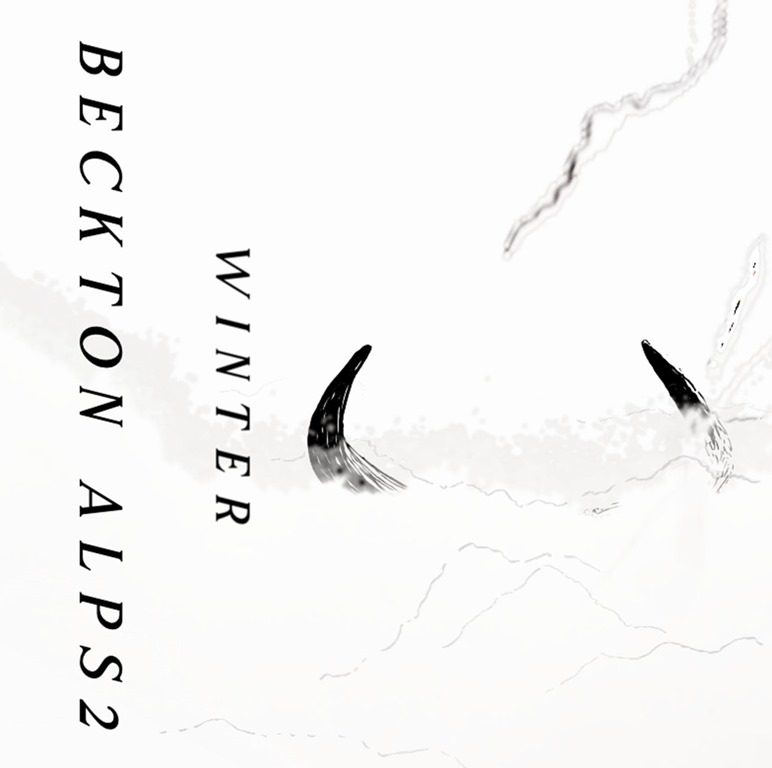
So arriving at Winter by Beckton Alps2 – the final part in the series of ambient concept albums released throughout 2025, imagining Stone Age people reacting to the changing seasons – I feel in some ways that little imagination is required. Technologically, we live in a different world. As beings… we have evolved… but only so much.
Pub gigs provided me with my first experiences of live music, back in the early 90s. Often, pubs with upstairs rooms would pop bands on, and other still would simply pack bands somewhere in the bar. At some point, there seemed to be a shift away from this, with pubs seeming to be only really interested in solo performers and acoustic duos. Gigs in pubs stopped being such a thing. But now, pubs are dying. And grassroots venues are dying. Let me be more blunt they’re not so much dying, as being killed off in the interest of capitalist greed.
As I wrote recently on the repurposing of working men’s clubs – also suffering from a severe decline – as gig venues, so the return of the pub gig seems to solve two problems at once, namely how to bring punters into pubs, and providing bands with a place to play. This certainly seems to be happening in York.
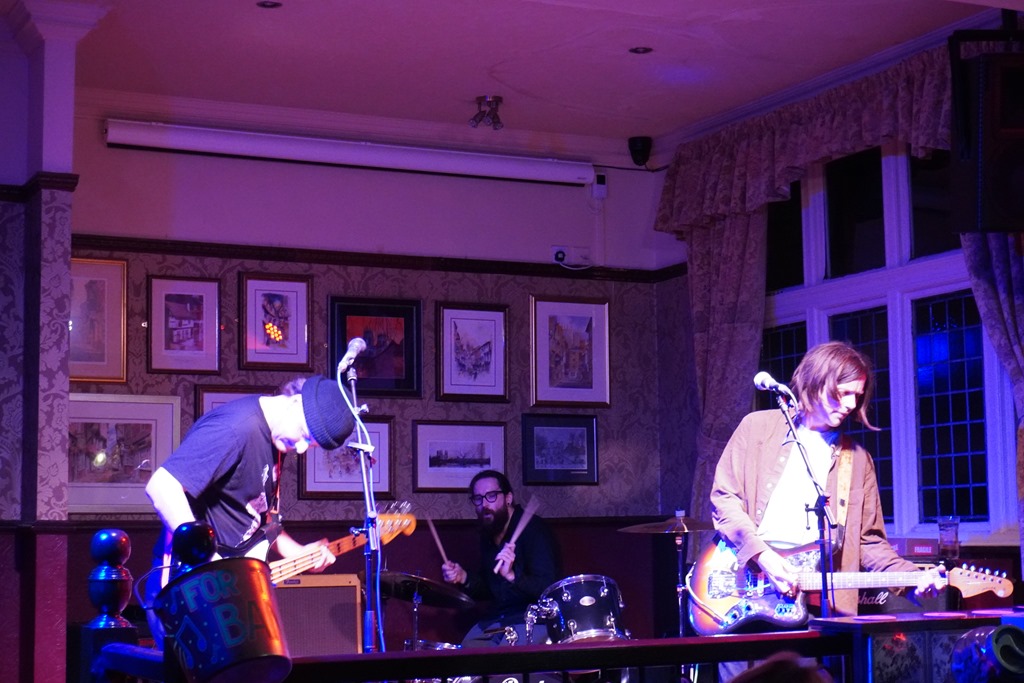
The Black Horse used to be a Tap and Spile, and has always been a solid Yorkshire boozer – real ale and bar snacks, and a weekly quiz. But clearing the top part of the room – more a raised area than a mezzanine per se – creates a fairly generous stage space, and not being a massive space, means a basic setup whereby the bands play straight through their amps with only the vocals going through the house PA, simplifying soundchecks and making switchovers straightforward.
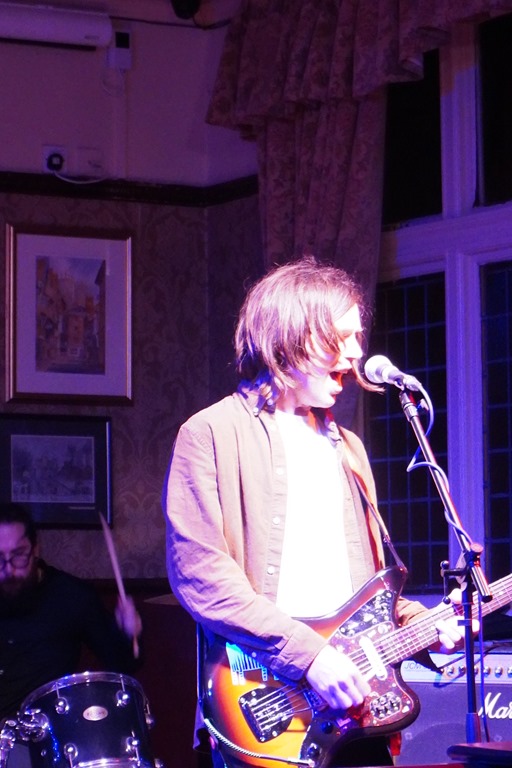
When this show was first announced, Strange Pink were an unknown quantity, but the release of their debut EP changed that, and the Hull-based power-trio-cum-supergroup consisting of Sam Forrest (Nine Black Alps, Sewage Farm), Eddie Alan Logie, and Dom Smith (whose resume is a feature in itself) make for a cracking opening act. They manage to be loose but tight at the same time, and it suits their 90s slacker rock stylings. As the EP attests, their approach is varied, and so, accordingly, is their set. They seem to grow in confidence as the set progresses, the sound coming clearer and brighter, too, and by the end of the set, they’re on fire. They close with ‘Boys Club’, the lead single from EP. It’s a clear standout and possibly their best song, with a strong hook, making for the perfect way to leave the crowd with something to remember.
Strange Pink
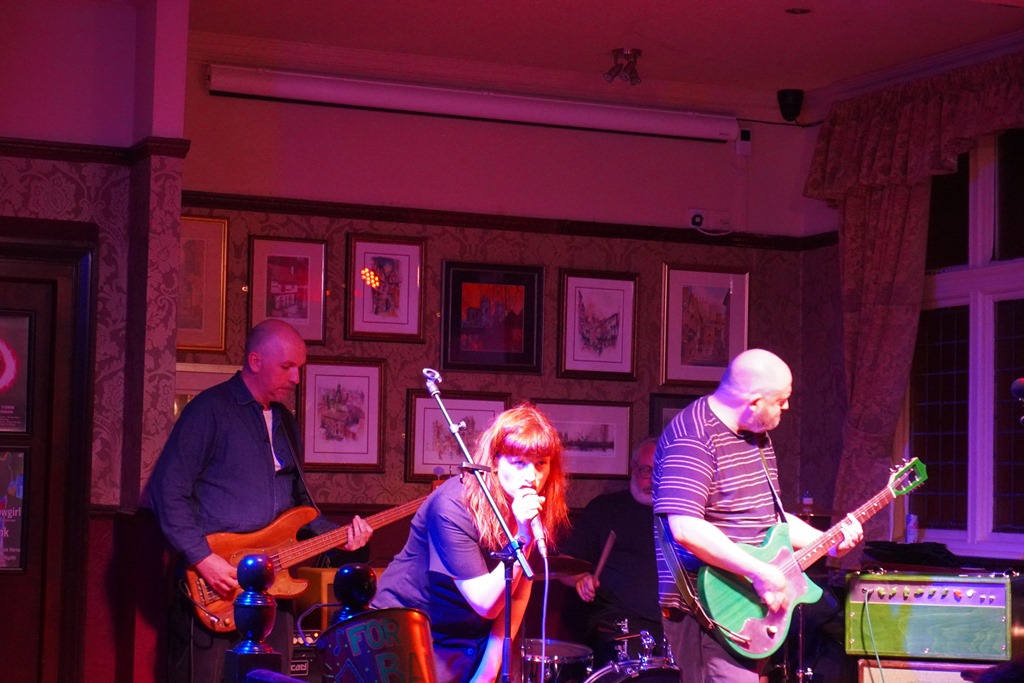
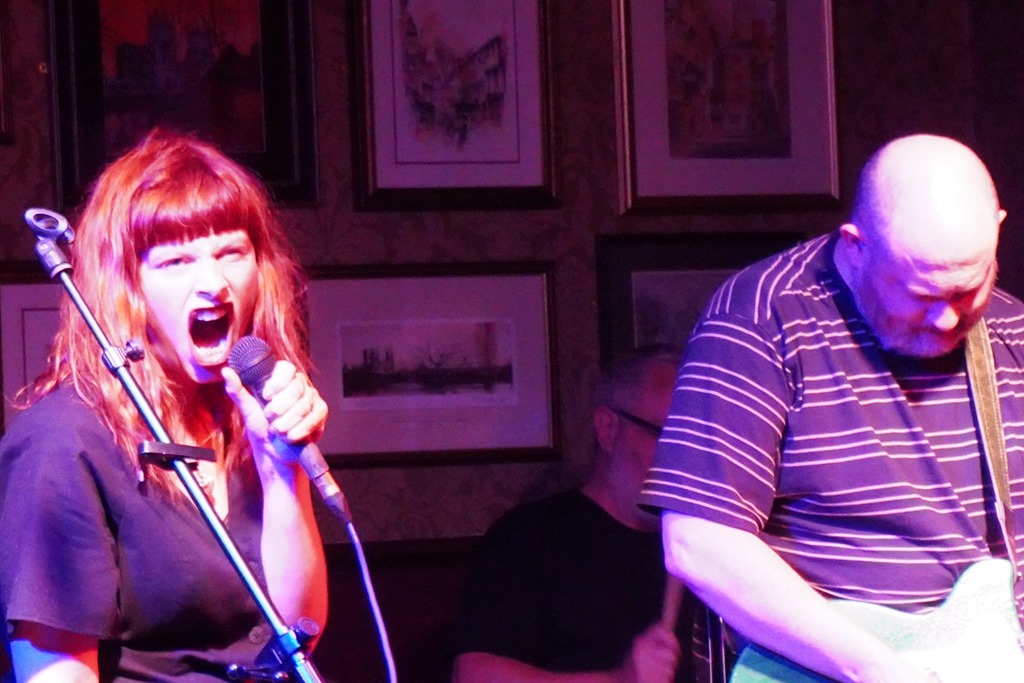
The Bricks have become Aural Aggravation staples, and are a band I will always go and see whenever possible, for two simple reason: they have great tunes, and they’re a great live band – always. During their brief soundcheck, I began to wonder if their run of infallibility might come to and end tonight, but I needn’t have worried, because they were firing on all cylinders from beginning to end. In fact, they seem incredibly at home in tiny venues such as this, and flame-haired Gemma cranks up the wild, eyes-wide, lung-busting intensity, as if relishing the proximity. By the end of a fierce set, her fringe is swept away and plastered to her forehead. The band play relentlessly hard, too, and I try to analyse what it is about them that’s so compelling, why they work so well. The songs are fairly simple, both structurally and in terms of musical complexity – simple lead parts, four-chord riffs, classic (post-)punk, built around solid rhythms, with most songs two or three minutes long and strong hooks. Simple proves effective, especially when played with precision and passion.
The Bricks
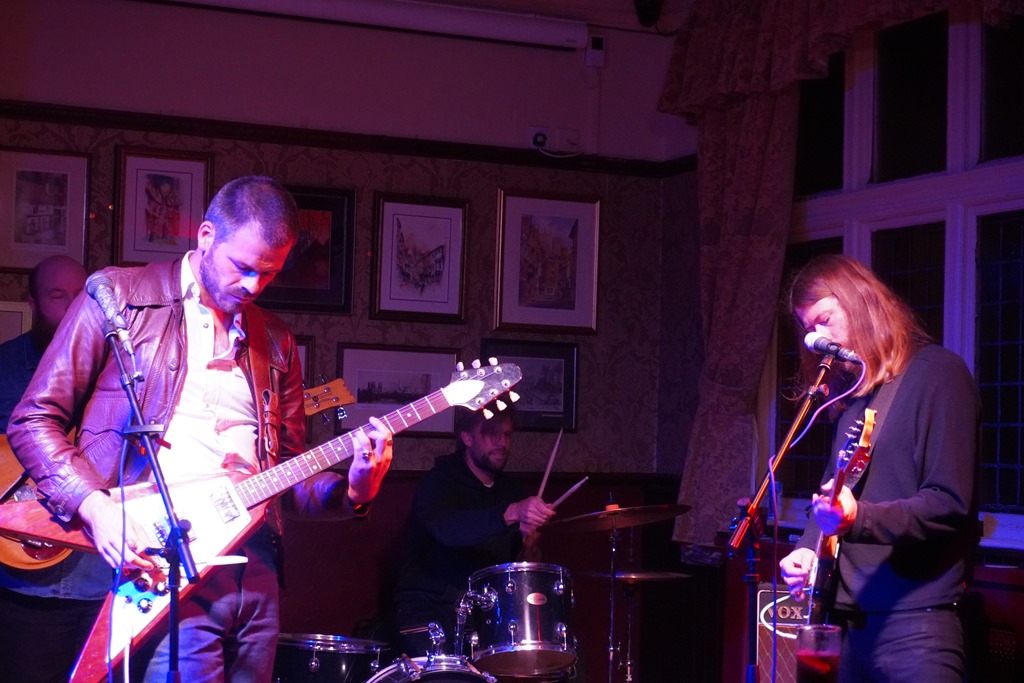
This does mean that Cowgirl have a tough act to follow. But they’re super-seasoned professionals. Danny Barton (guitar and vocals) plays bass in Sewage Farm, previously played bass with White Firs with former Federals drummer James Holdstock (who’s also drummed with Cowgirl), and has, in short, played in more bands in and around York than I’ve had hot dinners, and the same is true of Sam Coates (also guitar and vocals), who’s been pretty much ubiquitous on the scene for years now.
Looking around the room – it’s standing room only, and there’s plenty of beer being drunk, and I bet they’ve not sold this much on a Thursday night in a long time – half the people here are in other bands, or are otherwise recognisable as gig-going regulars, highlighting what a close-knit scene the city has, but also that this lineup has brought people out on a night that’s not exactly a popular one for gigs or pubs. The free entry and donations bucket may be a factor (although a facility to take card donations would likely have seen more contributions), but still, it’s proof that a quality lineup is a definite draw, and the fact a small venue can be filled more easily creates a sense of buzz, which is definitely the case here.
Cowgirl
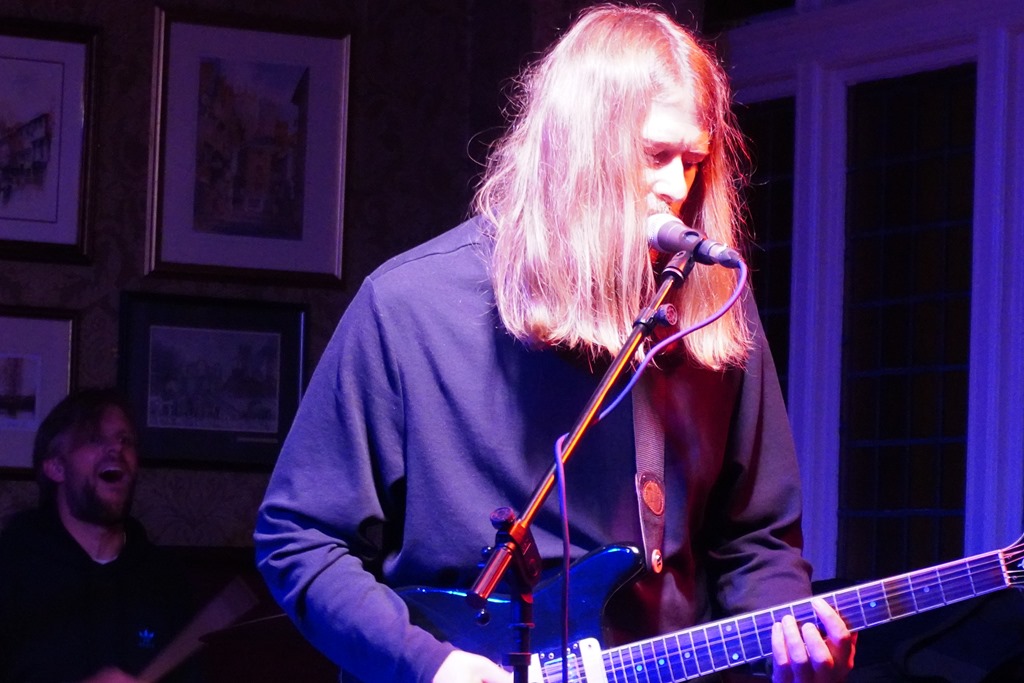
Early on in their set, a friend remarked that they sound like Oasis. He’s completely wrong, but the comment got me thinking. Some of the elements are there… some of the jangle, a bit of the swagger, but with a keen American indie influence. Perhaps his opinion was influenced by the fact that their sound is decidedly more ‘rock’ on this occasion than previous times I’ve seen, them, likely on account of the backline / PA setup, resulting in a sound dominated by blistering guitars. But they have actual melodies and a psychedelic hue, and once again, it’s a set that builds in every way – confidence, cohesion, and volume. The final brace of songs is segued together to form a ten-minute melting wall of sound, an epic psych-wig out that’s nothing short of a brain-cleansing blast that leaves you dazed as the final strains of feedback taper away.
Everything about tonight feels like a win. I may have had one more than was wise – easily done when it’s hot because it’s packed and all hand-pulled beers are a fiver and there’s half a dozen to choose from – and I may be a touch emotional at having attended my last live music of my forties – but stepping into the night, I feel like I’ve experienced something life-affirming and positive in the bleakest of times.
The latest instalment of the ambitious and wide-ranging Impermanence Project curated by Mortality Tables is a document, as the artist explains, simply and succinctly: ‘This is the sound of my footsteps. I walk through some woods every lunchtime when I’m at work. I try to take a different route every day. The recording starts and ends at the office door. There are two gates which separate a lake – one of several – from the woods.’
This simple premise of recording a walk – a few seconds short of seventeen minutes in duration speaks on a number of levels: the first, in context of the project’s premise, is also the context of the walk itself – the lunch break at work. A brief window in which to seek separation from the work and the workplace. Too few workers really use this time as their own, with many scoffing a sandwich as their desk, or nipping to a canteen or a supermarket for a prepackaged meal deal, instead of something more beneficial to both physical and mental health. I must stress that I’m not judging, and it’s not easy, but as a walker myself, when I was office-based, I would make a point of getting out on a lunch-break, and now home-based, divide my day with a walk. This time out from work is but brief, but affords an opportunity to decompress, to recalibrate.
The fact the artist reports trying to take a different route every day is interesting. Treading new ground, or even walking a known route in the opposite direction, or otherwise questing for variety keeps things fresh, and opens one’s eyes to new sights. These things are often in the detail, but also change with the seasons, noting the changes in the colour of the leaves, a toadstool, hearing birdsong. The world is ever changing, and while work can all too often manifest as a groundhog day of ‘same shit, different day’ which often feels like ‘same shit, same day again – and what day even is it?’ the outdoors paints a different picture. Even when the realisation hits that it only seemed as though Spring was beginning to break mere weeks ago and now summer has past and the air smells of Autumn, and that nagging sense of another year having evaporated and life slipping past settled awkwardly in the gut – a soft but palpable blow which serves as a reminder of how short life is, the outward signs of the passage of time are evidence of being alive.
Listening to 17 Minutes, we get to accompany Xqui on their walk in real-time. They keep a decent pace, too, and as one tunes the attention, changes in echo, background sounds, the metallic scrape of a gate hinges, the different terrains underfoot, all become significant. There is traffic. There are few people, at least speaking along the way. I abhor having to listen to people’s conversations as I walk. And yet I find I’ve been unable to listen to music while walking since lockdown, and simply have to hear everything.
Although documenting a walk through woods, the backdrop to 17 Minutes sounds somewhat urban, or at least overtly inhabited, a setting where human presence dominates nature. A couple of minutes from the end, a gate swings and clangs shut. Although we’re not yet back at the office door, it feels significant. I even feel myself slump a little inside, feeling that passing through this gate – which in the opposite direction represents the opening up of a path to freedom – signifies the end of this escape. And with this, comes the hard appreciation of the fact that nothing last forever, especially not a lunch break.
Finish purveyors of extreme noise, Vorare, has paired up with Earthflesh to create the abrasive blast of an album which is Rope Tower. We’re on the edge of our seats for the album, and are beyond thrilled to present an exclusive premier of the second track from the album to be unveiled after ‘Seepage’.
On the face of it, a mining disaster in the North of England which occurred way back in 1844 may seem like an unusual choice of subject matter for two artists based in mainland Europe: it’s a pretty niche piece of local history. But it’s also a harrowing historical event that warns of the risk to life the industrial age brought. County Durham had a long mining heritage, and Haswell was one of the county’s largest collieries, employing over 300 men and boys. This single incident – an explosion – caused the deaths of almost a third of the workforce, with the blast itself killing 14, and a further 81 dying by suffocation.
For a moment, just imagine the scene, and the sensation. ‘Haswell’ makes for a fitting soundtrack, with a reflection on not only the how of their deaths, but the why…
Lyrics:
We find ourselves in the mines day in and day out, breaking our bones, shoveling our route to the alluring ore necessary for someone else to thrive off of. The caged canary leads the way deeper and deeper into the uncharted maw of Earth left gaping by bombs built by weak little men far from here. The clangs of pickaxes haunt our dreams while the fetters on our ankles might as well be extensions of our limbs alongside the instruments designed to violate the soil below our homes. As the morning seeps in lightless, we continue our work. Descending to the black hole stretching for miles on end, the explosions seem particularly strong today. We can’t see, but we can hear and feel. The chirp of the canary abates and soon runs out. Is this the smell of profit?
An account of the Haswell Colliery Explosion can be found here.
The band’s website contains, if not exactly a manifesto, an eye cast over the world in which we find ourselves here in the early weeks of 2024: ‘Human singularity, a third world war, scorching deserts, rising seas – it’s all coming for us. The slow grind is already in motion, pushing concrete, bodies, Teslas, skyscrapers, shacks, banks and bitcoin into a collective abyss. Piles of discarded trash will inherit the earth. It’s anyone’s guess as to what happens next. Is this the end of the world? Who knows. Who cares? Stand by with the rest of us and watch it burn. We’re all guiltless. We’re all blameless.’
Here, then, we come to learn the origin of the band’s name, a grim, grimacing irony condensed into a single word. This articulates the sense of pit-of-the-gut despondency we should all feel when we look around us. The drivers to take to the roads in their SUVs to drive five minutes up the road for the school run because it’s raining doing their bit to ensure it’s going to rain a hell of a lot more; the moneyed who jet off for their annual skiing holidays who bemoan the lack of snow without for a second considering the fact that they’re the reason there’s no snow, may be small-scale compared to Shell declaring profits which are double the UK’s climate funding and being pressured to can their ‘green’ strategies in order to siphon off even more for their shareholders, but the point is, we could all do better, much better, but simply none of us is truly willing to sacrifice comfort and consumerism for a future they can’t comprehend.
The accompanying press release delivers a similarly positive pitch, telling how ‘Guiltless creates apocalyptic soundscapes in their imaginings of the surreal return to proto-human civilisation, as well as what life might be like for the survivors of the next mass extinction event on Thorns.’ Prepare to be harrowed, people, prepare to be harrowed. But also, prepare to take a look in the mirror: do you need to buy products from Nestle and Unilever? Do you have to shop at Tesco and Amazon, or are their local business you can buy from? How about loose fruit and veg instead of packed in plastic? And do you actually need that thing, the latest phone model, the delivery from McDonald’s? It’s a tough one: the majority of people who are most driven towards such basic convenience choices are on the lowest wages and are the ones generating the wealth for the rich cunts who will happily watch the earth burn rather than pay tax. You might think they’d grow a conscience for the future their children will find themselves in, but they’re banking on shipping off to Mars before the half of the world that isn’t incinerated is under water. Hey, they can probably take a few polar bears and pandas along, too.
Thorns is twenty-four minutes of hellish bleakness. It’s an EP to play when you’re in the mood for basking in bone-breaking blackness. ‘Devour Collide’ begins deceptively gently, a hum of extraneous noise which is overtaken by some gentle guitar and an understated bass, propelled by rolling toms – then forty-six seconds in, everything slams in, hard and heavy, the distortion rages and the snare crashes like a tectonic event. The riffage grinds to a crawl and churns it way to crushing lows, while Josh Graham’s raw, ravaged vocals sound as if his larynx has been scorched by fire and pollution. It makes for an utterly punishing six-and-a-half minutes, and sets the tone for a truly monstrous set.
It’s a thick blast of flanged guitar which powers in on a wave of thunderous drums on ‘All We Destroy’. It’s a criminally underrated and underused effect, and one which is far more versatile than is perhaps appreciated, with the capacity to create brittle metallic tones with quite the old-school goth vibe as well as sweeping swirls – and it’s a bold ‘whoosh’ which yields to a thick, sludgy grind, as dense and heavy as a mudslide. ‘Dead-Eye’ delivers repeated punches to the gut with its lurching, lumbering low-end tumult, jarring, sinewy guitars and clattering, slow, slow, slow drumming reminiscent of early Swans, but with a doomy metal aspect. It makes for a long and challenging five-and-a-half minutes, which leaves you drained, physically and mentally, weak in the limbs and gasping for air in the wake of its devastating intensity.
The EP’s closer, ‘In Radiant Glow’ starts slow and low, and as such, it’s vibe is classic Neurot. And then, just around a minute in, BOOM! Everything slams in and hits like a tsunami. It’s utterly punishing – and rightly so.
It’s perhaps fair to say that everything is fucked. As I write, the UK government is adamant that it’s bombing of Yemen and a growing number of countries in the Middle East is ‘not an escalation’, while continuing to give support to Israel’s ‘right to defend itself’ against Hamas. No-one would reasonably deny any state’s right to defend itself, but can anyone really justify 25,000 deaths and rising daily as ‘proportionate’ or ‘defence’? Meanwhile, Russia continues to pound Ukraine, and shareholders in weapons manufacturers like BAE Systems are making a killing from all the killing. Well, might as well make as much as you can while you can, eh?
And so, here we are. Twenty, twenty-five years ago, you’d have been labelled an apocalyptic nutter for stressing out over the future and over climate change. Sadly, big business and cunts like Trump and his supporters still will, raving about the ills of wind farms and favouring fracking and nuclear power instead. Even when Venice becomes the new Atlantis, they’ll still be saying the same. But there’s no escaping now that we are fucked. Guiltless know it and they’re not here too win anyone over or to change anything, because they recognise that it’s too late and it’s all utterly futile. Thorns is a dark document which faces the grim reality. Its purpose is not to offer solace, but simply solidarity for those who also realise that we’re on a one-way road to oblivion.
True revolution will come when the workers own the means of production. This is something that’s emerged in music not through an uprising, but a thoroughly screwed-up state of affairs, but one that’s very much a result of a capital-driven model. Major labels, and a fair few indies, don’t exist for the artists: they exist for themselves, for their execs, for the machine, the mechanism which enables them to gouge maximum profit for themselves, the shareholders, the middlemen, hell, anyone in the chain. And, depressingly it looks like even Bandcamp could be going this way before long. Capitalism doesn’t give a shit about art: it cares only about money, and art is simply another commodity, provided it’s got mass appeal. And who generates the profit? The artist, of course. The model is the same in any capitalist structure: without call centre and admin staff, multinational corporations would simply have no business: even banks need staff to manage the money being poured into them (although retail customers get the least service because they may be many, but they’re just your average pleb on the street, so fuck them and their wanting local branches and stuff that eat into the profit margins). But the staff who essentially generate the wealth are at the bottom of the pile with the worst pay and the worst conditions.
Sure, some artists get rich, but how many Coldplays and Ed Sheerans are there in the scheme of things? And there has been a shift since the turn of the millennium. Massive advances – or any advance at all in many cases – are a thing of the past. But labels have always been behind the time, and the concept of A&R is a longstanding joke in that labels aren’t interested in finding the next movement as riding on the coattails of whatever’s breaking in order to milk it.
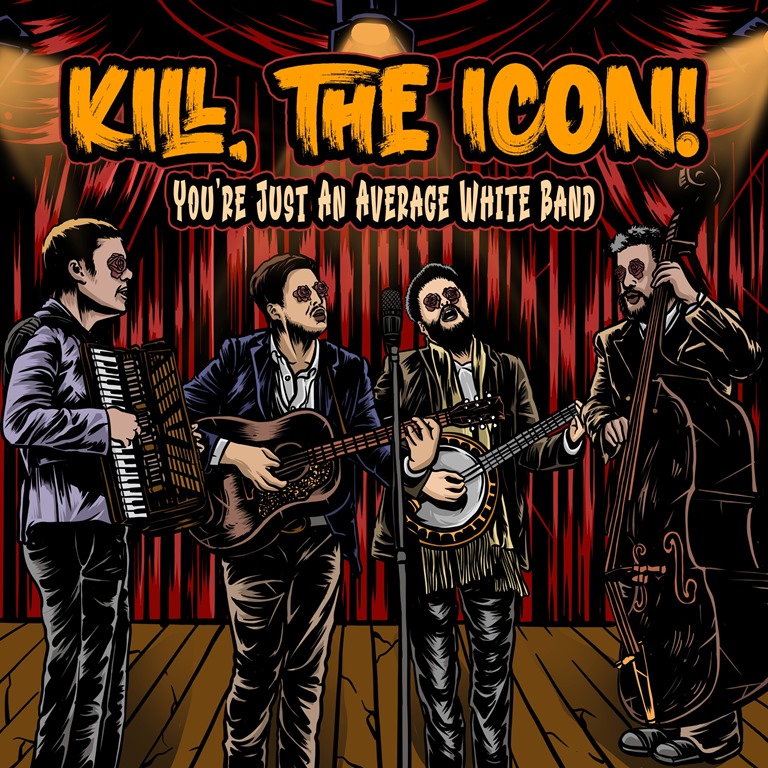
This latest offering from Kill, The Icon! marks something of a stylistic shift, at least superficially: less aggro and overtly confrontational, it’s also less guitar-orientated, built around a simple and unchanging synth loop. Nagging, earwormy, irritating… the repetition does become somewhat numbing after a while, but by the end off its three-and-a-half minute duration, you start to consider playing it again anyway.
Talking to me about the single, Nishant admitted ‘It’s really different and I expect will be polarizing in terms of content.’ He’s right on both counts, in that it’s not only a departure, but also likely to alienate a few fans and critics. But this is to the good: as I’ve written before, and will likely do so again in the future, you can’t please all of the people all of the time, and nor should you aim to do so. If you do, you’re Oasis or Ed Shearan. Punk is an attitude, not a style per se, punk is creating the music and art you believe in and not giving a fuck about the reception. Kill, The Icon! are punk, and this stylistic detour doesn’t see them budge an inch in their message or tame their fury for a second. Yes, true to their credo, Kill, The Icon are calling out institutional racism and general bullshit in society, and here, specifically, the music industry:
Average White Band / For the average white fan / Making average white music for the average white man
Joshi explains: “Mumford and Sons were the archetypal Average White Band. They had the son of a near-billionaire in their midst. And they made a career out of denying their privilege. They were bankrolled from the very start, and so they had a precious resource that’s not afforded to other bands: time. Most artists are told to play more shows, work harder, network harder. But that’s a huge lie that’s perpetuated by the music industry… Everyone involved in the music industry assures us that diversity, inclusion and equality are priorities – it’s written as much on the website of every festival, booking agent, manager, and record label. But the reality is an utter lie. We’re not all running the same race.”
One benefit of being a truly independent act is that the artistic control is not only retained by the artist, so is the scheduling. That means the pokes in ‘Average White Band’ are still contemporary, as Joshi calls it out:
“Once a band has been elevated, It’s fair to ask what they do with their new-found power: are they maintaining the status quo, or are they actively seeking change to make the music industry more equitable? The reality is that the music industry has been fantastic at improving diversity in indie music, but only to the extent that it champions female-led bands who approximate western beauty standards.”
Sitting on your chaise longue / Writing all your new songs / About cliches of cliches of cliches of cliches
It’s not a matter of sour grapes here: there’s no way Kill, The Icon! are jealous, or would want to be in the position of Wet Leg. But given the same elevated platform, Kill, The Icon! would be telling it like it is and making sure their message had maximum reach. But political bands don’t tend to get maximum reach, especially when they’re from minority backgrounds. Benefits are perhaps the most ‘real’ band with a broader reach right now – Sleaford Mods are simply too obvious are more about commentary than promoting change – but while they’re white, they’re too working class to be embraced beyond a certain demographic. In keeping it real, they’re not likely to get much radio airplay – or earn huge radio royalties – any time soon.
Stewart Home’s career to date has been enviably long by any standards, and extremely varied: emerging out of the London punk scene in the 80s, his modus operandi was – and remains – subversion, playing with form and literary theory in equal measure. The idea that a writer who cranked out lowbrow pulpy trash which was littered with references to highbrow theory, smashing the two together in a fashion that was the epitome of postmodernism confused and annoyed a lot of people, but earned him a substantial cult reputation at the same time.
His style and subject matter have evolved significantly over the years, although – some notable exceptions notwithstanding, in particular Tainted Love and The 9 Lives of Ray the Cat he has continued to utilise certain tropes, elements of cliché, and display a truly audacious streak is evident throughout his work. His work is serious / not serious, and he’s serious / not serious about it.
One defining feature of Home’s career is that it has always been forward-facing, often promoting the next book over the one most recently released (and he’s exceptionally dedicated when it comes to promoting his work). Even when reflecting back – as much of his earlier work did, on youthsploitation novels of the 90s did on the culture of the 70s – Home was anything but nostalgic in his angle, presenting as much of a critique as a celebration. Revisionist, parodic, comedic, yes, but not nostalgic.
Even Tainted Love wasn’t really nostalgic, and nor was She’s My Witch, which was fun and frustrating in equal measures, apart from near the end, when it became so, so sad. Home has the infinite capacity to confound expectations: for all of the overt revelling in ‘trash’ writing that most academics would dismiss as not even being within a mile of the field of literature, and for all of his one-dimensional characters who exist simply as vehicles to carry – often quite thin – plots and stand as ciphers for more theoretical ends, Home is clearly a writer capable of emotional depth.
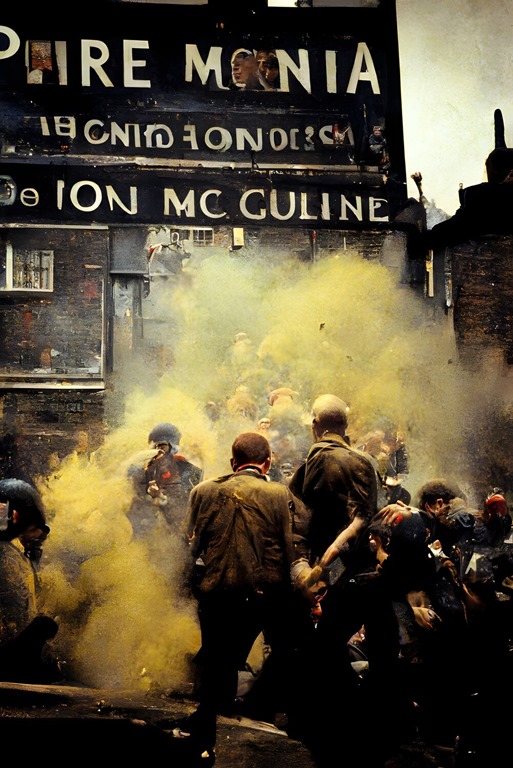
The circumstances of the publication of his most recent novel, Art School Orgy (which is very much not concerned with emotional depth), are worth considering in terms of what they tell us about the relationship between art and society. It would be too easy to pursue the ‘cancel culture’ route of discussion, but this feels like obfuscation of real issues. Times have changed significantly since the time of Home’s early novels, the violent, pulpy, parodic Pure Mania, Slow Death, and Come Before Christ and Murder Love. The perception is that society has opened up and anything goes now, but the fact he struggled to find a publisher willing to take on Art School Orgy suggests the opposite is true. Publishers are fearful. Fearful of recrimination, and fearful of not clearing their margins. It’s the perfect illustration of why art and capitalism are incompatible, and it was this situation which resulted in the book being published by a record label. Despite the music industry being dominated by a handful of huge major labels, independence and DIY in music are lauded, and aren’t subject to the same snobbery which pervaded publishing, which is still moored to old conventions.
What’s interesting and surprising in some respects about Home’s two forthcoming publications is that they’re both reissues from way back in the past: debut novel Pure Mania, and an obscure and long-deleted CD of punk tunes, Stewart Home Comes in Your Face.
Had Home been touting Pure Mania round agents and publishers now, it’s almost certain none would bite, simply because it doesn’t conform to the extremely narrow prescriptions of what they’re looking for. If it’s not the next Harry Potter or Games of Thrones, or something that will sit beside Karin Slaughter or Lee Child, then most publishers simply aren’t interested. It’s all about the bottom line, and what can sell millions stacked on the three-for-two table at Waterstones.
It had been a while since I’d been in contact with Stewart, other than a few exchanges around the time of my review of Art School Orgy, and even longer since my last interview, so this seemed like the perfect opportunity. What follows is a simple Q&A conducted over email, but on a purely personal level, I feel like we achieved some good riffing on some pertinent topics.
ER: Since the material on the album was written in the 70s and early 80s, and then recorded much later, in the 90s, it must feel quite strange to be promoting Stewart Home Comes in Your Faceand making promo videos now. How do you feel about the songs now with the benefit of so much distance?
SH: At first I found it hard to listen to the songs again. They almost seemed like something someone else had done but they grew on me once I got over the fact that my voice is what it is, and much as I’d love to be able to sing like Aretha Franklin that’s never going to happen. Likewise my guitar playing has always been rudimentary. So once I’d learned to accept my musical limitations once again, I found the songs very funny. It also struck me as hilarious that I should keep returning over decades to tunes that had been knocked up very quickly with little thought about arrangement. A decade and a half and sometimes more between writing and recording, then nearly 4 decades before I thought about making music videos for them.
With the music videos it was interesting to see how much I can get into the pretty juvenile state of mind in which many of the songs were written… I actually had no problem with that. I did a video for ‘Destroy The Family’ first because I saw I could fit that with the coronation by using masks of the royals on myself and a couple of sex dolls. The video I’ve shot for the song ‘Kill’ was even easier. I bought a teddy bear in a charity shop, took it into a wood and had a friend film me stabbing it with a large kitchen knife! I still need to edit explosions and other stuff into that, so it isn’t finished but will be soon. And I don’t want to put the music videos out too close together anyway.
I think the distance I have from the songs really helps. I can take them even less seriously now than I did at the time and that enables me to do things visually with them that I might have thought were too crass back then. I also like the way music sneakily builds online and elsewhere. It’s got much harder for my anti-art videos to gain much traction on YouTube, so music videos seem like they might be a way around that. The old content of the songs becomes something that gets people looking at the new content of the visuals, which is what I’m more taken up with now.
Of course I’m also making non-music videos. In terms of books promo, which the music videos link to as the songs also appear in my reissued novel Pure Mania, here is a series of video book sculptures made by me and artist friends where there is a video on small screen and a shelf with a pile of my books. The sculptures have 15 of my books to start but these are for sale retail and with each book sale, the price of the video sculpture goes up because less is more and you’re getting less. For Defiant Pose, I recite an eight-minute passage from that novel while standing on a Swiss ball and being tickled with a feather, so I’m trying to keep my balance and finish the recitation. So that’s a far more conceptual/live art approach to videos simultaneously connected to my novels.
The promo video for ‘Destroy the Family’ has given an old song a new contemporary relevance. Your position on the monarchy doesn’t really require any kind of interrogation, but do you think that Charles’ accession has raised the levels of anti-monarchy sentiment, particularly when the division between rich and poor (and especially those whose wealth is funded by ‘the taxpayer’) has never been felt more acutely or been more closely scrutinised?
I think we’re a lot closer to seeing the abolition of the monarchy than we were 25 years ago. You could say the image has cracked. When the cops busted up the Sex Pistols boat party promoting their anti-monarchist single in 1977, there was no mainstream sympathetic press coverage. Although the same kind of heavy-handed repression went on with the arrests of those expressing anti-monarchist views at the coronation, the mainstream press clearly can’t get away with the type of coverage it did in 1977. The fact that Charles Windsor is clearly an entitled windbag with dodgy friends and family means that many don’t like him. With the cost-of-living crisis, the ostentatious way the royals flaunt their wealth can only add to the fast-rising tide of anti-monarchist sentiment. It is time to strip the royals of their titles and wealth!
In terms of my performance on film, you can see I have been practicing with the martial arts weapons I use to attack the sex dolls with royal family face masks. That said my staff and sword fighting skill is still a little rough and it isn’t as graceful as it night be although still potentially deadly. So I think that mirrors my guitar playing at the point I wrote the earlier songs and also when I recorded them. I had a seven or eight year break from playing guitar before picking it up again for a few weeks to make those recordings.
AA
You described ‘Destroy the Family’ as ‘super-dumb 2-chord sleaze-bag thud’ (a phrase which appeared in the introduction to the second edition of Cranked Up Really High), and have variously been somewhat critical of the limitations of punk. As you yourself came out of the punk scene, to what extent is your own musical work parodic in its use of tropes and cliché? And to follow on, while songs like ‘Kill’ clearly aren’t ‘serious’, is there an element of catharsis and / or a serious element to simplistic sloganeering?
I think there’s a sympathy for the nihilism late-capitalism breeds in many people but also an attempt to make it clear a ‘blow it up’ or ‘hang them all’ response to exploitation should be moved on from. We all need to rediscover our humanity and reclaim it from the ways in which capitalist alienation have deformed us. But to answer your point, yes there is a certain catharsis in there but it’s undercut. In Kill for example it’s subverted where the words in the chorus are changed from “kill, kill, kill, fucking kill everything” to “kill, kill, kill, practically everything”. Hopefully people get the point that there is no one size fits all one time solution to the world’s problems. We have to keep working at them!
Punk should be fun regardless of musical limitations, What I’m critical of is the art punks who make too much of a fetish of not being able to play. You may as well play as well as you can but that doesn’t mean you have to make it complex. I’m a real fan of super-dumb sleaze-bag 2 chord thud when it rocks, what I don’t like is when it’s leaden.
There are few, if any, genres where authenticity is as highly valued as in punk. You’ve essentially built a career since the early 80s with your zine, Smile to ‘stage an ongoing assault on notions of authenticity’ and have espoused the concept of ‘radical inauthenticity’. Yet ironically, with perhaps one or two notable exceptions, such as Tainted Love, you’ve avoided the mainstream by producing work that’s antagonistic to not only the mainstream, but to academia, and the middle-class, middle-brow readership, while at the same time being too subversive and challenging for – sadly – the vast majority, which suggests you’re perversely authentic. How do you reconcile this?
To use a pat formula, I don’t think I can reconcile it while living under capitalist social relations…. But it could also be seen as a dialectical ploy and one that’s not uncommon in more art school orientated punk rock – although that’s not really the racket I make. Even back in the seventies I thought groups like Wire were operating in that way. Or to take a US example Devo. That said, I think I’m more parodying everything from the Clash to the anarcho-punk scene. One of the reasons other than the music I liked bands like Wire and the punk incarnation of Adam and the Ants, was that they just didn’t seem to take themselves too seriously. In relationship to all the phrase “artificial authenticity as authentic artifice” provides perhaps a more than superficial answer to your question. The Sex Pistols manager Malcolm McLaren used the term glorious failure to describe what he wanted to achieve – but I aim higher, since I intended to reinvent world culture in its entirety, even if that takes a life-time.
In terms of books, aside from Tainted Love I think The 9 Lives Of Ray The Cat Jones and She’s My Witch might have reached a mainstream audience if I didn’t already have the reputation I have. Audiences have a certain expectation of what a Stewart Home or Michael Moorcock book is going to be like and will impose that on everything you do. Because reading a book takes more time than listening to a music track, it is harder in the fiction world than the music world to turn around perceptions of who you are and what you do. If people think they’re not into what you do they’re not going to give a book they might like a chance, whereas they could easily be exposed to some music that didn’t sound as they expect it to be more or less by chance.
Nostalgia ain’t what it used to be, but many of the original first-wave of punk bands are still plugging away on the gig circuit, and while many are doing so to smaller and smaller crowds, some are doing pretty nicely out of it: The Damned, for example, are currently touring the UK’s 2,000 capacity O2 venues before heading Stateside. Would you consider playing your songs live again?
I guess for people who missed those bands first time around there’s an appeal to seeing them now. For me, I don’t want to go and see Slaughter and The Dogs or Menace because I saw them in the 70s. Also the line-ups are mightily changed from back then and the crowds and atmosphere are very different. I’d rather preserve my memories of how it was by not going to see those bands now. As for The Damned, I saw them in 1977 and compared to that I was even a little disappointed by how they were when they reformed after first splitting up in 1978. I saw them as The Doomed and a few times after that back as the Damned, two or three years on from first seeing them and for me they were never as good. Of course, they weren’t bad at all but for me they weren’t as super-phat and groovy as the earlier incarnation of the group.
I actually learned a lot from playing in bands in the 70s and 80s. I can see how a lot of what I’ve done subsequently with spoken word, live art and stand up etc. emerged from how I learned to present myself with punk and reggae bands. But at the same time I’ve no desire to play live again – I’ll probably regret saying that very soon if I find myself just doing it for some reason. But the songs weren’t written for me to sing, I just wanted to play in the band and have someone else sing them. When they got recorded, the musicians around me were saying you have to sing coz you’ve got a profile and they’re your lyrics…. I feel much happier just making music videos for those songs now coz it means I can develop something new with them. I can dig repetition but going back to playing those old songs live just doesn’t appeal to me and hasn’t for a long time, I have been asked to do it!
Pure Mania was your first published novel in 1989, and now commands a pretty hefty price tag on the second-hand market. I suppose as much as it draws on pulp novels, you could call it a punk novel, stylistically as well as in setting. How do you feel your writing has evolved since then?
It’s punk in that it took a reimagining of London 1976/77 punk as its subject and that I had a bricolage approach to writing which is very punk. But at the same time, it’s also a very postmodern novel. Back then I was still learning how that type of novel is constructed, I moved on to anti-narrative after I felt I’d perfected that postmodern simulation of pulp narrative with the follow up books Defiant Pose, Red London, Blow Job and Slow Death. You can also see my prose being honed very quickly, the journalistic approach to sentence construction is clearly smoother in my second novel Defiant Pose. Likewise the narrative/anti-narrative construction becomes slicker but never too slick. I can say that technically my writing improved through practice. But some like rawness best anyway.
I think there was a fairly systematic working through an evolution of material, despite changes in style, up to Mandy, Charlie & Mary-Jane in 2013 – if you discount Tainted Love which was me wanting to fictionalise my mother’s life since no one believed it in non-fictional form. Then with The 9 Lives Of Ray The Cat Jones I went back to Tainted Love and took that fictionalisation of family history in a different direction with a different relative. She’s My Witch riffed on the type of woman my mother was but took someone from my generation down rather than my mother’s – but with plenty of morphic resonance. So I think there are two trajectories in my novels and they fall into two groups. Art School Orgy goes back to the first set of novels and hews closer to the earlier trajectory – it is the book I might have written after Whips & Furs if I hadn’t wanted to write 2002’s 69 Things To Do With A Dead Princess (which was a development of what I’d done in 1997’s Come Before Christ & Murder Love).
Art School Orgy feels very much like a lot of your earlier works in stylistic terms, so I’m assuming the issue for prospective publishers was that the subject was a living artist, and their feared litigation. What were the rejection letters / emails like?
I was only trying independent presses so the rejections weren’t as rude as those I got for my earlier books. Mostly it was a “we’d like to publish you so why do you have to make it so difficult” kind of response. One publisher who doesn’t know me as well as the others said he’d like to do the book but to change the names. Obviously that didn’t work for me. But they feared litigation if the book came out using the names I’d chosen. But so far that hasn’t happened.
AA
A fair few of your earlier books have been translated into Finnish and German. How has the reception been in those nations compared to domestically?
They early books created a much bigger stir in Germany, Finland and Russia than here. In Finland and Russia I had a lot of young female readers, so the audience was also very different. When I had a post box I might go and find a pair of unsolicited used knickers from a Russian fan. In Finland I was the biggest selling writer there for a while in the late-1990s, so I’d had TV crews trailing me around and when I told an old drunk Finnish writer at a literary festival that he should shut up as he was talking through my reading, it became front pages news that I’d beaten him up, although that was an exaggeration. I just gave him a fright by leaning into him and screaming in his ear! I also got asked to appear in a nude celebrity feature in the biggest selling newspaper in Finland, which of course I accepted and I got an all expenses covered trip to Helsinki out of it.
In London I can walk around and no one pays any attention to me but it wasn’t like that in Finland in the 1990s. I went in a record shop to buy some Finnish released records you couldn’t get in London including JMKE, the first Soviet punk band, and they said “You’re Stewart Home you don’t need to buy records!” They gave me everything I wanted to buy and a load of other stuff too as they said I ought to have it. I enjoyed going over to Finland for a week or two and experiencing that sort of thing but I think it would be a drag to experience it full time in London. Anyway, it wouldn’t happen to me in Finland now…. Everything has its moment.
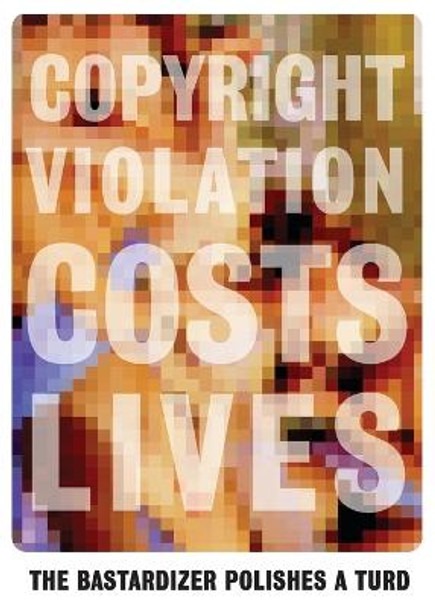
You were recently involved in the publication of Chus Martinez’ novella, The Bastardizer Polishes a Turd, which is a crazy and exciting read. Can you explain Chus Martinez, and also how Simon Strong comes into all of this?
Chus Martinez is a multiple identity project – a lot of different people anonymously producing work credited to the same name – following on in the tradition of projects like Karen Eliot and Luther Blissett. It’s been going in a low key way for over a decade. Chus as a diminutive in Spanish can be either gender and the gendered nature of previous multiple name projects was something those involved with this one wanted to overcome. The Luther Blissett project broke through a lot of earlier blockages but it seemed like gendering was something that still needed to be addressed. Chus Martinez started with a lot of retro-graphics and celebration of the sixties Spanish guitar player Chus Martinez. The first two Chus Martinez novels Copy and Issue came out in 2014 and were published by Simon Strong on his Ledatape Organisation imprint. The novels were written by different people and issued at the same time. Since then Simon has closed down Ledatape, so as there was a new Chus Martinez novel that needed putting out and which Simon had already done the typesetting and graphic design for, so I issued it on my Cripplegate Books. The project involves a lot of different people and although I’m involved, I haven’t yet done a book for it.
The fact that you struggled to find a publisher for Art School Orgy clearly slowed your output in terms of what’s been put out in the public domain, but despite that, you’ve maintained a steady output the last ten years, albeit at a lesser pace that in the mid-late 90s. What’s your method for keeping the flow?
I only write when I have something to say and as there’s plenty that needs addressing in this rotten world we live in, the books keep coming. But I’m constantly writing stuff – not just books and not just fiction. I’d like to write less fiction so I can spend more time on non-fiction. I have another novel written in first draft called Femdom Ninja Lockdown, which was hacked out during lockdown to try and record the experience while also utilising a cut-&-paste composition method closer to IFD and Filmark than Burroughs-style literary cut-ups. I like it but I’m in no rush to get it out. I’ll revise it when it seems like the time is right to publish it. I wasn’t planning on writing a novel, it just seemed unavoidable given the madness of the situation we were all in.
I’ve known a few writers sign up to big contracts with lots of money advanced and it chains them to producing books that they end up hating working on. They’re legally bound to produce these great big books with a literary content when they’d probably rather be writing almost anything else. I’m fortunate never to have been in that position, so I can stay alert to the world and do things that groove me. There is also an issue with those who want an identity as a writer, something that is a terrible drag on actually producing anything interesting. Rather than writing a book because they have something to say, there are way too many people writing novels because they want to appear profound and wise but inevitably they end up coming across as the opposite of that.
I assume you’re still keeping the flow now, so what’s in the pipeline?
Some non-fiction, probably starting with a book on yoga that explores how the term is undefined and defuse, what’s practiced in yoga studios bears no relationship to older Indian meditation traditions that are called the same things. The stretch routines that millions practice as yoga draw heavily on primitive Scandinavian gymnastics but they didn’t receive their confusing name until they were mixed with positive thinking and secularised Christianity dressed up as Hinduism in California at the start of the 20th century. I’ll also look at how the spread of this western yoga is intimately connected to the growth of fascism in the first half of the 20th century. So I’ll provide a corrective to the misplaced idea that some people in the overdeveloped world have that what they practice as “yoga” is a non-political tradition that is thousands of years old and originated in India.
Pure Mania will be published on 17th August 2023 with a brand new cover design in both limited edition hardback, which comes signed by the author and accompanied by an original Necrocard, and paperback, as well as eBook for the first time, via Leamington Books. Stewart Home Comes in Your Face will be released by New Reality Records in September.
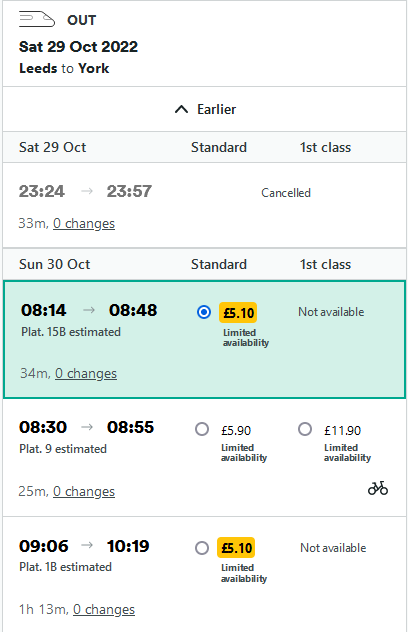
I am not happy. I was supposed to be at a gig in Sheffield this evening – a gig that had super-early doors – 18:30 – and a super—early finish (22:00). When booking the ticket for the gig, I checked the trains, and there was a 23:05 that got me home some time a little after midnight. Now, the last train home is at 21:22. I could split the journey, and make the 22:25 train to Doncaster, arriving into Doncaster at 22:49. But it only connects with the 23:50 out, which thanks to a lengthy wait in the arse-end of nowhere, takes 9 hours and 58 minutes, arriving into York at 08:48. Getting a train to Leeds is marginally, better, but not really: the sole train that goes via Leeds instead of Doncaster arrives in Leeds at 23:27, missing the 23:25 by 2 minutes, and so getting into York at, or there’s the 23:05 from Sheffield to Doncaster, which then connects to the 23:50 to Leeds, which, having missed the cancelled 23:24 means waiting for the first train out on Sunday at 08:14. No thanks.
This is not a criticism of striking rail staff: there are no strikes involved here. The reduced timetables are companies, heavily subsidised by the government, cutting services to maintain maximum profit. When I say cutting services, it’s not really a service when you can’t get anywhere when you need to.
They may not have sufficient staff to run the services, but why is that? The mantra that ‘no-one wants to work anymore’ is quite simply bollocks. It’s just that no-one wants to work to the detriment of their health and wellbeing, no-one wants to work two or three jobs to then have to still find time between shifts to queue at the local foodbank. No-one wants to work themselves to an early grave without spending any time with their families. People work to live, they don’t live to work, unless they’re deranged.
At a time when the economy is on its knees, the government claim to be supporting both people and businesses. But what gig venues need is for people from beyond the immediate catchment to be able to attend live music shows.
Back in 2014, I published a collection of essays entitled The Changing Face of Consumerism, which focused largely on the demise of the high-street record store and the like. Things felt pretty bleak then, but these were positively halcyon times compared to now, where we’re living in an amalgamation of every dystopian future ever written or dramatized.
Time was when travel was considered a luxury – but that related to air travel, not domestic rail. It simply should not cost more to travel domestically than to travel overseas. And in looking to book tickets for non-existent return to tickets from York to Sheffield, I noticed the price was around £28. Given that it’s approximately 50 miles between the two cities, that’s around 25p a mile, around 5p per mile more than the average vehicle, be it petrol or diesel. It wasn’t so long that it was perhaps £17. Similarly, pre-pandemic, a return to Leeds was around £12. Not it’s about £18. This cannot all be put down to rising fuel prices, and however much the government insist it’s all down to ‘Putin’s war on Ukraine;, this was escalating long before the tensions did.
But with crippling inflation and real-time wages crashing, like many people, I don’t have the same disposable income I had before, and so I choose the events I attend with a no small amount of consideration. To now not be able to attend because it’s simply not possible to travel isn’t only frustrating for me: the rail providers have lost a ticket sale, and the music venue has lost the sale of maybe three or four pints, and the band potentially, say a T-shirt or CD sale, in a climate when bands only survive by the skin of their teeth by selling merchandise on tour because everyone’s streaming music nowadays and the only people who make off that are the streaming platforms and major labels.
It’s a domino sequence, and what should be clear from this real-life example is that by cutting public services, or running what should be public services privately, for profit and the benefit of shareholders, is that the people who actually require the service are the ones who suffer, but it also has a knock-on effect to many other areas of the economy. The venue sells fewer pints, so they buy in less beer; the breweries sales decline, especially in the face of rising production costs and small breweries fold, large ones cut staff to reduce costs against declining sales. The staff who’ve been laid off don’t have an income, let alone disposable income to go to gigs, to go to pubs and bars, to go to coffee shops, to have meals out.
We no longer manufacture or have any industry to speak of: we’re dependent on people dining and drinking out, on going to the cinema, on going bowling, attending sporting events, on watching live music.
So when these tertiary industries are crushed, so is the nation as a whole, because there is nothing else. How does this stack up against the aim for growth and a high-skilled, high salary economy? This is, of course, a rhetorical question.
Call it trickle-down economics, call it what you like: the fact is that giving money to the rich, be it by tax breaks, or allowing major corporations to siphon off immense profits to divvy out to shareholders and top-flight executives does absolutely nothing for the majority of people, be they working people, laid-off people, or zero-hours contracts people who are statistically in work but in reality earning nothing.
One can’t help but feel that capitalism is slowly suffocating itself, and at an accelerating rate. Before long, the top 5% will own everything while the rest are dying in the gutter, at which point the elite will have no-one left to milk anything from. But until that day, they’re just going to keep on draining every last drop.
Fuck’s sake. I just wanted a night off with beer and live music over the county border.
Argonaut offshoot Videostore have swiftly established themselves as a DIY act who can kick out solid tunes in no time at all, and as having embraced the immediacy of the technology at their disposal to write, record, and release tunes in the space of a week.
Under life on lockdown, many bands are taking to the net to pump new output direct to fans, but Videostore, having already adopted the model, are ahead of the curve, and their latest single, ‘Building Breaking’ is exemplary: a buoyant blast of overdriven guitars that fizz in choppy bursts over a vintage drum machine, it’s the pinnacle of punk.
The cover at reminds me of various scenes I’d observe on my walk to work up until a month ago: regeneration gentrification; so often change for change’s sake, collapsing new buildings. I made it something of a project to photograph all the cranes and diggers, scaffolding, tarpaulin and holes. I intend to actually use them for something one day. Meanwhile, Videostore have tied this image into a commentary on the constant state of flux that’s come to define out cityscapes with a constant programme of demolition and (re)construction… but for what end?
The accompanying home-shot-video is simple but effective, and the fact they pack some sweet harmonies and a neat hook into just 54 seconds is beyond impressive.





 Aural Aggravation