Time marches on, and here we are almost midway through December still catching up with November releases, this time with Polish ‘dark rock’ duo Shrine Of Reflection.
There’s a great temptation to split hairs and that argue that surely the dark rock tag is goths pretending not to be goth, but that would be unjust, as this six-and-a-half-minute sonic adventure is more post-rock than anything, but there are also hints of prog and bleak neofolk vibes emanating from the murky tones, where a sparse, spindly lead line drifts over a slow, deliberate thunder-like beat that plods away like a heavy heart, before it blossoms into colour at the midpoint into an expansive, cinematic sweep.
The blurbage summarises that “‘Child Of The World’ is a song inspired by the movie, Interstellar. It’s about the misery of a human being who is trapped on planet Earth and who is unable to discover the truth of the universe’s nature despite the fact of being its child. All this person can do is just simply stare at the sky and dream.”
That sense of entrapment is relatable, but more than this, the vocals become increasingly cracked and desperate as the song progresses, before the slow-building crescendo takes over, finally tapering off into muffled samples that leave you looking into the emptiness, and wondering.
Hardcore darkwave band, Neon Funeral recently unveiled their latest single and video, ‘A Void’.
The song deals with escaping a life of drugs and societal pressures; avoiding it but not wanting to talk about it. It’s about someone being tortured by their addictions and demons. The instrumentals emit an overall sound that is darker and a range that is more dynamic than on previous releases. They just flow in the direction of the layered guitars that take over during the fadeout.
The video concept was one that finds the band’s front man, Randy waking up while experiencing hallucinations of a dark cult-like figure. He joins a strange cult doing strange rituals while initiating other members unwillingly. The video opens questions of societal pressures and about not being able to escape one’s mind and the darker paths of life.
The fire pit represents passion and a rebirth of his life. At the end you see all the people wearing masks in a row essentially giving into the cult like Randy gives into his fear. But they gain strength through the darkness at the end. particularly in the last scene when Randy grabs the light bulb to essentially say that he darkens his own light.
So the themes of the song and video are fear, spirituality, rebirth, strength and passion.
Watch the video here:
AA
Neon Funeral US live dates:
1.6.23 Richmond, VA @ Fallout 1.7.23 Washington DC @ The Runaway 1.8.23 Philadelphia, PA @ Century
FVNERALS have released a video clip for the track ‘For Horror Eats the Light’, which is the first single taken from the dark doom duo’s forthcoming new album Let the Earth Be Silent, which has been scheduled for release on February 3, 2023.
FVNERALS comment: “The track ‘For Horror Eats the Light’ is a lament about giving up all sense of hope, embracing the absence of light and a forced return to barren lands through devastation”, guitarist Syd Scarlet explains. “The song is about contemplating our lives coming to an end while accepting that nothing can save us and nothing should. It was written to include several movements that each mirror an emotional stage. The title of the song was inspired by a quote from Thomas Ligotti: ‘Not even the solar brilliance of a summer day will harbor you from horror. For horror eats the light and digests it into darkness’.”
Tiffany Ström adds: “The video was created by Simona Noreik, an amazing artist with whom we had previously collaborated on our live visuals”, the singer and bass player writes. “Simona’s artistic vision really complemented the apocalyptic nature of our song perfectly and she managed to portray desolation, extinction and nothingness with grace.”
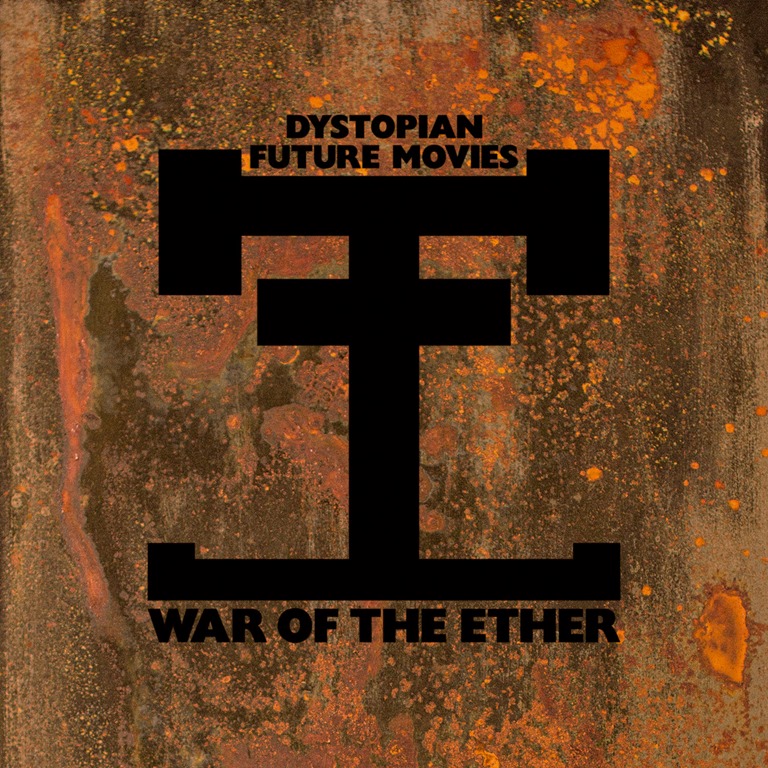
While Dystopian Future Movies’ ‘difficult’ second album, Inviolate, took a full three years to land after debut Time, their third, War of the Ether crashed in after just over two, and it’s an immense sonic documents that the Nottingham trio have compiled in this time.
Back in the spring of 2020, I wrote of Inviolate that ‘Everything about Inviolate is bigger, bolder, more pronounced and yet more nuanced, shaper and more keenly felt and articulated. And every corner of the album is imbued with a sense of enormity, both sonic and emotional: Inviolate feels major-scale, from the driving riffs to the heartfelt human intensity.’ That amplification is again true of War of the Ether. Dystopian Future Moves’ previous releases amply demonstrate a band with both an interest in and a knack for the cinematographic, the dramatic, so it stands to reason that they should extend these focal elements here.
This time around they’ve drawn inspiration from little-reported but truly horrifying events which took place at the former Catholic-run Tuam Mother and Baby Home in songwriter Caroline Cawley’s native Ireland, where 796 skeletons found in the grounds after suspicions were raised by a local historian in 2012. As the press release explains, ‘to hide the shame of pregnancy outside of wedlock, women were sent to homes like this all over the country – forcibly separated from their mothers, many of the children died in infancy due to neglect, and some were trafficked for adoption to the US. The country is still dealing with the fallout from these discoveries.’
War of the Ether is not a joyful record. It is, however, a record with real depth, and imbued with real emotion, as well as an aching sense of tragedy. And, as has been established as Dystopian Future Movies’ signature style, it’s an album which balances riffs and restraint, and is built on atmosphere and menace. They promise an album that ‘explores a wide range of genres from prog and shoegaze to doom-metal, noise-rock and folk,’ and don’t disappoint.
War of the Ether opens – somewhat daringly – with the ten-minute spoken word crawler that is ‘She From Up the Drombán Hill’. For the most part, it’s sparse and spare, tingling guitars gently rippling behind the narrative – but there are bursts off noise, and it swells and grows and when it kicks in, it kicks in hard with piledriving riffage. The dynamics absolutely blow you away – exactly as intended. ‘Critical mass’ is appropriately titles, starting out with a haunting, echoed clean guitar and delicate drums rolling in the distance as a backdrop to Cawley’s aching, melodic vocal as it stretches and soars, and ‘The veneer’ is a magnificent slow-burner that builds to a shimmering sustained crescendo which unusually fades at the end. Against the weight of the subject matter and brooding instrumentation, it feels somewhat frivolous to focus on a fade, but it serves to highlight the many ways DFM are outside trends and exist in their own space. This is never more apparent than on the dreamy but serrated buzzing shoegaze of the title track.
For all its darkness, War of the Ether is a remarkably accessible album – not on account of its myriad hooks and killer choruses, but because it is simply so strong on melody and so utterly captivating. And because, as they demonstrate admirably on ‘No Matter’, the album’s shortest and most overtly structured song – they do have a real knack for snagging the listener with the combination of tunefulness and megalithic riffery. And then, the final track, the eight-and-a-half-minute ‘A Decent Class of Girl’ brings together all aspects of the album in a powerful accumulation of sedate, strolling psychedelia and climactic crescendos that optimise the impact of both.
Magical, majestic, and immensely widescreen, the scope of War of the Ether is simply breathtaking, and leaves you feeling stunned. Awesome in the literal sense.
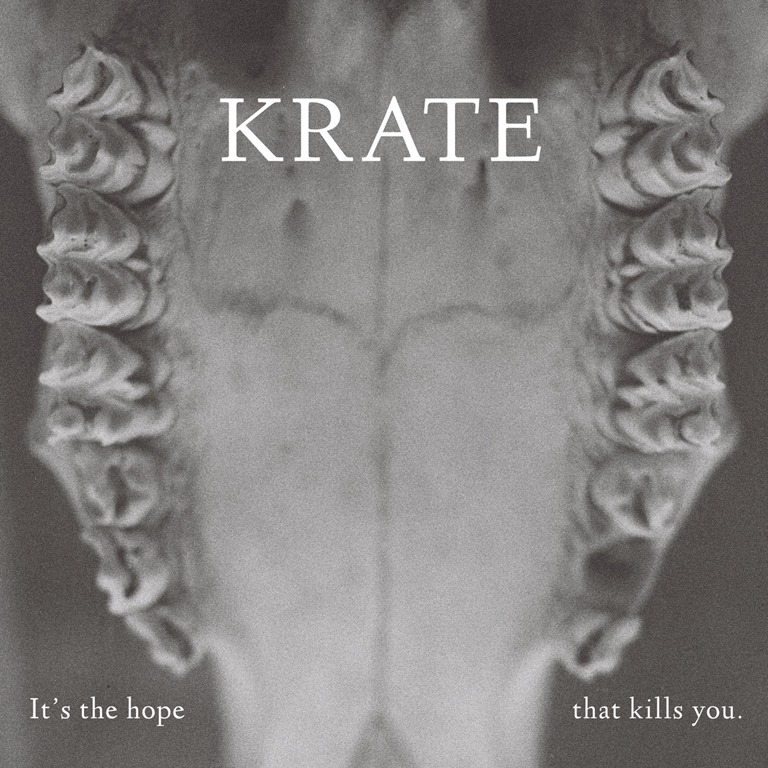
Electro-industrial band KRATE is back and once again teams up with a number of incredible talents on their fourth endeavor, It’s The Hope That Kills You.
The general theme of this release is hopelessness. No matter how hard you try, in the end nothing else matters as all matter is destined to die. Your prayers will be lost while you watch the horizon sink. There is no one to blame but us. We reach for the needle and ask ourselves one last time, "Where do we go from here?" Absolutely nowhere.
Songs like the hard-hitting title track featuring Anatoly Grinberg (Dead Voices On Air) & drummer Dan Milligan (The Joy Thieves). Other tracks feature members of Bow Ever Down, Slighter, Liquid Black Goo and Numbered Men.
Five tracks of electro – industrial spanning the full spectrum of what this subgenre encompasses; from nightmarish beat-driven to heavy orchestral/industrial. The Hope That Kills You is available now on all digital platforms including Bandcamp. Listen to it in full here:
AA
KRATE was born in late 2017 when Chris Shortt (VERIN) and Roland Zwaga (Acidrodent, Construct) began discussing a collaboration.
The initial concept was to compose a dark ambient project between the two. After the first stems were exchanged, however, they both quickly agreed that a rhythmic element would be required to augment the sounds thus far created, leading to the abandonment of the original ambient goal.
Dark electro/industrial beats were submerged in deep cavernous, rumbling structures that were later complemented by an ever growing roster of collaborators.
As the songs originate from the input of such a varied group of artists, the music virtually spreads itself across the entire spectrum of electronic music, all the while managing to craft a cohesive and singularly focused sound.
Hot on the heels of second album Can’t Be Arsed, Cruel Nature have repackaged the eponymous debut from the Manchester makers of ‘kitchen sink punk for the 21st century with a whole side’s worth of remixes from both previous releases – including two pretty radical reworkings of snarling single cut ‘Brain Driver’.
First, to revisit the debut – it’s a primitive, noisy document of disaffection. Adam Stone’s drawling, sneering vocal style is vintage punk, less about holding a tune as conveying attitude, and from the off they set the tone with the seven-minute ‘Food Chain’. A thick, dirty bass grinds out just a couple of notes over a plodding drum while Stone vomits vitriol. If ever a track encapsulated the monotonous drudgery of existing in Boris Johnson’s Britain, this is it. Most of the songs churn away for around seven minutes, but if you’re wondering just how far a band can push low, slow, trudging bass repeating the same simple motif atop a plodding beat, then the answer lies in ‘Half Priced Chickens’ – and the answer is just shy of fourteen minutes. This quarter-hour slog is a gloomy, dark, monotonous trudge: the kick drum sounds like a wet lump of wood, and the sneering shoutiness is replaced by a blank monotone spoken word, and in combination, they create an oppressive sonic fug. The scenes depicted are mundane. Words drift in and out – mobility scooters, office, boyfriend, cough mixture, cheese pasty – and these objects assume bleak resonance as you ask yourself, ‘is this it? Is this life?’ and the answer is there, slumped, devoid of energy, eyelids half closed: yes, this is life. And this is as good as it gets. And it’s fucking endless. Until it ends, in a swampy morass of slow decayed distortion and noise.
The final track, ‘Bunker’ locks into an uptempo groove, but while the drums rattle and bounce away, the mood remains tense, equal parts The Fall and Uniform. As the track progresses, so the anguish builds, and the effect is cumulative Stone hollers roughly about world war as feedback wails and the bass and drums just batter on, and on. Same old, same old…
There’s nothing pretty about Pound Land – the band or the album – and this is a good thing: they deal with the gritty reality of living in shit times. Pound Land articulates the languorous torpor of demotivation, of waking daily to feel the aching anguish of being beaten by life, every minute of every day. Sonically, it’s a long, long way from early Swans, but the density and oppression are very much shared aspects.
By the end of the five tracks, you’re absolutely harrowed and drained.
The remixes are a nice addition, though. The Ruffians on the Train Remix of ‘Brain Driver’ ventures into swampy, almost avant-jazz / trip-hop territory, before kicking into gnarly space-rock swirl. The drums are crisp but overloading, while the bass is pure punishment. Where remixes for most other bands are either dancier or more ambient or whatever, this set – with three of the six from R.O.D., these are primarily exercises in accentuating the gnarliness of the originals, with everything simply sounding even heavier, more crushing.
Pound Land is the real soundtrack to the now. They may have to change their name to Tenner Land before the year’s out the way things are going, so you’d be wise to bag this while you can, and hunker down before things get really tough…
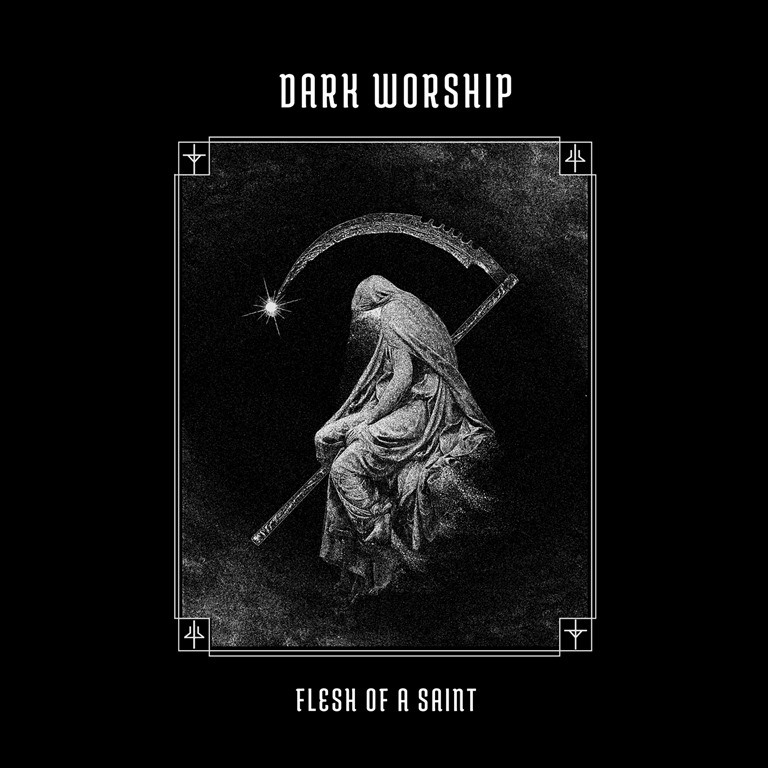
Dark Worship came together in what they describe as ‘the bleak and unsettling landscape of the post-industrial American Midwest’ and is less of a band and more of a collective of musicians from various bands, co-ordinated by J. Meyers (Axioma, Aureae Crucis). They pitch their sound as dark, and it is, but this is a different kind of dark: Flesh of a Saint has the murky lo-fi production values of black metal, which serves the bleak atmospherics well, but it’s not metal, and nor is it dark ambient or tethered to any specific or clear genre.
The two-and-a-half-minute shock of ‘We’ve Always Been Here’ begins as an ominous drone before erupting into swampy grunge spewed from Satan’s sphincter: there’s a nagging guitar riff half-submerged in the mix, and a thudding kick drum stammering out a beat that’s on the brink of a panic attack, and it only gets dingier from hereon in.
There may only be six tracks with a total running time of just over twenty minutes, but over its duration, Dark Worship live up to their name: punishing percussion hammers and clatters before giving way to doomy, funeral synth drones to provide the backing to harsh, shouted vocals on ‘Culling Song’, and it evokes the mangled noise of Prurient. It’s heavy listening. ‘Hollow Body’ brings a rasping vocal, the empty rasp of the walking dead, grating from a purgatorial pit shaped by a pulsating low-end throb.
If the final ‘Well of Light’ sounds redemptive, the light at the end of the tunnel, think again: it’s more like being sucked into the vortex after the last drops of energy have been sapped from your limbs and you hang, lifeless, waiting for the end. Oblivion can’t come too soon. Worship the dark.
So I’ve been bigging up OMNIBAEL from the outset – not because I’m acquainted – that cuts no ice with me as a critic, and if I don’t dig the music, I’m not going to back it for anything – but because I really rate what they’re doing. And what they’re doing is… well, they’re not entirely sure. OMNIBAEL are on a voyage of discovery, and they’re inviting you – and me – and all of us – along for the ride. They have no idea where it’s headed or where it will end, and that’s a large part of the appeal. So much supposedly ‘experimental’ music is scripted and scored. Rain Soaks the Earth Where They Lie is an experiment within a long-term experiment.
Each release to date has been a document of an evolution, and their debut album roper is no exception. Twittering feedback gives way to ripping riffage that’s distorted to fuck on opener ‘Mind is a Mess’ that’s the gnarliest of black metal melted into the darkest pits of burning torture, a missive from a purgatorial inferno.
I may have written on this album elsewhere, including some abstract liner notes that capture its essence, but I haven’t previously reflected in detail on the listening experience. It’s not pleasant, but it is intense, and it is, in the same way as it is with listening to Uniform, or The Body, a full-on body slam. It’s not easy, it’s not comfortable, and it’s a physical experience – one that’s like taking a kicking from a gang. Drums hammer in like boots reining in on the ribcage, and there’s absolutely no fucking mercy across the album’s nine tracks.
The churning murk of the eight-plus minute ‘Last Days’ is pure Throbbing Gristle, and this is dark, gnarly, nasty. ‘The Repetition’ starts with a mess of overlayed tape loops that’s very much reminiscent of the Burroughs / Gysin tape loops that so influenced Cabaret Voltaire in the early days, and after a moment of crackling electronica that strays into Whitehouse / Merzbow territory, it plunges deep into torturous melting industrial metal, a dingy mess so dark and so charred as to be corrosive to the organs. It ccu88ulminates in punishing screeds of howling feedback atop thunderous percussion that hammers like thunder. There are some deeply fucked-up vocals low-down in the mix, too.
It’s not pleasant, and listening to this breeds tension upon tension, you feel your muscles tense and your head grow tight at the temples and the back of the cranium. If the dank and gloomy ethereal ambience of ‘Rung Keep’ evokes swimming underwater, it equally feels like the soundtrack to drowning slowly, and there really are no breaks on this album: despite its sonic and textural variety, it’s heavy all the way. ‘Sound of the WW2 Story’ may be a brief interlude with some soft ambience akin to the swafting of a jellyfish, but it’s still dense, tense, and oppressive, and offers but two minutes breathing before the thundering punishment of ‘Flowering backwards’, which callas to mind Swans circa 1986 and early Godflesh in dub form. The volume, the power, the force, all combine to create something utterly cruising.
Listening to Rain Soaks the Earth Where They Lie is hard. It’s a brutal nihilism I’ve been craving and welcome unreservedly; it articulates the fact that life is pain. But the pain is without letup. Rain Soaks the Earth Where They Lie is uncomfortable, painful, and very, very necessary.
It’s a cliché to say ‘I don’t know where the time goes’, and it’s often, if not an outright lie, then at least somewhat disingenuous. Between dayjob work, school runs, cooking, other domestic chores, gigs, occasional TV, and writing reviews, it’s pretty obvious to me and most people who know me where my time goes. I know where my time goes. This doesn’t make it less of an issue. The fact I’ve been chipping away at this particular review for days, even weeks, adding a few words here and there, is testament to the time-deficient lifestyle. I can’t even quote remember where I was going at the start of this by the time of the finishing point, but ultimately, I suppose the point is that time is something that is ephemeral, fleeting, something of which we’re all too often acutely aware and are in thrall to and yet at the same time, it is simply a construct by which to structure our existences.
This split release on Newcastle cassette label Panurus Productions promises ‘two sides of bleak catharsis on this transatlantic split from Petrine Cross and Tower of Filargyria.’ And that is precisely what it delivers, with three tracks from each artist, both of whom scour the depths of darkness in contrasting and complimentary ways.
Black metal may have relatively modern origins in musical term, but its murky invocations speak of something altogether more ancient, and Petrine Cross has a way of transcending time and genre, taking the standard tropes and merging them with atmospherics so dark and dank as to blur to near-ambience. The muffled production values which are core to the genre are something not only embraced here, but utilised to create a distancing and a sense of ‘otherness’: this isn’t drums, guitars, vocals, it’s a dense wall of sound that envelops your entire being, and smothers the senses, stifling, suffocating, like a cloud of mustard gas.
There’s a point near the end of ‘Sobriquet’ where everything simply erupts into an explosive crescendo that hits like a bomb, and the sound is like mud, dirt, rocks and splintered body parts – being splattered in all directions from an immense crater. You’ve no idea of the song’s lyrics or real meaning, only the impact of this devastating moment. But there’s light. The third and final PC cut, ‘The Grecian Bend’ seems to offer glimmers from amidst the murk, with some delicate wisps and washes of sound. There’s a rare subtlety and delicacy about this that resonates on a subconscious level.
Tower of Filargyria, apparently referencing ‘the medieval term meaning love of money or silver, rail against their monumental namesake, produce three tracks of sample laden anti-capitalist black metal’. We have to take this on trust, of course, as what this manifests as is a blistering assault of guitars so trebly they hurt and snarling vocals with so much reverb everything clangs into a mesh of noise, the drums thumping away somewhere low in the mix like a pillow thwocking around in a washing machine.
Samples of lectures and speeches dissecting the beast of capitalism abound, and the semi-ambient opening to the third and final ToF track, the eleven-and-a-half-minute ‘Capitalfascist State Apparatus’ (no question about the sentiment / agenda there) works particularly well in the way it draws the listener in – which makes the ‘metal’ section all the more disappointing, being quieter, and of a very different sound quality. It feels more like a demo than a finished take – but for that, it’s true to black metal production values, and it’s one of those songs that gets better as it goes on, and builds and builds to a roaring crescendo of howled, raw-throated vocals and thundering percussion amidst a squall of guitars and feedback. It’s a real whorl of noise and comes on full-throttle, and this – THIS – is the release. It’s been a long time in coming.
Catharsis is hard to beat, but the downside is that it’s often hard to know how to manage the drop, the slump which follows – and it inevitably does. This split release is all the catharsis, and it’s one the listener can project onto and draw inwards from. It has immense (dark) force: the only slump is for the listener on the realisation that after forty-five minutes of immersion in the gnarliest, most painful depths of anguish, it’s over.
Pink Turns Blue have been around practically forever, having formed in 1985, and while they may not be widely regarded among the first wave of goth acts, they very much emerged from that milieu as a duo with a drum machine, and what they’ve achieved over so many of their peers while lingering on the peripheries is longevity. Having re-emerged in 2003 after an eight-year hiatus, they’ve continued to mine the classic post-punk seam that’s distinctively theirs, due in no small part to Mic Jogwer’s vocals. And of course, what goes around comes around. Their return in the early years of the new millennium was well-timed, coinciding with the point at which the post-punk renaissance bloomed with the likes of Editors and Interpol breaking through. There were of course countless also-rans, and bands who emerged but failed to fulfil their promise, but nevertheless, time has proven that the style has remained current, and the darker the times, the greater the craving for dark tunes, and this is where Pink Turns Blue really prove to be as contemporary and vital as ever.
Their eleventh album was written, recorded, mixed, and mastered during lockdown in their Berlin studio, and the first thing that strikes about Tainted is just how bleak it is. It’s achingly majestic, it’s magnificent, and possesses some wonderful hooks and choruses, but there’s an all-pervading atmosphere of sadness, of melancholy that’s draped over every beat and radiates from every note. Glimmers of positivity are dampened by an air of resignation, optimism doused with defeat. The next thing that soon becomes apparent is just how consistent the album is. It’s not only all killer, but had a remarkable cohesion. It’s true that that for cohesion you might interpret sameness, and they do operate with a fairly limited sonic palette. One suspect this is at least in part the result of the material being the product of three guys in a studio without any external input or interference.
But working within such limitations places the focus on the songwriting, on the tunes, on the delivery, instead of throwing in all sorts of fancy stuff.
The guitar to opener ‘Not Even Trying’ evokes the into to ‘Severina’ by ‘The Mission’, and it’s got that same solid four-four strike on every beat bassline that Craig Adams made his signature back in the early days of The Sisters of Mercy, and which has become something of a defining feature for so many gothy post-punk bands, and it makes the song an instant grab. ‘I’m not even trying’, Jowger admits blankly, as if admitting defeat from the outset, and setting the pessimistic tone that echoes through single cut ‘There Must Be So Much More’. It’s a song of yearning, of questing, and of determinism, and a song Editors would have likely killed to have penned for one of their first two albums.
This isn’t an album of depression, but the sound of downward-facing defeat, of staring at the ground and wondering where it all went wrong. ‘Never Give Up’ encapsulates the conflict, the inner turmoil of staring emptiness and defeat straight in the face and realising there are only two choices. But to never give up is not a positive thing, merely the stubbornness that comes from not knowing what else to do.
The bass and guitar are melded together in a tunnel of chorus and reverb, and tied to a relentless drum track, and it’s gripping and compelling. ‘Why Not Save the World’ has heavy echoes of mid-80s Depeche Mode and would sit comfortably on a She Wants Revenge album, while ‘I’m Gonna Hold You’ comes on like New Order as covered by A Place to Bury Strangers, with a nagging bass and brittle guitar that grips hard.
Just as Robert Smith can make a skippy pop song sound tear-jerkingly sad, so when Jowger sings of the joys of ‘a new day’, it’s with a wistful melancholy that aches deep and you feel something tug in your chest as you swallow it down, that inexplicable sadness. ‘Listen to the bumble bee’ he sings on ‘Summertime’, and it’s carried a way on a chiming jangle of guitars that are so wistful, while the tone is of deep nostalgia. A perfect sunny day can have its joy marred by the realisation that it isn’t quite as perfect as sunny days of a time gone by, happy, carefree times that will forever be trapped in the memory as magical, but now faded and never to be recreated.
The song structures are comparatively simple and straightforward, and built around repetitive chord sequences and guitar motifs, and there’s nothing fancy about any of the playing – which is absolutely key to the success.
Any fan of Interpol or Editors would do well to explore Tainted – but then again, so would any fan of not only post-punk, but anyone with ears and with a heart and soul. It’s a masterful work in music of the mood. The mood is low, the mood is sad, and this is an album of real depth that speaks and resonates beyond the immediate.






 Aural Aggravation