Welsh avant-garde ‘post-rock, post-pop (post-everything)’ band Photographed by Lightning, consisting of Syd Howells (words and music, vocals and instruments) and D M Mitchell (music, instruments, painting) have released their first album in a long time – a 20-years long time, in fact.
To accompany / promote the release of NO, Not Now, never, they’ve made and released a video for ‘Hands of Humans’. While the review of the album is in the pipeline, you can watch the video here:
Stewart Home’s career to date has been enviably long by any standards, and extremely varied: emerging out of the London punk scene in the 80s, his modus operandi was – and remains – subversion, playing with form and literary theory in equal measure. The idea that a writer who cranked out lowbrow pulpy trash which was littered with references to highbrow theory, smashing the two together in a fashion that was the epitome of postmodernism confused and annoyed a lot of people, but earned him a substantial cult reputation at the same time.
His style and subject matter have evolved significantly over the years, although – some notable exceptions notwithstanding, in particular Tainted Love and The 9 Lives of Ray the Cat he has continued to utilise certain tropes, elements of cliché, and display a truly audacious streak is evident throughout his work. His work is serious / not serious, and he’s serious / not serious about it.
One defining feature of Home’s career is that it has always been forward-facing, often promoting the next book over the one most recently released (and he’s exceptionally dedicated when it comes to promoting his work). Even when reflecting back – as much of his earlier work did, on youthsploitation novels of the 90s did on the culture of the 70s – Home was anything but nostalgic in his angle, presenting as much of a critique as a celebration. Revisionist, parodic, comedic, yes, but not nostalgic.
Even Tainted Love wasn’t really nostalgic, and nor was She’s My Witch, which was fun and frustrating in equal measures, apart from near the end, when it became so, so sad. Home has the infinite capacity to confound expectations: for all of the overt revelling in ‘trash’ writing that most academics would dismiss as not even being within a mile of the field of literature, and for all of his one-dimensional characters who exist simply as vehicles to carry – often quite thin – plots and stand as ciphers for more theoretical ends, Home is clearly a writer capable of emotional depth.
The circumstances of the publication of his most recent novel, Art School Orgy (which is very much not concerned with emotional depth), are worth considering in terms of what they tell us about the relationship between art and society. It would be too easy to pursue the ‘cancel culture’ route of discussion, but this feels like obfuscation of real issues. Times have changed significantly since the time of Home’s early novels, the violent, pulpy, parodic Pure Mania, Slow Death, and Come Before Christ and Murder Love. The perception is that society has opened up and anything goes now, but the fact he struggled to find a publisher willing to take on Art School Orgy suggests the opposite is true. Publishers are fearful. Fearful of recrimination, and fearful of not clearing their margins. It’s the perfect illustration of why art and capitalism are incompatible, and it was this situation which resulted in the book being published by a record label. Despite the music industry being dominated by a handful of huge major labels, independence and DIY in music are lauded, and aren’t subject to the same snobbery which pervaded publishing, which is still moored to old conventions.
What’s interesting and surprising in some respects about Home’s two forthcoming publications is that they’re both reissues from way back in the past: debut novel Pure Mania, and an obscure and long-deleted CD of punk tunes, Stewart Home Comes in Your Face.
Had Home been touting Pure Mania round agents and publishers now, it’s almost certain none would bite, simply because it doesn’t conform to the extremely narrow prescriptions of what they’re looking for. If it’s not the next Harry Potter or Games of Thrones, or something that will sit beside Karin Slaughter or Lee Child, then most publishers simply aren’t interested. It’s all about the bottom line, and what can sell millions stacked on the three-for-two table at Waterstones.
It had been a while since I’d been in contact with Stewart, other than a few exchanges around the time of my review of Art School Orgy, and even longer since my last interview, so this seemed like the perfect opportunity. What follows is a simple Q&A conducted over email, but on a purely personal level, I feel like we achieved some good riffing on some pertinent topics.
ER: Since the material on the album was written in the 70s and early 80s, and then recorded much later, in the 90s, it must feel quite strange to be promoting Stewart Home Comes in Your Faceand making promo videos now. How do you feel about the songs now with the benefit of so much distance?
SH: At first I found it hard to listen to the songs again. They almost seemed like something someone else had done but they grew on me once I got over the fact that my voice is what it is, and much as I’d love to be able to sing like Aretha Franklin that’s never going to happen. Likewise my guitar playing has always been rudimentary. So once I’d learned to accept my musical limitations once again, I found the songs very funny. It also struck me as hilarious that I should keep returning over decades to tunes that had been knocked up very quickly with little thought about arrangement. A decade and a half and sometimes more between writing and recording, then nearly 4 decades before I thought about making music videos for them.
With the music videos it was interesting to see how much I can get into the pretty juvenile state of mind in which many of the songs were written… I actually had no problem with that. I did a video for ‘Destroy The Family’ first because I saw I could fit that with the coronation by using masks of the royals on myself and a couple of sex dolls. The video I’ve shot for the song ‘Kill’ was even easier. I bought a teddy bear in a charity shop, took it into a wood and had a friend film me stabbing it with a large kitchen knife! I still need to edit explosions and other stuff into that, so it isn’t finished but will be soon. And I don’t want to put the music videos out too close together anyway.
I think the distance I have from the songs really helps. I can take them even less seriously now than I did at the time and that enables me to do things visually with them that I might have thought were too crass back then. I also like the way music sneakily builds online and elsewhere. It’s got much harder for my anti-art videos to gain much traction on YouTube, so music videos seem like they might be a way around that. The old content of the songs becomes something that gets people looking at the new content of the visuals, which is what I’m more taken up with now.
Of course I’m also making non-music videos. In terms of books promo, which the music videos link to as the songs also appear in my reissued novel Pure Mania, here is a series of video book sculptures made by me and artist friends where there is a video on small screen and a shelf with a pile of my books. The sculptures have 15 of my books to start but these are for sale retail and with each book sale, the price of the video sculpture goes up because less is more and you’re getting less. For Defiant Pose, I recite an eight-minute passage from that novel while standing on a Swiss ball and being tickled with a feather, so I’m trying to keep my balance and finish the recitation. So that’s a far more conceptual/live art approach to videos simultaneously connected to my novels.
The promo video for ‘Destroy the Family’ has given an old song a new contemporary relevance. Your position on the monarchy doesn’t really require any kind of interrogation, but do you think that Charles’ accession has raised the levels of anti-monarchy sentiment, particularly when the division between rich and poor (and especially those whose wealth is funded by ‘the taxpayer’) has never been felt more acutely or been more closely scrutinised?
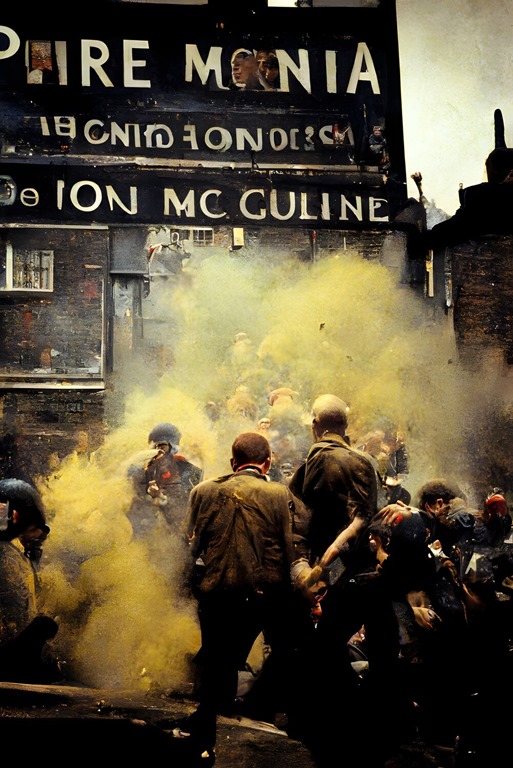
I think we’re a lot closer to seeing the abolition of the monarchy than we were 25 years ago. You could say the image has cracked. When the cops busted up the Sex Pistols boat party promoting their anti-monarchist single in 1977, there was no mainstream sympathetic press coverage. Although the same kind of heavy-handed repression went on with the arrests of those expressing anti-monarchist views at the coronation, the mainstream press clearly can’t get away with the type of coverage it did in 1977. The fact that Charles Windsor is clearly an entitled windbag with dodgy friends and family means that many don’t like him. With the cost-of-living crisis, the ostentatious way the royals flaunt their wealth can only add to the fast-rising tide of anti-monarchist sentiment. It is time to strip the royals of their titles and wealth!
In terms of my performance on film, you can see I have been practicing with the martial arts weapons I use to attack the sex dolls with royal family face masks. That said my staff and sword fighting skill is still a little rough and it isn’t as graceful as it night be although still potentially deadly. So I think that mirrors my guitar playing at the point I wrote the earlier songs and also when I recorded them. I had a seven or eight year break from playing guitar before picking it up again for a few weeks to make those recordings.
AA
You described ‘Destroy the Family’ as ‘super-dumb 2-chord sleaze-bag thud’ (a phrase which appeared in the introduction to the second edition of Cranked Up Really High), and have variously been somewhat critical of the limitations of punk. As you yourself came out of the punk scene, to what extent is your own musical work parodic in its use of tropes and cliché? And to follow on, while songs like ‘Kill’ clearly aren’t ‘serious’, is there an element of catharsis and / or a serious element to simplistic sloganeering?
I think there’s a sympathy for the nihilism late-capitalism breeds in many people but also an attempt to make it clear a ‘blow it up’ or ‘hang them all’ response to exploitation should be moved on from. We all need to rediscover our humanity and reclaim it from the ways in which capitalist alienation have deformed us. But to answer your point, yes there is a certain catharsis in there but it’s undercut. In Kill for example it’s subverted where the words in the chorus are changed from “kill, kill, kill, fucking kill everything” to “kill, kill, kill, practically everything”. Hopefully people get the point that there is no one size fits all one time solution to the world’s problems. We have to keep working at them!
Punk should be fun regardless of musical limitations, What I’m critical of is the art punks who make too much of a fetish of not being able to play. You may as well play as well as you can but that doesn’t mean you have to make it complex. I’m a real fan of super-dumb sleaze-bag 2 chord thud when it rocks, what I don’t like is when it’s leaden.
There are few, if any, genres where authenticity is as highly valued as in punk. You’ve essentially built a career since the early 80s with your zine, Smile to ‘stage an ongoing assault on notions of authenticity’ and have espoused the concept of ‘radical inauthenticity’. Yet ironically, with perhaps one or two notable exceptions, such as Tainted Love, you’ve avoided the mainstream by producing work that’s antagonistic to not only the mainstream, but to academia, and the middle-class, middle-brow readership, while at the same time being too subversive and challenging for – sadly – the vast majority, which suggests you’re perversely authentic. How do you reconcile this?
To use a pat formula, I don’t think I can reconcile it while living under capitalist social relations…. But it could also be seen as a dialectical ploy and one that’s not uncommon in more art school orientated punk rock – although that’s not really the racket I make. Even back in the seventies I thought groups like Wire were operating in that way. Or to take a US example Devo. That said, I think I’m more parodying everything from the Clash to the anarcho-punk scene. One of the reasons other than the music I liked bands like Wire and the punk incarnation of Adam and the Ants, was that they just didn’t seem to take themselves too seriously. In relationship to all the phrase “artificial authenticity as authentic artifice” provides perhaps a more than superficial answer to your question. The Sex Pistols manager Malcolm McLaren used the term glorious failure to describe what he wanted to achieve – but I aim higher, since I intended to reinvent world culture in its entirety, even if that takes a life-time.
In terms of books, aside from Tainted Love I think The 9 Lives Of Ray The Cat Jones and She’s My Witch might have reached a mainstream audience if I didn’t already have the reputation I have. Audiences have a certain expectation of what a Stewart Home or Michael Moorcock book is going to be like and will impose that on everything you do. Because reading a book takes more time than listening to a music track, it is harder in the fiction world than the music world to turn around perceptions of who you are and what you do. If people think they’re not into what you do they’re not going to give a book they might like a chance, whereas they could easily be exposed to some music that didn’t sound as they expect it to be more or less by chance.
Nostalgia ain’t what it used to be, but many of the original first-wave of punk bands are still plugging away on the gig circuit, and while many are doing so to smaller and smaller crowds, some are doing pretty nicely out of it: The Damned, for example, are currently touring the UK’s 2,000 capacity O2 venues before heading Stateside. Would you consider playing your songs live again?
I guess for people who missed those bands first time around there’s an appeal to seeing them now. For me, I don’t want to go and see Slaughter and The Dogs or Menace because I saw them in the 70s. Also the line-ups are mightily changed from back then and the crowds and atmosphere are very different. I’d rather preserve my memories of how it was by not going to see those bands now. As for The Damned, I saw them in 1977 and compared to that I was even a little disappointed by how they were when they reformed after first splitting up in 1978. I saw them as The Doomed and a few times after that back as the Damned, two or three years on from first seeing them and for me they were never as good. Of course, they weren’t bad at all but for me they weren’t as super-phat and groovy as the earlier incarnation of the group.
I actually learned a lot from playing in bands in the 70s and 80s. I can see how a lot of what I’ve done subsequently with spoken word, live art and stand up etc. emerged from how I learned to present myself with punk and reggae bands. But at the same time I’ve no desire to play live again – I’ll probably regret saying that very soon if I find myself just doing it for some reason. But the songs weren’t written for me to sing, I just wanted to play in the band and have someone else sing them. When they got recorded, the musicians around me were saying you have to sing coz you’ve got a profile and they’re your lyrics…. I feel much happier just making music videos for those songs now coz it means I can develop something new with them. I can dig repetition but going back to playing those old songs live just doesn’t appeal to me and hasn’t for a long time, I have been asked to do it!
Pure Mania was your first published novel in 1989, and now commands a pretty hefty price tag on the second-hand market. I suppose as much as it draws on pulp novels, you could call it a punk novel, stylistically as well as in setting. How do you feel your writing has evolved since then?
It’s punk in that it took a reimagining of London 1976/77 punk as its subject and that I had a bricolage approach to writing which is very punk. But at the same time, it’s also a very postmodern novel. Back then I was still learning how that type of novel is constructed, I moved on to anti-narrative after I felt I’d perfected that postmodern simulation of pulp narrative with the follow up books Defiant Pose, Red London, Blow Job and Slow Death. You can also see my prose being honed very quickly, the journalistic approach to sentence construction is clearly smoother in my second novel Defiant Pose. Likewise the narrative/anti-narrative construction becomes slicker but never too slick. I can say that technically my writing improved through practice. But some like rawness best anyway.
I think there was a fairly systematic working through an evolution of material, despite changes in style, up to Mandy, Charlie & Mary-Jane in 2013 – if you discount Tainted Love which was me wanting to fictionalise my mother’s life since no one believed it in non-fictional form. Then with The 9 Lives Of Ray The Cat Jones I went back to Tainted Love and took that fictionalisation of family history in a different direction with a different relative. She’s My Witch riffed on the type of woman my mother was but took someone from my generation down rather than my mother’s – but with plenty of morphic resonance. So I think there are two trajectories in my novels and they fall into two groups. Art School Orgy goes back to the first set of novels and hews closer to the earlier trajectory – it is the book I might have written after Whips & Furs if I hadn’t wanted to write 2002’s 69 Things To Do With A Dead Princess (which was a development of what I’d done in 1997’s Come Before Christ & Murder Love).
Art School Orgy feels very much like a lot of your earlier works in stylistic terms, so I’m assuming the issue for prospective publishers was that the subject was a living artist, and their feared litigation. What were the rejection letters / emails like?
I was only trying independent presses so the rejections weren’t as rude as those I got for my earlier books. Mostly it was a “we’d like to publish you so why do you have to make it so difficult” kind of response. One publisher who doesn’t know me as well as the others said he’d like to do the book but to change the names. Obviously that didn’t work for me. But they feared litigation if the book came out using the names I’d chosen. But so far that hasn’t happened.
AA
A fair few of your earlier books have been translated into Finnish and German. How has the reception been in those nations compared to domestically?
They early books created a much bigger stir in Germany, Finland and Russia than here. In Finland and Russia I had a lot of young female readers, so the audience was also very different. When I had a post box I might go and find a pair of unsolicited used knickers from a Russian fan. In Finland I was the biggest selling writer there for a while in the late-1990s, so I’d had TV crews trailing me around and when I told an old drunk Finnish writer at a literary festival that he should shut up as he was talking through my reading, it became front pages news that I’d beaten him up, although that was an exaggeration. I just gave him a fright by leaning into him and screaming in his ear! I also got asked to appear in a nude celebrity feature in the biggest selling newspaper in Finland, which of course I accepted and I got an all expenses covered trip to Helsinki out of it.
In London I can walk around and no one pays any attention to me but it wasn’t like that in Finland in the 1990s. I went in a record shop to buy some Finnish released records you couldn’t get in London including JMKE, the first Soviet punk band, and they said “You’re Stewart Home you don’t need to buy records!” They gave me everything I wanted to buy and a load of other stuff too as they said I ought to have it. I enjoyed going over to Finland for a week or two and experiencing that sort of thing but I think it would be a drag to experience it full time in London. Anyway, it wouldn’t happen to me in Finland now…. Everything has its moment.
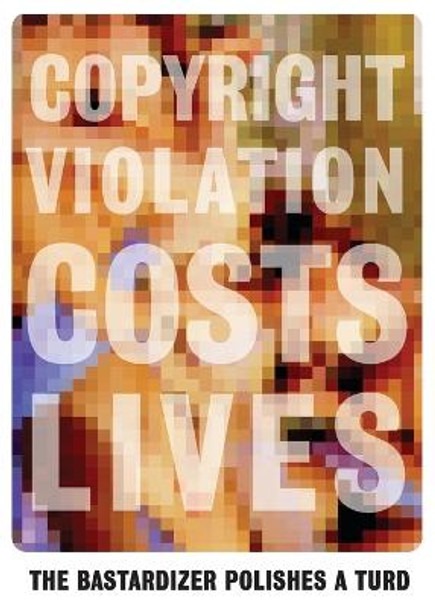
You were recently involved in the publication of Chus Martinez’ novella, The Bastardizer Polishes a Turd, which is a crazy and exciting read. Can you explain Chus Martinez, and also how Simon Strong comes into all of this?
Chus Martinez is a multiple identity project – a lot of different people anonymously producing work credited to the same name – following on in the tradition of projects like Karen Eliot and Luther Blissett. It’s been going in a low key way for over a decade. Chus as a diminutive in Spanish can be either gender and the gendered nature of previous multiple name projects was something those involved with this one wanted to overcome. The Luther Blissett project broke through a lot of earlier blockages but it seemed like gendering was something that still needed to be addressed. Chus Martinez started with a lot of retro-graphics and celebration of the sixties Spanish guitar player Chus Martinez. The first two Chus Martinez novels Copy and Issue came out in 2014 and were published by Simon Strong on his Ledatape Organisation imprint. The novels were written by different people and issued at the same time. Since then Simon has closed down Ledatape, so as there was a new Chus Martinez novel that needed putting out and which Simon had already done the typesetting and graphic design for, so I issued it on my Cripplegate Books. The project involves a lot of different people and although I’m involved, I haven’t yet done a book for it.
The fact that you struggled to find a publisher for Art School Orgy clearly slowed your output in terms of what’s been put out in the public domain, but despite that, you’ve maintained a steady output the last ten years, albeit at a lesser pace that in the mid-late 90s. What’s your method for keeping the flow?
I only write when I have something to say and as there’s plenty that needs addressing in this rotten world we live in, the books keep coming. But I’m constantly writing stuff – not just books and not just fiction. I’d like to write less fiction so I can spend more time on non-fiction. I have another novel written in first draft called Femdom Ninja Lockdown, which was hacked out during lockdown to try and record the experience while also utilising a cut-&-paste composition method closer to IFD and Filmark than Burroughs-style literary cut-ups. I like it but I’m in no rush to get it out. I’ll revise it when it seems like the time is right to publish it. I wasn’t planning on writing a novel, it just seemed unavoidable given the madness of the situation we were all in.
I’ve known a few writers sign up to big contracts with lots of money advanced and it chains them to producing books that they end up hating working on. They’re legally bound to produce these great big books with a literary content when they’d probably rather be writing almost anything else. I’m fortunate never to have been in that position, so I can stay alert to the world and do things that groove me. There is also an issue with those who want an identity as a writer, something that is a terrible drag on actually producing anything interesting. Rather than writing a book because they have something to say, there are way too many people writing novels because they want to appear profound and wise but inevitably they end up coming across as the opposite of that.
I assume you’re still keeping the flow now, so what’s in the pipeline?
Some non-fiction, probably starting with a book on yoga that explores how the term is undefined and defuse, what’s practiced in yoga studios bears no relationship to older Indian meditation traditions that are called the same things. The stretch routines that millions practice as yoga draw heavily on primitive Scandinavian gymnastics but they didn’t receive their confusing name until they were mixed with positive thinking and secularised Christianity dressed up as Hinduism in California at the start of the 20th century. I’ll also look at how the spread of this western yoga is intimately connected to the growth of fascism in the first half of the 20th century. So I’ll provide a corrective to the misplaced idea that some people in the overdeveloped world have that what they practice as “yoga” is a non-political tradition that is thousands of years old and originated in India.
Pure Mania will be published on 17th August 2023 with a brand new cover design in both limited edition hardback, which comes signed by the author and accompanied by an original Necrocard, and paperback, as well as eBook for the first time, via Leamington Books. Stewart Home Comes in Your Face will be released by New Reality Records in September.
I don’t think – or don’t like to think – that it’s an age thing when I say that at some point recently I started to feel not only a separation from certain aspects of mainstream culture, but a seismic wrench away from vast swathes of so-called culture.
Clearly, I don’t fit the stereotype of my peers who decide on turning 35 that there’s been no decent new music since they were 19 or thereabouts, and immediately perpetuate the generation gap musical position that kids today only listen to shit manufactured crap, even if it is largely true.
But more than anything, I simply cannot grasp the concept of the NFT. I mean, what the actual fuck? Cryptocurrencies are insane and seemingly purely for the ultra-rich, but I kinda get them. But paying for a thumbnail GIF? That’s beyond me.
Kaan Bulak’s Illusions has my head swimming, in that it offers not only a multidimensional sonic streaming experience and a length bibliography, but also comes exclusively as a download and offers an art print, and I find myself wondering ‘How’, ‘Why’? The first why is ‘why did it get so bad?’ Like, how is it that artists hawk this shit? As if signed drum heads and the like weren’t exploitative enough (and believe me, they are, and then some). Stepping back from my knee-jerk spasm, I realise I should perhaps give some benefit of the doubt. After all, artists outside of the mainstream have always been compelled to innovate and to find novel ways of not only reaching an audience, but eking an existence that funds their work.
And as the accompanying text reveals, Illusions has been an arduous labour of love:
‘The album had been in the making since 2013, and its creative journey started back then with the track ‘Falling in a Dream’: it was created with violinist Contrapunct playing the melody, when Kaan Bulak had his studio in a techno club above the dance floor, and the thought came that falling asleep must lead to a noisy dream state. In January 2018 Kaan Bulak recorded a prepared grand piano, improvised and locked himself in until numerous sketches were finished. In 2018-2020 he worked on-off on the tracks, including additional recordings on Wurlitzer, oud, frame drums, and electric guitar, and then actually completed them in the summer of 2020. As visible in the quotes in the appendix, it is about a journey into the self through the help of art and philosophy. Zen kōans create an awareness of the illusions and contradictions in everyday life, art makes them tangible.’
Illusions, then, is the product of an immense journey, and ‘Falling in a Dream’ is in fact the last of the fourteen compositions presented here, in a set that’s a shade jazzy, smooth yet angular and unpredictable, with fast-fingered piano and an understated melding of funk and motoric grooves with a dose of hypnotic Doorsy keyboard drone, not to mention minimal techno and spartan disco. There’s a certain slickness to it, too, which gives the album a kind of polish that may attract radio play.
It’s hardly an obvious radio choice, but it’s an album that clearly warrants some playlisting, by virtue of it being, well, a bit out-there. But Illusions is solid, and real, and a nice album.
Kee Avil isn’t an individual, and isn’t really a band, so much as a concept, a collective, a project, the brainchild of Montréal producer and guitarist Vicky Mettler. Debut album, Crease, is pitched as ‘a singular expression of fractured dream logic concretized in chiselled postpunk guitar, sinuous low-end electronics, a panoply of organic and digital micro-samples creating alternately twitchy and propulsive rhythm, and the anxious intimacy of her finely wrought lyricism and vocals’.
It all sounds pretty grand and sets expectations high. Thankfully, Crease doesn’t disappoint. To manage those high expectations, let’s get it established here and now that it’s not a conventional album, with easy songs with obvious or accessible verse/chorus structures.
‘See, my shadow’ starts out with hints of early PJ Harvey but swiftly spins into industrial post-punk with electro/hip-hop beats, more akin to Lydia Lunch fronting Coil remixed by Portishead. It’s a lot to happen in the space of under four minutes, but then, that’s par for the course here: Crease is as jam-packed with ideas as it is sonic strangeness. It’s not an easy album to get a grasp on, and Mettler comes across as quite otherly. Some may say crazy, unhinged, but it’s not that. It’s just apparent she exists on another plane, and Crease shuns conventional structures in favour of exploring avenues of songwriting that more closely reflect an alternative vision and concept of ‘songs’. I certainly don’t mean that as a criticism, but equally, don’t want to sound like a wanker by saying that this is art and therefor superior. I mean, it is superior, but not because of that. To unpack that a bit, Crease is clearly the product of a quite specific mindset, and a determination to find a means of articulating. And sometimes, to articulate is to go beyond language and beyond conventional musical structures. As such, what Crease articulates is a separation from the rest of the world, the turmoil of the mind, the duality of the internal monologue.
‘Drying’ is sparse, glitchy, a clicky clatter and pop of percussion providing an erratic framework for the incidental instrumentation and slowed-down, opiate-haze vocals that are at once sultry and threatening.
‘And I’ is a sparse, scratchy acoustic guitar-based song; the tense picking at times calls to mind early Leonard Cohen, and the atmosphere is muscle-tensingly taut. It’s a masterclass in how less is so much more, and as Mettler’s breathy vocal arcs over the spindly fretwork, a kind of magic happens in the way it draws you in with a hypnotic sensation. ‘Devil’s Sweet Tooth’ lunges and sways, violins teeter on the brink of a breakdown
It’s often difficult to make out the actual lyrics, so you lean in closer in an attempt to get your head and hands around them. You fail, but you’re drawn in closer to the dissonant strangeness that’s more than just music: it’s a world of disconnection and dislocation. It’s unnerving, alien, but likely better than this one right now.
If ever I needed a reminder of just how badly live music – and life in general – was affected by the successive lockdowns and restrictions over the last couple of years (and I really didn’t), then the realisation that my last live music at The Brudenell was Shellac in December 2019 brings in home with a thump.
The car park’s now pay and display and there are more tables outside than I remember, but otherwise, it’s a relief to discover that not much has changed. There are new toilets, meaning fresh toles and no stickers on the wall. The bars are behind Perspex. But it’s the same venue, the same vibe, and the beer is still astonishingly cheap. I soon run into some familiar faces, and it’s like I’ve never been away.
There’s a tangible air of anticipation for tonight’s show, and it’s heightened by the chewy taste of thick smoke shrouding the state. The taste and smell takes me back to early 90s goth gigs, and it’s something I’ve missed. Did they change the formula of the fluid? Or maybe most bands simply don’t use this much smoke. It’s certainly pretty smoggy in the build up to the start of the show, and Årabrot certainly aren’t any run-off-the-mill support act. With a substantial back catalogue, they’ve no shortage of fans in the house, but that’s not all: there’s simply nothing ordinary or run-of-the mill about any aspect of this band.
Årabrot
Samples herald their arrival onstage before they launch into an intense set built around minimal arrangements honed to yield maximum noise, and they rock out hard. Their Frontier schtick image is at odds with grungy noise rock sound, but they’ve got range and even slip into more Bowie-influenced glam. They’re not just tight but exhilarating. The vocal harmonies are strong throughout a set that draws heavily on their last album, the rabid Who Do You Love, from which ‘Maldoror’s Love’ drops early in the set. They dispense rollicking riffs throughout, interspersed with the trappings of evangelism, nevermore pronounced on the frothing howl of ‘Sinnerman’.
It’s a proper pea-souper that’s billowing through the venue for Nordic Giants’ arrival after a seriously fist-pumping 80s soundtrack over the PA. It’s so, so incongruous that it’s absolutely perfect. For the majority of the set, which showcases substantial portions of their new album, Symbiosis, released just last month, they’re practically invisible behind the smoke and strobes, and then there are the extravagant visuals. In their feathered headdresses, the duo are merely shadows on either side of the stage and positioned right at the back for the first song, and only venture forward occasionally when switching instruments. The drums are switched for bowed guitar, and there’s suddenly brass in the mix, too, and it’s powerful. These guys get drama and tension and infuse every moment of the set with both.
Nordic Giants
They must spend as long devising and sequencing the visuals and performance aspect as rehearsing the songs, and there is a lot going on. Rolling piano, all live keyboards, strobes and exploding heads, it’s so much to take in. Immersive is an understatement: the experience borders on the bewildering, but in a good way: everything sits together, and it feels incredibly co-ordinated and immaculately choreographed.
I tend to watch gigs from right down the front, because I want to connect with the energy and immediacy of the stage, to be as close to the action as possible, but sometimes, panning back reveals other aspects, and The Brudenell is one of those venues that means wherever you are, you’re always in the room. From further back, it looked and sounded even more spectacular, the band even more invisible as the smoke and strobes exploded at the climax of a stellar performance.
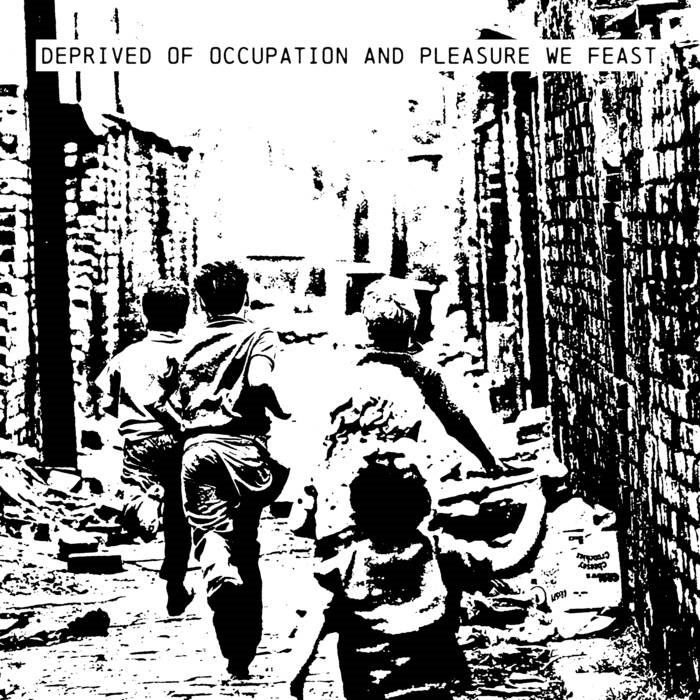
Ahead of the release of the first compilation on the NIM label – the snappily-titled Deprived of Occupation and Pleasure We Feast – Aural Aggravation are immensely honoured to premiere ‘1010’ by Obviate Parade, the exploratory guitar vehicle for Paul McArthur of Damn Teeth.
With lyrics centred around Emily Dickinson’s 1010th poem, it’s a largely spontaneous cut, with all instruments and vocals recorded in a single take (albeit subsequently edited), it’s a magnificent balance of immediacy and controlled manipulation.
Don’t just take our word for it: get your lugs round it here:
Just when things threaten to be getting a bit safe and predictable, with many musical artists having found ways of working around Covid restrictions to record remotely, release digitally and promote by means of performing on line or otherwise streaming shows, the ever-restless Maja Osojnik manages to do something truly different and innovative.
The third release on her recently-established Mamka Records is far, far more than just another digital single, and it’s not just about the music, either: it’s about both art and artefact, and forms the very fabric – literally – of an exhibition as well.
With Matija Schellander, Osojnik is Rdeča Raketa, and for this project, they’ve teamed up with author Natascha Gangl and evolved a genre unto themselves, in the form of the ‘sound comic’ (or beautifully evocative ‘Klangcomic’ in German). The concept – whereby, as with comics, ‘where words and images merge into one another, here it is the spoken word and sound which blend together.’ As such, this is a graphic novel in audio form, a juxtaposition of word and sound that conjures an alternative space in between, a cut-up collage of sorts.
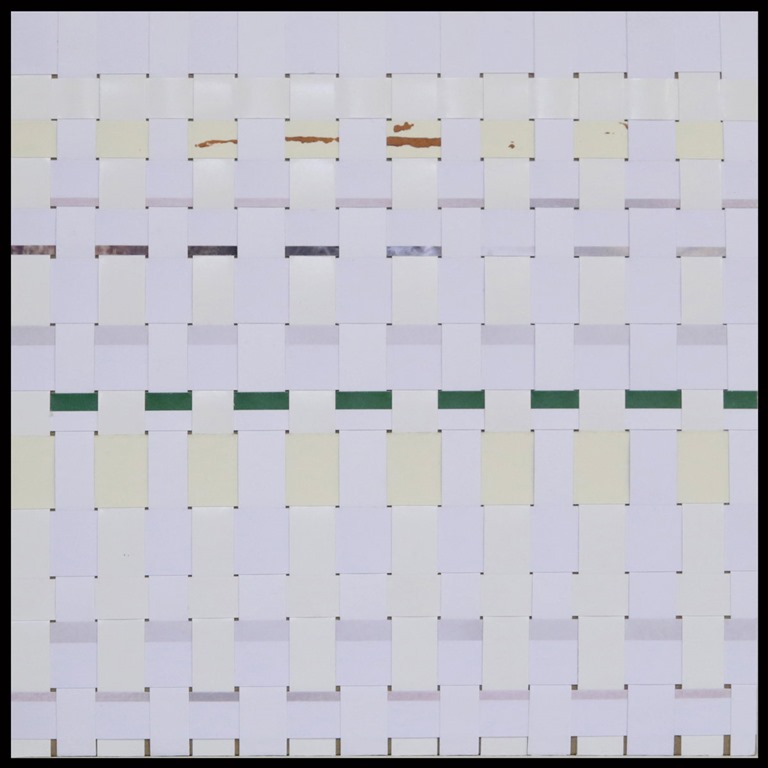
But first, the artefact: as the liner notes explain, ‘Each individual record is its own uniquely woven and hand-printed specimen. Woven from the randomly selected strips of paper, cutting remnants from the other works’. Consciously or otherwise, this links the project into the lineage of cut-up forms that feeds through from Tristan Tzara to Kenji Siratori, although perhaps most obviously via William Burroughs. The assimilation and recycling of pre-exiting material taps into the subconscious on a level that’s difficult to explain, conjuring a strange sense of deja-vu, whereby the ghosts of those remnants and scraps of other works forge a subliminal nexus of intertextual references, reminding us of the things we know, but don’t know that we know (to paraphrase Burroughs).
‘Superandome’ very much exists within this territory of the simultaneously familiar and unfamiliar, a murky electronic collage – not really a tune or a song but a shifting soundscape – but an immersive experience. Woozy, tremorous synthy wibbles oscillate and ripple and churn, while a mutter of voices gradually rises in volume and pitch until it reaches a helium-filled cacophony or babble. As with any collage, interpretation is as much about rezeptionsästhetik – essentially what the individual brings to the work as its specific meaning as bestowed upon a work by its creator. And as such, I find myself increasingly on edge, the swelling conglomeration of chatter evoking the anxiety of overcrowding and agoraphobia.
‘Super Random Me’- which is exactly the same 4:28 duration as ‘Superandome’ – is a yet more extreme collage as fragments of voices are overlaid and cut in / out over ominous rumbles, eerie drones, and random tweets. Again, it’s disorientating, bewildering – and yet equally, an encapsulation of the experience of life as lives, a clamour of voices and random sounds all at once.
Both tracks are reworked and edited from a previous work, and so such, are recycled cut-ups that in turn form a self-referential intertext which also challenge the concept of a work of art ever being ‘finished’ or a fixed definite article.
As for the art, in lieu of a conventional single launch, the record was set to be presented as a picture (built out of 110 of the 160 singles) and a video on 17th of December as an Exhibition in the Gallery Kluckyland in Vienna, and the exhibition is scheduled to run until the 3rd of January 2021 – and while at present it can only be viewed from outside, ‘Superandome / Super Random Me’ stands as a remarkable accomplishment that shows once again that it’s the artists of the avant-garde who innovate the hardest. In the year of the lockdown, we need art even more than ever.
‘Walk away… walk around it.’ On the page, the words are devoid of threat or menace. But delivered in a fractured, disembodied voice that carries a strange sense of madness, it takes on altogether different shades of unsettling uncanniness. Amidst creeping fear chords, clicking insectoid flickers and scrapes and scratches, the voice, childlike and compressed warps and twists, as through refracted through a temporal veil or a spiritual force-field of some description. It feels like a communiqué from the other side. The voice is that of celebrated modernist sculptor and Henry Moore contemporary Barbara Hepworth, and this is one of the early moments on Olivia Louvel’s latest release, a work which forms the basis of the artist’s Masters degree, in which she investigates the voice ‘from preservation to resounding, while taking further the voice of Hepworth into the physical space as a multi-speaker diffusion’.
The source material is a 1961 recording of Barbara Hepworth’s voice, recorded by Hepworth herself in her studio in St Ives, the tape’s initial purpose was for a recorded talk with slides for the British Council, with an original duration of thirty-two minutes. Louvel’s resounding is of a similar duration, but instead of a linear narration which details the artist’s working methods, we get scrambled cut-up snippets which strangely still give a semblance of sense, reducing the extrapolations to the barest bones to give a sense of Hepworth’s creative processes and focus. But them, Willian Burroughs suggested that cutting up text (and for the purpose of this discussion, we’ll consider audio a form of text) reveals the truth, and while Hepworth’s talk isn’t brimming with political rhetoric and doublespeak, one feels that Louvel’s cut-up of her words does perhaps bring us closer to the heart of her meaning.
‘Must Carve a Stone’ loops and layers a breathy whisper of the word ‘carve’, which becomes an unsettling mantra. Minimal glitchtronica and hovering, echoing notes provide a ponderous, stammering backdrop to the looping, multi-tracked vocal layerings of ‘I Draw What I Feel in My Body’, and the sparse arrangement creates an uneasy backdrop to the words.
There isn’t a moment that’s comfortable or easy here, and Louvel’s ‘resounding’ of Hepworth is relentlessly challenging as an auditory and sensory experience. But it’s also impressive in the way that it provokes the listener to awaken those senses and absorb a multi-faceted presentation of what it is to be an artist.
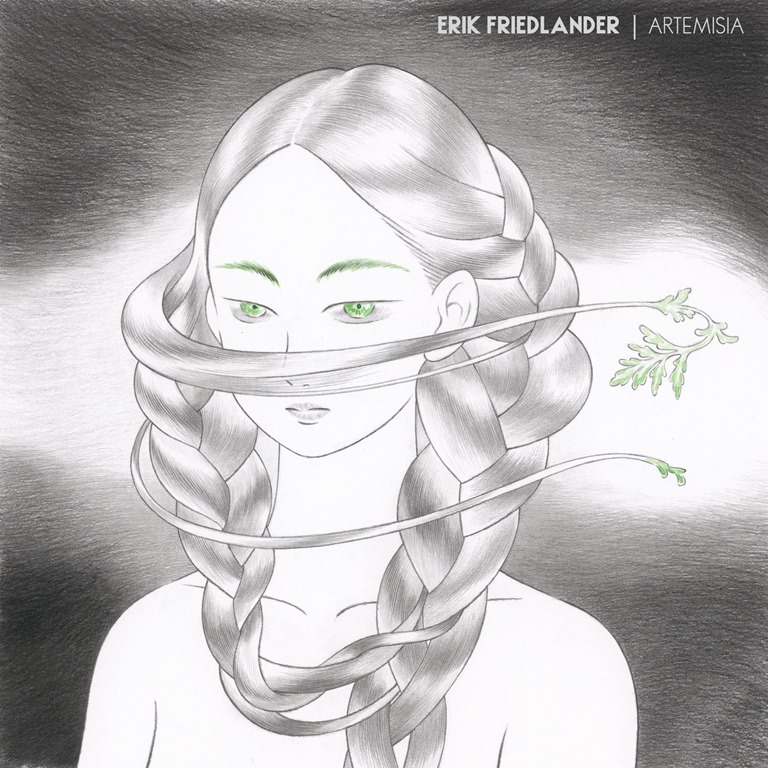
Pun unintended, there’s something groovy about releasing an album as a triple-deck of 10” records. I was never averse to getting up and turning a record over or changing the disc, even though some releases do take the piss a bit in terms of making work by pressing just one four-minute track into a side of a 12” on an album release. But with the 12 tracks clocking in around six or seven minutes apiece and with two per side, Artemisia seems to balance the vinyl experience and the practicalities of playing records.
Artemisia is by turns tranquil and volatile, and this makes sense in context of the album’s inspiration, whereby, as the press release quippingly quotes that cellist Erik Friedlander distills (sic) the brain-bending powers of absinthe, and the darkness of its murky past into his latest project’.
While perhaps one of the most famous works of art inspired by absinthe is Degas’ L’Absinthe (1875-6), followed maybe by Manet’s The Absinthe Drinker (c.1859), it’s Picasso’s absinthe glass sculptures which captured Friedlander’s imagination in 2015 when he visited MOMA.
“The glasses were pretty… kind of innocent on first glance, but as I looked more closely, I found a dangerous side. The front of each glass is exposed – torn away to show its insides. It seemed like Picasso was saying this is what happens to you when you drink absinthe,” says Friedlander. This viewing spurred Erik, who’s played with a host of artists spanning The Mountain Goats, John Zorn, Dave Douglas, and Courtney Love, into ‘an exploration of absinthe’s mysterious history: beneath a glamorous veneer in 19th century Paris lurked accusations of hallucinatory properties and elusive effects that created an atmosphere of addiction and demise’.
That absinthe has – or ever had – hallucinogenic properties appears to be a myth, but the romantic notion of the drink’s properties proliferate in art and writing, and Friedlander’s jazz-orientated representation of the drink and its history is intriguing and at times quite hypnotic. Take, for example the sparsely-arranged, exploratory ‘La Fee Verte’ with its sporadic percussion and mournful strings.
Friedlander’s cello is augmented by a band of collaborators, which includes pianist Uri Caine, bassist Mark Helias, and drummer Ches Smith, and certainly, his cello takes something of a back seat, or at least occupies a less dominant position in these varied compositions which range from the buoyant, focused and direct, to wandering experimental works.
Capac are an electronic duo, currently based Athens and Bristol. But geography is a state of mind, and while details about the context and circumstance surrounding Through The Dread Waste are limited, the music stands for itself. Yes, it’s supposed to contain ‘ten interpretations of the coldest traditional winter music in the form of dark drone and atmospheric ambience’, but without a priori knowledge of the original versions, all that is left is drone and ambience.
The ‘dread’ ascribed to the ‘waste’ is entirely redundant: waste is surplus, unnecessary, for disposal. Why dread it? The sense of portent, of impending doom… Yes, in a world where there is no time to waste, no money to waste, we may rightly dread it. And yet. The waste: anything waste is unnecessary, and should be confronted, not dreaded or feared. And without value or purpose, anything is waste.
On the subject of disposal, the order page for the physical edition of the album is most telling, containing as it does the following: ‘The physical form and true embodiment of the concept behind Through The Dread Waste… You receive a fire log with a metal plate hidden deep inside. After burning the log, among the ashes you will find your metal plate revealing instructions to access the original constructions of the traditional pieces of music, prior to their deconstruction. Destruction, after all, is a form of creation.’ This echoes a classic and fundamental tenet of the avant-garde, namely the premise that one must destroy in order to create anew.
Postmodernism’s defeatism and acceptance of the death of originality is either the last gasp of the avant-garde, or the point at which is necessarily destroys itself to re-emerge, the creative equivalent of stubble-burning at the end of the cycle of growth and croppage. It would be easy to deride the ‘fire log with a metal plate’ but this is art, and there’s precious little the production and release of music by and large, especially in the mainstream. And this is art which is more than merely willing to be ephemeral, and actually invites its own destruction.
The album’s ten compositions are by no means indicative of a conventional, square set-up, as longer tracks are separated and segued by fragmental pieces. And over its duration, there is a lot of piano, and a lot of space. A lot of space. Through The Dread Waste is a sparse, ominously atmospheric set. This is music to stare into space to. At times, its presence is so sparse as to be beneath detection. The lilting piano, the endless resonant air between them, is captivating, yet so understated as s drift into the ether.
The overlaid and unintelligible snippets of voice on ‘Winter Morning’ call to mind the scratchy, pre-fade in discord of ‘Disintegration’ by The Cure. But here, there is no swampy tune riding in on oppressive drums to hammer it all home. Instead, it drifts into another space, and we consider valiant spaces and parallels. Elsewhere, monasterial voices hover in fogy darkness and drones crackle, from eternity.
As such as it’s a spiritual, transportative, and eventually an immediately accessible release (and not in the same sense of ‘accessible’ which is at the centre of the divisive and heated debate which is raging in the poetry sphere right now). Through The Dread Waste has infinite inroads, and is not abrasive or overtly difficult. Yet equally, it’s not dull or unchallenging. It has melody, and drifts in a way you can get lost in.





 Aural Aggravation