Posts Tagged ‘analogue’

22nd November 2025

Christopher Nosnibor

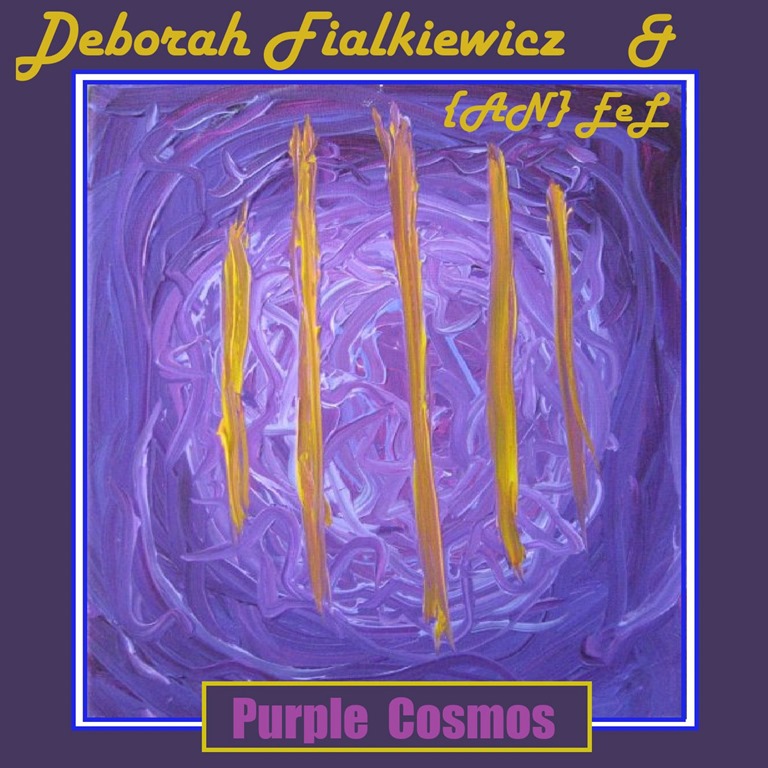
The second collaborative release of the year by Deborah Fialkiewicz & {AN} EeL (aka Neal D. Redke) lands amidst a blizzard of output from two musicians who are both insanely prolific – by which I mean prolific on a scale which isn’t far off Merzbow or Kenji Siratori: they each release more frequently than the average person has time to listen to it. I don’t in any way consider myself to be an average person – and we’ll not go there – but writing about music means that having something play in the background while I do other stuff, like changing the cat litter or whatever, isn’t always something I fancy, and certainly isn’t my way of hearing a release for the first time. Ok, so this is not how, say, my daughter, who’s fourteen, or her generation, or even some of my peers take in new music, but my formative experience of new music involved sitting down and setting a new album to spin and giving to my undivided attention for its entire duration. Sometimes twice in succession, or more on a weekend.

Attention, in 2025, is, it would seem, in short supply. And yet, flying in the face of this, albums with long tracks seem to be becoming increasingly more common. Perhaps it’s a sign of artistic rebellion. Perhaps it’s that artists feel a need to reclaim the focus and concentration associated with longer works. Whatever the reason, it’s welcome, and Purple Cosmos contains three compositions spanning a solid half an hour.

This is a thoughtful, delicate trilogy of compositions, which build from hush to tumultuous tempests of sound incorporating powerful space rock and progressive elements within their protracted ambient forms.

‘The Floating Monk’ is centred primarily around a thick, earthy drone that has the texture of soil, and it’s enmeshed with dark layers of serrated tones and thunderous rumblings. It’s dark and it’s dense, and it’s uncomfortable. The rest of the album doesn’t offer much by way of light relief.

Yes, the title track strays more toward bleepy electronic experimentalism –a different kind of space rock, if you will – and the final track combines wailing synth overload with some persistent beats… but first and foremost this is an unashamedly experimental work.

Purple Cosmos is a work which reflects a rare attention to detail, and it possesses a certain persuasive relentless in its marrying of dark noise, analogue undulations, and insistent beats. There’s more than a hint of Throbbing Gristle about it, and perhaps a dash of Factory Floor. It gets inside your head, and at the same time enwraps your entire being with its otherworldliness. It sure is a far-out groove.

AA

a2147012585_10

Room40 – 13th December 2024

Christopher Nosnibor

Nostalgia is a subject I’ve touched on on a number of occasions in recent pieces, because it’s become something of a preoccupation in contemporary culture. Arguably, this is the natural evolution of the postmodern, an epoch in which the new was primarily a fresh – or not so fresh – permutation of the old. The culture of the twenty-first century has been marked by an ever-increasing acceleration of more of less everything: the accelerated communications and technological innovations and ensuing blizzard of media Frederic Jameson wrote of when defining postmodernism has gone into overdrive, and we’re now moving at a pace whereby we’re nostalgic for breakfast by lunchtime.

Nostalgia is big, big business, and this has been no more evident than in the response to ABBA’s hologram shows and the Oasis reunion. This isn’t to overlook other huge musical events – Taylor Swift’s Eras tour, for example – but it’s fair to note that she’s been established for over a decade and a half now, and can’t be viewed as representing ‘newness’ in any way – especially given that four of her last six albums were rerecordings of previous albums. This encapsulates the way in which culture laps up endless recycling on account of its familiarity.

Comfort culture is rather like comfort food: you know what you’re going to get, there are no unpleasant surprises, there’s probably not a great deal of chewing involved, and it’s less scary than the unknown. The world’s gone to shit, and people feel a real and quite desperate need for that blanket of safety and reassurance that there are still at least some things you can rely on. The good old days have happened, they’re fixed and can’t be taken away. And nostalgia has a universal appeal, because it’s something we all feel for certain things at certain times. We tend to feel – and I accept this is a colossal generalisation – that our childhoods and teenage years took place in simpler, better times. They didn’t, but because we didn’t have the burden of adult responsibility, and were discovering things for the first time, they’re coloured with brighter hues.

This latest offering from Glim – a project by Vienna based musician and composer Andreas Berger – is steeped in nostalgia. Berger outlines the inspiration and creative methodology with enthusiasm:

I have a particular love for cassette tapes and how they can influence the character of sound – even just by the simple fact of being played on different quality sources. I like the way they can color audio material, especially when using lower-quality gear. It adds modulation, sometimes (a long time unwanted) degradation of sound, but also gives a certain nostalgic touch – at least for me.

I recorded (and played) most of the material on an old Walkman cassette player, and what I got in return were some faded sonic Polaroids which might trigger a hidden memory or at least evoke a vague feeling of nostalgia.

Perhaps somewhat ironically, Tape I is only available as a download, or to stream online. The tape revival remains some way behind vinyl, despite the format being considerably cheaper to produce. Perhaps it’s because tapes just don’t have the same effect on Instagram, or hung on your wall.

Having grown up in the cassette / tape era myself, I can vouch for the unique nature of the format. When I started making music, I would sketch stuff out with a condenser mic on a portable tape deck, later progressing to a four0-track portastudio, bouncing tracks down to create additional tracks. Each stage would erode the quality of the audio by some incremental degree, but what it lost in fidelity it would gain in character. You just don’t get those happy accidents with infinite digital tracks, just as you don’t get the same sense of the personal with a link to a playlist as one-off compilation tape with handwritten track-listing, smudges and misspellings and all. Don’t get me wrong: tapes were a massive pain in the arse, difficult to skip tracks, easily chewed, easily overrecorded – and for these and other reasons, I have not leaped aboard the tape renaissance train. I’m happy with my memories, thank you, and don’t feel the need to start spooling reels with a biro to remember the good old days of recording songs off the radio.

It’s the happy accidents, the whorling analogue fogs, the fuzzy edges and softened-off corners which define the eight pieces on Tape I, unnamed beyond sequential number. But while I feel richly textured, immersive atmosphere, and the pull of strains of sonic palimpsests filtering through the recordings like ghostly whispers, vague, elusory, like memories which linger in the hard-to-reach recesses of the mind, and with a somewhat grainy texture like an old photograph or a photocopy of a photocopy, akin to the kind of fanzines which used to circulate in the eighties, I don’t feel as if I am truly connected to Berger’s sense of nostalgia.

Herein lies the paradox of memory, and of nostalgia: as much as there is a unification to be experienced from reminiscing with friends about those good old days, we each harbour subtly different recollections of those experiences, and as such, our experiences all differ. It also highlights the scope for the disparity between intent and end product. ‘1_4’ is incredibly haunting, eerie, and a quite magnificent exercise in ethereal dissonance, and ‘1_6’ is at times barely there, thin streaks of aural contrails drifting through a big and darkening sky. I feel a certain melancholy, a creeping chill, perhaps, but not any real sense of nostalgia. And yet it’s apparent that his creative process has involved a quite intense and personal engagement with the source materials and the tools necessary to create this diaphanous gauze of slow-drifting ambience. This simply highlights, however, the way in which, while large social brackets have a collective appreciation and nostalgia for one thing or another, the detail, when boiled down to an individual level, looks very different when viewed from that specific individual perspective. It’s here where you realise that you are completely alone: not even your partner or your best friend sees that shade of green or purple the same as you do. No-one else’s perception is entirely aligned to yours, and no-one sees, or hears, the world in exactly the same way.

AA

DRM4201 art

22nd December 2023

Christopher Nosnibor

We live in strange times – times which have gone beyond the established expectations of what defines postmodernism into a period which is something else. Something else we’re yet to come to terms with, let alone define. Postmodernism heralded the arrival of what one might call ‘the nostalgia schtick’ by meshing together past, present, and future to conjure something of a liminal territory in which all times exist simultaneously. But if postmodernism, as defined by the likes of Francois Lyotard and Frederik Jameson is primarily defined by an accelerated pace of communication and an overwhelming blizzard of media, one thing which no critics or theorists could have readily anticipated when defining the term was the rush to cling to the recent past, or that the next big boom in industry would be nostalgia and revivalism.

The advent of the Internet heralded a revolution in terms of all things archival. Back in 1996 or thereabouts, when I first got online – with AOL on a floppy disc and a 14k dial-up modem plugged into a second-hand IBM 486 ­ it seemed like a new dawn. It was basic, but text from obscure zines from the 60s, 70s, and 80s and pretty much anything you could ever wish for from the depths of the most subterranean archives was suddenly available, as was anything else. By the early 00s, Warren Ellis’ Crooked Little Vein was the world as it was: if it existed, it was on the Internet. But then the Internet got hijacked by big business, MySpace ceased to be the anarchic free virtual world that it had been, and everything turned to shit. Because capitalism ruins everything.

Amidst all of this, postmodernism is – or was – characterised by a celebration of depthlessness, of rejoicing in its own disposability, what Stewart Home referred to as ‘radical inauthenticity’. Postmodernism was laced with irony, knowingness, self-awareness. We seem to have lost the sense of irony and humourous knowingness somewhere along the way, and as we grapple with AI, deep fakes, and music industry plants, we have come to return to the question of authenticity as something which should perhaps be valued. Admittedly, these debates are perhaps minority issues, because for the most part society is split between those who believe everything they’re told and those who believe nothing, and there is only limited space for nuanced critical debate. It is, of course, hard to have a nuanced, critical debate in segments of 140 characters or so, and this compression, coupled with an ever-decreasing collective attention span has, undoubtedly been damaging in many ways.

The tug-o-war regarding the value of authenticity has been particularly apparent in music, as fellow musicians and critics alike have descended on punk and ‘indie’ bands to challenge their authenticity as exponents of punk and indie. With the rise of the ‘industry plant’ threatening the integrity of the DIY and indie music scene, it does make sense, but the point I suppose I’m ultimately making is that nothing really makes sense anymore, and that everything is a contradiction.

So, at the same time as AI has surged forwards to recalibrate the means of production, we’ve also witnessed a sustained boom in all things nostalgia. As much as it would pain many to admit it, it’s that same pining for the past that has driven the demand for vinyl, cassettes, grunge, tribute bands, as brought us Brexit. Admittedly, a yearning to return to the days of the Empire and when England resembled a Hovis advert is more socially damaging than basking in the glory days of Britpop, but it’s a pretty close call. A significant portion of the success of Stranger Things, for example, is its retro context, which has seen many hailing it as bearing parallels with The Goonies. I can’t help but wonder if this passion for the not-so-distant past is a means of escaping the absolutely hellish present and the utterly-fucked-up future we’re hurtling headlong into.

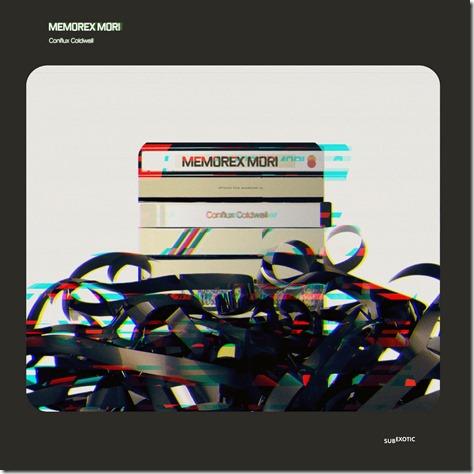
Conflux Coldwell’s latest project is one which plunges deep and direct into nostalgia, and as such resonates with the zeitgeist which has been simmering for a few years now. We’ve all seen it: the ersatz recreation of scratchy recordings, crackles and pops of old vinyl and the warps and snow of videotapes. And now everyone’s back to buying vinyl and audiotapes… how long before the VHS renaissance? And at the same time, it raises the question of ‘the archive’, of the (im)permanence of documents. We have always believed that documenting and recording events was the route to immortality, and that the advent of modern media would solidify our legacy in the same way as The Anglo-Saxon Chronicle or The Bayeux Tapestry. It was not so long ago that the Internet was supposed to be an eternal archive of everything ever. Only now, it’s apparent that modern technology is as ephemeral and disposable as our very culture, and that online archives vanish the moment their owners stop paying for the domain.

Memorex Mori is an unusually authentic work, born out of an excavation of -personal archives, as Coldwell explains: ‘Last year I found a dusty box of old unlabelled VHS tapes at my parent’s house, including some early work of my own I’d long forgotten about. Unfortunately the tapes were all in very poor condition and I only managed to recover some of the material. Despite the bad quality I decided to sample the videos anyway and make something new out of the various noisy remnants – the final result of that extended process is Memorex Mori.

Coldwell himself isn’t outside the frame of nostalgia with this ambitious project, either, as he continues: ‘VHS was the medium of my childhood in the 80s and 90s, and was still routinely used for budget productions by the time I started making films and music of my own. Looking through the old tapes made me realise the ultimate fragility of all our recordings and the memories they hold. These analogue tapes only have an estimated lifespan of 25 years, and this artificial life is only granted to the videos we actually decide to keep. The vast majority ended up in landfill when the world went digital – what was lost in the waste? In contrast, we might think that current digitisation and cloud storage allows our memories to live forever, but they are still fallible. The major difference is that with digital archives this mortality is hidden – with analogue media we can potentially witness that death happening in slow motion before our eyes.’

It’s an interesting and valid distinction between analogue and digital: growing up in the 80s and 90s myself, I remember being told not to vacuum clean near any video tapes, and so on, while toward the turn of the millennium the emerging digital future was presented as eternal. But now, it’s clear, that there is no such thing as permanence, or the eternal, and that any archive is as fragile as life itself.

And so, Memorex Mori is a multi-faceted, multi-dimensional, multi-media project, where past, present, and future collide, and postmodernism melts into the as-yet-to-be-defined present. It’s a film and it’s a soundtrack, and both can be appreciated independently of one another, as intended.

Coldwell expands on his notes, explaining ‘This project continues a lineage started by William Basinski and The Caretaker, exploring themes of memory loss, entropy and spectrality, through the sampling of destroyed recordings. But Memorex Mori extends this idea into the visual realm, presenting a feature-length music video alongside the music. As well as sampling early Conflux works from tape (Traveller, Glitch, Machinedance and Trainboy) various other unknown recordings were appropriated from the video box – all sorts of forgotten cultural detritus including my Mum’s 30 year old Open University programmes. A few modest pieces of equipment were used to add extra sonic layers – including the Korg NTS-1 and a home-made Marantz tape delay – then all bounced back to VHS.’

The video is a disorientating barrage of film clips, from train journeys to clouds, via small aircraft lifting off and droplets of water rippling out. Everything flickers and fades , glitches and warps. At times, we’re simply submerged in a snow of magnetic degradation and ruination, and it’s not always easy to discern what we’re actually being shown. But, often devoid of context, these detached, fragmentary scenes take on a sense of significance. The effect is an uncanny emotional response, a pull in the lower intestine as something unexplained and inexplicable evokes something within. There’s a comparison to be drawn with Memorex Mori and the experimental works created by William Burroughs and Brion Gysin in the late 50s and early 60s – in the soundtrack, the tape experiments, perhaps, but more so the whole audiovisual project, which calls to mind films such as Towers Open Fire, produced in the mid-60s with Anthony Balch, and a step closer to what Gysin’s quest to realise ‘a derangement of the senses’.

The soundtrack is the perfect soundtrack to this endlessly unsettling sequence, an eternally shifting sonic drift that’s at times noisy, even harsh, while at other altogether more ambient. Like the visuals, it draws you in, but it also stands independently as a purely sonic experience, and it’s also a smooth, expansive scene for reflection, and perhaps it’s to be expected that the soundtrack has greater impact when experienced in isolation, without the distraction of the visuals.

As a whole, or in part, Memorex Mori is quite an unsettling experience: visually compelling, and aurally challenging. It demonstrates the fragility of any documentation, any archive, and of life itself. Nothing lasts forever. And it speaks of how, as memory fades, so the documents diminish in value: moments captured in moving or still images which seem so essential at the time lose meaning over time: where was that picture taken? What was I doing there? Why did I think that would be worth filming / photographing? Who even is that?

I feel a weight descend as I reflect on all of these things while immersing myself in Memorex Mori. I can’t even begin to imagine the experience of assembling it. Then again, I can’t really assimilate the experience of other viewers or listeners, either. What’s intensely personal to an artist is likely to hit a spot with the audience, but for each, the reception will differ, based on their own experiences, their own immediate headspace.

But, regardless of individual interpretation, the vast ambition of Memorex Mori is matched by its accomplishment. THIS is a document. A powerful work, which will stay with you long after the silence descends.

AA
a2043088135_10

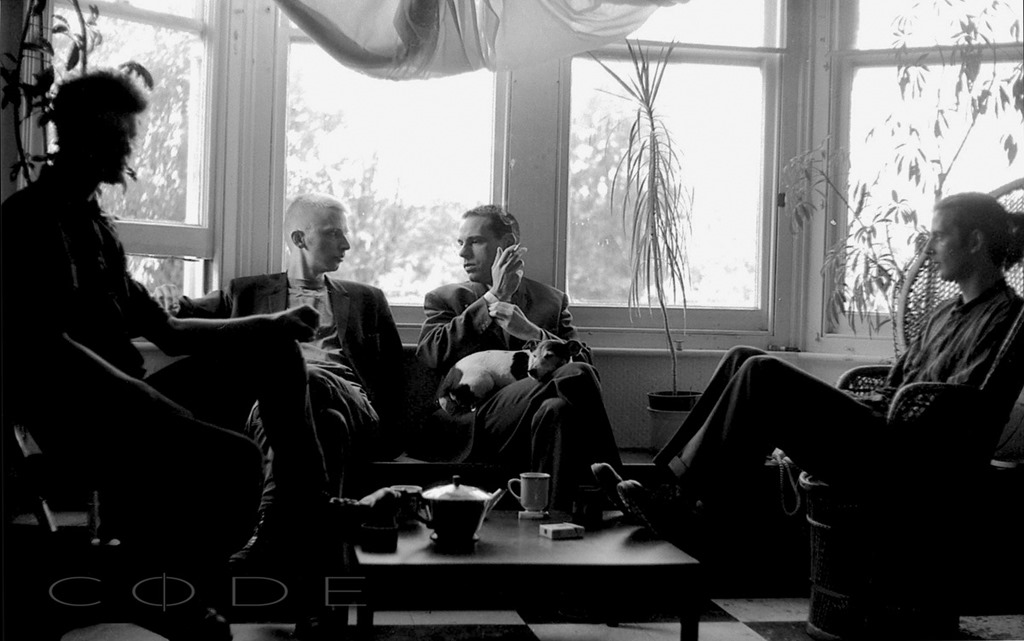
UK electronic quartet CODE earned their stripes in the electronic scene of the early 1990s and were championed by the likes of John Peel, John Digweed and Kiss FM presenters Colin Dale and Colin Faver. Their debut album, The Architect, was issued on the Third Mind label in 1995 just as that company folded, but has often been cited as a cult classic. Its follow-up, Ghost Ship, finally arrived in late 2020 after a 25 year journey and was enthusiastically received by critics and fans.

Like that album, Continuum has been assembled by remodelling material from archived studio sessions and sounds like it could have been made yesterday. Emotionally engaging and exquisitely produced, it is timeless music that, although carrying traces of influences such as Kraftwerk, The Blue Nile, Talk Talk, David Sylvian and Depeche Mode, also has a romantic techno intensity all of its own.

‘Acheron’ is the second single to be teased ahead of the album. An instrumental, it sits in contrast to its predecessor, ‘Pleasure’, which was a slinky slice of pop existentialism. Acheron is known in Greek mythology as the ‘river of lost souls’, although sci-fi fans are likely to be more familiar with ‘Acheron LV-426’, one of three moons orbiting the gas giant Calpamos. It was here that a crew member of the USCSS Nostromo first discovered the eggs of a species of alien that would go on to spawn a highly successful movie franchise.

CODE had embraced the tactile nature of analogue tech from the outset and often jammed ideas as their DAT machine recorded, with each band member presiding intently over one or more pieces of kit, including their pre-MIDI SH101 and Korg PolySix synths, slightly newer Roland drum pads, guitar, 16 channel mixing desk and cassette deck. One of these sessions saw them focus on a version of an existing piece entitled ‘Atlantic’, with the resulting new track being entitled ‘Acheron’.

The band explain that “the challenge was to retain the warmth and idiosyncrasies of the original recording whilst subtly enhancing definition and clarity. This primarily involved reshaping the original nine minute jam into a more concise form whilst enhancing key elements to create a more dynamic soundscape.”
‘Acheron’ appears on the CD and digital formats of Continuum, with the 2xLP release featuring a remixed/remastered version of ‘Atlantic’, which had been included on their debut album.

Watch the video here:

AA

fac0974c27ee288fc93c1e5f929c789fddc655ff

4th September 2021

Christopher Nosnibor

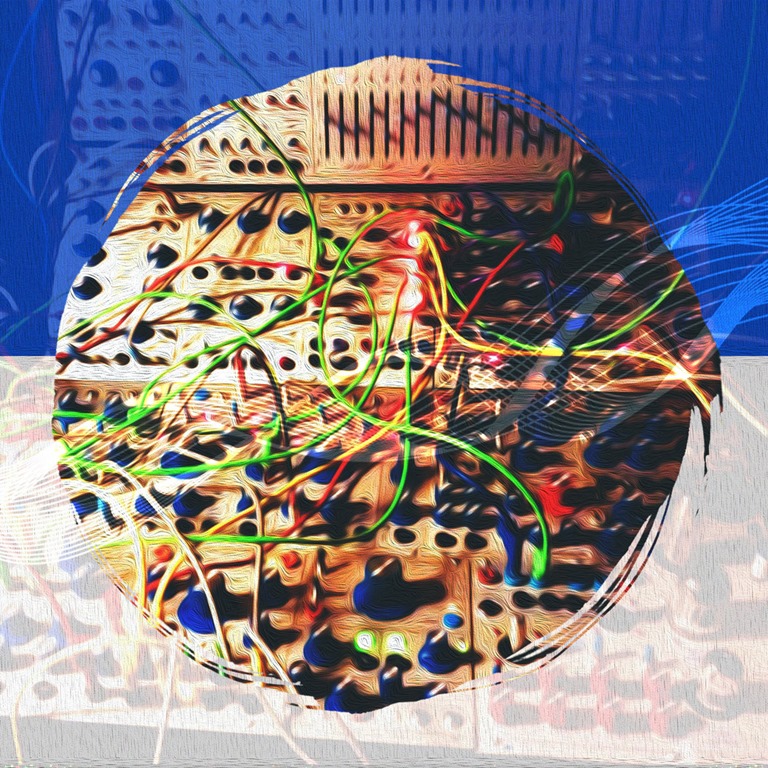
It’s small wonder that there is a huge affection for modular synths, because quite simply nothing else creates the same range of sounds. French label Modulisme is devoted to all things modular, to the exploration of modular synthesis. It’s operated by a small team consisting of Philippe Petit (A&R), Yan Proefrock (Founder, administrator & artistic director), Guillaume Amen, Cédric Languin, and Bas Mantel, and elements of the contents of their website are telling: the header for the links section suggests that ‘To keep our virus spreading Modulisme is relayed thru the following alleys’. William Burroughs references aren’t the only literary and theoretical allusions, and there’s an interesting formal styling to the titles of the label’s releases, which document artist sessions for the label, which is clinical and library-like. Subtitled ‘the birthday session,’ Modulisme Session 051 2nd Year BD commemorates the second anniversary of the label’s existence.

Petit explains that for this release, he elected to ‘« compose » a session instead of improvising’, and explains how he ‘followed the idea of drift as a privileged practice of opening up to the new, the one defined by Debord’… and ‘Following the spirit of situationist irreverence and creativity I hope to stimulate a dérive towards a closer listen…’

In doing so, Petit explores the full range of his modular gear on this outing for an even ten pieces, which include four behemoth workouts spanning in excess of seven minutes, including the monumental seventeen-minute ‘Une villégiature Cosmétique’ which spirals in as the second track.

There’s a lot of bibbling bubbling, frothy, squelchy synth sound on offer here, and much of it is quite palatable; but then, in exploring that range, Petit lands on the grinding unease of ‘Driftin’ to EcsTazy’ which strays into metallic discombobulation and discomfort as it serves up eleven minutes of metallic scrapes, buzzes and agitated drones, but-ups, samples, loops and overlays. It’s neither pleasant nor comfortable, and if on the one hand it’s a thrown-together random work of frivolousness and near-flippancy, it’s equally a reminder that endless ruptures can be difficult to navigate, and ‘drift’ ultimately translates as entirely non-linear and consequently at times difficult to digest and difficult to process.

The two ‘Psychographical Pivotal Point’ pieces may be but brief interludes, but they both pack in an abundance of warping rhythms and general abstract weirdness. No, it is not all in your mind.

Listening to Modulisme Session 051 2nd Year BD is like swallowing a lot of food without chewing, and some if it is hard to swallow. That’s by no means a criticism. Art is supposed to be challenging. And this is most definitely art.

AA

a1561580880_10

Powdered Hearts – 15th October 2020

Christopher Nosnibor

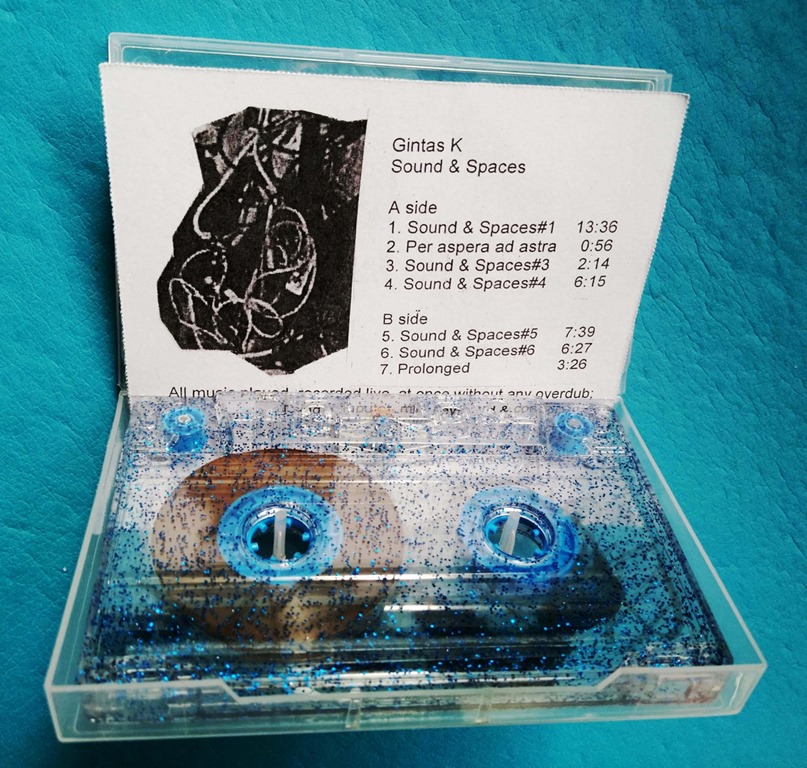
Gintas K releases albums more often than I change my clothes. That’s of course intended as a comment on the prolific nature of his output, rather than a confession about my personal hygiene post-lockdown, although not going into the office or being around people – or ever within two metres of them – has meant I’ve maybe made slightly less effort of late.

The same clearly can’t be said of Gintas K, at least in terms of his work, since I don’t know if he’s been tweaking away at his circuitry in his pyjamas or the same jeans for a week and a half or if he’s been bothering to shave or deodorise daily. I don’t need to, either, of course.

Anyway: Sound & Spaces explores what’s become established as familiar territory for Gintas K, with gloops and bibbles, froth and foam, squelchy bubbles of sound rising up randomly against the crackling burrs of electronic distortion. Sound & Spaces is less attacking and less abrasive than some previous outings, and is les intense and intensive in its interrogation of microcosmic space than some of his previous microscopic, microtonal explorations.

The first track – the thirteen-minute ‘Sounds & Spaces #1’ is a challenging mess of stammers and jolts, fizzing and crackling in a swampy slosh of analogue synth soup. It very much sets the tone, but in context, it’s a comparatively gentle start to what ultimately unravels to be quite a brain-shredder of a set.

‘Per aspera ad astra’ is a brief interlude of tingling, jangling dissonance before ‘Sounds & Spaces #3’ brings a bit of low-end grumbling, whining, and distortion, yawning undulations whizzing and popping all over.

By ‘Sounds & Spaces #4’, it’s almost impossible to differentiate distortion from percussion, and what originates where, although there are distinctly snare-like cracks in the feverish melting-pot of contrasting textures and tones, which become increasingly fragmented, fractured, and overloading as the album progresses. As an album it’s a frothy foment, and while some may find it simply uninteresting or a wash of so much noise they can ignore, I’m unlikely to be alone in finding the experience quite tense and uncomfortable – and nothing more so than the twenty seconds of silence at the end of the overwhelming chaos of ‘Sounds & Spaces #5’

If disorder offends your sensibilities, avoid this recording: once again, Gintas K has captured metal turbulence in aural form. It’s hard to process, but well worth enduring the turmoil for.

AA

a0638906201_10

Room40 – DRM475 – 24th July 2020

Christopher Nosnibor

In one of a brace of releases on Lawrence English’s Room 40 label in July, Australian minimalist Todd Anderson-Kunert presents a selection of Moog synthesiser compositions, which we learn are ‘exercises in intimacy, restraint and unerring patience. Past Walls And Windows plays with how sound emerges and decays. It is an edition that celebrates the ephemeral nature of the medium and the way sound’s immateriality invites a constant sensing and seeking on behalf of those that encounter it’.

These are indeed minimal works, so sparse at times as to be barely audible, and they’re a long way from presenting any sounds conventionally associated with the vintage Moog. Instead of jangly, trilling tones, Anderson-Kunert teases hovering single notes that evoke a sombre, even funeral atmosphere for the most part. There are flittering oscillaations and low, diminishing drones, and they make up much of the fabric of this set, comprising six pieces, most of which sit over the five-minute mark.

It’s quiet and delicate: ‘Better Left’ begins with distant grumbles of thunder, before low ominous notes drone in and halt abruptly, while ‘An Echo’ brings slow pulsations and haunting drones like a trilling church organ ringing out dolorous notes in a sepulchral setting. It’s gloomy, and it’s ambient in the background sense, yet it has the capacity to send the listener inside themselves on a contemplative course.

It’s no criticism to remark that there isn’t a lot to say: this is an album that requires not commentary, but peace, and time: to be listened to without interruption or distraction, and ideally in semi-darkness. It isn’t an album that really raises questions, and it doesn’t offer answers: it simply is. An as a sonic vehicle for contemplation and tranquillity, it’s ideal.

DRM475_art

Southern Lord – 26th April 2019

A new Sunn O))) album is still an event, even after all these years as the leading exponents of droning doom, a field now crowded with imitators and influences. The sense of ceremony is a major factor: Sunn O))) appreciate and command ceremony in every aspect of their exitance. As good as so many who have emerged to follow in their wake may be, there really is only one Sunn O))). The thing with Sunn O))) is that while they very much do mine deep into their self-made seem, each release offers something different, a variation on that consistent sameness.

And so it is on Life Metal that co-founders Stephen O’Malley and Greg Anderson set themselves a production-orientated goal for realising their immense sound, namely to have their playing captured by god himself, Steve Albini. The story goes that Steve took the call, and said ,“Sure, this will be fun. I have no idea what is going to happen.”

The resulting four tracks, which evolved through time in rehearsal, and with collaborative input from Anthony Pateras, Jóhann Jóhannsson collaborator Hildur Guðnadóttir, guitarist / bassist Tim Midyett, and live mainstay T.O.S bringing Moog action, were laid at Albini’s legendary Electrical Audio studio, and the end product (at least on vinyl) is pure analogue, with an AAA rating.

And it certainly brings the band’s earthy qualities to the fore: the richness, the density of the speakers vibrating in their cabs as displaced air emerges as sound in its most overtly physical manifestation is all captured in a way that conveys the immersive, all-enveloping experience of being a room with the band. As is also the case with Swans and A Place to Bury Strangers, the intense volume isn’t a gimmick but a necessary part of the sound and the experience. Some frequencies simply don’t exist at lower volume, and tones resonate against one another in a certain and quite different way when everything is turned up to eleven and then maximum gain applied. And the effect is transcendental. And whereas its predecessor, Kannon was comparatively concise, with its three tracks clocking in around the half-hour mark, Life Metal goes all out on the expansive, the four pieces running for a fill seventy minutes.

It begins with a distant rumble, before, after just a matter of seconds, the first chord crashes in: thick, dense, so distorted and low-registering as so almost collapse under its own density. But from the slow-crawling swamp-heavy ooze emerges individual notes, the makings of a melodic lead guitar line, and from the darkness radiates a gleam of light. Feedback… soaring notes… grandeur on a galactic scale. And then… Guðnadóttir’s voice. Detached and somehow simultaneously clinical yet emotive, assured yet utterly lost, it possesses an other-worldliness as it drapes dimensions across a simmering drone forged from a lattice of layers reminiscent of sections of Earth on Earth 2.

‘Troubled Air’, which features Pateras’ pipe organ work heightens the impact of volume as well as the ceremonial, ritual undertones which run through every Sunn O))) composition. By turns beauteous and beastly, shifting between moments of monumental grace and churning discord.

The nineteen-minute ‘Aurora’ goes low and slow, a single chord hanging in the thick, muggy air for an eternity until it twists out of shape and becomes a whine of feedback. And then it goes lower and slower still. The suspense builds between each chord, which elongates out to a droning sustain, and when the next lands, it’s with the force of an imploding black hole. Because Sunn O))) don’t do things on a small scale or in light: instead, they amplify darkness until it goes beyond critical mass to become all-consuming.

It ends abruptly in a peak of feedback before a deluge of grinding guitar, overdriven and distorted to a point beyond devastation hits like a tsunami to open the twenty-five-minute closer, ‘Novae’. Again taking clear cues from Earth 2, it’s a heavy drone that occupies the full sonic spectrum as howling strains of feedback whine over bowel-rupturing lower frequencies. Nothing much happens: it doesn’t need to. This is about taking a concept and pushing it as far beyond its logical end as possible, something Sunn O))) have effectively made a career of. And it still works.

And if ever a single album encapsulated the fundamental concept of Sunn O))), Life Metal would be a strong contender.

AA

919042

Nonclassical – cnclss024

Christopher Nosnibor

Langham Research Centre originated through late-night experimental gatherings at the BBC studios, and have evolved to produce long-form radiophonic works, of which 2014’s Muffled Ciphers was inspiredby JG Ballard’s seminal novel -which challenged the very notion of the form – The Atrocity Exhibition. Created with an accumulation of rare and obsolete instruments and devices, and inspired by early electronic composers spanning John Cage, Alvin Lucier, and Delia Derbyshire, Tape Works Vol. 1 is pitched as ‘a collection of modern musique concrète.’

The first thing I noticed was that my copy is number 11 of an edition of 30 promos. This knowledge spurs me to get my finger out and provide some coverage. The second thing I notice, on scanning the track listing, before reading the biography containing the above, is that it features tracks with the titles ‘The Voices of Time’ and ‘The Terminal Beach’ – the former of which is a collection of short stories by Ballard, and the latter of which is the title of one of the stories in that collection, which first appeared in 1963 under the title The Four-Dimensional Nightmare.

On Tape Works Vol. 1, the Langham Research Centre (and doesn’t that sound so Ballardian in itself… I’ve spent hours scanning my collection to see if there’s a character named Langham in Ballard’s oeuvre and have drawn blanks before ultimately deciding it’s better to actually get the work done than disappear down another rabbit-hole of research) explore all the dimensions. And while at times it confirms to the template of so much experimental analogue work, at times it ventures in the truly weird.

‘LOL, Pt 1’ mixes monkey chatters and R2D2 bleeps with eerie abstractions, bibbling bloops, fractured vocal snippets and small samples of laughter enter the mix alongside the kitchen sink to from an uncomfortable, disorientating sound collage.

There’s a lot of stopping and starting, whistling and droning, woe and flutter and infinite disruption. This is the sound of dislocation, a soundtrack designed to induce maximum disorientation.

Bleeps and squiggles, trilling squeals rising to a high-pitched hum collide with woozy, groaning bass frequencies. Notes bend as if on a stretched tape, and tape whips back and forth through heads. There are moments which recall the head-spinning cut-up and drop-in tape experiments conducted by William Burroughs, Brion Gysin, and Iain Sommerville in the late 50s and early 60s.

Birdsong. New snippets. A plane roars overhead. A conglomeration of voices. Static. Interference. A howling wind. Sparse, arrhythmic beats clatter and clang. Yes, this is life: fractured discordant, difficult. Simultaneous. Overwhelming. This is essentially how I feel about it. I cannot compute. I feel dislocated, alienated. I feel tense. Nothing new there. But Just as reading Ballard makes me feel uncomfortable in my own skin, so Langham Research Centre’s fucked-up sampling of old adverts and blending them with minimalist dark ambient twists me into a state of discomfort.

At time gentle, at others abrasive and bordering on the attacking treble whistles and white/pink noise crackle of early Whitehouse and Merzbow, Tape Works Vol. 1 is at no point accessible, easy, cuddly. But it does push the senses and question linearity and accessibility and even the boundaries of musicality. And as such, it fulfils its objective.

AA

Langham

Acte – Acte 002

Christopher Nosnibor

The press release provides previous little detail about the release, or the artist, beyond a brief summary of his broad interdisciplinary pursuits which include dance, theatre, live electronics improvisations and audiovisual performances and installations. It’s quite an expansion on his biography last time I encountered his work, back in 2011, when he simply described himself as a ‘sound artist’. That was when he released the ambient-orientated exploration usure.paysage.

Transfert/Futur is a long way from ambient. Heavy on the synths, it’s a beaty work that packs some considerable attack amidst the airy pulses and breezy blossoms of effervescence. It contains two tracks, the first of which, ‘transfert (299 792 458 m/s)’ is the audio element of a touring sound/light installation from 2017. On CD, it’s simply sound without the light, and clearly, the interactive and multisensory aspect of the project is nowhere near fully represented. Nevertheless, musically, it works. Over the course of some eighteen minutes, Bernier builds the atmosphere but above all, builds the beats. Scratchy, stuttering, synthetic, exploding in all directions, the rhythms pop and thrum, marching surges halting abruptly to change direction before powering forwards once more embarking on a propellant trajectory. The surround synths glide, pop and bubble, but mostly click and bleep and elongate, morphing and stretching longways, occasionally plunging into expansive, oceanic depths and venturing into eerie subaquatic territories. With so many false starts, false ends, twists, turns and unpredictable stammers, it’s anything but linear.

The second composition, ‘synthèse (299 792 458 m/s)’ has no such obvious context attached, but again is centred around warping synths and woozy bass tones wrapped around bold beats. Over the course of twelve minutes, it swerves from oblique bleeps and minimalist electronic squiggles and arabesques, via slow-building crescendos, to passages approximating straight-ahead dance music that you can actually get down to. As the track progresses, its form gradually dissolves. The soundscape is increasingly rent with bleeps and whispers and tranquillity always gives way to tension after a few uncountable bars. Microbeats and circuit spasms come to dominate the swell of hyperenergetic electrodes in synaptic collapse. Finally, nothing is left but a quivering whistle which slowly decays to nothing.

What does it all mean? Probably precious little. Transfert / Futur is about the journey, and the algorithms, rather than the meaning. It’s not a journey that traverses from A to B, but burrows its way into its own unique space.

AA

Nicolas Bernier