Posts Tagged ‘Album Review’

Human Worth – 17th September 2021

Christopher Nosnibor

Sometimes, a record hits you before it’s even got going. Perhaps it’s the way sound connects beyond the rational, striking a chord in the soul on a subconscious level that’s almost impossible to pinpoint, let alone articulate. We All Do Wrong is one such record.

From the first bar, the chord struck is a brittle clang that intimates something sharp-edged and to be mindful of. Meandering brass isn’t the most obvious thing to enter the mix next, but then for all of their hardcore / noise credentials, there’s nothing obvious about the material on this release from X’ed Out, featuring members of Silent Front and Working Men’s Club (the hardcore one, not the shit indie one). And then the guitars blast in and everything explodes. It’s only the first track, and already I’m dazed and dizzy, feeling as though I’d been beaten around the head with a crowbar outside a jazz club – because how else do you explain such a brutal battering while brass bursts all around?

Turns out this is just the gentle introduction to the full-throttle mania that ensues. ‘The 5 Headed Boy’ is a jolting, jarring mess, a blurring whirl of hardcore, math-rock and weird craziness, like Black Flag, Shellac, and Truman’s Water in a blender. I can’t remember if it was NME or MM (probably the latter) who described Truman’s Water’s deconstructed math-rock with their jolting, jerky, off-centre riffs as being ‘the real Pavement’, but it made sense at the time, as Pavement were hailed as inventing slackerist lo-fi with skewed riffs, while TW were way more slanted (if not necessarily enchanted) in their manic approach to similar materials. I digress, but I suppose this is informative to the context of what X’ed out sound like, with stop/start rhythms, changes in tempo and direction at the most unexpected of moment

Sometimes, this job is really tough. You’re exposed to new music quite literally all the time, your inbox bursting with more than you can ever even listen to or even aspire to listen to – in my case, twenty or more albums a day is a minimum average. Have you ever listened to twenty albums in a day? Let along listened to and written about them? I’d love to, of course, and knowing it’s simply not humanly possible, I’ve contemplated the possibility of having music injected directly into your brain, so you have it stored, heard and assessed, without the labour.

Of course it’s a ridiculous concept: you listen to music to feel the energy and emotion, to bask in the experience, not to simply ‘know’ it, and albums like this remind me why. You feel this with a blistering, blinding intensity.

Everything is louder and faster and more angular than everything else. When they play slower, it gets sludgier and gnarlier, as on the synapse-blasting ‘Fouling the Nest’ and ‘Self Healer’. On the former, it’s a bowel-quivering bass that dominates, while on the latter, from seemingly out of nowhere, there’s a long, slow, expansive instrumental section over which melodic vocals drift, and you momentarily forget where you are – namely in the middle of a sonic riot, with bottles, brick and Molotov cocktails being slung in all direction. What happened? Were you temporarily hypnotised? Possibly. I believe it’s called being ‘in the moment’, and this of course is one of the most wonderful things about music, in that it can transport you, can make you forget. A rolling piano chimes out and it’s grand, and almost soothing, and then the drums hammer harder.. and then it’s gone.

The epic ten-minute final track, ‘The Noble Rot’ is different again – expansive, emotive, it sounds very much Oceansize in styling, at least until the trumpet marks its arrival. With so much in the blender, it’s so, so hard to categorise or pigeonhole We All Do Wrong, although alongside the aforementioned comparisons, Terminal Cheesecake and Bilge Pump are probably worth mentioning: if these bands means anything to you, then you need X’ed Out in your life. If they don’t, then you still need X’ed Out in your life, as well as to expand your education.

What’s more, being released on Human Worth, a label where the clue is in the name, 10% of the proceeds from the release is being donated to charities, on this occasion Breast Cancer UK. It’s all good.

AA

a1642734540_10

Bizarreshampoo – 11th August 2021

Christopher Nosnibor

The last time we heard from Ukranian purveyor of brutal noise, Vitauct, it was the scouring noise abrasion of Breaking Bad back in the spring of 2020; before that, it was the split album with Crepuscular Entity in December 2019. It turns out there’s a whole lot of activity that’s happened in between, including a fair few split releases, and this latest offering is yet another, this time with Georgia-based ცოდნის მფლობელები, an artist who, in his own words ‘uses field recordings to create tracks that try to communicate different states of mind’, and explains that within his work, ‘there is a certain tension and expectation next to a piano taken from some informal performance.

The release is available on double cassette and CD, although the way it’s laid out would also lend itself well to four sides of vinyl, with each artists contributing two fifteen-minute / side-long compositions, alternating, with Vitauct occupying sides A and C, and ცოდნის მფლობელები occupying sides B and D.

The first piece, ‘Search’ is perhaps more ‘Destroy’: a tearing wave of harsh noise that simply blasts the sense for quarter of an hour straight with barely no perceptible variation, it’s practically HNW, bar some subtle shifts and reverberations of pain echoing in the background. It howls and screams, but mostly it’s like the sound of ground zero of an atomic bomb, and it just goes on, and on, without mercy, shredding the air and blasting away at the organs from the inside.

‘თვალთვალი’, the first of the two tracks from ცოდნის მფლობელები, offers a quite different tone and atmosphere. The sound is murky, swampy, almost subaquatic in its drowned muffledness, and there’s a low, slow, rhythmic rise and fall like a tidal current that drags you along in surging increments, pulling, then releasing a little, before pulling again. It’s dense – suffocatingly so – and gurgles, dark and abstract while creating some kind of sensory deprivation that becomes more intense and unnerving the longer it persists. Everything slows. Nothing happens. It feels as if time has stalled, and you’re hanging in suspended animation, unable to speak, unable to move, incapacitated and simply floating, paralysed. You start to find interest in the most granular detail, in the same way you wonder if you need to go over parts of a wall you’ve just painted because you can’t be sure if you’ve missed a bit or it’s just drying faster than other areas. You wonder how long you will remain trapped here, if the nightmare will ever end, if, indeed, you will ever escape to the surface. It’s a long and torturously slow fifteen minutes, and when it does finally end, you’re left feeling limp, drained.

And then it’s back for round two: with ‘Uncertainty’, Vitauct brings a crackling fizz of overloading static and digital distortion that sounds like your speaker cones are torn. It’s a tonal / textural combination that’s almost guaranteed to disrupt the equilibrium because it simply sounds like everything is fucked – both your equipment and your hearing – and sets a churning in the pit of the stomach. This could perhaps be some kind of auditory trick of sorts that sets the listener off balance, like an infection or damage in the inner ear. It’s painful, but as an example of devastating mid-range harsh noise, it’s outstanding.

‘იდეოლოგიის მეტრონომი’ is the final piece, another fifteen minutes of murky, bubbling babbling. This time, it feels speeded up, and the bubbling babbling sounds like a large gathering of people, chattering excitedly underwater, while a stream of analogue synth streams and stammers in a sustained state of agitation. It’s an unheimlich, otherly experience that’s unsettling and uncomfortable – which is a fair summary of this release as a whole.

If its hour duration seems daunting, in some respects I suspect that’s part of the intention: this is not a release for noise casuals, but that hardcore who have real staying power and probably something of a masochistic streak. For such a niche genre, the amount of material it has yielded – and continues to yield – is astronomical, and it’s not always easy to differentiate the quality form the lethargic, but as we’ve come to expect from Vitauct and his pairings, this is strong stuff.

AA

a3215801437_10

27th August 2021

Christopher Nosnibor

Who would have thought in the middle of March 2020, we would be living in such different – and fucked-up – times a full sixteen months later? Many of us who work in offices left thinking we’d be back in a few weeks, and surely no-one predicted the decimation of so much retail and hospitality. While the most unprecedented thing about the pandemic in the UK was the overuse of the word unprecedented, it is true that this is the first time in history that the healthy have been quarantined en masse alongside the sick and the vulnerable.

In many respects, the vulnerable have been the hidden sufferers and forgotten people during this time. As the band write, ‘People with learning disabilities in England are eight times more likely to die from Covid than the general population, according to research that highlights a “hidden calamity” of the coronavirus crisis. At a time where arts centres are critically underfunded, and the disabled community will be the last to come out of lockdown, we want to offer solidarity and support to our artists and friends.’

The communal and collaborative element of Sly’s work is integral to their ethos: anyone who’s seen them live is as likely to have been implicated in the set as simply spectated, with the band among the audience, the audience becoming part of the band and banging drums… and this is no corny, manufactured communal clap, a contrivance to mask government bullshit, this is a real in-the-moment collectivism that’s life-affirming and enriches the soul. Their music may be murky and weird, but Sly and the Family Drone very much do use music for the power of good. And so of all the bands who would perform at the ICA with Jamaica!!, they were always the most likely candidates. Jamaica!! is less a band than a group musical session operating out of The Gate, an arts centre for adults with learning disabilities located in Shepherds Bush, London. The Gate write, ‘out of efforts to make the music sessions we facilitate there as inclusive as possible which we found by necessity entailed abandoning notions of what makes sense musically; an extension of the central ethos at the gate of reshaping the round hole to allow the square peg to fit rather than the unfair expectations of the inverse’. Their sessions are entirely improvised, and the band is whoever turns up on the night.

Jamaica!! Meets Sly and the Family Drone is a document of this particular night, and it’s being released as a special art edition with the aim of raising money for The Gate. It’s clear from the two expended workouts that occupy a side each of this c46 cassette that the two units readily come together as one in their improvisational stylings

Side one of Celebrating The End Together In The Good Time Swamp is an immense exploratory piece: twenty-one minutes of wild, percussion-heavy, industrial jazz noise. What, that’s not a thing? Yes, yes it is: it’s precisely Sly & The Family Drone’s thing, and the joy of their live work is that the only thing you can predict is that will be percussion-heavy industrial jazz noise.

It begins quiet and atmospheric, picked notes ringing out over a misty murk, drones and croaks of horns groan and yawn like a slumbering beast in dream, perhaps on the brink of awakening… You feel you should tread carefully. But clattering percussion swells unevenly, and there’s a building tension as well as a building volume. It sounds ominous.

And then, off-key notes ring from every whichway. Is it free jazz or is it simply chaos? Perhaps it’s both. Rising up momentarily, a big-band swinging beat that dives some kind of shape and spine to the seemingly formless sonic mass that’s swirling all around.

Ten minutes in, there are some indecipherable vocals shouting, while whizzes and whooshes enter the mix and it’s like a space rock rendition of a Throbbing Gristle performance. And then it gets really fucking drummy. It’s a full-on barrage, a solid wall of percussion. The final few minutes are truly cathartic, as the pace picks up and we hear the sound of ALL THE DRUMS. EVER. ALL AT ONCE. It’s beyond thunderous – it’s positively volcanic.

Side two is, in many respects, more of the same, only it’s slower, denser, more undulating, dronier. It’s a swirling, seething mass of sound, a glorious twenty-three minutes of mayhem, a surging hammering on of drums and drums and drums and drums, battering out a loping march while horns, kitchen sink and cement mixer churn out a heavy grind of weighty discord. There’s a lull around the mid-point, where it delves into an almost shuffling beat, and there’s even a brief paise while there’s some kind of bass break. Then the rhythm shifts again, and things are almost funky for a while – but mostly, it’s noisy and drummy. I mean, this lot are drummier than Boredoms, and they actually lock into a mean groove near the end. As the track powers onwards to its climax, the energy radiates from the speakers and it makes you feel good – because music really is always the best therapy.

AA

a2922480183_10

Ventil Records – V026 – 4th August 2021

Christopher Nosnibor

Ultimately, it’s apparent now that social media changed everything. But one thing specific was the relationship between artist and audience. Historically, the distance between the two was clear and also integral. The last, ten to fifteen years hasn’t only seen that separation eroded, but a certain expectation that the artist should engage directly with the audience via online platforms, be it social media or a blog maintained as a part of their website. As a marketing tool, it makes sense, but it’s hard not to feel that something has been lost along the way. Is it right that the artist should be made accessible, or that there should be an expectation of there being some kind of quite direct interaction? It’s not even necessarily about maintaining a persona or a degree of enigma: many artists are introverts by nature, and don’t create art to stand in the limelight in front of it. Many artists create to escape something, or simply to expel or have an outlet for that which they cannot convey by any other means.

I’m often not particularly communicative myself. I don’t want to talk about it, whatever it is – assuming I even know. I simply want to write or make ‘music’. But I did, recently post on Facebook about how I often berate myself for not being as productive as I would like to be. People were largely sympathetic, but few, it would seem, truly ‘got it.’

One artist who truly does understand that eternal restlessness is polyartist Maja Osojnik, and her quest for creativity is unstinting. Having been involved in several visual exhibitions, a live stream, and various compositions in recent months, she’s also recorded an album with collaborator Matija Schellander to deliver the debut Rdeča Raketa (Red Rocket) album.

This album is both very ‘now’ and also very much an expiration of the human condition, specifically its failings and how communication is key, but very much prone to failure.

As the liner notes outline, ‘…and cannot reach the silence deals with the current world of misunderstandings, communicating past each other, willingly and unwillingly overlooking or ignoring each other’s meanings via various fast-paced forms and platforms of communication; and, with that, the tightening of incompatible parallel “realities.” It explores forms of violence; physical and verbal, external and self-inflicted. It explores forms of power; the dangerous thin line between giving power to and giving power over oneself, and forms of subjugation and addiction on both societal and, more significantly, on interpersonal levels. “… Look at us! Beasts, bottomless pits, never to be full! To be fulfilled. Glued onto each other in sweat, a never-ending pain and evenly spread, at all times…”

They go on to ask, ‘In those dark, dystopian lyrics, full of questions, such as “What is being said and what stays unspoken? Who does it refer to? Who is protecting whom? For what reasons? Who is being addressed or what needs to be considered?” the wish, the need and the struggle for self-empowerment, honesty, love and reconciliation is exposed or, at the very least, nourished.’

All of this resonates, and deeply. Only yesterday, I had been considering how depth of conversation seems to have evaporated. People have neither the time more the attention. Conversations were often cut short or curtailed or otherwise hurried back in the days of the office, but that was nothing compared to thee standard one- or two-line text exchanges, comments shared by Skype or Teams. We – collectively – don’t really ‘talk’ anymore. We’re paranoid, time-deprived, stressed. We’re also so polarised and entrenched in our oppositional viewpoints that there is no debate, only division. And with social media, 24/7 scrolling news and infinite notifications from apps, there is no respite – ever. There is no silence, wherever you may seek it.

The three longform compositions on …and cannot reach the silence are heavy and rich with atmosphere. The first, the ten-minute ‘the night is spilling across the room…’ approaches by stealth. A low, slow, ominous drone, intercut with aberrant thuds and squelches. An artisanal, wordless voice drifts in, and it’s haunting, ghostly, otherworldly. What does it mean? The lyrics, sung in a detached tone, are stark, bleak: ‘You were unspoken / She was born already broken….’ Eventually, the words drift out into a wordless undulating hum and the world slowly disintegrates.

The disintegration continues through the lumbering lurch of counterpart composition ‘…like gasoline’. Its slow, yawning rhythmic intonations evoke the heavy grind of SWANS circa 1986, relentless, booming, droning, and it’s the perfect backdrop to Maja’s semi—spoken vocal delivery. She’s robotic, inhuman, empty, even when articulating human emotions – ‘I want to you so bad, I want you so bad,’ she repeats at one point. But is it want, or is it need? Something less about choice or desire, and more about emotional survival? ‘I am tired’ she repeats, over and over, in tones ranging from weary to frustrated, defeated to angry, and you feel it – you know it. The articulation is comparable to one of Bruin Gysin’s permutational poems: only, instead if rearranging the words, the emphasis changes in order to find different meanings of the same words. This one resonates. The tiredness saps your life and saps your soul, and you feel the differences between ‘I’m tired, please leave me be,’ and ‘I’M TIRED! FUCK OFF AND LEAVE ME ALONE!’

The third and final composition, ‘waiting it out’, is fifteen and a half minutes of ominousness. The vocals are all but submerged, a babble beneath the undulating drone and trilling. Synths crank up and head for take-off as they stray into the heavily phased world of early industrial and power electronics, a wheezing wall of wailing synths puffing and groaning and bleeping and whirring and all converging in a seething sonic mound. Towards the end, it ventures skywards in a succession of laser-guided rockets arcing into the sky.

…and cannot reach the silence is an album with an immense range, and an understated intensity – and a magnificent artistic achievement.

AA

KT.eps

6th August 2021

Christopher Nosnibor

For many, Leeds will be forever synonymous with goth, as the spawning ground of The Sisters of Mercy, as well as The Mission, The March Violets, Red Lorry Yellow Lorry, The Rose of Avalanche. But then, Leeds has always been so much more, and anyone who’s spent any time around the city in the last decade and a half will be aware that the only thing that defines the city’s sound is a complete eclecticism. There may be a leaning towards noisier stuff in recent years – well, the last ten or so – but the fact is that truly anything goes, and that’s the absolute joy of the melting pot that is such a diverse and thriving city. Bands like iLiKETRAiNS and Blacklisters, for example, couldn’t be more different, and the same is true of breakthrough acts Kaiser Chiefs and Pulled Apart by Horses.

And so here we land on Terra Incognita by Leeds-based electronic music collective Urban Exploration, which is either their third or fourth album depending on how you view their catalogue, and if you consider Utopic, Heterotopic and Dystopic as separate albums (and I probably would, but this doesn’t really carry much relevance to the task at hand, namely of discussing the new album).

The first track, ‘Beacon’, is a voyage unto itself, beginning a semi-ambient track with some subtle beats before mutating into a full-on beat-driven banger. It’s nothing short of full-on club music, and in the span of six minutes, they’ve spanned multiple genres and landed themselves squarely in the ‘eclectic’ category. ‘Virtual Light’ – presumably referencing William Gibson’s dystopian cyberpunk novel, places a looping synth motif to the fore, and it’s stark and detached. They’re big on references: ‘Kepler-186f’ is the name of the first Earth-size planet in the so-called ‘Habitable Zone’, and orbits the red dwarf Kepler-186, about 500 light-years from Earth. As such, the bands interests and influences are clearly apparent and very much on display here.

The pieces are long – the majority extending well beyond the five-minute mark – and exploratory. Terra Incognita definitely feels like it’s venturing forward and breaking new ground, tiptoeing around the space between tangerine Dream and The Orb. It’s a lot of space, and Urban Exploration seem keen to traverse it.

The full twelve-track set is a dense and dark, semi-ambient affair, which, in balancing ambience with defined beats, invites comparisons to another act who emerged from Leeds, who’ve gone on to do great things, worriedaboutsatan. The press release gives the warning / threat / promise that ‘Terra Incognita transports you to alien lands that are strangely familiar…’ and indeed it does. There is a lot of space, a lot of oddness, a lot of dissonance, and a lot of otherness circulating around Terra Incognita. It’s ain intriguing and well-realised work that is truly worthy of being described as ‘eclectic’, its experimental span leading the listener on a voyage into unknown territories, both earthly and far, far beyond.

AA

a1631477200_10

Dret Skivor – DRET008 – 6th August 2021

Christopher Nosnibor

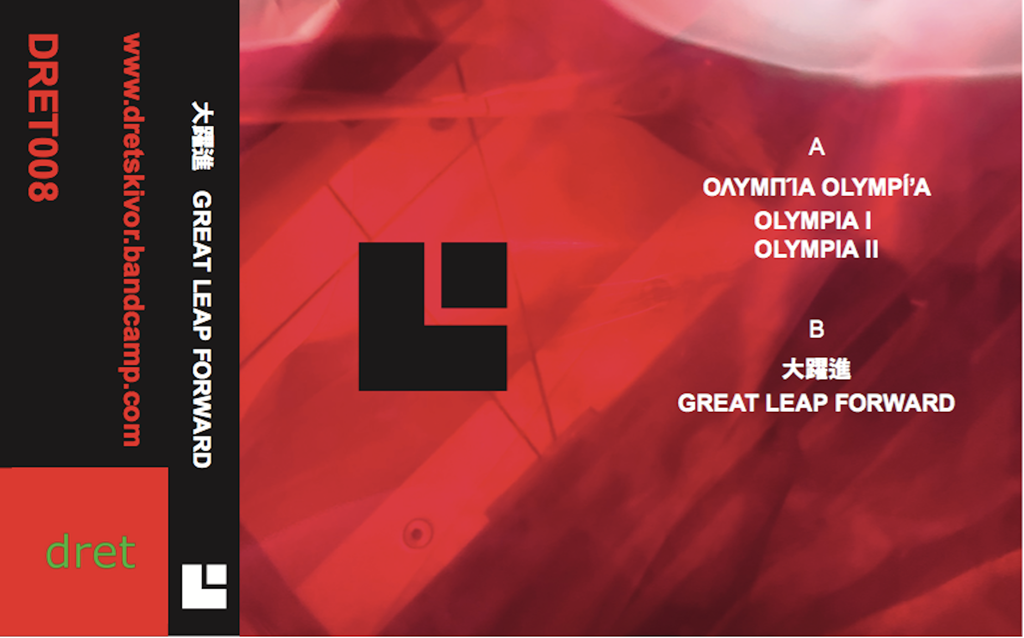
The latest offering from Dret Skivor, a Swedish tape label specialising in drone and various shades of experimental noise, is the new album from Danish maker of electronic noise Thomas Li, who, as Li, has self-released almost a dozen works digitally. Biographical details are less than minimal, and that’s cool. Why do we need to know about the artist, their background or their back catalogue? Do we really need to know the context or the intent, the theory behind a work? Sometimes, when it’s an experimental work informed by theory or a certain concept, it helps, because the concept and theory are integral to both the process and the end product. Then again, there’s a danger that sometimes said theory or concept can impinge on one’s appreciation of the work. Sometimes, it’s best to just be able to listen, and allow oneself to be immersed in the sound, without pouring over lengthy liner notes, researching myriad avenues presented by the references, and straining one’s brain over concepts. This is particularly true of many works of a more ambient persuasion. I’m not remotely anti-academic or anti-intellectual – quite the opposite. But sometimes, you just need a break, and music can be the perfect conduit to vital headspace. An overemphasis on context can detract from the often underrated pleasure of simply listening, and enjoying.

Admittedly, enjoyment of an album like this is the preserve of a small minority: it doesn’t contain any ‘tunes’, it’s beatless, and it’s not always entirely mellow either. But it does have a great deal of texture, and this is something you can really lose yourself in.

Great Leap Forward contains three tracks, with side one occupied with the two-part ‘Olympia’ and the second side containing the eighteen-minute monster title track.

‘Olympia I’ is nine minutes of dense, churning drones, billowing sonic clouds that choke and smother, while counterpart ‘Olympia II’ gurgles and churns a dark whirling cyclone of sound. The latter is more interesting, sonically, with a lot more going on – meaning it’s also more challenging and more tense, as crackles and hums fizz and spin from the dank depths of bubbling noise.

The title track is altogether less tumultuous and more background ambient by comparison. Being eighteen minutes in duration, on the face of it, not a lot happens: there are no climactic blasts of noise, there’s nothing explosive or even overtly disruptive. And yet for all its subtlety, it is engaging, and there is movement, there are shifts and distract and divert. Howling winds blast over barren landscapes of drifting sand and strains of treble and whines of feedback emerge from the eternal mid-range rumble that drones on, and on, and on.

In the context of his output to date, this may not really be quite such a great leap forward, but it does clearly mark an evolution and an expansion on the soundscapes sculpted on previous works. And, played with the accompaniment of a candle and some CBD-infused beer, Great Leap Forward is a well-executed soundtrack to mental recuperation.

AA

tape label grab for bandcamp

Hallow Ground – HG2104 – 13th August 2021

Christopher Nosnibor

There are few things in life you can really rely on, but Hallow Ground is one of them, if you’re seeking music from the darker side. The clue’s pretty much in the name here: this is pretty dark. Of course it is. It’s also quite an interesting and unusual blend of styles and sounds, for while this forty-minute, seven-track work is predominantly instrumental and ambient in its leanings, it pushes wider and deeper than that, to span a range of territories, with often quite unsettling results.

DarkSonicTales is a project by Rolf Gisler, who was granted an artist residency in a 300-year-old farmhouse in the Swiss countryside in autumn 2019, by the label. How this sort of thing comes about, I’m not really sure, but there it is. I am a shade covetous of artists who get dedicated time and space to work on their art in whatever medium, because the simple fact is that in ordinary life there never seems to be enough time. For anything. And creativity requires headspace and time, both of which are rare and precious commodities.

Rolf seems to have made the most of his time, and the result is an album that’s varied in terms of form and tonality, which makes for a fascinating listening experience. From the mellow chiming of the short intro piece, ‘Info Pandemie’, to the eight-minute drone-swirl of ‘Best Buddies’ that drags the album to a slow-simmering conclusion in a bilious fog of sonic drift, DarkSonicTales is a deeply exploratory piece.

‘I Still Believe’ is a long, slow-burning, low-key, low-tempo gothy tune, where Gisler whispers in a baritone croon over a delicately picked guitar that’s hauntingly atmospheric and pinned down by a distant but insistent drum machine, its cracking snare cutting through the sonic haze.

‘Best Buddies’ brings the finale, and there’s a stuttering heartbeat drum flickering like a palpitation against the slow, majestic musical backdrop.

In some respects, it’s a challenge, simply because however much the album leans towards electronics, the way the instrumentation is used is so widely varied this feels like an album that’s harder to accommodate far more than it actually is. Somehow, the pieces of the jigsaw fit together.

AA

a4220900238_10

SIGE Records – SIGE100 – 25th June 2021

Christopher Nosnibor

Woah! Dizzying, head-spinning chaos and cacophony! Twangs and bangs – strings stretched to within a millimetre of snapping, bending and scraping and scratching. Every instrument is playing across the others at an angle. About ten minutes into side one, you realise the discoordinated racket, having had some flickers of brass bubble through – like tentative flames licking around an oversized log on a fire that’s yet to fully establish itself -has congealed into a dense, soupy drone with industrial strength hip-hop beats played by a live drummer. And it just doesn’t stop. For twenty minutes straight. It gargles and parps and booms and toots and parps and growls and farts on and on and on, while the drums clatter and crash and thwack and thwock and bump and fuck me it’s an almighty headache-inducing din.

Details about this release are fairly limited, but details tend to be lost to history anyway. And most of history suggests that White People Killed Them is a common recurring theme throughout. There are so many of ‘them’, anonymous, often buried in unmarked graves in the name of progress – white progress. History is a narrative of shameful exploitation and bloodshed.

Whether or not the three musicians, Raven Chacon, John Dieterich, and Marshall Trammel, intended any such connotations when they came together in New Mexico in 2019, I have no idea, but the forty minutes of music recorded and relayed on this eponymous release would certainly make for a fitting soundtrack to the sheer brutality of history as a catalogue of killing. It’s so relentless, it makes you want to stand up and shout ‘stop! Enough is enough!’ But of course, as history shows us, it never stops. And nor, seemingly, does this album. It’s not a particularly pleasurable experience. It is an intense experience, and one that instils a kind of anxious excitement, even exhilaration. But pleasure… not really.

Things take a turn for the strange on side two, where from some warped, stretched-tape nastiness, there’s some twangy, spaghetti western weirdness that emerges briefly, before everything gets fucked up and mangled again. And it just builds and then sustains this massive wall of thick, discomfiting sound. The end leaves you absolutely drained, desiccated, mentally and physically decimated. If it was possible to achieve death by avant-jazz, White People Killed Them have slain us all with this monster.

AA

SIGE100_front

Sargent House – 6th August 2021

Christopher Nosnibor

Here in England – and Britain, as elsewhere further afield – division is rife: views and positions have become increasingly polarised and entrenched in recent years, and man, it’s fucking ugly. From here, it’s perhaps difficult to appreciate just how much uglier it gets when fervent religiosity is added to the mix. And while the white, Christian west expends boundless energy vilifying Islam, much of this feels like so much hypocrisy. For a religion that officially preaches for its adherents to ‘love thy neighbour’, Christianity is prone to being particularly harsh and judgemental, and as the album’s title suggests, there is a strong element of Christian judgment at the heart of the songs here.

The press release describes Sinner Get Ready as ‘an abrasive, unsettling portrait of devotion and betrayal, judgment and consequence, set in the severe and derelict landscape of rural Pennsylvania, a neglected and interstitial region deeply embedded with a particularly austere brand of Christianity, and where Hayter currently lives.’ It goes on to explain: ‘The rigorous and almost procedural site-specificity reflects an obsession with externalizing that site as the locus of great personal pain – pain that is the Will of that region’s presiding God; an atonement for sin that only the blood of Jesus can cleanse’. There is a certain specificity about the songs collected here, but, as is so often the case, the personal radiates out to become the universal, and however specific the subject and inspiration on a personal level to the artist a work may be, true art resonates far beyond.

Sinner Get Ready is an album that proves, demonstrably, that you don’t need noise or volume to achieve levels of devastating intensity. It’s spectacularly simple, raw, and at the same time complex and layered, not least of all in the vocal arrangements, and also hits like a tsunami. Sinner Get Ready is an intensely spiritual work, but it’s also quite simply an intense work, and one that conveys the power of the word of the Lord, that conjures fire and brimstone and that forewarns sinners- and non-believers – what they can expect.

The album begins gently enough, with rolling piano and strong but melodic vocals, operatic and elevating. But it doesn’t take long before things grow dark and disturbing on the nine-minute opener, ‘The Order of Spiritual Virgins’. The delicate, ethereal, choral evocations are rent with crashing, violent blasts of piano – fist-smashing thunderousness. It hits hard.

There is something of the musical about this, at least in terms of there being a narrative thread and a sense of characterisation running through it. It’s certainly more than simply a collection of songs: there is a sense of sequence, of progression. ‘I Who Bend the Tall Grass’ is sparsely arranged around a soft organ drone, and over which Hayter’s vocal cracks and breaks with force and emotion, and harmony melts into warped dissonance. ‘He has to die! There is no other way!’ she barks, rough and raw, before an atonal chorus of voices and drones carry it away.

Contrastingly, ‘Many Hands’ is traditional folk with an element of roots American country. It’s also dolorous, painful, its many-layered beseeching vocal, and ‘The Sacred Linametnt of Judgement’ is similarly folky, with a rich earthiness that speaks of tradition and evokes bygone times. Yet, as ‘Repent Now Confess Now’ brings into sharp relief just how alive some of those traditions still are in certain places, and these aren’t just small pockets, but huge swathes, and while the deep south is most commonly associated with hardline Christianity, it’s a trait of many rural areas. It may be 2021, but fire and brimstone and divine retribution are still dominant in these places, and what may seem strange to an outsider – like the material for a Louis Theroux documentary – this shit is real, and people live and die by their beliefs. There are some well-selected, well-placed samples, too, which accentuate this.

The songs on here soar, but rage with intensity, trembling with the fear of God and the weight of judgement and the threat of punishment. It would be hard to hear Sinner Get Ready and not feel moved in some way or another.

AA

701993

21st June 2021

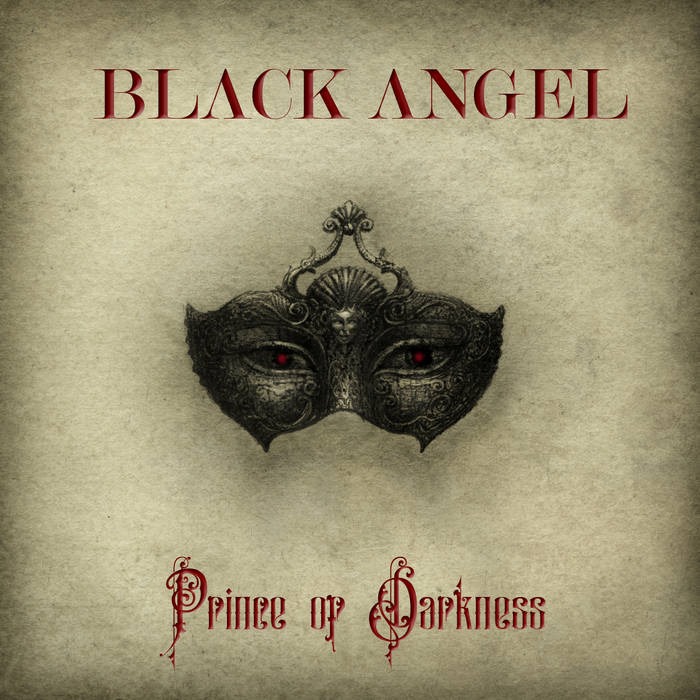
Black Angel emerged four years ago, and released Kiss of Death in July of last year – an album that brought together Matt Vowles’ years of experience from being in and around the goth scene to recreate the spirit of 1985.

This time, Vowles and co have come out with a concept album for their third outing, which is ‘inspired by cinematic classics such as ‘Dracula’ (Gary Oldman-1992) and ‘Interview with a Vampire’ with contemporary inspiration on tracks like "Alive" and "Give It To Me’" from the modern aristocratic sophisticated vampires in ‘Underworld’.

The album’s concept, the blurbage explains, is ‘to take you on a journey. The record starts out with an introduction to set the tone and to put you in 10th century England. As our protagonist embarks on his pillage through the town, we hear screams from the villagers as they run for their lives. He’s the Prince Of Darkness and causes chaos and mischief wherever he goes’.

There’s a fine line between artistry and pretence, theatre and corn, and despite the concept that veers towards an amalgamation of all the clichés of goth distilled into a dozen tracks, Prince of Darkness once again nails that vintage goth sound, with ‘Alive’ melding the energy of early Mission with the mechanised drumming of The Sisters to create a swirling cyclone of tripwire guitars and gloom with a glint of joy.

The energy is sustained across the bulk of the album, and the vibe is very much a muscle-flexing dominance, delivered with a big, ballsy swagger: there’s a hefty whiff of testosterone and a barrel load of rock god posturing going down here, but it’s delivered with a knowing nod ‘Live to Love’ is a proper old-school rock ‘n’ roll stomper with a smoky vocal growling and grizzled over a piston-pumping beat and a wonderfully insistent bassline that nags away at a repetitive motif. It’s got that level of grab that immediately makes you want to stick the whole album on repeat, especially after ‘Turn Around’, which pushes the quiet / loud dynamic with a searing guitar line that’s right in the vein of The March Violets – it’s that flangey reverby chorus thing.

Vowles has some depth, and range, too – on some tracks, like ’Call the Night Part II’ he showcases a grainy croon reminiscent of Mark Lanegan, and it’s heavy timbre is well-suited to such expansive epics, and then again, on ‘Secretly’ we see a more soulful, even tender side, and ‘My Love’ goes all out for the heart on sleeve grand gesture. It’s theatrical, but at the same times feels emotionally sincere, and while the melody bears similarities to ‘The Scientist’ by Coldplay, it sounds like it’s being sung by James Ray, and it’s quite moving in a brooding, gothy way.

Throughout, the songwriting is solid, with guitar hooks galore and a taut rhythm section that forges that classic goth groove. There’s a clear lineage from its predecessor in that Prince of Darkness is very much old-school goth delivered with a subtly contemporary twist, but it sounds and feels more confident, more ambitious, and not just on account of its embracing an overarching concept. Prince of Darkness is the sound of a band really hitting their stride, and achieves the perfect marriage of concept and execution.

AA

368330