Archive for the ‘Albums’ Category

10th July 2025

Christopher Nosnibor

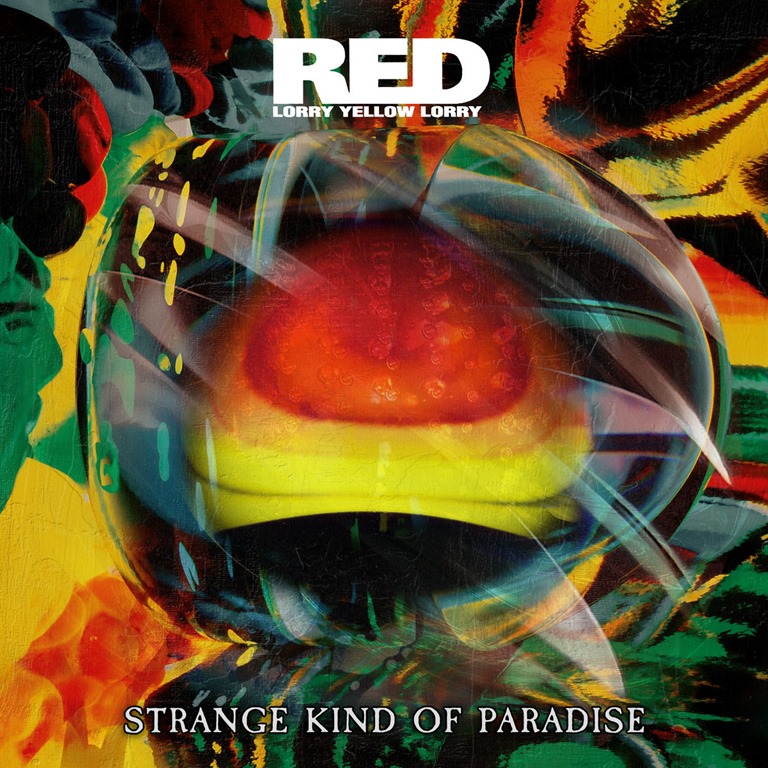
The band’s Bandcamp page describe it as ‘the final chapter of a legendary journey’. David Wolfenden, who joined on guitar in 1982 after the release of their first single expands on this, writing that ‘40 years on and the guitars still try to strangle each other, the words still struggle to make sense of chaos and the rhythms drive us to a glorious destination.’

To describe Strange Kind of Paradise as ‘long-awaited’ would be an understatement: it’s an album practically no-one expected. Emerging that the murky milieu of the Leeds scene which was the spawning ground for all things dark and post-punk (and long before ‘goth was even a thing), Red Lorry Yellow Lorry’s early releases soundtracked the grim North in Thatcher’s Britain. They weren’t overtly political but they were clearly pissed off, and along with The Sisters of Mercy, Skeletal Family, and The March Violets (among others), they followed Gang of Four in capturing the zeitgeist.

During the 80s, they put out a solid string of albums and remained firm favourites on the alternative scene, and while they may have mellowed a shade over that time, with Blow (1989) being notable for making a departure towards more melodic territories, there was always a fire that burned through everything they did, and seeing them in 2015 at The Brudenell in Leeds reminded me on a personal level that the dark, brooding currents ran as strong as when I’d seen The Lorries play the Off The Streets benefit alongside the likes of The Mission and La Costa Rasa (and Utah Saints, where Andrew Eldritch joined them for a couple of songs) in August 1993, and they sounded exactly as they had in all the video footage I’d seen before and since.

It had looked for all the world that Blasting Off (1992) would be their final statement, and while the 2015 shows had seen the sale of limited CDs which mentioned the ‘forthcoming album’ Strange Kind of Paradise, almost twenty years on with no further movement, it seemed to be more of a mythical projection than a reality, as likely as a new Sisters album.

But last autumn, all that changed with the arrival of the Driving Black EP and the announcement that the album would follow shortly. And at long last, here it is. And yes, it was worth the wait.

The title track opens the album with the driving guitar and solid bass/drum pairing that is quintessential Lorries, the sound and mix reminiscent of Blasting Off – in particular ‘This is Energy’, but with the pace and determination stepped up several notches. Reed’s vocal is strong – in fact, it sounds the same as it did 30 years ago, although perhaps now, there are additional levels of nuance to his delivery, and it suits the songs well.

‘Chicken Feed’ (a mix of which appeared on the EP) is more melodic, even a shade groovy in a sort of 90s indie sense, the guitars chiming over layers of vocal harmony, and providing a hint of the diversity and expansion of songwriting which sets Strange Kind of Paradise apart from anything in their catalogue.

The acoustic-led ‘As Long as We’re Breathing’ is perhaps one of the most ‘different’ songs not only on the album, but in the entirety of their career, revealing an altogether softer, mellower side, while at the same time hinting at country and desert rock, Reed’s gravelly baritone reminiscent of Mark Lanegan. It’s a beautiful moment, and a truly moving song. ‘Nothing seems quite right / I’ve got a feeling we’re over the hill, but I don’t know because my chest is pretty tight / As long as we’re still breathing’, Reed sings with a palpable air of melancholy.

Then again, ‘Walking on Air’ brings a glammy swagger, but played almost in the rockabilly style of The Fall, marking another unexpected departure from the steely grey confines usually constructed by The Lorries. The same is true of the post-grunge ‘Killing Time,’ which again, is strong on melody, and big on emotional ache, riven with pining, yearning, sadness.

Side two opens with ‘Driving Black’, which, as I outlined in my review of the EP, is vintage Lorries all the way. Driving black, and driving hard. Easing off the gas a bit, ‘Shooting Stars Only’ returns to the vibe of Blasting Off, before ‘Many Trapped Tears’ goes for mid-tempo anthemic, with a solid riff. To clarify, we’re talking more Iggy Pop than Oasis in execution here. ‘The Only Language’ takes the tempo right up again, and is one of the most forceful sonic expressions they’ve made in a long time (even by their standards). Everything is firing on all cylinders as Reed snarls with total conviction ‘The only language I speak is the truth’. It’s one of those songs that gets you really pumped up, and the message has never felt more relevant.

And so it is that as this band – true stalwarts of the 80s alternative scene – finally sign off, we can reflect on how much we have to be grateful for. And as a final document, Strange Kind of Paradise sees them go off with a bang. It’s not a tired rehash, a limp collection of offcuts or unfinished works in progress, but an album that stands out as being quality all the way.

AA
a4282525804_10

Cruel Nature Records – 27 June 2025

Christopher Nosnibor

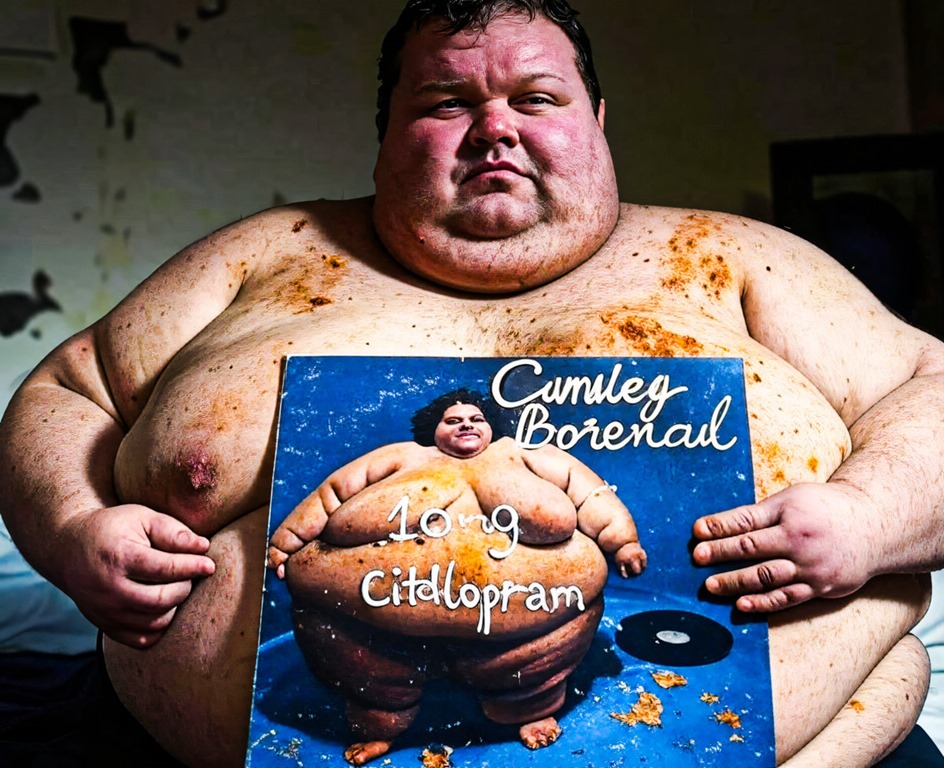
The cover within a cover artwork is only the first example of near infinite layers when it comes to this complex and inventive work from the truly demented experimentalist who records under the moniker of Cumsleg Borenail.

This latest effort promises ‘a collision of methods—part LLM-based sampling, part MPC assembly, part human lyrics—stitched together into something fluid and unpredictable. AI scavenges random prompts, returning garbled errors and fractured phrases, while voices and instruments drift in from nowhere, guided by no fixed direction. Each track begins as one idea and mutates into another, warping its original design into something unrecognizable yet strangely intentional.’

Oh, and it delivers on that promise, alright. This is truly a derangement of the senses, a collaged cut-up, an uncompromising mash-up, a smash-up, if you will, where absolutely nothing is off limit, and it all gets tossed, unceremoniously and indiscriminately, into the blender and churned up into a mess of the most mind-blowing chaos imaginable.

To provide a detailed analysis of this would be to unpick the threads in a way which would reduce the album to less than the sum of its parts. 10mg Citalopram works precisely because it’s an exercise in brain-pulping loop-heavy derangement.

‘You mean nothing me!’ a female voice repeats, and repeats, against a clattering, springing backdrop of twangs and poings throughout ‘You Mean Something To Me’. My head’s a shed by the time we’re midway through the second track, ‘Denizen Invocation Via Lunar Phase’ – because this is a work that goes off in all directions, all at once, and it’s really not pretty. It is, however, weird and frantic. It’s a mess of noise and samples and glitchy electronic samples and frantic breakbeats. Later in the album, there’s a companion piece of sorts, ‘Now I Know I Am Nothing Because You Said’.

AA

In some respects, I’m reminded of early Foetus, JG Thirlwell’s crazed tape loops and cacophonous noise bursts, and the way Cabaret Voltaire took the tape experiments conducted by William Burroughs and Brion Gysin and the ideas outlined in The Electronic Revolution as their starting point – but it’s also a bit Trout Mask Replica, in that it’s like listening to several songs being played at the same time, only it’s got bust-up techno beats exploding all over the shop and frankly, it’s impossible to know what the fuck’s going on most of the time. Too much, for sure. But that’s the point.

For context, Citalopram is a widely-prescribed antidepressant, described on the NHS website as ‘a medicine that can help treat depression and panic attacks’. This album, however, sounds more like a prolonged panic attack or all of the listed possible side-effects being experienced at once, while the numerous references to being ‘nothing’ appear to allude to the inner voice of low mood. Then again, there are other medical matters of an altogether different sort which provide the reference points for tracks like ‘Clostridium Difficile’ (a bacteria which causes diarrhoea) and ‘Snifflers, Nostril Pickers and Dribblers’. All of it is utterly batshit wonky and wildly arrhythmic, and certainly not for anyone who’s feeling tense or jittery or suffering from any kind of psychosis. For anyone else… proceed with caution. May have unwelcome and unpleasant side effects.

AA

a1363557647_10

Dark Scrotuum – Rotting Dream

Cruel Nature – 27th June 2025

Christopher Nosnibor

As the label recently hailed in its midyear roundup, Newcastle-based cassette label Cruel Nature has put out some forty releases so far in 2025, which equates to one every fortnight. It’s no small achievement, particularly considering that not only are they essentially a one-man operation but they’re hardly mainstream in their output – and what’s more, that output is remarkably diverse. More often than not, niche labels adhere to a fairly narrow range, whether it’s black metal, indie, or experimental in nature: they know their audience, and cater to them, knowing they will shift inventory. Cruel Nature takes a different approach, which isn’t without risk, in that they release music they feel meets a standard based on quality rather than style, meaning that label collectors may not love everything – at least at first – but will be introduced to stuff they wouldn’t have otherwise listened to, and fans of given bands or styles will make discoveries by association.

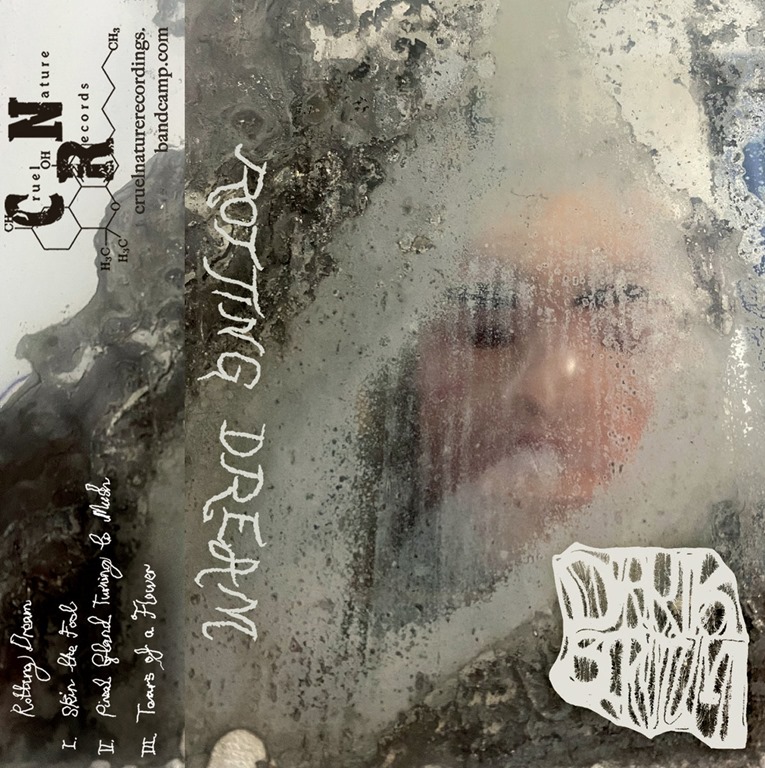
And so we come to Rotting Dream by the wonderfully if somewhat crassly-named Dark Scrotuum. You know before you hit play that whether it’s black metal or power electronics, it’s probably going to be pretty nasty, right? Right. It’s pitched, quite succinctly, as ‘crushing dark ambient BM drone sludge noise’. BM could as readily be taken in the American sense – bowel movement – as black metal here. And believe it or not, that’s not a diss. Anyone who’s familiar with Aural Aggravation will be more than aware that heavy shit is our bag, and specifically my bag. And this is some heavy shit, bowel-trembling, uncomfortable, heavy shit.

The first of the three tracks, ‘Skin the Fool’, is seven and a half minutes of earth-shifting, stomach-churning dark ambience with a growling, grumbling industrial edge. It’s dark, and it’s heavy, a constant, heavyweight rumbling, the sound of destruction, of desolation, like slow-motion detonation. The first three minutes alone are utterly harrowing, and then, from nowhere, it goes nuclear, a churning blast of noise so dense it hurts, an extended billowing explosion that replicates the impact of Threads. Game over? Life over. Existence over.

Dark scrotuum? Tense and shrivelled scrotuum is the initial reaction to this brutally harsh work. ‘Pineal Gland Turning to Mush’ is ten minutes of tension, meaning the track is appropriately titled, barrelling into a relentless wall of harsh noise. It’s not quite HNW because there is texture and variation over its duration… but fuck. It’s abrasive, obliterative. I find myself sitting here, sweating, wide-eyed, uncomfortable. This is… intense, alright. It hurts.

And then, there is ‘Tears of a Flower’, the harshest heaviest, most explosive cut of the three. Toss Sunn O))), Prurient, Swans, and Vomir together and you’re about there. It seems that Dark Scrotuum have pulled together everything – and I mean everything – they can conceive to create the nastiest, most overloading wall of noise possible. ‘Tears of a Flower’ is a punishing, brutal sonic assault which offers no respite, only more pain, and more pain and more pain. And you feel it. There is not one fleeting moment of kindness, no respite. This is music to puke to as you feel your eardrums collapsing and your soul shrivelling. As for our dream…it’s over.

AA

a4040102512_10

The Helen Scarsdale Agency – 23rd May 2025

Christopher Nosnibor

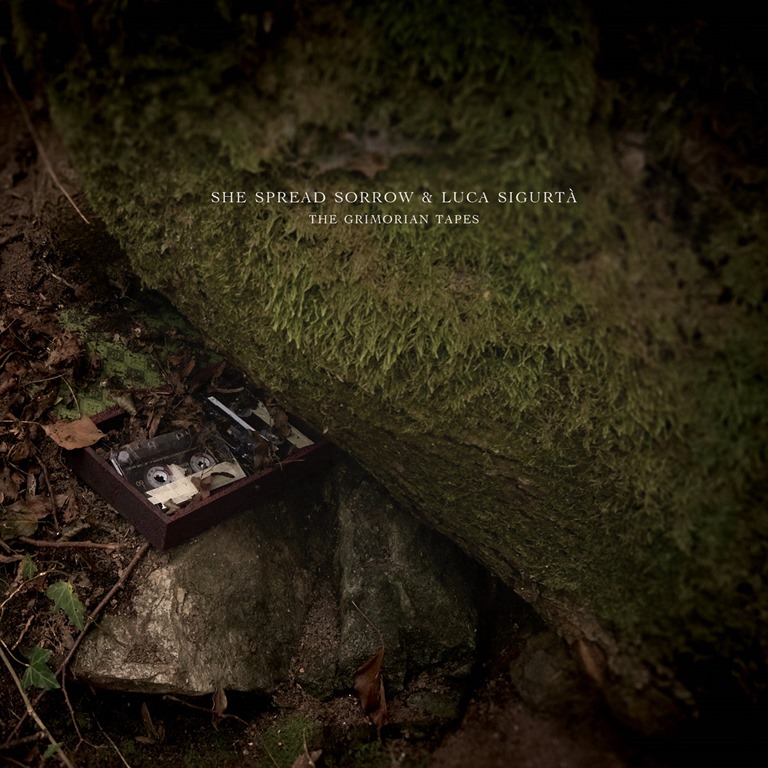
The pitch alone is harrowing: ‘“Don’t be scared by death,” Alice Kundalini (aka She Spread Sorrow) calmly instructs at the beginning of her collaborative Grimorian Tapes with partner Luca Sigurtà. Her words slither from her lips with a subtle, sinister unease, compounded by the unsettling quality of her whisper. The fear of death, this most profound condition, has long been a subject of philosophical, spiritual, and existential inquiry. To fear death is undeniably human; to transcend that fear is often seen as reaching a higher plane of existence. At least, that’s the intention behind the rituals, the spells woven into the fabric of The Grimorian Tapes.”

I myself have spent a lot of time contemplating death, and the fear of death, especially of late. We are all scared of death, particularly in Western culture. When my wife was diagnosed wit stage 4 breast cancer, where it had spread to her bones, I was terrified, not only of losing her, but of waking up to find her dead in the bed beside me. What do you do in that situation? I did not want to see her dead, and she did not want me to see her dead. Thankfully, she made it to a hospice for her last day, but I lived for a year under the shadow of that ‘what if…?’

You might think that her passing brought peace, but it did not: instead, I have spent many mornings twitching and drenched in sweat lest I should die and leave our daughter an orphan, being thirteen. This is not a call for sympathy – simply as summary. It’s hard not to be scared by death, inevitable as it is.

For additional context, it’s worth delving into the details of the album’s inspiration, a large portion of which comes form The Black Pullet, ‘an 18th-century French grimoire filled with instructions for making talismans and magical artifacts’. We learn that ‘Kundalini weaves her own take on the book’s esoteric themes into the shadowy tape loops that comprise The Grimorian Tapes. The Black Pullet is a detailed guide into alchemy, divination, and occult practices, with a particular focus on harnessing hidden forces through the construction of specific objects imbued with magical power. Though Kundalini doesn’t practice these rituals per se, she finds a deep, poetic resonance with these ancient teachings. The allure isn’t in the performative aspect of these rituals but in the seductive power of its symbols and ideas, which speak to a long-forgotten language of metaphysical mystery. It’s this sense of transmutation, hidden knowledge, and occult wisdom that lends The Grimorian Tapes its dark, ritualistic intensity.’

And so it is that ‘grimoire’ introduces the album with a dark etherality, whispered vocals, the words indecipherable. Echoing amidst rumbles and a persistent drone which ebbs and flows. It’s compelling, and enticing, but at the same time, unsettling. It’s the fear of the unknown, of course: the esoteric and other-worldly and anything that speaks of a realm beyond one’s ken is always difficult to assimilate. This, in a nutshell, is the appeal of horror, because a lot of us find entertainment in being scared. It’s the same reason people go on rollercoasters. Being scared half to death reminds you that you’re alive. And The Grimorian Tapes is pretty scary, in the suspense and horror sense.

‘initiatory’ rumbles and hovers dark and murky, sonically entering the domains of Throbbing Gristle, and again, the whispered vocals are menacing, and reminiscent of Prurient’s Cocaine Death, while ‘the stairs’ brings a hint of disturbing playground, psychological derangement, the other ‘other side’ we’re all so afraid of due to a lack of comprehension. And the further this album progresses, the more uncomfortable and unsettling it becomes, the further it extends beyond the domains of the ordinary, the mainstream comprehension.

‘babele’ is a dank, muddy morass of sound over a slow thudding heartbeat rhythm, while ‘kirtan’ brings flickering, stuttering beats, while again leading the listener through hair-prickling terrain, with triffid-like stem-clattering and gloomy swirls and abstract vocals. ‘we worship you’ plunges deeper into a darker space, with sputtering electrostatic sparking, and gargled vocals, deep and robotic, growling, threatening and emanating from another place, another world, one beyond reach. ‘me and I’ churns like slow machinery, and is industrial in the primitive sense. Again, the way we have come to understand ‘industrial’ has evolved: Foetus is a far cry from Throbbing Gristle, and both are a world away from NIN and Ministry. But The Grimorian Tapes takes us right back to the origins of the genre.

This is one dark and difficult album, heavy and suffocating and uncomfortable from beginning to end. Two thumbs up. And now I need to lie down.

AA

a0844152259_10

Sonic Pieces – 30th May 2025

Christopher Nosnibor

Five years is quite some time, and a lot has happened in the last five, that’s for certain. Although the fact so much has happened means that the last five years have been something of a void for many. And so it is that Reverie, recorded in October of 2024, sees Otto A Totland (piano) and Erik K Skodvin (guitar, cello, electronics, and processing) reunited in concert for the first time since 2019.

It’s pitched as ‘a follow up to 2014’s Recount, which saw two pieces of music created around their live-sets in different periods. This time, we are treated with a contemporary, raw live performance from October 2024 in Rabih Beaini’s studio, Morphine Raum in Berlin, during the 15th anniversary celebration of Sonic Pieces.’

The two longform pieces which make up Reverie were recorded live, and as if to prove the point, there’s the sound of a light cough just as the first piano note hits, then hangs in the air. They could have dubbed it out, I’m sure, but to have done so would be against the spirit of this work – spontaneous, improvised, in the moment. The recording is not only about capturing the music, but the moment itself.

The seventeen-minute ‘Rev’ is delicate, built primarily around Totland’s graceful, nuanced piano work, and considerable reverb, which may well be natural from the room, but however the sound is achieved, the sense of space is integral to the atmosphere. Skodvin’s contribution is magnificently understated: the slow scrapes of strings and subtle sonic details may seem secondary or additional because they’re not the focal point, but without them, the effect would be diminished by more than half. A great musician is not necessarily the one who dominates or demonstrates virtuosic talents, but the one who understands their contribution to the work as a whole, and appreciates that less is more. And so it is that elongated notes quiver and quail, wailing tones and sonorous drones swirl about and bring so much depth and texture, an as the piece progresses, the piano and extraneous incidentals achieve an equilibrium, and it’s utterly mesmerising.

‘Erie’ turns the tables, and it’s Skodvin’s strings which take the lead initially, before trepidatious piano creeps in. Trilling tones hang hauntingly like distant memories and displaced ghosts, and there’s a melancholia to this piece which is difficult to define, but lingers amidst the brooding lower notes. The slow piano is soft, and sad, while tremulous strings evoke a sense of something lost, somehow.

Without words, Reverie paints a picture, and hints that memories and reveries are inherently tinged with sadness. For even to recall a happy time is to remember a moment which has passed, and will be relived. However many times one may return to a particular place which is imbued with fond memories, however many times one may listen to that favourite song which carries such joyous connotations, that moment, that time will forever continue to recede into the past, never to be experienced again. The past is forever past, and will become further past with each day that goes by. Summers will never be as long, or as carefree as in childhood. The exhilaration of new experiences will never provide the same buzz, however hard you chase it. And with this realisation comes the slow fade, and a sense of acceptance. Bask in the reverie, and hold those times dear as the years slip away.

AA

ReveriePATTERN013 front

Photo: Alex Kozobolis

Mortality Tables – 20th June 2025

Christopher Nosnibor

Lunar Forms is Rupert lally’s second release on Milton Keynes label Mortality Tables, following his Interzones album, released in November last year, and forms part of the latest ongoing project by the label, dubbed The Impermanence Project (which so happened to feature a tense but lugubrious ambient work by some guy called Nosnibor a short while ago).

Sometimes, while I try to work through my review pile in a broadly systematic way, I have to reshuffle my priorities according to mood. And right now, my mood is jittery, jumpy, tense, unfocused, meaning that what I need is something fairly gentle, somewhat abstract, if not necessarily ambient. But also something which feels relevant, in some adjacent fashion. And so here we are: bombs are dropping and missiles are flying, and it’s maybe easy to dismiss it as taking place at a safe enough distance away…. But is any distance truly safe enough?

And so, it’s necessary to seek solace in distraction, solace in abstraction, something that offers layers and textures that draw you in, captivate the attention… but at the some time, offers something more to reflect on while listening to the glitches and echoes, woozy, skitty fragments of analogue pull my attention in different directions.

Impermanence… as polyartist and the innovator of the cut-up method, Brion Gysin said, ‘we’re all here to go’. And we are. We fear it, but it’s impossible to escape the inevitable. It’s not a question of if, but when.

Lunar Forms transitions between stuttering, glitching minimal techno and slowcore EDM, and more expensive, cinematic instrumental sounds which are overtly ambient. Electronic fuzzed and buzzes spark over swirling soundscapes, and at times we’re led into Tangerine Dream territory, while at others, we find ourselves adrift. The fact that, including bonus tracks, Lunar Forms features eighteen pieces, and has a running time of some seventy-four minutes, is significant. It’s a vast and expansive work, and one which is easy to get lost in, since the tracks are distinguished only numerically, ad those numerical titles are not tagged sequentially.

There is a lot of dark atmosphere, a lot of rumbling. There is much haunting reverb, considerable space, a great deal of bubbling, blipping, hovering. The deeper it plunges into spacious, cloud-like disturbance, the more immersive and simultaneously the more the power of this work increases. Breathe deep… and feel everything this represents. ‘313’ May be sparse, but it also edges its way into the space between dance music and the BBC Radiophonic Workshop, while ‘325’ pitches jittery microtonal beats against sonorous strong-like sound. It’s simultaneously tense and introverted, and outward-facing through cloud. The beats of ‘303’ are like the dripping of a tap amidst synthesizer drones and swirls. And it goes on. As such, Lunar Forms is more than varied: it straddles boundaries in a way which renders it almost impossible to place.

AA

cover

16th June 2025

Christopher Nosnibor

Gintas K’s latest offering was recorded live, using computer, midi keyboard and controller in January 2025, and first released by Japanese label Static Disc in May.

It’s worth perhaps mentioning that ‘Breakcore’ is – and I shall shamefully quote from Wikipedia here – ‘is a style of electronic dance music that emerged from jungle, hardcore, and drum and bass in the mid-to-late 1990s. It is characterized by very complex and intricate breakbeats and a wide palette of sampling sources played at high tempos.’ In the main, not really my personal field of expertise, or particularly within the remit of Aural Aggravation.

But this is a Gintas K album, and the nine pieces are typical of his style, combining experimentalism and the application of software and midi / laptop setup, producing a range of glitchy, frothy, gurgly sounds which stop and start intermittently, unpredictably. His live and improvised works always come with a sense of unpredictability, of spontaneity, while bearing his distinctive sounds. One of the key focuses within K’s work is on detail, zooming in on microtonality, granularity. When I say it sounds ‘bubbly’ or ‘frothy’, I mean it’s the sound one might consider the equivalent of the visual experience of slowly swirling a latte or a pint of ale, or hyperfixating on the bubbles in a bath. This is not, however, the gentle swill and flow of currents, but a frenzied effervescence, like the reaction between bicarbonate of soda and vinegar. And look long enough and hard enough, and patterns begin to emerge.

Listening to the bubbling blitzkrieg of digital clicks, beeps, and fizzing of any work by Gintas K can be stimulating to the point of eye-popping discombobulation. It’s almost too much – and this is nevermore true than the experience that is Breakcore. There are beats present – but they’re composed not of beats in the conventional sense, being neither rhythmic nor percussive, either from an analogue source or a digital sampled source or emulation. These are flickers, pulses, rapidfire stutters, hard sounds which replicate the essence of a beat without being a beat, per se. For example, those of a certain age may recall the successive ‘pink-pink-pink’ chattering digital babble of dial-up. Few would necessarily consider those sounds beats in context, but… yes, they have a certain beat-like quality. And this is how the beats often emerge from the clicks and pops, moans and drones or another quintessential Gintas K demonstration of circuit meltdown as an artform.

I had never considered his work in a ‘dance’ context before, and still wouldn’t: one feels as if the title is perhaps a shade ironic. But the tempo is certainly high and the beats are complex and intimate, emerging as they do from the thrum of what sounds like a revving engine, the whirr of an old hard-drive, the click of a CD driver whirring into action. Every second of this release sounds like some kind of digital or mechanical malfunction, as tempos whirl and blur, drawl and slow. Scrunching, crunching, twanging, springing, stammering and stuck, it’s a relentless attack of wrong sounds. But emerging from all of it, there are erratic beats, like a succession of deliberately jarring jazz fills and simply wild judders.

It is relentless, and it’s complete overload. The nine tracks run for a total of twenty-nine minutes: its intensity is such that you feel as if your brain is starting to melt after the first ten. In short, Breakcore is truly wild, and it’s not remotely easy or accessible – but it absolutely encapsulates everything that defines what Gintas K’s does.

AA

AA

cover

Panurus Productions – 20th June 2025

Christopher Nosnibor

You’d think that cassette labels would be not only niche, but few and far between, and in the main, they are, but Newcastle is home to not one, but two labels who provide a near-endless supply of releases to satiate the need for weird shit the world over, with Cruel Nature Records being one, and Panurus Productions being the other. The labels have a considerable amount in common, too, not least of all in that they both favour music that’s of a quality, rather than a style.

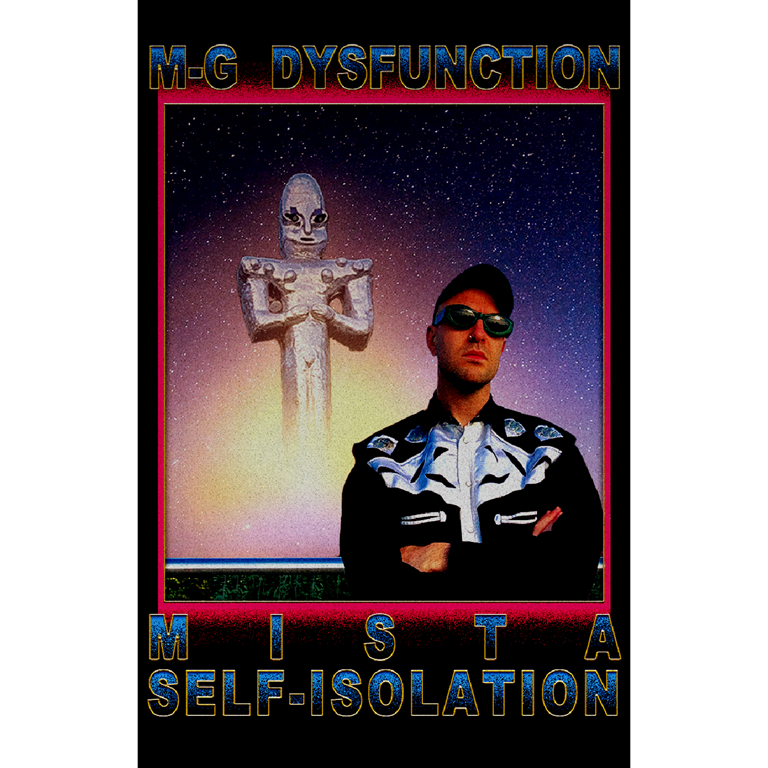
The latest Panurus release is a perfect case in point. The label’s previous offering, a split release from Belk and Casing was a raw blast of guitar overdrive. In contrast, the third album from M-G Dysfunction is of an altogether more experimental bent, leaning toward hip-hop and beat-driven electronics, but once again marking the close connection between the scenes in Leeds and Newcastle, both of which have become significant spawning grounds for the offbeat, the difficult, the wilfully obscure.

According to the blurb, ‘Mista Self-Isolation is the fullest realisation of the M-G Dysfunction project to date – a record of trepidation and humour, of lopsided passion and warped poetics. This album is about surveying the wreckage of monoculture and navigating the act of making music amidst a land-grab of rights, melodies and rhythms by people who never liked music in the first place. It’s about properly honest artistic expression – what “keeping it real” looks like, sounds like, feels like in 2024. It’s about getting some official beats and saying fly shit over them.’

That it’s quirky may be obvious, but it’s a necessary headline observation. On the one hand, it’s white rap, so there’s an awkwardness, but on the other, there’s some dirty experimental electronic noise layered over the beats, and this is an act that shared a stage with Benefits, a band who may have made their reputation by being angry, shouty, and noisy, but who aren’t without humour or an appreciation of nuance.

As tracks like ‘Roger Daltrey (Permanent Record)’ illustrate, M-G Dysfunction are multifaceted – something likely to leave many quite nonplussed. How can they do jokey, daft, a bit random and be serious at the same time? In truth, the answer is simple: because human beings are complex creatures, capable of a vast range of emotions and infinite ways of expressing them. It’s something we seem to have lost sight of in recent years, when everything has been boiled down to binaries, and everything is a conflict because the lines have been marked in such either / or terms. It’s no longer possible to be a woolly socialist: suggest that, I dunno, people on disability benefits are right to receive free prescriptions, and you’re labelled a left-wing extremist, a communist, and by the way, disabled people should get back into work or die. Something is severely fucking wrong with this picture.

Back in the early 90s, genre crossovers were all the rage, and the Judgement Night soundtrack was a real watershed moment that took the idea of rock / rap crossover, first witnessed in the mainstream when Run DMC and Aerosmith did ‘Walk This Way’ to the next level. At that time, it felt like a new future was emerging, and perhaps, even a future where boundaries and differences were dismantled. But here we are, and times are bleak.

But with Mista Self-Isolation – an album which is by no means an exercise in buoyant pop tunes – M-G Dysfunction show that in 2025, there is still scope to create something that speaks of what it is to be human.

The structured, beat-led songs are interspersed with self-reflective spoken word segments, spanning CBT meditation and contemplations on experiences and life in general. It is truly impossible to predict the twists and turns this album takes.

’50 Words for Blow’ comes on like a hip-hop-inspired barber’s shop quartet, while ‘John Wick’ is a critical memo, and the title track is abstract, minimal, dreamy but quietly intense. ‘Junglists Only’ is a perfectly executed pseudo-banger which knows it’s absurd and works because of it. The last song, ‘All that is Solid Melts into Deez Nuts’ evokes both humour and at the same time draws attention to M-G Dysfunction’s hip-hop credentials. If you know, you know, as cunts say, but for those who don’t, it’s a reference to Dr Dre’s ‘Deeez Nuuuts’ from The Chronic in 1992.

Postmodernism is alive and well after all, at least in some quarters, and it’s very well in the world of M-G Dysfunction. There is a lot going on on Mista Self-Isolation – and it’s all good.

AA

cover

9th May 2025 – Room40

Christopher Nosnibor

Souvenirs are unusual things, in that they’re intensely personal, and imbued with a resonance which is often difficult to articulate.

I will revisit an anecdote I relayed no so long ago: my dad gave me £15 spending money when I went on a Cub camp in Yorkshire when I was probably fourteen. We had a day trip to York, where I discovered an independent record shop, the now gone and sadly-missed Track Records. I blew most of my £15 on 12” singles by The Sisters of Mercy: Alice, Temple of Love, and The Reptile House EP. On returning home, my father was not happy: he’d given me the money for real souvenirs – fridge magnets, mugs, erasers… but the fact that I still have those records and tale to tell says these were the best souvenirs I could have ever purchased. Would I still have an I Heart York mug or a tea towel thirty years later?

But one thing that’s become apparent is that for fringe, niche, and unestablished acts like Sadie Powers, even when released by labels like Room40, physical releases are becoming less of a thing. It’s a sad reflection on the state of the world and how the arts in general are suffering. People don’t want to pay for stuff, or they can’t afford to pay for stuff, and the end result is the same.

Souvenir is a sad album, based on a premise which resonates on a personal level. I’ve written extensively of late on both the impact of the pandemic, and of losing my wife, and Souvenir is a work which explores grief, with a particular focus on the pandemic. Powers explains the album, its context, and its musical limitations and development in terms of instrumentation, in a fashion which warrants quotation in full:

‘Between 2020 and 2022, a significant number of friends and family passed away. Due to the pandemic, funerals became impossible to travel to or just didn’t happen. How does one grieve alone? What is that language? What is that movement? What do I do with my hands, with the muscle memory of care weaving phantom thread? What is the shape of the shelter one makes to bear this loss? If I’m not holding, will I sink to the bottom?

‘What is my last memory with them? Almost always, it is of embrace.

‘I’ve had a relationship with fretless bass for about 20 years. It’s an unforgiving instrument. It exposes everything. Like porcelain: elastic, pliable, detailed, expressive. Suggestive to subtle touches. It shows the hand of the player. I began recording improvisations with silence, thinking of those I’d lost, their embraces, those moments of stillness and when time folds in on itself, then cutting the tracks up processing and layering them, a sound collage. Programmable music box bells, sheet metal, cardboard box, and field recordings from the same spot on the back patio of my former home color the shape. Like a bird collecting items to create a nest of memory. Sounds drifting in and out like recollections, like ghosts. The practice became a life raft, or a grieving raft.

‘Is the souvenir the embrace? Souvenirs originated from pilgrimages in the Middle Ages, as a remembrance of a journey.’

The four compositions which make up Souvenirs are each approximately ten minutes in duration, and this would have made for a magnificent vinyl LP, particularly given the texture and detail of the works.

The first track, ‘Right After’ is exemplary: it begins so quietly as to be beyond range, before the crackle of a slow fade-in becomes discernible. And against this, and some rumbling dark ambience, there is the strolling fretless bass work. I can’t help but think – however fleetingly – of Duran Duran, not because it actually sounds like Duran Duran, but because that fretless bass has such a distinctive sound – thick, bulbous, rounded, warm.

‘Soft Materials: Permanent Rose’ is move overtly ambient, and ripples its way along in an understated fashion, and ‘Rabbit Hour, too, hovers and hums, clatters and clinks, plunging deeper into abstraction, drifting cloud-like and formless, hovering, while occasional scrapes and nails-down-a-blackboard feedback sounds cut through the soft waves.

‘Princess Moo Bear’ may sound soft, but the clanking chines are pitches against thick helicopter sounds and dark abstraction, before finally expanding and drifting to nothing.

Souvenir is not an easy or instant album. Quite the contrary is true. But it is detailed, layered, and has much going on.

AA

a0102366993_10

Human Worth – 11th July 2025

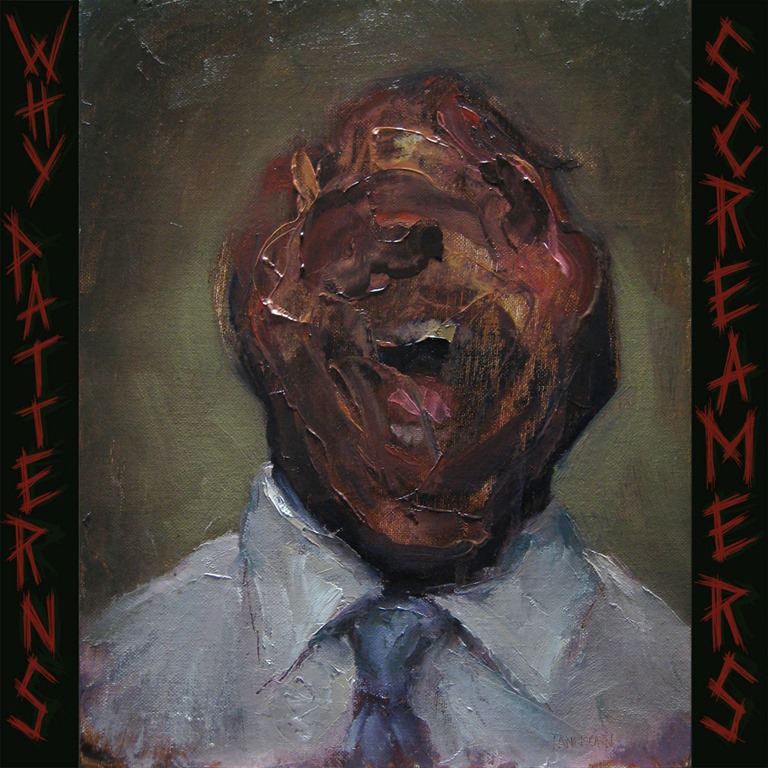
Why Patterns’ latest offering marks something of a shift from Regurgitorium, released back in 2022. I say ‘back’ in 2022 because it feels like a lifetime ago. Some of that is, admittedly, due to personal circumstance, but for most, 2022 was a very different time. We still weren’t all that long out of lockdown, for a start. We were still coming up for air, and finding our way – and likely crawling our way back to the office, while a lot of shops still had their Perspex screens in place. I remember in the checkout queue in Aldi just willing these weird cunts who had seemingly either forgotten the preceding year and a bit, or had lost all sense of how to engage, by looming and leaning over and pressing too close would fuck off. I revisit the context of the last album because it somehow managed to capture the mood in some obtuse way, and when I wrote ‘It’s fucked up. It’s deranged. It hurts,’ I could as easily have been referring to life itself at that point in time.

Screamers is different again. Or, if not so much, different, compressed, compacted, distilled, the intensity amplified by the concision of the tracks.

The crunchy, gnarly bass still dominates, and it’s snarling away and tearing strips straight out of the traps on the frenzied ‘After the Bullfight’. Clocking in at a mere minute and forty-seven seconds, it’s noise rock smooshed down to the tight parameters of grindcore, and with insane amounts of reverb, the stuttering, stammering vocal yelps from Doug Norton, the man behind the ‘Mouth Sounds’ owe an equal debt to Suicide and The Cramps, and this may be the spawning of industrial psychobilly as a new genre. Everything is overloading, the speakers are crackling with megawattage overload, and when ‘Clown in a Housefire’ blasts in, you actually begin to wonder if it’s supposed to sound like this of it your gear’s fucked.

One may cling in references to the Jesus Lizard and all the rest, but really, this sounds like a psychotic reimagining of early Blacklisters – specifically early because of THAT bass racket. But whereas Blacklisters were, and remain, quite song-orientated, at least structurally, Screamers sees Why Patterns take their template and smash the living fuck out of it by throwing it against a brick wall and stomping on it until there is nothing but splattered pulp. None of the songs – I mean, they’re not really songs, more demented blasts of discord played at three hundred miles an hour, all of the instruments playing at angles against and across, rather than with one another, the vocals the sound of a breakdown in real time. And listening to this as bombs and missiles are going off everywhere and no-one knows what is going on anywhere, I fin myself listening to this tumultuous mayhem and thinking ‘yep, they’ve done it again. This is the closest I’ve heard anyone articulate this moment.’ I mean, they don’t really ‘articulate’: as the title suggests, Screamers is a raw, primal scream. It’s a frenzied, lurching, gut-punching racket that rattles the bibs and kicks the balls, hard. Pleasant, it is not. Especially that grungy bass that churns the stomach.

There aren’t really any riffs: it’s just a relentless assault of jarring noise. ‘Nervous Laughter’ brings hints of the latest mclusky album, but does so with menace, malice, and a hint of the unhinged, and following on ‘Wind Up Chattering teeth’ is a minute and six seconds of rabid raving. It’s almost enough to make you want to puke.

Then there’s ‘Club Foot By Kasabian by Blacklisters’. It extends the joke of the original – since the Blacklisters song, ‘Club Foot By Kasabian’ wasn’t a cover, and had nothing to do with Kasabian, and so it is that ‘Club Foot By Kasabian by Blacklisters’ is a minute and a half of squalling, brawling, guitar-led abrasion. It’s somewhat reminiscent of Castrovalva in its deranged intensity, and frenzied, squawking disregard for decency. The title track is fifty-two seconds long. It’s rabid. It has to be heard to be comprehended.

The last track, ‘Buffoons and Barel Organs’ is both the longest and most structurally coherent. ‘Why do I cross the road? Why do I cross the road? Because I’m a fucking chicken!’ Norton hollers amidst a raging tempest of bass and drums.

Screamers is certainly appropriately titled. Every song is a brief but blistering assault. It’s full-on, and will melt your face, and as such, I wholeheartedly recommend it, unless you’re a wuss.

AA

AA

a3117811268_10