Archive for the ‘Albums’ Category

Midira Records

Christopher Nosnibor

The press release informs us that Four Movements Of A Shade is the second solo album by Sarram, and that it ‘features four haunting tracks, that move through different genres like doom, drone, ambient and somehow minimal post-rock, played with just a guitar and some synths. The idea behind that album was to go to the studio without having tracks, just an idea and the mood he had in mind to play an improvisational session. The result was recorded in one day and turned out as a very dark and intense soundjourney. You can feel the temper of the recording session by listening to that record. Sarram recommends very loud volume.’

I can’t recall an album that mentions volume which actually recommends playing at a reduced level, although increased volume can definitely increase or even optimise the level of impact and appreciation, depending on context. Music played and recorded at high volume is definitely best heard at the volume intended: there’s a distinct relationship between volume and frequency, and certain frequencies and notational interplays only occur with the amps up. Many of the bands which stand out as purveyors of dangerous decibels – MBV, Sunn O))), Swans, A Place to Bury Strangers – simply wouldn’t work quiet: and I say that as having witnessed Swans’ show at Leeds Cockpit (no longer in existence) a few years ago. At regular gig volume, they sounded like a band rather than a transcendental sonic force capable of shattering atoms.

Listening to Four Movements of a Shade, the benefits of increased amplification soon becomes clear. It’s got some heft, and while these are countered by extended quieter passages which are often delicate and nuanced, and chime along nicely at ordinary levels, it’s when the crescendos climax that Sarram’s music really needs to be felt vibrationally as well as sonically.

The first movement begins quietly, rising to a bowel-trembling wall of low and mid-range dark ambient droning sonic cloud. Big, barbed, sonorous swells of sound scrape sharp edges, while other aspects of the resonant whirling blackness cast sinister shadows, long and deep: hints of the billowing drone of Sunn O))) build into tempestuous thunder and rumbling, grating storms that cast unsettling atmospherics into the psyche and resonate around the gut, but this is very much a composition of ebb and flow. Nevertheless, while the underlying menace remains undiminished, around the mid-point the darkness yields to dappled sunlight and soft strings, hinting and optimism and freedom. For a fleeting moment, one actually feels somehow lighter, despite the inescapable sense that it’s only the calm before the next storm – an instinctive drag that proves – of course – to be correct. It’s always a matter of when, rather than if….

The album’s second half – comprising the megalithic, fifteen-minute third movement and the final, eight-minute forth – focus on the atmospheric layers and the drifting clouds of drone on drone, occasionally straying into expansive post-rock territory.

If it feels like the grip of darkness is being released, the dying minutes swirl into a deep, dark vortex that leave the listener drained, shattered.

The success – and ultimate power – of Four Movements lies in Sarram’s attention to detail and the compositional awareness: it’s not just the way the crushing weight contrasts with the graceful levity, but the timing of the transitions. Everything is exquisitely poised and placed to yield the greatest effect – cerebral, emotional, physical – and that effect is most moving.

AA

Sarram – Four Movements of a Shade

gk rec – 18th February 2019

Gintas K’s catalogue continues to expand at a remarkable rate, and yet again, he demonstrates his deep interest in the production of theory-driven experimentation. However, the theory behind M isn’t necessarily as it may appear, as the text on his Bandcamp page for the release indicates:

Ralph Hopper: Is ‘Mimicry’ a re-imagining of the earlier ‘M’? It appears that ‘M’ is computer music and that ‘Mimicry’ is also computer music but in a live performance if I have that right and thus I’m thinking that your are ‘mimicking’ the earlier release. Maybe not?

Gintas K: well, when you said so it looks quite logical. Music inside is a bit similar. But in fact it is not. It is made using a different vst plugins. M is made from live played files, but later from them is made a collage. Mimicry is made just from real time made files, without any overdub.

In effect, M and Mimicry – released here together under the single monograph banner of M – are the product of a process played forward and then in reverse: first, the live performance collaged and generally fucked with, and second fucked-with sounds played as a live performance.

As a consequence of its modes of production, M is very much an album of two halves, a call-and response, an expostulation and reply, a working as a reworking. Comprising two album-length suites of compositions, ‘M’ and ‘Mimicry’, M was originally ‘played, composed & mastered by gintas k by computer in 2012. M (2012)’, while ‘Mimicry’ was ‘played live / real time & mastered by gintas k by computer’ some five years later in 2017.

‘M’ consists of six compositions, numbered in sequence, with the longest being the first, ‘1m’ which clocks in with just shy of 18 minutes of gurgling digital distortion, hissing static, whistles of feedback and fucked-up overloading, glitching gnarliness that sits comfortably in the bracket of extreme electronica. It’s not the frequencies which hurt: it’s the relentlessly stuttering, juddering, fracturing of sound, the jolting, the jarring the cutting out, the intermittency. By nature, the mind works to fill in gaps, and so the subconscious work required to smooth the tremolo effect of the stammering noise mess is mentally exhausting.

‘3m’ and ‘4m’ are substantial pieces, over seven minutes in duration, while the remaining three are snippety fragments of drone and hum, although they all congeal into a morass of brain-pulping pops and whizzes which crackle and creak and skitter and sizzle in erratic tides of discomfiting discord. And yet there’s something oddly compelling about this sonic sup that bubbles and froths and tugs at the nerve-endings without pity.

My synapses are fried and firing in all directions by the time I’m halfway through ‘3m’, a grinding, grating mess of clipped signals with all dials in the red which resembles ‘A Cunt Like You’ by Whitehouse, minus the ranting vocals. And then on ‘4m’… what is that? Some kind of subliminal vocal? Or is my mind just messing with me as it struggles to find orientation and points of familiarity in the stream of inhuman sound. It’s disorientating and difficult – and these are the positive attributes.

The ten ‘Mimicry’ pieces are perhaps re overtly playful – bleeps and whirs, crackles and pops, all cut back and forth so fast as to induce whiplash – not necessarily in the neck, but in the brain stem as the organ shifts into meltdown as it attempts to process the bewildering back-and-forth transmission of sonic data. Tones bounce and ripple at pace in confined spaces, and much of the sound seems to be in reverse, which adds to the dizzyingly fractured, disorientating sensation. There are dark moments, which hum and throb and drill and yammer and chew at the guts, but overall, the ‘Mimicry’ suite is less dense, less brutal, less painful.

The two sections would have worked as standalone albums, but to hear them side-by-side as contrasting and complimentary works is, ultimately, a more fulfilling experience, despite also being something of an endurance test. Its clear that as much as M challenges the listener, Gintas K is an artist intent on constantly challenging himself. And in an era when trigger warnings, entertainment and safe conformity have infiltrated and now dictate every corner of the arts, Gintas Kraptavičius’ unswerving commitment to pursuing his own interests and ends stands out more than ever.

AA

gintas k - M

Gruenrekorder – Gruen186 – 1st February 2019

Christopher Nosnibor

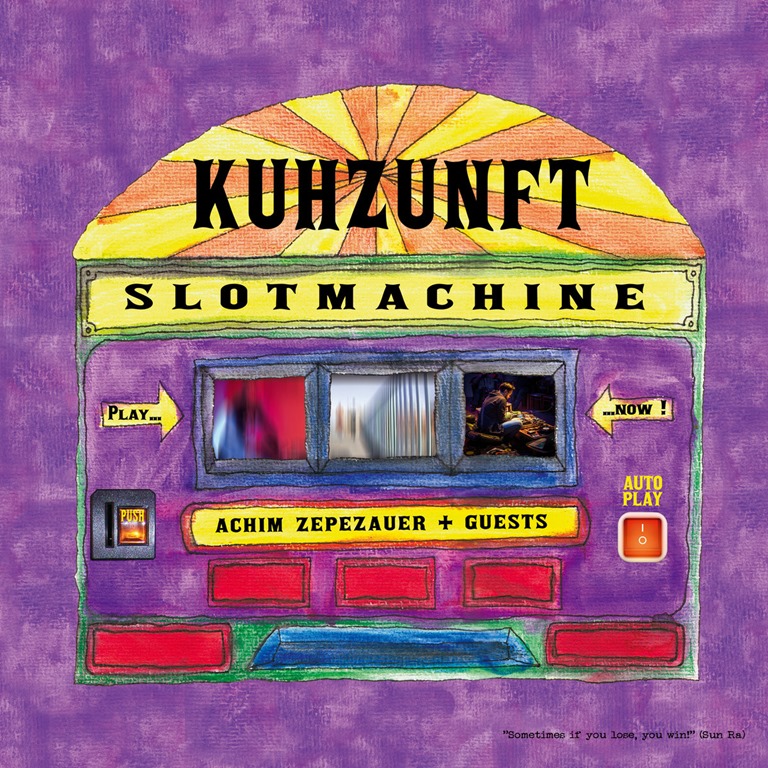
This is perhaps one of the strangest, most far-out and outright strange releases I’ve encountered in quite some time, and that’s certainly saying something. Slotmachine exists as an on-line project run by musician/artist Achim Zepezauer.

The press release explains that ‘online the user can combine three tracks by 13 different artists with different instrumentations, either hand sorted or completely randomized from the 158 recordings. Every artist provides at least ten tracks to generate from, which leads to the theoretical possibility of 1 billion different combinations’.

Curious, I spent some time messing about at the Slotmachine website in an attempt to get a handle on how it actually works. It looks like a slot machine. You can spin each of the three rows to change the track, and you can mute one, two, or even all three – but for best effect, spinning in three random pieces simultaneously is the way to go.

In some respects, Slotmachine offers an extension of Brion Gysin’s permutational poems, which involved the rearranging the words of a single phrase in every possible arrangement or permutation. This could be achieved by systematically moving the first word to the end of the row and moving each subsequent word one place to the left, hence A B C D E becomes first B C D E A, then C D E A B, and continuing until all of the variations had been exhausted. From a five-word phrase, a total of 119 new phrases, plus the original, could be created.

Zepezauer’s approach is less systematic – by which mean it appear to be completely random and arbitrary – but the one-word title attributed to each 45-second composition means each piece which utilises all three ‘rows’ has a three-word title which can be permuted. For example, ‘Cowshed’ by Simon Whetham, running alongside ‘Neck’ by Achim Zepezauer, and ‘Rupture’ by Jérôme Noetinger yields a track entitled ‘Cowshed Neck Rupture’ is a three-way collaboration by Whetham, Zepezauer, and Noetinger. But of course, what Zepezauer adds is the sonic element, which renders these permutational works multisensory, particularly when interacting on-line. Admittedly, touch is limited to mouse-work or keypads and you can’t taste or smell it, but it’s still pretty engaging.

The vinyl release on Gruenrekorder documents the project with a selection from 13 artists and 158 recordings, that offered a possibility of 3,944,312 tracks. Whittled down to just 30 choice cuts, it gives a flavour of the audio aspect of the project, if not of the interactive experience. And these short, snippety pieces are intriguingly varied, the layers forming experimental works spanning ambient, free jazz, hop-hop, dark electronica, and spacey Krautrock – and pretty much everything else in between. At times jarring, jolting, discordant, woozy, with clashing and complimentary sound works merging to create a single piece, it’s not always readily accessible, or even listenable. Then again, when things combine, as they do, to create (fleeting) moments of mystical musical magic, it’s truly wonderful. With each piece being so short, it’s difficult to find a flow or rhythm: instead, you find yourself swept along on a rollercoaster of lo-fi oddball weirdness and unusually eclectic hybrids. This is very much an integral part of the charm, the appeal, and the enjoyment.

And it’s an enjoyment that the record only captures the corner of, since the online-slotmachine has the ability to continuously grow and contains at the date of the vinyl release (February 1st, 2019) four more artists and a total of 225 recordings, providing some 11,390,625 possible titles. Even with audio clips being only 45 seconds long, that’s a lot of hours pissing about online before you’re explored the project fully.

AA

Slotmachine

SkipStone – SKST024

Christopher Nosnibor

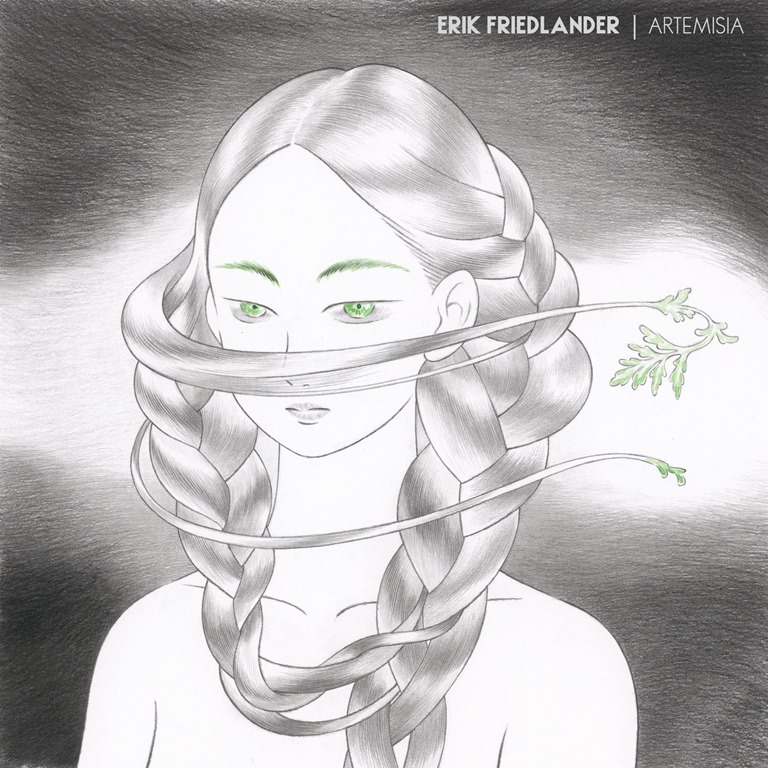
Pun unintended, there’s something groovy about releasing an album as a triple-deck of 10” records. I was never averse to getting up and turning a record over or changing the disc, even though some releases do take the piss a bit in terms of making work by pressing just one four-minute track into a side of a 12” on an album release. But with the 12 tracks clocking in around six or seven minutes apiece and with two per side, Artemisia seems to balance the vinyl experience and the practicalities of playing records.

Artemisia is by turns tranquil and volatile, and this makes sense in context of the album’s inspiration, whereby, as the press release quippingly quotes that cellist Erik Friedlander distills (sic) the brain-bending powers of absinthe, and the darkness of its murky past into his latest project’.

While perhaps one of the most famous works of art inspired by absinthe is Degas’ L’Absinthe (1875-6), followed maybe by Manet’s The Absinthe Drinker (c.1859), it’s Picasso’s absinthe glass sculptures which captured Friedlander’s imagination in 2015 when he visited MOMA.

“The glasses were pretty… kind of innocent on first glance, but as I looked more closely, I found a dangerous side. The front of each glass is exposed – torn away to show its insides. It seemed like Picasso was saying this is what happens to you when you drink absinthe,” says Friedlander. This viewing spurred Erik, who’s played with a host of artists spanning The Mountain Goats, John Zorn, Dave Douglas, and Courtney Love, into ‘an exploration of absinthe’s mysterious history: beneath a glamorous veneer in 19th century Paris lurked accusations of hallucinatory properties and elusive effects that created an atmosphere of addiction and demise’.

That absinthe has – or ever had – hallucinogenic properties appears to be a myth, but the romantic notion of the drink’s properties proliferate in art and writing, and Friedlander’s jazz-orientated representation of the drink and its history is intriguing and at times quite hypnotic. Take, for example the sparsely-arranged, exploratory ‘La Fee Verte’ with its sporadic percussion and mournful strings.

Friedlander’s cello is augmented by a band of collaborators, which includes pianist Uri Caine, bassist Mark Helias, and drummer Ches Smith, and certainly, his cello takes something of a back seat, or at least occupies a less dominant position in these varied compositions which range from the buoyant, focused and direct, to wandering experimental works.

AA

Erik Friedlander – Artemisia

Karlrecords – KR064 – 15th March 2019

Christopher Nosnibor

This is one of those made-for-vinyl releases comprising two longform tracks, and comes with a title that has heavy hints of JG Ballard. But then, doesn’t so much nowadays. Perhaps it’s my personal intertextual radar, but it does very much seem that the prescience and influence of Ballard’s work which was often spoken and written of in his lifetime has only become truly apparent in its extent in the last decade. It’s perhaps fitting that while Terminal Desert carries connotations of his more stilted, genre-driven works of the 1960s in its title, its sound calls to mind some of Ballard’s more wayward peers, not least of all William Burroughs and the Tangiers Beat collective.

The accompanying text refers to ‘Jajouka Pipe Dream’ as ‘a clear reference to the Master Musicians of Joujouka, with lots of flutes and percussion’, and describes it as ‘a very rhythmical, ritualistic track.’ And it is. Slow, undulating, dominated by polytonal, polyrhythmic percussion, it marks a thematic revisiting of some of Barakat’s previous work, albeit in a less confrontational and more ambient-orientated setting.

But then, this collaboration marks both a departure and a continuum for each of the contributors. German-Palestinian artist Ghazi Barakat, after playing in rock bands including The Golden Showers and Boy From Brazil, developed the alias Pharoah Chromium, a vehicle for the creation of what he calls “meta-music for meta-people in a meta-world”. Meanwhile, Paul LaBrecque, of vast collective Sunburned Hand of the Man and who usually records as a solo artist as Head of Wantastiquet, contributes guitar and synthesizer to the two tracks.

Less cut-up and less mashed than some of his other stuff, it’s still certainly not rock. It chanks and thumps and conjures an air of obscure eastern mysticism as haunting notes echo through a sonic heat-haze.

‘Planet R-101’ is altogether mellower, less edgy and agitated, rippling out over seventeen minutes of soft synth oscillations that brings together ambience and Krautrock to forge a mellow, immersive sonic expanse, a drifting sea of soft tones and Then, from amidst the wibbly, woozy, spacey ripples emerge some word music / new age pipe drones which echo out into eternity. And then, soaring guitars that are pure prog emerge as if rm nowhere and take the composition to another genre plain.

What to make of it all? Terminal Desert is best absorbed without too much contemplation. That isn’t because it lacks conceptual depth or consideration, but because it’s an album that needs to be given room to breathe without close analysis, for the atmosphere to be fully absorbed.

AA

Terminal Desert

Neurot Recordings – 15th March 2019

James Wells

They probably started off with perfect hearing, but a couple of sessions rehearsing this cacophonous melange at infinite decibels would soon put paid to that. Monastic chorals meet Sunn O))) with the wordless vocal drones that build sinister spirituals that echo into eternity on ‘Vox Dei’, the opening piece on the colossal noise fest that is Metaprogramação by Brazilian act Deafkids. And then all hell breaks loose: ‘Alucinações de Comando’ is a blizzard of lasers, manic percussion, and messed-up vocals echoed to infinity. The overall result comes on like listening to Whitehouse duetting with Dr Mix from across the street.

Metaprogramação is an insane work. Seriously: where are their heads at? Thrumming bass bounces around on the dubby, experimental electro-ish ‘Pacto de Màscaras’, while ‘Mente Bicamerel’ packs a dirty, amped-up groove as it pounds away at a single riff motif – albeit with the occasional chord omission – for what feels like a very long time, but is actually only four and a half minutes. This isn’t to say it’s arduous, but recognises the rewards of repetition.

All of the aforementioned come together on ‘Templo de Caos’, a frenetically drum-driven riot of echoed vocals, grating bottom-end and stun guitars, while ‘Raíz Negativa (Não-Vontade)’ is a mess of murk, with everything as muddy as hell, and even more oppressive as they crank out a repetitive cyclical chord sequence on bass and guitar, while the vocals are more or less lost in the fog. Then again, ‘Vírus da Imagem do Ser’ goes full-on thrash, a hypercharges blur of crusty grind.

Ending in a short, sharp blast of white noise, there isn’t a moment to breathe here. I’ve no idea what the fuck it’s about, but it’s a sonic blitzkrieg that’s nothing like anything else going.

AA

Deafkids – Metaprogramação

Metropolis Records – 8th February 2019

Christopher Nosnibor

In a sense, I was raised on so-called ‘industrial’. It was the very early 90s and I was in my mid-late teens: Ministry had broken through to the MTV major league with ‘Psalm 69’ and I worked weekends in a second-hand record shop. The other hired hand, who worked when the owner wasn’t around and drove the van carrying the shop’s contents to record fairs on Sundays, was around 15 years older than me, and was massively into all sorts, but particularly punk, new wave, and industrial shit. He’d feed me stuff like Pigface and Lard. Records and CD had a pretty rapid turnover, so recent releases often landed with us for resale within a few weeks of release after a rush of ‘mistake’ purchases off the back of reviews in the music press, and at record fair, it was possible to swipe Wax Trax! remainder12” – which included albums, often still sealed – for a pound apiece.

The fact there was a certain similarity of sound across many of the releases was, in a sense, part of the appeal: the uniformity of industrial civilisation and its attendant culture, reflected in musical from echoed a blank nihilism that simultaneously accepted and confronted the grim harshness of daily reality.

But it’s 2019 and many of the old bands are still cranking out the same trudging grind, and there don’t really seem to be that many emerging bands in the field, making for a genre that’s increasingly stagnant, continually cross-feeding from within itself without drawing inspiration or air from outside its hermetic grey-hued space. The additional contributors featured here is a case in point: the album features contributions from Robert Gorl (DAF), Nick Holmes (Paradise Lost), and Chris Connelly (Revolting Cocks, Cocksure). As a catalogue of luminaries from the scene, it’s cool, but it’s the same catalogue as you might have seen as far back as twenty years ago

Wake Up the Coma isn’t bad by any means, and it certainly has its standout moments. It’s brimming with thumping industrial-strength disco beats, bubbling basslines and stabbing synths, and in this field, songs like ‘Hatevol’ are exemplary. The minimalist slow grind of ‘Tilt’ sounds very like PIG with its woozy, grimy, stop / start synth bass and snarling vocals, fuzzed at the edges with a metallic distortion. Then again, their cover of Falco’s ‘Rock Me Amadeus’ (with Jimmy Urine) stands out for less good reasons: it’s 100% straight, with negligible deviations from the original save for a more industrial beat. And I can’t help but think ‘what’s the point?’ there have been plenty of inspired industrial covers, and I will always cite RevCo’s take on ‘Da Ya Think I’m Sexy’ as an example of irreverent and inventive adaptation.

No-one looking for a solid Front Line Assembly album is going to be disappointed by this. And since FLA, now thirty-three years and almost twenty albums into their existence, are always likely to be preaching to the choir, they’ve delivered firmly with Wake Up the Coma.

AA

Front Line Assembly – Wake Up The Coma

12th April 2019

Creativity is one of those things that’s innate, and as such, while it’s something that can be suppressed, sidelined, ignored, overlooked, and can even lie dormant for protracted periods, it’s an urge that never dies.

Karen Haglof stepped in to play guitar with Band of Susans after two of the three Susans who featured in the original lineup departed after the first album and featured alongside Paige Hamilton on 1989’s Love Agenda and the band’s Peel session, also released as an EP before departing to pursue a more solid, and what some might call ‘grown-up’ career’.

Most people in bands have day-jobs on account of the economics of music-making, but few have successful headline careers in medicine. And yet, after building a career as an oncologist for some twenty years, Haglof felt the urge to get back into music. And somehow, she’s found time to release three albums and an EP since 2015 – although their writing and evolution goes back a little further.

Karen says of her music, “I love a heavy drum beat and thick deep bass. I love noise and wall of sound guitars and idiosyncratic rhythms. I love open D and finger style. I love a crunchy guitar. I love sly lyrics and depth of feeling. I love a pop song and a pop groove. I love a dance groove. Does all this come through in my music? I don’t know, but I am always trying for it to come through.”

Tobriano is certainly a lot poppier than anything Band of Susans released, and definitely boasts some tidy grooves, bringing to the fore elements of country and vintage radio-friendly rock. But pop should never be viewed as synonymous with lightweight, weak, or disposable. ‘Humbled and Chastened’ brings some beef, while ‘These are the Things’ brings some jazz brass and a solid groove. Elsewhere, the choppy guitars, insistent drums and raw sax of ‘Favour Favour’ calls to mind the early years of The Psychedelic Furs, which is certainly no bad thing.

To describe Tobriano as ‘mature’ isn’t to do it a disservice or dismiss it as dull: it’s an album that’s laid back, confident, assured. It isn’t about testing limits or pushing boundaries, and it’s in that sense that Tobriano is mature. What it is about is enjoying act of making music, and celebrating musicianship and creativity. And this very much does come through in the music, making for solid listening pleasure.

Karen Haglof online.

karenhaglof-e1537816517825

Rocket Recordings – 22nd February 2019

Christopher Nosnibor

Evolution – that’s perhaps the only word when considering Teeth Of The Sea. Their career is defined by it.

Their BandCamp biography gives some sense of context: ‘Since their formation in 2006, London-based Teeth Of The Sea have metamorphosized into the most adventurous psychedelic rock outfit in the UK. Taking on board influences like Morricone, Eno, Delia Derbyshire, Goblin, and the Butthole Surfers, they’ve arrived at an incendiary sound that marries the aural enlightenment of an avant-garde sensibility with the reckless abandon of trashy rock & roll.’

It was with Your Mercury that I joined the trip, sold instantly by ‘The Ambassador’ with its overloading noise intro, spiralling into a slow-paced desert rock weird out.

Each release has been different again, and so there’s nothing of that ilk to be found on Wraith, an album that’s slanted more toward the electronic end of the spectrum, although the guitars, while far from prominent, are very much integral to the texture and depth. But this being Teeth of the Sea, it’s a bit of everything all at once, and this is apparent from the very first track: ‘I’d Rather, Jack’ brings a sonorous bass and droning synth together over a thumping industrial disco beat with crashing snare that stutters and glitches all over, before jazz trumpet and a space-rock guitar fire off on different trajectories. It’s rare for such a maelstrom of ideas and forms to whip together into anything other than a horrible mess, but Teeth of the Sea manage to blend the ingredients into something far greater than the sum of the parts, the atmosphere shifting from oppressive to uplifting.

There’s some of the old Ennio Morricone vibe about the spaghetti western sunset guitar twang of ‘Hiraeth’, before snaking drums and twisted allusions to Asian musical motifs was in and out of expansive layers of brass on ‘Burn of the Shieling’.

There are hints of Tangerine Dream and expansive synthy electronica about compositions like the buoyant, spacey, retro-futurist ‘VISITOR’ and ‘Gladiators Ready’, which combines the tweeky, bleepy Roland sound that echoes Josh Wink’s remixed ‘Higher State of Consciousness’ with some gritty guitar noise off in the background. Equally, the forms belong equally to post-rock, and whereas peers Vessels have gone all-out techno and ditched any vestiges of their origins, TOTS succeed in creating the most dazzling hybrid, discarding nothing and instead assimilating an ever-widening range of elements into their work. There’s so much detail in every bar, from blurred, muttering voices buried in the mix to synth incidentals and shifting reverbs that it’s impossible to take it all in, and oftentimes, Wraith is an overwhelming experience.

The centrepiece of ‘Her Wraith’ and brief counterpart ‘Wraiths in the Wall’ explore more minimalist approaches, the forms vague and vaporous, as echoing piano notes hang in the air over mournful trumpet. Pulling back on the prominent beats and instead allowing ponderous strolling basslines to wander to the fore, they’re as intangible as the album’s title suggests.

An album this eclectic and uncategorizable rarely feels cohesive, but Wraith feels more like a psychotic mind-journey than an album. And it’s nothing short of epic.

AA

Teeth of the Sea - Wraith

Panurus Productions – 22nd February 2019

Christopher Nosnibor

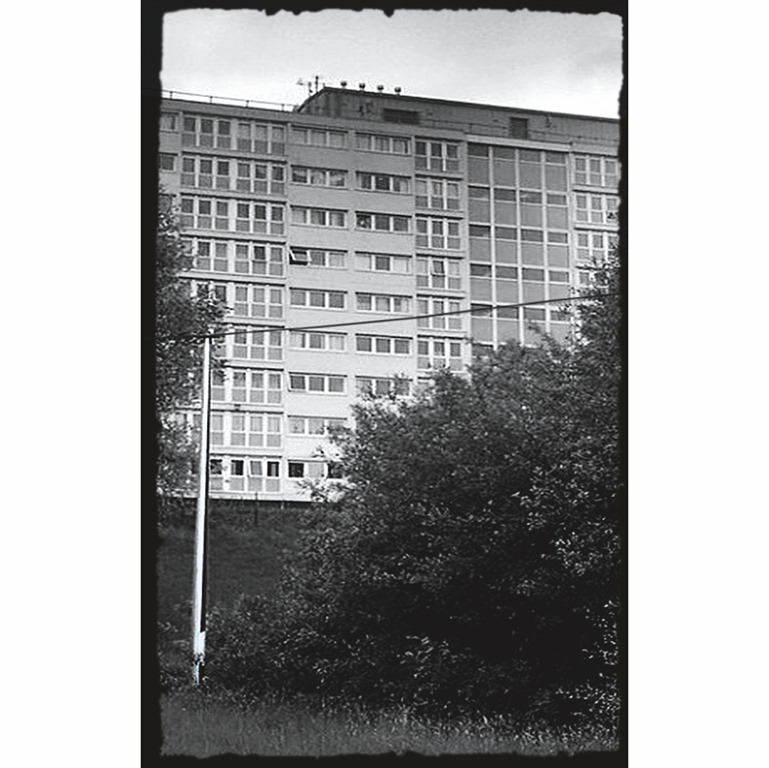
It promises ‘a voyeuristic excursion through the concrete labyrinth of Greater Manchester. A collage of the constantly evolving sensory barrage of the big city and it’s accompanying paranoia. The infinite possibilities of an adopted home and the entangled memories of the intrepid listener.’ It’s also pitched as a ‘prequel’ to Absolution – by which I’m assuming that the August – December 2017 recording of Burden predates that of Absolution, released in March last year.

It matters little. Chronology is a construct. While an individual’s actions may follow a simple chronology, events overall do not: things happen simultaneously, and in different locations. Those lines of time and location are distorted by real-time communication by such means as telephone and television, which can temporarily connect different time-zones and countries, even bridging periods of history. Letters, on the other hand, have an effective time delay. The idea that events can be charted by means of a simple chronological timeline is further discredited when thoughts and recollections, as well as dreams, can occur completely at random and in a fragmentary manner.

Supposedly combining ‘snippets of conversation and field recordings [filtered] through Kepier Widow’s digital ear’ and combined ‘with droning synth and bubbling glitches’, the two messy, disorientating, half-hour sound-collages (corresponding with the two sides of a C60 cassette) pay no heed to chronology or sequentiality. This, of course, is the beauty of the medium, in that it is non-linear, articulating instead the simultaneity of experience. And while it’s impossible to extract any semblance of narrative or even cohesion from the jumble of chatter, birdsong, car engines, grinding synths and wispy mists of ambient abstraction, often overlapping into one another, and occasionally all at once, Burden replicates – in a warped but intensely immersive way – the experience of traversing a large city. It’s loud, a collision of sound, uncoordinated, discordant, disorientating.

Some of the electronic intrusions penetrate with some pretty harsh noise. There are unsettling, hums and drones, and glitchy ruptures kink the flow of any attempts to create smoother, more linear flows. Sonorous, undulating ripples of sound weave in and out. There is no structure. There doesn’t need to be – nor should there be. Everything simply ‘happens’. And this is life.

cover