Archive for the ‘Albums’ Category

Crónica – 9th April 2019

Christopher Nosnibor

Useful points worth noting by way of a preface: Unwritten Rules for a Ceaseless Journey

documents three pieces composed for dance, commissioned by Ballet Teatro for the play Revoluções (Revolutions) by choreographer Né Barros. The in three parts are designed to embody formal idealisations of the three decisive layers of time — past, present, and future.

The three tracks each span around fifteen minutes, and the first, ‘Something’s Missing (Utopian) begins with elongated, scraping drones… and continues onwards with ominous hums that swirl and eddy around a barely-audible hissing buzz. A rolling organ while emerges from a clamour of shuffling intangibility to provide a vague semblance of form and instrumental musicality, but the it’s sad and sinister in equal parts, conveying a sense of loss while reminding us that the past is dark. The muttering voices, inextricable individually: are those the voices of the dead?

It seems entirely fitting that the pieces should melt into one another: time always transitions seamlessly, and in terms of life lived, it’s difficult to appreciate the fact that every passing second is stacking up the record of time past as the present slips away instantaneously. It’s also fitting that the present, as represented by ‘The Pulsating Waves (Reality)’ flattens into an indistinguishable mid-range hum that groans and sighs and whispers. Metallic sparks hiss way off on the horizon, forever out of reach. There’s a sense of emptiness and despondency about this inhospitably bleak sonic wasteland, even as it swells into an altogether smoother, denser, broader droning hum. It’s the sound of absence, a dulled absence that lacks dynamism or detail. So much positive, pro-mindful life-coaching material and contemporary self-help verbiage tells us that we should live in the moment; but the fact of the matter is that the moment is invariably empty, bleak, depressing.

‘Don’t Look Back, Run (Trauma)’ is solid advice: it’s impossible to retreat to the past, or to recreate it, despite the booming nostalgia industry’s suggestion otherwise. To commit too much time to reflection is to lose oneself to the past and deny the possibility of progress; but, to run to the future without due attention to history is to be doomed to repeat the mistakes of the past. There is a balance to be found. The album’s final track suggests a certain degree of balance: it’s slow, its form emerging from dragging pulsations drawn out in bowed strings – or ersatz assimilations thereof – which gradually diminish into a rumbling gust of wind, blowing grey, blurred particles into a formless mass. The future is, and will forever be indistinct, unclear, as unpredictable as the weather, fashion, and our fragile emotions. And in the dying minutes, it crumbles to a cloud of grey obscurity, lacking shape, form, and tonality, a vaporous viscosity of… what? Uncertainty. Murky, messy, abstraction. What the future holds, we know not: the present is unsettled, dangerous, turbulent. The present is well out of hand, and the future yet more so.

AA

H_CE_ARTES_FINAIS

Kranky – 10th May 2019

Cristopher Nosnibor

As with its predecessor, Konoyo, Anoyo draws its inspiration from traditional Japanese music, but very much reconfigures it not only through an ambient lens, but through Hecker’s own unique musicality.

Anoyo is very much a sequential, linear work, to the extent that the song titles create poem, and also a form of micronarrative:

That world / is but a simulated blur

Step away from Konoyo / into the void

Not alone / you never were

This sense of narrative also extends to the overall listening experience. ‘That World’ begins tentatively, tightly-wound strings picked, twanging. Washes of sound, reversed, flit like will-o-the-wisps as the tapers run the wrong way and slow, warm pulses flesh out the immense spaces between the notes. It’s ambient, and it’s (superficially) background, and quite hypnotic, but not without points of interest: in fact, while it’s easy to simply allow it to drift past, turning up the volume a way and concentrating reveals almost infinite details and ever-shifting forms. This is where Tim Hecker stands out in his field.

‘Is but a simulated blur’ presents a very different dynamic, dominated by irregular percussion. The arrythmia contrasts with the soft wave forms which drape, mist-like around the beats, which evaporate into the air, and the tracks bleed into one another. Things become fuzzier, less distinct, less clearly focused on ‘Into the void’, as piano notes stutter and glitch, warp and bend in the most disorientating ways.

‘Not alone’ brings bold, thunderous drums, but again the beats are erratic and ever-changing in pattern, before melting into the static-rumbling ‘You never were,’ which fractures and stammers like something’s damaged in the playback mechanism, like something in the process is broken, and the effect is disconcerting, discomfiting.

And so it is that Anoyo subtly transitions from delicate and mellow to something altogether more fragmented and more difficult. The subtlety is the key here: it creeps up on you, barely noticeable… and then, by the end, you find yourself wondering how you got here from there.

AA

449080

Houndstooth -15th March 2019

Christopher Nosnibor

And We Are Passing Through Silently is pitched as ‘a collection of songs reworked by Abul Mogard between 2015 – 2018’, with the press blurb describing it as ‘the sublime first survey of reworks by [the] cult synthesist’. It’s also keen to point out that while there may only be five tracks on offer, here, the stature of the artists with whom Mogard has had involvement, noting ‘divine renderings’ of songs by Aïsha Devi, Penelope Trappes (The Golden Filter) and nick nicely (heralded by luminaries of the US underground Ariel Pink & John Maus), with the album culminating with Brian Eno’s collaboration with Irish avant-folk band Fovea Hex.

The 2LP, CD and digital editions also feature Abul’s brand new rework of Becoming Animal’s ‘The Sky Is Ever Falling’ which features vocals from Cinder (This Mortal Coil/Cindytalk) and Massimo Pupillo on bass (Zu/Thurston Moore/Stephen O’ Malley),

The album opens with Mogard’s reworking of Aïsha Devi’s ‘O.M.A.’ The minimalism of the original, as well as its woozy atmospherics are substituted for a mellow sonic wash, and while it’s eminently listenable, there is a certain sense of loss. The darker, more disturbing aspects are stripped out in favour of something less psychologically traumatic, but… I’m torn between the function of a remix bringing something different, and it taking out the essence, and this very much feels like a stylised dilution.

In contrast, his rendition of Penelope Trappes’ ‘Carry Me’ distils that essence and concentrates it, while also drawing out three mellow minutes into twelve and a half of droning organ abstraction, and Mogard’s reworking of nick nicely’s ‘London South’ follows the same trajectory, stretching out four minutes of soft, wistful psychedelia into a fifteen-minute drift, with long, sonorous drones expanding to cinematic proportions. The vocals are preserved, but spaced out, pushed to the back, partially submerged in reverb.

Everything reaches a perfect coalescence on ‘The Sky Is Ever Falling’. Which combines cinematic and operatic, minimalism and maximalism, as the sparse yet full, widescreen instrumentation comes to crate the backdrop for a soaring vocal performance that lifts and soars. The piece warps and wefts on a solar wind for almost a quarter of an hour, before the contrails bleed into an eternal scraping drone that creates a soporific calm that flows from foreground to background in an imperceptible transition.

On the one hand, there isn’t much to it, and Mogard’s method is simple – but it’s not only effective, but has ‘signature’ stamped all over it: his style is distinctive, to the point that his reworkings relegate the original artist and their work to a secondary placing while his own sound and style dominate. On occasion such an approach to remixing may appear ‘insensitive’ or even ‘selfish’, but Mogard seems to have established himself as a re-creator more than a remixer, with artists lining up to submit their work to his reworkings, he’s clearly got some leverage in the musical community, and fair play.

AA

Abul Mogard – And We Are Passing Through Silently

Wonkystuff

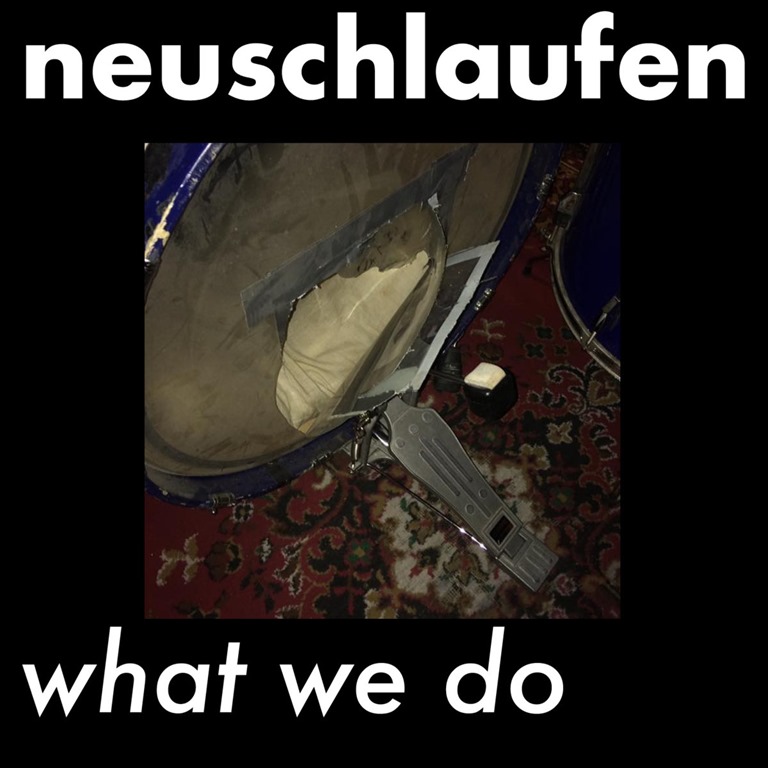
What do Neuschlafen do? The York / Leeds collective which features member of myriad other bands and projects seem to exist more in the ether and in theory than as a tangible entity, despite the existence of a handful of recordings, most of which capture live improvisations in collaboration with other artists.

It’s been some time since the trio, comprising John Tuffen (guitar, synthesiser, vocals), Ash Sagar (bass, percussion, synthesiser, vocals) and Jason Wilson (drums, percussion, synthesiser) combined forces to release anything ‘proper’, although What We Do – a rehearsal room recording committee to (virtual) tape on a Tascam DR07-mkII (with no overdubs) at House Of Mook, Leeds on March 24th, 2019 adheres to their improvised, zero-budget, DIY ethos to the letter. Some of the sound is a little muffled and muddy, and the balance isn’t quite what studio ix would aim for, but it does capture the band’s essence and approach a vast expanse, before

With the exception of the twenty-five second ‘Breath #1’ the eight pieces here are all long-form explorations that sit toward the ten-minute mark. The first, ‘The Set-Up’ could be a literal rendition of its title and is more f a soundcheck than a song, with a wild crash and slash of cymbal mayhem and frenetic jazz percussion over a gloopy, strolling bass.

‘A Slow Hand’, with its wandering, repetitive motifs, has echoes of latter-day Earth and conjures a spaced-out-desert rock / folk hybrid played under sedation. It meanders along, before the playing becomes quieter, and it finally sort of peters out. And yet it doesn’t feel remotely disappointing, because it sounds somehow intentional.

The tracks tend to follow a similar flow in fundamental terms: the drums plod along with frequent and explosive, unpredictable fills punctuating the rhythmic line while the bass wanders around casually while returning to its root motif by way of an anchor just when things start to look like the structure is losing shape and the guitar lays down layers of abstraction and textured atmospherics rather than affecting any semblance of melody or tune.

The title track is a definite standout: landing at around the albums mid-point, it steps up the tempo and goes straight into a chunky jazz-tinged krautrock groove. It’s the rhythm section that dominates, while synths waft and ripple and heavily echoed guitar rings out crisp and clean but at a distance. And whereas the other pieces tend to drift, ‘What We Do’ drives and maintain a linear, forward-facing trajectory as it builds through successive slow-burning crescendos.

It’s the percussion that comes to the fore on the closing tryptic, with the 15-minute ‘Divisions’ constructed around a relentless rhythm around which pulsating synths grind and drone in way that calls to mind Suicide’s debut. Somewhere, maybe about halfway through, when the drums have hit an optimal thump and the cymbals are crashing all over, the bass boosts into an approximation of Joy Division’s ‘Isolation’, while monotone vocals, the words inaudible, drone away in the background as the instrumentation stretches out into a vast expanse, before the final cut, ‘to the end’ breaks loose with a thunderous clatter of freeform percussion and sprightly bass that bounds around freely and fluidly to conclude a set that’s simultaneously tense and mellow, an amalgamation of so many disparate elements that renders it difficult to place. And that’s all the more reason to rate this effort, that broadly sits in the brackets of avant-garde, experimental, jazz, and even post-rock and math-rock, albeit at their most minimal and most deconstructed. And that is what they do.

AA

Neuschlafen – What we do

Metropolis Records – 22 March 2019

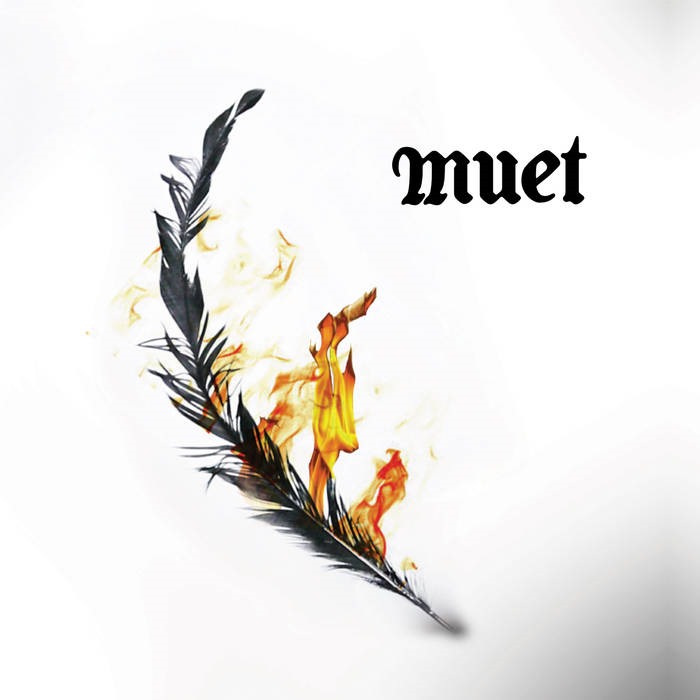
So often, less is more. All we know if muet is that ‘muet is the sound of American noir. Sonically defiant art rock sung under the shadow of a long brim hat. Deliberate dissonance and heartbreaking melody are stitched together beneath sodium light with tales of the tragic, the romantic, and the bizarre. The band features Steven Seibold, Daniel Evans and Vince Mcaley, who have all enjoyed moderate success in various post-industrial and punk bands. based out of Chicago’.

I may have mentioned before that I broke free of mainstream music by route of 80s goth, so I have something of an appreciation of hats. Actually, that’s something of an understatement, as I’ve been an avid hat-wearer for large portions of the last 27 years. Muet is the sound of doomed romanticism and hat-wearing, a meshing of the gothier end of the post-punk spectrum with more contemporary takes on the same: because for all of the referencing and influence, the likes of Interpol and She Wants Revenge very much filter the past through a post-millennial lens.

The album’s first chord is a single, echoing strike that could almost be a sample of the opening note on ‘Marian’ by The Sisters of Mercy, and then a mechanoid drum and solid , square bass groove rumbles in, holding down that c.85 Sisters vibe… but the nagging, trebly guitar that chops in is more Gang of 4 via Radio 4 ‘Leather Jacket Perfume.’

There’s a heavy sleaze vibe that permeates every aspect of the album, with song titles like the aforementioned ‘Leather Jacket Perfume’, ‘Weirdest Sex’, ‘Her Dad’s Car’, and ‘Muscle’, but there’s equally a considerable amount of brooding and melancholy, conveyed by atmospheric, echo-drenched, minor-key guitars picked and spun.

‘Reach out and Murder’ features some wild, bending post-punk guitar and a thunderous rhythm section and kicks out a riff reminiscent of Department S’ ‘Is Vic There?’, whole the chorus has something of a Cooper Temple Clause feel. ‘on2u’ combines swagger and groove with a dash of early 90s Mission wrapped in a haze of psychedelia

One thing that comes across strongly is the emotional depth ploughed into each of the songs. Yes, there’s an element of stylisation which is part and parcel of the genre form, but there’s a conviction that resonates and it’s unmistakeably genuine. Moreover, muet has range, and doesn’t focus excessively on any one theme or mood, while maintaining a stylistic cohesion. It’s a proper album, and a damn fine one at that.

AA

muet

The accompanying text records that ‘n is a collaboration between close friends Nathan (London) and Neil (Devon). The first album is a collection of seven words which were sent by text and used to inspire and direct the playing and production’. And so, we have insight into the title and the process, but what matters is the end result.

Delicate notes, distanced apart in time, hang in the air, dripping slowly like drops of water from an icicle. And so ‘Trust’ forms, slowly, gradually, imperceptibly, a ringing note at a time; the mood is optimistic, but tentative, fragile. Deeper, fuller, piano notes creep in, but remain at a distance.

‘Subtle’ certainly fulfils its title’s promise, and while there is a gradual growth of an ebb-and-flow, the form is very much forged from soft, rippling notes from beneath which incidental bumps and scratches occasionally emerge.

The power of music like this is the infinite room given for the listener to interpret, ad to project: to fill the vast expanses of space with their own emotional response. I’m as guilty as the next music critic of describing music as ‘haunting’, but what does tat actually mean? For me, it’s about a personal resonance, the way a single note, hanging in a suspension of reverb, evokes memories and feelings, likely completely unconnected in any way to the music itself. But, when the mind is given subtle stimuli which encourages introspective wandering, sensations buried and locked away suddenly rise to the surface, free of the constrictions of linguistic association.

Minimalist is the word: n is sparse both compositionally and sonically, with a hushed ambience rendering the sparing works in a way which accentuates their quietness. One wouldn’t listen to a work like this and highlight a standout track, although ‘Awe’ marks something of a departure from the barely-there spatiality with a fuller sound comprising long, turning, drifts of sonic mist and chirruping birdsong – something which returns in the final track, ‘Truth’, which is uplifting in its tranquillity as I’m reminded of the sounds of early spring, the trilling chatter a confirmation that winter’s gloom is finally losing its grip and light and life can blossom once more.

N is a wonderfully simple, yet meticulously considered and exquisitely executed work, which contains and emanates everything and anything you want it to.

AA

n

Front & Follow – 3rd May 2019

I genuinely had no idea that this would be landing with me just days after my review of the split release on worriedaboutsatan’s This is it Forever records, featuring Gavin Miller and Polypores. Not that knowing would have altered my decision to mention the outstanding contribution to the split release format of Front and Follow vie their ‘The Blow’ series, but still. Serendipitous is most definitely the word.

The same is perhaps an apt description for this release, on which Polypores (Stephen James Buckley) and Field Lines Cartographer (Lancaster-based electronic musician Mark Burford – aka techno producer Impulse Array) contrived to create an album about ‘alternate realities and altered states of consciousness.

They write: “We’d both been reading books relating to this, and after a few weeks of book-swaps and numerous Youtube wormholes (some valid science, some pure conspiracy theory madness) we each started writing music with this in mind. The idea was to see what would happen if we both wrote from the same starting point, and came up with alternative interpretations of the same subject matter.”

According to the accompanying text, ‘specific inspirations included the life and works of Philip K Dick, MK Ultra experiments, Shamanic drumming, Migraines, the work of Anthony Peake, Neuroplasticity, Aldous Huxley, Hinduism & reincarnation, Superstring & Brane Theory, alien abductions.’

And so it is that, once again, serendipitously, I’ve spent recent weeks sifting through material relating to The MK Ultra project while researching the novel I’m working on, as well as migraines, and while not especially well-versed in the works of Philip K. Dick, I’m more than acquainted both with classic sci-fi and its particular tropes, and Huxley, and what the pair proffer here is a quintessential work of retro-futurism, espousing the spatiality of early electronica and krautrock, with the soft, supple but simple beats of Kraftwerk and the ebb-and-flow of sonic washes underlying textured layers of broad brushstrokes and noodly doodles reminiscent of Tangerine Dream.

It’s the kind of spacey trip that evokes kaleidoscopic visuals, and the rippling synth waves pull the listener into another dimension: listened to intently – and believe me, I listened intently with my newly-positioned speakers that seem to inject music directly into my brain ad in perfectly but sometimes dizzying stereo – the gauzey granularity of the tones becomes apparent.

And it’s with intent listening that Polypores and Field Lines Cartographer‘s collaboration really reveals itself and takes life. The differences which separate the two artists’ work are subtle, as they strive toward the same objective, and clearly cross-pollinate one another’s ideas. With heavy, pulsating repetitions dominating and surging and swelling throughout the duration of the album, but equally countered by sonorous drones and rippling solar winds, it’s apparent just how much attention to detail both artists pay to the construction of their music.

Ultimately, this proves to be the strength of this collaboration: while the concept remains fuzzy, the execution is superlative in its field.

AA

Blow Vol 6

Christopher Nosnibor

No bones: Santa Sangre was one of the standout albums to land with me last year. The perfect amalgamation of dark-edged 80s synth-pop which took its cues from Depeche Mode and A-Ha, and gritty guitar-driven post-punk, it felt contemporary while also joyously retro. Having found myself in the late 80s (circa ‘87/’88), when the goth of the early/mid 80s was finally cracking the top 40, and could be heard on R1 on a Sunday night and even on Top of the Pops. At a time when pop was altogether darker anyway (I recall, aged 8, seeing Killing Joke perform Love Like Blood’ on TOTP and being rapt), I find myself right at home with this.

For the recording of their third album, the Italian quartet made the journey to Leeds, the heartland of the 80s post-punk / goth scene and equally a hotbed for its postmillennial revival, to work with Matt Peel, perhaps best known for producing Kaiser Chiefs and Eagulls, at The Nave Studios. And all of this shows, and the band have very much continued to embrace their influences to deliver an album that’s both taut and atmospheric.

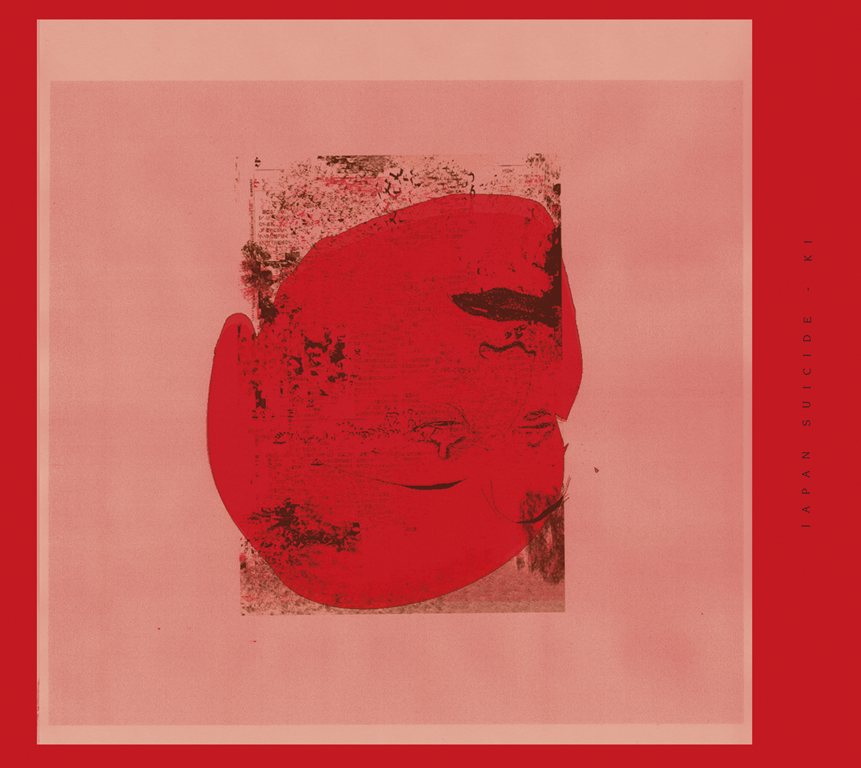
KI perhaps lacks the immediacy of its predecessor, but that’s no bad thing. This means that instead of kicking in with lasers set to stun at the opening, ‘Dance for You’ makes for a fairly low-key entrance, a thrumming sequenced synth bass and Curesque sweeps overlaid in misty layers, the vocals low in the mix and twisting together wistfulness and melancholic desperation.

It isn’t until the second song, ‘Empire’, that Ki really hits its stride and immediately expands the band’s sonic palette: a yawning shoegaze blur that’s part Ride, part Curve, but filtered through a Jesus and Mary Chain mess of treble noise and driven by a thudding four-square bass, it’s a mid-pace squall of density – and it’s this that really kicks through the driving ‘Fury’, which combines drifting, fractal guitars with a pulsating bass, driving drum track and darkly desperate vocal. It’s the Sister’s circa 84, it’s early Mission, it’s brilliantly crafted, capturing the spirit of the retro zeitgeist.

‘Kanagawa-oki Nai-ura’ broods like all the brooding over droning organs and glacial synths underpinned by a murky funeral rhythm section, replete with dolorous bass before a crunching guitar glides in and

‘Mishima’ slips into dream-pop territory, again taking obvious cues from The Cure – which is no criticism. Is it wrong to chuck in references to early Interpol and Editors? I’ll say no: this is music cut from the same post-millennial post-punk cloth. It’s no longer about uniqueness, but how well influences are assimilated, and here, Japan Suicide show enough capacity for crafting a tune that their stylistic appropriations are more than acceptable.

‘One Day the Black Will Swallow the Red’, which lifts its lyrics from a piece of writing by artist Mark Rothko , with its thumping beat and chunky bass underpinning a wash of hazy guitars, and moody but driving ‘The Devil They Know’ make for a strong finale to a solid album that has ‘grower’ written all over it.

AA

Japan Suicidie - KI - copertina WEB

Love Love Records – 26th April 2019 – LOVLP03

Christopher Nsnibor

However you remember Sly and the Family Drone, whatever your past experience, and whatever you may expect, the reality of each new entry in their catalogue brings something slightly different.

My first encounter with them was in a live setting, and I was left reeling with images of a bloke in boxer shorts pummelling drums and getting half the audience to join in. I remember noise, rhythms and chaos. Various YouTube footage confirms this is pretty much representative.

All of those elements are present on their studio recordings, but in different measures. It works: it’s a different medium. And moreover, each release reflects an evolution, usually a subtle but nevertheless key shift. And so it is on Gentle Persuaders, the collective who describe themselves as a ‘neo-noise-jazz outfit’ (one suspects that as apt as the description is, there’s an element of tongue-in-cheek here, just as their absurdist track titles aren’t entirely straight-faced) ‘vomit forth a smooth serving of curious and clattering noise not devoid of fun’.

Smooth is perhaps one thing it isn’t, and for that we should all try and be grateful. Challenging, angular, tonally and structurally abrasive, Gentle Persuaders finds Matt Cargill and co. playing to their ever-growing strengths.

The album opens in suitably uncompromising style, with the longest of the four compositions, the fourteen-minute ‘Heaven’s Gate Dog Agility’. It takes its time to get going, and with minimal instrumentation save for elongated sax drones, it has something of a sparse, free jazz feel. The percussion is restrained, distant, muted, and the emphasis seems to be on atmosphere, and – so it would seem at this stage – musicianship. But by the mid-point the drums are full-blooded, and the sax is battling amidst a barrelling wall of extraneous noise. The closing minutes find the rare emergence of an overt structure, a form, with repetition and a coalescence of sound that could almost be mistaken for a tune.

Crashing, head-blasting industrial beats worthy of Test Dept or perhaps reminiscent of Revolting Cocks’ ‘Beers, Steers & Queers’ shatter the air on ‘New Free Spirits Falconry & Horsemanship’. And they continue to pound away for the duration, while the sax screeching becomes ever more strangled and frenzied.

‘Votive Offerings’ ventures into murky, dark ambient territory, and reveals glimmering flickers of light shifting amidst the shadows of sombre drones and unsettling incidentals. It’s a mosaic of fragments: forms start to emerge, solid rhythms kick in, only to halt after a few bars, and if it’s jazz with noise, it’s jazz with noise penned as a soundtrack to the fragmented hallucinatory anti-narrative of Naked Lunch.

It’s this change of mood that renders the finale all the more impactful: beginning stark, sparse, eerie, with single notes ringing out into a sea of black echo and swampy low undercurrents, the spectacularly punny (and so very typical) ‘Jehovah’s Wetness’, a low-end bass grind begins to build the foundations of a swirling sludge-trudge climax. It’s not gentle, but it’s extremely persuasive.

AA

Gentle Persuaders

COdA / Lonktaar – 20th March 2019

Christopher Nosnibor

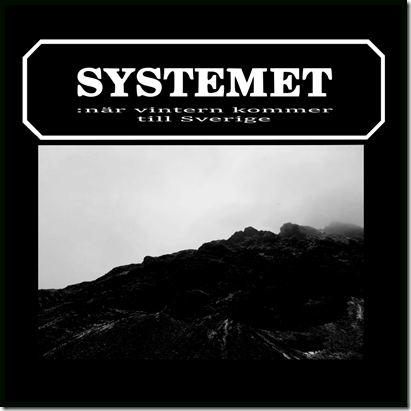
This release came my way via master purveyor of noise and drone and occasional collaborator of mine, Dave Procter. The man with more pseudonyms and projects than possibly anyone I’ve ever met – with Legion of Swine, Fibonacci Drone Organ, Wharf Street Galaxy Band, Hundbajs, Dale Prudent, and Trouser Carrier being just a few of his outlets – he’s immensely well-connected (and deservedly respected) in this niche corner of difficult experimental music (with forays into poetry and spoken word and with an angular post-punk band in the mix). I’m therefore assured that anything he recommends will be suitably obscure, and challenging, and probably very good and right up my alley. This is very much the case of Systemet’s När Vintern Kommer Till Sverige.

According to the press sheet, ‘Systemet is a collective that challenges the architecture of a standard band. While the sounds have their roots in early industrial, dungeon synth, dark ambient and noise drone music, only a segment of Systemet is a harsh reinterpretation of the mix of these genres.’ And it is harsh. Meanwhile, according to Dave, it’s a ‘beast’. And it is a beast.

I learn that ‘the aim of this album is to recreate the sensations of the Swedish winter, based on a one-week off-track trek in the Sami area north of mount Kebnekaise, where the cover picture was taken, in the period between autumn and winter 2018.’ Having never experienced a Swedish winter, I’m ill-equipped to comment, but if it really is anything like När Vintern Kommer Till Sverige, I can only conclude that Swedish winters are seriously tough.

I also learn that ‘all sounds were produced by ELI and ELQ synthesizers’ – which, being custom-made, you won’t find in the shops or emulated on-line – on a quadraphonic system, and recorded in dual stereo. The effect is deep, wide, immense.

‘Čievrrajávri’, the first of the album’s four pieces – I’d be reluctant to call them compositions, begins as barely a whisper of wind, a delicate breeze laced with almost invisible, inaudible traces, before the low-gravity bass notes begin to amble and moan in rumbling undercurrents that set an uneasy tone.

Things don’t get lighter or easier from thereon in: ‘Glaciären Brinner’ brings more space-age pulsations, oscillating rhythmic throbs of distorting low-end and murky mid-range over which whistles and screeches. But mostly, it’s about dark washes out found, swirling gurgles that spiral and whip the air. It’s an ever-shifting soundscape of swirling, pulsating darkness, a vortex which sucks the listener in. and it only become s progressively more difficult. It’s perhaps a cumulative effect: scrapes and drones in small doses are simply scrapes and drones, but over the course of almost forty minutes, it slowly becomes increasingly torturous, and När Vintern Kommer Till Sverige offers no respite.

The ‘extended version’ of ‘Gaskkasvággi’ is 11:11 of elongated, grating drone and what sounds like heavy breathing up close to a mic amplified and looped. It’s a shade hypnotic. It’s followed by the final piece, ‘Vy Över Visstas’, Which is the sound of collapse and a protracted final meltdown; circuitry slowing, fizzling to a halt, howling and braying like slain robots in an uncoordinated wash of distortion and stuttering analogue froth.

När Vintern Kommer Till Sverige is indeed a beast: challenging, uncompromising, bridging the gap between Tangerine Dream, Throbbing Gristle and the vast field of contemporary dark ambient / industrial / electronic crossover, it succeeds in pitching unsettling layers of unease in the pit of the stomach.

Systemet – När Vintern Kommer Till Sverige