Archive for December, 2024

Christopher Nosnibor

I haven’t done and won’t be doing any best-of or top-whatever lists this year: I tend not to anyway, for a number of reasons, a leading one being that social media is absolutely saturated with end of year lists. I mean, by the first week in December I was absolutely fucking sick of them – and there was still a fair chunk of year left. I have enough submissions in my inbox to review 2023 releases to the middle of 2025. Why would I want to add to this relentless noise? Another factor is that having reviewed maybe three-hundred albums this year, I honestly can’t remember what was this year or what was last, and when it comes to what I’ve been listening to by way of entertainment, when it was released isn’t something I consider: I’m still catching up with or otherwise processing albums from three or four years ago, meaning that they still feel new to me – and I don’t use Spotify or any other streaming service to tell me. I don’t feel the need to revisit the Spotify / streaming debate here. The simple fact of the matter is that I don’t do it. Ultimately, then, I don’t see the point in adding to the infinite lists, and if anyone really is that desperate to know what I recommend from the last twelve months, take a scan back over the reviews from the last year: I rarely cover anything I don’t consider to have any merit, and even where I’m not necessarily recommending a release, if I write about it, it means I feel it’s worthy of discussion and probably hearing at least once.

Alongside all of the countless ‘top albums of 2024’ lists, there are various ‘top gigs’ things in circulation, but due to personal circumstances, I’ve attended a very low number of live events for the second consecutive year. As such, I don’t feel entirely qualified to present such a list. Moreover, the handful of gigs I’ve attended, with perhaps a couple of exceptions, haven’t featured ‘name’ bands, meaning that any list I might compile might meet with the same kind of blank expressions and shrugs I get when my work colleagues and relatives ask who I’m going to see on the comparatively rare occasions I do go out.

As a brief aside, music is perhaps the thing I’m least comfortable discussing in my dayjob, to the extent that I rarely disclose that outside my dayjob I review music, because invariably, they’ll ask what I’m into and even if I try to focus on artists wo are better known within my own sphere of reference, they’ll mist over in an instant. I love The Cure, but the fact that the majority think they’re alternative reminds me of where I sit, and where the music I cover sits, in relation to the rest of the world beyond my microcosmic focus.

But I do feel that a theme, a message, has emerged across the live reviews I have written this year, and it’s one that’s probably worth making the focus of my reflection on the last twelve months.

I used to spend a lot of time in Leeds, attending shows at The Brudenell, Boom, Key Club, as well as the O2, but now travel is not currently an option, at least more than a couple of times a year, I’ve been tied to local gigs – by which I mean the three (and now currently two – more of which shortly) venues in York which are around fifteen minutes from my house. This means I’ve simultaneously been more selective, but at the same time taken punts based on proximity and cost. This limitation has meant that I’ve been dependent on grassroots venues for my live music kicks. I’ve not really seen any ‘big’ bands this year, but I have seen no shortage of amazing bands this year. Most have been free or under a tenner, and the venues have been selling quality regional beers at decent prices. Had I not been able to do this, I can’t conceive the state I’d be in by now. I realise I’m fortunate to have three 100-300 capacity venues within walking distance, but it’s never been more apparent that supporting local music and grassroots venues is vital on so many levels. I don’t want to preach, but I’m going to, simply because. Every additional ticket sold, every pint that puts money over the bar helps. It helps venues, it helps bands, it helps communities, and it helps individuals by providing the spaces that boost mental health.

I learned at relatively short notice that one of the three York venues – The Vaults – would close in December, the freeholder having decided to sell it to a developer for (obviously) considerably more than they paid for it, with a view to it being converted to three homes – presumably shitty flats, like nearly every other properly sold in York, which becomes either luxury flats, student accommodation, or a hotel. I also learned that CAMRA had initiated an application for it to be granted the status of an Asset of Community Value. I submitted a document in support of this – admittedly with no expectations – point out (as others also did), that while the freeholder and purchaser claimed there were around 40 live music venues in the city, that there is a significant distinction between a pub that has live music in the form of acoustic solo artists or duos or covers bands, and a dedicated venue which hosts original bands, local, regional, and even international, and that at a time when such venues are disappearing at an alarming rate, a venue that is not unviable, but being sold due to capitalist greed should be preserved at all costs. Amazingly, the council agreed. Of course, this is only the first step: there’s a lot of shit to unravel, since the venue has closed, the sale had already reached completion, and the purchaser is now saddled with a building they can’t convert, but we have secured the building for its current purpose.

My point here is that while most end-of-year gig lists are solid with academy and arena bands, there is a world beyond these cavernous, impersonal spaces. Most of the bands who play the little venues won’t progress to the major leagues, but so what? There is a unique thrill to being so close to the band you can see the chords they’re playing, the sweat breaking, the spittle flying. Small things also matter, like going to the bar and still being no further than thirty feet from the stage, going for a pee and barely missing a verse and being able to hear every second while you’re out of the room. Being able to find your mates without spending ages looking for them, calling and texting. Being able to get a decent drink – often in a proper glass – for a fiver or even less, and with no queues. Being recognised by other gig-goers, and the bar staff.

There is so much more to gig-going than the bands alone, but even if we just focus on the bands: a band you’ll pay, say, £50 to see in a big venue won’t by default be ten times better than a band you’ll see for a fiver a grass-roots venue, and nor is it likely the experience will be ten times better.

It’s been interesting to note that hits for reviews of relative unknowns are significantly greater, on average, than for established acts. I can only conclude that it’s because, having received little to no press, this early exposure is being circulated and generating the buzz they need. A couple of positive press quotes are often vital for press releases, future gigs, and even radio play. Where do those quotes come from if the press only show up at academy and arena gigs? I’m not competing with The Quietus or The Guardian or whoever. I’m not competing with anyone. I may sometimes wish I received the promos they did, and I may wish I received more physical advance copies than I do, but I get that the further down the ladder your publication is, and the more obscure the bands covered, the less money there is for promotional largesse. I still refuse to touch anything that’s only on Spotify, though.

I’ve seen arguments that people pay to hear bands – and songs – they know, hence the appeal of tribute acts. But there’s a flaw to this logic, in that song has to be heard for the first time. Even the suckers who forked out megabucks for Oasis in 2025 weren’t born knowing every Oasis song (although being so derivative, it maybe feels as if they did). But then, these are likely the same crets who are convinced there’s been no decent new music in the last twenty years. So what are their kids going to do for music? Listen to Oasis as well, because that was the end of the line? Do they really think music somehow stopped when they hit 30?

I’ve been going to ‘little’ gigs since I was about 14, over thirty years ago, and have discovered so many bands, as well as seeing longstanding favourites, in rooms with a capacity of a hundred or so, from Future of the Left to These Animal Men, Rosa Mota, S*M*A*S*H to The March Violets, and Wayne Hussey of The Mission; hell, I’ve seen The Young Gods in a 250-capacity space that was only half-full, The Fall, The Psychedelic Furs… these are just a few which spring to my tired mind.

This is more of a ramble than a review, but for this I make no apology. I suppose, ultimately, what I’ve learned from what has been, on many levels, a crap year, there’s a real need to appreciate, and utilise, these places on your doorstep, and to spend time listening to acts with which you’re unfamiliar. They may not have immediate appeal, but may offer something different, but also have the potential to offer something lifechanging, or, at the very least, life-enhancing. I have certainly never been more grateful for the new, off-the-beaten track acts I’ve encountered, and the grassroots venues near me. And my reflection on 2024 is that we need more of this in 2025.

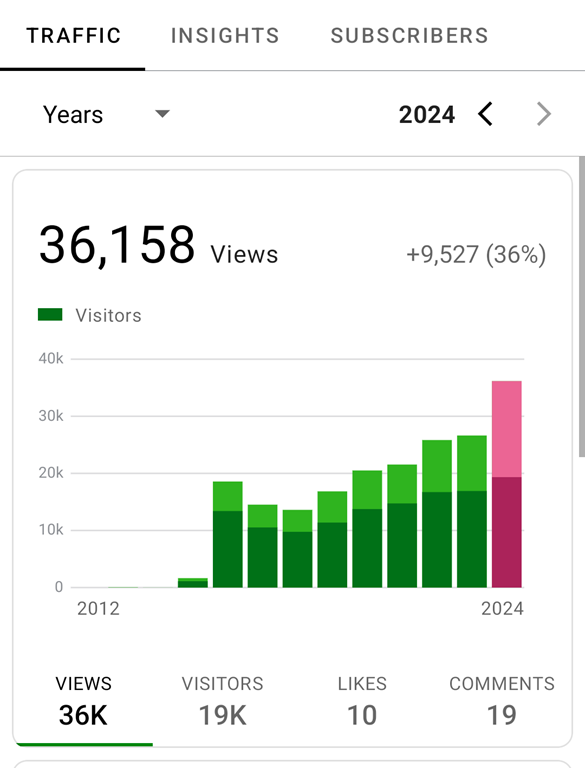
As a final point, having spent more time at home and studiously working on reviews, Aural Aggravation’s readership has grown significantly in the last 12 months.

AA
Screenshot_20241230-223254~2

AA

Sites are often cagey about their readership, and while I appreciate that Aural Aggravation is nowhere near world domination status, it has developed a readership. 2024 has seen that readership reach new peaks, and for this, I would like to say ‘thank you’ to everyone who has read even a single article on here in the last year. As unconcerned as I am about readership, and all the rest, this does feel like an achievement. And again, you can expect more of the same in 2025.

Former LORDS OF ACID vocalist, Mea Fisher (aka DJ Mea) and her solo project, ME AND MY NIGHTMARE just unveiled the heartfelt & poignant new single and video, ‘Don’t Forget Me’. The single features En Esch (Slick Idiot, <PIG>, Pigface, Ex-KMFDM) on keyboards.

‘Don’t Forget Me’ is Mea’s tribute to her mother, Patricia who tragically passed away after a battle with Alzheimer’s disease at the age of 84.

A common occurrence during the stages of Alzheimer’s disease is when the patient loses their memory. Mea states, “As her only child, the fear of being told that someday my mother might forget me terrified me to the core.  I feared it everyday but it didn’t happen. She always remembered her ‘little baby girl’ all the way to the very end. Never once did she forget me. It was a gift, even though I lost her.”

AA

654efa9b-9a88-7d5c-b6ca-5fb8d9b04700

Sound in Silence – 5th December 2024

Christopher Nosnibor

As my final review of the year, what could be more fitting than a work, the title of which, suggests an element of reflection on the recent past. Businesses provide regular reports, people and musical ventures tend not to, with perhaps the notable exception of Throbbing Gristle, but then, they were an exception to more or less everything before or since. Their debut album proper, The Second Annual Report, which followed a brace of cassettes, The Best of Throbbing Gristle Volume I, and The Best of Throbbing Gristle Volume II, set new precedents in so many ways.

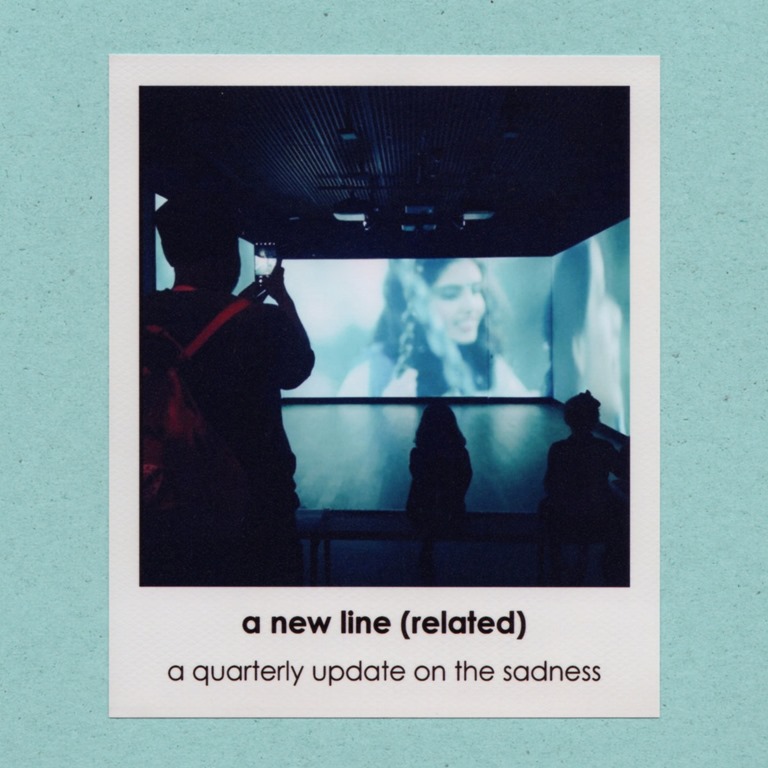
Arriving to the latest release from A New Line (Related) – the solo project of Andrew Johnson, who has previously released music as a member of bands such as Hood, The Remote Viewer, and Famous Boyfriend among others, one feels compelled to wonder ‘just how is The Sadness, and how has it been of late?

This is his third album, which we’re forewarned is an ‘immersive’ work, which ‘balances between minimal techno, dub house and ambient pop.’

‘Calapsis’ drifts in with low-key beats pulsing beneath delicate waves which ebb and flow subtly, gusts of compressed air which build to a hypnotic close. It’s not until the glitchy, disjointed groove of ‘3AM Worry Sessions’ arrives that we begin to get a sense of The Sadness. Stress and anxiety manifest in many ways, and while worry and panic may manifest differently their cousinly relationship It heaves, jittery unsettled and tense, conveying an uncomfortable restlessness.

The globular grumblings of ‘The Ballad of Billy Kee’ emerge from a rumbling undercurrent or mirk to glitch and twitch like a damaged electrical cable sputtering and sparking. Elsewhere, there’s a certain bounce to ‘Only Star Loop’ which gives it a levity, but the scratchy click of cymbals which mark out the percussive measures feels somehow erratic and the time signatures are apart from the bubbling synths and the distant-sounding, barely-audible vocal snippets, which give echoes of New Romanticism. Overall, the track has an elusive air of whispering paranoia.

In many ways, not a lot happens on A Quarterly Update On The Sadness, and the sparse and repetitive yet curiously dynamic title track is exemplary. It leaves you feeling strangely disconsolate, bereft, not only as if you’ve perhaps missed something, but that you’re missing something – not from the music, but from your own life. It seems, in conclusion, that The Sadness is thriving in its own, understated way.

AA

a0970760296_10

Room40 – 3rd January 2025

Christopher Nosnibor

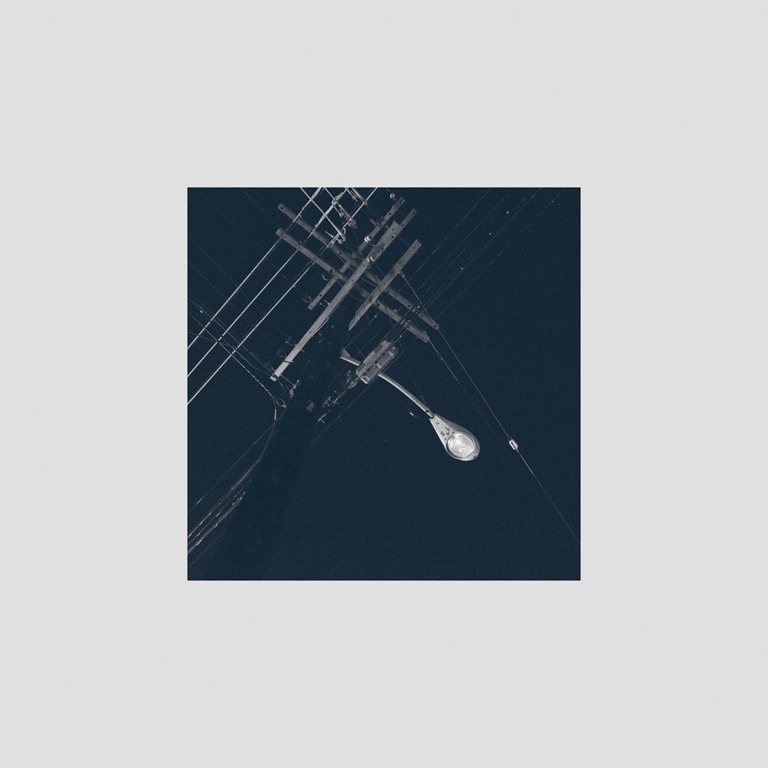
Ian Wellman’s works are usually responses to environmental issues, be they derived from articles covering global matters or more immediate or personal situations. His latest, Can You Hear The Street Lights Glow, sits very much in the latter category, as he details in the accompanying notes, which I shall quote in full:

I moved to Pasadena during the fall last year. One of the first new sounds I noticed were the mercury-vapor street lights that filled the air as the sun went down every evening. Under the sidewalks, exhaust vents hummed along to the song of crickets and the rumble of traffic. Being away from the inner city, more individual details in the soundscape emerged.

As a way to explore the new area, I walked around at night with my equipment. I placed geophones and contact mics on every metal surface I could. I ran electromagnetic sensors across electronics accessible by the sidewalk. I put mics out on quiet streets, behind shopping areas, and in parking lots. I felt very compelled and inspired to listen and learn about my new home. Can You Hear The Streetlights Glow? is the result of these listenings.

Certainly, the first part of this is something I find quite specifically relatable – not due to relocation, but to finding myself suddenly discovering a heightened awareness of my immediate surroundings. Like many people, I used to walk around with earphones in, listening to music to cut out the noise around me. This was essential on my daily commute, as listening to music as I walked through town created a separation between home and work, and while on the bus from town to the office, it shut out the babble of other people, and created a barrier between myself and anyone from work on the bus who may have been inclined to strike up a conversation. And on the way home, the same was also true but listening to music also helped me decompress – or mirror my angst – after a day in a noisy open-plan office. Lockdown changed that. I suddenly felt the need to be alert in case of approaching runners or cyclists or people kicking off in queues for the supermarket because someone wasn’t observing the two-metre rule or otherwise losing the plot over COVID restrictions. In short, I was scared – terrified, even. Not so much of the virus, but other people. I felt I needed to be on high alert at all times, because people are simply so unpredictable. One byproduct of this was that when I left the house form my allotted hour of exercise, I became acutely aware of the quietness – the absence of the thrum of traffic, the absence of chatter, and in their absence, I could instead hear the wind, birdsong, my own footsteps. In fact, I could hear everything. In the quiet, the small sounds were suddenly so much louder. The quiet wasn’t nearly as quiet as it first seemed. It was the aural equivalent of one’s eyes growing adjusted to the dark.

The auditory voyage of discovery Wellman charts on Can You Hear The Streetlights Glow bears clear parallels to my experience, but takes things a step or three further with his use of an array of equipment in order to capture sonic happenings in these spaces and his interrogation of the sounds in order to reach a deeper, more intimate understanding of his environs.

The results are quite fascinating, and range from a cluster of brief snippets, of under a minute and a half to just over two minutes, to more expansive segments – 5G Antenna Power Box is almost five and a half minutes, and ‘Mercury-vapor Lights’ is a full twelve and a half minutes in length. The titles of the pieces are location-specific, and some are quite evocative in themselves – notably ‘Time Depleting on Bird Scooter’ and ‘Gas Pipes Behind Smoothie Shop’. On the one hand, they’re utilitarian in their descriptions; on the other, they create an image of a filmic world in which sound events happen in particular places.

Most of those sound events are different levels of hum and drone, but these varying levels of low-level throbbing serve as reminders of how mankind has interfered with the naturally-occurring sounds which are the true sounds of the outdoors. While I am likely to note the hum of the power lines as I pass a pylon, and so on, I am still attuned to the wind in the trees, the scurry of squirrels. The sounds on Can You Hear The Street Lights Glow are all entirely man-made, mechanical, and despite Wellman’s relocation to a more rural setting facilitating the opening of his ears, the locations are all noteworthy for their constructed, non-natural nature. People may interpret this differently, and Wellman’s intentions may have been different again, but the leading thing I take away from this is just how hard it is to truly escape the mechanised world we’ve made. But equally, Can You Hear The Street Lights Glow is a document which highlights the extent to which even in silence, there is sound – lots of it.

AA

a1805176232_10

Mortality Tables – 24 December 2024

Christopher Nosnibor

There’s something about Christmas that really does send people spiralling in one of two directions. The people who absolutely love it seem to love it just too much to be considered sane, and this year has been one of the worst I can remember for people actually buying chocolate and putting their trees up almost immediately after hallowe’en. Amusingly, I’m seeing them taking down their trees and decorations from Boxing Day, declaring that they’ve had enough now. Well, it’s hardly surprising after three months. I really for feel sorry for the kids of these deranged households: it must be quite confusing for them, not least of all seeing their parents troughing whole selection boxes to themselves in November as they effervesce about the Christmas spirit and plaster their hedges, bushes, trees, and house frontages with lights – which is as trashy as it is environmentally unsound (‘oh, we use green energy, it’s 90% nuclear now!’) – only to tear them down a whole tend days before twelfth night. But these are the kind of people who call what they do – things like going to work and parenting – ‘adulting’ and piss and moan about it on social media, while posting pics of their decorations at the start of November. And it’s cunts like these who make me loathe Christmas with a passion I didn’t even know I possessed. They spoil it for more moderate, more sane people – and people who just despise other people and herd mentality twattery in general.

And so I’m with Mat Smith, the main man behind Mortality Tables, and am one hundred percent into ‘Grouch Thoraces (II)’, pitched as ‘The festive sentiments of a misanthrope, processed into dark and enveloping ambient texture. An updated version of a release from 2023’. In fact, I consider this to be a release that stands alongside – in spirit, if not necessarily sonically – with my own Festive Fifty noisework, released on December 20th. Against the tidal wash of syrupy, saccharine Christmas tunes – shit covers or endless rereleases or just the same toss that’s been the staple of the airwaves since the 70s and even earlier – nothing says ‘fuck this commercial Christmas shit’ like some dark noise.

‘Grouch Thoraces’, released on Christmas Eve in 2023 was a dank, murky cut, presenting just shy of five minutes of the most rumbly dark ambience. This year – to use a phrase I despise almost as much as the cheery festivity fanatics who bounce around the office in Christmas jumpers and Deely boppers or reindeer antler headbands and start arranging secret Santa and team drinks and buffets from the middle of November – Smith has doubled down on his anti-festive sentiments with a reworked ‘Grouch Thoraces’: this time it’s even darker and danker and almost eight minutes in length. It’s a churning, disorientating mess of stuff thrown together, found sounds and elongates drones twisting together to forge a thick morass of unsettling, uncomfortable noise. According to the credits, there’s a vocal by Carroll Spinney, but it’s submerged in the slow-sinking swamp. There are chimes clattering in the dark whorl of purgatorial noise, but they sound like the ching of broken decorations swinging in a post-apocalyptic nuclear wind as the survivors crawl, blind, skin peeling, through the ruins of what little remains.

On its own merits, this is a strong dark ambient work with a certain edge: in context, it speaks. Fuck this festive shit, fuck this commercial shit, fuck the obligation to socialise: let’s celebrate stepping back from it all and just getting through it, without feeling the need to pretend that we love any of it. We misanthropes need to stand together.

AA

a0412538683_10

Room40 – 13th December 2024

Christopher Nosnibor

Nostalgia is a subject I’ve touched on on a number of occasions in recent pieces, because it’s become something of a preoccupation in contemporary culture. Arguably, this is the natural evolution of the postmodern, an epoch in which the new was primarily a fresh – or not so fresh – permutation of the old. The culture of the twenty-first century has been marked by an ever-increasing acceleration of more of less everything: the accelerated communications and technological innovations and ensuing blizzard of media Frederic Jameson wrote of when defining postmodernism has gone into overdrive, and we’re now moving at a pace whereby we’re nostalgic for breakfast by lunchtime.

Nostalgia is big, big business, and this has been no more evident than in the response to ABBA’s hologram shows and the Oasis reunion. This isn’t to overlook other huge musical events – Taylor Swift’s Eras tour, for example – but it’s fair to note that she’s been established for over a decade and a half now, and can’t be viewed as representing ‘newness’ in any way – especially given that four of her last six albums were rerecordings of previous albums. This encapsulates the way in which culture laps up endless recycling on account of its familiarity.

Comfort culture is rather like comfort food: you know what you’re going to get, there are no unpleasant surprises, there’s probably not a great deal of chewing involved, and it’s less scary than the unknown. The world’s gone to shit, and people feel a real and quite desperate need for that blanket of safety and reassurance that there are still at least some things you can rely on. The good old days have happened, they’re fixed and can’t be taken away. And nostalgia has a universal appeal, because it’s something we all feel for certain things at certain times. We tend to feel – and I accept this is a colossal generalisation – that our childhoods and teenage years took place in simpler, better times. They didn’t, but because we didn’t have the burden of adult responsibility, and were discovering things for the first time, they’re coloured with brighter hues.

This latest offering from Glim – a project by Vienna based musician and composer Andreas Berger – is steeped in nostalgia. Berger outlines the inspiration and creative methodology with enthusiasm:

I have a particular love for cassette tapes and how they can influence the character of sound – even just by the simple fact of being played on different quality sources. I like the way they can color audio material, especially when using lower-quality gear. It adds modulation, sometimes (a long time unwanted) degradation of sound, but also gives a certain nostalgic touch – at least for me.

I recorded (and played) most of the material on an old Walkman cassette player, and what I got in return were some faded sonic Polaroids which might trigger a hidden memory or at least evoke a vague feeling of nostalgia.

Perhaps somewhat ironically, Tape I is only available as a download, or to stream online. The tape revival remains some way behind vinyl, despite the format being considerably cheaper to produce. Perhaps it’s because tapes just don’t have the same effect on Instagram, or hung on your wall.

Having grown up in the cassette / tape era myself, I can vouch for the unique nature of the format. When I started making music, I would sketch stuff out with a condenser mic on a portable tape deck, later progressing to a four0-track portastudio, bouncing tracks down to create additional tracks. Each stage would erode the quality of the audio by some incremental degree, but what it lost in fidelity it would gain in character. You just don’t get those happy accidents with infinite digital tracks, just as you don’t get the same sense of the personal with a link to a playlist as one-off compilation tape with handwritten track-listing, smudges and misspellings and all. Don’t get me wrong: tapes were a massive pain in the arse, difficult to skip tracks, easily chewed, easily overrecorded – and for these and other reasons, I have not leaped aboard the tape renaissance train. I’m happy with my memories, thank you, and don’t feel the need to start spooling reels with a biro to remember the good old days of recording songs off the radio.

It’s the happy accidents, the whorling analogue fogs, the fuzzy edges and softened-off corners which define the eight pieces on Tape I, unnamed beyond sequential number. But while I feel richly textured, immersive atmosphere, and the pull of strains of sonic palimpsests filtering through the recordings like ghostly whispers, vague, elusory, like memories which linger in the hard-to-reach recesses of the mind, and with a somewhat grainy texture like an old photograph or a photocopy of a photocopy, akin to the kind of fanzines which used to circulate in the eighties, I don’t feel as if I am truly connected to Berger’s sense of nostalgia.

Herein lies the paradox of memory, and of nostalgia: as much as there is a unification to be experienced from reminiscing with friends about those good old days, we each harbour subtly different recollections of those experiences, and as such, our experiences all differ. It also highlights the scope for the disparity between intent and end product. ‘1_4’ is incredibly haunting, eerie, and a quite magnificent exercise in ethereal dissonance, and ‘1_6’ is at times barely there, thin streaks of aural contrails drifting through a big and darkening sky. I feel a certain melancholy, a creeping chill, perhaps, but not any real sense of nostalgia. And yet it’s apparent that his creative process has involved a quite intense and personal engagement with the source materials and the tools necessary to create this diaphanous gauze of slow-drifting ambience. This simply highlights, however, the way in which, while large social brackets have a collective appreciation and nostalgia for one thing or another, the detail, when boiled down to an individual level, looks very different when viewed from that specific individual perspective. It’s here where you realise that you are completely alone: not even your partner or your best friend sees that shade of green or purple the same as you do. No-one else’s perception is entirely aligned to yours, and no-one sees, or hears, the world in exactly the same way.

AA

DRM4201 art

A homage to Speilberg’s seventies masterpiece Close Encounters, masterfully recreated by Dave Meyer.

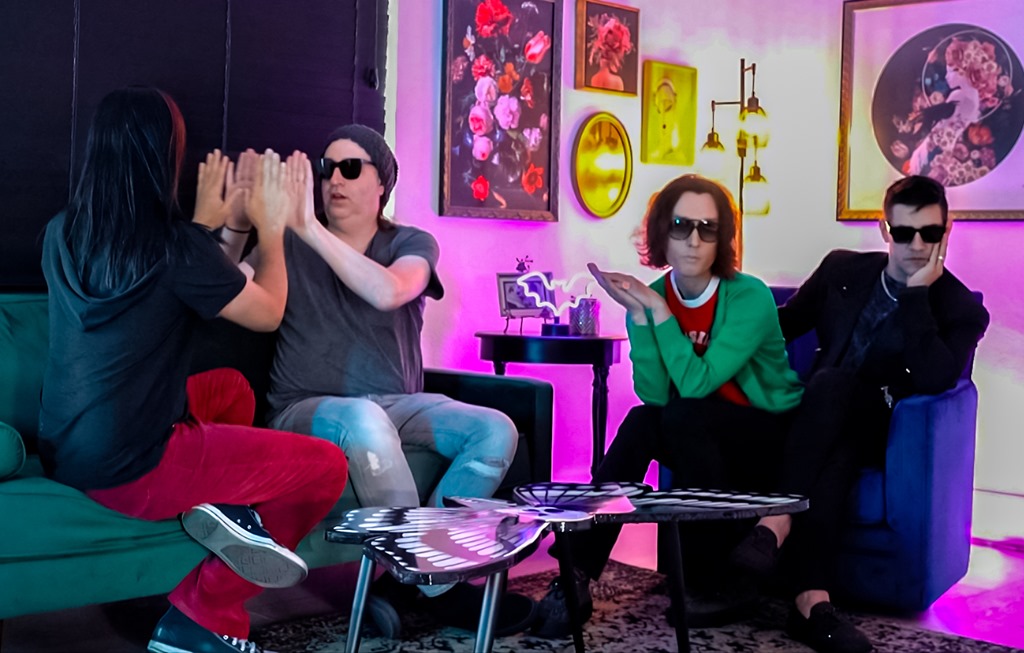
ASTARI NITE unveils ‘Double Feature Matinee’ – the fourth music video off the Resolution of Happiness album! It now joins ‘Ashtray Ballet’, ‘Bowie in Daydreams’ and ‘Tongue Tied Galore’ in short music films.

Says ASTARI NITE vocalist, Mychael, “We had a few songs that we were very pleased with and wanted to share this year, so we released our Resolution of Happiness record a few months back, in the summer of June… This one song in particular, ‘Double Feature Matinee’ was quite playful! It is a real delight to play out at concerts, a song that I am not ashamed to admit is honestly about me.

“So, we set out to create a music video with a little help from our friends! Snippets, if you will, were taken from a few special days and nights of our lives while traveling and playing in my new shoes.

Honestly, at this stage in my life, I find it to be healing, surrounded by individuals that simply enjoy being alive and are accompanied by a vibrant and cheerful personality.
The word “fun” kind of drives me mad, though I’m finding that it’s okay to have some whenever needed. I personally can’t be gloomy all the time; you know what I mean? I would rather smile the most instead.

Happy Holidays and I wish everyone a lot of love going into the start of the new year.”

2025 will hear the release of two new singles by the band titled, ‘Ms. Rain on My Parade’ and ‘Unisex Games’.

AA

2e050603-9eb3-1cb5-5a62-0575d27f7a09

It’s been another incredible year for Benefits, and one which has seen them evolve – and drop a single with Pete Doherty ahead of their second album, Constant Noise, due on 21 March 2025 via Invada Records.

And what a treat for Christmas eve – a new tune which is, again, more ambient than noisy, but which pitches a low-key and quite menacing-sounding spoken-word assessment of the state of things as war rages around the world and death tolls continue to increase as do tensions as the West bankrolls mass destruction and civilian slaughter.

New Benefits may not be quite as in-yer-face sonically, but don’t think for a second that they’ve gone soft.

Check ‘Missiles’ here:

AA

471339238_897662605683873_8615911540289970348_n

French progressive metal collective March of Scylla has released a captivating music video for their latest track, ‘Ulysses’ Lies’, from the forthcoming album Andromeda, set to be released on March 7, 2025, via Klonosphere/Season of Mist. Directed by Kevin Meriaux, the video seamlessly merges the band’s dark, progressive metal sound with their signature mythological storytelling, offering a mesmerizing visual experience.

Watch the video here:

AA

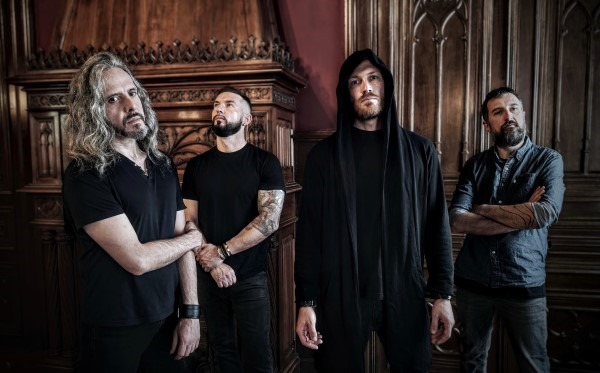
Initiated by Christofer Fraisier, guitarist and former member of Taman Shud, March Of Scylla is a dark, progressive metal project that emerged in Amiens in 2020. The band features drummer Gilles Masson from Ashura, bassist Robert Desbiendras, and vocalist Florian Vasseur. Their two EPs, Archives and Dark Myth, showcase their diverse influences, drawing comparisons to Gojira, Tesseract, Sleep Token, and Architects.

Their debut album Andromeda was recorded, mixed, and mastered at Studio Sainte-Marthe in Paris by Francis Caste, and explores the vastness of space and humanity’s complex relationship with science, the cosmos, and the afterlife. The album tackles fundamental human anxieties, injustices, and emotional struggles, blending personal lyrics with universal mythology and history.

d123cd19-d086-a72a-8165-5a46e3a4fa6ca2477402970_10