Archive for March, 2024

ant-zen – 12th February 2024

Christopher Nosnibor

First – the format! So much is being made of the vinyl renaissance right now, and much as I love vinyl, it’s hard to be entirely comfortable with this comeback, in this form. Back in the 90s, when CDs were in the ascendence, I often bought vinyl because it was cheaper: I could pick up an LP for £7.50 when a new-release CD was £11. I still have the receipts in my vinyl copies of PJ Harvey’s Rid of Me and Pandemonium by Killing Joke, among other treasures. Now, vinyl is a luxury item. Even a standard LP is around £25, and many are pressed on two pieces of heavyweight vinyl and cost closer to £40, or more if released on Record Store Day. This isn’t right. It’s not honouring the format, it’s another example of exploitation.

But this is rather different, and altogether cooler on so many levels: ant-zen have brought us this release by Kojoohar & Frank Ursus in the form of a 7” EP, with two tracks on each side. You can’t blame them for the price tag given production costs, but the unique hand-printed inlays, etc., at least make each copy unique and make this release a million miles removed from the capitalist conveyor belt.

The thing that matters here is that this release is completely suited to this retro format: a 10” or LP release would have been extravagant, indulgent, and frankly, ill-keeping.

It’s worth quoting the liner note for the back-story here, too: ‘The spark that ignited this collaboration came from a conversation between KOJOOHAR and FRANK URSUS – aka Te/DIS – about the kojoohar album that has just been released at the time and about angst pop and its position in the music scene. talking about new tracks kojoohar was working on, the decision was made to start a collaboration.’

And so we’re presented with Frost Drought, which they describe as ‘a 4-track ep that offers edgy angst pop with analog, gripping synthesizer sounds, metallic rhythms and enigmatic melodies, complementing by frank ursus’ vocals… music and lyrics of FROST DROUGHT describe a world of isolation, mistrust, alienation and the individual’s distance from itself. left alone in the dark…’

Entering the ‘debris field’, we’re presented with dark synths, groaning, whining, whistling, and a slow-tempo-echo-heavy beat. If the baritone vocal is distinctly from the gothier end of post-punk, the instrumentation is equal parts post-punk and ultra-stark, bleak hip-hop. ‘never compromise’ pushes into stark, dark, electro territory, in the realm of mid-80s Depeche Mode. Ursus’ vocals are commanding, but so dark, and the music is so claustrophobic as to be suffocating. ‘never compromise’ sounds like a manifesto, and whipping snares sounds crack and reverberate in an alienating fog of synth, and with hints of Depeche Mode’s ‘Little 15’, it’s as bleak as hell, too. ‘threshold’ is dark and boldly theatrical, like Bauhaus battling it out in the studio with Gary Numan.

There’s no light here: this is dark and it feels like a dragging weight on your chest, on your heart. Drawing on early 80s electro but adding the clinicality of contemporary production – and a dash of Nine Inch Nails – Frost Drought is a challenging work, thick, dense, and intense, it’s a heavy listen, and one that’s incredibly intense.

AA

a3285530151_10

Industrial band, LIVERNOIS recently unleashed their new EP, :ablation:. The term "ablation", the surgical removal of flesh, serves as a metaphor for closure in the context of the EP’s concept.

:ablation:. as an album, wrestles with the human reaction to trauma. More specifically, the EP addresses the responses that tend to be stigmatized and shunned by an increasingly repressed, and emotionally-paralyzed state.

The intent herein was to walk a fine line between violence and vulnerability. The sounds echo between precision and senselessly screaming into the void.

Check ‘Hekk Closet’ here:

AA

3c63b579-0665-de4d-9946-d980886f794b

Erototox Decodings – 1st March 2024

Christopher Nosnibor

Holy hell! Where to start? We’ll come to the band’s pedigree and the CVs of this supergroup in due course. But first, the immediate impact of this second album by The Children – that’s what hits in an instant. Perhaps because I missed the first, I simply wasn’t prepared in the way I might have been, but then again, is there any adequate preparation in advance of this?

A stark acoustic guitar – something about the way it’s picked and pulled is sharp, tense, scratchy, in the opening bars of ‘gOd is a Bereaved’ is prickly, awkward – paves the way for an eye-opening vocal performance. It simply doesn’t conform to the mores of conventional musicality, and instead flies skyward and swoops towards the ground in terrifying, unnatural flips and arcs. Something is certainly sudden, and it’s not a craving, but the impact of this completely out-there sound. Intense is an understatement.

‘Woven Mother Aflame’ brings brooding atmospherics split asunder by explosive percussion – a snare that has the power to split skulls cutting through serpentine strings and heavy, resonant bass reverberations which hang in the air, before the gentler ‘Breathing Shards’ fades electronics into a strummed acoustic guitar. Breathe… out. But all is not comfortable. The quavering vocals – not quite falsetto, not quite any specific range, but warbling, tremulous – quiver, uncomfortably atop and amidst the multi-layered backdrop which slopes and slides and traverses through starless space as basslines stroll and amble sedately.

Some background: The Children… ‘are . They have been making music together for over 15 years. Former Barkmarket bassist John Nowlin and drummer Rock Savage have consistently anchored the rhythm section, with a savagely airtight groove that’s both thunderous and mellifluous, primal and funky, and cellist Kirsten McCord has regularly enriched the band’s sound with her somber, lulling phrasing as a one-woman string section. John Andersen was a founding member and key early collaborator. The inimitable vocalist Shelley Hirsch has been a visceral contrapuntal foil for several live shows. Former Swans guitarist Norman Westberg and clarinetist Johnny Gasper provided invaluable texture to the recording sessions for this LP.

Norman Westberg has long been one of my favourite guitarists on account of his absolute minimalism: few guitarists would be content to bludgeon away at two chords for eight minutes straight, but his stoic patience is a rare trait which sets him in a league of his own. His more recent solo work is noteworthy for his sculpting feedback into musical shapes, and as such, his magnificently understated contribution to this album is essential.

Then again, how really to assimilate this? Our instinct, as humans, is to trust what we know, to lean into the familiar, the comfortable. This is perhaps why so much conformist pop, accessible blues-rock, landfill indie, continues to command so much appreciation. It’s not even that it’s easy and comfortable, but that it sits within an established framework with which people are comfortable – and the same, unsurprisingly, applies to people. ‘Weirdos’ are ostracised, and find themselves on the fringes, alone. People find ‘otherness’ simply too much of a challenge. Who can honestly say they haven’t taken a step back and made effort to put distance between themselves and a ‘crazy’ in their lives or on social medial? No shame in it: life is difficult as it is, and you have to have limits on who and what you can accommodate. But the point stands: other peoples’ disturbances create further disturbances. And A Sudden Craving sounds pretty disturbed.

A Sudden Craving is the sound of otherness. Yes, the vocals in particular are difficult to process. They sound… well, deranged. Wailing theatrically in a howling whorl of chaos and discord, underpinned by a hypnotic wave and monotonous plod of percussion, they really stand out as the definition of mania. ‘Breathing Shards’ may be mellower, but still possesses a sharp, jarring edge.

A Sudden Craving is scary because it doesn’t conform to any norms. Every one of the album’s ten tracks is unsettling, uncomfortable, unpredictable. It has depth and detail and many great qualities. Comfort and ease of access are not among then.

A Sudden Craving is a great album. It is not an accessible album, or an album which is comfortable or easy in any way. But then it’s not designed to be. It’s a head-shredding riot which really delivers some uncomfortable moments. At times I’m reminded of late Scott Walker. It’s compelling, and it’s quality, but one to file under ‘W’ for ‘Weird Shit’.

AA

a0924183782_10

US noise/blackgaze experimentalists Cave Moth have recently unveiled the leading single off their forthcoming new EP In Memory Eternal, which is set to be released on March 29th.

Listen to ‘In Memoria Aeterna’ here:

AA

For nearly a decade, Cave Moth have been turning some heads thanks largely to their intriguing and caustic combination of noise, grindcore, and death metal driving each song. It’s no new territory, yet the diversity of their sounds and the full-blooded urgency of their playing really sets them apart from many bands of their kind. 
Originally from Florida, Cave Moth now resides in that peculiar space on the internet that oscillates between live band and studio project with members spread out across the east coast. 

The band’s new EP In Memory Eternal, however, sees a shift in direction with Cave Moth injecting more black metal and screamo influences into their songs.

“We’ve dabbled in the post hardcore/screamo ether before. This is more similar to our 2021 release ‘Don’t Worry’, but In Memory Eternal definitely has a more black metal feel. I was experimenting with chord melodies and just found it really easy to write music in that melancholic, minor key vibe.” Says the guitarist/vocalist Daniel Quinn. 
This 10-minute composition hauntingly blends the melodies of Pianos Become the Teeth and Really From with explosive energy of black metal, delivering a visceral sonic experience.

6271e981-2f91-69d3-20e4-2b7abd872580

Australian instrumental post-rockers sleepmakeswaves have released another single from their forthcoming album "It’s Here, But I Have No Names For It" following the addition of two more US shows to their growing world tour dates.  The band took to social media to tell fans about the new single: 

"’Ritual Control’ was first demoed as ‘Dr. Riff Has Arrived’. I still wonder whether we were mistaken to have not kept the old title.  Otto originally presented the song skeleton to us with the concern that maybe the riffs were "too dumb". In fact, Tim and I responded, they are the *perfect quantity* of dumb. Sure, these riffs aren’t going to earn a PhD. But they will hold down a full-time job, get the kids to school on time and read the occasional piece of challenging non-fiction on weekends. Courageous and heartfelt conversations like this are the core of what effective post-rock songwriting is all about.  New album out next month!"  -Alex

Listen to ‘Ritual Control’ here:

AA

The new album It’s Here, But I Have No Names For It, released on 12th April, was produced by the band themselves, at Golden Retriever Studios in Sydney, Australia. Written during the pandemic, it was originally recorded during 2022 just before the band embarked on a 3 month tour for their previous EP trilogy ‘these are not your dreams.’ Further recording was completed in 2023, including string arrangements by Simeon Bartholomew (SEIMS). The record was then mixed by Andrei Eremin (Closure in Moscow, Tash Sultana, G Flip, Luca Brasi) in Philadelphia USA and mastered by Jeff Lipton and Maria Rice at Peerless Mastering in Boston USA.

The first single ‘Super Realm Park’, prefiguring the record as a whole, is a majestic return to the classic hallmarks of the band’s melodic post-rock sound, whilst introducing new production and arrangement elements. Fans of the band’s heavy bombastic aggression will resonate with tracks such as ‘All Hail Skull’ and ‘Ritual Control.’ They also shine with invigorated melodic and emotive performances and arrangements on tracks like ‘Black Paradise’ and ‘Terror Future.’ Retaining their signature approach to heavy dynamics and crescendos the band are still at their unmatched peak when they turn their hand to cataclysmic emotional epics such as the title track and the album closer ‘This Close Forever.’

The band released a statement to fans, saying: 

"The mysterious phase of nothingness, crucial to the smw creative process, is over: our new album is finally done. Thank you so much to all our listeners for your patience. It has been a slow but intense labor of love and we are proud of the songs on this record, and grateful for the many people who helped bring it to life. Hope to see you on the road in 2024, more show announcements to come, and we truly hope the new music we’re about to release resonates with you in the same way it does with us.   Love smw”

SMW

Mortality Tables – 8th March 2024

Christopher Nosnibor

Mortality Tables once again bring us a release that’s deeply immersed in the spirit of the avant-garde, and about setting defined parameters within which a project must function. When it comes to such things, it’s not about dictating restrictions, but about providing focus. Not all artists like to work to guidelines, although a prompt can open infinite possibilities for interpretation, and as such, there’s creative potential in working in such a way. And so it is that, as the accompanying notes explain, ‘Central Park: A Picture-In-Sounds is a site-specific performance piece, for one or more performers aged between ten and 95 years old. It is a tribute to the multi-disciplinary work of Charles Ives that will be published in 2024.’ We go on to learn that ‘To execute the piece, each performer will refer to a map of Central Park divided into areas representing the life expectancies listed in an 1874 US insurance industry mortality table. Each performer will identify an area of the Park corresponding to their life expectancy in 1874 and make a field recording lasting precisely eight minutes and thirty seconds.’

These are some highly specific instructions, but, once there, what performers are essentially looking at is eight and a half minutes to express as they feel appropriate, and of course, here, the possibilities are near-limitless. How one responds to a setting, a time, a space is, after all, a purely personal thing. Just as no two people’s lived experiences are the same, so no two responses will be identical.

This is a document of Mat Smith’s second performance, recorded on. 9 February 2024, at 16:13.

His own commentary is illuminating, and merits citation here, for context:

‘I was 47 years old when I performed ‘Central Park: A Picture-In-Sounds’ for the second time. Although I was a year older, when I looked at the life expectancies table and cross-referenced that with my divided Central Park map, it indicated that I should once again perform the piece near Strawberry Fields… The character of a place is in a continual state of mutability, and that was evident when I began the piece. It was a different season, the trees were barren and sleeping, snowdrops were springing up everywhere, and there were significantly more people in the park than the day I performed the piece in June the previous year. A carpet of dry leaves covered the area I set myself up in, crispy underfoot, waiting to crumble into dust.’

He recounts how ‘Someone at the John Lennon memorial began singing. Somewhere near the path, a street musician with what sounded like an amplified violin began playing a rendition of ‘Jingle Bells’, even though Christmas was retreating rapidly into the past. In between, he would play a plaintive wistful little coda that seemed so at odds with the relatively gleeful ‘Jingle Bells’. Often, his playing is accompanied by the harsh ringing bells of bikes as they whizz along the bike paths…’

His narrative creates a vivid – and moving – picture of the scene. It’s easy to think of these kind of performances taking place either with some sort of ‘arrangement’ and a cluster of observers who are ‘in the know’ gathered as witnesses, or in seclusion; it’s not so obvious to consider the actuality of creating sonic art in a public space, and all of the randomness and happenstance which that entails.

However, Central Park: A Picture In Sounds (Performance #2) captures this perfectly. The combination of the breeze and traffic creates a constant roar in the background. Birds chirp in abundance – far more than one might associate with February, at least here in England – and dogs yap and bark constantly. You can’t move for bloody dogs anywhere, in parks in fields, post-pandemic, it seems as if there are more dogs than people. But for all the ambience, all the thronging noise – and this really does remind that even quiet spaces really aren’t in large cities, with blaring radios and chatter and that constant roar – this is mostly eight and a half minutes of ‘Jingle Bells’ being played on a fiddle. In February. Bloody buskers.

But, as a snapshot field recording, Central Park: A Picture In Sounds (Performance #2), is absolutely alive, buzzing, bustling, busy – a slice of life.

AA

a3856078691_10

Janka Industries – 3rd May 2024

Christopher Nosnibor

Once again, I find myself tussling with a jazz album and in a quandary as to quite what to make of it. For many, many years, I was absolutely certain I detested jazz. Until, that is, having been introduced in my line of work to acts like The Necks, I came to learn I’d simply been exposed to the wrong kinds of jazz. The weirdy, noisy, cacophonous kinds of jazz made sense in context of my appreciation of mathy noise rock, and wasn’t such an immense leap from Shellac to be incomprehensible. Like any genre, or even tea or coffee, it’s all about finding a point of entry, a flavour that suits your palette. I used to hate both tea and coffee, having been given the former with full-fat milk and sugar and the latter in the form of a fairly weak blend with milk but no sugar, and they only really clicked when I ditched the sugar and discovered Earl Grey, and that you could have really dark-roast coffee with no milk and a shovel-load of sugar. So, you know, you find your thing.

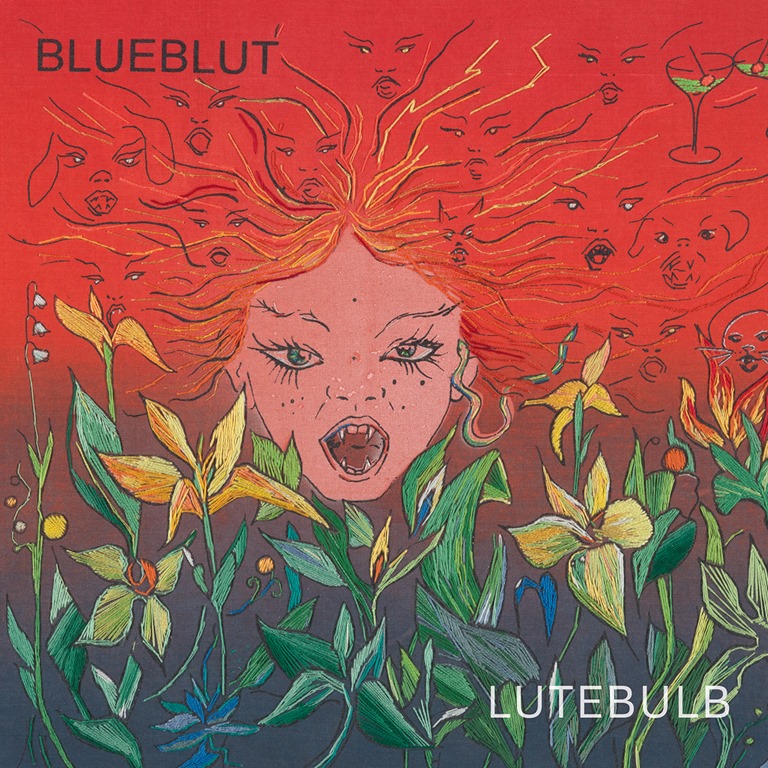
And then along comes Lutebulb, by Blueblut.

The blurb isn’t wrong in describing Blueblut’s lineup as ‘highly unusual, bringing together ‘three musicians acclaimed for exceptional contributions to their respective spheres in experimental jazz, electronica and rock.’ It’s a jazz-centred fusion, for sure, but it’s not jazz fusion as one tends to think of it, and certainly not as I’ve come to understand it. So what is it? As we learn, ‘Lutebulb is the fabulous culmination of ten years of intensive touring, with the Vienna based trio of Pamelia Stickney (theremin, vocals), Chris Janka (guitar, loops, samples) and Mark Holub (drums, vocals, percussion) socking it to global audiences with an international polystylistic musical language which takes in improv, jazz, avant-rock, ska, folk and Krautrock among other elements.’

There’s certainly a lot going on: initially, it comes on a bit laid back, not so much loungey as a smug muso pop collision of jazz and Latin dance, and I suppose the title, ‘Cocktail’ is something of a giveaway as to its swinging party vibes, but then shit happens – particularly some pretty crazy guitar work, and the percussion goes big and suddenly the party’s been crashed by a towering riot of sonic chaos, before suddenly, the entertainers seemingly remember themselves, pull their ties straight again and try to pull together some semblance of a funtime groove.

This sets the album’s template, really. Tracks tend to begin a bit kinda loose, a bit kinda boppable, a bit pool party fun times, albeit with some weirdness in the way the rhythms and the notes don’t quite chime in the conventional ways, and you wonder if it’s maybe the punch or the heat, but the tempo drifts a bit, first one way, then the other, and then maybe something doesn’t quite feel right, and it certainly doesn’t sound right and… what is going on? The room’s spinning and there are all sorts of random noises and you can’t tell if it’s people losing the plot or if some chickens have escaped and the sky’s falling in.

‘Aumba’ starts rather differently, a gentle piece led by acoustic guitar that brings a more reflective atmosphere, but it takes a hard swerve, the pace picks up, there are choral chanting vocals and then a handbrake turn into buoyant math-rock territory before some truly frantic fretwork. And because more surprises are needed, from nowhere, we get a crooning lyrical ballad in the last couple of minutes.

There’s unpredictable, and then there’s Lutebulb, which emerges with a fourteen-minute centrepiece of oddball experimental jazz that mashes absolutely everything together: one minute, I’m reminded of America’s ‘Horse With No Name’, the next, it’s Paul Simon’s Graceland and a Joolz Holland world music extravaganza. Then, somewhere in the midst of it all, we get the jazz breakdown with erratic percussion and space, dogs barking, and then, something else again. Led Zep riffage. Noise. More dogs barking. Every time I leave the house, the streets and parks and fields are like bloody Crufts, and the headfucking noise that’s emanating from my speakers – mostly a horrible conglomeration of barking and a strolling bass is making me angry and tense. And then the last piece, ‘Kaktusgetränk’, incorporates a familiar and popular jazz piece I can’t place or be bothered to research because by now I can’t decide if I need a lie-down or a massive gin.

With Lutebulb, Blueblut have created one of the most wildly varied – and in places, difficult, irritating, random – albums I’ve heard in a long time. I neither like nor dislike it: it has some truly great moments, and it has some not great moments. But when you throw this much into the blender, it’s to be expected, and I’d like to think that this kind of reaction isn’t entirely unexpected. The musicianship is outstanding, and their capacity to switch style, tempo, form, is something else, and the results are enough to leave anyone punchdrunk.

Blueblut – Lutebulb cover 1240px

NC’s Totally Slow offers up razor sharp, no-frills punk music, with angry lyrics that show how the personal is inseparable from the political when the country is on the brink of chaos. The band has combined the melodic anthems of 1980s SoCal bands like The Adolescents, Agent Orange and The Faction, with the skewed rawk of ‘90s San Diego bands Drive Like Jehu and Truman’s Water, and the righteous conviction of classic DC hardcore like Dag Nasty, Gray Matter and Fugazi.

Eddie Sanchez (Night!Night!, Solar Halos, The Love Language) has recently joined on bass, completing the current lineup which includes Andy Foster, Chuck Johnson, and Scott Hicks.

Having shared the stage with various acts, from Agent Orange to Laura Jane Grace to Man or Astroman, they bring a diverse musical experience to their audience.

Totally Slow’s fourth LP The Darkness Intercepts will be released on March 22 via Refresh Records.

Stream the new single ‘Pistol Whip’ here:

‘Propaganda Now’ is the closing track from the upcoming album Confused OK by York band Soma Crew.

‘Propaganda Now’ was lyrically informed by an awareness of the increased discrepancy between fact and its interpretation through social media. Participation in the dispersion of information is unavoidable in contemporary society, and it is virtually impossible to be sure of the veracity of sources. Visual cues are taken from historical posters where images are used to persuade the viewer of a particular point of view. In these circumstances we are presented with a dichotomy, and our innate circumspection is smothered.

Check it here…

AA

Soma new