Archive for May, 2023

HalfMeltedBrain Records – 9th June 2023

Christopher Nosnibor

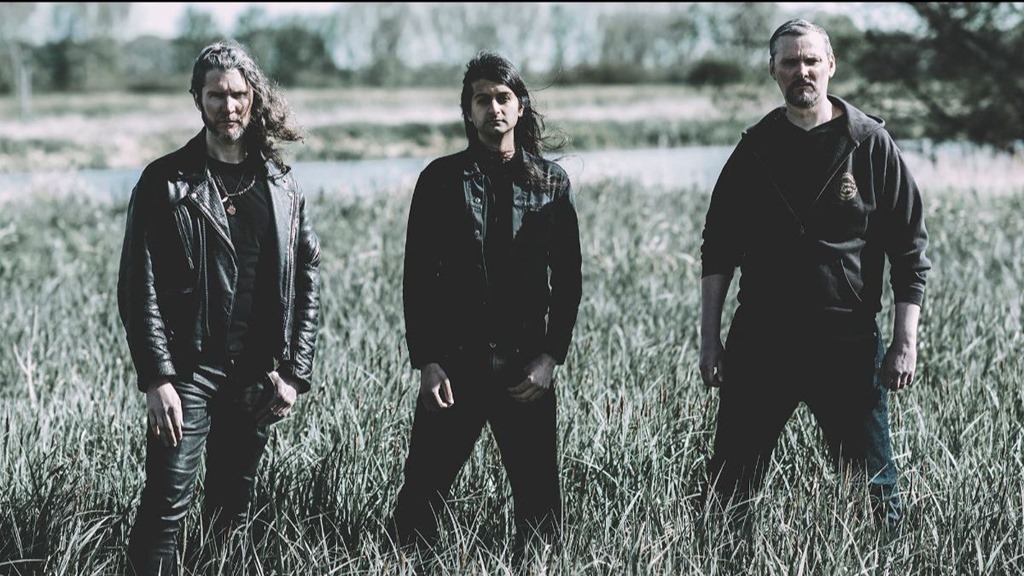
They may have only formed in 2020 during lockdown, but Brighton’s heavy post-punk noisemakers Mules (not to be confused with 90s US punk blues band, Mule) have already racked up three digital single releases before this six-track cassette EP. And while three of the tracks here are the preceding singles (with a studio recording of the live debut, ‘I Think We Need to Talk’, Illusions of Joy stands as a taut, cohesive document.

Their bio pitches their sound as being ‘equal parts dissonant and melodic, with a tight rhythm section providing insistent motorik grooves and angular rhythms’, adding that ‘In the tradition of Mark E Smith, the vocals are generally spoken, with very little concession to melody. Occasionally they escalate into a desperate and emotional yelp. With roots in the punk scene, Mules take influence from the first wave of post-punk, indie-rock, 90s noise-rock, and various more contemporary bands such as Parquet Courts, Metz, and Gilla Band.’

At the risk of repeating myself, shit times do at least make for decent music, and it’s no coincidence that the social and political landscape in which we find ourselves, which bears remarkable parallels to Thatcher’s Britain, is spawning a wave of disaffected musical voices. It’s not simply that the contemporary crop are aping the sound and feel of the first generation of punk and new wave acts because it feels fitting: the music itself is a means of articulating those knotty emotions that are a conglomeration of anger and frustration and the sense of powerlessness in the face of a need for change. Angularity, discord, dissonance, noise; these are the sonic vehicles which carry the sentiments sonically.

And so it is that while the primary grist to Mules’ mill is ‘everyday life in Tory austerity Britain’, they also pull on ‘broader themes, which draw on Tommy’s MA thesis, such as cultural hegemony, global political economy, and systems of control.’

There’s something particularly pleasing about hearing the words ‘cultural hegemony’ in the first verse of the first song on a record. Because as much as we live in shit times on so many levels, a real bugbear – and a genuine issue – is the dumbing down of culture; we have a government who openly attack intellectualism and deride ‘experts’, who refuse to engage in debate and view critical thinking as unhealthy – and in their tenuous position of power which serves only to protect their own interests – and, specifically, wealth – it is. And so it is that ‘Ergonomic Living’ takes its lead from Marxist social critique, and while the verses are defined by an insistent beat and wandering guitar, it all explodes into a roaring chorus. I’m reminded rather of Bilge Pump, and this is very much a good thing.

‘The Things We Learn in Books’ spews lists of theory against some driving guitars, and the urgency of the delivery is gripping and exhilarating. ‘Lonely Bored and High’ is the most Fall-like of the songs, but there’s a dubby element to it as well as spacious atmosphere, rendering it as much Bauhaus as The Specials, and again, it rips into a raging chorus. Fuck, these guys have such a knack for dynamics and tempo changes, it’s hard to respond in any way other than pumping your fists, because YEAHHHHH!!! FUCK, YEAHHHH!

‘I Think We Need to Talk’ is mathy, messy, disorientating, hypnotic, and ‘Clapping for Carers’ largely speaks for itself. Claps don’t pay bills, motherfuckers, and it shouldn’t be volunteers distributing limp packaged sandwiches and bags if crisps to the people sitting for ten hours or more in A&E units up and down the country (this one’s particularly sore for me, but we’ll save that for another time and just leave it that hearing a song like this really revs me).

Feeling angry and frustrated but disenfranchised and disempowered? Mules speak to, and for, you.

AA

a4160379836_10

OXBOW recently announced the arrival of their first new music in six years with the anticipated release of Love’s Holiday, to be released via Ipecac on the 21st July. They have shared their second single and video for album track ‘Icy White & Crystalline’ and announce further live shows in the UK and mainland Europe – dates and details below.

About the making of the video Eugene S. Robinson comments, “Funny going all the way to a UK-based filmmaker/journo from Belfast in Kiran Acharya for directing the video for ‘Icy White & Crystalline’ but if you take the same elements and expect something different, you’re on the road to madness. Which is precisely why we used wildly disparate elements to visualize our first ‘live’ music video for Love’s Holiday. Sixteen takes all the way through… ‘you don’t know how…hearts burn’ is the opening lyric. For probably the best of all reasons here: this video almost killed us to make.”

Niko Wenner continues, “’Icy White & Crystalline’ began as a blown-out ferocious rehearsal phone-recording we’ve aimed to match in high fidelity, the bridge another improv, the two joined make a classic Oxbow banger we’ll doubtless rock live for as long as we plug-in. Enjoy!”

Watch the video here:

AA

XBOW LIVE DATES SEPTEMBER 2023

Friday, September 01, 2023 UK Glasgow Broadcast
Saturday, September 02, 2023 UK Birmingham Supersonic festival
Sunday, September 03, 2023 UK Leeds Brudenell Social Club
Monday, September 04, 2023 UK Bristol Exchange
Tuesday, September 05, 2023 UK London Studio 9294
Wednesday, September 06, 2023 BE Kortrijk Wilde Westen
Thursday, September 07, 2023 BE Brussels Botanique
Friday, September 08, 2023 NL Nijmegen Merleyn
Saturday, September 09, 2023 LUX Tetange Human’s World festival (free entry)
Sunday, September 10, 2023 DE Bochum Die Trompete
Monday, 11 September 2023 AT Vienna Volkstheatre Rote Bar
Tuesday, 12 September 2023 PL Wroclaw Liverpool
Wednesday, 13 September 2023 PL Warsaw Hydrozagadka
Thursday, 14 September 2023 DE Berlin Roadrunners Paradise
Friday, 15 September 2023 DE Hamburg Hafenklang
Saturday, 16 September 2023 DK Aalborg Lasher fest

Y3ogMwyA

Photo credit: Phil Sharp

Brooklyn 5-piece Geese have shared ‘Mysterious Love,’ a new track and accompanying music video from their anticipated sophomore album ‘3D Country,’ out June 23 via Partisan Records/Play It Again Sam.

The song fries and bends through the full spectrum of what ‘3D Country’ has to offer – showcasing both the band’s most angular experimentations and their warmest harmonies to date. “Mysterious Love” picks up where previous singles “Cowboy Nudes” and the album’s title track left off, fusing fragments of classic rock into a sound that is wholly the band’s own, while painting a picture of a newer, weirder America.
Geese frontman Cameron Winter explains:

“This song is about a dozen ‘90s rock clichés mixed into one little over-produced package. We like the contrast in mood between the first and second halves. We used to punctuate the very end with one last hit and be done with it, but then one day Max [Bassin, drummer] just kept hitting his drums, and we kept doing the same ending hit for like, two minutes. When we recorded it, there were about 40 hits, but our label begged us to cut them out. We ended up at around 15 after negotiations.”

Watch the video here:

AA

GEESE UK LIVE DATES 2023
03 SEP 2023 / UK / Dorset / End of the Road Festival
06 SEP 2023 / UK / Brighton / Patterns
07 SEP 2023 / UK / Bristol / Thekla
08 SEP 2023 / UK / London / Lafayette
10 SEP 2023 / UK / Glasgow / King Tut’s
12 SEP 2023 / UK / Leeds / Brudenell Social Club
13 SEP 2023 / UK / Manchester / Band on the Wall
14 SEP 2023 / UK / Nottingham / Bodega

5ef54b23-f6bb-15a9-fa94-16bb6cc16058

(credit: Kyle Berger)

19th May 2023

Christopher Nosnibor

A couple of months after the epic grind-influenced outing that was ‘I Am Weak’, Bournemouth-based quartet Solcura return with their fourth single since their debut album, Serotonin, released in 2021, ‘Imposter Syndrome’. They describe it as an ‘absolute rager’ and ‘a result of the miasma of deceit and media tyranny we are all forced to swallow every single day of our lives.’

Music that was so angry and overtly political was rare only a year or so back. Practically every other release was a lockdown project, or addressed the challenges and traumas of lockdown; the isolation, the depression, and it was only natural that that would be the case. Not everyone is over lockdown or has recovered from the impacts of the pandemic and its handling, not by a long shot. Many suffer from levels of anxiety – particularly social anxiety – not experienced before, and many still haven’t got back on track financially, either. So many people got fucked in so many ways, and the likelihood is that it will take years – and years – before people are back to themselves again.

But the mood has definitely shifted, at least here in the UK, and particularly in England. The zeitgeist is no longer one of reflection, and if the mood remains on the downside, it’s no longer directed inward, as the fallout of the Johnson administration has ignited an incendiary rage that eclipses any inward-looking darkness. As the corruption of our government becomes exposed with new revelations practically by the day, from the billions tossed to mega-rich buddies for PPE that either never materialised or was otherwise unfit for purpose, to the crumbling NHS and public network system, while top execs and shareholders gouge immense profits while workers – now striking en mass – are being told there’s no spare cash for wages because of inflation, the swell of anger at the sense not only have we all been had, but that we’re being utterly screwed and lied to, brazenly, has built from a mutter of dissent to a scream of rage.

For a time, Sleaford Mods and Killing Joke were pretty much the only acts telling it like it is, but the explosive rise of Benefits, on paper the band least likely to go massive and hit the festival circuit of all time tells you precisely where we’re at now as a nation. And this is where Solcura are at: they’re pissed off and are going to shout about it.

‘Imposter Syndrome’ finds Solcura exploring some richly atmospheric vibes at the start, with spaced-out, slightly trippy, stumbling guitar and mystical wordless vocals that radiate spiritualism. Then, thirty-odd seconds in, the guitar slams in on hard overdrive and bangs into Soundgarden territory, with a beefy riff. The drums really stand out among it all, the snare a sharp crack that cuts through the thick distortion, with a hint of Therapy? pulling through it all.

The commination of melodic, reverby vocals and chunky riffage also reminds me of early Amplifier, but then there are some dark overtones and screamy backing vocals that are more nu-metal than neo-prog, and the two elements combine to optimal effect. This is some savvy musical alchemy here, and ‘Imposter Syndrome’ is a dense work with depth and dynamics. Yes, it harks back to the early 90s, but that’s another reflection of the time we live in. Recycling is good, especially when it’s done this well. Believe the hype. Believe in Solcura.

IMG_1703

Cruel Nature Records – 26th May 2023

Christopher Nosnibor

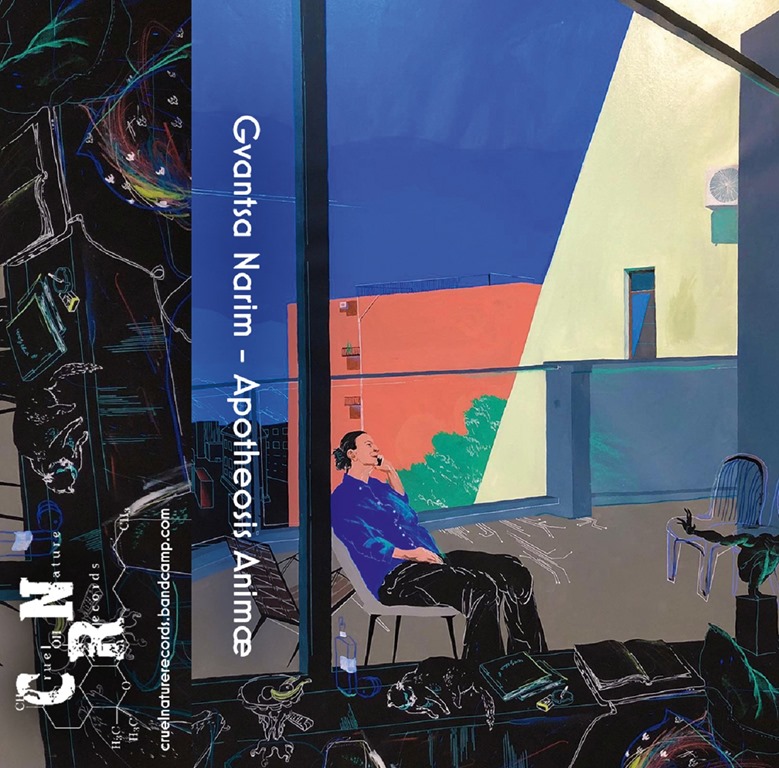
Having recently celebrated a decade of diversity, Cruel Nature Records continue to release a broad range of non-mainstream music – and the range couldn’t be more pronounced than placing two of May’s releases side-by-side: Gvantsa Narim’s latest offering, Apotheosis Animæ exists on another sonic plane form the grating industrial noise of Omnibadger’s Famous Guitar Licks Vol. III. They’re a sort of Yin and Yang: the world definitely needs both, and I personally need both, too, and it’s testament to Steve Strode’s singular commitment to releasing music of quality regardless of style or genre that they can both find a home on the same label.

Apotheosis Animæ, we learn, takes ‘inspiration from religion, esotericism and Georgian polyphonic music’, and that ‘her latest work was written in late 2022 / early 2023 and tells the dark and cold story of winter’.

It seems very much that winter now is not like the winters of twenty or thirty years ago: instead of two feet of snow, we get seven feet of flash flooding here in the UK. And now, despite it being the middle of May, it’s impossible to predict from one hour to the next, let alone from one day to the next if it will feel more like October or February. But despite this, winter not only has timeless connotations, but also, whether it’s sub-zero or only just a bit chilly, the cold winds and long dark nights do have a profound effect on human activity and our lives as individuals. It’s not only psychological; it’s biological and metabolic, and some of this is genetically coded into us from our prehistoric existence all the way through to as recently as just before electric lighting and mains power. There’s a case that says this is where we went wrong, as a species, and for the planet, in evolving beyond lives in tune with nature.

We each have our own unique relationship with winter, and our own associations and reminiscence. While I’m prone to Seasonal Affective Disorder, presenting as low mood and low energy, my wife would invariably suffer a low ebb in health from late October through the February, often suffering back-to-back colds that would drag on for weeks, the lack of daylight dragging down her levels of vitamin D and her immune system struggling to fend off the endless barrage of bugs and viruses that thrive in the cold months, especially when being breathed around in close-packed environments like offices. I fully acknowledge, then, and actually embrace, the fact that I am coming to this album fully loaded with my own baggage which will colour my experience and interpretation. This is a healthy, a function of music, something which can exist as a vessel for us to pour our thoughts, feelings, memories, and traumas into.

The compositions ‘Apotheosis’ and ‘Animæ’ bookend the album, and as the former lifts the curtain, it’s a slow, simple piano that evokes a slowing, a darkening which paves the way for mournful strings and distant echoes of bass and percussion on ‘Sicut Mortuss’ (which I believe translates as ‘like death’ or similar) conveys that paralysing sensation which descends with the darkness; while on the woozy, disorientating ‘Amnesia’, snippets of speech drift in and out, but instead of giving a sense of human connection, as they echo into the droning hum, there is only distance and detachment. Stretching out past the tend-and-a-half-minute mark, it’s hypnotic and unsettling, a little like the point at which you realise you’ve gone a little too far into your own head and need to drag yourself back to life, if only because it’s scary in there and you’ve got to work and at least appear normal.

There are moments of grand, sweeping ambience, soft and gentle, which convey the comforting experience of watching large flakes fall, heavy and silent, settling thick and deep in a silent white blanket; there are also moments of gritty disturbance, swirling glacial winds and shards of ice. ‘Born in the Mist’ is dark and brooding, shapeless, formless, ominous, impenetrable, the howling scrapes that ebb and flow are unsettling and uncomfortable, and it’s evocative; personally, I’m reminded of slogging across mountain tops in the Lake Diastrict in dense cloud and storm-force wind, and no doubt anyone else would being different mental visuals along.

This is where instrumental, abstract music really does come into its own: listener response simply cannot be prescribed, and has to come from within, and for this reason, we will all hear and experience something different. Following on, ‘Stopwatch’ sounds like the clouds lifting and waking up from a daze to remember that you do know how to live, that sense that perhaps hibernation is over and there’s a world outside, and this applies not only to the winter which is determined by the meteorological and astronomical seasonal changes, but the winter of the soul which can chill even deeper.

It’s soft and soporific: ‘Train’ glances and glides with crisp, crystalline tones into the – sadly missed, proverbial – sunset. The fifteen-minute ‘Codex’ is a big, brooding, bruising storm building in the form of a rumbling drone that’s dark as oppressive. Crackles, bleeps and bubbles rise cautiously on the edges of this mass of dense, dark atmosphere. Over time, it throbs lower and slower, and rippling details emerge and float along on the surface – but that darkness, that threat, is always present. At some point, you find yourself lost in the drift, and a slow thumping beat emerges behind a locked loop of synthesised notes… and then it shifts again, reminding us that nothing is ever static, however much it may seem that nothing changes, however much we may yearn to remain in a moment forever.

There are some truly beautiful passages; but they’re tempered by sadness and tension, which conveys the sense of coldness, darkness, isolation, longing that the long dark nights bring – a yearning for warmth, for comfort, for hot, hearty food, the primitive craving to sit beside a roaring fire.

AA

cover

Subsound Records – 10th March 2023

Christopher Nosnibor

It’s easy in the age of the Internet to conduct enough research behind the scenes to present oneself as having an extant k knowledge of a subject. It’s also a huge temptation to do this as a reviewer or critic, because there’s a certain expectation from audiences that if you’re going to proffer opinions on things, you ought to know what you’re talking about. It’s that knowledge and authority that ought to differentiate someone who presents insightful critiques from the boorish tosser down the pub – or, as is more common now, on social media who has an opinion on everything but talks out of their arse because they know nothing.

But life is an open-ended learning experience, and the day you stop learning, you’re effectively dead. And so it is that while I’m familiar with Malcolm McDowell, primarily for his role in A Clockwork Orange, and Massimo Pupillo of ZU, but not the Italian poet and essayist Gabriele Tinti – which is surprising given his prolific output and the immense reach of his work, especially considering that his career hasn’t been without controversy. Still, the fact he is prolific and has immense reach, as well as being a keen collaborator, explains the coming together of these three for a collaborative album, which finds McDowell reading Tinti’s works over music by Pupillo.

McDowell reads five pieces from the 2021 collection Ruins, dedicated to what he calls the “living sculpture of the actor”, ruminating on the distant past as it echoes through to the present. In keeping with the subject matter – where art and mythology of the ages provide evocative contemplation – there are weighty words, formulated with such syntax as to accentuate their gravity and import, and McDowell’s delivery does them admirable justice. As much as Tinti is given to elevated tone, there’s both a resonating sense of spirituality and an earthiness to his words, and McDowell reads with nuance, bringing the more visual aspects to the fore as he speaks of flesh and blood and bones wounds and exploding veins. There’s a physicality to the writing which possesses a rare potency, and as such, the words are well-suited to the context.

Pupillo’s atmospheric score, conjured using ‘a plethora of different sources, various synthesis, samples of eastern European choirs, processing McDowells’ voice,’ lends further layers of depth: at times choral and monastic voices rise and ring out against elongated drones, rich and organ-like, at others billows of sound creep like tendrils of fog.

Songs Of Stone may only be some twenty minutes in duration, with each side working nicely as a single, continuous soundwork punctuated by the spoken segments, but its grave intensity means that any longer would be difficult to digest. As it stands, Songs Of Stone feels perfectly formed.

AA

a3543316873_10

4th May 2023

Christopher Nosnibor

It’s been a few months since we last heard from London based industrial/alternative rock duo GLYTSH, who made some waves with their first single releases – and rightly so, because they were absolute bangers: their cover on Nine Inch Nails’ ‘Closer’ on hinted at the original material that was to follow, with both ‘(Hard)core memory’ and ‘SAV@Ge’ kicking serious arse. They’ve been busy in the meantime, landing a live slot supporting Tom Saint in June as part of the publicity for their upcoming debut EP, which ‘V.H.S.’ gives us a flavour of.

‘V.H.S.’ – that’s ‘Vulgar Holy Spirit’ – is pitched as ‘loud, proud and kind of a sombre love song’, which Jennifer Diehl – who now goes by the pseudonym of Luna Blake when she’s in Glytsch mode – expands on as being “about a lost relationship trying to be resurrected… It’s a dark romantic tale 2.0 with a Frankenstein flavour and could be seen as the sequel to our second single – ‘Hard(core) Memory’”.

It’s another slice of savvy songwriting that does so much all at once, starting out like some clean, crisp ‘alternative’ pop – the kind of electro-goth that pretends to be menacing but really isn’t – before going absolutely raging wild, demonic screaming with a barrage of noise exploding white hot and devastating. There’s a really thick swampy low-end and the production is dense and dirty – and it’s a real asset in realising the song’s full impact potential, because it very much accentuates the sense of volume, with the drums being pushed down beneath the speaker shredding guitar… and the guitar is a wall of sheet metal and it’s a riffy as fuck and properly heavy…and yet, somehow, there are glimpses of melody, a keen chorus that breaks out from the demonic rage of the verses, which returns us to the point where we’re forced to consider that there is a keen pop element to their songs. How can it be? And how can it all happen in two and a half minutes?

There’s no time to think or dissect it: it’s hard to take in what’s going on. It’s a blur, a blitzkrieg, an in-out smash-and-grab, fast, furious, violent and so well executed.

In the wake of Nu Metal and Marilyn Manson – who rose in on the tattered mesh coattails of Trent Reznor who brought the kind of niche noisy shit that was the domain of Wax Trax! and strictly underground to a huge global audience and then took it up several notches, aggro stuff has become quite normalised, not to mention predictable – but Glytsch bring something new and unique, and it’s not just that they’re female. They present a new hybrid, and a new level of ferocity that’s absolutely terrifying.

They’re racking up radio plays already, and they’ve got world class quality howling from every pore.

AA

853686

Photo Credit: Ulrich von Trier

Thanatosis – THT23 – 12th May 2023

Christopher Nosnibor

I might have ordinarily made some quip about my own system and that of many being nervous, but then I read the accompanying notes and thought better of it, as this album, the debut full-length album by Swedish producer Autorhythm, aka Joakim Forsgren, a visual artist and former bassist of several punk and rock groups, comes from, if not from a dark place, then certainly a serious one.

As the notes explain, ‘Forsgren started to work on what was to become Songs for the Nervous System in 2015, after having been diagnosed with Parkinson’s disease. The album is a series of intuitive compositions drawing from the latest medical research on how light and sound at specific frequencies has a potential to affect bodily functions, down to the cellular level. The resulting contemporary but surprisingly human electronic music is a dynamic mix of driving rhythms and meditative soundscapes. While the polyrhythmic beats suggest a kinship to some contemporary club music, the work of Brian Eno would be a more obvious point of reference in its genreless amalgamation of music, life and conceptual art.

‘Except for mixing and minor adjustments computers were shunned, with Forsgren instead relying on an assortment of synthesizers, of roughly the same age as himself and thus all members of the pre-digital generation. Conventional sounds and solutions were avoided, as much out of incapacity as imagination. The name and the impetus for the music were born out of the question of what music his electronic devices and machines themselves would play if Forsgren were not able to play them himself.’

The album contains six tracks, most of which sit within the midrange of around four to seven minutes in length. The first, ‘Clairvoyance’ is seven minutes of squelch and pop dance music that has a real analogue vibe and a nagging insistence, as well as a hint of Factory Floor. The beat doesn’t alter, but the tones shift and layers build.

Sequencing matters here, and two shorter compositions, ‘Doom Variations’; and ‘Neuropathic Factors’ – complimentary pieces which perhaps render the album’s objective to present ‘intuitive compositions drawing from the latest medical research on how light and sound at specific frequencies has a potential to affect bodily functions, down to the cellular level’ most apparent: there are some unusual sounds here, and the interplay between them is unusual and not always easy to consume in comfort. It’s hard to explain just how these pieces are affecting – but they are. Perhaps a greater understanding of the theory and practise may help, but listening to Songs for the Nervous System leaves me feeling too drained to do anything much.

Opening side two, ‘Plasticity’ is a six-minute slow-trip-hop throb kicked along by a vintage drum machine. The bass groove is one you can nod along to, but there are rather more uncomfortable, discordant elements and a strange warping drag that makes time twist and stretch a little. It’s the time signatures: they don’t seem to match up and induce a deep dizziness and a sense of disorientation, of discombobulation. It’s an overload, too much too process. Around the midpoint, amidst laser snaps and synth bass pulations, it slopes down to a point where you feel very much like you’ve stopped for a break before grind an in to our infinite arrival at our, final destination. That final destination is the album’s longest track by far: ‘Intercelular Communication’ presents as an extended audio research piece, and it’s well-realised, but difficult.

Three times I’ve tried to write this review: three times I’ve listened to this album and it’s left me feeling tired and strange and my writing has stalled. Perhaps I’m tired, or perhaps this really does reach the most inaccessible parts, and perhaps it does speak on a very different level.

AA

THT23_front

FEN release the epic and constantly shape-shifting track ‘Truth Is Futility’ as the second single taken from the East Anglians’ forthcoming album Monuments to Absence, which is slated for release on July 7, 2023.

Fen comment on ‘Truth Is Futility’: “The title says it all: the quest for truth is a futile one and even when presented with self-evident realities, our species will violently reject anything that contradicts enshrined dogma and the fragile beliefs to which many desperately nail their sense of identity to", mastermind Frank “The Watcher” Allain muses. “History has shown time and again that the purveyors of knowledge, the seekers of understanding, and those who challenge conventional wisdom are persecuted and stigmatised. At the very core of most of us lurks the kernel of one actual truth that many of us dare not even admit to ourselves: we do not desire to know the fundamental truths of ourselves and our world. We do not want our cosseted egos and comfortable safety blankets to be disturbed in any way – even by the revelations of enlightenment. Against such cemented defence, what is real truth if nothing but futility? Musically, this song is a true Fen ‘journey’. We feel that ‘Truth Is Futility’ embodies the balance of intensity, encroaching despair, and the primordial roar of rage that can be the only genuine reaction to such hopelessness.”

Hear ‘Truth is Futility’ here:

AA

c3d57583-99e4-7b73-bcd5-82a850252504