Posts Tagged ‘tension’

Today, celebrated electronic composer Loscil shares the video for ‘Candling’, taken from his forthcoming album release, Lake Fire (kranky, 2nd May).

‘Candling’ is one of Lake Fire‘s nine tracks offering ash-laden sonics that mine the tension within the cycle of destruction and rejuvenation.

AA

Loscil will perform the following live dates:

May 1, 2025, SFU – Vancouver, CA  SOLD OUT
Sep 4, 2025, Extreme Chill – Reykjavik, IS
Sep 8, 2025, Silent Green, Berlin, DE  tickets
Sep 10, 2025, Botanique, Brussels, BE 
Sep 12, 2025, Casa Montjuic, Barcelona, ES  tickets
Sep 16, 2025, Rich Mix, London, UK  tickets
Sep 18, 2025, Ostre, Bergen, NO  tickets
Sep 20, 2025, OSA Festival, Gdansk, PL

Lake Fire is the result of a disjointed creative process. Originally conceived as a suite for electronics and ensemble, most of the original compositions were deserted, save for Ash Clouds, featuring James Meager on double bass. The remaining tracks were reshaped and remixed, built anew out of the remnants of the abandoned work. The result is a phoenix, an album burnt to the ground only to be reassembled out of its cinders. Fragments of the original lurk beneath a densely overpainted canvas of sound.

Infused into the resulting rearrangements are impressions from a road trip into the mountains marking a personal half-century milestone, surrounded by the ominous proximity of wildfires and dense smoke; celebrating life while the world burns. The album’s title comes from the striking irony that forest fires are often named after regional lakes – perhaps subconsciously referencing ancient lore. The cover photos were taken from this same trip, while sitting in a rowboat staring into the grey abyss of an opposing mountainside outside of Revelstoke, BC, obfuscated by smoke from a nearby lake fire.

AA

3_loscil_ferry25_nocredit-99045103cf04513c

Sound in Silence – 5th December 2024

Christopher Nosnibor

As my final review of the year, what could be more fitting than a work, the title of which, suggests an element of reflection on the recent past. Businesses provide regular reports, people and musical ventures tend not to, with perhaps the notable exception of Throbbing Gristle, but then, they were an exception to more or less everything before or since. Their debut album proper, The Second Annual Report, which followed a brace of cassettes, The Best of Throbbing Gristle Volume I, and The Best of Throbbing Gristle Volume II, set new precedents in so many ways.

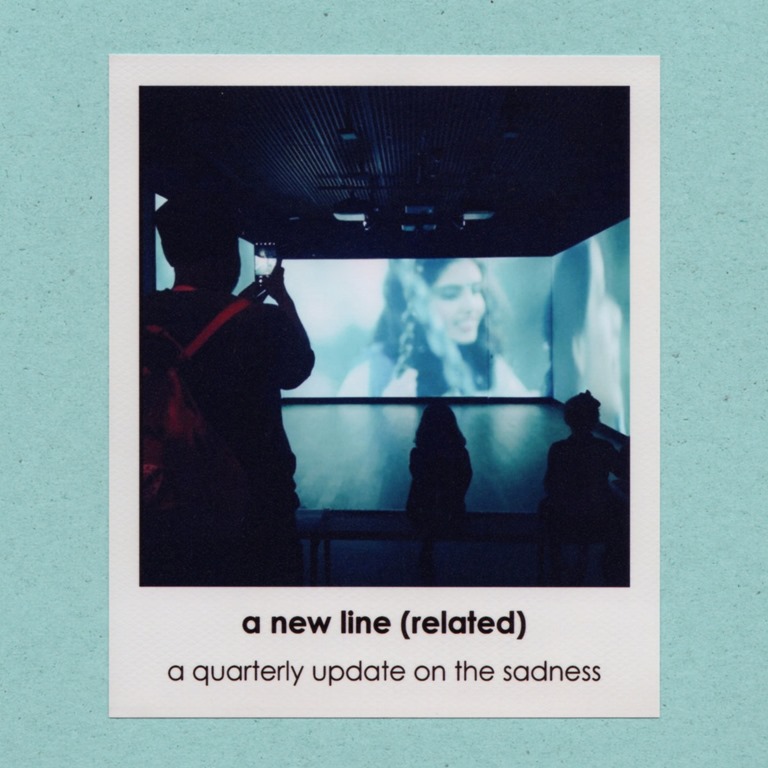
Arriving to the latest release from A New Line (Related) – the solo project of Andrew Johnson, who has previously released music as a member of bands such as Hood, The Remote Viewer, and Famous Boyfriend among others, one feels compelled to wonder ‘just how is The Sadness, and how has it been of late?

This is his third album, which we’re forewarned is an ‘immersive’ work, which ‘balances between minimal techno, dub house and ambient pop.’

‘Calapsis’ drifts in with low-key beats pulsing beneath delicate waves which ebb and flow subtly, gusts of compressed air which build to a hypnotic close. It’s not until the glitchy, disjointed groove of ‘3AM Worry Sessions’ arrives that we begin to get a sense of The Sadness. Stress and anxiety manifest in many ways, and while worry and panic may manifest differently their cousinly relationship It heaves, jittery unsettled and tense, conveying an uncomfortable restlessness.

The globular grumblings of ‘The Ballad of Billy Kee’ emerge from a rumbling undercurrent or mirk to glitch and twitch like a damaged electrical cable sputtering and sparking. Elsewhere, there’s a certain bounce to ‘Only Star Loop’ which gives it a levity, but the scratchy click of cymbals which mark out the percussive measures feels somehow erratic and the time signatures are apart from the bubbling synths and the distant-sounding, barely-audible vocal snippets, which give echoes of New Romanticism. Overall, the track has an elusive air of whispering paranoia.

In many ways, not a lot happens on A Quarterly Update On The Sadness, and the sparse and repetitive yet curiously dynamic title track is exemplary. It leaves you feeling strangely disconsolate, bereft, not only as if you’ve perhaps missed something, but that you’re missing something – not from the music, but from your own life. It seems, in conclusion, that The Sadness is thriving in its own, understated way.

AA

a0970760296_10

Gagarin Records – 6th December 2024

Christopher Nosnibor

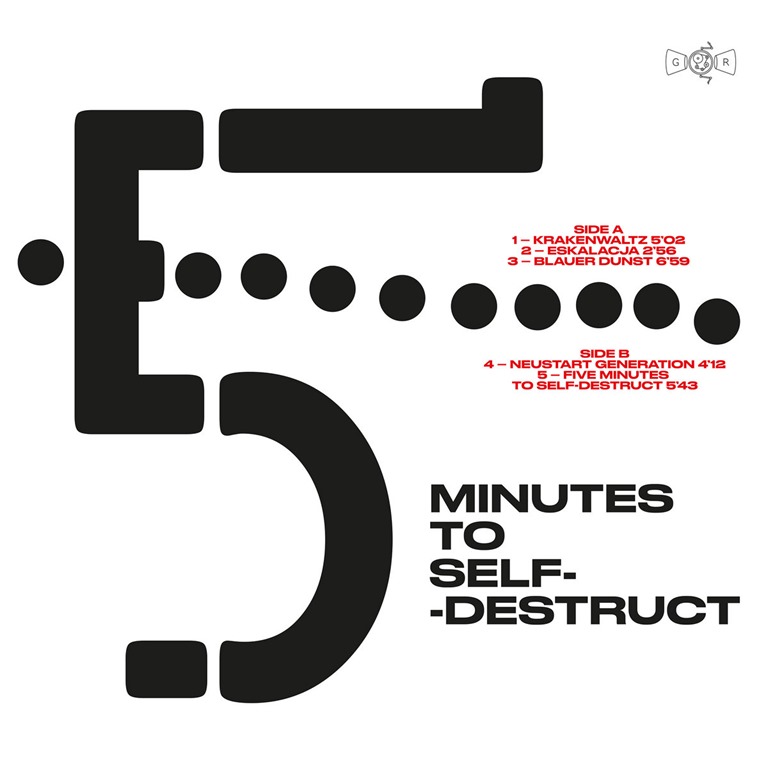
You might be hard-pressed to call CEL a supergroup, but Felix Kubin has been creating sound here, there, and everywhere for a long time now, and Five minutes to self-destruct is definitely a coming together of established creative forces, containing as it does five recordings of live tracks performed by longstanding Kubin and longstanding collaborator Hubert Zemler, remixed by Warsaw sound engineer Jan Wroński.

And the thing about creative collaborations is that they often rely on spontaneity, immediacy, the frisson between the individuals in proximity, feeding off one another in the moment. And so it is here, as the accompanying notes set out: ‘The expressiveness of these recordings is evident not only in their unbridled live energy, which can hardly be reproduced in the studio, but also in a musical nervousness that sets itself apart from the current wellness folklore of the modular community. The pieces gather in their DNA the paranoid plasma of cultural unease, chaos and upheaval.’

To make a small sidestep, we hear endless decrees that employees need to return to the office in order to foster the spirit of collaboration and all the rest. We know that this is bollocks, and is simply about working the instruments of control. Collaboration and the coalescence of energy for creative ends is not something which cannot be forced, and it happens, regardless of distance, time, and space, given the right connection and chemistry. Hearing the performances on Five minutes to self-destruct, it’s immediately apparent that this is not something that could ever be created by desire or will alone.

As the accompanying bio notes, ‘The expressiveness of these recordings is evident not only in their unbridled live energy, which can hardly be reproduced in the studio, but also in a musical nervousness that sets itself apart from the current wellness folklore of the modular community. The pieces gather in their DNA the paranoid plasma of cultural unease, chaos and upheaval.’

The title track ‘Five minutes to self-destruct’ is a quote from Michael Crichton’s sci-fi classic The Andromeda Strain, which describes a research team’s fight for survival against an accidentally triggered self-destruct mechanism, underpinned by trigger impulses and increasing panic.

My own experience of the modular community may not be on quite the same scale or the same higher circles as theirs, but it does feel primarily the domain of the middle-class, middle-aged white male these days, and there’s a certain air of ease and the satisfaction of hobbyism about it. Needless to say, not so here. There’s a tension that runs throughout the entirety of the release. ‘Krakenwaltz’ cartwheels and loops in jittery circles, head-spinning rhythmic cycles with no small degree of attack, with some sharp, aggressive snare sounds and a frenetic, frantic undercurrent which grows increasingly disorientating over its near-six-minute duration.

‘Eskalacja’ is dominated by hectic percussion and a whirl of fairground bleeps and toots running in ever-tighter concentric circles. It some respects, it calls to mind the frenzied looping and wild, vaguely manic excesses of early Foetus 12” singles, seeing just how far they can push the concept, and themselves in the creation of hyperactive sound.

The seven-minute ‘Blauer Dunst’ which sits as the album’s centrepiece marks a distinct shift in tone and texture, a rumbling dark ambient piece that invites comparisons to some of the more abstract works of Throbbing Gristle. It predates the rest of the set by almost four years, having been recorded in October 2020.

It’s back to more upbeat, stomping percussion-led synth work on the DAF-like ‘Neustart Generation’ – but don’t mistake upbeat for uplifting: it clatters and bangs with a clipped, regimented, Germanic feel, and the grooves are taut and tense, and it’s simmering tension which crackles beneath the lumping, shuffling, organic rhythms which underpin the sparse, tetchy title track. A couple of minutes in, a loping percussive cycle breaks out and the repetition of this and the dominant synth motif, amidst a swell of extraneous sounds – samples, sirens – makes this one of those tracks where you can feel your blood pressure increasing as it progresses and the pace quickens to a blur. It ends before reaching the point of inducing an aneurysm, and the assurance to the applauding audience, “We’re still alive, it’s ok,” at the fae injects some unexpected humour to proceedings.

AA

a1852422406_10

7th July 2023

Christopher Nosnibor

I recall, when I was growing up, people often being admonished for using the word ‘hate’. ‘It’s such a strong word’, would be the lecture. Usually it was adults telling teens this: no, you don’t ‘hate’ school, you don’t ‘hate’ that band, or that annoying kid in your class. I never saw it as such a big deal. I suppose, on reflection, we were using ‘hate’ in a hyperbolic sense. Now, however, we seem to use the word somewhat less frequently, but feel hate – real hate – being expressed more freely. It’s not pleasant, and while much is said and written about the toxic environments of social media, the real world really isn’t any more pleasant. From toxic work environments to increasingly right-wing governments creating division and stoking hatred of minorities, be they immigrants, the poor, or the disabled, the world we live in is not a nice place to be, and it’s small wonder that mental health issues are at an all-time high.

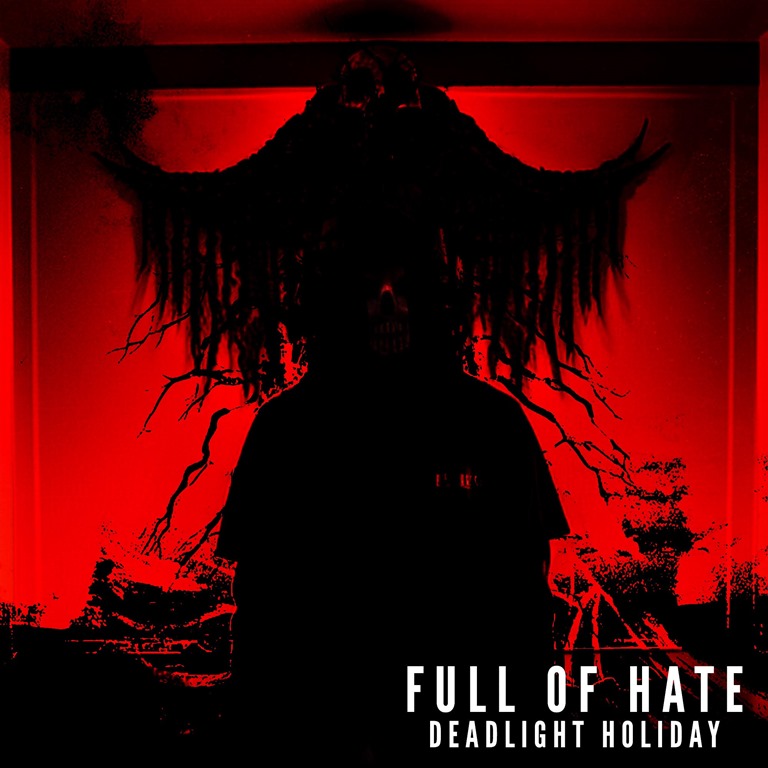
‘Full of Hate’ isn’t about the outward projection of hate onto individuals or groups, but the inward-focused grapplings of torment, as the accompanying notes explain: ‘The song captures the suffocating feelings of anger and isolation that engulf us and often leave us with a feeling of being confined. Moreover, the song does so within the span of ninety seconds.’

And that it does: they’ve condensed all the intensity of emotion into a minute and a half. Zero fat here. It’s the bass that defines ‘Full of Hate’. By which I mean it’s a 360-degree immersive sound, the thick distortion secondary in impact to the booming frequencies. So dense is the sound that it almost submerges the mechanised drums and growling vocals. The vocals are unexpected, at least on first listen: there’s an association with screaming and full-lunged roaring as giving vent to anger, rage, and catharsis. But on ‘Full of Hate’, the vocals are controlled, focused, all the more difficult to process in context. There are some moments of dodgy autotune, but overall, it’s that sense of keeping a lid on things that suggests psychopathy, and which renders ‘Full Of Hate’ all the darker, all the more intense.

It’s one powerful, tension-blasting minute-and-a-half that’s awkward and uncomfortable, seething rather than foaming as the rage flows.

AA

476853

Aural Aggravation is immensely proud to present an exclusive video in the form of ‘Lifted by Marionette Strings (For Kleist)’ by Dan McClennan.

Taken from the album Unfurling Redemption released by Cruel Nature Records on 2nd September, ‘Lifted by Marionette Strings (For Kleist)’ is an unusual hybrid of neoclassical and experimentalism, balancing ominous synths and graceful piano with elements of noise to create a multi-faceted journey brimming with drama and tension.

Known for his energetic furling beats with noise-rock experimentalists Warren Schoenbright and Why Patterns, this solo release sees Daniel McClennan draw on classical and avant-garde influences such as Giacinto Scelsi; Svarte Greiner; Valentin Silvestrov; William Basinski; along with sound-artists such as Jacob Kirkegaard and The Caretaker .

Unfurling Redemption is a collection of eight assemblages comprised of synthesised instruments and freely available/stock sound samples. These assemblages explore the widely observed and seemingly inherent desire for overcoming in humankind, a dangerous proclivity for dreaming the transcendent. Particularly, the tracks pull at the problem of what we can do when these efforts inevitably drop us short of paradise, miss the mark or leave us as pyrrhic victors. Taking the form of empathetic or imagined inward reflections, they are inspired by characters in both fiction and critical discourse and take the form of unpredictable, spectral or melancholy audio ruminations. What must be done when transcendence is forever thwarted? Where then, must we seek redemption?

Watch the video here:

AA

a1220833455_10

Xtra Mile Recordings – 8th July 2022

Christopher Nosnibor

She sang it! She sang it! Yes, the hook to the album’s opening song, ‘We are Machines’ is ‘We are machines / it’s how we function’. Simple pleasures and all that. But there are many pleasures packed into this album’s forty minutes.

Having been showcasing BERRIES tunes since the time of their second EP back in 2017, the arrival of their full-length debut is a cause of excitement. And the anticipation is justified, with a tight set of songs that don’t disappoint.

What’s promised is an album ‘rammed with taut, angular guitar lines and packing a gritty, garage-grunge punch’, and that’s what’s delivered. None of the songs are over four minutes in duration, but they each contain so much action, so much traction, so much movement, each takes time to unravel the tightly-woven, knotted, intermingled noodly jumbles of guitar lines. There’s a lot of taut, tense jangling and angling going on here, as they cut across the mathy aspects of the guitar lines and the spiky post-punk chop of Gang of Four, and they marry it all together with strong melodic vocals.

The tension is appropriate for an album that tackles themes of mental health, feeling overlooked and sexism ‘with a searing honesty and intensity’ to present, as the put it, a collection of songs about “growth, strength and rising above all of the negativity and noise”.

There isn’t a duff track to be found here. Yes, the singles are obvious choices and standouts, not least of all the gutsy ‘Haze’, which is more or less representative of the album as a whole with its bold , grungy guitars and dynamic construction, exploding into the chorus after an understated verse, but then ‘Discreetly’ really pushes things hard, and rocks more overtly than much of the album with a monster chorus and driving riff – and frenzied guitar solo – and packs it all into two and a half minutes. ‘Fabricate’ calls to mind Kenny Loggins’ ‘Dangerzone’, and is propelled by a thick, gritty bass, while the guitars stop and start and stutter, and ‘Basic Tables’ starts with some tightly interweaving, stop/spart guitar work before breaking into a breezy chorus.

What BERRIES achieve is a perfect balance of passion and personal honesty, with sass and a pop sensibility. That means that How We Function feels sincere, as it is, but isn’t lecturesome or lugubrious. It doesn’t sugar-coat difficult emotional matters, but isn’t whiney or woeful. How We Function is an album of empowerment, of determination. The songs are both instant grabs and growers, and with this much energy, it’s exciting, not just the first time, but again and again.

AA

thumbnail_unnamed-447

Cool Thing Records – 7th August 2020

The band – the coalescence of an enigmatic visual artist, a prodigal singer-songwriter and an ambitious beat-maker ‘trapped inside a digital landscape’ describe their debut, ‘Lumbering’ as being ‘about viewing the world with a sense of claustrophobia and dread, as humanity bounces between various financial crashes, wars and climate disasters, whilst continuing to lumber endlessly forwards, seemingly in a wounded state.’

This is, indeed, the world of the now, and as such, I expect it’s broadly relatable to many on its perspective. It’s certainly relatable to me on a personal level, having become attenuated to a sense of perpetual panic and wild upheaval. The only thing you can be sure of is that nothing is certain, and you can’t rely on or trust anything – or anyone. The fact is, no-one is exactly who you think, and we live in an evermore divided and more extremely polarised society, be it Brexit or the wearing of masks.

‘Lumbering’ is pitched as ‘an intriguing soundscape of skeletal guitars, layered angular rhythms and fantastic lyrics’ and a hybrid of Boards Of Canada, 00’s Radiohead and The Cure’s Bloodflowers era.

With clattering drums and a pulsing bassline, I’m reminded more of the early 00s New Wave revival as spearheaded by the likes of Interpol and Editors, as well as The Cinematics. A Cause In Distress capture that tension and sense of urgency and distil it down to a truly gripping three-and-a-half minutes of surging dynamism.

It doesn’t necessarily make me feel better, but articulates my restless tension perfectly.

 AA

thumbnail_Lumbering Cover

When an act comes as being recommended for fans of STABBING WESTWARD, Nitzer Ebb and <PIG>, we’re all ears here at Aural Aggro. and ‘Lockdown’ by Thrillsville doesn’t disappoint, mixing a dark bubbling synth bass groove and tense vocals with a bold, bombastic chorus, it’s a strong effort.

Lyrics like “Can’t stop touching my face,” “Don’t even know what day it is anymore,” and “Losing my f*cking mind” convey the mental and emotional strain the crisis has had on all of us.
"This song was directly inspired by the unrelenting restlessness of being “stuck on lock-down.”  In essence it’s a romantic song about longing for a normal night on the town.” – Rani Sharone (THRILLSVILLE)

Check the video here: you won’t regret it 9and besides, you’ve probably not got anything else to do):

AA

f0c5aa0e-75eb-446a-b9f0-cc9ad2fb2df7