Posts Tagged ‘Swans’

Christopher Nosnibor

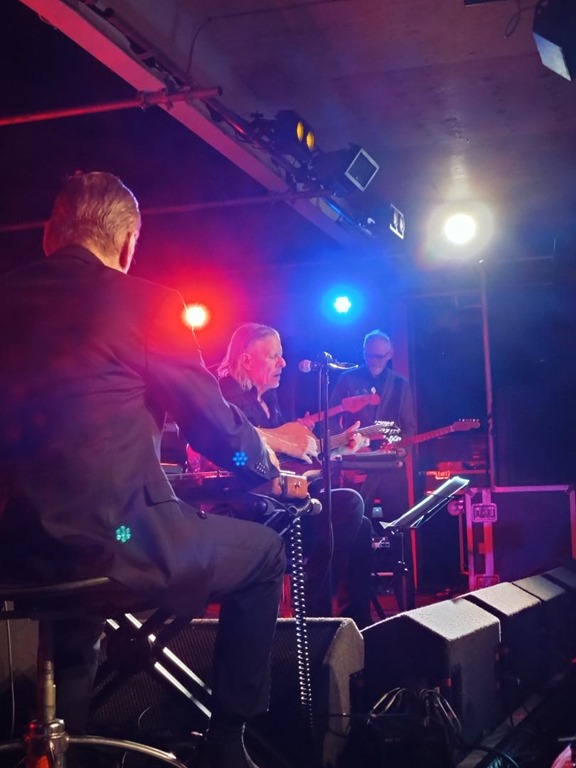
The last tour of Swans’ current iteration, drawing the curtain on a succession of albums – and tours – which have been truly immense in every way: the build-up felt like the end of an era. The event itself, perhaps less so. At one point, someone calls out a request. “We don’t do that,” Gira explains, in a kindly manner. He seems pretty relaxed tonight, and smiles a fair bit. No-one in the band gets bollocked or scowled at, and they all seem to be having a pretty good time.

But no, they certainly don’t do ‘that’. You don’t go to see Swans expecting to hear choice guts from their extensive back catalogue. You don’t even go expecting to hear songs, at least not in any recognisable form. The versions of recorded songs bear only limited resemblance to their studio counterparts, twisted, stretched, and otherwise evolved while on the road to a point whereby they’re almost new songs entirely. Recent shows have seen the band playing sets spanning a full two and a half hours, while only featuring six songs.

Before we come to Swans, Jessica Moss, who, amidst an extensive catalogue of work over the course of a lengthy career, is best known for her contribution to Thee Silver Mt. Zion Memorial Orchestra and being part of the whole Godspeed You! Black Emperor milieu. Tonight, she plays a rendition of her latest album, An Unfolding, in its entirety, and it’s breathtaking. Her nuanced violin and vocal work is augmented with booming, resonant bass tones. There’s a lot of yakking at the bar and further back in the 1,000 capacity, sold-out venue, where the house light stay up toward the rear of the room for the duration of the night, but for those of us in the front two-thirds, it’s a spellbinding experience, which perfectly sets the tone for the main event.

Moss’ half-hour set is over by around 8:40, and Swans, after a few brief checks, take to the stage around ten minutes later. Gira politely asks that there are no cell phones – “at least not where I can see them”, before he begins strumming a monotonous at two strings. He does so for what feels like an eternity. Or perhaps not. When Swans play, time takes on a different meaning, and it’s been a feature of this current iteration that the songs evolve and elongate over the course of the extensive tours, transforming and transmogrifying over the weeks and months on the road. They’ve been touring Birthing and this ‘farewell’ for a fair while now, although the set on the most recent leg has only featured ‘The Merge’ from said album. With ‘Paradise is Mine’, from The Beggar, and ‘A Little God in My Hands’, from To Be Kind, this is as close to a retrospective set as you’re likely to get, but none of these songs much like the studio versions, and half the set therefore features material which is either new or so far removed that it’s been retitled as well as restructured. But as I say, you don’t come to a Swans show for the songs. You come for the experience. And what an experience it is.

S1

It’s fair to say that there is simply no other band like Swans. Their reputation for extreme volume is only part of the story, a piece of the equation. Older fans who saw them in the 80s love to regale with tales of people throwing up, passing out, and so on, and that they’re pretty tame these days, and I have no reason to believe that these are purely apocryphal. Gira just can’t do quiet: even his solo acoustic sets playing smaller venues circa 2003 / 2004 were fucking punishing.

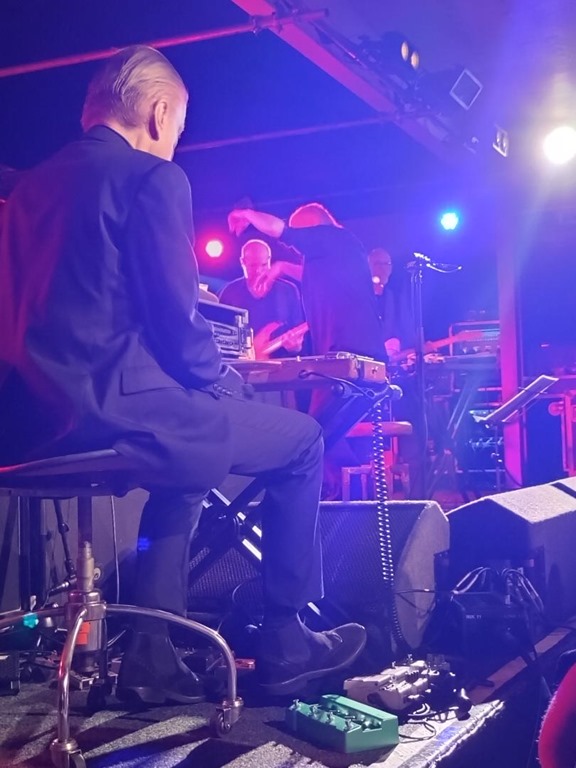
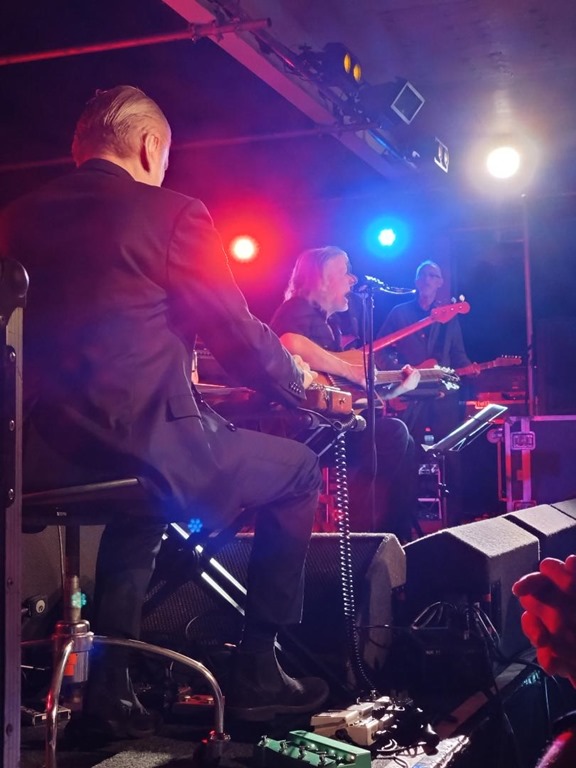
Some time in, Gira downs his guitar and stands up, turning to face the band, and flails his arms as if experiencing some kind of rapture or episode. But every gesture is a signal, from which the band members – there are six of them, plus Gira – and his near-psychotic choreography guides them through ebbs and flows, to ever greater, more intense crescendos. It’s maybe half an hour before the full drum kit kicks in, and I feel my nostrils vibrate with the sheer quantity of air displaced from the speakers. It’s transcendental, euphoric.

S2S3

A number of people who had started the set near me in the front row dissolved. I didn’t really notice when: like almost everyone else, I was simply transfixed. And yet, this was by no means loud by Swans standards: while I can’t claim to have witnessed the nauseating brutality of their early years, or the notorious punishment of the Burning World tour (ironic that their gentlest album, released on a major label, should have been served by a tour of such infamous volume… or perhaps not, perhaps it was a statement to prove that they hadn’t sold out), their shows at Leeds Stylus in 2016 and 2017 were something else – something so intensely physical, it hard to find the words. Then again, on their last visit to Leeds, playing at The Belgrave, I found myself thinking ‘this isn’t so loud’ but before long finding myself dizzy and wondering quitter where that immense noise had grown from. And this is perhaps an indication of how they’ve evolved. The bludgeoning force is still very much present, not least of all with two basses and the return of Norman Westberg to the lineup – surely one of the world’s most patient and understated guitarists, content to stand, not playing for ten to fifteen minutes, before battering away at one or two chords and thirty BPM for the next fifteen minutes, creating noise and texture rather than doing the conventional ‘guitarist’ thing – but now it’s more subtle, growing building, slowly, so slowly. A tweak here and there, another player adds a later, and while you’ve been watching the dynamics of the two bassist and Gira’s windmilling, the volume has increased threefold and your ribcage is rattling and your brain is slowly scrambling. Kristof Hahn does things with lap-steel that is beyond comprehension, cranking out squalling, screaming walls of noise – but there isn’t a weak element in the lineup. They each bring something unique, and the collective output is something else.

If this is the end of Swans doing big band, big noise stuff, then they have certainly delivered a finale of spectacular proportions. And whatever comes next, we look forward with bated breath.

Room40 – 18th July 2025

Christopher Nosnibor

Norman Westberg seems to be a man of few words. Through all of his years with Swans, I can only recall interviews with Gira and Jarboe, although I have for many a decade now admired Westberg’s stoic approach to playing: no showmanship, no seeking of attention, instead channelling the sound, often with infinite patience, screeding feedback and a single chord for an eternity. His solo material is considerably softer than Swans in tone, but no less brimming with tension and atmosphere, and this is nowhere more apparent than in his solo live sets, as I recall in particular from seeing him open for Swans in Leeds two years ago. Onstage, he was unassuming: in contrast, the sound he made, was powerful.

And so it is that the words which accompany Milan are not those of the artist, but Room40 label head Lawrence English, who recounts:

In 2016, I invited Norman Westberg to Australia for his first solo tour.

He’d been in Australia a few years before that, touring The Seer with Swans, and it was during this tour that I’d had the fortune to meet him. Since that time Norman and I have worked on a number of projects together. He very kindly played some of the central themes on my Cruel Optimism album and I had the pleasure to produced his After Vacation album.

Last year Norman shared a multichannel live recording with me from a tour where he was supporting Swans. The recording instantly transported me back to the first time I heard Norman perform.

Whilst many people know his more dynamic and tectonic playing associated with his band practice, Norman’s solo work is far more fluid. Often, when I hear him live, I imagine a vast ocean moving with a shimmer, as wind and light play across its surface.

Norman’s concerts are expeditions into just such a place. They are porous, but connected, a kind of living organism that is him, his instrument and his effects. He finds ways to create moments of connection which are at times surprising, and at others slippery, but always rewarding.

There’s a deeply performative way to his approach of live performance. There’s a core of the song that guides the way, a map of sound, but there’s also an extended sense of curiosity that allows unexpected discoveries to emerge.

Milan, which I had the pleasure to work on for Norman, captures this sense perfectly. It is a record that exists in its own right, but is of course tethered to his other works. It’s an expansive lens which reveals new perspectives on familiar vistas.

This almost perfectly encapsulates my own personal experience of witnessing Westberg performing. And Milan replicates that same experience magnificently. Admittedly, despite having listened to – and written about – a number of his solo releases, including After Vacation, I was unable to identify any of the individual pieces during or after the set. Such is the nature of ambient work, generally. Compositions delineate, merge, and while the composer will likely have given effects settings and so on, which are essential to their rendering, to most ears, it’s simply about the overall effect, the experience, the way movements – even if separable – transition from one to another.

This forty-minute set is dark, disturbing, immersive, somewhat suffocating in its density, from the very offset with disorientating oscillations of ‘An Introduction’. It flows into the next piece, ‘A Particular Tuesday’, where tinkling, cascading guitar notes begin to trickle down over that woozy undulation which rumbles and bubbles on from the previous track. And over time, it grows more warped, more distorted. Something about it is reminiscent of the instrumental passages between tracks on Swans’ Love of Life and White Light from the Mouth of Infinity, and for all the swirling abstraction, there are trilling trickles of optimism which filter through here.

Amidst a swell of bass-booming, whorling sound on sound, gentle, picked notes just – just – ring clear and give form to an amorphous sonic mass, but this too gradually achingly, passes to the next phase, and then the next again. ‘Once Before the Next’ is the sound of a struggle, like trying to land a small wooden rowing boat in a gale. And it’s in context of this realisation that there are many depths and layers to Milian, but none which make for an easy route in, and there is no easy ‘check this snippet’ segment. Instead, it’s the soundtrack which prefaced the ugly one w know is coming.

While Milan is obviously a live set – and at times, the overloading boom of the lower frequencies hit that level of distortion which only ever happens in a live setting, and the sheer warts-and-all, unedited, unmixed approach to this release is as remarkable as it is incredible in listening terms. This isn’t a tidied-up ‘studiofied’ reworking of a live show. Milan is a document of what happened, as it happened. You can feel the volume. The density and intensity are only amplified by the volume, and you really do feel as if you’re in the room. Let it carry you away.

AA

AA

a1125531819_10

The Whimbrels is an outer-borough masterpiece. The sound is dense, polyrhythmic, hard, and sweet, hooks and riffs to save your soul pop out at unexpected moments. The players’ credits — The Glenn Branca Ensemble (dating to the 1980s), The Swans, J. Mascis — predict the guitar-driven, sonic onslaught of The Whimbrels, captured on their startling debut – and as a taster, they’ve unveiled a video for the song ‘She is the Leader’.

A Whimbrels show involves racks of guitars, tuned in different and unconventional ways with the players constantly switching between them. ‘The Whimbrels’ album showcases this. There are counterpoint choirs, dueling e-bows phase against each other, chunking, poly- and cross-rhythmic interludes, soaring arias of distortion from Westberg and Evans’ strangely melodic and inventive guitar. Evans’ and Hunter’s vocals front a three-guitar line up tuned every way but normal. The ax men are veterans with contrasting styles that come together in a potent whole. The beats are smart and unrelenting. The album concludes with the instrumental Four Moons of Galileo, four short sections with the inner two framed by shimmering walls of descending, slowly evolving harmonies. The title recalls the four moons discovered by Galileo, suggesting the many more then lurking unknown in space.

ARAD EVANS (guitar, vox, primary songwriter) was a member, recorded and toured with Glenn Branca’s ensemble from the 1980’s until Branca’s death a few years ago. He is founder and still performs with Heroes of Toolik. In addition to Branca, he has played with Quiet City, Rhys Chatham, Ben Neill, John Myers’ Blastula, The SEM Ensemble, The New Music Consort, Virgil Moorefield’s Ensemble and many other groups. “A truly inventive and surprising guitar player.” (Rick Moody, The Rumpus Aug. 25, 2016).

NORMAN WESTBERG altered the course of rock as the main guitarist of the Swans over 35 years, contributing "overwhelming waves of volume with a mix of the rhythmically slashing and the harmonically sensual." He has a busy career as a solo artist and with other projects, such as Heroin Sheiks, NeVah and Five Dollar Priest.

LUKE SCHWARTZ is a New York guitarist and composer to watch; he also toured and recorded with Branca, and he performs in a wide range of groups, including Rick Cox, Joh Hassell, Lotti Golden, Wharton Tiers and with several of his own projects, The Review and the improvisational Hive and Quiet City and is in demand for film scoring work.

MATT HUNTER (bass, vox, songwriter) is a co-founder of New Radiant Storm King and plays or has played with a galaxy of cool projects, including J. Mascis & the Fog, King Missile, Silver Jews, SAVAK, and his own Matt Hunter and the Dusty Fates.

Drummer STEVE DiBENEDETTO, is a widely shown and collected fine art painter but also in in high demand for his music. ("The Spinless Yesmen" 1984—89, "Wonderama",aka "The Shapir-o-Rama" 1990—95, Airport Seven from 2010 to 14). He frequently collaborates with Dave Rick (Bongwater, King Missile, Yo La Tengo, Phantom Tollbooth) and Kim Rancourt (When People Were Shorter and Lived by the Water).

LIBBY FAB (drummer on That’s How It Was) is a founding member of the noise duo Paranoid Critical Revolution. She was technical director of Glenn Branca’s Symphony 13: Hallucination City from 2006-09 and toured as drummer for his ensemble on the Ascension: The Sequel tours. Her own electro acoustic and video works have been featured in festivals in Europe, North America and the Caribbean.

JIM SANTO (producer) partnered for many years with Wharton Tiers in the fabled The Kennel studio. At his own Tiny Olive, Santo has worked with a wide range of clients and projects. As a guitar player, his credits include The Sharp Things, George Usher and Harley Fine.

The New York Times once placed Arad Evans on “an index of creative or experimental electric-guitar-based music in America — young lords of the wild in the post-rock tradition.” That description fits The Whimbrels perfectly. You may need earplugs.

AA

Whimbrels_platforms

Young God Records – 30th May 2025

Christopher Nosnibor

And so we arrive at the end of another era in the epic history of Swans. When they called it a day in 1996 with Soundtracks for the Blind, and a farewell tour documented on Swans are Dead, it really did seem as if that was it. Swans had run their course, and the colossal Soundtracks double CD summarised everything they had achieved over

It may seem strange that the bookend to this phase of their career should be titled Birthing. But such is the cycle of life, and indeed, the avant-garde: death gives way to new life, to build anew one must first destroy. And so in this context, Birthing, which Gira has announced will be the last release of this epic, maximalist phase, makes sense. With a running time of a hundred and fifteen minutes, it’s comparable in duration to its predecessor, The Beggar, and The Glowing Man (a hundred and twenty-one minutes and a hundred and eighteen minutes respectively) , but on this outing, the individual pieces are all immense in proportion, with the album containing just seven tracks, with only one clocking in at less than ten minutes.

‘The Healers’ makes for a suitably atmospheric, slow-burning opener. Around seven minutes in, the gentle eddying begins to swell, like a breeze which wisps and ruffles the leaves on the trees – a minute or so later, the drums have entered the mix, and the ambient drift begins to take a more solid form, and there’s a change in the air temperature, the barometer plummets and the breeze becomes a wind. In no time, there’s a swirling wail of sound surrounding Gira’s increasingly exultant enunciations, but as he growls and mumbles and raises his voice higher, he’s increasingly drowned by the maelstrom. And yet, it’s nowhere near a crescendo, and I’m reminded of their set on the 2013 tour, where, having told my friend that having seen them in the same venue three years previous that they took volume to another level, the first twenty minutes of the set was loud, but not remarkably so – and then suddenly, there was a leap of around thirty percent that felt like a double-footed kick in the chest. Will it happen here? Around the fifteen minute mark, it tapers down to a haunting whistle of wind – and it’s the calm before the storm, as a raging tempest suddenly erupts, a frenzied wall of noise that has become their signature, and the song surges to a powerful sustained climax.

While the delivery is considerably less brutal than it was in the early 80s, Gira’s lyrics are still riven with dark and disturbing imagery, and now coloured with a hint of abstraction and madness, and this is nowhere more evident than on ‘I Am a Tower’, which was aired as a lyric video a little while ago. ‘With thin boneless fingers and pink polished nails, I’m searching for the fat folds of your blunder. Speak up, Dick! …Bring your fish-headed fixer to whisper in my ear. Please worry me here, tongue that victim in there…’ he intones like a cracked messianic cult leader against a backdrop of swirling drones. Attempting to unpick sense or meaning from it feels futile, and potentially traumatic, so instead, it’s perhaps experienced holistically, as a jumble of images and impressions, a fractured collage, a derangement of the senses whereby you allow it to transport you to another plane, away from anything concrete or grounded, beyond all that you know. Seemingly from nowhere, a motorik rhythm kicks in and we get something approximating a driving Krauty post-rock riff, hook and all. It could be Swans’ most pop moment since the White Light / Love of Life albums in the early 90s.

The title track arrives in a ripple of proggy synth that has a hint of Mike Oldfield about it, but gradually builds into a dramatic swell of sound, the likes of which has come to characterise the last decade of Swans, with a single chord struck repeatedly for what feels like an eternity. And then, from nowhere, they launch into something approximating a jig – on a loop, where the bass and drums simply hammer away repeatedly, like a stuck record. It is, if course, pure hypnotic magnificence. Gira’s words slip into soporific sedation amidst descending piano rolls. ‘Does it end? Will it end?’ he asks at the start of an extend wind-down, and it does feel like this would make a perfect gentle close – but there are more jarring, jolting ruptures to come, whipping up a truly punishing climax by way of a close, and by the end of the first disc – a full hour in duration – we’re left drained and hollowed out, tossed this way and that on a sonic – and emotional – tempest only Swans could create. Disc one, then, feels like a compete album. But this is a Swans release, and a landmark one, at that there isa whole further album’s worth of material yet.

‘Red Yellow’ begins in a dreamy drift, but soon slides into a warping drone pitched against another of those relentless, repetitive grooves, this time with some jazz horns freaking out in every direction. And at this point, there does arise the question of what new this iteration of Swans is offering at this point, but the immense, immersive soundscapes provide the answer in themselves. Swans have certainly evolved, but they have always done so gradually. The first half of the eighties was devoted to crushing slow grind, and you’d have to be a glutton for punishment to listen to more than one album in a sitting. The point is that Swans have always pleased themselves and made music that tests the listener’s limits, and Birthing is no exception.

Reviewing a Swans album is always a challenge, especially their comeback releases. They’re not about songs, and, broadly speaking, not really about impact in the way their early works were: instead, they’re about transcendence, about moving beyond mere music.

‘Guardian Spirit’ starts out textured an atmospheric, but ends full Merzbow, before ‘The Merge’ takes noise to the next level, albeit briefly. It’s as if Gira is toying with us. Perhaps he is, but when the noise erupts, it really erupts. ‘Rope’ returns us full cycle to there My Father Will Guide Me, while making an obvious connection with all phases of their career, through which ropes and hangings have been a perpetual theme.

Birthing is not an easy album, but it is one which requires listeners (and reviewers) to do something different in terms of approach. You don’t listen so much a feel it, and ride its endless waves: sometimes slow, gentle, at others an absolute roar, Birthing brings together everything Swans have done, and achieved, over the course of this iteration. It’s often overwhelming, and almost impossible to reduce to words. The second disc does feel softer, more abstract, and leaves on wondering precisely what the next phase will look or sound like.

SwansBirthingalbum-cover-artwork-

SWANS have announced details of their seventeenth studio album, Birthing, due for release on Mute / Young God Records (N America) on 30 May 2025. Birthing will be released on triple vinyl (in a brown chipboard sleeve, double CD (in a brown chipboard digi-pack), and digitally. Initial pressings of the triple vinyl and CD editions will come with a bonus DVD featuring ‘Swans Live 2024 (Rope) The Beggar’, a live concert film directed by Marco Porsia from the last Swans US tour, plus Christopher Nicholson’s documentary from Michael Gira’s solo tour in 2022 entitled I Wonder If I’m Singing What You’re Thinking Me To Sing.

Listen to the first track to be shared, ‘I Am a Tower’ here:

“The material contained in this album was largely developed over the course of a yearlong Swans tour, during 2023 – 2024 (‘The Healers’, ‘I Am a Tower’, ‘Birthing’, ‘Guardian Spirit’, ‘Rope’, and ‘Away’), then recorded and further orchestrated and rearranged in the studio. Two pieces were created and performed in the studio (‘Red Yellow’, ‘The Merge’).

In all cases the material began with me sitting in my office with an acoustic guitar, singing and dreaming about what would become of these skeletal songs. I’m blessed to have such a stellar group of musicians to work with live (listed below), and through improvisation, endless revisions and an intensity of focus in performance (not to mention endurance), over the course of time the music morphed into what you generally hear on this collection.

This album, coupled with the recent live release, Live Rope, constitutes my final foray (as producer / impresario) into the all-consuming sound worlds that have been my obsession for years. We’ll do a final tour in this mode towards the end of 2025, then that’s it.

After that, Swans will continue, so long as I’m able, but in a significantly pared down form. Hints of that direction can be found in a few moments on the current album. In the meantime, my hope is that the music provides a positive and fertile atmosphere in which to dream.” – Michael Gira / Swans

AA

Swans

Erototox Decodings – 1st March 2024

Christopher Nosnibor

Holy hell! Where to start? We’ll come to the band’s pedigree and the CVs of this supergroup in due course. But first, the immediate impact of this second album by The Children – that’s what hits in an instant. Perhaps because I missed the first, I simply wasn’t prepared in the way I might have been, but then again, is there any adequate preparation in advance of this?

A stark acoustic guitar – something about the way it’s picked and pulled is sharp, tense, scratchy, in the opening bars of ‘gOd is a Bereaved’ is prickly, awkward – paves the way for an eye-opening vocal performance. It simply doesn’t conform to the mores of conventional musicality, and instead flies skyward and swoops towards the ground in terrifying, unnatural flips and arcs. Something is certainly sudden, and it’s not a craving, but the impact of this completely out-there sound. Intense is an understatement.

‘Woven Mother Aflame’ brings brooding atmospherics split asunder by explosive percussion – a snare that has the power to split skulls cutting through serpentine strings and heavy, resonant bass reverberations which hang in the air, before the gentler ‘Breathing Shards’ fades electronics into a strummed acoustic guitar. Breathe… out. But all is not comfortable. The quavering vocals – not quite falsetto, not quite any specific range, but warbling, tremulous – quiver, uncomfortably atop and amidst the multi-layered backdrop which slopes and slides and traverses through starless space as basslines stroll and amble sedately.

Some background: The Children… ‘are . They have been making music together for over 15 years. Former Barkmarket bassist John Nowlin and drummer Rock Savage have consistently anchored the rhythm section, with a savagely airtight groove that’s both thunderous and mellifluous, primal and funky, and cellist Kirsten McCord has regularly enriched the band’s sound with her somber, lulling phrasing as a one-woman string section. John Andersen was a founding member and key early collaborator. The inimitable vocalist Shelley Hirsch has been a visceral contrapuntal foil for several live shows. Former Swans guitarist Norman Westberg and clarinetist Johnny Gasper provided invaluable texture to the recording sessions for this LP.

Norman Westberg has long been one of my favourite guitarists on account of his absolute minimalism: few guitarists would be content to bludgeon away at two chords for eight minutes straight, but his stoic patience is a rare trait which sets him in a league of his own. His more recent solo work is noteworthy for his sculpting feedback into musical shapes, and as such, his magnificently understated contribution to this album is essential.

Then again, how really to assimilate this? Our instinct, as humans, is to trust what we know, to lean into the familiar, the comfortable. This is perhaps why so much conformist pop, accessible blues-rock, landfill indie, continues to command so much appreciation. It’s not even that it’s easy and comfortable, but that it sits within an established framework with which people are comfortable – and the same, unsurprisingly, applies to people. ‘Weirdos’ are ostracised, and find themselves on the fringes, alone. People find ‘otherness’ simply too much of a challenge. Who can honestly say they haven’t taken a step back and made effort to put distance between themselves and a ‘crazy’ in their lives or on social medial? No shame in it: life is difficult as it is, and you have to have limits on who and what you can accommodate. But the point stands: other peoples’ disturbances create further disturbances. And A Sudden Craving sounds pretty disturbed.

A Sudden Craving is the sound of otherness. Yes, the vocals in particular are difficult to process. They sound… well, deranged. Wailing theatrically in a howling whorl of chaos and discord, underpinned by a hypnotic wave and monotonous plod of percussion, they really stand out as the definition of mania. ‘Breathing Shards’ may be mellower, but still possesses a sharp, jarring edge.

A Sudden Craving is scary because it doesn’t conform to any norms. Every one of the album’s ten tracks is unsettling, uncomfortable, unpredictable. It has depth and detail and many great qualities. Comfort and ease of access are not among then.

A Sudden Craving is a great album. It is not an accessible album, or an album which is comfortable or easy in any way. But then it’s not designed to be. It’s a head-shredding riot which really delivers some uncomfortable moments. At times I’m reminded of late Scott Walker. It’s compelling, and it’s quality, but one to file under ‘W’ for ‘Weird Shit’.

AA

a0924183782_10

Sacred Bones – 1st December 2023

Christopher Nosnibor

Released simultaneously with the reissue of their eponymous debut, Khanate’s second album originally released in 2003 – which is, incomprehensibly, 20 years ago further evidences just how far out they were at the time. And the time is worth assessing: in 2003, Nu-Metal was in its final throes, and Post-Rock was in the early arc of its ascendency. It was something of a wilderness time in many respects, with no real dominant trend: it was the year Avril Lavigne and Evanescence broke and Muse exploded, amidst an ocean of limp indie and even shitter commercial pop and r’n’b. The underground was the only place of interest, but even in those underground circles, there wasn’t anything quite like this.

The bio accompanying the release points us toward the darkness that pervades the album and does so from the start: ‘“Pieces of us in my hands, on the floor, in my pockets/red glory,” Dubin howls on opener ‘Commuted,’ setting the stage for Khanate’s second installment of existential dread. Dripping in death, murder and desperation, the album is somehow less forgiving than its predecessor. Which was probably the point”.

On this outing, they really do seem to have gone all-out to engineer an album that’s as stark and brutal as is possible, and the four tracks are drawn out to torturous lengths to achieve maximum discomfort. The aforementioned opener, ‘Commuted,’ is over nineteen minutes long, and the instrumentation is sparse, minimal and heavy with lugubrious atmosphere, while Alan Dubin howls like he’s having his fingernails pulled out slowly and painfully, one by one. It’s as bleak and harrowing as one of Derek Raymon’s ‘Factory’ series novels. It’s not pleasant, not even slightly, it’s not even enjoyable, but it’s perversely compelling. When a rhythm and guitars do coalesce, it’s at a glacial BPM, the kind of crushing, feedback-strewn, bludgeoning grind of Swans around the time of Cop, but with the more paired-back, spacious sound of Greed and Holy Money. But Khanate didn’t simply take these as templates – they scrawled all over them and then trampled on them in order to forge something even more challenging and even more fucked-up. There are lengthy passages where there is little more than crackle and hum, and the occasional burst of percussion. It may employ the tropes of avant-garde jazz, but it ain’t jazz. But what it is is hard to define. It’s not industrial, and it’s not doom. It’s not really metal in any recognisable form. But it is heavy. And it is unsettling, harrowing, and an absolute endurance test.

By the end of ‘Commuted,’ you feel utterly beaten and find yourself wilting from the sheer brutality of it all. And then ‘Fields’ crawls in, lower and slower, taking obvious cues from Earth 2 and marking clear parallels with Sunn O))). This is sinister, chthonic, demonic, not so much other-worldly as nether-worldly. It’s almost ten minutes before the bowel-juddering billows of overdriven, low-tuned guitar slides in like a slow-crawling river of lava. It’s monstrous, ugly, explicitly outright horrible. The hovering hum that takes hold around the fifteen-minute mark isn’t in any way a calming pause, but a nuclear wasteland of tension that pressurises the skull. Dubin raves maniacally like a psychotic locked in a soundproofed cell, and there’s a sense that the whole of Things Viral is a prison, whereby the listener is trapped within walls of sound. ‘I did this for you’, he screams murderously. It doesn’t sound like a kind favour, but like it’s time for payback. It’s chilling and grotesque. This is a fair summary of Things Viral overall. Even the quiet segments – and there are many – are occupied by sections of such weight that make your body feel as if its being dragged down, not by gravity, but by a darker force, one which will suck your very soul.

‘Dead’, at ten minutes, is but an interlude, but it radiates serial killer raving lunatic mania vibes for its entire duration, as the guitars throb and burn. It’s messy, and so, so heavy: you feel the pressure in your ribs, a weight in your limbs. The final track, ‘Too Close Enough To Touch’ is an absolute monster, which sits more closely alongside the harsh noise and overt extremism of Whitehouse and the point at which industrial strains its mangled way into power electronics than anything even remotely metal. ‘Stay inside… stay inside’ Dubin snarls, his vocals distorted and crazed. You barely dare move a muscle, let alone leave the house.

Things Viral goes way beyond darkness, and plunges into purgatorial depths that would have terrified Milton, and 20 years on, still sounds like the dankest, nastiest thing you could hear in any given year.

AA

a2725064236_10

Erototox Decodings

Christopher Nosnibor

Internationally, Kristof Hahn is best known as a member of Swans since their return in 2010, contributing electric guitar to My Father Will Guide Me up a Rope to the Sky and everything since (he was briefly a Swan in the late 80s and early 90s, becoming a touring member for The Burning World and appearing on White Light from the Mouth of Infinity and subsequently joining Gira’s Angels of Light. A lot has happened since then: My Father Will Guide Me was only forty-four minutes in total, whereas now they’ve evolved to have single tracks of that duration, and Hahn’s contribution on recent albums and tours has been lap steel. Witnessing his action on the last tour, while standing so close to him I could actually see the mud spattered around the ankles of his jeans, the significance of his contribution to the immense walls of noise the band create is clearly apparent. I’ve also been vaguely amuse by just how neat and dapper his presentation is, producing a comb to slick his hair back following particularly strenuous crescendos – although I also witnessed him taking said comb to the strings of his instrument in Leeds to yield some particularly unholy noise from an instrument more commonly associated with laid-back twangin’ country tunes.

What’s perhaps less widely known is that Kristof has enjoyed a lengthy career in music before joining Swans, as both a solo artist and a member of rockabilly garage acts The Legendary Golden Vampires, founded in 1981, and The Nirvana Devils (circa 1984). It’s with the former he’s back flexing his creative muscles despite an intense touring schedule with Swans.

Here, the Berlin-based core duo of filmmaker Olaf Kraemer (vox) and Kristof Hahn (guitars, organ, harmonica), reunited for the first time in many years, are joined by Thomas Wydler (drums), Achim Färber (also drums), and Chandra Shukla (sitar), to cook up a collection of ten songs.

The style is understated, country-leaning, occasionally folksy, with an underlying melancholy hue, with ‘Wohin Du Gehst’ crossing the language barrier to convey a low-level ache of sadness in its tone. Kraemer’s vocals are husky, almost croony, with hints of Mark Lanegan, and suit the low-key compositions well, conveying emotion and world-wearinness and a certain sense of sagacity, which is nowhere more apparent than on ‘White Horse Blues’.

If the reverby guitars of their Husker Dü’s ‘She Floated Away’ channels Chris Isaak, the song’s incongruously jaunty twist is in the vein of fellow German duo St Michael Front, while ‘The Rain’ is sparse and hypnotic and wouldn’t sound out of place on True Detective. The melancholy Leonard Cohen-esque ‘Sad Song’ speaks for itself, quite literally, self-referentially returning to the hook ‘this is such a sad song / and I sing it just for you’.

Discussing the songwriting ‘craft’ on an album feels pretentious and a bit wanky, but making songs this sparse – but also this layered – is a true example of crafting. Having mentioned Leonard Cohen previously, one thing that’s often overlooked is just how many incidental details there are on many of Cohen’s songs: The Songs of Leonard Cohen in particular is , on the face of it, acoustic guitar and voice, but there’s much more happening in the background, coming in and out of the mix, and this is something that comes through in attentive listening to Polaris. It’s subtle, keeping the overall sound quite minimal, but the attention to detail is what really makes it special.

AA

a3829215066_10

Cruel Nature Records – 29th September 2023

Christopher Nosnibor

Following the stop-gap video release of ‘Liar’ from their singles compilation, Manchester’s most miserable are back with another long-player.

For their sixth album, they promise ‘eight filthy tracks of vitriolic desperation’ on a set that ‘often veers towards a nineties alt-metal/industrial sound, along with the usual smatterings of customary Pound Land abstraction…In addition, this new album continues to aggressively push lyrical themes relating to the same old shit that seems to be getting worse: corporate hegemony, business culture, mainstream media influence, automation, class polarisation and economic austerity.’

I sit in the dim, narrow ‘spare bedroom’ that is the office where I work my day-job by day and write reviews by night, slumped, exhausted by life. I moved into this house ten years ago, and while I was fortunate to be able to buy it, it was previously a magnolia-coated rental with fire doors and stain-forgiving turd brown carpets throughout. The fire doors may be gone, but my poky office which, measuring 7 feet by 12 feet, would make for a fucking tight bedroom, still had the turd-brown carpet, because when presented with the choice of food and beer or a new carpet, carpet seems like an extravagance I can survive without. I realise and appreciate that I’m fortunate: I can at least afford both food and beer.

If Pound Land’s releases seem to plough the same furrow only deeper and laced with a greater despondency, that’s largely the point. As they say, ‘the same old shit that seems to be getting worse’, and that’s the shit that’s grist to their mill. No doubt their mill will be sold off or shut down, or knocked down to make way for a hotel or flats before long, but for the time being at least, they’re still plugging away. And thank fuck they are.

Yes, there is a rising swell of music that’s telling it like it is: if Sleaford Mods led the way, it’s been a slow trickle rather than an opening of the floodgates in their wake, most likely because people are too busy working overtime in their day jobs to pay the electricity bill to make music, but lately we’ve seen these guys, plus Benefits, Kill! The Icon, and Bedsit calling out the shitness of everything. And make no mistake: everything really is fucking shit, unless you’re a fucking billionaire.

‘Programmed’ barrels in with a squalling mess of grimy bass and screeching electronics reminiscent of Cruise-era Whitehouse, and it’s a sonic amalgamation that’s painful and penetrating, hitting the guts and piercing the ear drums simultaneously. The thunderous ruff buries the drums and when the snarling vocals enter the mix, spitting vitriol with blinding rage, everything combines to tear forth with a wall of nihilism that’s in the same field as Uniform. Then – what the fuck? Wild roaming saxophone sprays all over before another onslaught of rabid rage. It’s seven and a half minutes of devastating carnage that leaves you feeling hollowed out and wondering where they could possibly go from here?

More of the same, of course: grimacing and with gritted teeth, they grind, thud, trudge and bulldoze their way mercilessly through another six tracks – and half an hour – of relentlessly grey sludge, by turns angry and despondent.

Like Sleaford Mods, Pound Land’s compositions are built around monotony and repetition, but whereas the former place predominant emphasis on the lyrics, the snappy wordplay and caustic commentary, Pound Land batter and bludgeon repetitive lyrics in the way that Swans did in their early years, and their music is very much a mirror of the crushing effects of drudgery. It does articulate the gut-puling anguish of the everyday, and in the most direct way possible.

The raw, raging punk of ‘New Labour’ offers a shift in tempo, but it still sounds like it was recorded on a mobile phone left in a corner of the rehearsal room.

The majority of the album, though, is a succession of crawling dirges dominates by overloading bass. The lyrics are simple, direct – when they’re audible. ‘Fuck the facts and roll the news’ Adam Stone yells repeatedly over a bowel-busting bass growl on ‘Media Amnesia’. ‘Life is so much easier / with media amnesia,’ he spits before launching into a brutal rant – one of many.

There is absolutely no let up on Violence. It’s hard and heavy, uncompromising and unpleasant. Even sparser tracks like ‘Low Health’, where it’s more spoken word with churning noise, the atmosphere is never less than crushingly oppressive, harrowingly bleak.

The last track, ‘Violence Part 2’ is five minutes of brutal racket that’s the nastiest of lo-fi- sludge and which is the perfect encapsulation of the album as a whole. It’s grim, it’s bleak, and it’s supposed to be.

Rarely has a band so perfectly captured the zeitgeist through a horrible mess of noise that makes you physically hurt and ache and feel like you’re being subjected to an array of tortures. This is the world. This is Britain, in 2023. If you’re not a millionaire, you might as well be dead. It’s what they want. Poor, disabled? Fuck off and die. This is the grim reality of the world Pound Land present, and while that isn’t actually one of their lyrics, the bleak message is clear: we’re fucked.

AA

a1836109826_10