Posts Tagged ‘Solo’

Gizeh Records – 28th March 2025

Christopher Nosnibor

I sometimes wonder if Aidan Baker has secretly mastered cloning, since he has seemingly pursued multiple careers simultaneously. He’s been active for some time, it’s true, but even the compressed version of his bio makes for quite the read:

As a member of Nadja, Hypnodrone Ensemble, Noplace Trio, Tavare and a host of other projects and solo endeavours, Baker’s prolific output remains vital as he continues to explore a vast terrain of sounds and genres across a 30 year musical career.

His latest work, & You Still Fall In, we learn, was recorded at Baker’s home studio in Berlin, and ‘hints at the mood and songcraft of the likes of Midwife, Hood, Stina Nordenstam and Movietone. The album is a compelling listen, stripped down to mostly electric guitar and vocals and moving at a distinctly glacial pace. The intimacy of the hushed tones and muted textures lean into a dark, hypnotic and gentle stillness that lingers in the air…’

That fact that this is a truly solo work, with Baker taking care of guitar, bass, drum machine, and vocals is perhaps key to its low-key, introspective atmosphere. Intimate is the word: on the title track which raises the curtain on this soporific sequence of compositions, the acoustic guitar strum hovers to a drone, wavering in volume, seeming to drift, seeming to warp, to fade, you can hear fingertips swiping on strings between frets, and Baker’s vocal is but a mumble; you hear sound, but the words don’t fall free to clarity.

‘Drowning Not Waving’ blends rumbling bass distortions with glitching drum machine and an air of uneasiness: the experience is every inch the struggle the title suggests. And that title… the phrase may have become a popular adaptation of the line from Stevie Smith’s 1957 poem and a metaphor for depression, but to momentarily reflect on the actuality of this all-too -common experience is to recognise the extent to which we, as a society, still – STILL – fail to identify a person in crisis. ‘Cheer up, it might never happen’, we hear often. But it does happen. Even well-meaning friends will diminish the spasms of crisis with ‘well, my life’s shit or probably worse, actually’ type responses. And each such response is like a hand on the head, pushing down. And yes, I speak from experience, and not so long ago I was out for a walk in an attempt to find some tranquillity, some headspace, some time with my thoughts. A dog, off lead, ran up to me and began barking and hassling. Its owners called it back and then groused at me for my failure to smile and thank them. “Ooh, someone’s lost their smile,” the guy said loudly, purposefully so that I could hear. No fucking shit. But you know nothing about my life. My wife died recently and I am not in the mood for being hassled by dogs, and I owe you twats nothing, least of all a smile. I continued on my way without a word, let alone a smile, and there was no point in waving. I was simply drowning. The moral? People may have stuff going on you know nothing about, so don’t be a twat. And anger is only a few degrees along from depression. Music has a boundless capacity to inspire the most unexpected responses.

Things stray into even more minimal, lo-fi territory with ‘You Say You Can See Inside Me’, which captures the spirit of Silver Jews and the soul of some of Michael Gira’s solo recordings. It’s muffled, droning, barely there, even. And yet, somehow, its sparsity accentuates its emotional intensity. There’s almost a confessional feel to this, but it’s a confession so mumbled, either through shame, embarrassment, or plain unwillingness.

On the surface, & You Still Fall In is a gentle work, defined by mellow, picked acoustic guitar and vocals so chilled as to be barely awake – but everything lies beneath the surface. And the surface isn’t as tranquil as all that: ‘When The Waves They Parted’ may be defined by a rippling surge but there’s discomfort beneath the ebb, and the reverb-soaked crunch of ‘Still Cold from the Rain’ is bleak and lugubrious.

Although presented as two separate pieces, ‘Thin Film Interface’ is a continuous thirteen-minute expanse of murky ambience with lead guitar work which soars and echoes over a shifting sonic mist. It hovers in the background, yet simultaneously alters the texture and colour of the air, relaxing but with an unresolved tension beneath.

& You Still Fall In is a difficult album to place – but why should that be necessity? A lot happens, an at the same time, it doesn’t. & You Still Fall In is sparse, drifting between acoustic and altogether simpler acoustic instrumentation. But instead of dissecting the details or reasoning, I’m going to point to the album, and simply say ‘listen to this’. Because it’s simply incredible.

AA
cover

12th July 2024

James  Wells

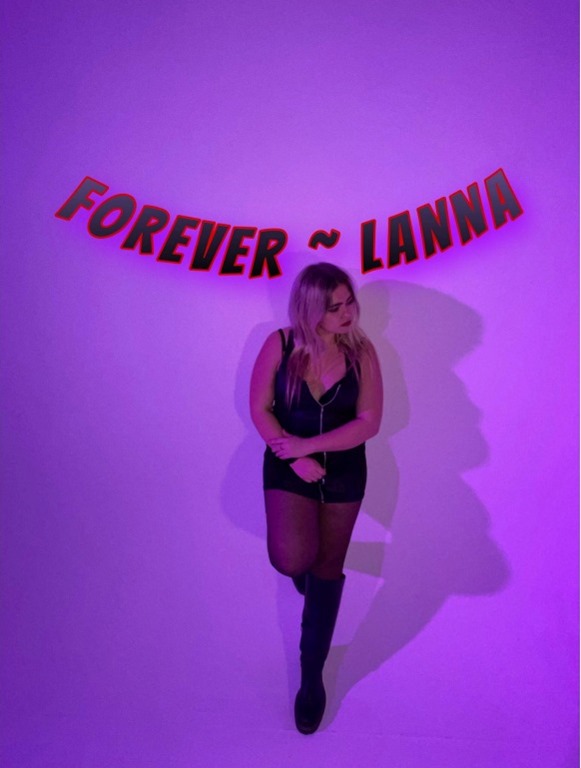
This may be Lanna’s debut single, but she’s by no means new to the industry, and has featured a couple of times here at Aural Aggravation with her band Miss Kill, who have garnered some thumbs up for their feisty grungy / alt rock sound.

Initially, I felt a sense of disappointment, assuming – erroneously, as it turns out – that the duo had parting and would never fulfil the early promise and future potential. It came as a relief to discover that Miss Kill are thriving, and have an album out soon, but in the meantime, Alanna is launching a parallel solo career. It’s a twofer!

But what’s interesting about Lanna’s debut single is that while her bio indicates a continuation of Miss Kill’s energetic flight, their emotive grunge stylings, again referencing inspiration from ‘Alternative, Garage and Pop artists like The Kooks, Hole, Cherry Glazerr, Chris Isaak, Placebo & Pearl Jam’, this feels like quite a departure. The premise is that, ‘rather than whine about breakups and having your heart broken’, ‘Forever’ ‘is all about the amazing feeling you get when you’ve found your special one.’

But for a song that’s so much about an effervescent emotional state, it’s remarkably subdued, with a soft, delicate piano, introspective vocal and backed-off drums with a hushed rimshot keeping slow and steady time. It may be a million miles wide of the mark, but this debut sounds for all the world like Lanna is pining for the thing she’s lost, a sad celebration for the loss of a special one as she finds herself bereft and alone.

That doesn’t mean that ‘Forever’ isn’t true to those principles of grunge and alternative rock, but probably feels more like a mid-album slowie than a lead single, and is more Chris Isaak than Pearl Jam or Hole. Still, it’s a well-realised song with an emotional weight that’s conveyed with sincerity, and leaves many doors open for future releases.

AA

Lanna image 1

Sinners Music Records – 15th May 2023

On reviewing the debut EP by Fashion Tips recently, I commented that the northern noise ‘scene’ was, in effect, more of a community. I suppose this is something that is true of many more niche corners of the musical world, and it’s certainly true of the electronic scene, particularly that which has grown up around the EMOM (Electronic Music Open Mic) nights that take place around the country as a platform for all strains of all things electronic based (several of which I’ve reviewed, and a few of which I’ve performed at). These nights are a broad church, and have not only welcomed me, but opened the doors for myriad collaborations, as well as providing a safe space for testing stuff out as well as an opportunity for seasoned performers and novices alike to connect with an accommodating audience, and this release comes courtesy of Sinners Music Records, established by Ian J Cole, another face familiar to attendees of the York EMOM nights, who also streams the Audiophile radio podcast showcasing weird and wonderful exploratory electronica.

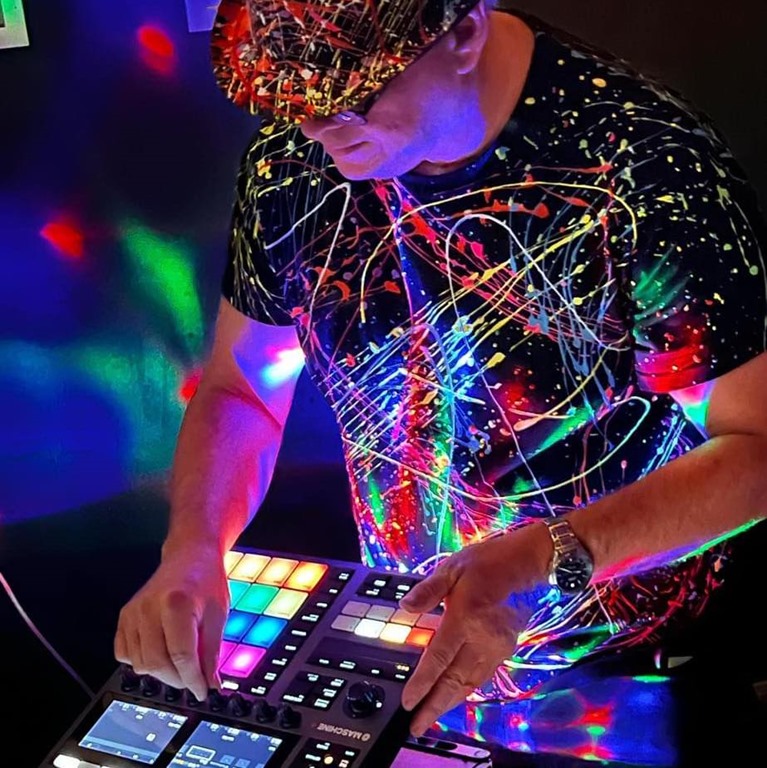
Mho – that’s ohm backwards, and pronounced ‘mo’ – is the musical vehicle of Dave Walker, who’s been a regular face at the EMOM scene, and has become established as being instantly recognisable for his stagewear, with neon-splatter t-shirt and hat. Obviously, these visual props don’t translate to the recordings, which must stand on their own merits – and they very much do.

Over the course of ten tracks, Walker showcases a broad span of styles and sounds, and the compositions are all accomplished and considered. As his bio states, he ‘began his foray into making electronic music at school when he built a Transcendent 2000 synthesiser and a ETI String Synth, as the Polymoog synth cost as much as a house back then’. He’s since switched to more contemporary kit, but his years of experience have led to a nuanced approach to musicmaking: there’s a lot of detail, but nothing’s overdone. Every drop, every time the beats bang back in, every layer, every stutter, every new sound and sample, is perfectly placed – but not in such a way that the precision leads to sterility. Walker’s tunes flow with a rare naturalness, and there are no jarring jolts or awkward lurches between segments.

Predominantly, these pieces are built around conventional piano sounds and broad strokes of synth which fill out broad spaces, and there’s a lot of analogue-style pulsations, too, cut from the cloth of Mike Oldfield and Tangerine Dream.

There’s something familiar that I just can’t quite place about the melody of ‘Nie Rozumiem’ (which will undoubtedly annoy me for days), and elsewhere, ‘Chorale’ brings ambience with low-key beats that washes along nicely, being largely undemanding but pleasant. ‘Eternal’ brings a hint of Eastern promise and a vaguely operatic vocal carried on a soft breeze of shuffling beats and rippling piano.

‘Contact’ and ‘Moon’ appear to be thematically linked, the former bursting with samples and laser-beam bleeps, and it does have quite an 80s feel to it. This, though, is true of much contemporary electronic music which isn’t overtly dance – or EDM and the encroaching Americanism would have it. The latter is a seven—minute sonic exploration that expands through time and space with crackling radio transmissions from the lunar landing of 69.

‘Take it Easy’ is pure 80s retro tootling melting into 90s euphoric trance, and while well-executed, it’s perhaps the least engaging or enticing tracks on the album, but it’s but a brief weakness in an otherwise solid album which concludes with the surprisingly light and accessible spin of ‘I Am With You’ which practically skips along.

With EMOM sets providing just ten to fifteen minutes for artists to showcase their style (these nights are absolutely bloody packed, to the point that despite being ‘open mic’, all slots are usually taken a full month in advance), it’s good to hear the full span of the elements which feature in an Mho set, and even better to hear that Mho has the material for not only a longer set, but a full album which is at once diverse and cohesive.

AA

333455632_2197845260603259_2646669291313228150_nmho1

Last month, Mat Ball (BIG | BRAVE) announced his first full-length solo album, Amplified Guitar, arriving on The Garrote on 1st July on all formats.

Today he shares the entrancing and moving video for second single, ‘To Catch Light III’. Filmed and edited by Joshua Ford at The Garrote HQ in Illinois using the most simple elements, this video presents a remarkable visual analogue to the economy and elegance of the music and provides an astounding physical account of the sound.

Having recently stood transfixed watching Ball wring notes from his guitar and similar setup while on touch with BIG | BRAVE, this video is both mesmerising and representative of that experience. Calling to mind the expansive guitar workouts of Dylan Carlson’s solo work, ‘To Catch Light III’ hints towards and album that’s rich, textured, immersive.

Watch the video here:

Recorded at Hotel2Tango by Godspeed’s Efrim Manuel Menuck, Ball performed each of these beautiful songs in a single take. Plucking, strumming, bowing, or just slowly moving an electric guitar of his own construction in front of an array of amps, Mat Ball managed to expertly coerce some very deeply moving music from very little. 

Additionally, Mat Ball shall release a book, Accidents (with orders via www.thegarrote.com and Bandcamp). Operating as a visual analog to the Amplified Guitar LP, the work in Mat Ball’s book Accidents is also based on chance: chance in discovery, chance in process, or chance in accidental results. Whether found at rest and documented in that natural/untouched state, or assembled/touched by Ball’s hand, the aleatoric element in each piece is vital. First edition limited to 100 copies.

cosmicimg-prod.services.web.outlook.com

Photo Credit: Stacy Lee

2nd November 2018

Christopher Nosnibor

Not so long ago, I began a review by saying I felt sorry for Jo Quail. That was no slight on her musical output, but an observation that as incredible performer, it seemed wrong that she should be put on so early that her set was a third of the way through before the doors even opened. On listening to Exsolve, my awe of her musicianship is greater than ever, which only renders the injustice worse. To get the point: this is an incredible album, a triumph of musicianship and vision in tandem to create something not only greater than the sum of the parts, but beyond imagination.

The accompanying press release informs us that Exsolve is comprised of three tracks, with each one being broken down in to sections and movements across 45 minutes. Mastered by James Griffiths, himself a film composer, there is, the blurb notes, an almost symphonic quality to the album. This is true, but there is so, so much more, much of which defies conventional description: it speaks not to the domain of words, but the psyche.

The bald facts are that Jo Quail plays cello, and does so through a raft of effects to create sounds a million light years removed from the cello, looping bangs on the mic to create thunderous percussion and conjuring eerie moans and grating tempests of sound. The result is pretty heavy, not to mention intense.

Eight minutes into ‘Forge of Two Forms’, Quail is conjuring blistering interweaving prog riffs against a swirling backdrop of noise and thumping beats. Epic doesn’t come close. It sounds like a full band pushing into new realms of enormity, and with a blistering distorted picked motif that sounds like a crisply-executed lead guitar line, it’s easy to forget just how this music is made. Twelve minutes in, it’s tapered down to nothing and actually sounds like subdued, low-tempo orchestral dronings, creeping atmospherics and melancholy. The transitions are seamless, invisible, but definite as the extended soundworks transition between segments.

‘Mandrel Cantus’ sends sonar echoes across low, slow ripples of mellow cadences, and somehow builds into a monumental emulation of a guitar solo of monumental proportions. How did this happen? From whence did this immense sound emerge?

Everything coalesces on the third and final composition, ‘Causleens Wheel’ which begins delicately, builds to a rolling, roiling, sustained crescendo. It’s a multi-faceted composition, tonally rich and also moving, not just by force but by expression.

Powerful, graceful, compelling and dramatic, Exsolve is a remarkable album of rare quality.

AA

Jo Quail - Exsolve

Young God Records – 28th April 2017

Christopher Nosnibor

The great Swans back catalogue reappraisal and re-release continues with a brace of albums from near the end of the band’s initial incarnation. The latest pairs Swans’ 1995 album The Great Annihilator with Gira’s simultaneous solo release, Drainland. 1995 was a fertile year: Jarboe also released Sacrificial Cake through Alternative Tentacles in the same year, in some respects mirroring the period eight years previous, when two different Skin albums – effectively Gia and Jarboe solo releases – appeared in 1987 and 1988 in near synchronicity with Swans’ pivotal Children of God. Indeed, while the ‘definitive’ reissue programme is both extremely welcome and is a genuine boon for Swans fans both new and old, it does highlight the complexity of the band’s back catalogue. Precisely which album sits with which is a question which will never find an easy resolution, but on balance, Gira and Young God have made a decent fist of presenting a cohesive and linear recataloguing of the band’s initial history.

The Swans album The Great Annihilator arrived some three years after the epic twin salvoes of Love of Life and White Light from the Mouth of Infinity, which had represented both an evolution and a return to form following The Burning World in 1989. And while The Great Annihilator clearly belonged to the same broad phase as its immediate predecessors, it also felt more focused and more intense. It also stands as a transitionary album, the last studio release before the immense, everything-through-the-wringer churning mash of Soundtracks for the Blind, at which point the first phase of Swans collapsed and terminated.

Soundtracks perhaps hinted at the direction the reincarnated Swans would take on their return, but lacks the immensity of the sound they would produce on their post-millennial return, and equally lacks the focus of The Great Annihilator, and in this context, it’s this album which stands as such a significant document of the band in the later years of their first phase. The 2002 reissue saw the album augmented with a six-minutelive recording of ‘I Am the Sun’, which is also included here. However, this version is more about presenting a ‘restored’ version, returning to the recently-excavated original tapes to deliver the album as intended.

Great Annihilator / Drainland (Remastered 2017) - PRE ORDER

By this point Gira had perfected the cavernous, monotone drone which is now his signature: emerging on Children of God and honed over the course of White Light and Love of Life, on The Great Annihilator and Drainland the dark, bleak detachment conveyed in that vocal is as terrifying as any of the growling, barking threats of violence contained on Filth and Cop. He may have sounded brutal in his rage on those releases, but here Gira affects a demeanour which is altogether calmer, and consequently all the more dangerous in its psychopathy. He no longer sounds like a tortured, tormented human soul: he sounds like he’s detached himself from humanity.

What makes The Great Annihilator such a strong album is its range, which is equalled by its force and its cinematic production, balancing slow, repetitive, hypnotic tracks with explosive, percussion driven compositions. As such, it’s a perfect encapsulation of the ugly / beautiful juxtaposition which characterises the Swans ethos. The raw, visceral Jarboe-led ‘Mother/Father’ is gruelling in its intensity and contrasts with the mesmeric ‘Killing for Company’ and the expansive, uplifting ‘Where Does a Body End?’ (which stand among some of my all-time favourite songs by Swans – although, if truth be told, in the scheme of their vast output, it would be easy to fill a double album with my favourite songs by Swans).

‘I Am the Sun’ shares common ground with previous percussion-led tracks like ‘Power and Sacrifice’ (which stand a world away from earlier percussion-led tracks as featured on their albums prior to Children of God, which very much marked a turning point for the band), but at the same time, offers the first hints of what the band would evolve to produce during their second, post-millennium phase. Elsewhere, ‘Mind/Body/Sound/Light’ and ‘Celebrity Lifestyle’ display a certain newfound commercialism (beyond the folk leanings of The Burning World), magnificently counterpointed by Gira’s monotone baritone drone. And who else could succeed with a line like ‘she’ just a drug addiction, a self-reflecting image of a narcotized mind’? ‘Alcohol the Seed’, meanwhile, is sparse, stark and harrowing, the direct, declarative lyrics standing at the point where art and life intersect to deliver maximum discomfort to the receiver. ‘Killing for Company’ is delicate yet beyond dark, a song which reflects Gira’s interest in serial killers and takes its title from Brian Masters’ 1993 biography of Dennis Nielsen.

Gira’s solo debut, Drainland, has always stood as a singular release, both stylistically and in overall terms of the Swans / Gira oeuvre. It also seems to be one of those releases which has been somewhat overlooked.

The first track, ‘You See Through Me’, which features a serrated, grating, oscillating drone and haunting piano provide the musical backdrop to a recording of Gira, drunk, nasty, arguing with his then-partner Jarboe over money and his alcohol problem. It’s one of those works which crosses a line that will never be readily acceptable, where art transgresses the boundaries of the personal and the public. This, of course, is art of the highest order, that demands the receiver face uncomfortable and painful realities. Simultaneously, Gira, in his capacity or artist, dismantles all sense of persona and lay himself bare in the most unfiltered way imaginable.

It paves the way for what is a difficult album on every level, as he trawls the darkest recesses of his psyche: the lyrics may not be as visceral as those contained on early Swans releases, but they’re every bit as gut-wrenching in their impact, not least of all because they’re so intensely personal.

Great Annihilator / Drainland (Remastered 2017) - PRE ORDER

It’s a dark, stark album, which makes for uncomfortable listening on many occasions: even the more overtly post-Children of God tracks, where Gira spins hypnotic, opiate-hazed acoustic strums, as on ‘Unreal’, it’s more nightmarish than dream-like. And then there are jarring, nauseatingly difficult loop-led nightmare dirges like ‘Fan Letter’. And yet, the album contains moments of true beauty. Songs like ‘Why I Ate My Wife’ (which again alludes to Gira’s serial killer fascination and also draws on, and shares its title with, a piece from 1993 which appeared in Gira’s book of collected prose, The Consumer (1994)), dark as they may be lyrically, are also truly magnificent, and as touching – and well-crafted – as anything Gira has done during his long career.

The mastering seems comparatively quiet, but that’s largely on account of the fact everything tends to be mastered so damn loud and so damn bright these days that much of the dynamic range is lost. The very purpose of this remaster is about audio fidelity and unravelling knots in the original processing. Sonically, this remaster feels richer, denser than the original releases, although it would take obsessive comparison and a lot of time to draw out all of the detail. Most importantly, this release makes two classic Swans / related albums (one being something of a lost or unsung classic at that) readily available once more, and on vinyl, too – The Great Annihilator has been commanding obscene prices on the second-hand market for a long time now, while Drainland was only released in the US packaged with Jarboe’s Sacrificial Cake and is again expensive and hard to come by: as such, it all adds up to an essential release.

Hallow Ground – HG1605 – 1st June 2016

Christopher Nosnibor

While MRI, released by Room40 in February, was a reissue of a 2012 album, The All Most Quiet contains new material in the shape of two long-form tracks. Like its predecessor, The All Most Quiet is radically different from his contributions to Swans. The fact he’s actually found the time to compose and record new material is impressive in itself: the latest Swans album, The Glowing Man was released on 10 June, and the two-hour colossus of a sonic experience was developed and recorded off the back of a full year spent touring its predecessor, To Be Kind. Given the duration and intensity of a Swans live show, it’s remarkable that Norman Westberg’s had time to piss and still has the energy to stand, let along record a new album. But then, perhaps his solo work has therapeutic benefits, and affords him the opportunity to decompress after long days spent in the Swans pressure-cooker.

The All Most Quiet is, as the title suggests, not a loud album. It is also a gentle album. But that doesn’t mean it lacks dynamic tension, and while it is calming, it’s also not completely undemanding.

The title track starts its long, meandering journey as a mid-range drone which pulsates subtly. The tonal changes which emerge are gradual. It’s easy to let it simply drift by, and it’s pleasant enough to appreciate in this way, but attentive listening brings its rewards. The introduction of new layers, textures and tones, shifts in the scale and pace of oscillations change the mood, subtly, inconspicuously, but no less definitely. And while The All Most Quiet bears no obvious resemblance to Swans, it is possible to hear a certain correlation in the way Westberg builds on slow-burning transitions to hypnotic effect. There are hints of ominousness and darkness, but the sense of scale and grandeur seeps through the very fabric of the sound. The second track, ‘Sound 2’ maintains the atmosphere, and the absence of any clear highs or lows builds a tension beneath the calm surface.

The All Most Quiet once again highlights the trait I most admire in Norman Westberg’s approach to guitar laying: patience. No heroics. No sense of the ego common to guitar layers. His playing is focused on achieving texture and an overall listening experience. Whether he’s peeling off shards of noise, as on early Swans’ releases or creating more sculpted sound, as on their later releases, and in his solo recordings, at no point dos one ever find oneself thinking ‘what fretwork! What guitar wizardry!’ In fact, much of the time, Westberg’s guitar doesn’t sound like a guitar, particularly on The All Most Quiet. And for the most part, the sound is too immersive for one to really think at all.


Norman Westberg - The All Most Quiet


Norman Westberg Online