Posts Tagged ‘Room40’

Room40 – 30th June 2023

Christopher Nosnibor

There is no quick way to consider this album. And for many reasons – the first being that it needs to be heard in its entirety before being able to summarise and pass critical comment. The second being that after hearing it, one needs to drag themselves from the wreckage of their psyche and process an experience that is likely akin to a week being subjected to psychological experiments at the hands of the CIA under MK Ultra. Brace yourself…

As his bio points out, ‘Tony Buck is no stranger to the realm of durational performance and composition. As a part of Australian unit The Necks he has been central to defining a reductive, but rich sound language that equally interrogates timbre and time…[and] with Environmental Studies he moves even further into these longitudinal pursuits.’

Longitudinal is one word to describe this album. It’s a single, continuous piece, some two hours in duration, and while there are a couple of five-minute excerpts designed to give potential listeners an indication of what it’s like, it’s simply impossible to convey the experience in snippets. The snippets are lifted from the album’s lighter moments: that doesn’t mean they’re mellow, melodic, but the multi-layered clattering percussion that’s evocative of some kind of space-jungle and brief segment of avant-jazz feedback is nothing in the wider context. And – as I always say – context counts.

While chart music – geared toward snappy three-minute cuts which are 90% chorus – and the inclusion of streams when compiling charts, has effectively killed the album in the mainstream, further afield (and to be fair, you can’t get much further afield than this), the album is still very much a cherished format for both artists and listeners alike. In fact, it’s interesting to observe the rise of the really long album. I will often harp on about Swans releases from the last decade, but they’re not isolated. Frank Rothkkaramm released an album as a 24-hour CD box set – which couldn’t be much more different from Throbbing Gristle’s 24 hours box – as he explored sounds which helped with his tinnitus. Numerous doom, drone, and ambient albums in recent years have really pushed the parameters of an album thanks to digital releases not being subject to the same limitations of physical formats – or the same production costs. Is the medium the message? Perhaps, at least to an extent.

The recorded medium was always an issue: even going back to the height of the classical era, once recording became possible, the media limited what could be released, meaning to hear a full performance of, say, Handel’s Messiah, you had to be there, since even a recording which required a box-set album release required truncation. It also, of course, required the turning of records and the segmentation of the work.

In its day, Earth’s groundbreaking Earth 2 challenged the conventional notion the ‘the album’ – more even than any monster prog releases like Yes’ eighty-one minute Tales from Topographic Oceans and the two-hour plus, sprawling triple YesSongs. Because what differentiates these is the fact that Yes was a lot of noodling wank, while Earth did something different, with a specific desired effect intended, and its duration was in fact integral to its cumulative effect, namely that of a sonic blanket of suffocation. Anyway: the point is that Environmental Studies is an absolutely immense album, and it’s a work that needs to be heard as an album. You may find yourself drifting in and out, but it feels as if this is part of the experience: better to drift than experience in fragments.

The accompanying notes describe Environmental Studies as ‘An incredibly dense matrix of interwoven voices and layers, each occupying and exploiting a unique space within the fabric of the sound-environment, co-existing to slowly reveal themselves in multiple interconnected relationships.’

Immediately from the start, the listener is assailed by a deluge of discord and dissonance and streams of noise. It gradually drifts through an ever-evolving, eternally-shifting journey, where mellow jazz piano and slow-melting notes emerge and drip slowly over cascading cymbals and an infinite array of extraneous sounds which wash in and out. There are passages of supple, strummed acoustic guitar – which get harder and more challenging at times but also explore mellow passages –– and gurgling extraneous nose, straining, clattering. There are sections which so tense, straining and submerged by noise that as feedback twists and turns and groans and hums, that the enormity of Environmental Studies finally hits.

There are infinite layers of percussion rattling shakes and clangerous curiousness, with errant twangs and all kinds of shades of strange, with dingy distortion crashing in heavy amidst the a maelstrom of noise that sounds like a hundred pianos being thrown down a hundred flights of stairs at the same time while someone in the top floor flat blasts a Sunn O))) album at wall-cracking volume and there’s a fire broken out in the basement and it’s rapidly escalating upwards.

An hour in, we’re in sonic purgatory – and it’s absolutely magnificent. The polytonal percussion builds and builds; industrial, tribal, everything all at once, with sonorous drones and crushing distortion and noise and wailing feedback whistling and screaming all the while, it’s a relentless barrage of sound – but not noise, and that’s an important distinction here. There are noises, and they’re collaged into something immense, with the rattling of cages and furious beating of skins.

When it does simmer down, some time further in, we find ourselves in an alien landscape, that’s strangely spacey and tense before the next round of percussion barrels in. Environmental Studies is big on beats, but not all of the beats are big: insectoid skittering and scratchy flickers are as integral to the complex interweaving as the thunderous floor toms and reverberating timpanis, and everything melts together to weave a thick sonic tapestry.

While there is nothing about Environmental Studies which is overtly heavy in the conventional sense, to immerse yourself in the album is an exhausting experience, both physically and mentally. But if art doesn’t challenge, what is it for? It’s merely entertainment. This is not entertainment. But it is an incredible work of art.

AA

a1038790420_10

Room40 – 14th March 2023

Christopher Nosnibor

You might describe this as a ‘technical’ album. I certainly would. Because much as it’s constructed using field records, the methodology behind it is, quite simply, not that straightforward straightforward. It’s not a guy with a mic wandering around capturing sounds from spaces, that’s for certain.

The accompanying notes explain that ‘Atmospheres and Disturbances registers the changes in high altitude ecologies caused by increasing global temperatures. The composition is based on field work undertaken at the High-Altitude Research Station at Jungfraujoch, Switzerland where for four weeks I deployed various recording devices around the station, and in the surrounding alpine environment to register natural, anthropogenic and geophysical forces. The project provides new encounters of an endangered alpine environment to enhance the way we perceive and engage with notions of place, community, and environmental dissonance.’

This, then, isn’t simple field recording, but environmental work, and the five pieces capture different aspects of environmental and ecological conditions. You may shrug and say ‘meh, weather’, but Atmospheres and Disturbances really captures just how affecting these are on our everyday existence.

It’s a perpetual joke that it’s the favourite topic of conversation for the British, but the fact is, meteorological conditions rule human lives; all agriculture is centred around the weather, our ability to travel is dictated by it. Tell me your mood isn’t affected by it.

Atmospheres and Disturbances is, then, very much a mood album, among other things.

For the most part, the fifteen minute ‘Wind’ which opens the album is subtle and simple, a recording of gusts as they rustle and buffet. It’s a relentless turbulence, a roar like a rough ocean, and it fills your ears and crowds your mind. While a windy day can be an annoyance or a source of irritation, there is always an element – no pun intended – of threat when it comes to winds, of damage even devastation. Around nine minutes in, things are building in volume and force, and it sounds like a barrelling blast hammering at a corrugated iron roof, rain, snapping twigs, and the tension is high as a storm rages. There’s something – not unreasonably – rooted deep in our psyche that finds storms a source of fear or excitement, or a combination of thew two, like a horror movie. Listening to this track, it’s all in there.

‘Stations’ begins with a gurgling trickle of water before a low00flying plane engine sound obliterates it, and cracks and thuds and slams coalesce to create a percussive force amidst fizzing electronic crackles and pops. Metallic crashes call to mind Einstürzende Neubauten, before more dense noise begins to blast and we’re dragged into a mechanical drone, the throbbing heart of the generators and mechanics of the station itself.

The remaining tracks are shorter – less than eight minutes apiece – but are darkly dense, blurring nature and machinery into a droning discomfiture. ‘Melt’ sounds very like the beginning of ‘Stations; but with additional disruptions and disturbances, thunderous roars and torrential rain. And, of course, one can’t help but feel that this is the literal soundtrack to global climate change, and with this comes a further reminder that we are, indeed, doomed.

I don’t say this for drama or hyperbole. It does seem to be pretty much established now: it’s simply a question of how quickly Venice will be sunk and the sea will swallow half of Britain.

It’s likely not Philip Samartzis’ intention that my mood should plummet as the album progresses. There is a sense that for all of its industrial bleakness and whirring machines and roaring engines and howling precipitation, Atmospheres and Disturbances is designed primarily as a documentary work, but, in context, it’s a documentary with a message.

As gusts roar through ‘valley’ in the wake of cracking thunder and drag chanking notes in its wake, the lingering experience is one of disquiet and discomfort.

AA

RM4202_front

Room40 – 2nd September 2022

Christopher Nosnibor

It’s a sign of the times that this is being released only as a download: labels – especially niche labels like Room 40 – know their audience and know their budget. The time has now passed when a connection with a label with ensure a physical release, and theres something sad about this. Still, better a virtual release with a label’s backing than no release and / or no label backing, and ROOM40 have some respect in their field.

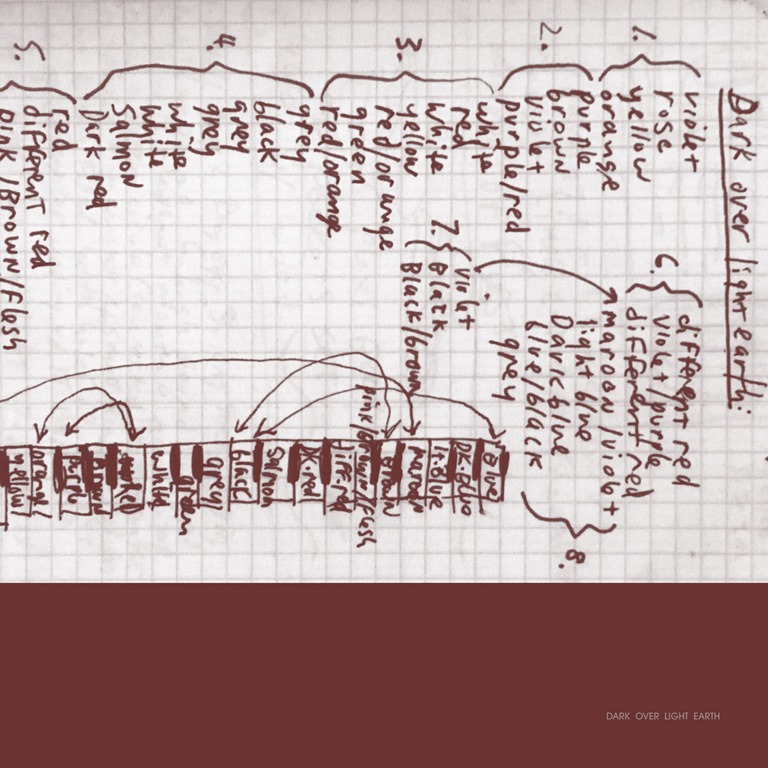
Dark Over Light Earth is very much a release that highlights the intersection of different media, specifically visual art and music. As Steve Roden explains of the album’s origins, ‘dark over light earth was created for the final weekend of the exhibition moca’s mark rothko, which featured 8 rothko paintings from the museum of contemporary art los angeles’s permanent collection… i initially made a list of every color in each of the 8 paintings, to generate a score. i recorded myself playing the score on harmonium and glockenspiel – the notes and their order pre-determined by my color notations; and the tempo, duration, and overall feel, improvised. some of these recordings were then processed electronically with filters.’

It’s fair to say, then, that this is a quite specific, technical, and theory-based work, and it’s not immensely accessible either. Granted, it features violin and amorphous synth drone, both of which are fairly familiar aspects of contemporary experimental music, and there are moments which are genuinely magical, and musical, as they skip from here to there with a lightness and ease that’s magnificent.

But so much of the album – which consists of a single track with a running time of nearly thirty-five minutes – is discordant, difficult, atonal, and it’s hard to get a handle on. The individual elements are comparatively tuneful, but when placed together… Picked dissonance flits over dolorous droning synths and mournful strings – the violin so often sounds sad, but all the sadder when it scrapes sinuously, against the note, against the grain.

The sparser passages are minimal to the max; stuttering scrapes and picked notes forge tension against not drones, but tense scrapes and scratches while notes drape in fatigue across the rough and barren soundscapes.

Listening to Dark Over Light Earth prompts me to revisit not only Rothko’s catalogue, but his biography, which reminds me that he committed suicide at the age of 66. So much is made of the ‘27’ club, that the suicide rate among older people, particularly artists, tends to be overlooked. Hunter S. Thompson, age 67; Ernest Hemingway, age 61; Robin Williams, age 63; Tony Hancock, age 44: it’s all to easy to bracket the psychology of suicide as an affliction oof young males, but this masks the broader issue.

Just as there is nothing in Rothko’s work which indicated darker underlying issues, so Dark Over Light Earth isn’t anywhere near as dark as all that; it’s simply a work of quiet, but troubled, contemplation.

It is, unquestionably, a fitting soundtrack to accompany the viewing of Mark Rothko’s work abstract, overheated, yet austere, simple yet confrontational in their stark minimalism, and in that capacity, it’s magnificently realised.

AA

a3413973115_10

ROOM40 – June 2022

Christopher Nosnibor

I feel like I’ m forever playing catchup. The simple fact is, there are more new releases – and remarkably good ones at that – than there are hours in the day to listen to them all. I can’t bee the only one who sees friends on FaceBook posting about how they’re loving the new album by X, Y. and Z, and who gets asked if they’ve head / what they think to this, that, or the other and wonder ‘how the hell do you actually listen to all this?’ These people must listen to music 24/7 and possess three pairs of ears by which to listen to all of this music simultaneously, or something.

Admittedly, it doesn’t help that my dayjob doesn’t really afford much opportunity for listening while I work, so I really only have a spell while cooking dinner, and evening, which, after everything else, tend to start around 10pm.

And so, presented with anything up to thirty new releases a day in my inbox, I simply can’t listen to everything, and I deeply envy those who can, and seemingly do.

One particular source of guilt, for wont of a better word, is my inability to keep up with ROOM40 releases. They may only be number three or four a months, but they’re invariably interesting, exploratory, intriguing. And tend to warrant for more detailed analysis than I can reasonably offer. Hence a summarising catch-up for the label’s June releases, on the day July’s have just landed with me.

Alberto Boccardi’s Petra (released on tape) is a comparatively short album of intense electronic drones: consisting of just five tracks spanning around thirty-two minutes, is sparse, ominous, sonorous, predominantly mid-range but with some stealthy bass and sonorous, trilling organs. Recorded over several years and partly inspired and assembled while Boccardi was resident in Cairo, it’s both chilling and soporific, it’s an intriguing minimal work.

RM4165_front

Blue Waves, Green Waves by Alexandra Spence isn’t receiving a physical release, and is an altogether different proposition. As the tile suggests, the ocean provides the primary inspiration, and sure enough, it begins with the sound of crashing waves, but this soon recedes to the background, while analogue organ sounds ebb and flow as the backdrop to low-key spoken word pieces. Noters drip and drop and hover in suspension like droplets of water hanging from leaves before their inevitable yielding to gravity, sliding off and into a puddle. ‘Air Pockets’ sloshes and sploshes, reverberating against empty plastic pipes. The flatness of sound and the shifting of tones as they bubble and sploosh is the aural equivalent of close reading, interrogating a source to microcosmic levels.

DRM4143_art

‘All intensive purposes’ is one of those (many) misspeaks that drive me fucking crackers. And this release by there inexplicably—monikered ‘Pinkcourtesyphone’ is an album likely to frustrate and bend the brain, albeit for different reasons. With the exception of the final mid-album interlude, ‘Out of an Abundance’, these are darkly mellifluous drones that stretch well beyond the five-minute mark, and ebb and flow slowly amidst rumbles and reverberating snippets of conversation and radio. The mood is tense, unsettling; not creepy, so much as just uncomfortable, spine-tingling, ominous, and at times, other-wordly.

BW RM#4188_pinkcourtesyphone_sleeve_final

Some will likely find something in one or another of these, while others will doubtless find all three of these releases to be of interest and collectively, they do very much provide a broad, wide-ranging view of matters experimental and ambient, presenting different perspectives of found sound and field recording. It’s credit to ROOM40 for giving space to these artists, and showcasing such a range of music from within what may, on the surface, appear a narrow field, and demonstrating otherwise.

Room40 – 14th January 2022

I know I’m not alone in experiencing the sensation that large parts of my life have been spent wading through treacle. It may be something of a cliché, but it’s a valuable simile for that slow struggle.

Although these are the associations circulating sluggishly in my mind, they have no bearing on the origins of the album’s title, which is, as Cooper himself explains, ‘a soundtrack for an otherwise silent film. The title of the album, and of course the film, is borrowed from my late friend Fred Hardy’s book The Religious Culture of India – Power, Love and Wisdom, considered to be one of the most important books on the subject. In this book Fred wrote,

“In 1835 the historian Macaulay investigated whether there was anything in the traditional Indian systems of learning and education that could be used in the training of native personnel. In fairness to Mr Macaulay, we must remember that those were days long before the writings of a Tolkien or a Mervyn Peake. He came to the devastating conclusion that people who believe in oceans of milk and treacle had nothing to offer to a modern system of education. A straightforward, realistic assessment in an age that believed in science and realism! The effects were far-reaching. Traditional Indian ways of looking at the world were written off as obsolete. India was provided with three universities (Calcutta, Bombay and Madras, founded in 1857) as the hothouses to nurture a custom[1]built, English-speaking Indian intelligentsia. A new age began for India, and two of its inevitable consequences were the demand for independence and the production of atomic bombs and satellites by the post-independent Bhārat.”

This places Oceans of Milk and Treacle in an altogether more academic context, and perhaps, if only a shade, this knowledge does colour my appreciation of the work specifically, an album consisting of nine compositions.

The pieces themselves present a collaged array of sounds, from distant rumbles and clanging hammers, to wind-chimes and static crackles. The clanking windchimes and eerie vocal moans and bleats, which drift amidst a breaking storm on the first piece, ‘A Chart of the Wet Blue Yonder’ contrive to create something quite sinister, and a significant contrast from the playful Jazz frivolities of ‘Boogie Boards and Beach Rubbish’. Oceans of Milk and Treacle is very much an album of contrasts and of strange sounds, combining chillout grooves and collaged field sounds and weirdness, often simultaneously.

It’s one of those albums that packs in so much, it transcends definition or categorisation, for better and worse – because genre distinctions tend to be lazy marketing pitches, and music – or any other artistic medium – should just be. Why can’t a book simply be a book or a story? Why does I have to be crime fiction, a thriller, sci-fi, or otherwise tossed into the netherworld of literary fiction or speculative fiction? And so why can’t an album simply be an oddball amalgamation of all sorts and simply be an album? Electric guitar and Moogs or something tinkle around while something electronic happens in the background to fill the space like crickets scratching, but clearly actually something less natural in origin on the warping, bending array of almost-pleasantness of ‘Tirta Gangga’, a woozy collision of sedated bleeps and chimes that sounds like it’s nodding off near the end – and it’s not an unpleasant experience.

The title tracks goes deeper into jazz territory, but there’s trilling analogue noise humming in the background, and it nags away at the peripheral sense, while on ‘Mono-Hydra’, amidst tweeting birdsong, the musical elements sound warped., bent, as if the tape is stretched and the notes spin off their spindles to spin into strangeness. ‘Under Vertical Sunlight’ brings hectic percussion to the fore, amidst drones and groans, before drifting into abstraction on ‘Toward Great Piles of Masonry’, which sounds like a wander down a city street while the clubs are still open.

Oceans of Milk and Treacle isn’t really a journey, but then what is it? A meandering sonic amble through a succession of sonic spaces and a range of scenarios? Possibly. Whatever it s it’s interesting, and devoid of genre conventions.

AA

a0586186042_10

Room40 – 14th January 2022

Christopher Nosnibor

One of the many wonderful things about music is that it has no limits, and no constraints. There is music to be found in anything and everything, and music can be made my anyone, anywhere, anytime, with anything, or even nothing. Steve Roden’s choice of instrumentation on Oionos is noteworthy for being quite unconventional, as he explains: ‘The audio was built from field recordings and small “poor” objects such as tin whistles, toy harmonicas, and the like. These “instruments” suggested by the museum of musical instruments in Athens, where the proper instruments take up most of the museum, but there is a wonderful display case in the basement with musical toys, religious objects, and other sounding devices not considered musical instruments.’ These instruments and objects combine to conjure a magical, mystical soundscape with overtly musical sounds contrasting with less overtly musical sounds and woven together to create something that occupies a unique sonic space.

In popular western culture, we’ve come to understand only the narrowest of definitions of music, which for many is represented by an album consisting of a number of ‘songs’, bite-size pierces which are tightly structured and subject to conforming to certain parameters, including rhythm, and suchlike. Even many ambient works, which delineate many of those mainstream conventions, are created within limitations; these are compositional factors, imposed by the creators, rather than being significant of true musical limits.

With Oionos, Steve Roden frees the music, presenting a single, continuous piece with a running time of one hour, one minute, and fifty-five seconds. Time was when the CD format placed a time constraint of seventy-two minutes on a release, but technology has evolved, and the duration of this piece feels entirely natural, as if the music has run its course to a satisfying conclusion by the close.

The composition is, in many respects less concerned with time, than with place. As Roden writes on the album ‘Oionos was created for the exhibition The Grand Promenade, in Athens, Greece. The exhibition took place in various archaeological and historical sites in central Athens, creating a situation for contemporary site specific works to be in dialogue with their historical surroundings.’

Although the location was integral to the album’s inspiration, it’s less integral to the listening experience when taken out of the context, and the music featured is, if not necessarily ambient in the most conventional sense, it is very much abstract, and also very much background sounds rather than music one actively listens to. But zoning in and out is a pleasurable experience, which perhaps serves to highlight the multifaceted nature of the sounds. Metallophone-like notes chime and ring, seemingly with an almost random notations and the loosest of rhythms, against a backdrop of scrapes and drones, while sounds like wind gusts and lapping water fill the space in the background. While the different elements conglomerate throughout, by half-listening, one finds oneself becoming aware of them individually at different times, and you find yourself experiencing the recording differently at different times as you tune into and become aware of the different sounds, textures, and tones.

As a whole, Oionos feels like something living and breathing, as if the sounds in combination have taken on a life of their own – and in many senses, they have, and they merge together to form a shifting, pulsating whole. It’s unfamiliar, but not eerie despite its otherness; there is a certain calm that radiates throughout the duration.

AA

a2445050686_10

Room40 – 3rd September 2021

Christopher Nosnibor

This is a work that connects the event with the memory of the event, and exists in the space in between the actual and the recollection – and specifically, those things forgotten .

The material was recorded when David Toop and Akio Suzuki visited Australia, where Lawrence English resides, back in 2013. The pair engaged in creating a site-specific work during a residency on Tamborine Mountain, and were joined by Lawrence during the project. The release is accompanied by a book containing text written by Toop at the time documenting the visit.

And English writers, ‘Going back to listen again to these recordings of which I was a part with David and Akio, I was surprised by what elements had stayed with me and what others had slipped into the eternal greying of my mind. I have vivid recollections of listening to a Lyre bird before recording the pieces together at Witches Falls. I remember both Akio and David finding musicality in decaying palm fronds. I remember Akio’s voice, amplified through his Analpos, bouncing off the stones and trees. I remember David’s flute, so quiet in the pitch black of the night forest as to appear like a hushed tone of wind or a distant animal calling. I also remember trying to match my modest hand held electronics with the pulsing and pitching of the insects around me.’

Memory fades and distorts over time; but then again, is Toop’s contemporaneous document entirely factual and without bias? Nothing here now but the recordings… surely we can at least trust the recordings to be pure in their capturing of the event? Of course not: there are no facts, only representations, fragments. Everything is subject to some form of filter, and eyewitness accounts to crimes are notoriously unreliable, even immediately after the fact.

The album contains six tracks, each one a collage of sounds captured in and extracted from their environment to exist in distilled detachment in recording. Context counts, and while the drips and trickles, gurgles and chirps all sound familiar in a ‘natural’ setting, when set apart, things become less clear. You see, with the sounds of othjer / unidentifianblee origin blended in, it’s difficult to determine the origins of any of the individual sounds and they twist and blur together.

It sounds like running rivers and splashing waterfalls, merged with extraneous sounds doused in heavy echo. It sounds like finger-drums. It sounds like chattering primates, agitated parakeets. It sounds like barks and grunts and yammers, reverberating into the humidity. Amidst the drift of the breeze on ‘Night Drive’ a springing sound arrives as if from nowhere. It’s one of those cartoonish, novelty spring sounds. Surely it wasn’t in the original recording? There are strains of awkward, infiltered feedback, notes of a flute trilling and warbling without musical focus, as the notes yodel and wobble, or otherwise simply waver as quavering notes trailing in the air.

Ominous drones hover and hum, tweets hover and howl out into the air. There are extensive passages where there is little of note – that is to say, not lonely little remarkable, but few notes to speak of – and sparse sounds buzz and drawl seemingly endlessly, like the agitated bee sound that vibrates hard during ‘Small Holes in the Sky’. ‘Leaving No Trace’ again sounds like running water and returns to the sounds of wildlife and the jungle.

Set adrift, and with only the sounds to interact with, the listener finds their own memory triggered, perhaps first and foremost by sound association, having no likely connection with the location where the recordings took place. Just as distance in time leads to a slow decay, so layering if interpretation and association also diminish the link to the actual event, leaving only thoughts on thoughts.

A handful or sharp, trilling noises penetrate the bibbling babble, and then there is a stillness, and having awoken in Autumn, as night has fallen, it is indeed Winter already. Breathing Spirit Forms is a quite remarkable document – not of the actual event, but of something approximating it.

AA

a0762176011_10

Room40 – RM4143 – 9th July 2021

Christopher Nosnibor

This cassette release’s liner notes are prefaced with an epigraph from Fredric Jameson, one of the preeminent writers on postmodern theory. It reads, ‘It is easier to imagine the end of the world than it is to imagine the end of capitalism.’

One of the most profound things about Jameson’s writing is that much of it seems more true and more relevant now, than when it was first published. Postmodernism, or, The Cultural Logic of Late Capitalism appeared in 1991, with the rather more succinct The Cultural Turn, which collected his writings on postmodernism form 1983-1998 distilling his critique of the era. The present feels like postmodernism on steroids, a relentless blizzard of media, technology and consumption progressing at a pace that evolution simply has no hope of keeping abreast of. The worst spins ever faster, but our bodies and brains aren’t equipped for the environment we’ve created. And it’s capitalism that drives much of the pace, perpetually reinventing, recreating, reselling to milk the market dry. And any suggestion that the pandemic would cause a rethink is already proving to have bene but wishful thinking. Capitalism has made off the situation, even when high-street retail and hospitality has been dying, and now the race is on to get everyone back to work, back to the office, and to supply those ever-growing demands.

This, then, is part of the context for Robert Gerard Pietrusko’s new album, and the press release provides a more granular and specific level of context, explaining how ‘On Elegyia, Robert Gerard Pietrusko reflects on notions of accumulation and decay, calling specifically on his memories of the demise of the Soviet Union. The sudden collapse of the USSR shocked the world and in that moment came an intense and wholesale reveal, that spoke to the impermanence of all political and social structures, no matter how fixed they might appear. Using this as a compositional metaphor, Pietrusko creates an edition of muted sonics, rich saturation and submerged low energies.’

The album and the compositions it contains are highly structured, ‘based on five piano motifs that are repeated with constant variation and extrapolation across the album’s nine tracks. In structure, harmony, and timbre each piece attempts to capture the contradictory condition of a macro-level stasis versus a tumultuous interior, rigorous movement but no progression, and a threat of its own undoing’.

Indeed, the greatest threat to capitalism is always capitalism itself, and it’s the endless recycling and regurgitation of ideas that keeps it alive: each revival is a reimagining of the past that exploits the ache of nostalgia, which grows ever stronger the worse the present becomes.

And so it is that Elegyia mourns the passing of the past through its subtly-sequenced movements of droning ambience and slow-turning mellifluous aural abstractions. The nine-minute ‘Perishing Red Skies’ sets the tone and is formed from slow-turning waves and the most gradual of movements. The motifs are often buried beneath broad washes of sound, and twist and warp further out of shape as the album progresses – but they are, breaking through the waves, at times discernible, bobbing around in eddying flows. Sometimes, the feel is quite light-hearted – but then, at others, it feels vaguely threatening, while at others simply contemplative. How I miss those periods of quiet introspection, before work, family, and simply life took over.

Dark clouds build on the two-parts of ‘The Lost Seasons’, the second occupied by a stammering oscillation of slow disruption to a smooth, soft surface. It’s soothing, but is it real? Postmodernism is all about surface, about deception, about appearance, and so one must inevitably ask how much of Elegyia is art, and how much is artifice? take the sepiatone cover image. It’s an evocation of a bygone age – but it’s simply a shortcut, a signifier – rather than the signified.

And these are the questions to ponder as you cast away on the drift, and without expending too much energy on what lies beneath the surface.

Elegyia is a delicate and finely-balanced work, with expansive sweeps and fine detail coexisting, layering atop of one another, reforging its own reality in the moment.

AA

Print

Room40 – 11th September 2020

Christopher Nosnibor

I struggle to keep up with the influx of material I’m sent for review, and have done for at least the last 8 years, which may or may not be coincidental with a) becoming a parent b) rapidly developing a massive network or PR and band contacts. It turns out that there comes a point when you don’t need to ask to be added to mailing lists, and people just find you. Anyway. Sometimes I just struggle, but that’s a whole other matter.

Apparition Paintings is a collection of oddly disjointed compositions that alternately soothe and trip the listener, moving between mellow melodies and rippling calmness – ‘All I Desire’ is a slow melt of chillwave, electronic post-rock and Disintegration-era Cure – and eerie weirdness – ‘When I first came here (I thought I’d never get used to the trains; now when it’s quiet I get nervous)’ is part chamber-pop, part deranged spookiness. None of this sits comfortably, in any context, and the deeper one delves into the eerie collage work that is Apparition Paintings, the more unsettling it becomes.

Toop’s notes which accompany the release are as disjointed and confounding as the music they accompany: ‘Don’t ask me about genre or consistency. Who cares? Half the world is drowning; the other half is in flames. Each story is an animal, a plant, something you drink, a surface you touch, a faint line, some memory emanating from a cardboard box. “’Things’ in themselves are only events that for a while are monotonous,” wrote Carlo Rovelli in The Order of Time. Maybe sounds are melting ‘things’, tired of the monotonous real.’

Yet on a certain level it makes sense. In a post-Covid world. The monotonous real is the lived experience of the everyday for many – not that it wasn’t before, but now, without the commute, without being in proximity to the volatile colleague, the explosive tension or the whatever, the monotonous real is confined to the household and to within the head. It may not be immediately apparent, but Apparition Paintings is a sort of inside soundtrack of the now, with extraneous and unexpected noises pinging back and firth across the main sonic backdrops to each piece.

‘She fell asleep somewhere outside the world’ finds a disembodied female voice singing a quavering melody, hesitantly. It’s a popular trope, but the deranged, childlike singing against a spooky backdrop is an effective trigger for cognitive dissonance. Apparition Paintings is an album that very much speaks to the sounds of the interior.

AA

a2399192845_10

Room40 – DRM475 – 24th July 2020

Christopher Nosnibor

In one of a brace of releases on Lawrence English’s Room 40 label in July, Australian minimalist Todd Anderson-Kunert presents a selection of Moog synthesiser compositions, which we learn are ‘exercises in intimacy, restraint and unerring patience. Past Walls And Windows plays with how sound emerges and decays. It is an edition that celebrates the ephemeral nature of the medium and the way sound’s immateriality invites a constant sensing and seeking on behalf of those that encounter it’.

These are indeed minimal works, so sparse at times as to be barely audible, and they’re a long way from presenting any sounds conventionally associated with the vintage Moog. Instead of jangly, trilling tones, Anderson-Kunert teases hovering single notes that evoke a sombre, even funeral atmosphere for the most part. There are flittering oscillaations and low, diminishing drones, and they make up much of the fabric of this set, comprising six pieces, most of which sit over the five-minute mark.

It’s quiet and delicate: ‘Better Left’ begins with distant grumbles of thunder, before low ominous notes drone in and halt abruptly, while ‘An Echo’ brings slow pulsations and haunting drones like a trilling church organ ringing out dolorous notes in a sepulchral setting. It’s gloomy, and it’s ambient in the background sense, yet it has the capacity to send the listener inside themselves on a contemplative course.

It’s no criticism to remark that there isn’t a lot to say: this is an album that requires not commentary, but peace, and time: to be listened to without interruption or distraction, and ideally in semi-darkness. It isn’t an album that really raises questions, and it doesn’t offer answers: it simply is. An as a sonic vehicle for contemplation and tranquillity, it’s ideal.

DRM475_art