Posts Tagged ‘Panurus Productions’

Panurus Productions – 20th June 2025

Christopher Nosnibor

You’d think that cassette labels would be not only niche, but few and far between, and in the main, they are, but Newcastle is home to not one, but two labels who provide a near-endless supply of releases to satiate the need for weird shit the world over, with Cruel Nature Records being one, and Panurus Productions being the other. The labels have a considerable amount in common, too, not least of all in that they both favour music that’s of a quality, rather than a style.

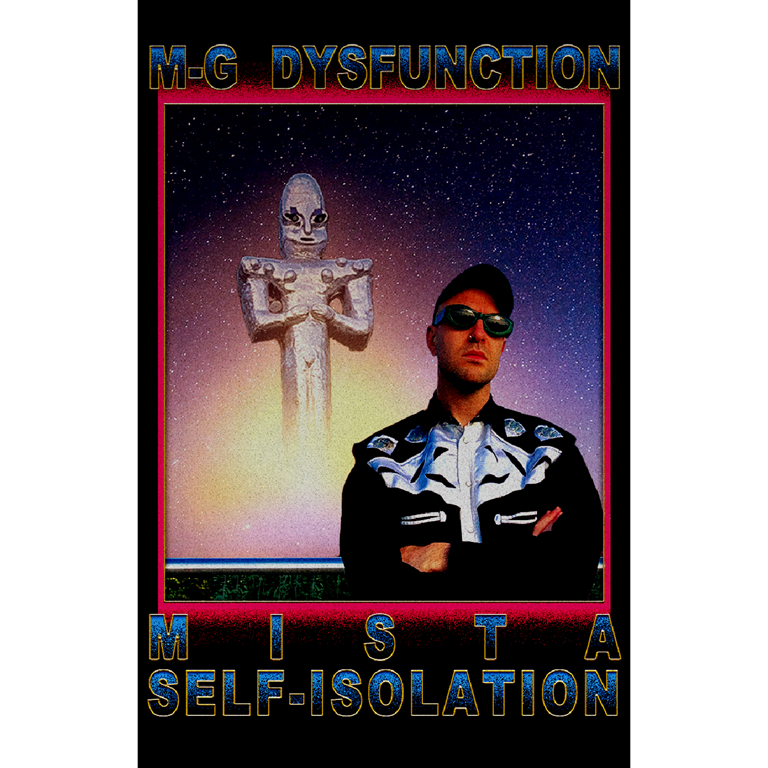
The latest Panurus release is a perfect case in point. The label’s previous offering, a split release from Belk and Casing was a raw blast of guitar overdrive. In contrast, the third album from M-G Dysfunction is of an altogether more experimental bent, leaning toward hip-hop and beat-driven electronics, but once again marking the close connection between the scenes in Leeds and Newcastle, both of which have become significant spawning grounds for the offbeat, the difficult, the wilfully obscure.

According to the blurb, ‘Mista Self-Isolation is the fullest realisation of the M-G Dysfunction project to date – a record of trepidation and humour, of lopsided passion and warped poetics. This album is about surveying the wreckage of monoculture and navigating the act of making music amidst a land-grab of rights, melodies and rhythms by people who never liked music in the first place. It’s about properly honest artistic expression – what “keeping it real” looks like, sounds like, feels like in 2024. It’s about getting some official beats and saying fly shit over them.’

That it’s quirky may be obvious, but it’s a necessary headline observation. On the one hand, it’s white rap, so there’s an awkwardness, but on the other, there’s some dirty experimental electronic noise layered over the beats, and this is an act that shared a stage with Benefits, a band who may have made their reputation by being angry, shouty, and noisy, but who aren’t without humour or an appreciation of nuance.

As tracks like ‘Roger Daltrey (Permanent Record)’ illustrate, M-G Dysfunction are multifaceted – something likely to leave many quite nonplussed. How can they do jokey, daft, a bit random and be serious at the same time? In truth, the answer is simple: because human beings are complex creatures, capable of a vast range of emotions and infinite ways of expressing them. It’s something we seem to have lost sight of in recent years, when everything has been boiled down to binaries, and everything is a conflict because the lines have been marked in such either / or terms. It’s no longer possible to be a woolly socialist: suggest that, I dunno, people on disability benefits are right to receive free prescriptions, and you’re labelled a left-wing extremist, a communist, and by the way, disabled people should get back into work or die. Something is severely fucking wrong with this picture.

Back in the early 90s, genre crossovers were all the rage, and the Judgement Night soundtrack was a real watershed moment that took the idea of rock / rap crossover, first witnessed in the mainstream when Run DMC and Aerosmith did ‘Walk This Way’ to the next level. At that time, it felt like a new future was emerging, and perhaps, even a future where boundaries and differences were dismantled. But here we are, and times are bleak.

But with Mista Self-Isolation – an album which is by no means an exercise in buoyant pop tunes – M-G Dysfunction show that in 2025, there is still scope to create something that speaks of what it is to be human.

The structured, beat-led songs are interspersed with self-reflective spoken word segments, spanning CBT meditation and contemplations on experiences and life in general. It is truly impossible to predict the twists and turns this album takes.

’50 Words for Blow’ comes on like a hip-hop-inspired barber’s shop quartet, while ‘John Wick’ is a critical memo, and the title track is abstract, minimal, dreamy but quietly intense. ‘Junglists Only’ is a perfectly executed pseudo-banger which knows it’s absurd and works because of it. The last song, ‘All that is Solid Melts into Deez Nuts’ evokes both humour and at the same time draws attention to M-G Dysfunction’s hip-hop credentials. If you know, you know, as cunts say, but for those who don’t, it’s a reference to Dr Dre’s ‘Deeez Nuuuts’ from The Chronic in 1992.

Postmodernism is alive and well after all, at least in some quarters, and it’s very well in the world of M-G Dysfunction. There is a lot going on on Mista Self-Isolation – and it’s all good.

AA
cover

Panurus Productions – 2nd May 2025

Christopher Nosnibor

Northern noisemongers Belk are no strangers to the virtual pages of Aural Aggravation: I personally first caught them live as a duo back in 2021, when I remarked in my review that as fierce as they were, they might benefit from some bass. I could never have imagined just how much. These days, their sound is dominated by some juddering low-end that’s practically arsequake. It’s as if they thought ‘you want some bass, eh, bastard? Here’s some fookin’ bass. BOWWWWWWWMMMM’. They’ve certainly evolved over the last four years – but what that means, in real terms is that they’ve developed methods of making noise that’s even more nasty and gnarly and generally unkind to the eardrums. This is a good thing, and ‘Flayed’, the first of their two contributions to this split release is a beast. It has a definite and undeniable sense of swing to it, a swaggering groove that’s somewhat unexpected. But what is expected – and delivered – is a crashing riot of noise, a juddering wall of distortion, squalling, dirty guitars, drums blasting at a hundred miles an hour and guttural vocals half-submerged by the swirling chaos, with tempo changes galore and simply all hell happening at once inn explosive, brutal frenzy.

‘Cloak of Bile and Oil’ begins a little more gently – and for a moment I’m reminded of the intro to Fudge Tunnel’s ‘Hate Song’, which inevitably bursts into shards of incendiary sludge and squall – and sure enough, so does this, the extended intro giving the deluge of noise even more impact when it finally does arrive. They describe their style as ‘Blackened Leeds Hardcore’ and this must surely be a definitive example of what that means.

Casing are an unknown quantity, and their two contributions are brief – the longest piece is just over two minutes in duration. The sound they offer is certainly no less abrasive or disturbing. There’s nothing to indicate what the initialisms of the song titles actually mean, but the electronic excursion which is ‘L.U.A.N.L.B.’ begins with some rumbling dark ambience, soon rent with the wail of siren-like feedback, before a wall of harsh noise distortion swells like a tsunami and swallows everything. In contrast, ‘D.T.H.D.T.C.’ launches headlong into a gut-churning blast of manic grind, with a nauseating bass churn to rival that of Belk.

What it lacks in duration (the four tracks have a combined running time of less than eight minutes), this release more than makes up in devastating intensity. Mission accomplished.

AA

cover

Panurus Productions – 24th August 2024

Christopher Nosnibor

I take heart from discovering that Panurus Productions are as far behind on their PR as I am on my emails and messages. Even if it weren’t for the relentless flow of submissions – I’m looking at an inundation of around fifty a day, via email, messenger, and all the rest, even drops of CDs through the letterbox – there’s still that matter of… life. It consumes all of your time, and it wears you down. It’s an endurance test. Just living is a full-time job. No, it’s more than that. It’s exhausting, draining, it saps your very soul. On a personal level, just the day to day is too much at times for reading emails and listening to submissions. Throw in a dayjob, life and a single parent, and bereavement on top, and simply opening all the email submissions become too much. So arriving at the most recent Shrimp album around two months after its release, I feel ok about that – and by ok, I mean pleasantly calm, which is a rare sensation in the main.

Fucking hell. It’s a monster. It packs four tracks, the shortest of which clocks in at just under twenty five minutes. It’s more than a monster. It’s a skull-crushing leviathan. It will leave feeling week and so drained. It makes predecessor Mantis Shrimp sound like Barry Manilow.

They promise ‘a sprawling mass of free-form guitar, vocals (an associated miscellanea), effects and percussion’, whereby ‘the listener is thrown about the room with the sound, as the initial dirge collapses into a frantic scramble of activity, glitch and movement as the various pincers and claws dart out from the sonic mass. The sound field shifts as elements are isolated or the entire band is channelled through the snare, sometimes in line with the music and others completely of its own accord. Not even the platform you are listening from is stable.

‘Hidden Life’, with a running time of forty-one and a half minutes is an album in its own right. And it’s dropping tempo mood-slumping jazz with stutter percussion, at least at first. Before long, a slow-driving riff grinds in, and shortly after, it slumps into a drone and a feedback wail, while snarling, gnarling, teeth-gnashing, demented vocals rave dementedly amidst a tempestuous cacophony of… of what, precisely? Cacophonous noise. Everything is a collision, a mess, every second is pulled and pummelled, and it’s like The Necks on acid, only with chronic roar and an endless raging blast bursting every whichway, amidst howls of feedback.

Then you realise that this is only the first track and you’re already physically and mentally exhausted. You are absolutely on your knees here, battered, bruised, ruined by the noise, and still the frenzied furore continues.

There’s mellow, trippy, almost jazz vibe which lifts the curtain on ‘Leaf-like Appendages’, another epic track – but then they’re all epic, all challenging. ‘Maximum Sanity’ brings maximum pain and derangement, as howls and sputters from the very bowels of the very depths squall in anguish. James Watts has a rare talent for creating the most chthonic tones

Brine Shrimp trills and shrills, quills and spins in so many directions. It’s not only a mess of chaos, but a truly wild, and at times hellish, mess of chaos. It’s heavy, and it hurts. It’s Shrimp erupting like the Godzilla of the crustacean world: a monster in every way.

AA

a0473555031_10

Panurus Productions – 1st December 2023

Christopher Nosnibor

What better way to mark the start of advent than with a new release on Newcastle’s Panurus Productions, home of noisy and weird shit on tape, eh?

This latest offering covers both bases, being noisy and weird, but predominantly weird.

Panurus releases always come with cracking explanatory notes, and they’re worth quoting for this one, too:

‘Glitching and laced with interference from its temporal transit, Splat R. intercepts nine broadcasts of lo-fi noise drenched beats from a possible future. Hooks lead you through what could be samples, generated electronica or interference noise, that at times meshes and augments the beat and others swells over and underneath it with a sense of menace. There’s a sense of retro-future to the album in its tones and the recognisability of some of the sound used, but presented as if those ideas were carried further forward before being thrown back towards us, warped and distorted; as if it was constructed from pieces of culture scavenged in the aftermath of some distant cataclysm.’

My work here is done.

Of course, I’m not being entirely serious, but whereas many press releases bring a heap of hype, much of which is a world apart from the product being presented, or otherwise fails to really explain what the release is about, Panurus always absolutely nail it in their summaries.

But of course there is more. ‘Kill Spill Thrill’ is a murky, messy mash-up which evokes The Last Poets, Dalek, and RZA’s Bobby Digital, as well as glitched-up, chewed-up, mangled elevator music. It’s chilled-out hip-hop, trip-hop, and ambient tossed together, melted down, and left to fester and ferment for a while. ‘peace to you, if you’re willing to fight for it’ adds a whole load of wrecking bass and distortion to the bubbling dingy mess, lurching into the territory of dirty experimental industrial noise in the vein of Throbbing Gristle, only with samples thrown in hither and thither. ‘reality denied comes back to haunt’ is plain fucking horrible: lurching booms of thunderous noise and trills of feedback and wailing synths pushed to their limits in a power electronics meltdown suddenly segues into a crackling mess of club-friendly dance, but distorted in a nightmarish way.

‘authentic creation is a gift to the future’ lurches so hard as to reach the pit of the stomach, before ‘there is nothing new under the sun, but there are new suns’ pumps a beefy beat that’s pure nightclub – but obviously, the vibe is anything but buoyant or euphoric. It’s bad trip, apocalyptic, the dance dynamics distorted to the shade of a nightmare, fizzing sparks and subsonic detonations occurring simultaneously, like a nuclear blast landing a direct hit on a night club.

I can’t decide if I need to puke or shit as the messy mass of stuttering overload stammers and rolls and lurches onwards. This is glitch of the highest order: the briefest, almost imperceptible of stammers are amplified to the most uncomfortable, blurring, bilious horrors which emulate the worst post-binge room-spin.

Kill Spill Thrill is a splurging, intestinal-churning, head-shredding sonic attach that lands thick and heavy. For all of its touchstones, it doesn’t sound quite like anything else, and it rips the ground before it to devastating effect.

AA

Cover

1st September 2023 – Panurus Productions

Christgopher Nosnibor

A couple of years ago, Fading Tapes released Cartographer, an hour-long album divided into four near-equal segments which thoroughly confounded expectations, for it was no ordinary collage of found sounds assembled to charter fields of exploration.

On Rites Of Passage, they promise a work of greater urgency than its predecessor, where ‘sparse percussion forms the pulse of the ceremony, as whistles and less identifiable sounds weave through and over droning amplified strings and effects… The remnants of some post-apocalyptic culture so far removed from the catastrophe that the relics of their past exist only as cyclopean ruins and talismans.’

This is some evocative verbiage, and it’s fitting for such an evocative aural experience. Whether or not it’s music, well, opinions are likely to be divided.

On the subject of division, Rites Of Passage is far less equally divided than its predecessor, featuring two compositions, in the form of the ten-minute ‘Bantu’ and the twenty-seven minute title track. An album of two halves it is not. Harder and harsher than its predecessor it really is.

‘Bantu’ is a warping drift of psychedelic semi-ambient desert-rock with some twisted, twangy guitars stretching overheatedly across a lethargic beat which clatters and clumps lazily. But there’s a trilling recorder or something in the distance and the guitars build to a swirling drone and as the sound swells the drone – the buzz of a loose, downtuned string against a fret – grows. That woodwind… it sure as hell ain’t Jethro Tull.

And then… ‘Rites of Passage’. Epic doesn’t cut it. If Earth 2 was ground zero for heavyweight drone, the last thirty years have seen a large number of acts follow suite. It’s fitting that Earth 2 was released thirty years ago, really, as it provided some useful context. While Sunn 0))) have taken the template of Earth 2 and pushed it to the absolute limit in terms of crushing doom-laden drone, others have expanded on this premise. Sleep’s Dopesmoker may be a landmark release in this timeline but the fact s that there have been so many influential offshoots that it’s not easy to keep track.

But ‘Rites of Passage’ is hypnotic, mesmerising. You find yourself zoning out. Of course you do. You’re supposed to. ‘Rites of Passage’ is a remarkable track which plugs away at a relentless motoric beat for its entire duration. There’s a wall of noise building. Sensurround, now, and an enveloping shell of abstract noise around it, a squall of sound.

Glorious and tense and painful in equal measure Rites Of Passage is one hell of an album: All the guts, all the grit, and all of the weight.

AA

AA

a3793804968_10

Panurus Productions – 28th May 2023

Christopher Nosnibor

There are many things to love about Panurus Productions releases, the main one being the music, which probably goes without saying. But for me, the notes which accompany their releases are always quality – dense slabs of prose that convey the releases in the most physical of terms. And it’s fitting, seeing as said releases, which showcase the vibrant noise scene in the North-East, do tend to be the kind which evoke a certain physical reaction.

The one thing that is apparent is that the scene does involve a lot of bands sharing personnel, and four-piece Fashion Tips are no exception, featuring Esmé Louise Newman of black metal muthas Petrine Cross on vocals and microkorg. She’s joined by Butch Lexington (drums, drum machine), Liam Slack (bass, bass VI) and Jorden Sayer (guitar), and the four tracks were recorded t Liam’s house in County Durham, and was mastered by Freddy Vinehill-Cliffe of Thank and Beige Palace (because there’s a fair amount of cross-sharing in the Leeds scene too, and the northern DIY scene in general. In fact, it’s less of a scene and more of a community, and it’s nice, and I mean that sincerely: in an industry that’s pretty harsh, cutthroat, backstabby and all that shit, it’s a source of joy that there’s a sense of collectivism where artists are mates and help one another out: it should be a model for society in general).

And so it is that Fashion Tips’ debut EP is described as ‘A dance but one of mania, possessed by a need to expunge, switching between mournful and self effacing to raining down scorn. A quivering musculature of strings erupts in spasms of screeches and squawls, held to arched backbone of drums by straining bass tendons. Run through with varicose electronic veins bursting near the surface of skin, a fraught body emits its secrets through a variegated range of croons, shrieks and bellows.’

It sounds a terrifying prospect. The result is, in fact, altogether less scary, although those accustomed to Esmé’s chthonic guttural growls may be surprised by the helium-filled hollers ad yelps here.

Fucking Hell is pitched as ‘Sitting at the uncomfortable mid point between the upbeat and deeply visceral; Fashion Tips drag you in with virulently infectious riffage while simultaneously drenching you with noise and battering you with wild eyed and frantic vocal delivery’.

‘Lunched Out’ is scuzzed out, bass-driven and noisy, but also lively and hooky, and comes on more like X-Ray Spex than anything from the noise-rock scene. The guitars are fizzy fuzz, and the definition comes from the throbbing bass that’s melded to a crisp drum and then there’s the warping space-rock synth lines that really lift it.

Things get heavier with ‘Waltzing’, with hints of Cranes and Daisy Chainsaw bouncing around between the Stranglers-esqe synth, before it melts into a swirling sonic stew on ‘Cinema Vérité’.

‘Standing O’ brings crisp, cutty guitars and a certain (post-)punk minimalism against a swirling mess of feedback and noise, and synths tones that gyrate and grate against one another as everything surges to a rabid climax of barking vocals and a swirling soup of nasty noise.

Fucking Hell stands apart from other Panuras releases on a number of levels, its brevity being one of them. With the longest song clocking in at under four and a half minutes the whole EP’s duration is less than fourteen minutes. But that’s all it needs: Fucking Hell is about instant high impact. And it delivers. It also – unexpectedly, in context – delivers some decent, catchy tunes.

AA

a2995487316_10

Panurus Productions – 5th May 2023

Christopher Nosnibor

What is this? Sludge-jazz? Avant-doom? It’s certainly not quite like anything else you’ve ever heard.

The Leeds act – who despite several years of hard-gigging to refine and hone their sound, I’ve not previously encountered – describe their debit long-player as ‘a modern doom tome in which thrashings of drums, bass and guitar find kindred spirits in larynx-shredding vocals and lamenting horn arrangements, delivered on trombone and saxophone.’

It’s the lamenting horn (I often find myself lamenting my horn, too) and grainy guitars that greet the listener at the opening of the album, the first crushing bars of ‘Accursed Land’ offering a strange sonic experience – strange because it’s neither one thing nor the other. And when it drops down to just bass, the rasping vocals are the sound of purgatorial torture. The bone-dry vocal chords sound like sandpaper in a desert, before the instruments return to conjure some sort of doom rendition of a Hovis advertisement. It’s circa 2004 post-rock with the most pungent metal overdrive, the track’s explosive finale a punishing experience, like a Satanic I Like Trains or Her Name is Calla as dragged through the flaming bowels of hell.

The riffery steps up several notches on the heavy grind of ‘Arise’, but it’s the manic brass that really messes with your ears and your head. Brass isn’t a new feature in metal: These Monsters, another Leeds act from back in the day who pitched noise and psychedelia with mental sax are obvious precursors and possible influences, but Lo Egin scribble all over the template and make everything louder, gnarlier, messier. And yes, Volumancer is seriously fucking messy, mangling everything together all at once ins a genre-crunching morass of disparate elements which coalesce to create something utterly mind-warping.

Half the time, you find you’re utterly revved and raving, marvelling at the ingenuity and the enormous weight of Volumancer; the other half you’re baffled and bewildered , wondering how much you’re actually enjoying this while feeling dazed after the relentless punches the album lands. The album’s centrepiece is the ten-minute ‘The Things His Highness Overlooked’ and it’s a magnificently mellow slow-drone jazz piece which borders on a chamber-orchestra arrangement, where layers of brass overlap one another, until about three minutes in when the guitars and drums crash in and it scales the heights of epic while bringing crushing weight.

This album may only contain five tracks (six if you get the cassette version with a bonus cut), but it has a running time of nearly forty minutes, and it’s a beast.

Brutal, ugly, yet beautiful and glorious, Volumancer is something else. What that something is, I have no idea.

AA

cover

Panurus Productions – 2nd December 2022

Christopher Nosnibor

Panurus Productions are renowned for their favouring of pop and jaunty indie on their catalogue, but as the title suggests, they’ve really excelled with the saccharine-sweet, shimmery Christmas bauble stylings on this December release by Distant Animals, the vehicle for Daniel Alexander Hignell.

The accompanying blurb sets the pitch for ‘A scuzzed out synth/noise/punk affair… straddling a range of genres but never settling on any one of them for long, shifting around with an angry, anxious energy directed at our bleak status quo.’

Granted, this does mean it’s nowhere near as abrasive as recent releases from Trauma Bond or as dark as Carnivorous Plants, this is a hybrid form that coalesces to convey the sound of post-industrial nihilism.

The synths drive and dominate the sound, and they’re layered into thick, foggy swirls pitched against grinding, fuzzy-as-fuck sequenced bass and a drum machine that’s largely submerged beneath the swelling squall. The opener, the eight-and-a-half-minute ‘Greetings from the MET Office’ builds and builds into an immense wall of sound, the guitar adding layers off noise and feedback rather than melody. There is a tune in there, somewhere, and vocals, too, buried in a blitzkrieg that sounds like Depeche Mode covered by My Bloody Valentine and then remixed by Jesu or Dr Mix and the Remix.

‘Phase Down and Sweat to Death’ gets dubby, with samples and snippets cut in and out of the mix, and actually finds a murky, echo-drenched groove in places, before veering off on myriad detours.

As titles such as the title track and ‘Panning For Shit In The Shallow End’ intone, this is far from a celebratory collection, with the delicate and brittle-feeling ‘Hegel’s Violin’ sounding like it could have been penned by The Cure circa Seventeen Seconds, and yes, it’s fair to say that there are what some may refer to as ‘gothic’ elements to the brooding sound.

If songs titles like ‘Fondly Remembering When Primark was a Woolworths’ and ‘They Didn’t Have Snowflakes In 76’ might suggest that Hignell’s been gorging on the Memberberries, but on the evidence there is, buried away in trudging industrial sub-zero trudges and stark, oppressive abstraction, this couldn’t be further from the truth, and we can appreciate these compositions as critiques of the multi-billion-pound nostalgia industry and Brexit Britain, where narrow-minded twats get dewy-eyed all over social media reminiscing over false memories of a golden age that never was. ‘They don’t make ‘em like they used to…’ It’s patent bullshit of course, but so many subscribe to this that, well, it must be true that The BBC haven’t screened Monty Python in decades because they’re woke lefties (and nothing to do that after airing it in 2019 for the fiftieth anniversary, the rights were purchased by NetFlix), and Stranger Things is only good because, well, it’s like The Goonies, isn’t it?

‘Panning for Shit’ is sparse, minimal electro that borders on Krautrock, and is the sound of drowning, not waving from our turd-encircled island, and there are many elements of this album which seem to align with the bleak perspectives and sounds of early industrial acts like Throbbing Gristle. But, to be clear, these are simply touchstones, rather than direct comparisons. Everything Is Fucked And We Are All Going To Die may evoke a sense of familiarity and a strange sense of déjà-vu, but ultimately presents a unique view and amalgamation of influences and stylistic references, and herein lies its true strength.

AA

a0758660749_10

Panurus Productions – 15th July 2022

Christopher Nosnibor

In a world where there’s so little that you can rely on, knowing that there are some labels that can be taken as a measure of quality provides a much-needed reassurance that not absolutely everything is shit. Panurus is one of those labels, along with Cruel Nature, Bearsuit, and Human Worth, that provides an unwritten guarantee that if they’re releasing it, it’s worth hearing. And what’s particularly pleasing with all of these labels is that they’re not genre-specific. Human Worth may lean toward guitar-driven noise, while Bearsuit favour genre-straddling avant-gardism, but ultimately, these little labels put out stuff that they like and find interesting, and this is healthy, in that it provides a platform for a diverse range or acts and fans to connect.

Trauma Bond’s The Violence Of Spring is in fact a reissue, having been originally released by Digital Destruction in the US just over a year ago, in a limited run of twenty-five hand-stamped pink neon tapes. Panurus have retained the original design, but rotated the image to replicate the band’s own digital release, which makes more sense when you study the flows off blood down the face. It’s not a pretty over, but it does very much provide a fair visual representation of the ‘raging grindcore/powerviolence/noise onslaught’ it houses.

As their biography summarises, ‘Trauma Bond is the conception of Eloise Chong-Gargette & Tom Mitchell – blending a shared love of violence, noise and metal to concoct a visceral exploration of aggression’. I mean, who doesn’t love violence, right? I am being sarcastic and, indeed facetious, and should perhaps reiterate here that both makers and fans of the most brutal music tend to be among the gentlest, most docile people I’ve encountered. The music is the outlet for everything they aren’t in the every day. With the exception of Marilyn Manson and Genesis P. Orridge, it’s the bland indie types who are more likely to be the real scumbags, and likewise their fans. This is the long way of saying that there’s violence, and there’s violence.

The original notes pitch ‘a furious onslaught of razor-sharp, disorienting grind; that darts between blasting intensity, to dirge, to industrial noise, and back again before you’ve realised what you’ve been hit by.’ And that’s exactly what The Violence Of Spring delivers, packing nine brutal sonic assaults into twenty minutes.

It all begins with an ominous roll of thunderous rumbling, the fifty-seven-second ‘O.C.B.’ building a tension and suspense that’s devastated with the explosive treblefest of ‘the title track, where everything piledrives in at a hundred miles an hour, from the flurry of guitars, the machine-gun drumming and screamy vocals, and from hereon in there’s not much let-up. There are samples galore – seemingly of panic-stricken crowds and people in streets where accidents, explosions, and shootings have just taken place. And The Violence Of Spring is simultaneously a drive-by and a hit-and-run that concludes with a suicide bombing.

They swing into black metal on ‘Total Fermentation’, and this is a dank brew, unfiltered and thick with sediment, and headcrackingly potent, while on ‘Daddy Do’, it’s more barking, guttural grindcore than anything else, and fuck me, it’s savage. One of the album’s two longer tracks, ‘Double Denim Dissociative Disorder’ which runs past the four minute mark against the usual minute and a half, is a grating wall of distortion, a churning landslide of sludge that slowly sinks into a spent crackle. Sandwiched between this and the finale, the overloaded tempo-shifting blast of demonic fury that is ‘Syndrome Imposter’ is ‘Little One’, a pained blast of metal anguish that’s delivered with remarkable and unexpected clarify, particularly in the vocals.

Nothing about The Violence Of Spring is gentle, but it hits all the harder on account of its comparative range. Yes, it’s all metal, but The Violence Of Spring is all the metal.

AA

cover

Panarus Productions – 3rd December 2021

Christopher Nosnibor

It’s a challenge faced by many artists, and many try but fail to capture the fleeting moments that pass before we even see them. They’re sometimes visual, sometimes auditory, sometimes emotional, and sometimes a combination of all three, like an instant where the lighting is so rare or perfect and you feel a fleeting pang of something inside that you can’t even pinpoint… there is a soundtrack to that somewhere, but it’s so fleeting, intangible, there is simply no way you can grasp it, no way to capture it.

This is where we convene with Sozna and Young Tribe, whose biographical details are sparse but likely irrelevant. Because as the title intimates, nothing is fixed, and details are not important; what matters is chasing the mood of the moment, which is like catching air in a fishing net. It’s a common notion within the spheres of ambience, and more often than not manifests as gentle, ethereal works, with mellifluous trails of vapour drifting softly in attempts to convey the wistfulness of fleeting intangibility.

Where Ephemeral stands out is not only in its heavy use of field recordings and material lifted from various sources – snippets of voices, building work, street sounds – to create a layered collage that quite literally captures and combines fleeting moments and assembles them in a kind of patchwork, bit its darkness and weight. Everything overlaps to crowd the mind, as construction work and idle chatter overlap.

‘Subincision’ is a swampy murk of swirling dark ambient electronica withy rumbling, thunderous grumbles and ominous overtones. Following that, ‘Gods From Saturn’ is particularly dense; part space-age abstraction with hints of Krautrock, [art dark ambient, it’s not a sigh of reminiscence about that brief moment of ecstasy, but the gut-pulling nag of anguish that comes from recalling that social wrong step, that embarrassing misspeak, the sinking feeling of that wrong choice or bad decision. These emotions too are fleeting and ephemeral, and in many ways a more common kind of ephemera. The title track is dark and punishing, a gloomy chant and thud from the depths of a cavernous cave; it’s oppressive and somewhat scary, with monasterial moans and elongated shadows droning and rising. It’s eerie, creepy, and other-worldly. You may feel a pang of fear, but it, like everything else, passes in no time. There is no permanence; everything happens, and exists, in but a moment.

Every moment is just that; a moment, and it’s gone before you realise it. The highs may often prove more memorable and feel more protracted in comparison to the highs and the alrights, but in terms of the period of their existence, all is equal. Sozna and Young Tribe explore this space, and delve courageously into the lows, the throughs, the darker spaces, the moments of discomfort, shame, and embarrassment which are but fleeting which often haunt us forever. Ephemeral grips the corners of fleeting discomfort, the lower reaches of the intestine, and pokes the points of nagging discomfort from fleeting moments which linger there. In doing so, they inch closer to creating art that reflects life.

AA

cover