Posts Tagged ‘Orchestral’

Foetus has unveiled the first material from the forthcoming final album. When JG Thirlwell told us at Aural Agravation  it was going to be ‘epic’, he wasn’t kidding. AS if we ever thought he might have been.

‘Succulence’ is featured on the imminent new Foetus album HALT. All instruments on this track played by JG Thirlwell except drums, which are played by Brian Chase of Yeah Yeah Yeahs. Play it LOUD!

AA

8596317461801017532

Aumeta Records – 7th November 2025

Christopher Nosnibor

The ever-accelerating pace of life, and the endless noise of not just the Internet, but absolutely everything, seems to have given rise to an increasing popularity in the sphere of ambient works. It can’t simply be my perception: post-pandemic, everything has got louder, busier, there’s more traffic, the driving is worse and more aggressive, there are people everywhere at all times of day, and even country paths and lanes are chocca with cyclists, runners, and dog walkers even at 2pm on a Wednesday afternoon. Never mind the fact that the entire world is at war, is flooded, is burning, rioting… fuck! Just make it all stop!

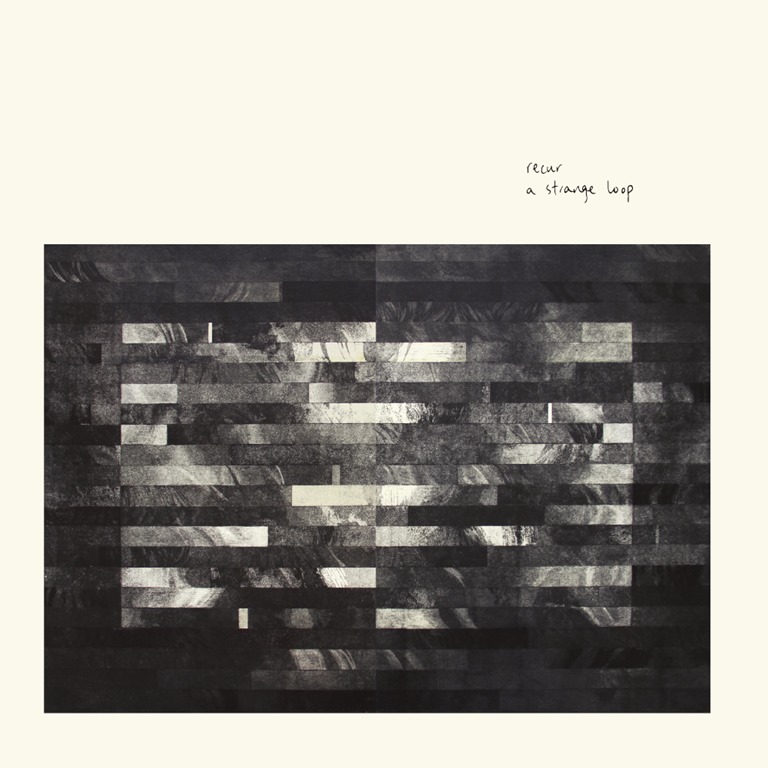
A Strange Loop may be Recur’s debut album, but the project’s lead, Tim Harrison, is by no means new to this, being a BIFA-winning composer, and for this excursion into analogue explorations, he’s joined by Richard Jones, the Ligeti Quartet, Jack Wyllie and the album was created using unique instruments crafted by Chase Coley. It’s not really ambient, not by a long way, and at times it’s quite dramatic, but it is immersive, in a way which leads the listener away from the turbulence of the everyday and into calmer waters, a sheltered cove where the tides are diminished, and there is respite, time and space to simply breathe slowly and regroup at distance from the noise, the constant disruption, the endless agitation and consternation. We simply don’t get anywhere hear enough time to breathe. When was the last time you properly relaxed your shoulders, filled your lungs to full inflation, and exhaled, slowly? When was the last time you truly felt ok?

The eight here pieces are slow, hazy-edged, abstract, immersive. Calming. ‘Oscillate’ delivers on its title, the volume surging and sliding unpredictably, creating a trick of the ear at times, with smooth, silken saxophone drifting in and out through delicate piano and washes of sound without any definite sound source. ‘Id Etude’ veers toward a chamber orchestra feel with picked strings and gliding notes.

It’s simultaneously focused and free: you very swiftly appreciate that this is a work where each composition is complex, detailed, the instrumentation varied, and the interplay between the instruments is both integral and remarkable. There are no fewer than thirteen players credited here, including four marimbas, two violins, two vibraphones, viola, cello, piano, and a host of more obscure instruments.

‘Nocturne’ brings the percussion to the fore to forge a hypnotic, beat-driven sway, before ‘Hieroglyph’ brings slow chimes, clumping trudging beats, and unsettling scrapes which evoke a mysterious, ominous sensation. This is Recur at their best: for all of the people playing here, they manage to create sparse, minimal, ominous, sombre works, pieces which are delicate, elegant, soft, supple, pieces which evolve, which shift gradually between places and moods, which make you feel… That’s it, really: they make you feel. From tension to emotion, from ease to unease, the scraping strings and swelling … ‘Iridescent’ is exemplary. It’s gentle. It surges and swells, there are moments of near-silence… and these moments are uplifting in a strange way, perhaps because moments of near-silence are so rare in all the babble.

Recur are unafraid of the silence, and, indeed, embrace it. We all need to embrace the silence.

AA

Recur – A Strange Loop  album cover 1000px

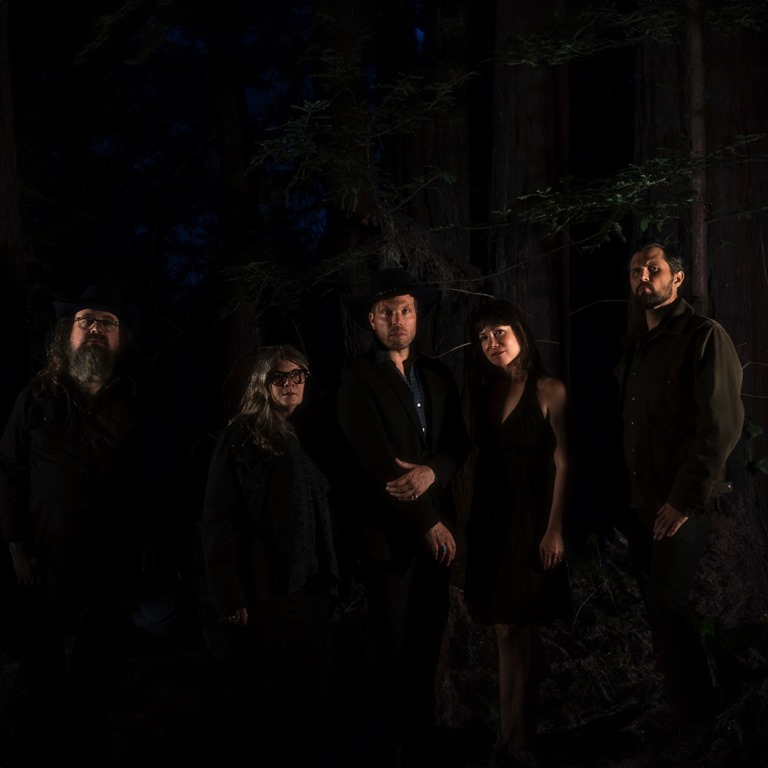
LUX INTERNA reveal the music video for the lush and warm track ‘No Arrow’ as the final advance single taken from the American dark folk innovators’ forthcoming new album New Wilderness Gospel, which is chalked up for release on May 2, 2025.

LUX INTERNA comment: “In ‘No Arrow’, a tangle of voices and moments meet, intertwine, and transform each other”, guitarist and singer Joshua Levi Ian explains on behalf of the band. “Here, it’s always 4:00 am. You’re stepping out of the roadside bar as the desert winds gently stipple flickering red neon with grains of sand, while the lights from the town in the valley shimmer below like ghosts in the darkness. Or perhaps you’re waking up in the Mojave heat and lighting a cigarette in the motel bed as you watch your sleeping lover bathed in shadows and the shards of electric light that creep in through the holes in the curtains. Or maybe you’re still driving, tired but full of flame, as the car’s headlights are continuously humbled by the vastness of a great nocturnal kingdom. Either way, you feel a mix of calm resolve and wildlife surging up inside you. Your body is awake, a beautiful animal of flesh and fire. It feels like everything that came before has intentionally led you to this moment. But you know that he’s out there, waiting and watching. And there’s a cold and calculating malice in his eyes. This thought used to terrify you. You would have done anything to shake him off your trail. But not anymore. Now you’re ready. You welcome the encounter. Now he’s the one that best beware.”

AA

bbcf112f-1d07-af27-3477-739d767e1e69

The final song in a trilogy of time-related experimental tracks, ‘Mnemosyne’ incorporates an original song – recorded in Mayfair Studios, London, in 1975 – into poetic musings, and haunting atmospherics, dwelling on nostalgia and false memory.

a0864877400_10

Intro: Christopher Nosnibor

Interview: John Wisniewski

Images: individually credited, via Foetus.org

It’s been over forty-five years since Melbourne-born James George Thirlwell washed up on English shores, and having played some keyboards on the album No Cowboys by post-punk act PragVec in 1980, he embarked on what would become a truly remarkable and lifelong musical journey of his own.

Along the way, he’s released no fewer than eleven studio albums under an array of variants of the Foetus moniker, not to mention quite literally dozens of other musical vehicles from big band (Steroid Maximus) to more experimental instrumental work (Manorexia) and almost everything in between, not to mention powerful collaborations with Marc Almond (Flesh Volcano), Jim Coleman (Baby Zizane), Lydia Lunch (Stinkfist), and the late Roli Mosimann (Wiseblood), to name but three of many. And then there are the numerous scores… and yet whatever he turns his hand to, his work has a certain distinctive style, a sense of drama.

Foetus may have been on hiatus since 2013, but at the age of sixty-four, Thirlwell is showing no signs of slowing down. John Wisniewski managed to catch a window in the man’s relentless schedule to ask about his myriad projects past, present, and future…

JW: Did you formally study music, JG?

JGT: I briefly learned cello and percussion when I was a kid. But I was very slow with sight reading.

Later I just taught myself everything from instruments to recording, programming, scoring etc.

Tell us about your first music project, Foetus. What did you want to present?

The initial catalyst for Foetus was to create something totally by myself, where I played wrote and produced everything, as a reaction to the democracy of playing with other people. I wanted to make the music in my head and the music I wanted to hear. I also wanted to create artifacts, a work of art as a multiple where everyone owned an original. It took me a long time to be able to fully realize what was in my head. I’m still not always successful with that transfer process.

How did the Lydia Lunch collaboration come about?

I knew Lydia’s work and was introduced to her when she moved to London in about 1982 through the Birthday Party. At first she asked me to write her a press bio as I had been writing fanciful bios for the Birthday Party! First I played sax with one of her projects which we toured with in Sweden. Then we started writing songs for something called The Hard Diamond Drill, which was never realized. Then we created Stinkfist and went on to make Immaculate Consumptive. We became involved romantically and moved to NYC together. I was with her until about 1989 / 1990.

Any favorite music artists?

Many favorite artists, it changes daily. I become obsessed with someone for an afternoon. I like to hear new things all the time. I am a cultural sponge. I publish a monthly playlist on my Tumblr blog. https://jgthirlwell.tumblr.com/

What inspires you to create?

Everything. I have so many ideas, it is an infinite renewable resource. I also have a hungry legacy and I have to make sacrifices to its insatiable maw.

Another legendary early collaboration was with Nick Cave. How did that one come about?

The Birthday Party broke up. Nick was looking to work with other people and we were friends. We wrote the music for one song together, which was Wings Off Flies on the first Bad Seeds album. When he came to record that album I went to some sessions, but drifted away as I was in the midst of a big bout of recording of Foetus material, the sessions that became the Hole album. A bit later we had the Immaculate Consumptive project – Oct 1983.

Do you like collaborating with other artists?

I have gotten better at it.
tumblr_lqecdl1bnu1r26hzho1_1280

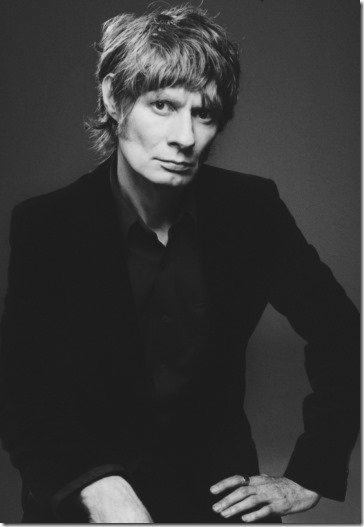
Photo by Marylene May

What was the experience like working with Marc Almond and Trent Reznor’s material?

Marc is very open minded and works very fast and is excited by music that challenges him and stretches the boundaries of what he has done. So that is stimulating. For Trent I remixed two of his songs, “Wish" and "Mr Self Destruct". I did my work on it, mutating the original material. he wasn’t involved. He liked what I did.

Do you like to work within different genres of music?

You may have noticed one of the hallmarks in my music, is that I combine multiple styles often within one song.

What are you working on now?

New Xordox album Terraform, Venture Bros Volume 3 and Foetus HALT should all be out in 2025.

Also under way are two albums of symphonies for chamber orchestra, and album of soundtracks I have written for Ken Jacobs. An EP with Laura Wolf, a triple box of music I created for sound and art installations. Hopefully another Archer soundtrack album. And much more.

Why do you have so many projects on the go (and how do you manage it)?
I like to work in a lot of styles and on a lot of projects in different forms – solo pieces, ensemble pieces, multi channel, electronic, acoustic, vocal, instrumental. Concert works, classic songs, scoring. I have a lot of ideas to get out of my system. There’s no one project that can harvest everything. There are things that I get out of my system with Foetus which are totally different to the place I am in when I create a sound installation, or a soundtrack,

My projects are usually staggered, which is to say a lot of projects in different states of completion. So I shunt them all along and they get completed in different paces. Then new ones sprout up. I couldn’t just work on one thing.

AA
2009-jgthirlwell-circa-2

Do you ever take time out and what do you do to unwind?
Yes I stop to watch movies, see art and travel. But my work is perpetual motion, I don’t need to unwind from it. I believe in being creative every day. That’s also manifested on ideas I have for visual art, photography etc
>
I’ve read elsewhere that the upcoming Foetus album, as the title alludes, is slated to be your last. What can we expect from it?
Tying up forty five years of Foetus is no mean feat and I have been working on it for seven years. There are parts that make it seem like a continuum and other parts that have never been done in the Foetus context. It’s going to be epic.

AA

Catch up on JG Thirlwell’s output on his Bandcamp page.
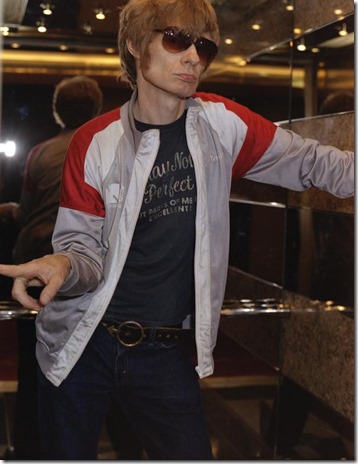
2010-jgthirlwell-circa-2

Summer has come to an end, all swallows have left the north, and autumn is already knocking on doors and windows with gusts of wind and rain. When the first leaves are falling, it is also time for melancholic tunes. WHISPERING VOID has the perfect offer for this darkening season: the eponymous song that gave the collective of renowned musicians from Norway’s west coast their name. ‘Whispering Void’ is taken from their forthcoming debut album At the Sound of the Heart, which has been scheduled for release on October 18, 2024.

WHISPERING VOID comment: “Lyrically, ‘Whispering Void’ combines all the elements of this album”, vocalist Kristian Espedal reveals. “The slow, gracious movements of the music evoke the innocence of natural beings moving through a forest, as acted out by the vocals in the verses. This song also features our third ‘outside’ collaborator, Matias Monsen from the band DROTT is playing the cello.”

Listen to this gloriously epic tune here:

AA

4e490e66-5245-adb3-6f07-95b056af9369

Metropolis Records – 27th September 2024

Christopher Nosnibor

Hot on the sweaty trotters of Red Room, released in May, the Lord of Lard, Raymond Watts has managed to mine fresh truffles for a whole new EP ahead of embarking on an extensive tour of the US, which so happens to take its name from the first track on said EP, ‘Heroin for the Damned’. The fact that this isn’t a set of remixes

The title alone is glorious, and you can almost feel the relish with which Watts conjured up the phrase, wicked, perverse, dark, and equally ostentatious and grand, evoking an image within the realms of The Last Supper but with an S&M slant as the participants dine on an orgy of gore… or something. When it comes to relishing the richness of language and delighting in deliciously devilish wordplay and alliteration, sifting through PIG’s catalogue for titles and lyrics (there’s a suitably extravagant book containing all of them just out) provides abundant evidence that Watts really gets kicks from it.

It’s also clear he is absolutely loving the whole self-styled industrial rock-god posturing, hamming it up in leather and mesh, and simply the whole music-making thing, perhaps more than at any point in his career. Instead of being awkward about self-promotion, he’s fully embracing its absurdity, and in a genre that’s largely dominated by serious, angry people, PIG stand out as being rather less po-faced, and altogether more fun than your average industrial act. I’m not sure I’ve seen Al Jourgensen or Trent Reznor posting pics on Facebook hugging their pooches.

That doesn’t mean that the music is any less serious. Watts and his various collaborators really know how to bring a crunching riff and a stonking beat, and, occasionally, having taken early cues from the legendary JG Thirlwell, spin in some bombastic strings and grand orchestral strikes. And Feast of Agony is dark, heavy, intense, and marks a strong return to the more experimental 90s work following a pursuit of an altogether glammier sound of late.

‘Heroin for the Damned’ – the opium of the people for the 21st Century, perhaps – starts low, slow, and sinister, Watts’ vocal a croak amidst a dank electronic swamp before a steady riff, laden with grit, grinds in, rubbing hard against a lowdown pulsating synth groove. It’s a bit NIN circa The Downward Spiral, but equally it’s quintessentially 90s PIG, and lands a monster chorus that combines the raging roar of Sinsation and the grainy grooves of Praise the Lard with gushing gospel grandeur – something that really dominates the final track, the Jim Davies remix of ‘Baptise, Bless, Bleed.’ Piano and bold orchestral sweeps meld with stark synths and crunching guitars on ‘Fallout’, before Watts comes on like Bowie on the slow-paced anthemic ‘Comedown’, while the verses of ‘Hand of Mercy’ owe more to Prince.

It’s a PIG release and therefore it’s a pure [serial killer] thriller, alright – but even within the now-expansive catalogue, Feast of Agony is a strong entry.

AA

a2658647365_10

Metropolis Records – 23rd August 2024

Christopher Nosnibor

Even at their commercial peak, PIG releases weren’t all that easy to come by, at least here in the UK, despite some of them being on big labels with big distribution. PIG – the project of London-born Raymond Watts – is an act which can legitimately claim to be big in Japan while largely unknown at home.

My own first encounter was seeing them support Nine Inch Nails on The Downward Spiral Tour in Wolverhampton in 1994. I was in the middle of my A-level exams, but no way was I going to miss NIN. I didn’t even know who the support were, but witnessing the heavy grind of PIG, with pigs’ heads on poles at the sides of the stage, as their lanky singer writhed his way through a gritty set was an absolute revelation. The set’s opening song stuck with me, but it was some years before I would actually source a copy of Red Raw and Sore, on this new site called eBay. The debut album, A Poke in the Eye…. With a Sharp Stick and the ‘Sick City’ 12” were fairly easy to find at record fairs around 1994, as Wax Trax! vinyl was available in abundance, and often cheaply, too, but anything else? Pretty much impossible to find. And so it was that PIG felt like a near-mythical act, and despite having played these big shows with NIN, still no-one was really aware of them.

Sinsation was released first in Japan in 1995, and a year later in the US, and on learning of its existence, I got my local record shop to order it in, but had to wait literally months for it to arrive on import. Oh, but it was worth the wait. It delivered all of the theatrical pomp that defined A Stroll in the Pork, but cranked up the dirty industrial guitars and found Raymond Watts in top form with his extravagant wordplay. In short, it reset the bar, not just for PIG, but for what ‘industrial’ music could be. This wasn’t just hard and heavy, but also playful, witty, intelligent, and still dark, seething.

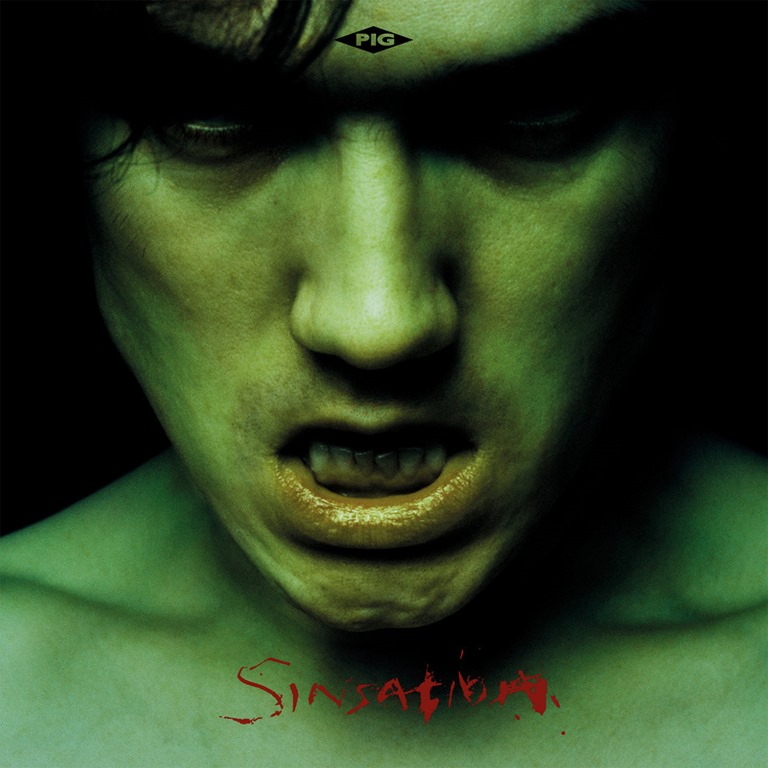
The cover alone is striking. Watts’ image is a standard feature on all PIG releases, but whereas more often than not he is depicted looking buff or brooding, the sickly green hue is unsettling – and slamming in with a series of orchestral strikes and a low, grumbling bass before hitting full-on industrial anthem mode on the first track, the six-minute ‘Serial Killer Thriller’ (the chorus of which provides the album’s title), it’s immediately apparent that Sinsation is something special (and not something sad…).

Admittedly, despite this being an album I’ve played to death over the last thirty years, apart from a few tracks being a few seconds different in their duration, I can’t discern any huge differences between this remastered version and the original: there are, perhaps, more details revealed in the mix, but then, the production on the original was impressive, and again, I’ll come back to that word, ‘detail’. There’s a lot happening; samples, snippets of bits and bobs, strings, multi-layered vocals… A touring member of Foetus early in his career, with JG Thirlwell involved in the early singles and debut album, Watts clearly learned much from Thirlwell, as well as his early involvement with KMFDM. Sinsation felt like the point at which he brought these two aspects together in perfect balance while simultaneously realising his own unique sonic vision. The result was a set of hefty, driving songs, exploding with ideas and noise, and so many layers, so much going off all over the place. It was bold, audacious, and while it’s easy enough to say that it’s a bit Foetus, a bit KMFDM, it goers so far beyond these points that comparisons are a diminishment of Watt’s achievements here.

Sinsation is certainly the first PIG album to showcase the full range of styles and compositional aspects Watts has in his locker, and as such, represents something of a creative peak.

While nominal single ‘Painiac’ (an early version of which was the lead track on a Japanese-only EP, and a video for which got a few spins on MTV on the album’s release) is a throbbing industrial beast of a tune, ‘Golgotha’ is a dark, semi-ambient interlude which sits between the driving snarl of ‘Hamstring on the Highway’ and the swaggering industrial-strength glam-tinged gospel-infused dark pop of ‘The Sick’, which would provide the blueprint for the PIG renaissance which started with The Gospel in 2016. ‘Analgesia’ is a magnificently atmospheric piano-led instrumental which incorporates elements of ambient and electronica and extraneous noise ‘Volcano’ is serpentine and sleazy, with some audacious orchestral work in the mid-section which take the bombast of Foetus’ Nail to another level, while ‘Hot Hole’ drives hard and heavy with pulsating electronics colliding with hefty chugging guitars and ferocious beats.

For the many who likely missed this the first time, this re-release provides the opportunity to make acquaintance with one of the definitive PIG albums, and for those already familiar, it’s a timely reminder of the incredible journey that has been PIG’s career to date, while offering the first chance to get it on vinyl. Almost thirty years on from its first release, Sinsation still sounds phenomenal – insanely ambitious, utterly deranged, and in a league of its own, quite unlike anything else before or since, even within the PIG catalogue.

AA

a2059987689_10

25th July 2024

Christopher Nosnibor

The art world is not so much a desert as a breakers’ yard, stacked to the sky with abandoned and aborted projects, works which were commissioned and shelved or otherwise dropped, canned, kicked into touch. The endless hours spent on projects which have never seen the light of day hardly bear thinking about. A career in the arts is likely to be one dominated by failure over success, even for a successful creator. But what is success? Artistic success and commercial success exist in different spheres, and while the world at large seems to judge more or less anything by the measures of the latter, one should ask why this us. Units shifted, radio plays, streams on Spotify, these are the metrics of success, based on the monetisation of art. Something is simply not right.

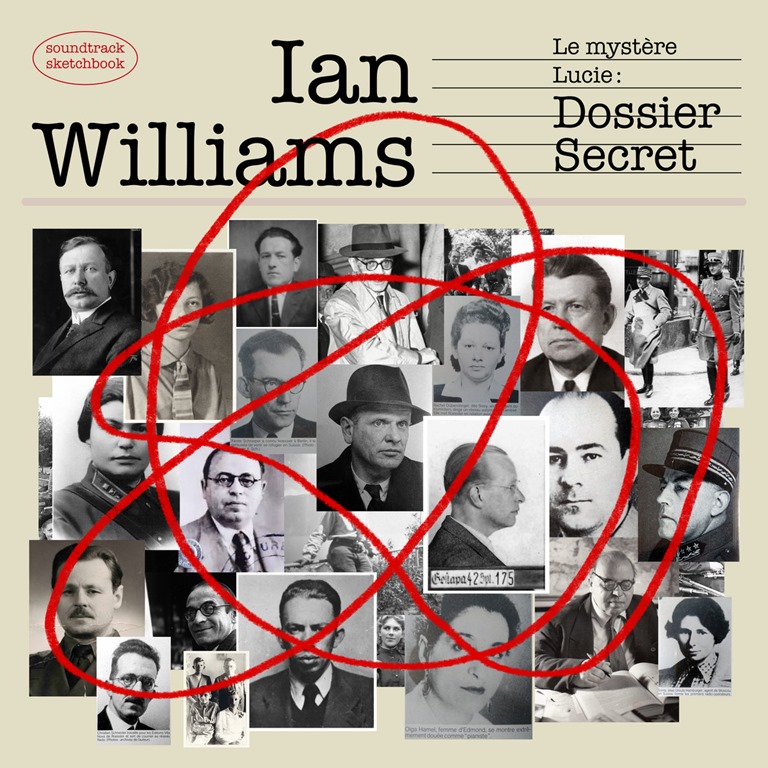
Ian Williams’ latest release is a product of failure. Le Mystère Lucie (Dossier Secret) (that’s Codename Lucy (Spies Against Nazism)’, a companion piece to the recently-released Le Mystère Lucie (Des Espions Contre Le Nazisme), his recent soundtrack album of music for the 2023 French documentary Le Mystère Lucie (Des Espions Contre Le Nazisme) / Codename Lucy (Spies Against Nazism).

As the accompanying blurb expounds, ‘it features music composed for but ultimately not used in the documentary, which was originally conceived as a 75 minute film but eventually released as a 52 minute TV broadcast. It seemed a pity not to make these additional themes and sketches available, so here they are, another collection of World War II spy music – melodic, electronic, orchestral, tuneful, abrasive, with both releases showcasing Williams’ knack of fusing big tunes with occasional blasts of industrial noise.’

Grand, bold, epic, expansive… these adjectives give a hint of the cinematic compositions n offer here. Being designed as a soundtrack, the album’s seventeen compositions are brief – largely under three minutes – and gentle, employing smooth synth bass and conjuring an atmosphere which is accessible to the ear. The tracks blur into one another with great rapidity, as one would expect for a soundtrack, where the segments flow with the scenes.

Le Mystère Lucie (Dossier Secret) is rich in mood and atmosphere, as befits its subject. There’s not much industrial noise present here but string-soaked cinematic sweep abound. Le Mystère Lucie (Dossier Secret) feels filmic, it builds drama and layers of simmering tension, as well as lakes of brooding darkness and ripples of uneasiness. It’s an accomplished score, and one which most certainly was too good to go to waste.

AA

a2382814546_10

Hallow Ground – 7th February 2024

Christopher Nosnibor

Silent movies provide a perfect inspiration for musical scores: unencumbered not only by pre-existing scores, but also dialogue or incidental sound, they offer a completely blank canvas and space for musicians to fully explore – and articulate – the mood of the movie, the moments of drama, to become both immersed in and enhance, even create, atmosphere.

Following the split of Siouxsie and the Banshees in 1996, Steven Severin devoted much time to writing scores for old movies, and performing them as live soundtracks in movie theatres, and I was fortunate to catch him in around 2012 when touring Carl Theodor Dreyer’s 1932 Vampyr. It was a powerful and haunting experience, and one which clearly brought new dimensions to a very old film.

In the same vein, Musique Infinie – the collaborative project of Manuel Oberholzer a.k.a. Feldermelder and Noémi Büchi – present an improvised score for Alexander Dovzhenko’s groundbreaking 1930 silent movie Zemlya (Earth) created for the 24th edition of the VIDEOEX festival for experimental film.

For those unfamiliar – such as myself, the crib notes inform that ‘Frequently cited as a masterpiece of early 20th century filmmaking, the movie deals with the collectivisation of Ukraine’s agriculture.’

Now, the movie clearly holds up on its own to be so revered and still revisited almost a century on, but what of the soundtrack? How does it hold up without the visuals which inspired it?

The soundtrack is divided into two movements of roughly similar duration – ‘Creation’ (14:25) and ‘Destruction’ (12:54). It begins with big, bold, sweeping symphonia, synthesised choral soarings atop majestic, broad-sweeping synth tones. There is a palpable sense of grandeur, and with deep string sounds resonating low beneath big, emphatic surging drones, this feels immense and so strongly cinematic that it’s hard not to be caught up in the tide. A sudden droning downturn marks a temporary change of mood before we’re brought out into calmer waters and begin to regain our breath around the five-minute mark. Robotic, industrial glops and bleeps undulate and oscillate, cresting through the smooth surface. Over time, the piece transitions between organic-sounding orchestral manoeuvres to altogether more space-age sounding synthscapes, before fading rapidly at quite an interesting intersection.

‘Destruction’ – as one might well expect – steps up the drama and the dynamics, but perhaps less expectedly becomes more overtly electronic, with stuttering, glitching disturbances and cold, dark waves blasting in, bending and warping. At times haunting, disconsolate, others foreboding and unsettling, this is certainly the more challenging half of the album. But on the one hand, while it’s more exciting, in some respects, it’s also less fulfilling. Partly, it’s because of the way in which the organic-sounding strings rub against the more overtly electronic sounds, and as much as this juxtaposition and interplay is essential to the compositional form, it sometimes feels like a clash whereby the pair are seeking to achieve two separate ends. Given its improvised nature, this is perhaps to be expected, and the overall flow of the album as a whole is marked by moments of convergence and divergence.

There’s also the nagging sense of just how contemporary this feels in contrast to the visuals the sound is designed to accompany, although without being able to observe the intended setting, it’s difficult to fairly judge the level of success here.

One could – and probably should – see the film, and should also watch it with this accompanying it, as intended – but that isn’t this release, which must be judged on its audio content alone. And taken apart, in isolation, Earth is a stimulating and dynamic work, and one which demonstrates that Musique Infinie aren’t afraid to test themselves and to test boundaries, and to create a powerful and dramatic listening experience.

AA

HG2401_front