Posts Tagged ‘Noise’

Hærverk Industrier – 25th August 2023

Christopher Nosnibor

Having a memorable name counts of a lot – as does having one that stands out at the top of Google searches. How many times have you had conversations where one of you has been struggling to think of the name of… that band… that band… You know, the one with… they did an album…. They supported… clicking fingers, scratching heads, gesticulating. Nah. And the acts that are simply untraceable, particularly those with banal single-word monikers. It’s like they didn’t think about the practicalities when picking a name – or they simply have no interest in being found, which is commercial suicide before they’ve even started.

This is not an accusation which can be levelled at this Oslo-based noise rock duo, who follow up their 2012 self-titled 12” EP on Handmade Records and self-released 2017 cassette This Century with their new album An Ki, which is being released by Hærverk Industrier and promises ‘Four tracks of extreme dynamics, density and intensity, resulting in an almost claustrophobic chaos of sheer rock ‘n’ roll ecstasy (sic)’. Burning Motherfuckers is neither forgettable nor hard to find.

The same is true of their music, in terms of its being memorable at lease. An Ki is an album which contains just four tracks, but ‘Lost It’ is a beast which clocks in at ten and a half minutes, and the title track is over twenty minutes long, making this a monster that runs for over forty minutes of feedback-strewn riffery. It’s a noisy mess of a record, and truly glorious in the most cacophonous and challenging way. ‘Difficult’ music, when it’s harsh and loud and discordant, isn’t simply something you can step on from. It’s hard to describe, but it’s disruptive, physically, and mentally. Such turbulence disrupts the mindflow and makes waves around the organs.

‘Eilert’ builds and builds and builds and it takes the very idea of building to a ludicrous level, up, and up, and up… what do you do with this? The form is very much 90s underground alternative, and this manic racket calls to mind the likes of Terminal Cheesecake – but then again, the driving guitars and thrashing drums of ‘Lost It’ are quite reminiscent of That Fucking Tank – arguably one of the greatest noise duos ever, and an act who really pushed the parameters not only of noise rock, but of the two-piece format to the max. And Burning Motherfuckers… woah, do these bastards make a racket. ‘Lost It’ hurts; the tempestuous assault of everything all at once is not comfortable. But it’s more than that: the vocals are deranged, demented, and this is brain-splitting, cracked, something else, an unapologetic mess of noise.

‘Unless It’s Trees’ is a real departure and stands apart from the rest of the album: a soft, almost folky indie piece, it’s largely bass-driven and it’s uncomfortable but gentle at the same time.

And then there’s the title track. Fuck, and fuck, and fuck. It’s a monster in every sense, taking the mutant form of an eternal guitar drone and mangling noise which builds while discordant vocals melt and burn among a riotous racket.

It’s not neat or tidy, it’s not even ordered or organised. But it’s not conventionally noisy or messy: this is something else. It’s a new level of mangled noise and it’s difficult, awkward, It hurts, and it feels like taking a kicking and being hit around the head with a plank. These motherfuckers sure know how to make music with impact.

AA

a1641074360_10

Artoffact Records – 22nd September 2023

Christopher Nosnibor

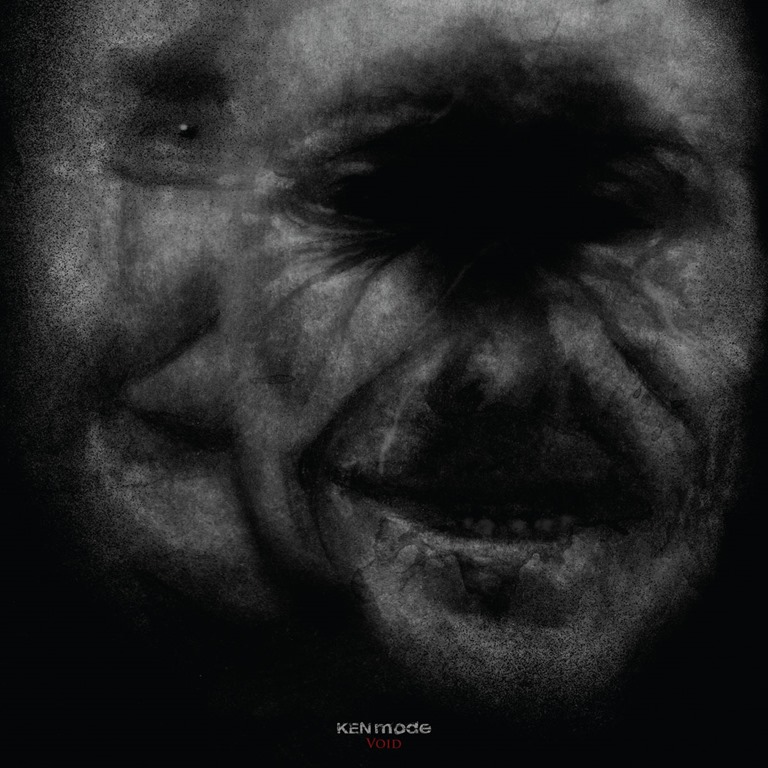
VOID always seems like the most appropriate title for a counterpart to a release called NULL: it was, indeed, the title for a brace of EPs released by Foetus in the early 00s as companions to the album Gash.

But with this, the title is more than simply an extension of a theme in terms of title. As the accompanying notes explain, ‘VOID, the companion piece to last year’s NULL LP, has a decidedly more melancholy and disappointed aesthetic than its predecessor. Featuring 8 new tracks recorded and produced throughout the fall and winter of 2021 by Andrew Schneider, mastered by Carl Saff, with artwork and layouts by the band’s longtime collaborator Randy Ortiz.’

Despite now marking twenty-four years of squalling noise, tenth full-length Loved (2018) found the band hitting new peaks of intensity and gaining newfound traction, and not just because of the vaguely disturbing cover. Combining weight and ferocity, their back catalogue straddles the abyss between The Jesus Lizard and Swans. It’s fair to say, then, that KEN mode are hardly celebrated as a party band, and writing in Decibel Magazine, Shane Mehling summarises the diptych of NULL and VOID as “It’s like the first record is you fighting, and this one is you losing”.

It’s a pretty accurate summary. That is to say, VOID is pretty fucking bleak, harrowing even. ‘The Shrike’ makes for a tense and tempestuous opening, where everything blasts out all at once before sinewy guitars twist and entwine like a contraction of the intestines with the pain of food poisoning before successive deluges of noise assail the senses. The tension draws the sinews so taut as to burn, and a mere four minutes in you feel the anguish rising through the gut and your throat tightening.

Single cut ‘These Wires’ is almost accessible, a sedate intro building the tension before the levee breaks on the lung-bursting anguish. It’s eight minutes of blank fury, raging nihilism that doesn’t necessarily make you feel better. The stab at catharsis feels blunted. Confined, entrapped. It’s tense, and you feel your heartrate well. VOID is so, so, dense, the music low and churning the

Comparisons are few and largely futile in the face of this, but it’s Kowloon Walled City’s bleak, desolate forms. The disappointment emanates from every chord, every pained syllable. Life… yes, it tears you up and it crushes you.

‘We’re Small Enough’ runs in ever-tightening circles around a repetitive bass groove motif, and become wound more tightly with every loop, and then ‘I Cannot’ crashes in and it’s like you can feel the band throwing themselves headline against lead-lined walls in desperate and futile attempts to escape. Escape what? Life… ‘A Reluctance of Being’ encapsulates that sense of struggle, the weight of simply existing some days. And yet just when you think you can’t do it, and don’t think you can even get up on a morning, you do, because you simply do, and then you get through another day, and then the next. It’s like wading through treacle, but what else are you going to do? I say ‘you’ in the hope that in redirecting the personal the universal it will take on a wider resonance. But for every ‘you’, I mean me. But you know that. And this track is the most gut-wrenching brutal.

Previous single ‘He Was a Good Man, He Was a Taxpayer’ is another slow, brutal slice of pain. Another shining example of what no-one would likely consider a single, it’s a crawling slogger spanning five monolithic minutes of bludgeoning noise, angry, grey, dark, dense, relentless. VOID is the soundtrack to staring into the void, while contemplating the practicalities and the future. Is there even a future? What if I step off here? What am I looking at, what am I facing? Is there really nothing? Probably not, and we need to accept that perhaps the end is the end.

VOID stands on the edge and looks down. Perhaps this is it. Perhaps there is more. VOID doesn’t offer hope, but it does provide a backdrop to your existential crisis while leaving you gasping for air.

AA

a2219072561_10

The Quietus

Christopher Nosnibor

It’s not that I like to brag, but I’ve been writing about Sly and the Family Drone since 2012, when they blew me away at the Brudenell in Leeds, with a chaotic, percussion-heavy, audience-participation-led performance (and since when my writing has improved and I’ve become a shade more sensitive, perhaps). Witnessing Matt Cargill standing aloft on a stack of amps while surrounded my members of the crowd battering drums distributed by the band was one of the most exhilarating experiences of my life, and I was an instant convert. In some respects, I was fortunate to witness it: in a recent interview, Cargill was at pains to stress that it’s one of those spontaneous things: “It doesn’t happen at every gig,” he warns. “And I don’t want it to become a thing that people expect or are disappointed when we don’t do it. There are times I’ve seen people write, ‘Bring your drumsticks!’ I’ve never said that and I don’t want you to do that! If we were doing it every night people would be, like, ‘Oh, fuck off! They’re doing their schtick.’”

It’s this spontaneity and true commitment to improvisation that is a significant part of the band’s appeal. You never know quite what you’re going to get, and there’s a sense that nor do they: it all unfolds in real-time.

Their subsequent releases since my introduction in 2012 have never disappointed, and for me, at least, the best thing about Sly is that they embrace the difference between the live and recorded media. As such the recordings are the recordings, the performances are the performances. Explaining the difference to The Quietus, Cargill says “It was nice to be able to do all that spatial and stereo stuff which we wouldn’t be able to do live,” he says. “Because of mics on drums and stuff, it just doesn’t really work in that way. So we were able to spend a bit of time just working on that and doing some quite weird-sounding drum stuff which I’m really happy with.” The same article also explains, ‘The passages of manipulated drumwork are bookended by the band performing together in full skronking and lumbering flow and, in a move that vaguely echoes the ecstasy of their live sets’ endings, it finishes with a warm and symphonic cacophony of horns. “It’s kind of a pieced together track but I think it works as an entire piece,” reflects Cargill.

They have forged a career – or perhaps eked one, on the breadline, with a cult reputation which exceeds the returns a fringe act can attain in this crappy climate, a climate whereby post-Brexit overseas travel is prohibitive and not just financially – from being far out. Embracing elements of jazz and noise and a whole spectrum beyond, it’s fair to say that this is an act who plough their own furrow, and for that, respect is due, and them some.

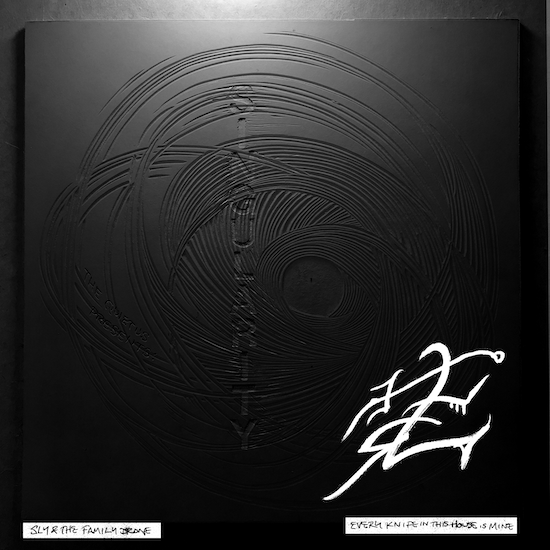
This latest release is – as ever – an interesting one. It’s a limited lathe-cut 12” released via The Quietus, a publication with an immense reputation for its championing of the weird and the wonderful, and which perhaps more than any online publication with a significant readership plugs the gap left when Sounds, and then Melody Maker ceased to be. For non-subscribers, it’s available digitally via the usual platforms.  The ones I don’t use or advocate. But I digress. ‘And Every Knife In This House Is Mine’ is Sly at their best.

As a single track – less a composition than an exploration – with a running time of twenty minutes, it’s an EP or an album by some bands’ standards, but what it ultimately is is an immersive experience which sees them make the most of having access to studio facilities to push their sound further in different directions.

It’s a shrill, rippling wave of feedback that pierces the eardrums in the opening seconds which announces its arrival before a tempest of crashing drums, wayward brass and extraneous noise deluges in, and more happens in the first forty seconds of this tune than the entirety of many albums. Shortly after, it settles into a thunderous groove, the rhythm section grindingly heavy while wild horns – Kaz Buckland’s alto sax and James Allsopp’s baritone sax interplay is a back-and-forth that is timed with perfect precision.

There’s a lot of reverb, and a lot of space here. They pull back from the brink of pure chaos and meander through some expansive gentler passages, before, each time, exploding into a wild crescendo. It’s hard to differentiate snarling electronics from barking vocal yelps , and there isn’t a second where there isn’t something happening. It’s impossible to maintain a commentary on this sequentially.

A tumult of noise, bleeps and glitches, bloops and whirls, all fuse to form a wild cacophony, and it’s pure bliss to yield to this sonic tidal wave. But over the course of the track’s twenty minutes, there are constant ebbs and flows, the lower-level churning swashes rendering the louder segments and extended crescendo’s all the more impactful.

Things get decidedly Throbbing Gristle around the midway point, with swampy electronics and groaning low swoons taking things down, disrupted by random clatterings of percussion, before things take a turn for dark around the fifteen minute mark, with drones that sound like a 747 heading towards the ground in a nosedive… and then the climaxes with an extended jazz frenzy, and… woah.

Running through every form and texture, Every Knife In This House Is Mine is both exhilarating and exhausting… and everything you would expect from Sly and the Family Drone, and all that jazz.

AA

SlyAndTheFamilyDrone_Flat_copy_1669300606_crop_550x550

Warren Records – 31st July 2023

Christopher Nosnibor

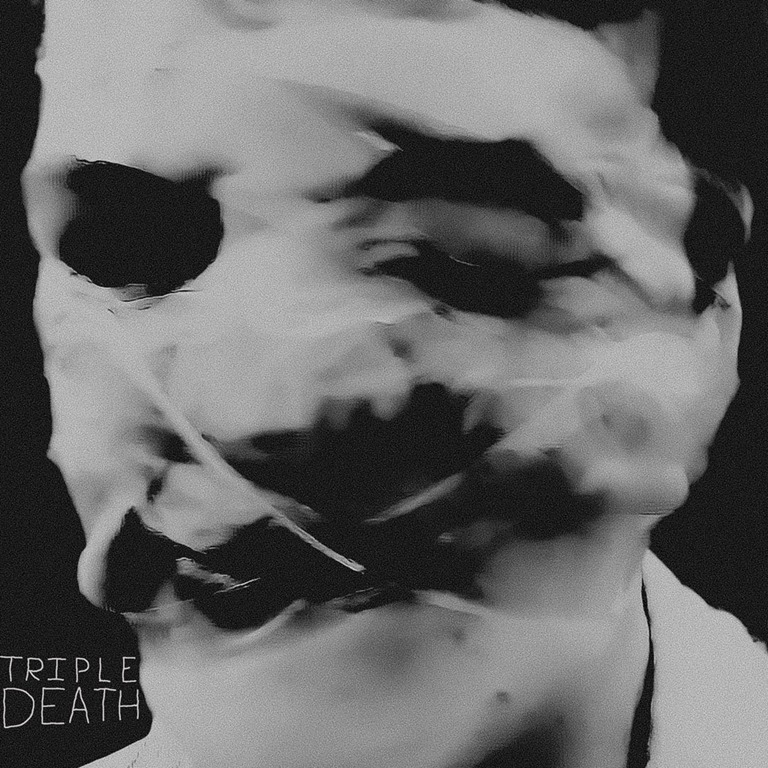
There are few things quite as gratifying as seeing one of your own quotes as the lead on a press release. And so it is that Hull noise punks Bug Facer, who I declared were my new favourite band on the release of their debut single, ‘Horsefly’ in Nov ember, praising them for their ‘claustrophobic, pulverising heaviness that leaves you aching’, rage hard on their debut EP.

What are they angry about? Everything and anything: modern life in general. Triple Death may only contain three tracks and have a running time of less than fourteen minutes, but they pack in the fury with a critical mass. The first cut, ‘Eggshell’ sets the tone, and, they say, ‘explores the idea of cycles with no end and how on an existential level we try to apply meaning to struggle.’ This isn’t just noisy shit: it’s noisy shit with some deep thought involved, and ‘Eggshells’ is low and slow, with a hesitant bassline and swirling guitar that swishes around in a gush of treble, and instrumentally it lands somewhere between The Fall and ‘Budd’ by Rapeman, and it’s completed with howling vocals that sound like every syllable is being torn from James Cooper’s lungs. It’s harsh and harrowing and truly the sound of pain leaving the body.

Theirs is an usual setup, with the drummer and bassist contributing vocals alongside co-founder Cooper who plays guitar. I say play: he and second guitarist Josh Burdette torture their instruments, channelling their angst through mangled chords at high volume. Sonically, their approach is unusual, too: they’re not big on riffs or distortion or driving percussion, the popular cornerstones of angry music of many genres: the sound on Triple Death is steely, grey, murky, creating the kind of oppressive sensation I feel listening to Unsane and Red Lorry Yellow Lorry. It makes you feel tense, twisted up and knotted inside.

Picking up the pace with ‘Prod’, which, with the addition of some gurgling synths, steps into a Krautrock groove, before the guitars lunge in and things get messy, the deranged, raw-throated vocals and serpentine guitar lines interweaving in a thicket of discord flay the nerves without mercy. ‘We are all the cattle… We are all the cattle, is the refrain’. And we feel it.

It’s a reworked version of ‘Horsefly’ that closes the EP off, and it’s a cleaner sound that marks the primary difference from the original release of this six-and-a-half-minute trudger of a tune that has the kind of earthy weight of Neurosis. The guitars chime dolorous doom as the bass and drums hammer hard, heavy, relentlessly thudding, so low and slow as to drag your heart down towards your knees.

The clue, I suppose, is in the name. This isn’t just death: it’s triple death, and Triple Death is grim, gloomy, the soundtrack to battling against the tide of shit on shit, when a trip to the seaside is a game of dodge the turds and a tub of butter costs seven fucking quid. When they tell you that inflation is a global issue but the fuel providers and supermarket chains record bumper profits and immense payouts to execs and shareholders while nurses are querying at food banks… fuck this shit. Triple Death is the soundtrack to telling the world, ‘fuck this shit’. One more time: fuck this shit.

AA

BugFacer_TripleDeath_artwork_1080sqr

Ipecac Recordings – 21st July 2023

Christopher Nosnibor

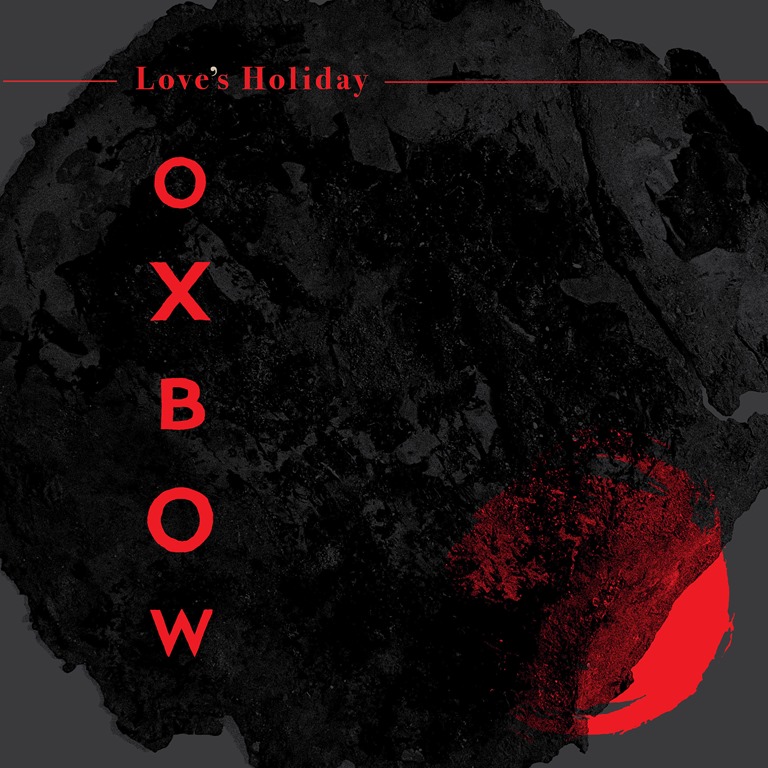
Thirty-five years is a long time. Not jus in cat or dog years, but in human years, too. For many, it’s half a lifespan. Perhaps it’s not so long in the scheme of the existence of the planet or cosmos, but that’s a timespan incomprehensible to most people, for whom the time from lunch till dinner feels like an eternity. But here Oxbow are, marking thirty-five years of existence.

A defining feature of their work has always been its diversity, and Love’s Holiday showcases that in abundance. The three songs released ahead of the album couldn’t have been much more different from one another, from the grainy, pained, and soulful ‘1000 Hours’ to the brooding, contemplative ‘Lovely Murk’ (both concerned with death and dying) via the full-throttle energised grunge-driven poke of ‘Icy White & Crystalline’.

How representative are they of the album? Entirely. Love’s Holiday has range, both sonic and emotional, and Robinson’s lyrics are dense and multi-facteted, and read like poetry. At first you’re struck between the eyes, but them you chew on them, because there’s more than mere impact, with smart wordplay running throughout, and they’ve visual, evocative, charged.

It screeches in with the sinewy discordant noise rock of ‘Dead Aherad’, Eugene S. Robinson hollering hard against scratchy guitar and tetchy drumming – and then, seemingly out of nowhere, everything locks together and brings a melodic chorus that’s somewhere between grunge and prog, landing in what you might call 90s alt-rock territory. Or you might not, but I’d challenge anyone to define it more specifically.

The raw, seething ‘Icy White and Crystalline’ drives in before ‘Lovely Murk’ and ‘1000 Hours’ follow one another in succession, changing the mood, pace, and dynamic of things. This piece of sequencing works well, as the intensity of the opening brace is enough to leave you gasping for breath and experiencing palpitation. Kristine Hayter’s Lingua Ignota choir vocals on the former fill the song with a white light, with something of a Gospel feel, in keeping with the song’s theme of death and ascension, after which ‘1000 Hours’ balances darkness with light.

A choral surge and rolling piano provide the backdrop to ‘All Gone’, and Robinson showcases his vocal versatility to stunning effect; first, a cracked, Bukowski-like drawl, before breaking into barrelling delivery more akin to Tom waits, and then switching to a hushed, intimate croon. The song bristles with tension and oozes soul.

There’s another switch of instrumental arrangement on ‘The Night the Room Started Burning’, with acoustic guitar entering the mix, and things taking a tense post-punk, almost gothy twist. But again, the choral backing adds a haunting dimension to the song, and it’s incredibly powerful. Pushing on with the stylistic collisions that they absolutely own and utilise to optimal effect, ‘The Second Talk’ melds no-wave noise with country-coloured slide guitar, before ‘Gunwhale’ takes leave by the grandest, most theatrical means possible, before slowing to a grinding drone.

If the overall mood of Love’s Holiday is reflective, introspective, there’s so much detail among it all that it’s hard to unpack even after several listens. Herein lies its greatest strength: it’s not an album which conforms to a genre, but an album which serves as a vehicle to convey, not one thing, but a whole spectrum of complexities. Love’s Holiday is not easy to process, but it’s an eye-opening artistic achievement that thirty-five years in, Oxbow are absolutely at the top of their game.

AA

OBLH_cover_final

With their anticipated new album, VOID, just a few months away, KEN mode has given us another look into what to expect from the full-length, out Sept. 22nd via Artoffact Records. Today, the band shares a new single, true to their unforgettable and unique sound – ‘He Was A Good Man, He Was A Taxpayer’!

On the new track, Jesse Matthewson comments candidly that it is, "perhaps a little more post-punk than people are used to hearing us – but we had fun playing with synth and pushing the boundaries of the emotionality of this track. Is this noise goth? I don’t know. Does that sound stupid? Did I just invent a new genre? There are equal parts Bauhaus and Unsane on this, so maybe?"

‘He Was A Good Man, He Was A Taxpayer’, follows the band’s absolutely bone shattering single, ‘The Shrike’, which last month gave us 4 minutes and 10 seconds of sheer energy, fueled by the frustration of the ‘lost years’ of the pandemic, pelting fans’ eardrums with blissfully crass instrumentals and a vocal approach like no other.

Listen here:

AA

With their anticipated new album, VOID, just a few months away, KEN mode has given us another look into what to expect from the full-length, out Sept. 22nd via Artoffact Records. Today, the band shares a new single, true to their unforgettable and unique sound – ‘He Was A Good Man, He Was A Taxpayer’!

On the new track, Jesse Matthewson comments candidly that it is, "perhaps a little more post-punk than people are used to hearing us – but we had fun playing with synth and pushing the boundaries of the emotionality of this track. Is this noise goth? I don’t know. Does that sound stupid? Did I just invent a new genre? There are equal parts Bauhaus and Unsane on this, so maybe?"

‘He Was A Good Man, He Was A Taxpayer’, follows the band’s absolutely bone shattering single, ‘The Shrike’, which last month gave us 4 minutes and 10 seconds of sheer energy, fueled by the frustration of the ‘lost years’ of the pandemic, pelting fans’ eardrums with blissfully crass instrumentals and a vocal approach like no other.

TOUR DATES:


09.24.23 Porto, PT @ Amplifest*

09.26.23 Rouen, FR @ Le 106

09.27.23 Lille, FR @ Aeronef

09.28.23 Paris, FR @ Point Ephemere

09.29.23 Angouleme, FR @ La Nef

09.30.23 Clermont-Ferrand @ La Cooperative De Mai

10.01.23 Yverdon, CH @ L’Amalgame*

10.02.23 Karlsruhe, DE @ Jubez

10.03.23 Dresden, DE @ Ostpol

10.04.23 Wroclaw, PL @ Klub Lacznik

10.05.23 Berlin, DE @ Urban Spree

10.07.23 Aalborg, DK @ 1000 Fryd

10.08.23 Aarhus, DK @ Headquarters

10.10.23 Liege, BE @ La Zone

10.11.23 Haarlem, NL @ Patronaat

10.12.23 Bruxelles, BE @ La Botanique

10.13.23 Brighton, UK @ The Hope & Ruin*

10.14.23 London, UK @ Perpetual Flame Ministries w/Lingua Ignota*

AA

Zoj64xD3

Photo: Brenna Faris Photography

Cruel Nature Records – 16th June 2023

Christopher Nosnibor

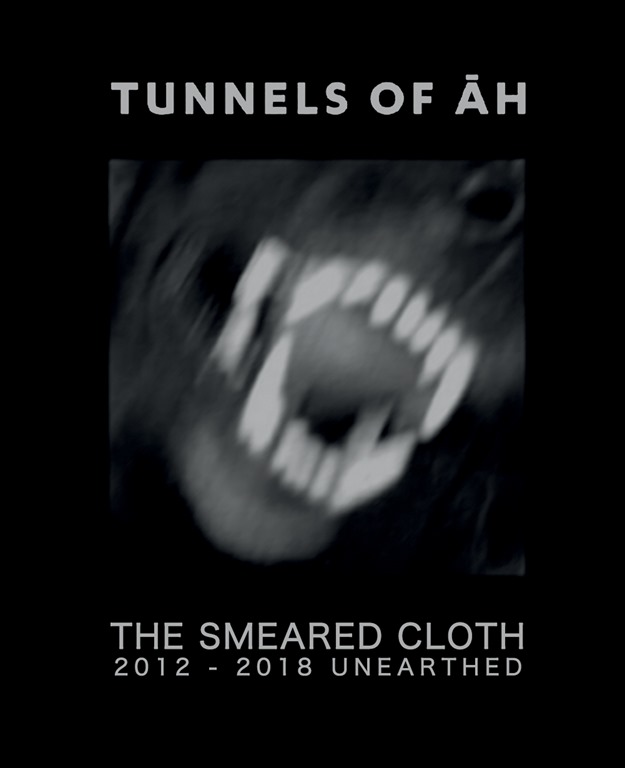
After calling time on Head of David in 1991, Stephen R. Burroughs re-emerged in 2013 as Stephen Ah Burroughs with recording as TUNNELS OF ĀH, and offering a dark ambient focus. Since the first TUNNELS OF ĀH album, Lost Corridors, Burroughs has maintained a steady output through the years, also working under the FRAG moniker (although this project was conceived in the ‘90s, it wasn’t until much later that recordings would begin to be released).

THE SMEARED CLOTH (2012 – 2018 UNEARTHED), as the title suggests, collects unreleased recordings made between 2012 and 2018 and more recently excavated. You couldn’t exactly call this a cash-in: this is ultra-niche and it is, however, a valuable dredging of the archives.

The cassette release is a double, with volume 1 spanning 2012-2015, and volume 2 spanning 2016-2018, and while an album conceived as an end-to-end listening experience would suffer from the enforced breaks, the (cruel) nature of this release means this isn’t an issue.

Oftentimes, with dark ambient works it feels as if the sounds are drifting out of the air rather than being forged by any kind of instruments, but the warping drones of the first composition, ‘Aceldama’, twist and grind and there’s quite analogue synth feel to it, with distant vocals adding an intriguing depth. In contrast, ‘Garlic Blades’ feels as if it something that has come not from instruments, but from a pair of bellows wheezing in a dank underworld. The two sonic facets come together on the third track, the heavy, stark ‘Brute World’ where drifting drones and creeping atmospherics filter over tense, brooding strings, and this all provides the backdrop to barely-audible incantations in a mystical tongue.

These contrasting elements highlight the range of the recordings featured on THE SMEARED CLOTH – and with twenty-one tracks, the majority of which are over six minutes in length, it’s a substantial document. But despite the contrasts – and the span of time over which the recordings were made – there is a certain cohesion to this collection, and the tracks run from one to the next without there being any jarring leaps.

Repetition is a common feature of the compositions; ‘Keys King at the Womb Again’ is centred around a short loop of a heavy industrial scraping, which equally sounds like a pained bark – or a pained barf, for that matter. Because Burroughs does venture into harsher territories at times, there’s some uncomfortable listening to be had among the drones and hums, scrapes and chants, and there are extended passages of quiet, ominous ambience, sounds without definition or any indication of origin ebb, flow, and eddy, to unsettling effect. The mid-section in particular is given to these more abstract forms, the sounds muted and creeping slowly, stealthily. ‘The Cloth is Smeared’ is exemplary: the words, spoken in an even, ritualistic tone, echo amidst creaking, creeping hums and clattering , and while stylistically worlds away, it harks back to themes that go back to early Head of David: the viscerality of ‘Smears’ (it’s a word which carries so much power and evokes a real revulsion, and religion, as represented by cuts like ‘Newly Shaven Saint’. Somewhat annoyingly and inappropriately because my brain is not my friend, the phrase ‘touching cloth’ insists on thrusting itself into my mind – and my mind wanders as it finds itself led through the dark, metal-edged passages of ‘Great Darkness’ with churning noise and what sounds like the clank of metal against railings, as if in protest or otherwise or trapped inside a prison cell. ‘Metallic Shoes and a Sword’ is particularly sharp-edged in the abrasive edges that saw through the swampiness of the damp gloaming, before ‘Gnosis of Self Loathing’ and ‘Amorphophallus’ drive us deep into some gruesomely dark spaces, suffocating, strangling, asphyxiating in their density: these are the sounds of slow punishment.

While the pieces themselves are (essentially) instrumental, the titles convey a great deal and ‘Circumcision (Hunter Christ)’ and ‘The Castrate Became An Angel’ largely speak for themselves. The latter is minimal, jittery, tense, like listening to the sounds in the walls at night and wondering if you have some kind in infestation. And perhaps. perhaps you do, but it’s in your body, inside your skull. There’s nothing here to calm that anxiety, only crackling distortion and drones and groans, grumbling, gut-shaking rumbles.

THE SMEARED CLOTH hangs dark, damp, and heavy, and rather than sounding like a bunch of straggly offcuts, it showcases the depth and breadth of Burroughs’ work, that the works in progress and outtakes and otherwise cast off and forgotten recordings are enough to make two full-length albums of consistent quality.

AA

cover

Room40 – 30th June 2023

Christopher Nosnibor

There is no quick way to consider this album. And for many reasons – the first being that it needs to be heard in its entirety before being able to summarise and pass critical comment. The second being that after hearing it, one needs to drag themselves from the wreckage of their psyche and process an experience that is likely akin to a week being subjected to psychological experiments at the hands of the CIA under MK Ultra. Brace yourself…

As his bio points out, ‘Tony Buck is no stranger to the realm of durational performance and composition. As a part of Australian unit The Necks he has been central to defining a reductive, but rich sound language that equally interrogates timbre and time…[and] with Environmental Studies he moves even further into these longitudinal pursuits.’

Longitudinal is one word to describe this album. It’s a single, continuous piece, some two hours in duration, and while there are a couple of five-minute excerpts designed to give potential listeners an indication of what it’s like, it’s simply impossible to convey the experience in snippets. The snippets are lifted from the album’s lighter moments: that doesn’t mean they’re mellow, melodic, but the multi-layered clattering percussion that’s evocative of some kind of space-jungle and brief segment of avant-jazz feedback is nothing in the wider context. And – as I always say – context counts.

While chart music – geared toward snappy three-minute cuts which are 90% chorus – and the inclusion of streams when compiling charts, has effectively killed the album in the mainstream, further afield (and to be fair, you can’t get much further afield than this), the album is still very much a cherished format for both artists and listeners alike. In fact, it’s interesting to observe the rise of the really long album. I will often harp on about Swans releases from the last decade, but they’re not isolated. Frank Rothkkaramm released an album as a 24-hour CD box set – which couldn’t be much more different from Throbbing Gristle’s 24 hours box – as he explored sounds which helped with his tinnitus. Numerous doom, drone, and ambient albums in recent years have really pushed the parameters of an album thanks to digital releases not being subject to the same limitations of physical formats – or the same production costs. Is the medium the message? Perhaps, at least to an extent.

The recorded medium was always an issue: even going back to the height of the classical era, once recording became possible, the media limited what could be released, meaning to hear a full performance of, say, Handel’s Messiah, you had to be there, since even a recording which required a box-set album release required truncation. It also, of course, required the turning of records and the segmentation of the work.

In its day, Earth’s groundbreaking Earth 2 challenged the conventional notion the ‘the album’ – more even than any monster prog releases like Yes’ eighty-one minute Tales from Topographic Oceans and the two-hour plus, sprawling triple YesSongs. Because what differentiates these is the fact that Yes was a lot of noodling wank, while Earth did something different, with a specific desired effect intended, and its duration was in fact integral to its cumulative effect, namely that of a sonic blanket of suffocation. Anyway: the point is that Environmental Studies is an absolutely immense album, and it’s a work that needs to be heard as an album. You may find yourself drifting in and out, but it feels as if this is part of the experience: better to drift than experience in fragments.

The accompanying notes describe Environmental Studies as ‘An incredibly dense matrix of interwoven voices and layers, each occupying and exploiting a unique space within the fabric of the sound-environment, co-existing to slowly reveal themselves in multiple interconnected relationships.’

Immediately from the start, the listener is assailed by a deluge of discord and dissonance and streams of noise. It gradually drifts through an ever-evolving, eternally-shifting journey, where mellow jazz piano and slow-melting notes emerge and drip slowly over cascading cymbals and an infinite array of extraneous sounds which wash in and out. There are passages of supple, strummed acoustic guitar – which get harder and more challenging at times but also explore mellow passages –– and gurgling extraneous nose, straining, clattering. There are sections which so tense, straining and submerged by noise that as feedback twists and turns and groans and hums, that the enormity of Environmental Studies finally hits.

There are infinite layers of percussion rattling shakes and clangerous curiousness, with errant twangs and all kinds of shades of strange, with dingy distortion crashing in heavy amidst the a maelstrom of noise that sounds like a hundred pianos being thrown down a hundred flights of stairs at the same time while someone in the top floor flat blasts a Sunn O))) album at wall-cracking volume and there’s a fire broken out in the basement and it’s rapidly escalating upwards.

An hour in, we’re in sonic purgatory – and it’s absolutely magnificent. The polytonal percussion builds and builds; industrial, tribal, everything all at once, with sonorous drones and crushing distortion and noise and wailing feedback whistling and screaming all the while, it’s a relentless barrage of sound – but not noise, and that’s an important distinction here. There are noises, and they’re collaged into something immense, with the rattling of cages and furious beating of skins.

When it does simmer down, some time further in, we find ourselves in an alien landscape, that’s strangely spacey and tense before the next round of percussion barrels in. Environmental Studies is big on beats, but not all of the beats are big: insectoid skittering and scratchy flickers are as integral to the complex interweaving as the thunderous floor toms and reverberating timpanis, and everything melts together to weave a thick sonic tapestry.

While there is nothing about Environmental Studies which is overtly heavy in the conventional sense, to immerse yourself in the album is an exhausting experience, both physically and mentally. But if art doesn’t challenge, what is it for? It’s merely entertainment. This is not entertainment. But it is an incredible work of art.

AA

a1038790420_10

14th July 2023

Christopher Nosnibor

I could harp on about how I was introduced to Cinema Cinema way back some time around 2012 when I was writing for fringe magazine Paraphilia, and the fantastic interview I got to do with Ev Gold on the release of their second album. But my recollections for dates are hazy, and no-one really cares.

Cinema Cinema simply don’t do predictable. The only thing you know to expect for sure is that whatever they do, it’ll be different. There are few bands so committed to the pursuit of doing whatever the fuck they please. While many will find a sound a adhere to it, or otherwise make a marked shift in direction having worn a template out, Cinema Cinema push themselves with each record to be different, and to see just how far their can expand. They describe themselves as art-punk, and have been described as ‘experi-metal’, while venturing deep into the terrain of avant-jazz on their two collaborative releases with Matt Darriau of The Klezmatics (CCXMD (2019) and CCXMDII (2021)). There is something uplifting to see a band who refuse to be defined or limit themselves: Cinema Cinema are whatever they want to be.

For this latest outing, their seventh album, the New York cousin duo is again trio, this time featuring the mighty polymath percussionist Thor Harris. Having witnessed Harris performing with Swans, he is an immense presence onstage – and that also translates to her performances in general. The man can turn his hand to practically any instrument that can be used for percussive purposes, and he doesn’t just bring percussion, but an impressive collection of synths to the party, marking another substantial shift in Cinema Cinema’s sound on Mjölnir. It couldn’t be much mor dramatic: they’ve not only ditched the free jazz but gone for short, punchy pieces: with the exceptions of ‘Zero Sum’ and ‘Voiceless Idaho’, the majority of the album’s eight tracks are around five minutes long or shorter. Structurally, then this is different: the last couple of albums featured ten, even eighteen-minute monsters with sub-two-minute interludes. As such, Mjölnir feels more even, more balanced.

It also feels like something of a return to their noise roots, as demonstrated by recent single, the roaringly aggressive ‘War On You’, a driving explosive sonic attack that sounds – quite unexpectedly – quite like The Screaming Blue Messiahs with its thunderous drums and choppy blues-based riff – while at the same time pushing in yet further new directions. And those directions are myriad: Mjölnir is the musical equivalent of an octopus, its tentacles reaching in all directions at once.

But before that, ‘This Dream’ is a warped nightmare of woozy, bending synths, dark drones and twisting discord. There’s a nagging bass groove that sits somewhere between Air’s ‘Sexy Boy’ and Suicide. That probably should not be a statement that even exists, but it’s a measure of Cinema Cinema’s range, and the fact they make it work is a whole other matter. The guys have a rare knack – and that’s an understatement.

‘Zero Sun’’, the first of the album’s sprawlers, — this one clocking in at seven minutes and forty-five – is a beast, with trilling organs and lasers on stun – and couldn’t be much more of a contrast to the chopping, drum and bass0driven blasts that define the album; s sound.

Mjölnir is tense, and Mjölnir is and noisy. There are moments that worder on progressive, but overall, it’s noisy, aggressive droney, and exploratory. It’s not an easy listen: for as much as it’s got name contributors, it’s challenging, antagonistic. No two tracks are alike, and instead the tracks are blurring… ‘Blurring’ is bewildering, and the bleak vocals of ‘Voiceless Idao’ which border on the demented as they scrape across a track that wrestles with itself into crumbling and collapse.

The shrieking cacophony of that last track is particularly hard-hitting, and reminds us of what Cinema Cinema’s recent work have been lacking: riffs. That’s no criticism: they recent works just haven’t been very riffy. But now, the riffs are dank and dense and it’s no hyp to say that Mjölnir finds Cinema Cinema at their absolute peak. This… yeah, this is good alright.

AA

digital_cover_mjolnir