Posts Tagged ‘Nine INch Nails’

24th May 2024

Christopher Nosnibor

Welcome… to The Royal Ritual! I simply felt the urge to open with that. It felt necessary, if only to me. But if you can’t please yourself…

In my case it’s something of a belated welcome, having been aware of the act and its founder, David Lawrie for quite some time, but having only recently come around to the actual music, with my introduction being their recent show in York. There’s something to be said for hearing a band live first, without knowing the songs, rather than the other way around: if they can grab you in that twenty minutes or half an hour, when you’re not necessarily primed to absorb songs and details, then there’s a strong chance they’ve won a fan, provided the recordings are up to scratch.

Where The Royal Ritual really stand out live is with the use of live guitar, which brings the benefit of not only an immediacy and human aspect to the predominantly digital music, but an additional body on stage, which creates not only a visual balance but a greater sense of movement.

Recorded, these elements are less essential, and the songs here are clearly the product of extreme focus and a meticulous attention to detail. When I wrote in my review of the York show that The Royal Ritual sound ‘produced’, I observed that ‘their approach to production owes more to the methods of Trent Reznor as pioneered in the early 90s on Broken and The Downward Spiral, balancing gritty live guitars with synths and fucked-up distortion and harnessing their tempestuousness in a way that creates a balanced yet abrasive sound.’ And so it is on record, also.

Pleasure Hides Your Needs is The Royal Ritual’s second full-length release, following MARTYRS in 2022. A lot has happened, and much has changed since then, and the project, born in lockdown, has evolved significantly – as have many of us. Life is different now: that’s a fact.

We learn that ‘Pleasure Hides Your Needs sees David contemplate his own life and experiences, adopting a distinctive, more personal tone than the expansive and outgoing approach of MARTYRS: “Pleasure Hides Your Needs is much more introspective when compared to the social and political commentary of MARTYRS,” says David. “For me, it is about the closing of three distinct chapters of my life. Finding the common threads through each of those chapters in order to represent them sonically, and in a consistent way, was a really interesting challenge – if at times quite emotionally exhausting.”

Life is exhausting, in every way, but there’s a tense energy to Pleasure Hides Your Needs. It builds from the instrumental intro piece, ‘Shadow Self’, where crashing waves erupt from soft ripples, dark rumbles and inaudible muttering contrast with chimes, before ‘Vantage Point’ opens a broad sonic vista paired with a solid kick drum beat. Just as it’s leaning into the proggier end of alternative rock, a gritty guitar kicks in and the mood immediately turns darker.

‘Fifteen 14’ lands as an unexpectedly pop tune, with a solid chorus, which softens the arrival of the album’s nine-and-a-half-minute centrepiece, ‘Sinner Gambler Fugitive’, which really does run the gamut for range, a sonic and emotional rollercoaster. It’s ‘Modes of Violence; that goes full industrial, with a metallic smash of a snare and snarling bass providing the backdrop or Lawrie’s wrought vocal as he wrestles with a veritable tempest of emotion, before he hollows himself on the bleak, minimal title track.

The album as a whole is more geared toward tension than release, always simmering but rarely bursting the floodgates. Muted isn’t the word: it’s more a case of clenching tightly to maintain a grip of control for fear of what may erupt otherwise.

Pleasure Hides Your Needs is dark and exploratory, but still eminently listenable. As The Royal Ritual evolves its sounds and expands its horizons, there remains much potential to explore myriad paths in the future, and recent touring will likely serve to open new avenues of exploration.

AA

a0879761406_10

Metropolis Records – 27th September 2024

Christopher Nosnibor

Hot on the sweaty trotters of Red Room, released in May, the Lord of Lard, Raymond Watts has managed to mine fresh truffles for a whole new EP ahead of embarking on an extensive tour of the US, which so happens to take its name from the first track on said EP, ‘Heroin for the Damned’. The fact that this isn’t a set of remixes

The title alone is glorious, and you can almost feel the relish with which Watts conjured up the phrase, wicked, perverse, dark, and equally ostentatious and grand, evoking an image within the realms of The Last Supper but with an S&M slant as the participants dine on an orgy of gore… or something. When it comes to relishing the richness of language and delighting in deliciously devilish wordplay and alliteration, sifting through PIG’s catalogue for titles and lyrics (there’s a suitably extravagant book containing all of them just out) provides abundant evidence that Watts really gets kicks from it.

It’s also clear he is absolutely loving the whole self-styled industrial rock-god posturing, hamming it up in leather and mesh, and simply the whole music-making thing, perhaps more than at any point in his career. Instead of being awkward about self-promotion, he’s fully embracing its absurdity, and in a genre that’s largely dominated by serious, angry people, PIG stand out as being rather less po-faced, and altogether more fun than your average industrial act. I’m not sure I’ve seen Al Jourgensen or Trent Reznor posting pics on Facebook hugging their pooches.

That doesn’t mean that the music is any less serious. Watts and his various collaborators really know how to bring a crunching riff and a stonking beat, and, occasionally, having taken early cues from the legendary JG Thirlwell, spin in some bombastic strings and grand orchestral strikes. And Feast of Agony is dark, heavy, intense, and marks a strong return to the more experimental 90s work following a pursuit of an altogether glammier sound of late.

‘Heroin for the Damned’ – the opium of the people for the 21st Century, perhaps – starts low, slow, and sinister, Watts’ vocal a croak amidst a dank electronic swamp before a steady riff, laden with grit, grinds in, rubbing hard against a lowdown pulsating synth groove. It’s a bit NIN circa The Downward Spiral, but equally it’s quintessentially 90s PIG, and lands a monster chorus that combines the raging roar of Sinsation and the grainy grooves of Praise the Lard with gushing gospel grandeur – something that really dominates the final track, the Jim Davies remix of ‘Baptise, Bless, Bleed.’ Piano and bold orchestral sweeps meld with stark synths and crunching guitars on ‘Fallout’, before Watts comes on like Bowie on the slow-paced anthemic ‘Comedown’, while the verses of ‘Hand of Mercy’ owe more to Prince.

It’s a PIG release and therefore it’s a pure [serial killer] thriller, alright – but even within the now-expansive catalogue, Feast of Agony is a strong entry.

AA

a2658647365_10

Metropolis Records – 23rd August 2024

Christopher Nosnibor

Even at their commercial peak, PIG releases weren’t all that easy to come by, at least here in the UK, despite some of them being on big labels with big distribution. PIG – the project of London-born Raymond Watts – is an act which can legitimately claim to be big in Japan while largely unknown at home.

My own first encounter was seeing them support Nine Inch Nails on The Downward Spiral Tour in Wolverhampton in 1994. I was in the middle of my A-level exams, but no way was I going to miss NIN. I didn’t even know who the support were, but witnessing the heavy grind of PIG, with pigs’ heads on poles at the sides of the stage, as their lanky singer writhed his way through a gritty set was an absolute revelation. The set’s opening song stuck with me, but it was some years before I would actually source a copy of Red Raw and Sore, on this new site called eBay. The debut album, A Poke in the Eye…. With a Sharp Stick and the ‘Sick City’ 12” were fairly easy to find at record fairs around 1994, as Wax Trax! vinyl was available in abundance, and often cheaply, too, but anything else? Pretty much impossible to find. And so it was that PIG felt like a near-mythical act, and despite having played these big shows with NIN, still no-one was really aware of them.

Sinsation was released first in Japan in 1995, and a year later in the US, and on learning of its existence, I got my local record shop to order it in, but had to wait literally months for it to arrive on import. Oh, but it was worth the wait. It delivered all of the theatrical pomp that defined A Stroll in the Pork, but cranked up the dirty industrial guitars and found Raymond Watts in top form with his extravagant wordplay. In short, it reset the bar, not just for PIG, but for what ‘industrial’ music could be. This wasn’t just hard and heavy, but also playful, witty, intelligent, and still dark, seething.

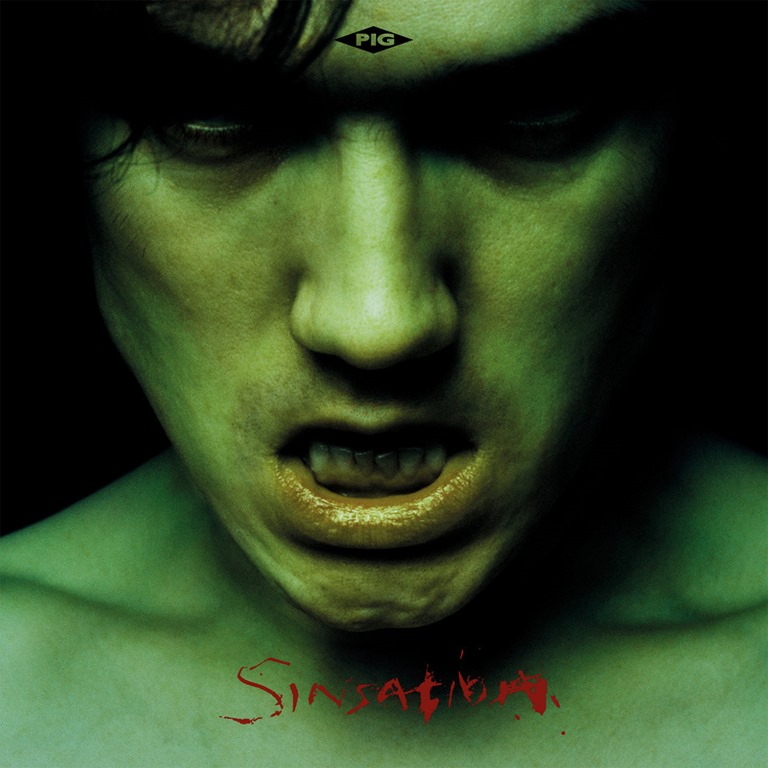
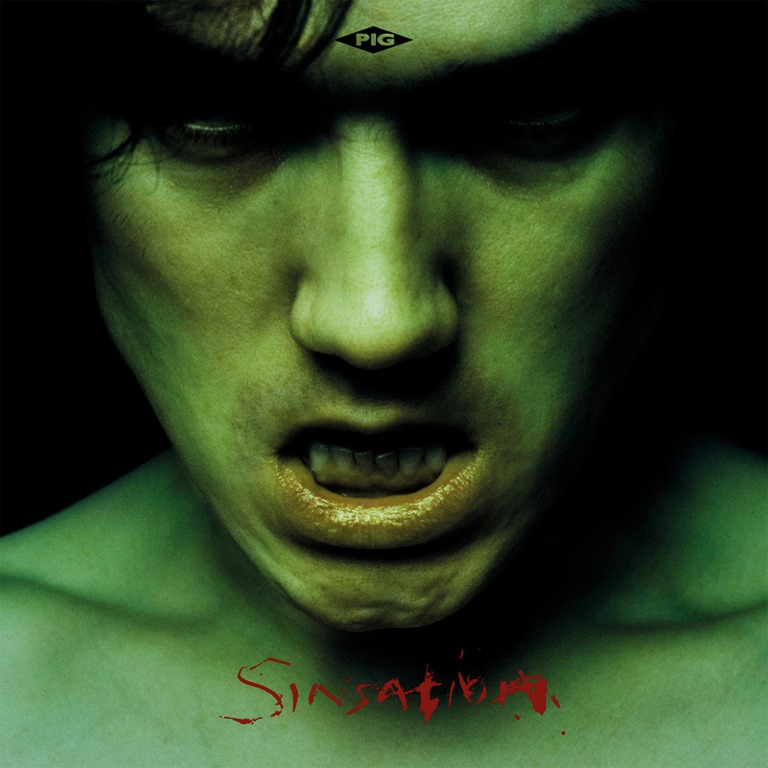
The cover alone is striking. Watts’ image is a standard feature on all PIG releases, but whereas more often than not he is depicted looking buff or brooding, the sickly green hue is unsettling – and slamming in with a series of orchestral strikes and a low, grumbling bass before hitting full-on industrial anthem mode on the first track, the six-minute ‘Serial Killer Thriller’ (the chorus of which provides the album’s title), it’s immediately apparent that Sinsation is something special (and not something sad…).

Admittedly, despite this being an album I’ve played to death over the last thirty years, apart from a few tracks being a few seconds different in their duration, I can’t discern any huge differences between this remastered version and the original: there are, perhaps, more details revealed in the mix, but then, the production on the original was impressive, and again, I’ll come back to that word, ‘detail’. There’s a lot happening; samples, snippets of bits and bobs, strings, multi-layered vocals… A touring member of Foetus early in his career, with JG Thirlwell involved in the early singles and debut album, Watts clearly learned much from Thirlwell, as well as his early involvement with KMFDM. Sinsation felt like the point at which he brought these two aspects together in perfect balance while simultaneously realising his own unique sonic vision. The result was a set of hefty, driving songs, exploding with ideas and noise, and so many layers, so much going off all over the place. It was bold, audacious, and while it’s easy enough to say that it’s a bit Foetus, a bit KMFDM, it goers so far beyond these points that comparisons are a diminishment of Watt’s achievements here.

Sinsation is certainly the first PIG album to showcase the full range of styles and compositional aspects Watts has in his locker, and as such, represents something of a creative peak.

While nominal single ‘Painiac’ (an early version of which was the lead track on a Japanese-only EP, and a video for which got a few spins on MTV on the album’s release) is a throbbing industrial beast of a tune, ‘Golgotha’ is a dark, semi-ambient interlude which sits between the driving snarl of ‘Hamstring on the Highway’ and the swaggering industrial-strength glam-tinged gospel-infused dark pop of ‘The Sick’, which would provide the blueprint for the PIG renaissance which started with The Gospel in 2016. ‘Analgesia’ is a magnificently atmospheric piano-led instrumental which incorporates elements of ambient and electronica and extraneous noise ‘Volcano’ is serpentine and sleazy, with some audacious orchestral work in the mid-section which take the bombast of Foetus’ Nail to another level, while ‘Hot Hole’ drives hard and heavy with pulsating electronics colliding with hefty chugging guitars and ferocious beats.

For the many who likely missed this the first time, this re-release provides the opportunity to make acquaintance with one of the definitive PIG albums, and for those already familiar, it’s a timely reminder of the incredible journey that has been PIG’s career to date, while offering the first chance to get it on vinyl. Almost thirty years on from its first release, Sinsation still sounds phenomenal – insanely ambitious, utterly deranged, and in a league of its own, quite unlike anything else before or since, even within the PIG catalogue.

AA

a2059987689_10

Following hot on the heels of his new album ‘Red Room’ (released in May 2024), industrial rock mainstay Raymond Watts aka PIG has today reissued a fully remastered version of his seminal mid-‘90s album ‘Sinsation’ via

Following hot on the heels of his new album ‘Red Room’ (released in May 2024), industrial rock mainstay Raymond Watts aka PIG has today reissued a fully remastered version of his seminal mid-‘90s album ‘Sinsation’ via Metropolis Records (CD, digital) and Armalyte Industries (deluxe 2xLP vinyl). Out of print for almost three decades, it makes a timely reappearance just ahead of a North American tour.

‘Sinsation’ was originally released in 1995 on Nothing Records, the label established by Nine Inch Nails kingpin Trent Reznor, and not long after PIG had opened for NIN at a number of shows. Nothing was an influential and commercially successful label with a cult underground following that also issued records by Marilyn Manson, Squarepusher, Autechre, Meat Beat Manifesto, Pop Will Eat Itself, Einstürzende Neubauten and Plaid, as well as NIN themselves.

(CD, digital) and Armalyte Industries (deluxe 2xLP vinyl). Out of print for almost three decades, it makes a timely reappearance just ahead of a North American tour.

‘Sinsation’ was originally released in 1995 on Nothing Records, the label established by Nine Inch Nails kingpin Trent Reznor, and not long after PIG had opened for NIN at a number of shows. Nothing was an influential and commercially successful label with a cult underground following that also issued records by Marilyn Manson, Squarepusher, Autechre, Meat Beat Manifesto, Pop Will Eat Itself, Einstürzende Neubauten and Plaid, as well as NIN themselves.

Check the video here…. Album review to follow….

AA

9af61b6130ce938e2fa6f1d2fbf2db35b6784588

ant-zen – 12th February 2024

Christopher Nosnibor

First – the format! So much is being made of the vinyl renaissance right now, and much as I love vinyl, it’s hard to be entirely comfortable with this comeback, in this form. Back in the 90s, when CDs were in the ascendence, I often bought vinyl because it was cheaper: I could pick up an LP for £7.50 when a new-release CD was £11. I still have the receipts in my vinyl copies of PJ Harvey’s Rid of Me and Pandemonium by Killing Joke, among other treasures. Now, vinyl is a luxury item. Even a standard LP is around £25, and many are pressed on two pieces of heavyweight vinyl and cost closer to £40, or more if released on Record Store Day. This isn’t right. It’s not honouring the format, it’s another example of exploitation.

But this is rather different, and altogether cooler on so many levels: ant-zen have brought us this release by Kojoohar & Frank Ursus in the form of a 7” EP, with two tracks on each side. You can’t blame them for the price tag given production costs, but the unique hand-printed inlays, etc., at least make each copy unique and make this release a million miles removed from the capitalist conveyor belt.

The thing that matters here is that this release is completely suited to this retro format: a 10” or LP release would have been extravagant, indulgent, and frankly, ill-keeping.

It’s worth quoting the liner note for the back-story here, too: ‘The spark that ignited this collaboration came from a conversation between KOJOOHAR and FRANK URSUS – aka Te/DIS – about the kojoohar album that has just been released at the time and about angst pop and its position in the music scene. talking about new tracks kojoohar was working on, the decision was made to start a collaboration.’

And so we’re presented with Frost Drought, which they describe as ‘a 4-track ep that offers edgy angst pop with analog, gripping synthesizer sounds, metallic rhythms and enigmatic melodies, complementing by frank ursus’ vocals… music and lyrics of FROST DROUGHT describe a world of isolation, mistrust, alienation and the individual’s distance from itself. left alone in the dark…’

Entering the ‘debris field’, we’re presented with dark synths, groaning, whining, whistling, and a slow-tempo-echo-heavy beat. If the baritone vocal is distinctly from the gothier end of post-punk, the instrumentation is equal parts post-punk and ultra-stark, bleak hip-hop. ‘never compromise’ pushes into stark, dark, electro territory, in the realm of mid-80s Depeche Mode. Ursus’ vocals are commanding, but so dark, and the music is so claustrophobic as to be suffocating. ‘never compromise’ sounds like a manifesto, and whipping snares sounds crack and reverberate in an alienating fog of synth, and with hints of Depeche Mode’s ‘Little 15’, it’s as bleak as hell, too. ‘threshold’ is dark and boldly theatrical, like Bauhaus battling it out in the studio with Gary Numan.

There’s no light here: this is dark and it feels like a dragging weight on your chest, on your heart. Drawing on early 80s electro but adding the clinicality of contemporary production – and a dash of Nine Inch Nails – Frost Drought is a challenging work, thick, dense, and intense, it’s a heavy listen, and one that’s incredibly intense.

AA

a3285530151_10

Negative Gain Productions – 9th February 2024

Christopher Nosnibor

Pitched as ‘a battle cry against the facade of perfection that suffocates an authentic connection’ and a song that’s ‘about the dark, often unseen journey of seeking forgiveness and finding solace in the unexpected kindness of strangers’ ‘Necessity Meal’ is perhaps the ultimate hybrid of everything that’s gothy and on the darker side of electro/synth pop.

I’d wager it’s pretty much impossible to write about ‘Necessity Meal’ without recourse to Depeche Mode. That isn’t to say it’s just some rip-off, so much as an indication of just how deep and broad their influence is felt at the darker end of the electro spectrum.

‘Necessity Meal’ is built around a rolling drum beat with a harsh snare, and some brittle, trilling synths pave an intro that gives way to some guitars that are by turns cutty and deliver strains of feedback. The verses are a bit rappy / spoken and I can’t help but think of it being like a gothy take on grebo and it sort of works but sort of doesn’t – in the way that The Sugarcubes worked but didn’t: you know, you either dug – or more likely tolerated – the Einar bits, or outright hated them as rubbish intrusions into some great songs, but ultimately, it worked because the Björk bits and the overall thing was more than worth the clash. This feels confused and confusing, a bit messy. But then, as front man Mychael says of the song, “In the end of it all, life can be rather messy, and I can sing if I want to, at my own pity-party!” In the mix there’s a bunch of noise that casts a nod to Nine Inch Nail, and…

…And so it is that from all of this sonic jostling emerges a magnificent refrain: the vocals suddenly come on like David Bowie, and with a heavy sarcasm, deliver the line, ‘Thank you, thank you for the guilt’. It’s unexpectedly, and almost inexplicably, affecting, but somehow, in this moment, the whole song, and everything around it makes some sort of sense.

AA

a0341299273_10

Metropolis Records – 3rd November 2023 (Digital) / 17th November 2023 (CD)

Christopher Nosnibor

Ian Ross’ electro-industrial project Flesh Field emerges, quite unexpectedly, from almost two decades of dormancy, twenty years in mute, to deliver ‘A concept work with each of its ten tracks representing stages of political radicalisation and violence, Ross states in the CD booklet that “believing falsehoods because those falsehoods reinforce our preferred narratives is not harmless. Promoting falsehoods to benefit your faction is not harmless, particularly in a well-armed society. If we remain locked in our own echo chambers, inevitably there will a voice of the echo chamber that speaks in the language of mass murder, believing it justified. This album describes that tragic inevitability.”

It’s not hard to ascertain ‘why now?’ While I’ve long become weary of the endless and continuing stream of ‘lockdown projects’ emerging, it’s a fair assessment that the pandemic did change everything. Confined, pressurised, and subjected to a relentless bombardment of news media, government ‘information’ and directives, and often with only social media for company beyond the four walls of home imprisonment, people struggled to separate fact from misinformation and conspiracy, reality from fiction and imagination.

I first really noticed the echo chamber some time before, in 2016, with the Brexit referendum in June, swiftly followed by the election of Donald Trump as US president in November. Both results seemed not only implausible, but nigh on impossible. No-one I knew or spoke to supported either as far as I knew – why would anyone vote for either of these outcomes? But against a backdrop of simmering tensions and social divisions and a general melee of things being pretty fucked, these seemingly unimaginable things came to pass. I would subsequently learn that relatives had voted in favour of Brexit ‘to see what would happen’. Fucking Boomers who won’t be around to live through the worst of the fallout. And this is how it goes when you have ageing populations and a swing towards the right in uncertain times. People seek to protect their own interests rather than the greater good. It doesn’t necessarily mean that echo chambers perpetuate falsehoods, but they do most certainly create confirmation bias, foster complacency, and distort reality by creating a bubble. And now… there is no way Ross could have predicted the dark turn that would assail the Middle East just a few short weeks ago. The divisions surrounding this conflict reverberate around the globe. And we watch. And we watch. It’s simply more TV, more unreality to many.

During Flesh Field’s protracted period of inactivity, their work continues to spread, like a fungus, or to perhaps use an analogy more akin to their own spheres of reference, like a virus, numerous tracks from their catalogue were placed in the soundtracks of films including the just released The Mill, TV shows such as True Blood and video games like Project Gotham Racing. Sometimes, being away is the best promotion.

But there couldn’t be a more appropriate time for Flesh Field to return, and Voice of the Echo Chamber is a powerful document reflecting these difficult times. The opening track, ‘

Crescendo’ stars strong, with a cacophony of babbling voices, before thunderous percussion and bold orchestral strikes build big drama. Not since Red Raw and Sore by PIG have I been struck by such a grand intro to an album, and this melds driving metallic guitars, industrial-strength techno beats and seething bombast. It’s a strong cocktail and one that hits the listener right between the eyes, paving the way for a set of ten insistent tracks all driven by loping sequenced synths and thudding hefty beats pushed to the fore and pumping, pulsating hypnotically. The are choral bursts woven into the dense fabric of the compositions, as well as strings and piano and incidental noise: ‘Catalyst’ crunches in with a harsh mechanised grind which gives way to a filly cinematic string segment before the pounding beat slams in and things get dark, like an industrial reimagining of Holst’s ‘Planets’ suite. The vocals are low in the mix and low in the throat. The delivery means the lyrics aren’t always especially audible, but the sentiment and energy is relentlessly loud and clear amidst the grunt, grind, and crackle.

‘Arsenal’ goes big, a gritty anthemic chorus paired with a crunchy industrial verse that draws together elements of NIN, KMFDM, and PIG, to big, big effect, being both attacking and cinematic at the same time. There’s plenty of attack here, but equally, Voice of the Echo Chamber is big on bold, widescreen, cinematic segments. ‘Manifesto’ is a monster, with all the guitars, all the orchestral work, and a relentless beat that hits hard and heavy and it all comes together to create a big, big sound. The pounding ‘Soldier’ is really big on impact, and contrasts well with the brooding, slow-crawling ambience and piano atmospherics of the unexpectedly gentle introduction to ‘Rampage’.

There’s a certain sense of uplifting empowerment to be found in the chorus of the last track, ‘Reset’. Ewe need this glummer of optimism in the face of so much relentless bleakness and gut-crushing darkness, which ends with more crowds, more shouting. You flinch and stall, because it’s too close, too real.

In places harsh and stark despite its enormity, Voice of the Echo Chamber is a strong, relentless, unyielding blast. I feel that this is a time to sit back, let things repercuss in their own time, and step back while Ian Ross blasts distortion, vitriol, and amplifies self-loathing with brutal force. Feel it.

AAAA

a2435923100_10

28th August 2023

Christopher Nosnibor

Techno/industrial is rather like craft beer. It was invented in Europe (KMFDM are obvious progenitors back in 1984), before being embraced in the States and with Wax Trax! almost singlehandedly spawning a factory for the genre, which in turn found significant popularity in mainland Europe, particularly in Germany.

English exponents are rather harder to come by, although Benjamin Blank, who has been working under the Binary Order moniker since 2008, is a worthy representative. His words on this latest single, lifted from forthcoming album The Future Belongs to the Mad (out at the end of November), illustrate perfectly why this mode of music is ideally-suited to life in Shit Britain: “’Slow Blade” is a reflection of the decline I’ve witnessed in my lifetime. It’s a decline that has gotten us to a point where we are more concerned with passing the blame than attempting fix the decay that has rotted away at us all, leaving many despondent and lost, myself included.”

I’m writing this in the week that, as schools are due to reopen after the summer break, hundreds are being forced to close or otherwise relocate students because the buildings are unsafe, built using cheap concrete which is structurally unsound and liable to collapse without notice. Our government has known about this for years, but has failed to act. And, indeed, over the last thirteen years, our infrastructure has been slowly crumbling – our roads, our sewerage systems, our rail network – as profit has been put before people, and we’ve become embroiled in petty patriotism, culture wars, and outright horrible racism and prejudice of every kind. It’s no wonder Blank feels as if our small island is sinking while the only things rising are rates of poverty, depression, and other mental health issues.

‘Slow Blade’ feels like a significant progression from the material which comprised previous album, Messages from the Deep. While it incorporated guitar elements, it was very much in the vein of early Nine Inch Nails, the sounds crisp, tight, overtly synth-dominated. In contrast, ‘Slow Blade’ is far more gnarly, far dirtier, more raw, rough-hewn, and simply more metal. And not the kind of metal you’d likely associate with industrial – the likes of Ministry or perhaps Godflesh – but gritty, murky black shit smashed together with the guitar slabs of nu-metal. At least, to begin with – because ‘Slow Blade’ is a song of psychotic multiple personalities, and a song in three parts.

Unexpectedly, the songs slows and goes first expansive and melodic, then explodes in a frenzy of stuttering techno beats that’s more Fixed than Pretty Hate Machine, and then it brings the two elements together in the third and final stage. While to suggest it has a particular arc, narrative or otherwise, feels like something of a stretch, ‘Slow Blade’ transitions through a series of emotions, from blind raging fury to the acceptance of defeat as everything collapses. The end is final. And we all know it’s coming.

AA

082306

Brutal Resonance / Confusion Inc. –21st July 2023

Christopher Nosnibor

One thing I find – often – is that I keep encountering acts who have been going for quite literally decades without my having the slightest knowledge of their existence. This is a source of frustration: after all, I like to think I not only have my ear to the ground – so to speak – when it comes to emerging artists, but that I am pretty well connected with labels and PR. But then, so much of the music industry, it seems, is about luck and change encounters, and being at the right place at the right time. That, and the fact that existing in underground circles for a decade or more doesn’t mean that the chance of rising up toward the light is anywhere near remotely assured.

And so it is that I have been blissfully unaware of Slighter – the solo moniker of Colin C., who it appears, according to the bio, ‘has been fine-tuning the future of electronic music since kickstarting his music in Mid City Los Angeles in the early 2000s… Creating from a unique vantage point, he was involved in collaborations for various Metropolis Records releases and Cleopatra Records compilations, in addition to Slighter releases via his own Confusion Inc. imprint.’

‘How?’ I ask myself, and again, ‘how?’ I’m not only a fan and follower of these labels, but frequently get sent releases for review. I’ve mentioned perhaps a few times now – or more – how Cleopatra tapes were an integral part of my introduction to goth, and subsequently, Metropolis have been the outlet for some of my favourite more industrial-leaning acta like PIG, who I’ve been a fan of since they supported Nine Inch Nails on The Downward Spiral tour back in 1994. It might have wiped me bang in the middle of my A-Level exams, but fuck, the trip to Wolverhampton was worth it.

This is apposite. It seems almost impossible to discuss anything in the bracket of contemporary industrial without recourse to either Niner Inch Nails or Ministry, depending on whether the music is of an electronic or metal persuasion. It wasn’t always this way: from the 70s and through the 80s, industrial was a different beast, but circa 88 or thereabouts, something happened. It’s hard to really pinpoint what that something was, but it definitely happened.

And so it is that Slighter’s latest, The Futile Engine, is some strong work, which sits in the post-NIN industrial bracket, while owning a certain debt to 80s Wax Trax!. ‘Introspection Illusion’ announces its arrival with a squall of noise, a scream of electronica, and some muffled, subterranean vocal whisperings which are dark and unsettling… and then the machinery grinds into action and things really get heavy, and in no time we’re submerged in a throbbing barrage of noise, driven by a thudding industrial disco beat.

‘Pulling Me Under’ is more obvious brooding industrial dance with whirling synths and mangled, menacing vocals pitched against pounding beats. This sets the tone for the album as a whole: ‘Have No Fear’ is dark and sparse, a mechanised beat pulsating in the background against menacing close-mic vocals and we’re deep in PHM terrain here. In contrast, ‘Nostalgia Hysteria’ launches headlong into trance territory, tweaking the 505 in a full-on Josh Wink style.

They plunge deep into dark waters with the more experimental ‘Memory Corruptor’, but so much of The Futile Engine is simply dance music with some darker edges that it’s hard to really engage with. And the trouble I have with so much dance music is that it feels cold, clinical, impersonal. Perhaps it was the lack of drugs that mean I never got 90s rave or techno. But this doesn’t gain more appeal with time, and that’s a fact.

The Futile Engine has its moments, for sure, its execution is pure perfection, and the album displays a knack for insistent beats… but it’s exhausting. Unless you’re seeking relentless beat torture, you probably won’t dig this.

AA

a0419039551_10

1st June 2023

Christopher Nosnibor

Sometimes, things don’t work out. It’s sad, but it’s life. But it’s how you deal with these setbacks that counts. Just over a year ago, I was getting enthusiastic about Warning Signal, a band who looked set to be ones to watch with their full-throttle gritty-industrial pop that was a head-on collision between Nine Inch Nails and Garbage. But, it was not to be.

But Eva Sheldrake is back and kicking it hard fronting new power trio Eville, and while there’s a clearly a shift from her previous project, the key ingredients remain in place, namely hard-edged metallic guitars and a crackling dark energy. ‘Messy’ melds goth and industrial and stitches them together with a pop sensibility, making for a high-impact tune – and again, clocking in at just over two and a half minutes, it’s succinct, and all the better for it, with there being no room for any tracer of flab or indulgent wankery.

‘Messy’, in songwriting terms, is anything but: they’re straight in, a back and forth slap round the chops, and out again before you know what’s hit you. It’s heavy but melodic and catchy, and if there are hints of nu-metal in the mix, there’s a lot more besides.

Jamie Sellers’ production nails it, balancing fizzy distortion with crisp, digital cropping and sharp edges, making it radio-friendly without dulling the serrated edges. Here’s hoping the second bite of the cherry is the one that delivers the pie – or some other failed extended metaphor relating to attaining well-deserved success, because they absolutely deserve it on the strength of this release.

AA

347123297_1197676684264041_4239722450375332471_n