Posts Tagged ‘Jazz’

La Force, the mesmerizing solo project of Ariel Engle, who has spent more than a decade as one of Canada’s most sought-after musical collaborators has shared ‘October, the second single off her forthcoming album XO SKELETON out September 29 via Secret City Records.

The first offering – ‘Condition of Us’ – has been received warmly by fans and critics alike, CBC Music stating, “Engle’s voice, wise and warm, envelopes the track, [..] Her words wrap around the music in odd ways at times, like a stream of consciousness versus melody, but the love that’s beaming from Engle is undeniable,” Clash Magazine thinks it’s “the sound of an artist moving deliberately towards evolution.”, while Guy Garvey (Elbow) at BBC6 Music said it felt “accomplished, passionate and slick. I love it.” The song was also praised by Stereogum, Brooklyn Vegan and more. ‘October brings warmth to the XO SKELETON album – a lush, intimate song with incredible vocals embracing soul, smooth jazz and r&b – all the while reminding some of the “quiet storm” movement from the 90s.

“October is a time of harvest here [in Montreal]. It’s a time when we settle into darkness and leaves drop from the trees. It’s a time when we turn inward into our clothing and protective shells. It’s a song about the voices we internalize. People we can no longer see but whose voices and words live on inside us and shape us. It’s a song about the uncanny. A song about the cycles of nature, cycle of life. The song reminds us that despite our grand feelings we are just like animals and plants, destined to be born, to live and to die.” – La Force

The video for ‘October’ is directed by Ariel herself and Ali Vanderkruyk. Watch it here:

AA

94ada8e7-dd5d-920f-0d17-25ea4dc5d39e

Photo credit: Mary Rozzi

Christopher Nosnibor

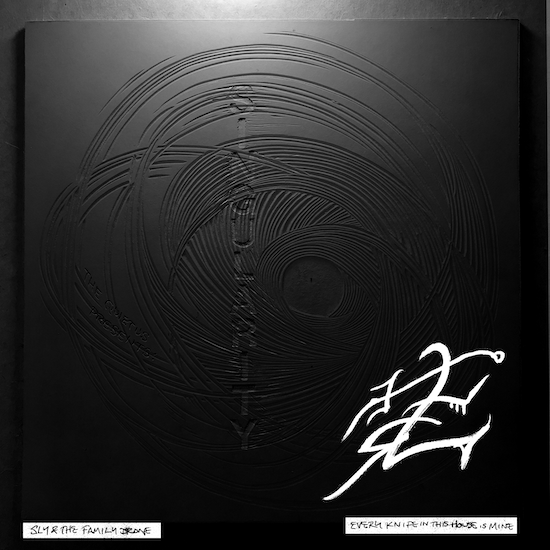
My openness to different genres has expanded substantially in the fifteen years since I began reviewing as a ‘proper’ thing fifteen years ago, although it’s perhaps only more recently that I’ve come to truly be accommodating of, and even appreciate, overtly jazz works. It’s been quite a journey. But I still very much have limits of what I can handle, meaning I can dig Cinema Cinema’s free jazz period and the warped rackets of The Necks and Sly and the Family Drone, and recently, I’ve dug the new album by Anna von Hausswolff, but not Trondheim Jazz Orchestra & The MaXx. But I haven’t witnessed this kind of stuff live, really.

Presented with a rare opportunity to get out for some beer and live music, and with travel options rather limited, I found Leeds and York offering slim pickings for tonight, and since I wasn’t on the market for third-generation ‘nu’ metal, I elected to make a trip to Hyde park Book Club, a venue I know and like, despite the long hike from (and back to) the train station, and haven’t visited since August 2020, when Talkboy played an acoustic set. Those inter-lockdown socially-distanced seated gigs where going to the bar was against the rules were strange and feel like another lifetime now.

It’s also been a long time since I spent any real time in Leeds, with recent trips being confined to car / train – gig – home: today, I got to spend an afternoon wandering between pubs, and sitting and reading and people watching over a few leisurely pints. Living in the rather conservative, white, middle-class and socially un-diverse York, I’d forgotten about Leeds, fashion… There are still hipsters, lot of hipsters… and beards, lot of beards… and also mullets… Above ankle drainpipes… Cropped vests… Flat caps… and moustaches: lots of moustaches.

Leeds trio Slozbo Kollektiv are first up, and they serve up a set of the kind of clean, crisp, technical noodling that never really seems to get going or take form. or find a groove… Initially, I’m struck that the drumming is as tight as fuck and the way he handles his sticks is something worth watching. He uses an array of broken cymbals to create a whole host of far-out percussive effects, laying one atop the snare to create a different kind of clatter… But then how tight is the playing when there are no rhythms to speak of, only rattles and bursts of percussion? The set is defined by so much discord and busyness… I find my thoughts becoming as fractured as the compositions. There are, it would seem, extremely tight structures here, but they’re chaotic, esoteric, and non-linear…. Playing two guitars and a horn simultaneously… How many notes can they fit into a bar? Vocals seem fairly redundant, and I come to thinking that they sound like shit musicians pretending to be good ones by playing as many notes as fast as possible and not knowing when to stop. It made for the longest 40 minutes ever.

IMG_20230711_201549

Slozbo Kollektiv

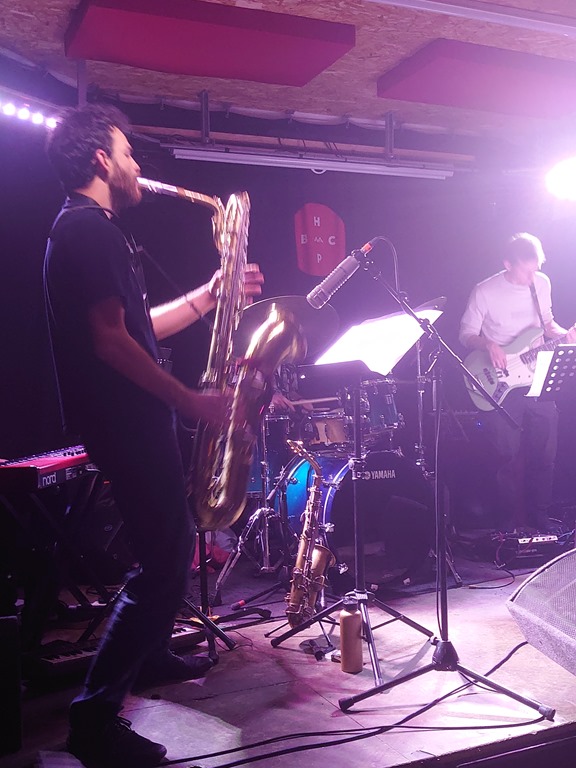
Fergus Quill’s ensemble features the same fascinating drummer, and the bassist from Slozbo Kollektiv is the keyboardist, and again he removes his sandals to play. Compared to Slozbo Kollektiv, this lineup brings more groove, more noise, and a bit of space rock, but still a lot of wanking with the added ‘bonus’ of some big ska overtones. No. Just no. And using your thigh as a mute for a sax? Also no. It does kinda work, but looks ridiculous. Fergus’ counting on of not only the tracks, but each section after a meandering detour gets tiresome and predictable, too.

IMG_20230711_210034

Fergus Quill

Selecting lineups for gigs is not easy: a little bit of range can make for great energy and an interesting night, but too diverse and it simply doesn’t work. A lineup of similar bands is sure to draw punters who will likely appreciate all the bands on the bill, but can lead to a surfeit of sameness, something which can happen in any genre, but was particularly prevalent during the post-rock explosion circa 2004. By the time you’ve stood through three instrumental post-rock acts with their extended passages of chiming guitar interspersed with crescendos, you’re weary of it all by the time the headliners take the stage.

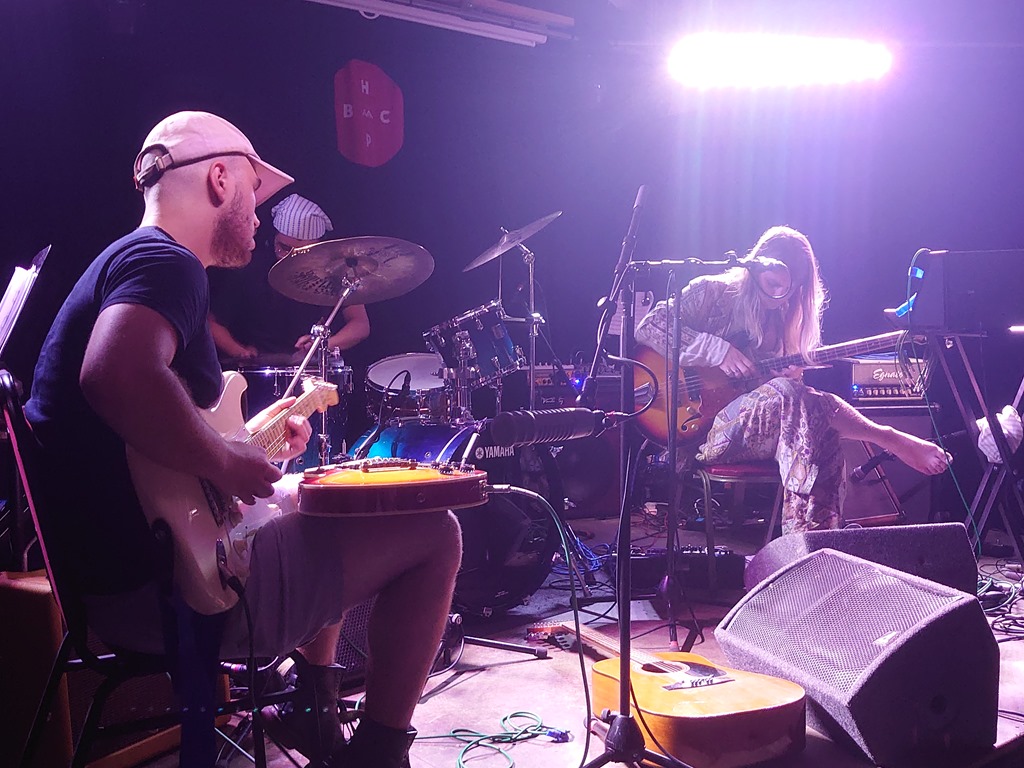
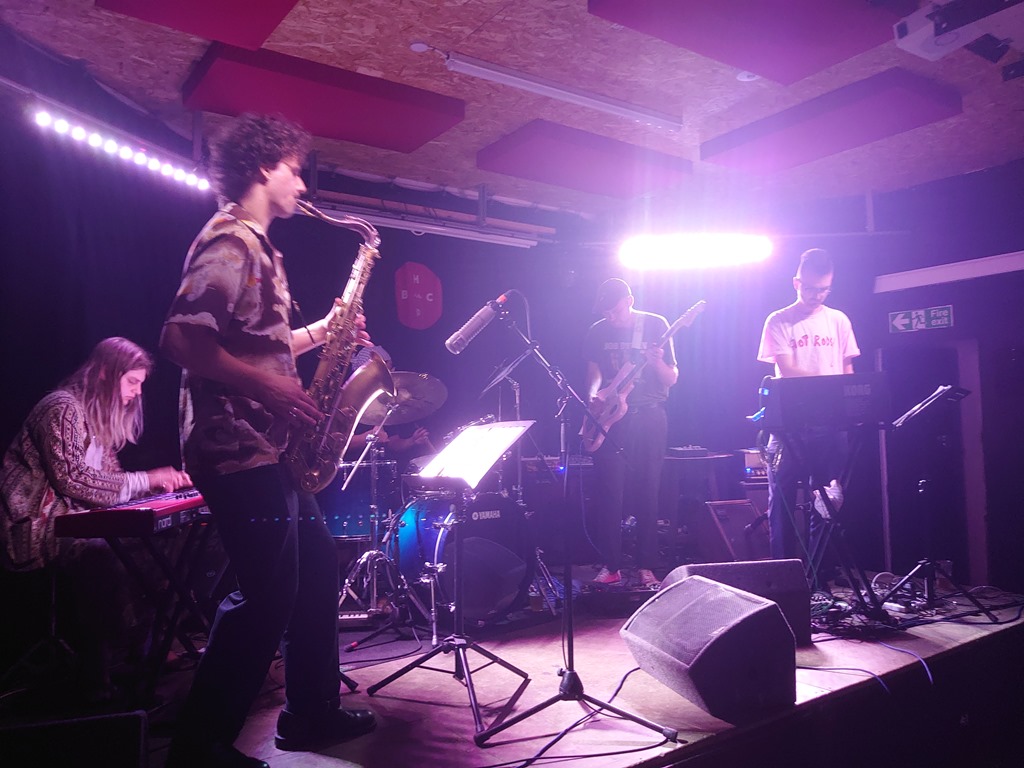
And so it is when Shatner’s Bassoon take the stage. I’m flagging, all jazzed out. Their material – and tonight they’re airing new material ahead of recording it for their forthcoming album – is more structured, atmospheric, building and forming shapes. There are some solid rhythms, moments where they actually settle into something for a time, instead of a constant explosion of sound in all directions all at once. They’ve clearly put the rehearsal time in, and there are all the tempo changes, enough to give you whiplash as they leap and lurch from one segment to another. People are really wigging out down the front, albeit mostly members of the support acts. It all starts to get a bit much after a time: they deal in discord, and the guitar sounds like twanging elastic bands. It’s when I see a guy nonchalantly bopping along from one space to another while clicking his fingers by way of applause I decide I’ve had enough.

IMG_20230711_220713

Shatner’s Bassoon

There’s no knocking their musical proficiency or adeptness in their field, but there’s noise and there’s noise, and it’s just how I’m wired that once thrills me and the other bewilders, and when you’ve got a bunch of people on stage all playing as hard and loud as they can but not, seemingly, all playing the same tune, I find it hard to dig. For all that, it was good to get out, and they definitely put on a show.

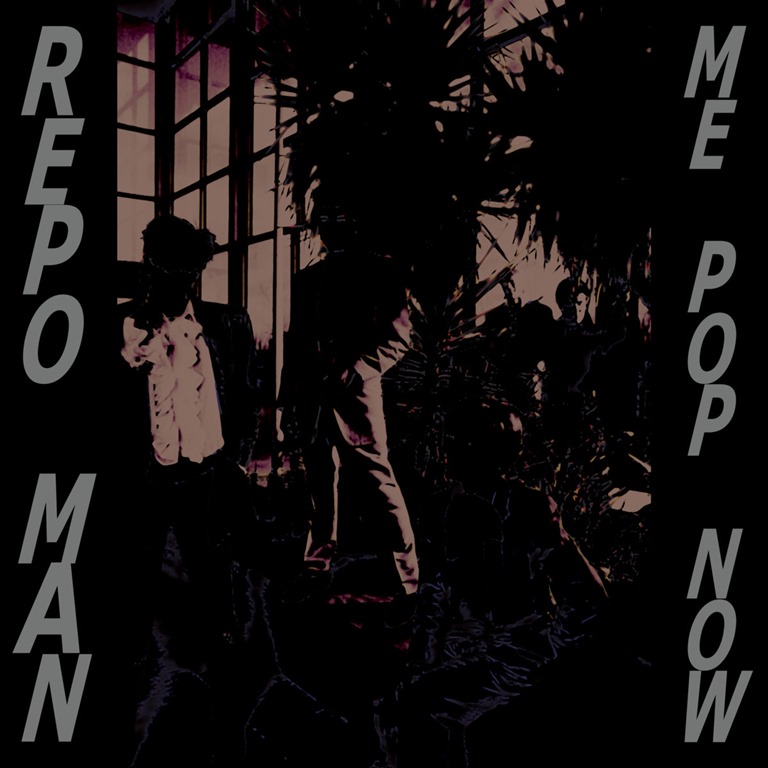
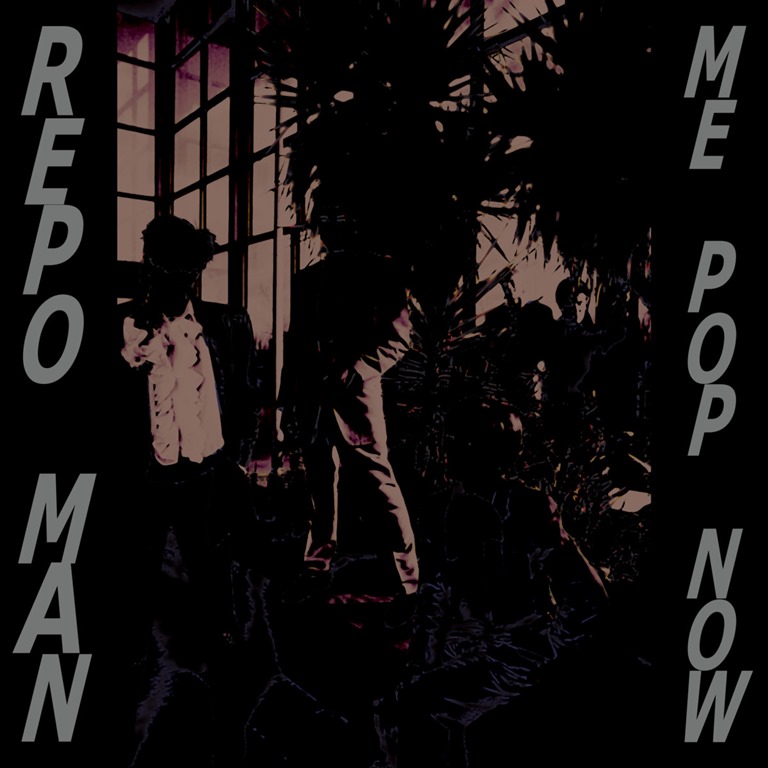
‘Sirhan Sirhan’ is the first track unveiled from the new Repo Man album Me Pop Now recorded at Giant Wafer Studios in Mid-Wales by Wayne Adams (Bear Bites Horse) in June 2022.

Me Pop Now is coming out July 24th. Me Pop Now will be physically released through Cruel Nature Records and Totality on a limited run of cassettes and CDs respectively.

‘Sirhan Sirhan’ is jazzy and proggy and groovy AF and a whole lot more besides. Check it here:

AA

a1000141308_10

Invada Records – 30th June 2023

Christopher Nosnibor

You know what? This never gets tired. I started reviewing live stuff in the 90s, but it wasn’t until 2008 I started receiving albums for review. Receiving albums ahead of release was a big deal back then: it made me feel somehow special. Advance promos probably meant something more then, on reflection. They would be, more likely than not., a single CD – or even a single-track CD – and my objective would be to get my review out ahead of, well, as many people as possible. It wasn’t so much about generating buzz as feeling a buzz.

I miss the steady drip of CDs and vinyl through the letterbox, although am coming to accept that space is an issue here, and if the endless bombardment of emails with downloads and streams sometimes – often – feels overwhelming, with up to fifty review submissions a day, when I clock a release I’ve been getting excited about well before time, the buzz still hits.

The way albums are released now isn’t quite the same, either: time was when there would be a single or two ahead of release, there’d be reviews and then the album would arrive and you’d have to buy it to hear it. Now, singles aren’t really singles and half the album’s been released on various streaming platforms along with a bunch of lyric videos and ‘visualisers’ (that’s one for another time). But having only slipped out a couple of tracks in a relatively low-key fashion in April and May, this landing in my inbox to download ahead of release, gave me a genuine buzz.

Gas Lit, released in 2021, was a powerful, album on so many levels. As they put it, the album was their ‘fight for Indigenous Sovereignty, Black and Indigenous Liberation, Water, Earth, and Indigenous land given back.’. The Australian duo make music with meaning, and do so with passion and sonic force.

How often do we hear recently that the failings were systemic? Systemic failings in the NHS led to deaths, and systemic failings in the schooling system resulted in kids committing suicide, systemic failings in vetting and so on has resulted in a culture of racism and misogyny in the MET police… daily, we hear or read news about systemic issues. And we know, we know the system is fucked. Not merely flawed: fucked.

And on fourth album Systemic, Divide and Dissolve examine ‘the systems that intrinsically bind us and calls for a system that facilitates life for everyone. It’s a message that fits with the band’s core intention: to make music that honours their ancestors and Indigenous land, to oppose white supremacy, and to work towards a future of Black and Indigenous liberation.’

“This music is an acknowledgement of the dispossession that occurs due to colonial violence,” says Takiaya Reed, saxophonist and guitarist in Divide and Dissolve. “The goal of the colonial project is to separate Indigenous people from their culture, their life force, their community and their traditions. The album is in direct opposition to this.”

Divide and Dissolve represent a people for whom the system hasn’t failed: it was always pitched against them, and succeeded in stripping Indigenous people of everything. What kind of system is it where this brutal debasement is a success? A capitalist one, of course.

Systemic certainly isn’t a flimsy pop record, then. But it is inherently listenable and does unashamedly incorporate pop elements, and this dynamic only serves to heighten its sonic power.

‘Want’ lulls us into a false sense of tranquillity, a looping motif pulsating over grand drones: it’s quite pleasant, even. And then ‘Blood Quantum’ hits: after a delicate, supple chamber-pop intro, the guitars crash in and it’s like a tidal wave. It’s a slow-stomping riff that grinds hard, and the textures are thick and rich.

The setup is simple, and the guitar and drum combo has become increasingly popular in recent years – but for all of its limitations, it also has considerable versatility, and Divide and Dissolve exploit and push those parameters by exploring the interplay between the two instruments when played slow and heavy and at high volume. And so it is that without words, their songs convey so much.

Photo_by_Yatri_Niehaus_516198

Photo by Yatri Niehaus

There’s almost something of a Duane Eddy / Western twang to ‘Simulacra’ before it explodes in a thrashing flurry of distortion and pummelling percussion. But for all the sludge-laden noise of ‘Reproach’, there is a grace and beauty about it, too, and this is what differentiates Divide and Dissolve from their myriad ‘heavy’ contemporaries: they imbue their songs with a palpable emotional depth. ‘Indignation’ begins with trilling woodwind, and possesses a wistful, aching jazz vibe before the thunderous deluge of guitar and drums heaps in. Featuring a spoken word recital from Minori Sanchez-Fung, ‘Kindgom of Fear’ is the only one of the album’s nine tracks to feature vocals: it’s a more minimal musical work which allows the words to stand to the fore, supplementing them with atmosphere and adding further variety and contrast to the album, notably ahead of the ragged riffery of ‘Omnipotent’.

The tranquil strings of ‘Desire’ provide the perfect bookend to stand opposite ‘Want’, and their synonymity is highlighted in this way. To want, to desire, something – something back – seems reasonable, should not need so much fight… but while there is the need to fight, Divide and Dissolve make protest music. It may not be protest music in the way many of us recognise it, but slogans and punk and folk are tired and worn, and on Systemic, Divide and Dissolve speak in their own strong and powerful way.

AA

644835

14th July 2023

Christopher Nosnibor

I could harp on about how I was introduced to Cinema Cinema way back some time around 2012 when I was writing for fringe magazine Paraphilia, and the fantastic interview I got to do with Ev Gold on the release of their second album. But my recollections for dates are hazy, and no-one really cares.

Cinema Cinema simply don’t do predictable. The only thing you know to expect for sure is that whatever they do, it’ll be different. There are few bands so committed to the pursuit of doing whatever the fuck they please. While many will find a sound a adhere to it, or otherwise make a marked shift in direction having worn a template out, Cinema Cinema push themselves with each record to be different, and to see just how far their can expand. They describe themselves as art-punk, and have been described as ‘experi-metal’, while venturing deep into the terrain of avant-jazz on their two collaborative releases with Matt Darriau of The Klezmatics (CCXMD (2019) and CCXMDII (2021)). There is something uplifting to see a band who refuse to be defined or limit themselves: Cinema Cinema are whatever they want to be.

For this latest outing, their seventh album, the New York cousin duo is again trio, this time featuring the mighty polymath percussionist Thor Harris. Having witnessed Harris performing with Swans, he is an immense presence onstage – and that also translates to her performances in general. The man can turn his hand to practically any instrument that can be used for percussive purposes, and he doesn’t just bring percussion, but an impressive collection of synths to the party, marking another substantial shift in Cinema Cinema’s sound on Mjölnir. It couldn’t be much mor dramatic: they’ve not only ditched the free jazz but gone for short, punchy pieces: with the exceptions of ‘Zero Sum’ and ‘Voiceless Idaho’, the majority of the album’s eight tracks are around five minutes long or shorter. Structurally, then this is different: the last couple of albums featured ten, even eighteen-minute monsters with sub-two-minute interludes. As such, Mjölnir feels more even, more balanced.

It also feels like something of a return to their noise roots, as demonstrated by recent single, the roaringly aggressive ‘War On You’, a driving explosive sonic attack that sounds – quite unexpectedly – quite like The Screaming Blue Messiahs with its thunderous drums and choppy blues-based riff – while at the same time pushing in yet further new directions. And those directions are myriad: Mjölnir is the musical equivalent of an octopus, its tentacles reaching in all directions at once.

But before that, ‘This Dream’ is a warped nightmare of woozy, bending synths, dark drones and twisting discord. There’s a nagging bass groove that sits somewhere between Air’s ‘Sexy Boy’ and Suicide. That probably should not be a statement that even exists, but it’s a measure of Cinema Cinema’s range, and the fact they make it work is a whole other matter. The guys have a rare knack – and that’s an understatement.

‘Zero Sun’’, the first of the album’s sprawlers, — this one clocking in at seven minutes and forty-five – is a beast, with trilling organs and lasers on stun – and couldn’t be much more of a contrast to the chopping, drum and bass0driven blasts that define the album; s sound.

Mjölnir is tense, and Mjölnir is and noisy. There are moments that worder on progressive, but overall, it’s noisy, aggressive droney, and exploratory. It’s not an easy listen: for as much as it’s got name contributors, it’s challenging, antagonistic. No two tracks are alike, and instead the tracks are blurring… ‘Blurring’ is bewildering, and the bleak vocals of ‘Voiceless Idao’ which border on the demented as they scrape across a track that wrestles with itself into crumbling and collapse.

The shrieking cacophony of that last track is particularly hard-hitting, and reminds us of what Cinema Cinema’s recent work have been lacking: riffs. That’s no criticism: they recent works just haven’t been very riffy. But now, the riffs are dank and dense and it’s no hyp to say that Mjölnir finds Cinema Cinema at their absolute peak. This… yeah, this is good alright.

AA

digital_cover_mjolnir

Music Information Centre Lithuania – 7th June 2023

Christopher Nosnibor

This is one of those releases where the context counts for almost as much as the content: ‘The cycle of nine vocal, instrumental, and electroacoustic pieces, Ramblings, a large part of which was written as music for the scandal-plagued drama play Literature Lessons by Jonas Vaitkus, was recorded in 1985 in the legendary Vilnius Record Studio, which at that time was very open to experiments. The recordings were made using a multi-channel tape recorder, a borrowed KORG synthesizer, saxophones, a prepared piano, a cello turned into a noisy bass, percussion, and bells. The composer used all the texts and the title for the cycle from the poetry collection Ramblings by Almis Grybauskas. According to the composer, this poetry is minor, cold, and laconic, like his favourite cool jazz style, while the title Ramblings itself raises a lot of questions, is a bit provocative and irritating.’

‘Provocative’ and ‘irritating’ are appropriate enough adjectives, it has to be said. Indeed, ‘ramblings’ suggest something unfocussed, incoherent, unstructured, and this is a wild ride which flies off on tangents every which way. Yet while the shapes of these compositions may be loose, there’s a definite sense of purpose, not to mention an atmosphere about them.

The further story is significant to this release, and it provides not only a fascinating insight into the way politics can often be the enemy of the arts, but also freedom of expression more broadly. It’s also a tale of underground rebellion, defiance, and strength of will.

‘After the premiere of the performance, the composer could have had a very bad ending – after “terrible” reviews and complaints appeared in the press, the Soviet censorship ordered the performance to be banned and the creators punished. Even the head of the composition department at the time suggested that this “cacophony” should be given the lowest grade, condemning Šarūnas Nakas to be expelled from the conservatoire, which would have meant being conscripted into the Soviet army during the Afghan war. Fortunately, professors Julius Juzeliūnas and Bronius Kutavičius saved their student.”

I mean, it is a “cacophony”. Ramblings is a jumbled mass of layered vocals, atonality, and exploratory jazz, the kind of jazz that prioritises performance over listenability, the kind of jazz that’s about the experience, the kind of jazz that’s interested in the relationship between notes and isn’t afraid of dissonance, discord, variable time signatures. At times tranquil, at others ominous and abstract, there are parts of Ramblings which are wild, chaotic, completely unconstrained. This is, of course, just how it should be.

The story continues as to how thew work escaped destruction at the hands of its persecutors: ‘It was the time of cassette tape recorders, and music was quickly reproduced, so Ramblings began its own journey, playing as background music on radio and television but never being published as a complete cycle. Later, only one piece called ‘Merz-machine’ was singled out from the cycle as an example of Lithuanian experimentalism and released in 1997. It then underwent a kind of renaissance: versions were created for different ensembles, including the Czech avant-garde rock orchestra Agon and the London piano sextet pianocircus. The sextet has performed the work more than 100 times in dozens of countries.’

It’s fascinating how an obscure musical work can infiltrate so many different channels, and effectively exist in a life entirely removed from itself. Consider the fact that parts appeared, internationally, unknown and uncredited. This isn’t only the most remarkable example of subversion for a supposedly ‘banned’ work, but also demonstrates how music can take on a life if its own. ‘Merz-machine’ is, without doubt, an outstanding piece, challenging and discordant as it is, but it’s only partly representative of the album as a whole: it’s certainly by no means background music.

The fact of the matter is that there is no one pierce on Ramblings which is really ‘representative’. Ramblings is truly eclectic, and odd, and that’s its design, its objective. From a critical perspective, it’s almost immaterial whether I like it or not – and I certainly like some pieces more than others – but it’s not aiming to please, and certainly not aiming to please all of the people for the duration. Despite being almost forty years old, Ramblings sounds contemporary – and still sounds challenging. That’s timeless.

AA

MICLLP004_front

Riot Season Records – 23rd June 2023

Christopher Nosnibor

Having had something of a chuckle at Henge for their pseudo-space mythology and psychedelic psilliness, I find myself squaring up to purveyors of genre-straddling experimental doom, Codex Serafani. Their biography explains: ‘Their journey started a long time ago, some say on Saturn, some say in the subconscious of the human psyche, coming out in different manners through the ages, channeled by mystics, witch doctors, shamans, free thinkers, free spirits. But we do know that what has become Codex Serafini travelled here from their home world on Enceladus in 2019 and crash landed into the music scene of Sussex.’ Of course they did.

But what are the chances that a I’m writing this review, an article from The Guardian pops up in my news feed reporting on how astronomers have spotted a six-thousand mile plume of water vapour blasting from Enceladus – a small moon belonging to Saturn believed to be one of the most promising places in the solar system to find life beyond Earth? As coincidences go, this was an usual one, and one which befits this band.

With a name which references Luigi Serafini’s Codex Seraphinianus, an illustrated encyclopaedia of an imaginary world, written in an imaginary language, it’s clear these guys have a keen interest in the realms of fantasy and mythology, to state it lightly.

I suppose that the concept piece whereby the concept includes the artist as much as, if not more than, the album goes back to Bowie – but back in 1972, this was new and novel, and moreover, Bowie was unique and an artist whom you could almost believe was from another planet. But even then, however much the concept became all-encompassing, it was also clear that the concept was a persona. But to base an entire career on a persona – not a media or public persona, but a far-fetched one which requires the suspension of disbelief – can be somewhat limiting. Where do you go when you’ve explored the concept to its logical limits?

In creating such a vast and multi-faceted alternative universe, Codex Serafini have ensured an abundance of time and space in which to explore and expand their concept, and rather than it being self-limiting, the challenge will be to test the capacity of their imagination, not only conceptually, but also musically.

While the adage that you should never judge a book by its cover hold some merit, one can tell much about an album by the ratio of its duration to the number of tracks, and The Imprecation Of Anima has a running time in excess of forty-five minutes and contains just four tracks. We know we’re in ‘epic’ territory before hearing a note, and the first of the four compositions, ‘Manzarek’s Secret’ unfurls slowly with a long droning organ (which one suspects is no coincidental nod to The Doors) and chiming percussion. It’s not long before a thick, gritty bass and reverb-heavy vocal incantations are joined by some wild brass to burst into the first of numerous big, jazz-flavoured crescendos. At nine-and-a-half minutes long, it’s epic, but only an introduction ahead of the fifteen-minute swirling mystical monster that is ‘Mujer Espritu’, which brims with Eastern promise and sprawls in all directions at once.

Single release ‘I Am Sorrow, I Am Lust’ is perhaps the least representative song of the album as a whole: it’s snappy, exuberant, uptempo, jazzy, rocky, busy, climactic, and fairly structured – and clocking in at three minutes, it feels like a single when standing alone, but more like an aberrant interlude in context of the album ahead of the seventeen-and-a-quarter minute ‘Animus in Decay’. Now this is a wig-out! It’s heavily psychedelic and transitions through a succession of passages on the path to – what? Enlightenment? It’s certainly a journey, whichever angle you approach it from. It builds and grows in volume and tempo, then falls again and there are some expansive ponderous sections and shifts like sand dunes in a vast sonic expanse.

And so it may be that the concept is a little daft, but they deliver The Imprecation Of Anima – a work that’s as ambitious as it is immense – with absolute conviction, and the vast sound pulls you into Codex Serafini’s (other) world. Inventive and accomplished, it’s a truly mighty record.

AA

thumbnail_THE IMPRECATION OF ANIMA FRONT copy

Panurus Productions – 5th May 2023

Christopher Nosnibor

What is this? Sludge-jazz? Avant-doom? It’s certainly not quite like anything else you’ve ever heard.

The Leeds act – who despite several years of hard-gigging to refine and hone their sound, I’ve not previously encountered – describe their debit long-player as ‘a modern doom tome in which thrashings of drums, bass and guitar find kindred spirits in larynx-shredding vocals and lamenting horn arrangements, delivered on trombone and saxophone.’

It’s the lamenting horn (I often find myself lamenting my horn, too) and grainy guitars that greet the listener at the opening of the album, the first crushing bars of ‘Accursed Land’ offering a strange sonic experience – strange because it’s neither one thing nor the other. And when it drops down to just bass, the rasping vocals are the sound of purgatorial torture. The bone-dry vocal chords sound like sandpaper in a desert, before the instruments return to conjure some sort of doom rendition of a Hovis advertisement. It’s circa 2004 post-rock with the most pungent metal overdrive, the track’s explosive finale a punishing experience, like a Satanic I Like Trains or Her Name is Calla as dragged through the flaming bowels of hell.

The riffery steps up several notches on the heavy grind of ‘Arise’, but it’s the manic brass that really messes with your ears and your head. Brass isn’t a new feature in metal: These Monsters, another Leeds act from back in the day who pitched noise and psychedelia with mental sax are obvious precursors and possible influences, but Lo Egin scribble all over the template and make everything louder, gnarlier, messier. And yes, Volumancer is seriously fucking messy, mangling everything together all at once ins a genre-crunching morass of disparate elements which coalesce to create something utterly mind-warping.

Half the time, you find you’re utterly revved and raving, marvelling at the ingenuity and the enormous weight of Volumancer; the other half you’re baffled and bewildered , wondering how much you’re actually enjoying this while feeling dazed after the relentless punches the album lands. The album’s centrepiece is the ten-minute ‘The Things His Highness Overlooked’ and it’s a magnificently mellow slow-drone jazz piece which borders on a chamber-orchestra arrangement, where layers of brass overlap one another, until about three minutes in when the guitars and drums crash in and it scales the heights of epic while bringing crushing weight.

This album may only contain five tracks (six if you get the cassette version with a bonus cut), but it has a running time of nearly forty minutes, and it’s a beast.

Brutal, ugly, yet beautiful and glorious, Volumancer is something else. What that something is, I have no idea.

AA

cover