Posts Tagged ‘Industrial’

Metropolis Records – 23rd August 2024

Christopher Nosnibor

Even at their commercial peak, PIG releases weren’t all that easy to come by, at least here in the UK, despite some of them being on big labels with big distribution. PIG – the project of London-born Raymond Watts – is an act which can legitimately claim to be big in Japan while largely unknown at home.

My own first encounter was seeing them support Nine Inch Nails on The Downward Spiral Tour in Wolverhampton in 1994. I was in the middle of my A-level exams, but no way was I going to miss NIN. I didn’t even know who the support were, but witnessing the heavy grind of PIG, with pigs’ heads on poles at the sides of the stage, as their lanky singer writhed his way through a gritty set was an absolute revelation. The set’s opening song stuck with me, but it was some years before I would actually source a copy of Red Raw and Sore, on this new site called eBay. The debut album, A Poke in the Eye…. With a Sharp Stick and the ‘Sick City’ 12” were fairly easy to find at record fairs around 1994, as Wax Trax! vinyl was available in abundance, and often cheaply, too, but anything else? Pretty much impossible to find. And so it was that PIG felt like a near-mythical act, and despite having played these big shows with NIN, still no-one was really aware of them.

Sinsation was released first in Japan in 1995, and a year later in the US, and on learning of its existence, I got my local record shop to order it in, but had to wait literally months for it to arrive on import. Oh, but it was worth the wait. It delivered all of the theatrical pomp that defined A Stroll in the Pork, but cranked up the dirty industrial guitars and found Raymond Watts in top form with his extravagant wordplay. In short, it reset the bar, not just for PIG, but for what ‘industrial’ music could be. This wasn’t just hard and heavy, but also playful, witty, intelligent, and still dark, seething.

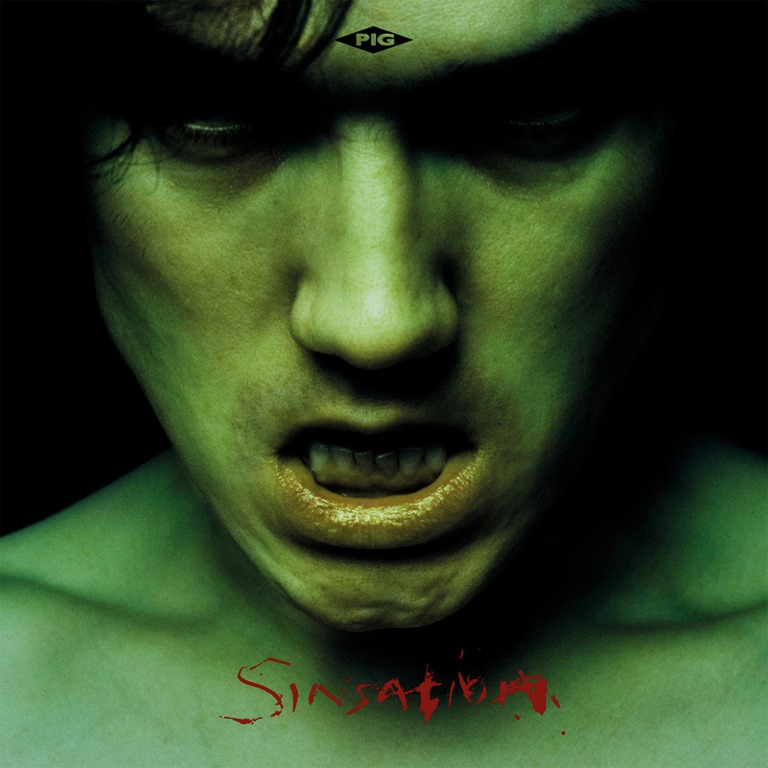
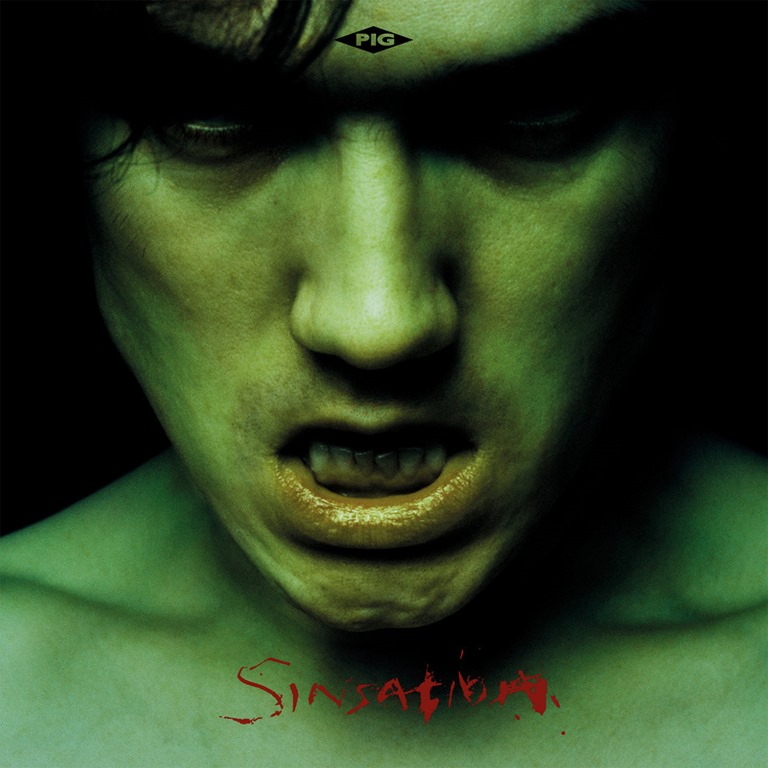
The cover alone is striking. Watts’ image is a standard feature on all PIG releases, but whereas more often than not he is depicted looking buff or brooding, the sickly green hue is unsettling – and slamming in with a series of orchestral strikes and a low, grumbling bass before hitting full-on industrial anthem mode on the first track, the six-minute ‘Serial Killer Thriller’ (the chorus of which provides the album’s title), it’s immediately apparent that Sinsation is something special (and not something sad…).

Admittedly, despite this being an album I’ve played to death over the last thirty years, apart from a few tracks being a few seconds different in their duration, I can’t discern any huge differences between this remastered version and the original: there are, perhaps, more details revealed in the mix, but then, the production on the original was impressive, and again, I’ll come back to that word, ‘detail’. There’s a lot happening; samples, snippets of bits and bobs, strings, multi-layered vocals… A touring member of Foetus early in his career, with JG Thirlwell involved in the early singles and debut album, Watts clearly learned much from Thirlwell, as well as his early involvement with KMFDM. Sinsation felt like the point at which he brought these two aspects together in perfect balance while simultaneously realising his own unique sonic vision. The result was a set of hefty, driving songs, exploding with ideas and noise, and so many layers, so much going off all over the place. It was bold, audacious, and while it’s easy enough to say that it’s a bit Foetus, a bit KMFDM, it goers so far beyond these points that comparisons are a diminishment of Watt’s achievements here.

Sinsation is certainly the first PIG album to showcase the full range of styles and compositional aspects Watts has in his locker, and as such, represents something of a creative peak.

While nominal single ‘Painiac’ (an early version of which was the lead track on a Japanese-only EP, and a video for which got a few spins on MTV on the album’s release) is a throbbing industrial beast of a tune, ‘Golgotha’ is a dark, semi-ambient interlude which sits between the driving snarl of ‘Hamstring on the Highway’ and the swaggering industrial-strength glam-tinged gospel-infused dark pop of ‘The Sick’, which would provide the blueprint for the PIG renaissance which started with The Gospel in 2016. ‘Analgesia’ is a magnificently atmospheric piano-led instrumental which incorporates elements of ambient and electronica and extraneous noise ‘Volcano’ is serpentine and sleazy, with some audacious orchestral work in the mid-section which take the bombast of Foetus’ Nail to another level, while ‘Hot Hole’ drives hard and heavy with pulsating electronics colliding with hefty chugging guitars and ferocious beats.

For the many who likely missed this the first time, this re-release provides the opportunity to make acquaintance with one of the definitive PIG albums, and for those already familiar, it’s a timely reminder of the incredible journey that has been PIG’s career to date, while offering the first chance to get it on vinyl. Almost thirty years on from its first release, Sinsation still sounds phenomenal – insanely ambitious, utterly deranged, and in a league of its own, quite unlike anything else before or since, even within the PIG catalogue.

AA
a2059987689_10

Following hot on the heels of his new album ‘Red Room’ (released in May 2024), industrial rock mainstay Raymond Watts aka PIG has today reissued a fully remastered version of his seminal mid-‘90s album ‘Sinsation’ via

Following hot on the heels of his new album ‘Red Room’ (released in May 2024), industrial rock mainstay Raymond Watts aka PIG has today reissued a fully remastered version of his seminal mid-‘90s album ‘Sinsation’ via Metropolis Records (CD, digital) and Armalyte Industries (deluxe 2xLP vinyl). Out of print for almost three decades, it makes a timely reappearance just ahead of a North American tour.

‘Sinsation’ was originally released in 1995 on Nothing Records, the label established by Nine Inch Nails kingpin Trent Reznor, and not long after PIG had opened for NIN at a number of shows. Nothing was an influential and commercially successful label with a cult underground following that also issued records by Marilyn Manson, Squarepusher, Autechre, Meat Beat Manifesto, Pop Will Eat Itself, Einstürzende Neubauten and Plaid, as well as NIN themselves.

(CD, digital) and Armalyte Industries (deluxe 2xLP vinyl). Out of print for almost three decades, it makes a timely reappearance just ahead of a North American tour.

‘Sinsation’ was originally released in 1995 on Nothing Records, the label established by Nine Inch Nails kingpin Trent Reznor, and not long after PIG had opened for NIN at a number of shows. Nothing was an influential and commercially successful label with a cult underground following that also issued records by Marilyn Manson, Squarepusher, Autechre, Meat Beat Manifesto, Pop Will Eat Itself, Einstürzende Neubauten and Plaid, as well as NIN themselves.

Check the video here…. Album review to follow….

AA

9af61b6130ce938e2fa6f1d2fbf2db35b6784588

Bill Leeb is the Vancouver-based musician and mastermind behind electro-industrial scene mainstays Front Line Assembly and ambient-pop duo Delerium, as well as a key member of recording projects that include Noise Unit, Intermix and Cyberaktif.

Model Kollapse marks the first solo venture by this sonic chameleon and creative trailblazer since the mid-80s days of Front Line Assembly, when Leeb began making recordings in his bedroom and released them on limited edition cassette format. Almost four decades on, his new album was recorded and produced in Vancouver, Toronto and Los Angeles with assistance from production duo Dream Bullet and long-term recording cohort Rhys Fulber, plus regular mixing engineer Greg Reely.

The song ‘Demons’ has been released today as the second single from the album, with Leeb stating that the EBM styled track is a comment on “how much darkness and evil exist in the world, some of it created via technology that is here to stay, and how we have to carefully navigate our way through it all on a day-to-day basis.”

‘Demons’ follows the introductory single ‘Terror Forms’, featuring Shannon Hemmett of the group ACTORS, who are also based in Leeb’s home city.

Watch the video here:

AA

a4b332826fb57004f015b07c9799a9237b0fe591

BILL LEEB | 2024 photo by Bobby Talamine

British singer, songwriter, producer and prog pioneer Tim Bowness has shared his stunning new single ‘Idiots At Large’. The third single to be released from his forthcoming album Powder Dry (out 13thSeptember on Kscope), ‘Idiots At Large’ presents an intriguing combination of delicate atmospherics and dynamic explosions to tell the story of someone drifting away from their previously safe home life and mainstream views.

Mixed by Bowness’s partner in no-man, Steven Wilson, the new single is accompanied by a vibrant, atmospheric visualiser created by Matt Vickerstaff.

Check it here:

Tim Bowness says, ‘The song is partly about eco-apocalypse and partly about someone becoming detached from their family and friends as a result of their increasingly strong beliefs (beliefs reinforced by digging deeper down the internet rabbit hole). This isn’t a commentary on the rights or wrongs of anything, it’s an observation about how idealism can alter the course of a life.’

Featuring 16 pieces over its restless 40-minute duration, Tim Bowness’s eighth studio album Powder Dry represents a new beginning on a new label.

A collection of acute contrasts, the album is a vibrantly accessible and wildly experimental genre-blurring assault, embracing Industrial Rock, Electro Pop, singer-songwriter directness, haunted carnival soundscapes and more.

Entirely produced, performed and written by Bowness (a first), Powder Dry was mixed (in stereo and Surround Sound) by Bowness’s partner in no-man (and The Album Years podcast), Steven Wilson, who also acted as Bowness’s sounding board during the mixing process.

AA

Tim Bowness

HAUJOBB reveal the new video single ‘Opposition’, which is featuring guest vocals by the outstanding Emese Árvai-Illés from the Hungarian pop noire duo BLACK NAIL CABARET. The track is taken from the Electro-Industrial act’s forthcoming new album The Machine in the Ghost. The German duo’s tenth full-length has been slated for release on September 20, 2024.

HAUJOBB comment: “Adding guest vocals towards the end of the song was basically the idea of a Saturday afternoon”, programmer Dejan Samardzic explains on behalf of the duo. “Emese is such a reliable artist, she delivered her impressive vocals within 24 hours. Maybe she sensed the urgency this had for me. I could hardly wait to add that new element to the arrangement as it brought a strong organic feel to it.”

Emese Árvai-Illés adds: “Dejan had some wordless singing in mind, like the side vocals of the Eurythmics’ classic ‘Sweet Dreams’, and he asked me to just improvise”, the Hungarian singer reveals. “I recorded a couple of takes and did some random Adlibs at the end. That gave me somewhat of a Massive Attack ‘Unfinished Sympathy’ feel, but in a more industrial way.”

Watch the video here:

AA

ebbc9731-d7a0-5959-8077-6263beb0d048

Christopher Nosnibor

Being restricted to live shows within walking distance of one’s house really does change one’s perspective and selections. As much as it also significantly limits my options, I’m fortunate to have no fewer than three venues within this range, and spotting that The Royal Ritual – a band I’ve long been aware of but have never witnessed live – were playing at one of them provided more than enough of a poke to get out.

It’s not exactly heaving. That is to say, come 8:15, it’s still pretty quiet, even for a Wednesday night. But then, I noticed that York was conspicuously quiet all day today: driving almost empty roads to a near-dead Tesco was as welcome as it was strange earlier in the day. The first week of the school summer holidays, and it seems everyone has buggered off – apart from the tourists clogging the town centre, which was far from quiet in the afternoon. But tourists tend not to seek out relatively unknown alternative bands playing a mile or two out of town. They should. Live music is as integral to a city’s nightlife as its pubs and bars and so on. I once ditched a conference dinner in favour of a gig when visiting Stirling, having clocked that maybeshewill were playing, and in the process, discovered And So I Watch You from Afar, who absolutely blew me away, plus I got to explore a new venue. It was a memorable event, and one which has stuck with me. It’s unlikely the alternative would have had quite the same impact – and while I’ll never know, as someone who’s uncomfortable dining with strangers and making small talk, I’m as comfortable with my choice now as then.

Comfortable isn’t really my default, and caving crawled out of my bunker, this is an evening I’m quite content to hide in a dark corner with a pint and observe.

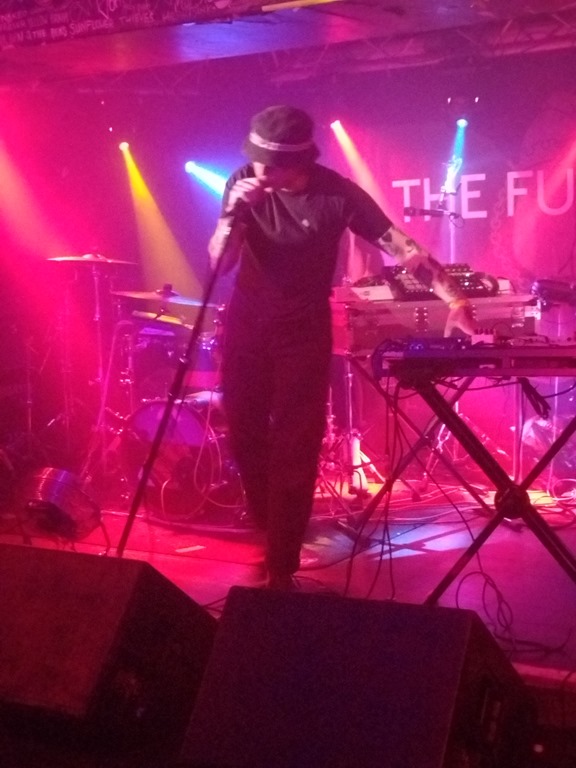
Material Goods are a last-minute replacement for Dramalove. It’s a solid, blank name which suits the duo’s style, which comprises some heavy, complex synth work paired with live percussion – and quite outstanding live percussion at that. The processed vocals are a bit muffled, but overall, the sound is dark and dense and the drums really cut through it with energy and force. Essentially, their palette is 90s alt rock, a bit NIN but with a vague dash of nu metal, and a bit Filter, too. Multitasking and a vast amount of gear affords the singer limited scope for movement on stage, but the sound has a really good, strong energy, despite the songs being pretty downtempo and downbeat.

IMG_20240724_200808IMG_20240724_200818

Material Goods

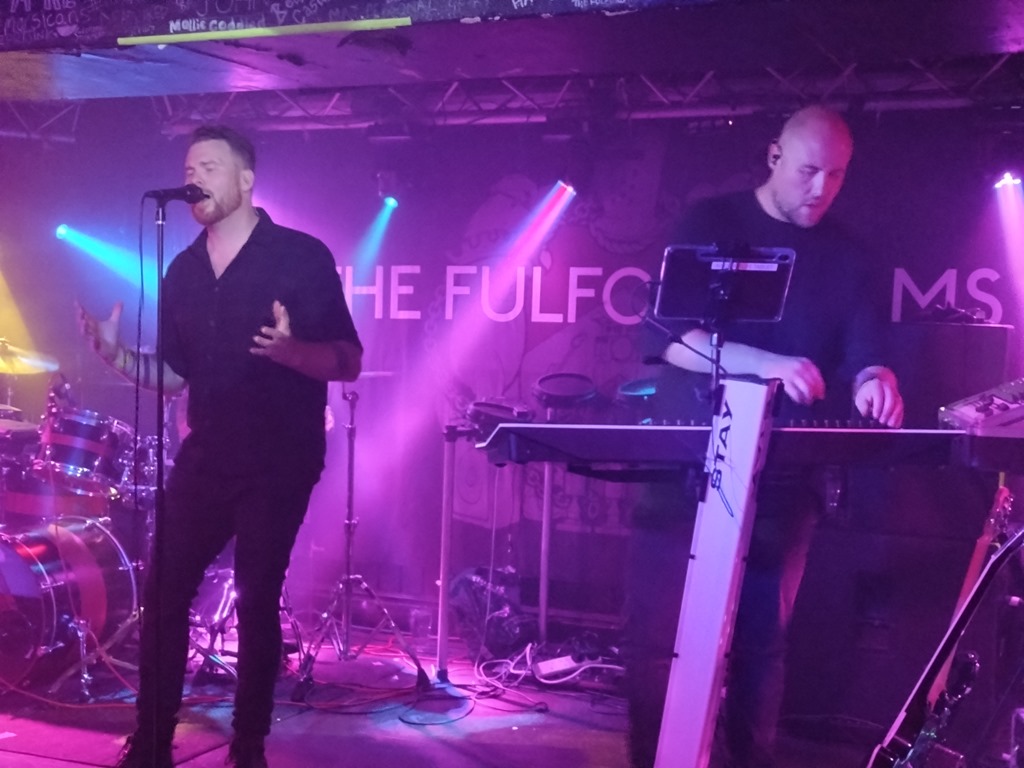
With Material Goods overrunning and Neon Fields also possessing an immense amount of flash-looking tech which needed setting up, we’re fifteen minutes behind time when they take to the stage. Sonically, they’re astonishing. Playing a hundred-and-twenty-five-capacity pub venue, they sound like half a million quid’s worth of gear in an arena. And the songs match it. They sound like they look: black clad, tattoo bands, neatly-trimmed beards, big, soaring emotional outpourings… And completely lacking in soul. Christ, this guy’s level of emotional trauma is enough to raise the blood pressure to induce a heart attack. Wracked with anguish and all of the pain of the lovelorn, the love-torn… And yet it’s all articulated so blandly, everything is so slick, and so one-level. The theatre soon wears thin, and I start to forget I’m listening to it while I’m listening to it. It doesn’t help that there’s a group of four people bang in front of me gabbing on and pricking around, pulling faces, play-fighting, the guys trying to impress the birds by demonstrating their strength by lifting one another up… they get shushed by a fan but even the absence of their distraction doesn’t really improve the experience. There’s some earnest, meaningful falsetto, and the penultimate song had some cliché tribal drumming, and they wrapped up their bombastic set ten minutes after the headliner was due on.

IMG_20240724_21083420240724_210849

Neon Fields

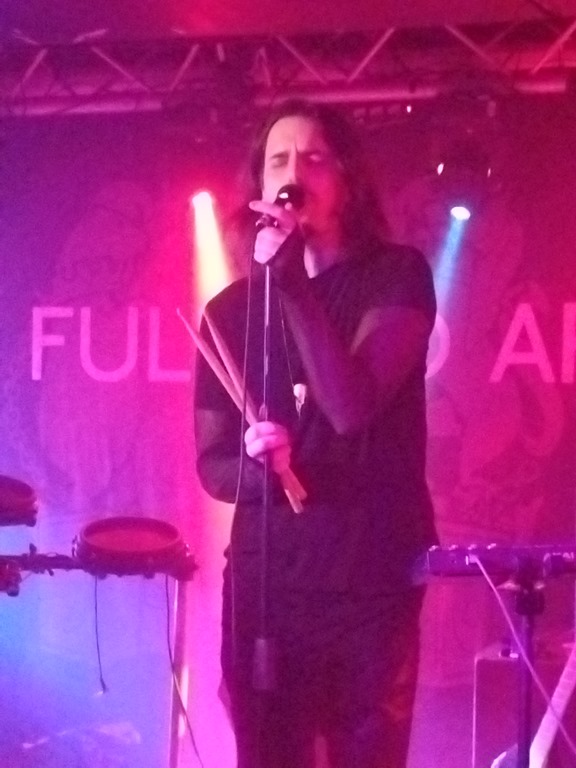
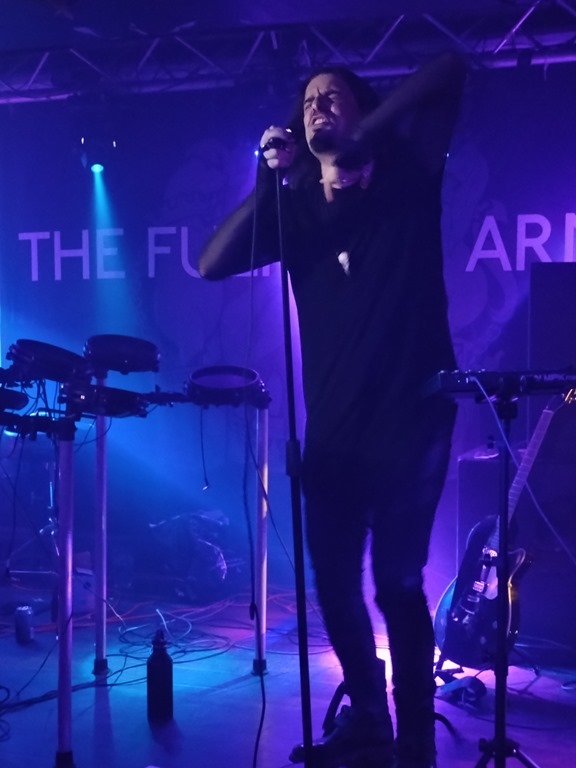
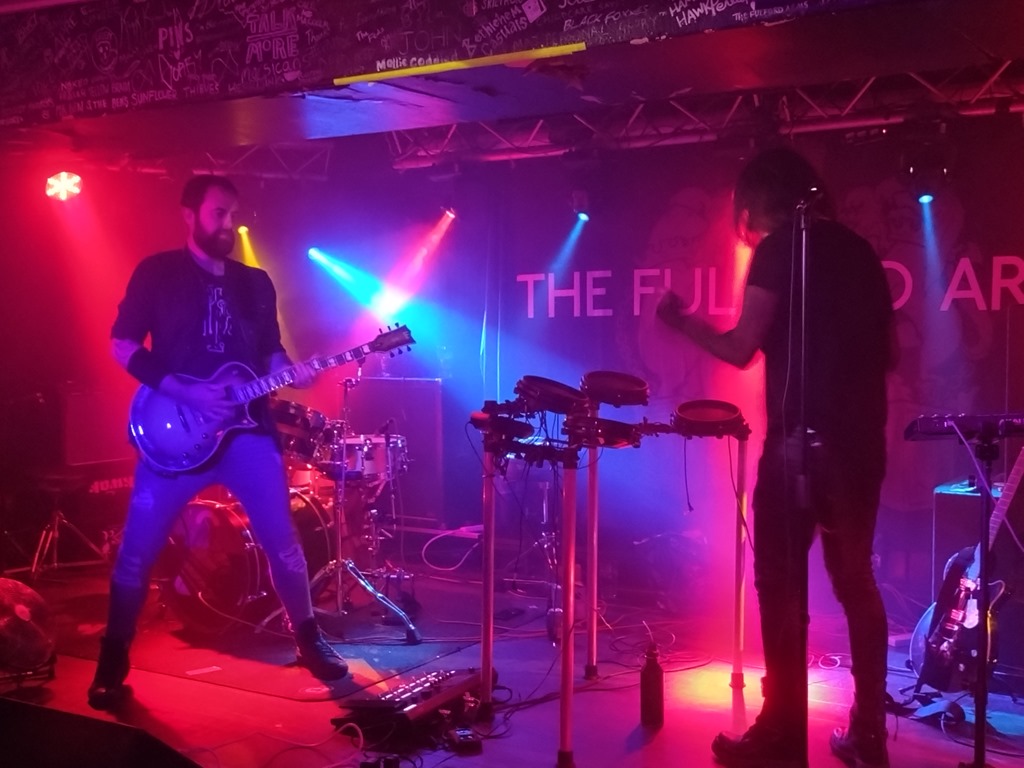
The Royal Ritual are also a duo who have an extremely ‘produced’ sound. But their approach to production owes more to the methods of Trent Reznor as pioneered in the early 90s on Broken and The Downward Spiral, balancing gritty live guitars with synths and fucked-up distortion and harnessing their tempestuousness in a way that creates a balanced yet abrasive sound. David Lawrie plays live electronic drum pads in addition to the sequenced beats, adding dynamics and live energy to proceedings, and flitting between the drum pads, synths, and mic stand, he’s incredibly busy throughout the set. But something about Lawrie’s delivery highlights everything that was absent on Neon Fields, and just carries so much more weight: the whole package brings a rush of adrenaline propelled by that emotional heft and solid force.

Objectively, the feel is very Stabbing Westward, and goes hard NIN at times in its combination of guitar, synths, and sequenced and live electronic drums. The Royal Ritual are strong on dynamics and atmosphere, and Lawrie is an intense and compelling performer.

IMG_20240724_22045120240724_22154320240724_220550

The Royal Ritual

He does break out of the moody persona to thank other bands and plug merch, but what do you do? In the current climate, bands sadly need to plug the stall. The fact that David steps out of broody tortured soul for two minutes of affable chap may seem hard to reconcile, but then, this perhaps speaks more of the human condition than remaining ‘in character’; people are complex and conflicted, multifaceted and inconsistent. And this is what truly lies as the heart of tonight’s performance by The Royal Ritual. Digging deep into the complexities of the psyche, there’s something about the duo’s performance that gouges into the flesh and demands contemplation.

Industrial band, FLEISCHKRIEG has unleashed their new single & video, ‘Eve’.

The song ‘Eve’ is based on the Gnostic tradition of Adam’s wife being the hero in the Genesis creation myth – rather than the villain. This second century Christian sect revered Eve as an early incarnation of the Divine Feminine, and if it weren’t for her courage to commit “original sin” – we’d still be trapped in a genetics lab known as the Garden of Eden.

The song is sung from Adam’s point of view – he praises Eve for delivering them from the tyranny of the Elohim. Though they are “thrown out the gilded cage”, Adam asks Eve to “make the thorns our home”, a poetic nod to human resilience in the face of catastrophe.

iItalian scholar Mauro Biglino and his research on the Biblical Apocrypha inspired the song’s themes and lyrical content. Mauro briefly translated for the Vatican – but was eventually fired when his published works revealed modern Christian theology was incompatible with the written texts of ancient Hebrew authors.

The song was produced, mixed, and mastered by Logan Mader (Machine Head, Once Human).

Watch the video here:

AA

813380

5th July 2024

Christopher Nosnibor

Sometimes, I really do feel as if my brain is my enemy. Word association and wordplay are a particularly frequent and annoying curse. Oftentimes, I keep this to myself, but midway through listening to this, it struck me, completely at random, that Killzones isn’t a million miles away from Calzone, at least when written down. So why share this? A problem shared, and all that, for one. But as much as anything, I felt the urge to purge, or moreover to crack open the challenges that present themselves as part of the creative process. Writing – and finding something new and interesting to say – about music, day in, day out, is a challenge in itself, without other factors.

Seemingly, the recording of this EP proved rather less challenging for its makers, who came together and developed it swiftly and fluidly –although the same can’t be said for listening to it. That’s by no means a criticism. In a climate where the airwaves are jammed solid with anodyne sameness and slickly-produced beige sonic slop disguised as raw or edgy on account of some explicit content and some choice language that requires beeps or asterisks in the mainstream media, anything that does something different offers a welcome challenge in the way many pit themselves against the Great North Run or similar. We’ve grown accustomed to everything being delivered neatly-packaged and pre-digested, and feeling like following a recipe from Hello Fresh makes us a Michelin chef. Collectively, we’ve forgotten how to chew – meaning that this will either kick-start your metabolism or simply make you spew if you’re unaccustomed to anything that’s this high-fibre. Just look at that cover art. It’s dark, grainy, uncomfortable. It’s the perfect encapsulation of the music it accompanies.

Machine Mafia is quite the collaborative paring: Adam Stone of gritty northern grimsters Pound Land and Jase Kester of ever-evolving experimental noisemakers Omnibael / Omnibadger have come together to do something different. Very different.

As Jase explained to me, the EP features ‘no live instruments, leaning into the way dub reggae was so embraced by punk right in the early days.’ And there’s no question that it has both – simultaneously – the spaciousness of The Ruts (D.C) and the density of early PiL. It’s a formidable combination, that’s for sure.

The title track assembles sampled snippets as its foundation, drawing parallels with the collaging methods of Cabaret Voltaire and Throbbing Gristle, evolved from William Burroughs and Brion Gysin’s late-50s tape experiments – in turn a progression from the cut-ups on paper. Atop of this slice ‘n’ splice selection of political speeches and an almost subsonic, floor-shaking bass, Stone delivers a mumbling, drawling semi-spoken spiel. It’s like Sleaford Mods on Ketamine, a heavy trudge of ever-degenerating sound which eventually collapses to a low-end buzz and a crisp sample that makes the pair’s political position clear through antithesis.

On ‘Faces’, scrapes of discord, distortion, and a thudding beat half-submerged in the mix grinds out the opening before a dark, dense bass groove starts a gut-shaking growl. The drawling, atonal vocals, too, are distorted and low in the mix, and I’m reminded of some of the more obscure Ministry offshoots witch Chris Connelly – the vibe is dingy, sleazy industrial, a bit early Pigface, and sounds like it was recorded in a damp mould-stained basement on a salvaged reel-to-reel.

The songs get slower and heavier – and longer – as the EP progresses. ‘I Am Not You’ comes on as if Dr Mix and The Remix had done dub, while ‘Lecture 0.3B’ goes all out on transforming a simple spoken-word piece into a cut-up tape experimental headfuck with loops and delays and effects galore, all laced with crackles of distortion and sonic degradation fuzzing and fading the edges. It lands somewhere between the JAMS, Max Headroom, and Throbbing Gristle’s ‘Hamburger Lady’ – weird, unsettling, dystopian, with near-familiar elements twisted and recontextualised in an ugly mash-up collage work.

Conceptually, Killzones is far from new – but then, there’s no claim to innovation here, explicitly drawing a line from the past. But the kind of reference points and influences in evidence here are not the ones you find often, if ever – independently, perhaps, but the whole point of intertextuality as a method of creating is the nexus of divergent touchstones and the way in which they’re combined. With Killzones, Machine Mafia deliver a crash course in experimental music 1976-1994. It’s a mangled, messy cognitive assault. It’s knowingly, and purposefully, difficult, unpleasant, and a complete creative success.

AA

a0890048129_10

German electro-industrial band, NEON INSECT has just unveiled their ambitious, & highly-anticipated album, LIBERTY FLOWERS.

LIBERTY FLOWERS sheds some light into different aspects of life in New Moscow, in times where unrest slowly settles in, even though everything is done to oppress its citizens. The ever-recurring concept of NEON INSECT’s music features the only habitable place in North America. It’s a dystopian version of New York in an alternative timeline, serving as a experimental playground for implants, cyborgs and indoctrination.

With this album, NEON INSECT also takes you on a trip sonically, with noises sounding like they’ve been taken straight from a dystopian nightclub, combined with analogue madness. The goal with this record was to rephrase the grit of old-school, early 90s electronic-industrial music, while not shying away to cross some boundaries. LIBERTY FLOWERS is a love letter to this era of music.

LIBERTY FLOWERS is currently available on CD and cassette formats as well as Bandcamp, digitally. It will be available on most major streaming services on August 30th.

Watch the video for ‘There is Beauty in Noise’ here:

NEON INSECT (Nils Sinatsch) is a dystopian storyteller, telling tales from New Moscow – New York in an alternative reality, where the cold war went hot and the soviets won.
As a normal citizen somewhere in Germany by day and a rebel by night, NEON INSECT fetches the stories through the cyber web from his contacts in New Moscow. – he only habitable city in a nuked America, where cyborgs rule the streets, where lower Manhattan is a prison and the last bastion of the local rebellion.

The stories are told in an old-school industrial fashion, the sound of the cold war, enhanced with stutters and glitches, the sound of the cyber web – a soundtrack George Orwell would approve of.

Bring Your Own Gasmask.

e66ddad5-9c6d-e914-70d2-c108fc4f03d5

German electro-industrial mainstays Haujobb have just dropped the sinister sounding retro-futuristic slo-mo banger ‘In The Headlights’ as the first single from their forthcoming new album, The Machine In The Ghost. Scheduled for release on 20th September, it is the 10th full length record by the Prague-based group, which formed in 1992 and has existed as the duo of Daniel Myer (vocals/programming) and Dejan Samardzic (programming) since the mid-‘90s.

“’In The Headlights’ was actually one of the first tracks written for the album,” explains Myer. "Dejan recorded and sampled his exhaust hood, which kind of sounds like a jet engine, and we built the song around that sample. There is also a sound that might be identified as a tambourine, which is really just a key chain dropping onto the floor. This and other physical constructions that are sampled throughout the album act as relics of interfaces between man and machine.”

Maintaining an impressive penchant for refusing to do the same thing twice on each studio album, The Machine In The Ghost deploys field recordings to create some of its most prominent sounds. In order to achieve the desired effect, the duo used a mix of software and hardware in the shape of everyday items. This deliberate nod to a previous era with more analogue shifting of the dials complements the retro theme of The Machine In The Ghost (albeit without indulging in nostalgia for its own sake), the album revolving around the highly charged relationship between mind and matter, analogue and digital.

Despite their constant artistic evolution, a unique musical handwriting is present throughout the Haujobb catalogue. Originally founded as a trio in the West German city of Bielefeld, they were initially influenced by the ‘Vancouver school’ of industrial electronics (the likes of Skinny Puppy and Front Line Assembly), but it did not take long for them to be recognised as figureheads of a more modern take on this sound that incorporated elements of IDM (intelligent dance music) that helped catapult them onto the wider international scene.

Co-founding member Björn Jünemann left the band after their second album, with Myer and Samardzic subsequently releasing the acclaimed ‘Solutions For A Small Planet’ (1996) and thereafter maintaining a strong strike-rate that has included New World March (2011), their 7th record and regarded as another milestone effort.
 The Machine in the Ghost has seen Haujobb begin another exciting chapter in their career. As we enter the next industrial and creative revolution that has been ignited by the rise of AI, it shows that they still have their musical fingers on the pulse.

Listen to ‘In the Headlights’ here:

AA

a03d5a2e23424b479e8fd8436c63d138f40a6be3