Posts Tagged ‘Glitch’

Dret Skivor – 7th November 2025

Christopher Nosnibor

Dave Procter is / has been involved in more musical projects than your mum’s had hot dinners. Having left Leeds for Sweden, not least of all on account of Brexit, he’s currently paying the UK a visit with a tour which features performances by no fewer than five of them – last night’s set in York was one of two halves, featuring the polite extreme electronica of Trowser Carrier and the whacked-out post-punk infused racket that is Loaf of Beard. So about these ‘Brexit benefits’… and the fear of taxing the rich for fear they’ll leave the country. Since they’re not paying much tax anyway, where’s the loss there? Meanwhile, we’re losing migrant workers who keep the NHS operating, who harvest crops, and flip burgers, AND we’re killing creative industries by making it harder for artists to tour here. A few years ago, there was considerable coverage given in the media about the country’s so-called ‘brain-drain’; there’s been rather less coverage given to the slow murder of the arts. The Guardian and The Independent have raised their hands in quite anguish over the killing off of arts degrees, degrees which are being targeted as not providing a route to a well-paying career, but in the main, this is happening quietly. What’s painful is that there’s so much raving about ‘small boats’, hardly anyone is noticing, and even fewer care because they’re too busy buzzing over the Oasis reunion or Taylor Swift. I’ve got no specific beef with Taylor Swift and her sonic wallpaper, but the point is that there is so much life and art and creativity beyond the mainstream. There is an extremely diverse array of subcultures, an underground that’s as big as the overground, only more diverse, eclectic, fragmented, and this is what’s suffering.

To return to topic, somehow, amidst all this activity and while in transit, Procter’s managed to launch both a new release and a new project via his Dret Skivor label, in the form of OSC, the debut – and likely one-off – album by the imaginatively titled oscillator.

The accompanying notes are unusually explanatory for a Dret release, forewarning of ‘Glitch, ambient and toy keyboard experiments. Play through decent speakers and headphones, the lows are LOW!!!’ The tracks were created during some free studio time in Copenhagen in October 2024, and, as ever, the CD run is minuscule, with just 6 copies. This, of course, is typical of the DIY cottage industry labels, particularly around noise circles. It’s not only a sign of an awareness of just how niche the work is – and it very much is that: no point doing 50 CDs or tapes when it’ll probably take a year to sell four – but also indicative of a certain pride in wilful obscurity. Just think, if the bigtime ever did beckon, those spare copies sitting under the bed may actually acquire some value. Just look at how much early Whitehouse albums go for, for example.

OSC is very much an overtly experimental work, featuring six numbered pieces – the significance of said numbers remains unclear, if there even any significance, although notably, they’re all zeros and ones, or binary – which range from a minute and twenty seconds to just over eight and a half minutes.

‘01’ is a trilling electronic organ sound skittering over long drone notes, and abruptly stops before the bouncing primitive disco of ‘10’ brings six and a half minutes of minimal techno delivered in the style of Chris and Cosey. It’s monotonous as hell, but it’s intended to be, hypnotic and trance-inducing. Zoning out isn’t only acceptable, but a desirable response. ‘100’ is seven and a half minutes of dense, wavering low-end drone, the kind which slows the heart rate and the brain waves. As the piece progresses, the rumbling oscillations become lower and slower and begin to tickle the lower intestines, while at the same time some fizzy treble troubles the eardrums. Nice? Not especially, but it’s not supposed to be. Sonically, it’s simple, but effective.

‘101’ is so low as to be barely audible: not Sunn O))) territory, so much as the point at which the sun has sunk below the horizon and the blackness takes on new dimensions of near-subliminal torture. The final track, the eight and a half minute ‘110’ is a classic example of primitive early industrial in the vein of Throbbing Gristle, with surging oscillations which crackle and fizz, a thrumming low-end pulsation. It ain’t easy, but it’s magnificent.

Procter loves his frequencies, just as he loves to be eternally droney, and at times Kraut-rocky. OSC reaches straight back to the late 70s and early 80s. OSC is unpredictable, and tends not to do the same thing twice. It’s in this context that OSC works. Embrace the experimental.

AA

a2917884968_10

Dret Skivor – 3rd May 2024

Christopher Nosnibor

Dret Skivor seem to have managed to sync their release schedule to Bandcamp Fridays pretty neatly. Meanwhile, the man behind the label, Dave Procter, has enough different musical projects to fill the entire label’s roster single-handedly.

Not content with pumping out harsh noise as Legion of Swine and ambient drone with mathematical divination as Fibonacci Drone Organ, and spoken word ramblings backed with dark noise as Trowser Carrier, or collaborating with countless other artists, notably Claus Poulsen with whom he (ir)regularly convenes for a release, and a brief excursion as twAt clAxon, Procter has also been operating as Klôvhôvve, a vehicle for ambient / glitch weirdness.

Following on from Is it? It is, an album containing two longform tracks which offered their own call and response, released in March, Live at JT Soar feels on one hand like a bit of a stop-gap, but on the other, a reasonable consolidation. More than reasonable, in fact, considering that Procter devotes a considerable amount of time to performing live – and is perhaps the only artist I can think of who will book a tour and not play under the same guise more than a couple of times, or for two consecutive shows. It is, undoubtedly, easier to get bookings if you have a broad range of styles to offer promoters, even if that range does sit under the wider umbrella of obscure electronic weirdy shit.

Before we ger to the obscure electronic weirdy shit of the recording, it’s worth a brief acknowledgement of the cover art, which is truly classic Procter (the photographs which grace the covers of his two collections of poetry / rants as Dale Prudent are strong cases in point). Gritty, unpretty, urban, and a bit off kilter, snapshots of the everyday strange. Here was have a shot of the outside of the venue, still with its signage for JT Soar, Wholesale Fruit and Potato Merchants, from which it takes its name. Unassuming is an understatement for this building, with graffiti on one door, and a piece of street art depicting Nottingham’s best-known polemicists, Sleaford Mods, replicating the artwork for their most recent and widely-acclaimed album, UK Grim on the garage door. The shot is some real-life documentary, its relevance heightened because the vocally socialist Procter departed the UK for Sweden post-Brexit because… well, Brexit.

Klôvhôvve’s set, which lasts twenty-four minutes, is mellow and mellifluous to begin with, but soon swerves into a melting together of soft tones with scratched, warping drones, the glitching eating into the surface of the looping tapes affected at first. Vocal snippets, fractured, fragmented, distorted, cut in and out, as the music ebbs in and out unpredictably.

There is a sense of nostalgia about this, but the overarching sensation is more that of a post-apocalyptic narrative, a bleak dystopia of degradation, of societal collapse whereby only damaged recordings and fragments of past technologies remain, twisted, rusted, malfunctioning. The set does have distinct segments, although they do flow together to form a continuous set, and as such, it makes sense that it’s released here as one single track. It’s not as if anyone is going to be skipping to hear the hit or their favourite song of the set, and it’s structured around transitions between evermore haunting atmospheres. It’s pretty unsettling stuff, dank and grumbling with thunderous rumblings away off in the background while a continuous slow of babbling and sharp scrapes cut into the foreground. But then there’s something resembling a trilling, twisted rendition of ‘Silent Night’ which crackles and stutters through static, and it warps and crackles its way to a slow fade.

There is some strong tonal separation here, and the interjections which appear unexpectedly are almost enough to make you jump But for the most part, it makes your skin crawl – slowly, in a state of curiosity and ponderous hesitation – as you winder where it may be heading.

Procter understands the importance of music which makes you feel uncomfortable, which tests your limits, and this release captures a live set which really teases at the tenterhooks.

AA

a3905712960_10

22nd December 2023

Christopher Nosnibor

We live in strange times – times which have gone beyond the established expectations of what defines postmodernism into a period which is something else. Something else we’re yet to come to terms with, let alone define. Postmodernism heralded the arrival of what one might call ‘the nostalgia schtick’ by meshing together past, present, and future to conjure something of a liminal territory in which all times exist simultaneously. But if postmodernism, as defined by the likes of Francois Lyotard and Frederik Jameson is primarily defined by an accelerated pace of communication and an overwhelming blizzard of media, one thing which no critics or theorists could have readily anticipated when defining the term was the rush to cling to the recent past, or that the next big boom in industry would be nostalgia and revivalism.

The advent of the Internet heralded a revolution in terms of all things archival. Back in 1996 or thereabouts, when I first got online – with AOL on a floppy disc and a 14k dial-up modem plugged into a second-hand IBM 486 ­ it seemed like a new dawn. It was basic, but text from obscure zines from the 60s, 70s, and 80s and pretty much anything you could ever wish for from the depths of the most subterranean archives was suddenly available, as was anything else. By the early 00s, Warren Ellis’ Crooked Little Vein was the world as it was: if it existed, it was on the Internet. But then the Internet got hijacked by big business, MySpace ceased to be the anarchic free virtual world that it had been, and everything turned to shit. Because capitalism ruins everything.

Amidst all of this, postmodernism is – or was – characterised by a celebration of depthlessness, of rejoicing in its own disposability, what Stewart Home referred to as ‘radical inauthenticity’. Postmodernism was laced with irony, knowingness, self-awareness. We seem to have lost the sense of irony and humourous knowingness somewhere along the way, and as we grapple with AI, deep fakes, and music industry plants, we have come to return to the question of authenticity as something which should perhaps be valued. Admittedly, these debates are perhaps minority issues, because for the most part society is split between those who believe everything they’re told and those who believe nothing, and there is only limited space for nuanced critical debate. It is, of course, hard to have a nuanced, critical debate in segments of 140 characters or so, and this compression, coupled with an ever-decreasing collective attention span has, undoubtedly been damaging in many ways.

The tug-o-war regarding the value of authenticity has been particularly apparent in music, as fellow musicians and critics alike have descended on punk and ‘indie’ bands to challenge their authenticity as exponents of punk and indie. With the rise of the ‘industry plant’ threatening the integrity of the DIY and indie music scene, it does make sense, but the point I suppose I’m ultimately making is that nothing really makes sense anymore, and that everything is a contradiction.

So, at the same time as AI has surged forwards to recalibrate the means of production, we’ve also witnessed a sustained boom in all things nostalgia. As much as it would pain many to admit it, it’s that same pining for the past that has driven the demand for vinyl, cassettes, grunge, tribute bands, as brought us Brexit. Admittedly, a yearning to return to the days of the Empire and when England resembled a Hovis advert is more socially damaging than basking in the glory days of Britpop, but it’s a pretty close call. A significant portion of the success of Stranger Things, for example, is its retro context, which has seen many hailing it as bearing parallels with The Goonies. I can’t help but wonder if this passion for the not-so-distant past is a means of escaping the absolutely hellish present and the utterly-fucked-up future we’re hurtling headlong into.

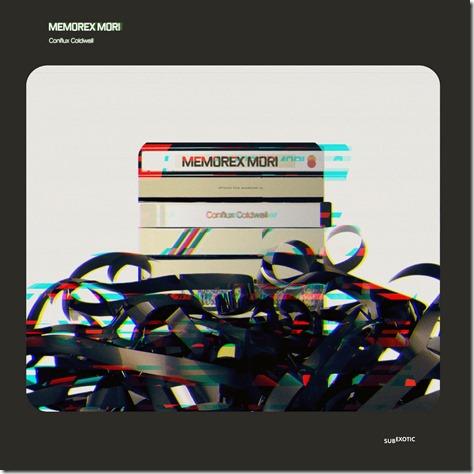
Conflux Coldwell’s latest project is one which plunges deep and direct into nostalgia, and as such resonates with the zeitgeist which has been simmering for a few years now. We’ve all seen it: the ersatz recreation of scratchy recordings, crackles and pops of old vinyl and the warps and snow of videotapes. And now everyone’s back to buying vinyl and audiotapes… how long before the VHS renaissance? And at the same time, it raises the question of ‘the archive’, of the (im)permanence of documents. We have always believed that documenting and recording events was the route to immortality, and that the advent of modern media would solidify our legacy in the same way as The Anglo-Saxon Chronicle or The Bayeux Tapestry. It was not so long ago that the Internet was supposed to be an eternal archive of everything ever. Only now, it’s apparent that modern technology is as ephemeral and disposable as our very culture, and that online archives vanish the moment their owners stop paying for the domain.

Memorex Mori is an unusually authentic work, born out of an excavation of -personal archives, as Coldwell explains: ‘Last year I found a dusty box of old unlabelled VHS tapes at my parent’s house, including some early work of my own I’d long forgotten about. Unfortunately the tapes were all in very poor condition and I only managed to recover some of the material. Despite the bad quality I decided to sample the videos anyway and make something new out of the various noisy remnants – the final result of that extended process is Memorex Mori.

Coldwell himself isn’t outside the frame of nostalgia with this ambitious project, either, as he continues: ‘VHS was the medium of my childhood in the 80s and 90s, and was still routinely used for budget productions by the time I started making films and music of my own. Looking through the old tapes made me realise the ultimate fragility of all our recordings and the memories they hold. These analogue tapes only have an estimated lifespan of 25 years, and this artificial life is only granted to the videos we actually decide to keep. The vast majority ended up in landfill when the world went digital – what was lost in the waste? In contrast, we might think that current digitisation and cloud storage allows our memories to live forever, but they are still fallible. The major difference is that with digital archives this mortality is hidden – with analogue media we can potentially witness that death happening in slow motion before our eyes.’

It’s an interesting and valid distinction between analogue and digital: growing up in the 80s and 90s myself, I remember being told not to vacuum clean near any video tapes, and so on, while toward the turn of the millennium the emerging digital future was presented as eternal. But now, it’s clear, that there is no such thing as permanence, or the eternal, and that any archive is as fragile as life itself.

And so, Memorex Mori is a multi-faceted, multi-dimensional, multi-media project, where past, present, and future collide, and postmodernism melts into the as-yet-to-be-defined present. It’s a film and it’s a soundtrack, and both can be appreciated independently of one another, as intended.

Coldwell expands on his notes, explaining ‘This project continues a lineage started by William Basinski and The Caretaker, exploring themes of memory loss, entropy and spectrality, through the sampling of destroyed recordings. But Memorex Mori extends this idea into the visual realm, presenting a feature-length music video alongside the music. As well as sampling early Conflux works from tape (Traveller, Glitch, Machinedance and Trainboy) various other unknown recordings were appropriated from the video box – all sorts of forgotten cultural detritus including my Mum’s 30 year old Open University programmes. A few modest pieces of equipment were used to add extra sonic layers – including the Korg NTS-1 and a home-made Marantz tape delay – then all bounced back to VHS.’

The video is a disorientating barrage of film clips, from train journeys to clouds, via small aircraft lifting off and droplets of water rippling out. Everything flickers and fades , glitches and warps. At times, we’re simply submerged in a snow of magnetic degradation and ruination, and it’s not always easy to discern what we’re actually being shown. But, often devoid of context, these detached, fragmentary scenes take on a sense of significance. The effect is an uncanny emotional response, a pull in the lower intestine as something unexplained and inexplicable evokes something within. There’s a comparison to be drawn with Memorex Mori and the experimental works created by William Burroughs and Brion Gysin in the late 50s and early 60s – in the soundtrack, the tape experiments, perhaps, but more so the whole audiovisual project, which calls to mind films such as Towers Open Fire, produced in the mid-60s with Anthony Balch, and a step closer to what Gysin’s quest to realise ‘a derangement of the senses’.

The soundtrack is the perfect soundtrack to this endlessly unsettling sequence, an eternally shifting sonic drift that’s at times noisy, even harsh, while at other altogether more ambient. Like the visuals, it draws you in, but it also stands independently as a purely sonic experience, and it’s also a smooth, expansive scene for reflection, and perhaps it’s to be expected that the soundtrack has greater impact when experienced in isolation, without the distraction of the visuals.

As a whole, or in part, Memorex Mori is quite an unsettling experience: visually compelling, and aurally challenging. It demonstrates the fragility of any documentation, any archive, and of life itself. Nothing lasts forever. And it speaks of how, as memory fades, so the documents diminish in value: moments captured in moving or still images which seem so essential at the time lose meaning over time: where was that picture taken? What was I doing there? Why did I think that would be worth filming / photographing? Who even is that?

I feel a weight descend as I reflect on all of these things while immersing myself in Memorex Mori. I can’t even begin to imagine the experience of assembling it. Then again, I can’t really assimilate the experience of other viewers or listeners, either. What’s intensely personal to an artist is likely to hit a spot with the audience, but for each, the reception will differ, based on their own experiences, their own immediate headspace.

But, regardless of individual interpretation, the vast ambition of Memorex Mori is matched by its accomplishment. THIS is a document. A powerful work, which will stay with you long after the silence descends.

AA
a2043088135_10

Mille Plateaux – 1st December 2023

Christopher Nosnibor

It’s always exciting to hear what electronic experimentalism Neuro… No Neuro have cooked up, and Positive* is the second album this year, following on from the collection of glitchy snippets which comprised Compartments back in January. Just as Compartments was a very different project from its predecessor, Faces & Fragments, so Positive* explores very different territory from the ‘Kawaii-Glitch’ of Compartments.

As the accompanying notes explain, ‘Positive* by Neuro… No Neuro is based upon thin slices of memory, and the disintegration of their existence. The day-to-day, with its ‘ups and downs’, all while operating/existing above and to the right of the body. When the day ends, and the separated is reunited; how does one collect what is no longer there? …Separating consciousness from the corporeal… Memory and thought are being swept out to sea in granules that are imperceptible to those around you. Short term is riddled with inconsistencies…Say “so long” to the granules.’

It’s all about focus, and the focus of Positive* is very different from any previous projects. And when it comes to projects like this, details are important. In context, it’s ok to focus on those details, and to do so isn’t obsessive or excessively picky, but to engage with a creative work on the basis of its design, its intent. I preface my assessment this way because the first thing I’m drawn to, before hearing a single note, is the asterisk in the title. Such a mark denotes a footnote, an aside, a necessary commentary on the subject.

But there is not one appended to the accompanying notes. What can it mean? Is this an accidental omission? It seems unlikely, and as such, one can only conclude that it’s for the reader to decipher the nature of the discourse. In my own experience of academic writing, it’s often the case that the real commentary and the grain of the research lies in the notes, and so it is the case here.

‘This Time for Sure’ brings some stuttering ambient drum ‘n’ bass which arrives in a drift of Japanese-inspired scales, bit there are some subtle details and textures to be found low down in the mix. It certainly sets the tone for this comparatively delicate collection of pieces, most of which are fairly fleeting, sitting around the two-and-a-half-minute mark on average.

Each of the titles pins a positive slant on neutral or even potentially negative scenarios – ‘Even I can See this Now’, ‘When You Actually Want to Wake Up’, ‘Drier days Ahead’ – all feel like phrases uttered the kind of pep talks you might give yourself in times of struggle. C’mon, you can do this! Sometimes, try as you might, it still feels empty and futile, and as oft as you repeat it, you struggle to believe it.

‘When You Actually Want to Wake Up’ perhaps represents this struggle most keenly, a loping glitch like the back and forth internal monologue you struggle to overcome: yes… no… yes… no… just get up… but…’

‘Of Course You Know it All’ has an implied snarky, snideness to its title, but it’s still positive, right? Its glitchy, picky, chiming mellowness float beneath some pinging arcs, while the sweeping ambience of ‘Almost Through’ arrives with a sense of sagging fatigue, the kind of positivity many feel in the last half hour of the working week – fagged out and clinging to that point of release.

The world is dark and life is a grind, and it’s often difficult to see the light, the positive aspects among it all – and they are few and far between. Platitudes like ‘at least I have a job’ or ‘at least I have my health’ don’t really carry much conviction. Sure, there’s always someone worse off, but it’s hardly saying much. It’s ok to be negative, to be discontent.

And perhaps it’s here we finally come to understand and appreciate the asterisk. Positive* is, overall, melodic, and feels quite uplifting, being gentle, the urgent beats tempered by ambience and melodicism. It’s actually – dare I say it – quite nice. But finding those uptempo, upbeat aspects, maintaining balance, is hard as you juggle and struggle to keep things together, a day at a time. And perhaps this is how we can best appreciate Positive*. Just as memory drifts and floats, so does our capacity to continue onwards and to stay afloat. All you can do is hang in there.

AA

a3005718583_10

Well this is appropriately timed. Me, I don’t handle heat especially well. By which I mean that even when my eye sockets don’t feel like they’re stuffed with teasels and I’m not sneezing and wheezing, my brain turns to pulp and my body gradually liquefies once it tips above 20ºC. This means that my dayjob is a struggle, I type and talk bollocks in chats with friends, and I don’t know what I’m doing half the time.

Yes, the heat affects me badly. I lose my appetite. I can’t think. I feel as if I’m existing outside my own body. You can call me a wimp if you like, but it won’t even register. I’m too busy being spaced out and excessively hot to register a coherent opinion. After a fortnight of sweltering, I kinda feel like I’ve lost myself. Me lost me, if you will.

This, then, is the result of two evenings’ work. After things have cooled down, after rain. After I had time to process, digest. And yet still I feel disconnected, outside of my own life.

‘Heat!’ is brilliant and strange, and this new single, ‘taken from their new album RPG out on Upset The Rhythm on July 7th’, is a brilliantly disorientating piece. Warped, woozy bass synth tones bend and glitch in the sparsest of compositions, where birdsong tweets and skitters. Something about the malleability of the notes, the weird pliability of the tones.’

There’s some kind of electro/tribal percussion which thumps and bounced along, and the numerous triptastic aspects paired with the quirky vocals make for something strange and unique.

It’s accompanied by a video that’s like a prehistoric reimagining of some vintage computer game – or the spaces you find when you tip off the track on MarioKart – only it bends and melts and is full of dinosaurs and a whole world of what the fuck. Mystical, magical, strange, this is an entry into another world.

AA

_SSKTEYg

Amelia Read Photography

Dret Skivor – 3rd March 2023

Christopher Nosnibor

Fern’s Deformed is appropriately titled: this some mangled shit. From the slow, deliberate, rolling grooves that boom and bow through snarled up noise, while against it, crisp, crunching beats thump and stutter, Fern keeps things interesting and innovative, but more than anything, keeps it uncomfortable.

Deformed sits within that bracket of dark ambient that’s deeply dark, but not entirely ambient, and doesn’t for a second let you settle into it, instead twisting and squirming awkwardly, refusing to solidify or confirm to any one fork of style.

‘Intro’, the minute-long splurge of wibbly dissonance set the scene nicely for the following twenty-five minutes of oddball electronica. The liner notes offer ‘Respect to Portishead, aphex twin, faster katt and Mindacid for inspiration (samples)’.

The majority of the album’s ten tracks are brief sonic snippets, most being well under three minutes in duration, and in many respects, Deformed feels more like a palette sampler than a fully realised work – although that is by no means a failing, as it gives the album an immediacy that further evolution would likely dilute.

It’s four tracks in that Deformed really starts to take (strange, twisted, unexpected and indefinable) shape: ‘Greyhats’, a live recording – it’s unclear if it’s live in the studio or soundboard, but there’s no crowd noise and it fades at the end – is aggressive, dark, and difficult.

Immediately after, ‘Heaven in my hands’ is a murky mangled mess of distortion and mid-range, drums overloaded and crackling in a grey blurry sonic haze, and ‘Give Your Soul Away’ is a skull-pounding beat-driven assault, and the samples pile in thick and fast. ‘Porthole’ is dense, robotic, repetitive, and while dance elements are a defining feature of the album’s style, this is by no means a dance album: it’s stark, it’s bleak, detached, and in places, unsettling.

Deformed is many things: easy, predictable, comfortable, are not among them.

AA

a0661217700_10

Mille Plateaux – 20th January 2023

Christopher Nosnibor

Less than a year on from Faces & Fragments, Neuro… No Neuro are back again with another substantial instalment of scratchy, glitchy electronica that’s rich in retro vibes.

Each piece is short – around two minutes – and drifts into the next. As the air floats past carrying soft analogue notes on a gentle waft, you suddenly realise you’re already five tracks in. It’s not that Compartments is undemanding, so much as that it’s subtle, meaning that it circulates in the atmosphere without dominating your headspace in an intrusive fashion.

The beats are backed off, even as they stutter and troll, flicker and jar. There’s a softness about the sounds and the way these woozy, warped snippets trickle together that’s almost soporific, especially when tinkling chimes cascade in ripples.

The Mille Plateaux website describes Compartments as Kawaii-Glitch (Kawaii being the Japanese culture of cuteness), noting that ‘The very artificial glitch aesthetics are not, as usual, depicted by a cold and sterile feeling; but quite contrary have the qualities of an artificial sweetener… Be careful when associating kawaii with just sweet, innocent or cute notions… just as Anime often masks grown-up topics with ‘childish’ surface structures, the album underlies a soft darkness & melancholy. Sometimes the unspeakable comes in disguise. Like the fashion style Yami-Kawaii, a bizarre mixture of kawaii-aesthetics with questions of depression and suicide, this album offers a mixillogical splice of life in which every second might take a turn into the irreal and eerie. To make distinctions between what is real and what are delusions, dreams or nightmares, emotional highs and lows, becomes impossible. In some sense it is ‘too much’ while still minimalistic in style.’

On the penultimate track, ‘Just Crumbling,’ things seem to come apart at the seams as stammering beats fly away from sounds firing in all directions like breaking springs. The temperature drops further at the finale, as those split sprockets echo into the cold night air and as the final sounds of the bonus-length last track, We’ll be Seeing You Soon’, which clanks and echoes for a fill four minutes, fade away, I sit, full, aurally content and calm… and worried. What subliminal toxicity has this album dispersed internally? How will I feel about Compartments once I begin to process and digest its multi-faceted contents? I don’t know but then, I don’t know if II trust what I heard, or my instincts on how to react. There is definitely more to Compartments than first meets the ear.

MP53_front

Front & Follow and the Gated Canal Community – 5th August 2022

Christopher Nosnibor

There’s so much to love about Front & Follow and the Gated Canal Community, and I’m absolutely not mocking when I say that Front & Follow have called it a day as a label almost as many times as Status Quo have announced farewell tours, because I deeply admire the fact that label head Justin Watson simply cannot resist a good project, and always returns after every break with a new release beyond bursting with great new music. This leads me to the next reason to love the label: every project that brings the label out of mothballs is for a worthy cause, and to see a label channel its energy into raising funds for charitable causes (without being preachy or holly about it) is truly heart-warming and goes a long way to remining us that human nature is, by and large, giving, and that it’s just the current government and the selfish / stupid anuses who keep voting for them who don’t give a fuck about anyone else. And then there’s the fact that – as previously mentioned – each release contains great new music, and the fact is that Front & Follow’s commitment to providing an outlet to lesser-known acts, including many who’ve not been previously releases, is unstinting. Just as it’s hard to find venues who will give gigs to bands who have yet to play and establish a fanbase, so it’s hard for those same acts to find an outlet other than doing it themselves on Bandcamp and Spotify, with their work being completely buried and diving under all radars in the process.

And so, here we have the first instalment of Rental Yields, a ‘multi-release collaboration project raising money to tackle homelessness in Manchester’. As the press notes explain, ‘Inspired by our current housing system, the project encourages artists to steal (or borrow, nicely) from another artist to create their own new track – in the process producing HIGH RENTAL YIELDS… Over 100 artists are now involved (the spreadsheet is fun), each one tasked with creating a new track from the sounds created by someone else – we are then collating the tracks and releasing them over the course of the next year.’

This is Volume One, and contains twenty tracks, ‘featuring the likes of Polypores, Elizabeth Joan Kelly, The Leaf Library, yellow6, Spaceship and more’, and it’s a cracker. This is no surprise on the basis of the label’s track record, of course. Most of the artists are super-obscure: Solomon Tump, The Incidental Crack, and yol are about the limit of my a priori knowledge, and that’s good: it means the collection is about the music rather than the artists, and people should be interested because it’s good, not because it has some shitty remix of acoustic version of a mediocre name band. It’s good because it’s good. And weird.

And there is nothing mediocre about this. It is a big compilation that showcases the exploratory, the experimental, the oscillating, the avant-garde. Dig, it, and dig it deep.

AA

RENTAL YIELDS - VOL ONE

Constellation are releasing three stylistically diverse electronic albums throughout May and June: the dazzling polychromatic avant-jazz-driven Familiar Science by JOYFULTALK (out now); the psycho-geographic glitch-noise minimalism of Gap/Void by Automatisme & Stefan Paulus (out May 20th); and the pulsing corrugated mantric-alluvial Miracles by T. Gowdy (out June 3rd).

The Montréal label has shared a video from each of these fine albums. Check ‘Üble Schlucht’ from Gap/Void by Automatisme & Stefan Paulus here:

AA

a1f13855-db47-5f53-51f3-df539e40a027

This is it Forever – 25th March 2022

Christopher Nosnibor

There are many artists who can boast bodies of work that are solid, and illuminated by outstanding gems along the way, but there are few artists with bosies of work as consistent as worriedaboutsatan. Fifteen years into the project’s existence, that’s a significant achievement. Some artists go off the boil or seem to struggle with maintaining that level once they achieve a certain degree of success, whether it’s simply through a perceived pressure to deliver something or create something that will replicate whatever it was that achieved that success, or simply diminishing returns, but worriedaboutsatan, despite having tracks featured on Coronation Street and Adam Curtis’ Hypernormalisation documentary, not to mention radio play on both 6Music and Radio 1, and the very vocal support of one Ian Rankin, remain unstinting in their path.

Operating solo since 2019, Gavin Miller has maintained a constant flow of output: so constant that since Providence last May, Miller’s slipped out a brace of album-length single track releases (Circles I and Circles II) and an EP Live from the Studio that entirely bypassed me while I was, well, I don’t know, what was I doing?

The thing about consistency is that it absolutely does not equate to sameness, and worriedaboutsatan’s output is defined by its evolution, incorporating wide-ranging stylistic elements from delicate post-rock to pounding beats within the overall sphere of haunting, reflective ambience of varying shades of darkness and light. And while satan’s sounds exist in a rarefied space all of their own, no-one lives in a complete bubble. We live in dark times, and not insensitive to this, this latest offering finds Gavin channelling that global turbulence through his work.

Bloodsport promises a departure, and it delivers. Miller describes it as ‘still very much a worriedaboutsatan album, albeit a fairly angry one.’ It’s a fair summary. The intro piece, ‘Je Suis Désolé’ is a classically ‘electronic’ composition with oscillating waves cutting across one another, but the treble tones sound like sharpening knives, and it has an edge that scrapes at the skull quite unexpectedly.

Making a linguistic and stylistic switch, ‘Bis Ich Komme’ is slow and dubby, a dense bass and backed-off beats holding the structure of a drifting ambience, before it solidifies and hardens around the mid-point. There’s a tension, a simmering aggression in the tone of the barbed synths, something uncomfortable and uncertain in the samples, before jungle beats hammer through the woozy, stomach-clenching undulations like machine gun fire

Released ahead of the album as an EP with three remixes, ‘Sigourney Weaver Fanclub President’ is the theoretical lead single, and it’s a brooding eight-and-a-half minutes of echoes guitar sustain and crashing sheet metal. It’s the sound of shattering destruction and trepidation. It’s classic ‘satan in that it’s all the layers, all the atmosphere, but it’s also steelier, with a certain bite previously unheard.

The two parts of the centrepiece, ‘An Absolute Living Hell’ are definitive and are a statement in themselves. Dark, dank, oppressive, bass-heavy and bursting with shards of extraneous noise, rippling in deep, deep echo, this diptych is the soundtrack to this bleak moment in time. ‘Part 2’ goes full industrial with a throbbing bass and crashing percussion worthy of Test Dept or Neubauten.

The stark robotix of the brief but claustrophobic ‘Perfekt’ makes for possibly the least WAS-like track of their career, before the metronomic thud of ‘Slur They Words’, dives headlong into the territory darkest hi-hop: the origins of the vocals are unclear, but they’re abrasive, and ‘Apex Redditor’ draws the curtain in a bleak fashion, but with a redemptive hint of a rippling piano and twitchy percussion that – I hope – alludes the prospect of a new dawn. Because surely, surely, there has to be a light at the end of this tunnel.

AA

a2575977490_10