Posts Tagged ‘fusion’

2nd October 2025

Christopher Nosnibor

The context for Ashley Reaks’ sixteenth solo album – and his third in three years (not counting the compilation of demos released earlier this year) – is weighty. He has written openly and extensively of his health issues, while sharing images and commentary nocturnal wanderings, and these both inform At Night The World Belongs To Me, of which he writes:

The looming spectre of death and loss haunt the album: Reaks survived two major health scares and a misdiagnosed terminal illness over the last 18 months, experiences that inform the reflective, poetically gloomy lyrics, and the 4 am downtempo grooves. Adding to the sense of loss, guitarist and long-term collaborator Nick Dunne died suddenly at home just one week after completing his guitar parts for the record.

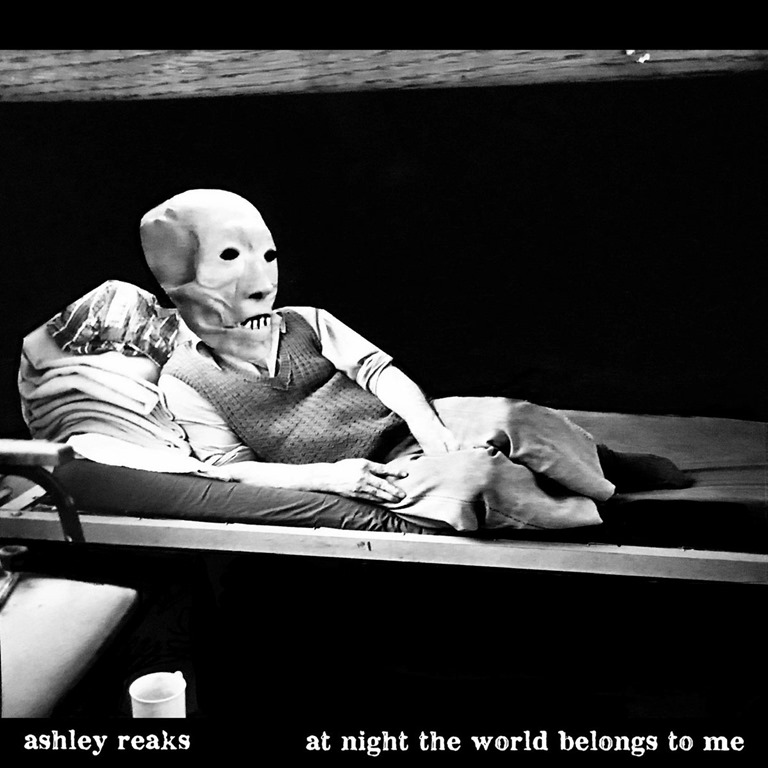
Through all of this, he has continued to collage and write prodigiously, but At Night The World Belongs To Me marks a distinct change of tone from its immediate predecessors, The Body Blow of Grief (2024) and Winter Crawls (2023). The usual elements are all present and correct – the sense of experimentalism, the collaging of genres, melding post-punk, jazz, and dub – but this feels darker, more introspective. The cover art, too, reflects this. While it has the same rather disturbing, grotesque strangeness of his usual work, the grim-looking figure in repose has connotations of ailment, frailty, even the deathbed.

The first track, ‘Playing Skittles With The Skulls and Bones’ has a bass groove that calls to mind The Cure’s early sound, melded to a rattling rhythm reminiscent of ‘Bela Lugiosi’s Dead’. The smooth sax that wanders in around the mid-point provides something of a stylistic contrast, but at the same time, it’s minor-key vibes keep the song as a whole contained within a bubble of reflection, evoking the stillness of night. I know, I’m sort of dancing about architecture here, but something about Reaks’ work prompts a multi-sensory response.

‘Rimmed With Yellow Haloes’ brings soaring post-rock guitars atop of an urgent ricochet of drumming and solid bass. On the fact of it, it’s almost poppy, but it soon shifts to take on a folksy aspect, while Reaks sings of death and funeral pyres, and the refrain, delivered with lilting, proggy overtones, ‘The Lord gave the day to the living, the night to the dead’. In context of the album’s title and theme, there is a tangibly haunting foreshadowing here, a suggestion that Reaks has not only accepted his mortality, but has assumed his place. It’s powerful, and deeply moving. Of course, Reaks can’t help but introduce incongruous elements, with some horns which are pure ska and some super whizzy 80s pop synths providing a pretty wild counterpoint to it all. It’s hard not to smile, because there’s an audacity to this approach to composition and arrangement – a lot of it simply shouldn’t work, but it does, and it’s uniquely Reaks.

The album’s shortest song, ‘Things Unseen’ is snappy, poppy, Bowie-esque, an amalgamation of post-punk and electropop, a standout which is succinct and tight, and consequently, the dark connotations of the bleak shuffle of ‘Life Forever Underground’ – a rippling synth-led tune – are rendered more profound. The sequencing of this album is such that the shifts between songs accentuate their individual impact.

‘Mask the face, unmask the soul…’ he sings softly on ‘Mask The Face’, which has a somewhat spacey Krautrock feel to it – before a guitar solo that worthy of Mark Knopfler emerges most unexpectedly. And as dark as things get here, Reaks never ceases to bring surprises. At Night The World Belongs To Me perfectly encapsulates the reason he’s so respected and critically acclaimed, but orbits light years outside the mainstream. In a world defined by an exponentially reducing capacity for sustained attention, Ashley Reaks makes music that requires real engagement, the musical equivalent of complex carbs and high fibre foods in a processed, white bread culture. But also, contemporary mainstream radio music favours short songs which cut straight to the chorus, where the hook has to land in the first twenty seconds. Here, we have eight songs, all but one of which are over five minutes long. They take their time, they’re expansive and exploratory, there’s atmosphere, there’s depth. And as ‘Eyeing Up The Sky’ tapers away on a buzzing drone, we’re left with much to chew on, much to consider.

AA
a2008509738_10

Constellation welcomes The Dwarfs Of East Agouza to the label and will release the Cairo-based trio’s new album Sasquatch Landslide in early October.

Maurice Louca, Alan Bishop, and Sam Shalabi expand on their telekinetic fusion of North African rhythm, heat-haze improvisation, shaabi rawness, free jazz, and psychedelic groove, following acclaimed albums on Sub Rosa, Akuphone, and Nawa Recordings.

Sasquatch Landslide overspills with the group’s signature trance-inducing explorative energies, anchored by Louca’s hypnotic beats and electronics, with Shalabi and Bishop deploying guitar and alto saxophone in a variety of signal-mashing modes. Comprised of seven febrile jams across 42 minutes, this is at once the most focused and twitchiest album in the DOEA discography to date. Recorded by Emanuele Baratto (King Khan, Elder) and mixed by Jace Lasek (Elephant Stone, Sunset Rubdown, The Besnard Lakes), the record will be issued in 180gram vinyl and CD editions, featuring artwork by Mark Sullo.

First single ‘Neptune Anteater’ is a signature example: Shalabi opens with a skittish repeating guitar groove (that draws from his parallel lifelong practice as an improviser on oud) as Louca progressively builds a widescreen 6/8 hand-drum rhythm while oozing bass notes support Shalabi’s excursions around the central riff. This is kinetic trance, East Agouza-style.

AA

a0681556981_10

InsideOutMusic is proud to announce the signing of Italian instrumental, prog-metal fusionists Asymmetric Universe to a new worldwide deal. The band, formed by brothers Federico Vese & Nicolò Vese, are also pleased to launch a brand new track titled ‘Don’t Go Too Early’, and you can watch the video for that here:

The band comment:

We are so excited to join such a big family as InsideOutMusic! Being part of a team with legendary artists and bands that we’ve been listening to since we started studying music, is a dream come true!

Our new single, “Don’t Go Too Early”, is a mixture of fusion-jazz, aggressive progressive metal, wind quartet arrangements and an avant-garde string quartet orchestration, that brings a unique colour to complex yet catchy music. We can’t wait to share with you all the music we are already working on!”

Freddy Palmer, InsideOutMusic, adds: “Asymmetric Universe are a perfect example of the kind of exciting, instrumental guitar music making waves right now, and we couldn’t be more thrilled to add them to the label’s roster, and be a part of their bright future.”

The band are currently confirmed to support Plini & Haken in Milan, Italy on the 5th July, as well as playing Arctangent Festival in the UK on the 16th August alongside Meshuggah, Animals As Leaders & many more.

Formed in 2018, with the goal of pushing the limit of modern prog and fusing disparate genres, they combine metal with jazz & ambient music, alongside chamber orchestration. In 2023, the band released their second EP ‘The Sun Would Disappear As I Imagined All The Stars’, which was mixed by Forrester Savell and mastered by Ermin Hamidovic. They also embarked on their first European tour as support to Australian progressive metallers Ne Obliviscaris, as well as opening for Caligula’s Horse in Italy.

Both brothers are mostly self-taught musicians, who have been heavily involved in composition and orchestration, as well as music production.

Federico has composed music for as wide ranging places as Radio Montecarlo (one of the biggest Italian radio stations), as well as one of the largest Italian amusement park Mirabilandia. He is a metal/rock producer and this background influences his work as a composer in the video game industry. He is also a professional music and guitar teacher with online students from different parts of the world.

Nicolò has composed pieces for various orchestral organisations (two pieces were performed in the latest symphonic season of Orchestra Sinfonica of Sanremo and one performed at Rome Jazz Festival in 2021 with a big band), worked as a composer in many Musicals and he is currently working in the video game soundtrack industry (also as a sound designer), ranging from indie games to bigger productions. He also professionally teaches composition, orchestration and adaptive music techniques for video games.

dFUOtV0g

Janka Industries – 3rd May 2024

Christopher Nosnibor

Once again, I find myself tussling with a jazz album and in a quandary as to quite what to make of it. For many, many years, I was absolutely certain I detested jazz. Until, that is, having been introduced in my line of work to acts like The Necks, I came to learn I’d simply been exposed to the wrong kinds of jazz. The weirdy, noisy, cacophonous kinds of jazz made sense in context of my appreciation of mathy noise rock, and wasn’t such an immense leap from Shellac to be incomprehensible. Like any genre, or even tea or coffee, it’s all about finding a point of entry, a flavour that suits your palette. I used to hate both tea and coffee, having been given the former with full-fat milk and sugar and the latter in the form of a fairly weak blend with milk but no sugar, and they only really clicked when I ditched the sugar and discovered Earl Grey, and that you could have really dark-roast coffee with no milk and a shovel-load of sugar. So, you know, you find your thing.

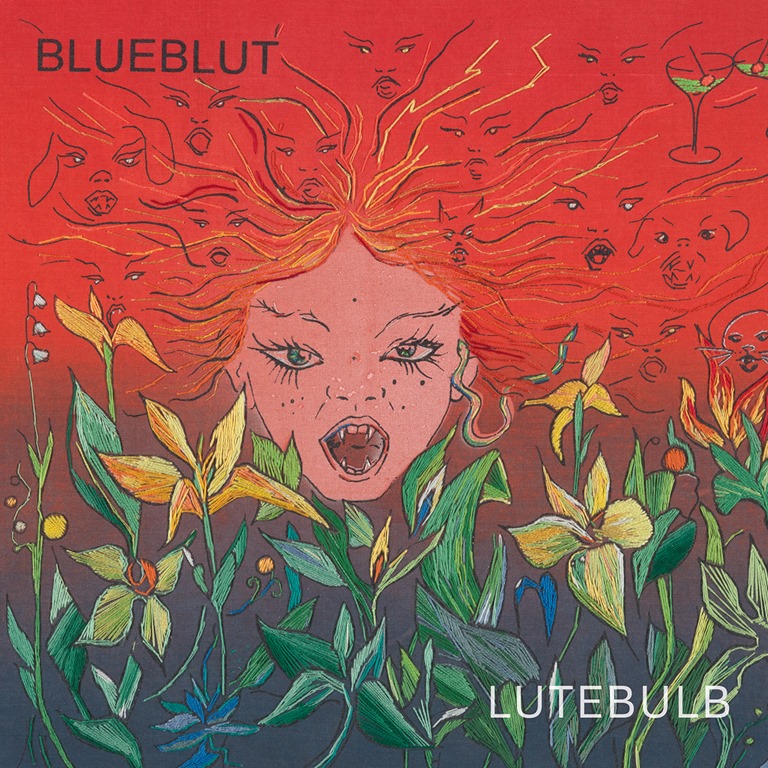
And then along comes Lutebulb, by Blueblut.

The blurb isn’t wrong in describing Blueblut’s lineup as ‘highly unusual, bringing together ‘three musicians acclaimed for exceptional contributions to their respective spheres in experimental jazz, electronica and rock.’ It’s a jazz-centred fusion, for sure, but it’s not jazz fusion as one tends to think of it, and certainly not as I’ve come to understand it. So what is it? As we learn, ‘Lutebulb is the fabulous culmination of ten years of intensive touring, with the Vienna based trio of Pamelia Stickney (theremin, vocals), Chris Janka (guitar, loops, samples) and Mark Holub (drums, vocals, percussion) socking it to global audiences with an international polystylistic musical language which takes in improv, jazz, avant-rock, ska, folk and Krautrock among other elements.’

There’s certainly a lot going on: initially, it comes on a bit laid back, not so much loungey as a smug muso pop collision of jazz and Latin dance, and I suppose the title, ‘Cocktail’ is something of a giveaway as to its swinging party vibes, but then shit happens – particularly some pretty crazy guitar work, and the percussion goes big and suddenly the party’s been crashed by a towering riot of sonic chaos, before suddenly, the entertainers seemingly remember themselves, pull their ties straight again and try to pull together some semblance of a funtime groove.

This sets the album’s template, really. Tracks tend to begin a bit kinda loose, a bit kinda boppable, a bit pool party fun times, albeit with some weirdness in the way the rhythms and the notes don’t quite chime in the conventional ways, and you wonder if it’s maybe the punch or the heat, but the tempo drifts a bit, first one way, then the other, and then maybe something doesn’t quite feel right, and it certainly doesn’t sound right and… what is going on? The room’s spinning and there are all sorts of random noises and you can’t tell if it’s people losing the plot or if some chickens have escaped and the sky’s falling in.

‘Aumba’ starts rather differently, a gentle piece led by acoustic guitar that brings a more reflective atmosphere, but it takes a hard swerve, the pace picks up, there are choral chanting vocals and then a handbrake turn into buoyant math-rock territory before some truly frantic fretwork. And because more surprises are needed, from nowhere, we get a crooning lyrical ballad in the last couple of minutes.

There’s unpredictable, and then there’s Lutebulb, which emerges with a fourteen-minute centrepiece of oddball experimental jazz that mashes absolutely everything together: one minute, I’m reminded of America’s ‘Horse With No Name’, the next, it’s Paul Simon’s Graceland and a Joolz Holland world music extravaganza. Then, somewhere in the midst of it all, we get the jazz breakdown with erratic percussion and space, dogs barking, and then, something else again. Led Zep riffage. Noise. More dogs barking. Every time I leave the house, the streets and parks and fields are like bloody Crufts, and the headfucking noise that’s emanating from my speakers – mostly a horrible conglomeration of barking and a strolling bass is making me angry and tense. And then the last piece, ‘Kaktusgetränk’, incorporates a familiar and popular jazz piece I can’t place or be bothered to research because by now I can’t decide if I need a lie-down or a massive gin.

With Lutebulb, Blueblut have created one of the most wildly varied – and in places, difficult, irritating, random – albums I’ve heard in a long time. I neither like nor dislike it: it has some truly great moments, and it has some not great moments. But when you throw this much into the blender, it’s to be expected, and I’d like to think that this kind of reaction isn’t entirely unexpected. The musicianship is outstanding, and their capacity to switch style, tempo, form, is something else, and the results are enough to leave anyone punchdrunk.

Blueblut – Lutebulb cover 1240px

Super Secret Records – 25th May 208

Given the album’s title, I wasn’t exactly expecting jaunty jubilance. But then, having heard a million albums since reviewing their 2014 debut, A Mothers Work is Never Done, I wasn’t expecting a wild hybrid of-hop hop and jazz at first.

They’ve upped the edge and intensity for this second outing, going all out with a strong start. An insistent groove, dominated by a relentless ‘vintage’ hip-hop beat, hammered out hard provides the backdrop to the jazz-rap crossover of the eight-minute ‘Attica Black’. Breaking from some nagging guitar and angry vocals, it breaks into a cacophony of discord, with brass honking like braying elephants tooting all over a collapsing barrage of percussion.

‘Black Tar Caviar’ mellows the pace and goes big on the sax and the sleaze in the opening bars. That sax… sax not in the smooth jazz sense, not in the café PA sense, but big bold, raucous, gutsy sax – before a thick, tearing bass grinds in, and… woah. Blackened hop-hop-jazz-metal? It’s like fur songs playing at once. It’s roaring and savage and intense and utterly bewildering. I don’t even know if it’ any good: it’s simply too much to take in. But if a derangement of the senses of the desires effect, then they’ve undeniably achieved it in around two and a half explosive minutes.

The weirdness abates for the start of ‘Bodiless Arms’, but only slightly, as a braying sax honks rudely to disrupt a delicately picked guitar piece that evokes pastoral tranquillity.

And yes, it’s ultimately all about the sax… it’s wild. The two short ‘untitled’ composition are bursts of noise without overt structure or form, but while the drums are all over and there’s

Ironically, ‘Jazz Oppression’ the least overtly jazz tune on the album, manifesting more as a full-throttle hip-hop metal crossover, a driving, two-and-a-half minute bass-driven barrage with throaty hollers and a sinewy lead guitar that’s swiftly buried amidst the chaos and screaming feedback. It’s swiftly followed by the equally attacking (and brief) title track: ‘Fuck all that weak shit’ is the half-buried refrain on ‘Morose’, which barrels headlong from a throbbing, insistent groove into screaming metal noise amidst a cascade of off-key xylophone.

If there’s a formula to be found, it’s a loose one based around shifting perceptions and expectations, the way in which a song can begin as one thing and end completely as another. The moments of accessibility lull and woo the listener, before s sharp left-turn and a sudden swell of noise annihilates all semblance of order and location.

But then, the crooning closer disrupts much of that: despite its extraneous additions, a swirling vortex of feedback in the background, and its awkward industrial trip-hop leanings, it’s a remarkably pleasant and smooth piece of soul-soaked hip-hop. To remark that it’s incongruous feels pretty redundant: everything about this album seems incongruous with the rest of the album. And somehow, it works.

AA

AA

Young Mothers - Morose

Thrill Jockey Records – 17th November 2017

Christopher Nosnibor

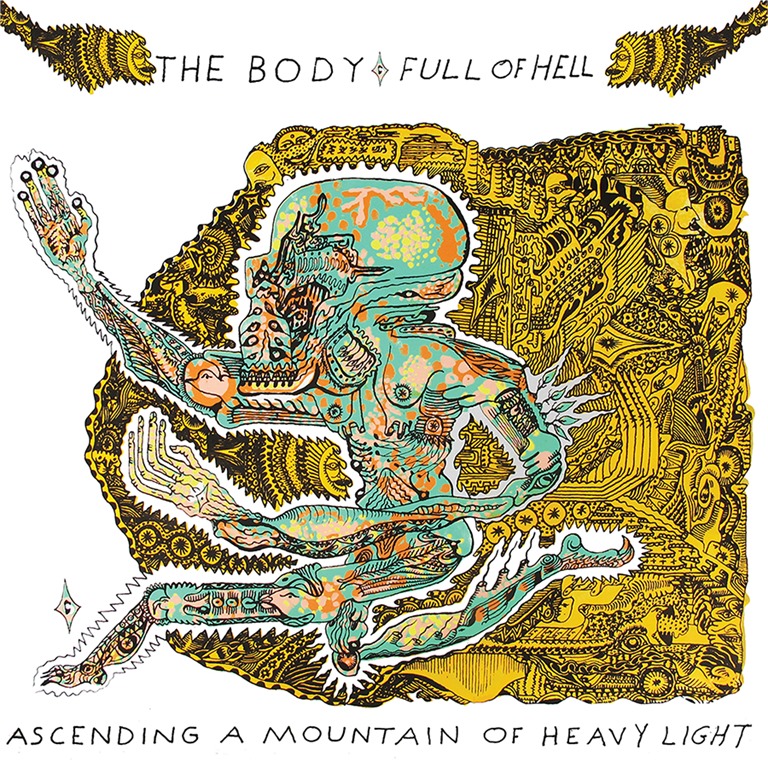
The second collaborative album between The Body and Full of Hell, which collides with the earth like a meteor, and a mere 18 months after its predecessor, and just six months after Full of Hell’s full-tilt annihilation that was Trumpeting Ecstasy, it’s every bit as unremitting and remorselessly heavy as anything previous. It’s the sound of two uncompromising bands finding compromise by amplifying one another to the nth degree, meaning that Ascending a Mountain of Heavy Light is fucking intense, fucking heavy, and yes, even more fucking intense.

The accompanying blurb forewarns that ‘samples, synth, saxophone, and a drum orchestra all throb, and sputter, coagulating under the weight of the two bands. Programmed drum patterns and loops taking cues from hip hop are bent and twisted throughout, flawlessly emboldening the distortion drenched guitars and howling vocals.’ And did I mention that it’s intense?

Beyond the first few seconds of skittering synth oscillations, there is no light on the opening track, ‘Light Penetrates’. The crushing power chords land at tectonic pace, while the vocals – an impenetrable scream of anguish – are nothing more than a primal scream of pain. And then the jazz shit beaks loose, with horns squealing like tortured pigs bleeding in all directions.

There’s nothing pretty about this, but occasionally, from amidst the screeding walls of amorphous racket emerge full-throttle stoppers, like the pounding ‘Earth is a Cage’. Elsewhere, ‘Didn’t the Night End’ is a snarling, grinding, bowel-shaking racket of surging waves of noise that simply hurt. It’s the kind of snarling, grinding, bowel-shaking racket that makes you want to lie on the floor and curl up into a foetal position. It makes you want to die, and it certainly makes you long for the night – and the noise – to end, as it assails the senses from every angle.

The drum intro is nabbed from oh, so many tracks – a simple four-four thump of a drum machine bass – before everything explodes in a tempest of screaming industrial-metal fury. Early Pitchshifter come to mind, at least in the drum programming, but this is something altogether more psychotic in its unbridled fury, and in its amalgamation of paired-back hip-hop and industrial metal, all crackling with overloading distortion, ‘Master’s Story’ invited comparisons to the innovations of Godflesh – at least until it goes all crushing doom halfway through.

As with anything produced by either band, either independently or collaboratively, Ascending a Mountain of Heavy Light is not music for pleasure, and large chunks are little short of anti-music, blistering walls of sonic brutality built on discord with the most challenging of tones and frequencies explored to the max.

AAA

cover

6th December 2016

Christopher Nosnibor

Some reviews are seemingly fated. This is one such review: I was slow to get started, and then, having spent several evenings working on a detailed critical analysis, exploring the album’s wild eclectism on a more or less track-by-track basis in a discourse of some eight hundred words, my laptop crashed and most of the work was lost, with the only available version being a collection of notes which were days old. How it happened, when my word processor is set to autosave every five minutes, I have no idea. Thanks Microsoft.

Still, this is an Ashley Reaks album, and a man who can produce three albums in a year – and continue to produce art, and to gig relentlessly, under difficult personal circumstances – deserves the same kind of unbowing attitude from a reviewer.

Because it’s an Ashley Reaks album, anything can happen. And it will. And it does. Following on from Reaks’ ‘punk album’ This is Planet Grot (and a remarkable credible and impressive punk album at that), Growth Spurts, on the one hand, could be considered a return to more familiar territories. But then, on the other, it could justifiably be tagged his ‘jazz album’. The familiar elements of reggae and post-punk inspired dub are present and correct, but this collaboration-based collection of tunes also brings in some wild jazz stylings. The collaborative element is also key here, not only to appreciating Growth Spurts, but to understanding Reaks as an artist, at least as much as it’s possible to grasp such an idiosyncratic and singular individual.

Like his collage artwork, his music is a mish-mash of elements drawn from here, there and everywhere, often bolted together at weird angles and demonstrating incompatible proportions and lines of perspective. He has very much his own slant on things, and his approach is also very much his own: Reaks is one of the few artists who consistently produces work which has the capacity to surprise, to confound, and, occasionally, confuse – which is a healthy response to something which is so staunchly unconventional. You get the impression that Reaks’ raison d’être is to produce art which surprises and confounds himself, as much as any notional audience. His mindset appears to be that if it’s not fresh, unexpected, and if it’s not sincere, then it’s worthless. Collaboration, when done right, yields an output which is greater than the sum of its parts, and draws out facets of each contributor which may not otherwise be known.

As such, Growth Spurts is a world away from his previous collaborative effort, Cultural Thrift (2015) with poet Joe Hakim, on which Reaks stepped toward the rear portion of the stage to provide a background accompaniment (which in itself was a departure given Reaks’ propensity for dizzying soundclashes). Five of the ten pieces – it would be wrong to refer to this as a collection of songs, given that they feature spoken word and poetry – feature writers and poets from a broad and diverse range of backgrounds. They’re disparate characters, as varied as Reaks’ own sources of input, hand-picked to contribute to the album.

The result is dizzying, a rollercoaster journey through a vast swathe of cultural terrain. Each of the collaborative pieces is distinct and different, and finds Reaks attentive to the style of the different speakers. And as the strange, strangles vocal cacophony which introduces the album’s first track, the oddly ominous prog-dub drum‘n’bass neoclassical jazz mixup that is ‘Divorced from the Body’ shows, he’s digging deep to locate new and unexpected hybrids. And yet, amidst the chaos, he still whips up some killer hooks – something so many experimental / genre-smashing artists completely overlook in their quest to innovate, to dazzle with their imagination and technical prowess.

‘The Gentle Art of Ignoring’ with Sylvie Hill is the most outright jazz track on the album, and her sassy vocal delivery and confident Canadian accent brings another sharp dimension to an album which displays almost infinite dimensions, but there’s just so much to take in. But if you need a pointer for where to start, start with the basslines. The crashing jazz-influenced drum ‘n’ bass drumming, the wild brass, the myriad perspectives of the different vocalists all slot into place over those low-down basslines that stroll and groove and leap and boogie. Get on down.


Ashley Reaks - Growth Spurts

Inter-Dimensional Recordings – 1st June 2016

Christopher Nosnibor

The greatest pressure for any emerging artist must surely to be to get product out onto the market: something to satisfy new fans and entice prospective fans. The urge to splurge material, whether ready or not, in order to strike while the iron is hot is more than most can resist. Nathassia is indeed a rare artist, and, it would seem, something of a perfectionist. Recording as Nathassia Devine, she had a 13-track debut album recorded, packaged, and in circulation to the press, finding favourable reviews (including one from me). That was 2014. The album was shelved. It’s now 2016, and a lot has happened. Having decided to pull back and regroup, restyling herself as Nathassia, she’s spent the intervening time reshaping her sound and building an enviable audience at home and internationally. Finally, she’s satisfied, and the end product is Light of the World. And yes, it was worth the wait.

Cut back to 10 tracks, only four songs from the original album remain. Having honed her songs with the assistance of Bruce Elliott-Smith, Light of the World finds Nathassia exploring cross-cultural music evermore broadly and evermore confidently. Half Dutch, half Indian and residing in London, Light of the World is very much a 21st century hybrid of these very different cultural backgrounds. It’s an electronic album, but not one that confirms to any one strain or style, leaping hither and thither and picking, magpie-like, from a host of musical strands.

Nathassia’s striking appearance is the perfect visual representation of her sound, and embodies her mixed roots, as East meets West in a perfect amalgamation. But this is no mere marketing schtick: she is very much a self-made package, and one which has immense market appeal both visually and sonically.

Contrast and juxtaposition lie at the heart of Light of the World, but rather than treat this yin and yang as conflicting elements, she embraces them and draws them together to intriguing effect. The sultry ‘Egypt’s Queen’ finds Nathassia rolling her r’s and accentuating the eastern influences of her music. Single cut ‘Turning Headz’ is more hard-edged and showcases a driving, drum ‘n’ bass orientated sound, something which wasn’t present on the original album, and similarly, ‘Parasite’ is driven by a grating bass and insistent, industrial-edged drumming. Melding insistent beats with snarling techno, it’s dark in hue, and paired with Nathassia’s keeningly exotic vocal delivery that’s tinged with a hint of venom, it’s a powerful piece.

Elsewhere, the title track spins out an expansive, cosmic vibe, highlighting the diversity of the material on Light of the World. It certainly isn’t an album that works to a formula, and stands as a truly multidimensional piece. It helps, of course, that the range is matched by the quality of the material.

Light of the World is an album which not only reveals Nathassia to be a fascinating, chameleon-like songsmith and performer, but a distinctive and even unique voice.


light-of-the-world-album-artwork

Nathassia Online