Posts Tagged ‘EP Review’

17th December 2021

James Wells

Pieces is the second in a projected series of five EPs, and on the face of it, it’s an immense undertaking: this release contains five tracks, and its predecessor four. Across the project, that’s a full two albums worth of material… until you clock that half of the tracks are remixes. Not that that’s a criticism per se, and I won’t revisit my eternal remix peeve yet again here, because no doubt readers are as sick of that as I am of remixes as a thing.

So ‘Pieces’ is in effect a single, comprising of ‘Disease of Kings’ and ‘Failure Principle’, bolstered by a brace of remixes of the former and one of the latter. ‘Disease of Kings’ is a in some respects a surprising choice of lead song, in that it’s a slow, brooding cut with expansive, cinematic synths casting an arena-wide vista over the reflective mood. It’s well-executed and emotionally charged, but the vocal treatment – namely a fuckload of autotune on the verses – is perhaps a little overdone and reduces the impact of the song’s kick-to-the-chest sincerity. It’s a fine choon, but maybe a fraction too produced and polished and even a little bit Emo, where a slightly rawer edge would have bitten harder.

‘Failure Principle’ is geared toward the mid-tempo, with quintessential dance tropes in full effect, with nagging synth loops rippling over and over an insistent dancefloor-friendly beat. While still featuring the core elements of techoindustrial, it carries a keenly commercial style.

The Assemblage 23 Remix of ‘Failure Principle’ is a standout by virtue of the way in which is accentuates the track’s danciness and general catchiness, bordering on euphoric dance which seems somewhat at odds with the lyrical content. But then, the medium is not necessarily the message, and there’s something to be said for slipping darkness in under the cover of light. In that sense, it works, although the extent to which suggesting any song by an industrial act has mainstream crossover potential and a broad appeal is questionable.

Rounding off the EP, the KALCYFR Remix of ‘Disease of Kings’ beings some fuck-off dirty great guitars and grinding bass to the party and comes on way more Nine Inch Nails, and tempers the vaguely emo leanings of the original and GenCAB remix.

The ‘limited-edition PANIC LIFT FACE MASK to accompany you on your journeys through the current post-apocalyptic landscape’ is a nice touch, too – because we need some nice things to help us navigate living through the reality of all of the dystopian fictional futures becoming reality all at once.

AA

AA

a0672630653_10

James Wells

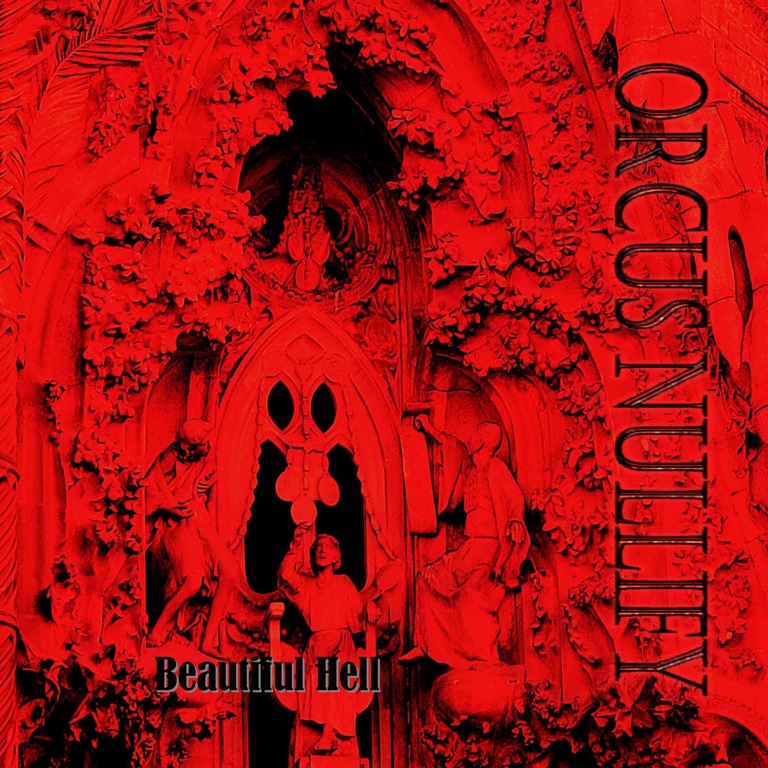
In advance, we learn that ‘The songs on Beautiful Hell will take you on a tour of the wreckage that is the contemporary state of affairs brought about during the reign of the Orange Beast. There was the destruction and reversal of environmental policies like withdrawal from the Parris Climate Accord, termination of the Clean Water Act & turning back the clock on human rights’, and that ‘the title track ‘Beautiful Hell’ draws a juxtaposition between the beauty of this planet and decaying state of political affairs. The tune ‘Under his Eye’ is focused on what is seemingly a path toward a Neo-Nazi Christian state. ‘Night Bird Cries’ is a lament for the decline of our environment and morality, that increasingly vie for our attention but go unheeded.’

The sound of Orcus Nullify – headed by bassist / vocalist Bruce Nullify – on this release is very much vintage goth, with fractal guitars, heavy in chorus and flange and setting spindly frameworks around thundering bass and tribal drums, the murky production evolving the sound and style of early Christian Death.

The intro to the title track sounds very like that of The Mission’s ‘Severina’ before it goes all splintering, spirally Nightbreed-sounding second-wave goth. For the record, that’s no criticism, just a contextual referencing placemarker. ‘Night Dance’ showcases a raw, dingy sound where the guitars are trebly and the bass is muddy and everything combines to create something dark and intense. ‘Fall from Faith’ is The Mission amped up to eleven, it’s The March Violets, it’s Groovin’ with Lucy, it’s Rosetta Stone.

As such, it’s not inventive, and Orcus Nullify clearly aren’t out to reinvent the genre, but to add to the body of the catalogue that could reasonably be labelled ‘classic goth’. Nothing wrong with that, and credit to the band, they’ve got the sound nailed, and some decent choons, too, with Beautiful Hell being a solid and dynamic EP.

AA

AA

a0128427574_10

1st December 2021

Christopher Nosnibor

Just shy of a year since Cave Suns threw their improvised ‘Surk Skum’ EP into the plague-ridden void, they return with a proper lo-fi DIY release, consisting of four pieces, ‘improvised live one take each song apologies included’ they write. The set was captured on an iPhone and is released on a limited edition cassette (and digitally, of course).

Beyond the world of the major label (and the domain of the indie label with some cash behind it), this increasingly appears to be the future of the little band. With the chances of getting signed and getting bankrolled these days practically nil even for solids acts with some commercial potential and significantly less than zero for artists doing anything without that commercial potential (which isn’t to say there’s no audience or demand), they’re taking thee means of production into their own hands and just getting on with getting their music out there. If one positive thing has emerged from the last couple of years under the pandemic – and let’s face it, it’s been hard to find anything positive, particularly for bands and small venues (I’m hesitant to say ‘the music industry’ because Ed Sheeran and Eric Clapton won’t have suffered too heavily from the lack of touring options in terms of bank balance or their ability to reach audiences or shift units / merch and I’m sure the likes of Warners aren’t questioning their viability right now) – it’s the fact that perhaps finally any stigma around self-releasing has been eradicated. That said, for Newcastle’s Cave Suns, it’s business as usual: they’ve been self-governed and self-releasing since 2014 and haven’t been troubling studios in order to lay down their intrusive improvised sessions, preferring instead to capture live shows and rehearsal room jams

‘Dunder Salt’ is a kind of mellow psychedelic swagger with a buoyant bassline and bopping beat that seems to all cast a nod to the verse of The Beatles’ ‘Come Together’. With minimal progression, there’s a Krautrock element to the vaguely jazzy, vaguely funky groove. It’s a solid jam, but it’s not until the eleven-and-a-half-minute ‘To Who It May Concern’ that they really show us what they’re capable of. Mystical, eastern-inspired scales twist in a slow-building swell of sound, a hum and a drone of bass and tentative drumming before emerging on a vast sonic plateau. It’s one of those compositions that stops and starts so often that it’s hard to decide if it ever really gets going, or if it’s several pieces string together; perhaps more reasonably it’s best described as several movements with a succession of ebbs and flows and sustained crescendos, often with the drums pounding hard with insistent thrashing of cymbals and hitting some solid grooves even with the stretches of meandering guitar.

‘Essesse’ kicks off wide two with something altogether lighter, more technical, with a mathy aspect, and also more overtly proggy, you might even go so far as to describe it as jaunty – but then, you may not. It’s kind of a collision between That Fucking Tank, Muse, and Royal Blood. Maybe it’s more as well, It’s certainly their most ‘muso’ cut to date, and is also highly accessible.

The 11-minute ‘13th Celebration’ that rounds off the EP and the remainder of side two is built around a repetitive bas throb that evokes the monotonous groove of Suicide, but overlaid with a sprawling guitar jam that’s part prog, part space rock, all improv. They lock into a neat groove for a time and really rock out, but then slow it down and trip out, crawling to the close.

Hypnotic, groovy, completely free of the shackles of genre and commerce, No Guards knows no limits and captures Cave Suns on fine form.

AA

a1022258747_10

26th November 2021

James Wells

Following on from the single releases of ‘Climb’, ‘I A Fire’, ‘Hold the Line’, and ‘What is a Life?’, Reading four-piece Third Lung have delivered their much-anticipated new EP, Dialogues Of The Fatal Few.

Three of those aforementioned tracks are featured here, and while it would have been obvious and easy to have released a five-track EP featuring all four with the new song on offer here, that they’ve gone for a more succinct release means that Dialogues Of The Fatal Few is a much more focused and cohesive release, and not a complete rehash and compilation.

Opening with ‘I A Fire’ sets the stall out nicely, and while it’s mid-tempo, it’s bold and anthemic, and recalls the spirit of circa 2004 when Keane broke through with ‘Somewhere Only We Know’ and the single releases from Coldplay’s A Rush of Blood to the Head were all over the radio. Bear with me. In context, these weren’t bad tunes which hinted at considerably more than the tedium that would follow from both bands. ‘Hold the Line’ is perhaps the strongest song in the set, balancing brooding and dark with a blossoming sunburst chorus

Piano ballad ‘The Art of Stealing’ reveals a different facet of the band, and while it’s clearly not a single track, illustrates the benefits of EPs and longer form releases. It also provides a well-placed change in form in context of the EP, bringing things down a notch or two between the monster tunes.

There’s more to Third Lung than straight-up anthems: lyrically, they’ve got some depth and are worth listening to, although I suspect that’ll likely be secondary to their career trajectory, and with such a knack for big tunes, it’s surely only time before they’re big, too.

AA

Artwork

15th July 2021

Christopher Nosnibor

Lately, being goth isn’t so much of a cause of derision, since everyone has been facing some existential angst about isolation and death in some form or another. It may sound a shade facetious, and the truth is, it is, but the point stands: circumstances have forced many people to reflect differently on life, and to experience a kind of alienation, as a result of separation and distancing in the most literal of senses.

And it is upon this thought that Johnathan|Christian singer/co-writer, Christian Granquist reflects when considering this new EP: “Unlike previous releases, the lyrics and inspirations on this one is a bit of a paradox” he says. “Some of our ‘usual’ vocal topics like loneliness, isolation and of course death have become so much more relevant during the pandemic. And for the exact same reason they appear less relevant, as they become less metaphorical.’

This EP may only contain four tracks (which feels like the optimal EP set, corresponding with vinyl 12” from the 80s), but does showcase some considerable stylistic range.

With ‘My Dying Words’, the duo spin a brooding goth tune that’s in keeping with the second wave style, and would be quite at home on a Nightbreed release. Lyrically, it’s one of those ‘big ego’ protagonist songs ‘You’ll never meet someone like me again’, he bombasts in the chorus.

The title track is a piano-led piece, that brings with it a certain theatricality and some moody strings. With live-sounding drums, the feel of the production is quite different, too. Recorded as a duet, it works well, presenting as a dialogue that plays out the themes of absence and missing, and the way those feelings can interplay, and drag on the soul.

After the brief string-draped interlude if ‘My Beautiful, Broken Butterfly’, ‘Never Trust a Man (With Egg on His Face)’ pitches a drably spoken-word vocal delivery against a sparse backdrop of spindly guitars and a remarkably danceable beat, coming on like a goth Pest Shop Boys and building to a majestic finish.

A strong EP doesn’t only have strong songs, but is also sequenced in such a way as to have a flow, and Together, We’re Alone very much has that. It feels like more than simply four songs in the same space, but a self-contained unit.

AA

a0542774550_16

Prank Monkey Records – 11th June 2021

Christopher Nosnibor

The story goes that London four-piece Muscle Vest reportedly ‘formed in 2018 over a mutual appreciation for ugly rock music’, and that’s what they serve up on their debut EP – a sweaty, guitar-driven dirty rock workout that’s brimming with churning riffs, grease and grime. They come out all guns blazing and firing wildly in all directions with the manic racket of ‘Creepy Crawlie’, a juddering, angular rager that melts the best of 90s noise into a mangled metal nugget in the vein of later acts like Blacklisters and Hawk Eyes, and it very much sets the fast and furious tone for the rest of the EP: ‘Stray’ bears fair comparison to Blacklisters’ ‘Shirts’, with a throbbing riff blasting out against a low-slung bassline. If Shellac and Big Black are in the mix, so are The Jesus Lizard and early Pulled Apart by Horses.

Muscle Vest pack in a boatload of adrenaline and bring ALL the noise: it’s fucking ugly and monstrously brutal, and those are its positive points. It ain’t polished or pretty, and if you’re on the market for something gnarly, look no further.

‘We’ll all be dead / we’ll all be dead one day’ vocalist Dave Rogers howls nihilistically into a tempest of abrasive guitar noise that churns and grinds on ‘A Slow Death’. He’s right, of course: the question is whether we will die a quiet, peaceful death, or a horrible, painful one, shrieking in agony for the duration of those final hours. This is very much the soundtrack to the latter, and it’s almost enough to make death sound appealing. Because, well, better to go out screaming than to flicker out. The last track, ‘Blissbucket’ is a minute and three-quarters of blazing napalm, taking its cues from hardcore punk and tossing in all the jarring, jolting guitars that scratch and scrape at all angles across the relentlessly churning rhythm section. It’s fast and furious and brings the EP to a blistering close and then some. It positively burns with an intense fury, and it’s beautifully brutal. Gets my vote, and then some.

Cover art

AA

Elli Records – 21st May 2021

Christopher Nosnibor

Mathematic graduate turned musician (Conservatory of music and jazz studies) Daniele Sciolla has, it would seem, found a suitable home on Elli Records: just look at those precise, diagrammatic, geometrically-precise cover designs.

There was a time I’d have likely dismissed all of this as one massive nerdgasm, and have been largely unimpressed by the tale of his ‘trips all around Europe searching for rare synthesisers’, but through exposure I’ve come to appreciate the minutiae that are the obsessional objectives of works like this, which really probe deep into the tiniest nuances of sound which can be achieved through the working of these machines.

This EP goes deep into the relationship between sounds, tones, and individual notes, and as the notes explain, ‘On each track, synthesisers are either presented as a timbrical mass, or left alone by themselves, in which case even the smallest details of a single synth become audible.’

Once acclimatised and accustomed to the granular, detailed explorations, it’s not difficult to grasp why there is such a fascination with analogue equipment: the extraordinary versatility they offer when all of the variables are tweaked, even infinitesimally, is a thing of wonder.

Sciolla’s five comparatively short pieces – only one extends beyond four minutes, and the whole EP is under fifteen – retain a sense of musicality that’s often absent from many experiments in analogue, and while there are many wows and flutters, and rapid-bouncing stammers that sound like ping-pong being played at a million miles an hour, there are structural elements that give the pieces shape. There are even brief moments that fleetingly call to mind Hot Butter’s ‘Popcorn’, although to be clear, there’s nothing quite so buoyant or cheesy on offer here. But there is a sense of fun, a certain playfulness – or perhaps it’s the sound of sheer joy.

AA

EL33 digital 5

Fierce Panda Records – 24th February 2021

Here we are: it’s the end of February 2021, and COVID-19 isn’t still a thing, but just a few weeks short of a year after the first lockdown was announced here in the UK, it’s pretty much the only thing, and it dominates and dictates our lives in ways we could never have predicted back then – or, arguably, even in September, or at Christmas.

In a time when the music industry isn’t as much in crisis as halfway on its knees and wondering what the actual fuck to do while touring remains off-limits both home and away on account of the pandemic and Brexit meaning the future of the foundations of musicians’ livelihoods is in question, while at the same time the debate over the equity of streaming services for artists has stepped up several notches, the need for an indie label like Fierce Panda seems even more vital. They’ve never gone with the grain and have continued to carve their own niche, focusing on single and EP releases.

The Covid Version Sessions EP is a classic case in point: bringing together a selection of artists you probably haven’t heard of alongside a selection you really ought to have even if you haven’t, it showcases six standalone cover (Covid) version (boom boom) releases, recorded during the pandemic by acts striving to find ways of working together while apart or otherwise unable to operate as normal.

It’s an eclectic mix, with some interesting takes on some well-selected tunes. While we’ve already given praise to National Service’s stripped back, haunting take on The Twilight Sad’s ‘Last January’ (released this January), it’s Moon Panda’s slick, sultry jazz-tinged cover of ‘Call it Fate Call it Karma’ by The Strokes that raises the curtain on the EP. It captures the essence of the original, but somehow manages to sound more authentic, perhaps because of the lack of self-consciously ‘retro’ production.

I’ve long had a soft spot for Pulp’s This is Hardcore album, not least of all because of the admiration inspired by their apparent commercial suicide in following one of the biggest albums of the Britpop era with such a desperately dark pop record. But also, because it has so much more depth and resonance. Desperate Journalist have an ear for drama, so their covering ‘The Fear’ is pretty much faultless: again, it’s a straight rendition, but magnificently executed. The same is true of Jekyll’s rendition of Japan’s ‘Nightporter’, which captures the understated, brooding theatrics of the original.

After Johnny Cash, is there any point on covering ‘Hurt’ by Nine Inch Nails’? Ghost Suns arguably step back closer to the original with electronic instrumentation, and in fact swing more to the other side, landing in ambient / synthwave territory. It’s not as good as Cash, and nor is it a good as the original, but then, it was a hugely ambitious undertaking and yes, it stull brings a lump to the throat – because it seems no matter what spin you put on this song, it is a classic that can’t be contained or twisted to be anything other than a blow directly against the heart.

The Covid Version Sessions may not offer much cheer: in fact they’re draped with sadness and remind us of all we don’t have – but they also remind us that we’re not alone in being alone, that it’s ok not to be ok, and that sometimes, the solution is to just take some time out, listen to some haunting melodies and remember that tomorrow is another day, and that for better or worse, nothing is forever.

5th March 2021

Christopher Nosnibor

I’ve spent hours racking my brains to fathom what the opening bars of ‘Nouveau Bleach’ – the first track on the eponymous EP by Nouveau Bleach remind me of, and I still can’t bloody make it out. With a name that’s straight out of Nathan Barley, this south London trio are as postmodern as they are post-punk, and the four tracks of their debut EP sets their stall out plainly, with no pissing about.

There’s are elements of The Fall with the ramshackle, rattling guitar that goes here there and everywhere, and especially the yelping, partially atonal vocal, with the simple repetition of the sloganeering refrain ‘Nouveau bleach / Rinse repeat’, conveying the ennui of tedious repetition so succinctly. The baritone vocal has a hint of Editors’ Tom Smith about it, but then, there’s quite a concoction of elements in the mix., and the production being lo-fi and primitive really suits the sound.

‘Pharmakon’ is amore straight head punk tune, and the band soon reveal a simple but effective formula, based on heavy repetition, and ‘Kondonauts’ exemplary – again, The Fall, Public Image, and comparisons to more recent acts from Scumbag Philosopher to Bilge Pump seem reasonable: a propensity for the motoric, for repetitive, cyclical riffs and unmelody still reveal some lovely moments – but mostly jarring, sharp-edged ones that make sitting back and just listening uncomfortable ‘but does it spark joy?’ they ask. In some way, it sort of does, and you join the dots to Gang of Four and snotty, shouty 90s underground and riot grrrl.

If it sounds like an explosive, incoherent identity crisis, it’s because it probably is: Nouveau Bleach are absolute magpies, and not entirely discriminate, which is actually an asset: everything is material, and they bring it together in a broiling melting pot to create a unique and antagonistic fusion, and it kicks ass.

Bleach

26th February 2021

Christopher Nosnibor

LA instrumentalists Teethers, centred around drummer and composer Andrew Lessman, brings together an unusual fusion for their debut release. With contributions straddling jazz, avant garde, and indie pop, for Teethers, Lessman has brought together an eclectic lineup, consisting of Graham Chapman on bass, guitarist Alexander Noise, Joe Sanata Maria and Ted Faforo on saxophones and Stefan Kac on tuba. The results are, as you might expect, unusual.

There’s a smooth, jazzy, swingy pop vibe that permeates the EP#s three tracks, and as ‘Goose Chasing’ indicates, they can locks down a tidy groove and create music you can bop to, nod along to, even dance to… and then they’re more than capable of – and willing to – drive that train straight off a cliff into a wild frenzy of horn-driven discord and madness. This is bit a brief introduction that sets the scene for what Teethers are really all about: the twelve-minute ‘Monopoly on Violence / Mushroom dance’ is a multi-faceted, shifting exploration of rippling shades and expansive soundscapes.

It’s rambling, at times immensely proggy in a vintage sense, and at times it just can’t seem to make up its mind as it ambles and weaves hither and thither, a mellow jazz meandering that hits some frenzies peaks and altogether more sedate intersections. It’s one of those pieces that transitions enticing and irritating in a mere blink – and that’s not even a criticism. Condensing so many elements into its space, it’s difficult to keep up.

The third track, ‘Love Poem’ is seven-and-a-half minutes of dappled sunlight painted in music, with a clean, picked guitar chiming in a simple, hypnotic sequence that’s a post-rock / contemporary prog crossover laced with soft, delicate strings. It’s perhaps the most focused and conventionally coherent of the three compositions, on what is a fairly wide-ranging set – so wide-ranging that it’s not easy to immediately assimilate, and even more difficult to pin down – not just stylistically, but in the most basic terms of formulating an opinion. Is it any good? Do I like it? Does it matter? There’s certainly no doubting the technical proficiency on display here, and having the confidence and audacity to make music that straddles so many boundaries and genuinely challenges the listener is an achievement worthy of recognition.

AA

a3152339815_10